

There’s a gap at the center of most management careers. Leaders are promoted for executing well — hitting targets, managing teams, delivering projects. Then, somewhere in their thirties or forties, they’re expected to think strategically, and nobody told them how.
Strategic thinking is now the most sought-after leadership skill. The MU Executive Barometer — a survey of 167 professionals and executives in consumer goods, FMCG, and retail, conducted with Ipsos — found that strategic thinking topped the list of leadership competencies for the first time, overtaking adaptability. Springboard’s State of the Workforce Skills Gap found that a majority of leaders named strategic and critical thinking the most sorely needed soft skill at companies today. Nearly 40% of those leaders said the gap between needed and existing skills is getting deeper, not smaller.
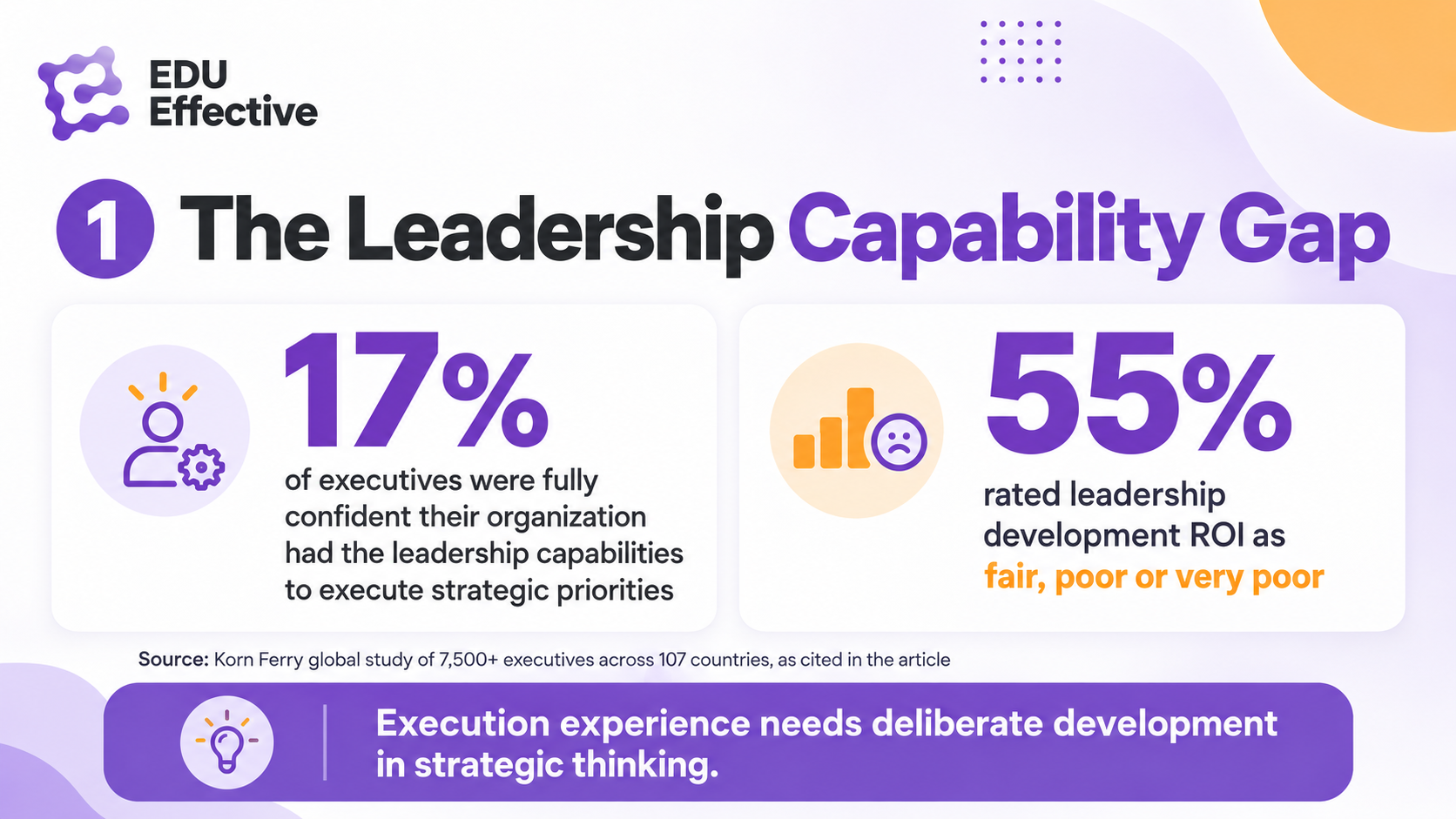
And yet most organizations do little about it. A Korn Ferry global study of more than 7,500 executives across 107 countries found that only 17% were fully confident their organization had the right leadership capabilities to execute its strategic priorities. 55% rated their leadership development ROI as fair, poor, or very poor. Organizations know the gap exists. They’re just not closing it.
Strategic Thinking Is Not the Same as Strategic Planning
The confusion between these two concepts is responsible for a significant portion of organizational underperformance — and for the frustration of talented managers who produce thorough plans that don’t translate into competitive advantage.
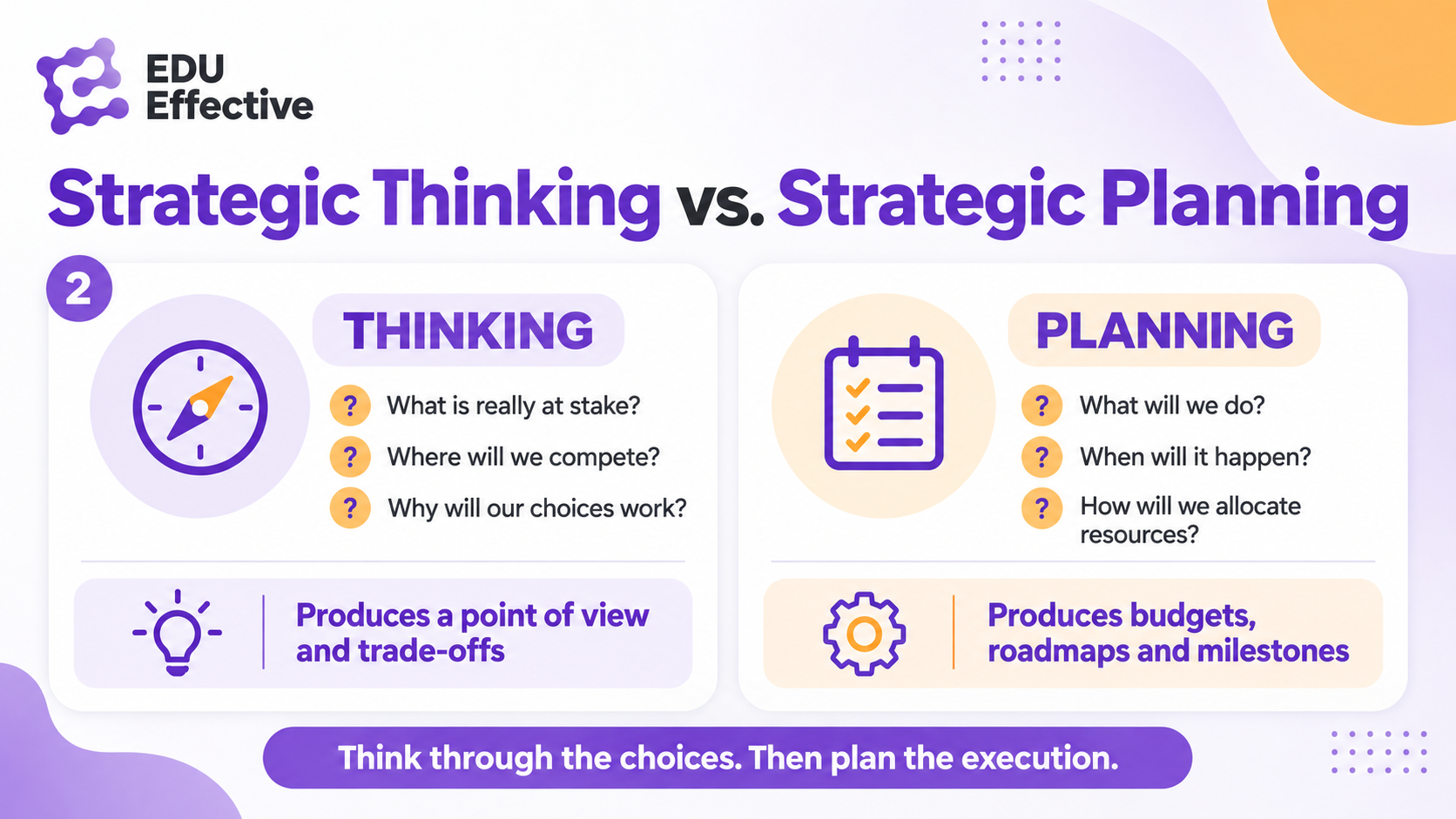
Strategic planning is the process of documenting and scheduling how an organization will pursue its goals. It produces budgets, roadmaps, timelines, and resource allocations. Done well, it is necessary and valuable. Done poorly, it produces what Roger Martin (former Dean of the Rotman School of Management) has called “a budget dressed up in strategic language” — numbers and milestones that answer the question “what will we do?” without answering the prior question of “why will that work?”
Strategic thinking is the cognitive capacity that precedes and informs strategic planning. It is the ability to analyze a situation from multiple perspectives, identify what’s actually at stake rather than what appears to be at stake, recognize patterns across time and context, and make choices about where to compete and where not to compete. A strategic plan can be produced by a committee. Strategic thinking requires an individual — or a small leadership team — doing something harder: forming a genuine point of view about the future.
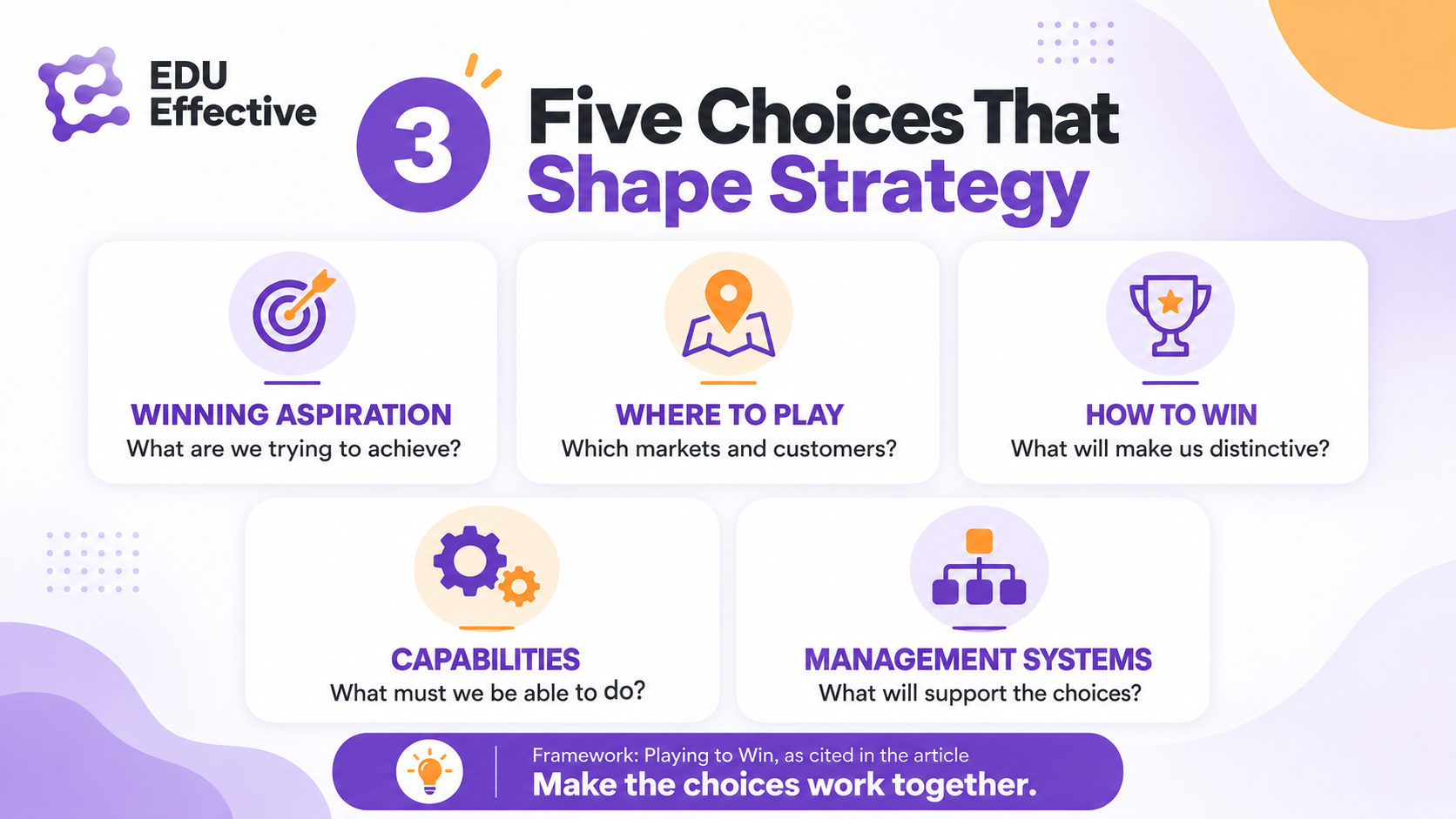
Martin’s framework from Playing to Win frames strategic thinking around five integrated choices: What is our winning aspiration? Where will we play? How will we win? What capabilities must we have? What management systems do we need? These aren’t planning questions — they’re thinking questions. They require taking positions that preclude other positions, which is precisely what most organizations resist.
The World Economic Forum’s Future of Jobs Report identified analytical thinking and creative thinking as the two most sought-after cognitive skills for the period through 2027. Strategic thinking sits at their intersection: it requires the analytical discipline to evaluate what’s actually happening and the creative capacity to imagine what could happen differently.
What Strategic Thinking Actually Involves
Academic research on strategic thinking has identified a consistent set of cognitive capacities that distinguish strategic thinkers from tactical ones. The five core components, validated across multiple studies:
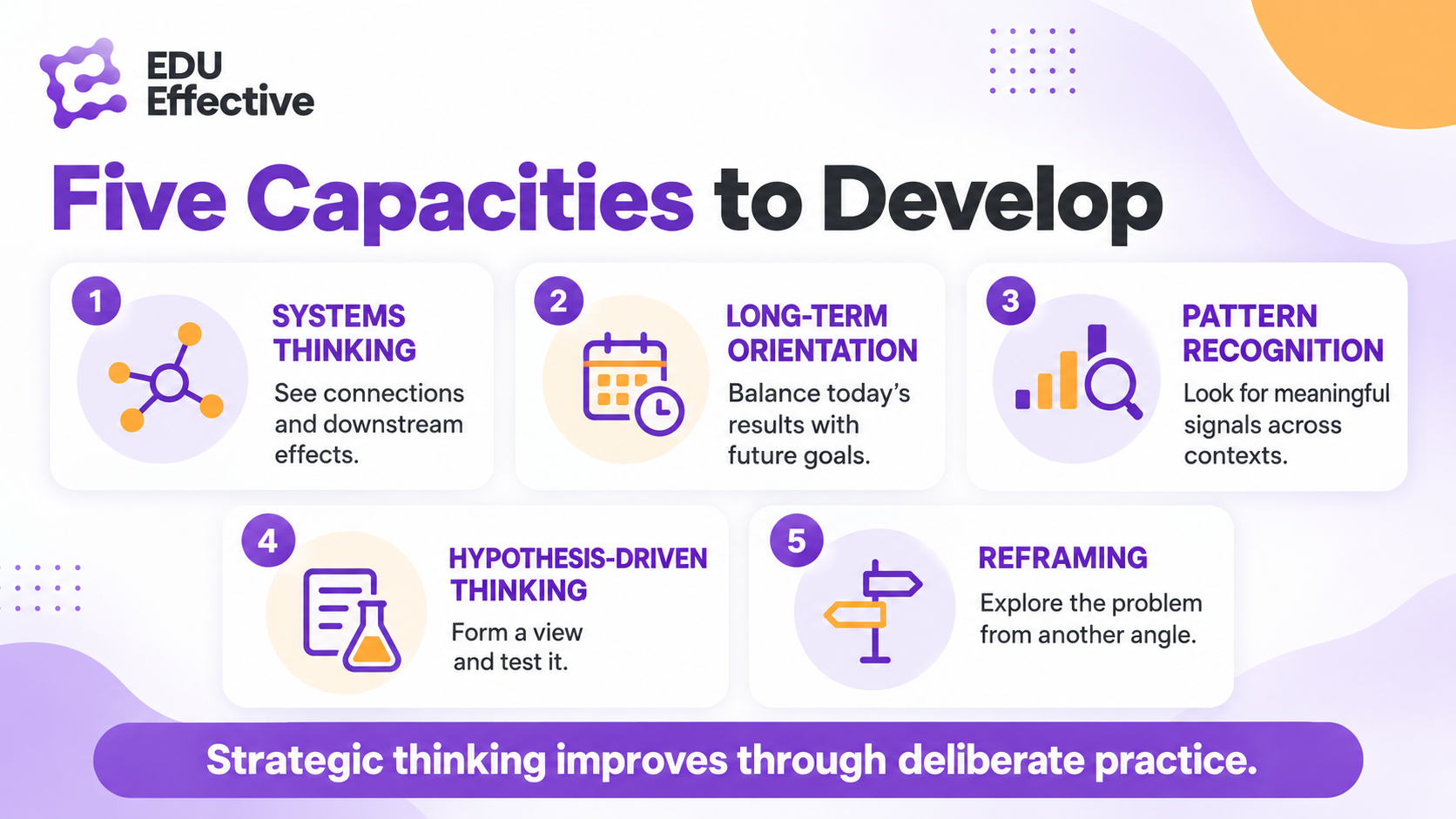
Systems thinking. The ability to see how parts of a system interact, how changes in one area create effects in others, and how feedback loops operate over time. Tactical thinking focuses on the immediate cause-and-effect relationship. Strategic thinking asks: what are the second — and third-order consequences of this decision, and who else in the system is affected?
Long-term orientation. The capacity to make decisions in the present that serve goals in the future, even when there is short-term cost or discomfort. This is not the same as ignoring short-term results — it’s the ability to hold both time horizons simultaneously and weigh them against each other explicitly. The MU Executive Barometer found that the defining challenge for today’s leaders is exactly this: “securing short-term success while simultaneously developing and implementing a long-term vision.”
Pattern recognition. The ability to identify meaningful signals in ambiguous data — to see that what looks like a random cluster of market events is actually a structural shift, or that what looks like a team performance problem is actually a process failure. This capacity develops with experience, but it also develops with deliberate practice: asking “what pattern is this an example of?” rather than treating each situation as unique.
Hypothesis-driven thinking. Approaching problems not by collecting all available information before forming a view, but by forming a working hypothesis early, then testing it deliberately. This is how McKinsey trains consultants and how effective executives approach strategic questions. It is faster than comprehensive analysis, more honest about uncertainty, and more likely to produce a genuine insight than a summary of existing information.
Reframing. The ability to view the same situation through a different frame and recognize what becomes visible from that angle. What looks like a competitive threat from the perspective of your existing business model might look like an opportunity from the perspective of a different value proposition. Strategic thinkers habitually ask: what am I not seeing from my current vantage point, and who sees this differently?
Why Managers Struggle to Think Strategically
Understanding why strategic thinking is underdeveloped in most managerial careers is the starting point for building it deliberately.
Operational pressure crowds out strategic time. Most managers’ calendars are structured around operational demands — status meetings, problem-solving, approvals, and execution oversight. Strategic thinking requires uninterrupted reflection time, and most organizations neither allocate nor protect it. The activities that fill a manager’s day are urgent by definition. Strategic thinking almost never is — until the moment when not having done it produces a crisis.
Success in execution is poor preparation for strategic thinking. The skills that produce promotion — delivering results on time, managing stakeholders, hitting targets — are largely tactical. They reward responding accurately to a defined problem. Strategic thinking requires defining the problem before solving it, and operating in the discomfort of not yet knowing the answer. Managers who are excellent executors often find this shift deeply uncomfortable, because their competence has been built on doing, not on sitting with ambiguity.
Organizational incentives favor the short term. Even when leaders understand the value of strategic thinking, the measurement and reward systems of most organizations pressure them toward quarterly or annual results. A manager who spends significant time thinking through competitive positioning five years out and producing no near-term deliverable is likely to be perceived as under-performing, not as investing in the organization’s future. The systems reward what they measure.
Strategic thinking is rarely taught. The Korn Ferry research — covering 7,500+ executives across 107 countries — found that 48% said they would discard nearly half of their current leadership development approach, and 55% rated their leadership development ROI as fair, poor, or very poor. Most management training focuses on frameworks and tools — strategic planning templates, SWOT analyses, OKR-setting processes — rather than on the underlying cognitive capacities that make those tools produce insight rather than paperwork.
The Difference Between Strategic Thinking and Being Strategic
A distinction worth making: being “strategic” in the everyday organizational sense — politically savvy, stakeholder-aware, careful about timing — is not the same as strategic thinking. Someone can be highly adept at navigating organizational dynamics and have very little capacity for genuine strategic analysis. Conversely, an excellent strategic thinker may need to develop entirely separate skills around stakeholder management and organizational influence.
The conflation matters because it allows organizations to promote people based on political effectiveness while describing this as “strategic leadership” — and then wonder why the strategy isn’t working.
Genuine strategic thinking is visible in specific behaviors:
It produces distinctive choices. A strategy that could have been written by any competitor is not a strategy — it’s a statement of ambition with no differentiating logic. Strategic thinkers ask: what choice are we making that our competitors won’t or can’t make? The answer is where competitive advantage lives.
It accepts trade-offs. One of the clearest signs that an organization has planning without thinking is the reluctance to say no. Strategy requires choosing where not to compete, what not to do, which customers not to serve. Organizations that try to pursue every opportunity have made no strategic choices — they’ve made a list.
It separates signal from noise. Not every competitor action requires a response. Not every market development changes the relevant context. Strategic thinkers have a view about what matters enough to update their thinking and what can be noted and set aside. Without that filter, organizations react to everything and focus on nothing.
Developing Strategic Thinking as a Deliberate Practice
The useful news from the research literature is that strategic thinking is developable. It is not a fixed cognitive trait. The development pathways that work:
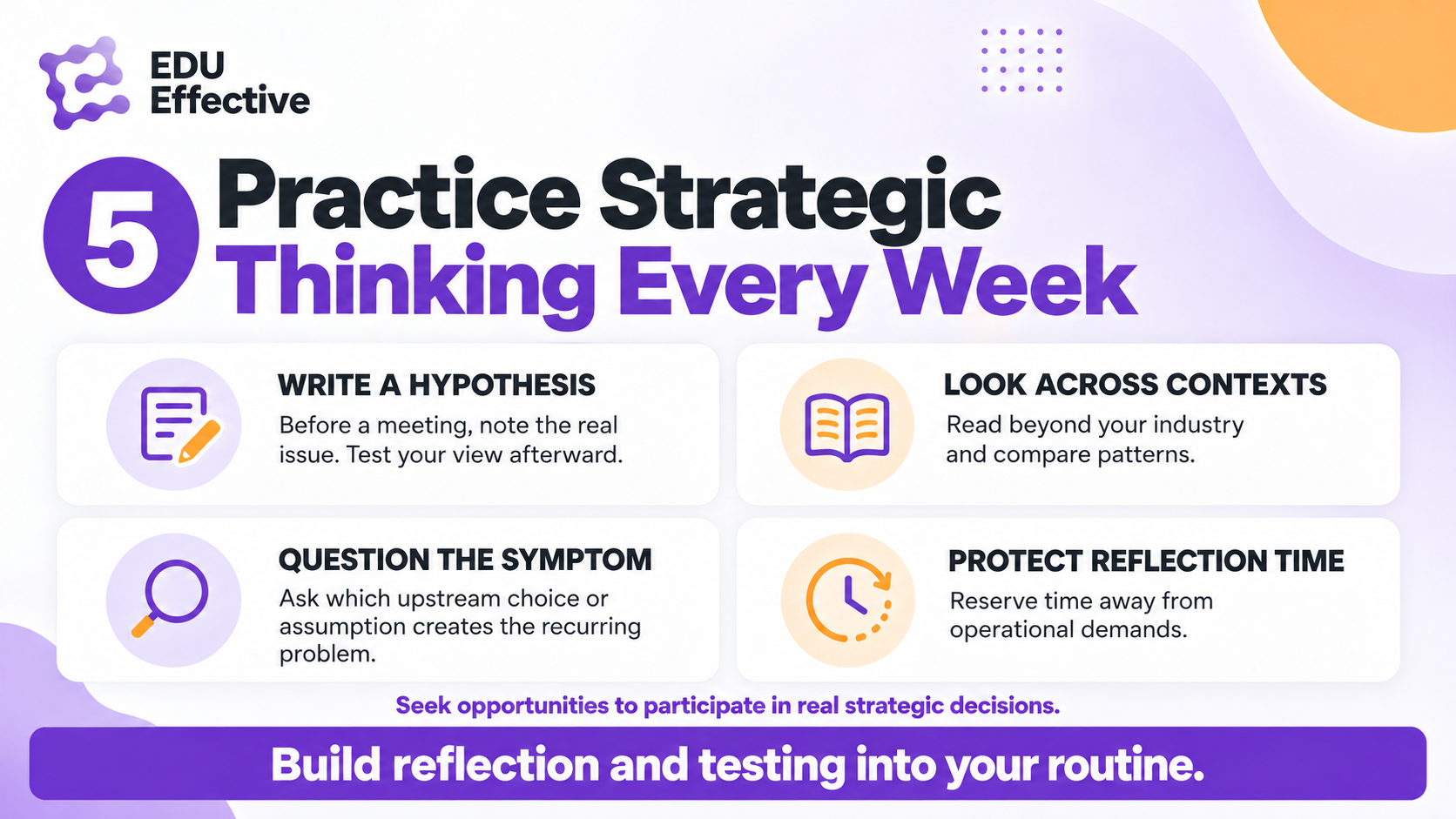
Exposure to strategic decisions. The fastest way to develop strategic thinking is to be present for, and involved in, genuine strategic choices — not to observe them from a distance, but to participate in the analysis, the debate about trade-offs, and the choice. Organizations that restrict strategic work to the C-suite produce exactly the leadership gap that the Korn Ferry and Springboard data describes.
Pattern practice across contexts. Strategic thinkers read broadly — not just in their industry, but across industries, disciplines, and historical contexts — because pattern recognition improves with the breadth of patterns you’ve been exposed to. The executive who has studied how Amazon’s logistics strategy changed retail, how Netflix’s content strategy changed media, and how Apple’s platform strategy changed software is better equipped to recognize analogous patterns in their own industry than one who reads only trade publications.
Hypothesis formation as a daily habit. Before an important meeting, write down your hypothesis about what the real issue is. After the meeting, check whether you were right and why or why not. Before reading an industry report, form a view about what it will say. This is low-cost, high-return practice that most managers never do.
Asking the strategy question of operational problems. Most operational problems are symptoms of strategic choices — made explicitly or by default. When a recurring operational problem surfaces, the strategic thinker asks: what choice or assumption upstream is producing this symptom? This reframe shifts attention from the immediate fix to the root cause, which is where strategic value lives.
Scheduled reflection time. Not optional, not “when things slow down.” The research on strategic thinking development converges on the simple fact that it requires time away from operational pressure. Michael Watkins of IMD Business School, who has studied executive transitions for two decades, frames the shift from operational to strategic thinking as the central developmental challenge in moving from middle management to senior leadership — and the primary reason leadership transitions fail.
Strategic Thinking in the Age of AI
One challenge to address directly: if AI can now analyze data faster and more comprehensively than any human, what remains of the strategic thinking premium?
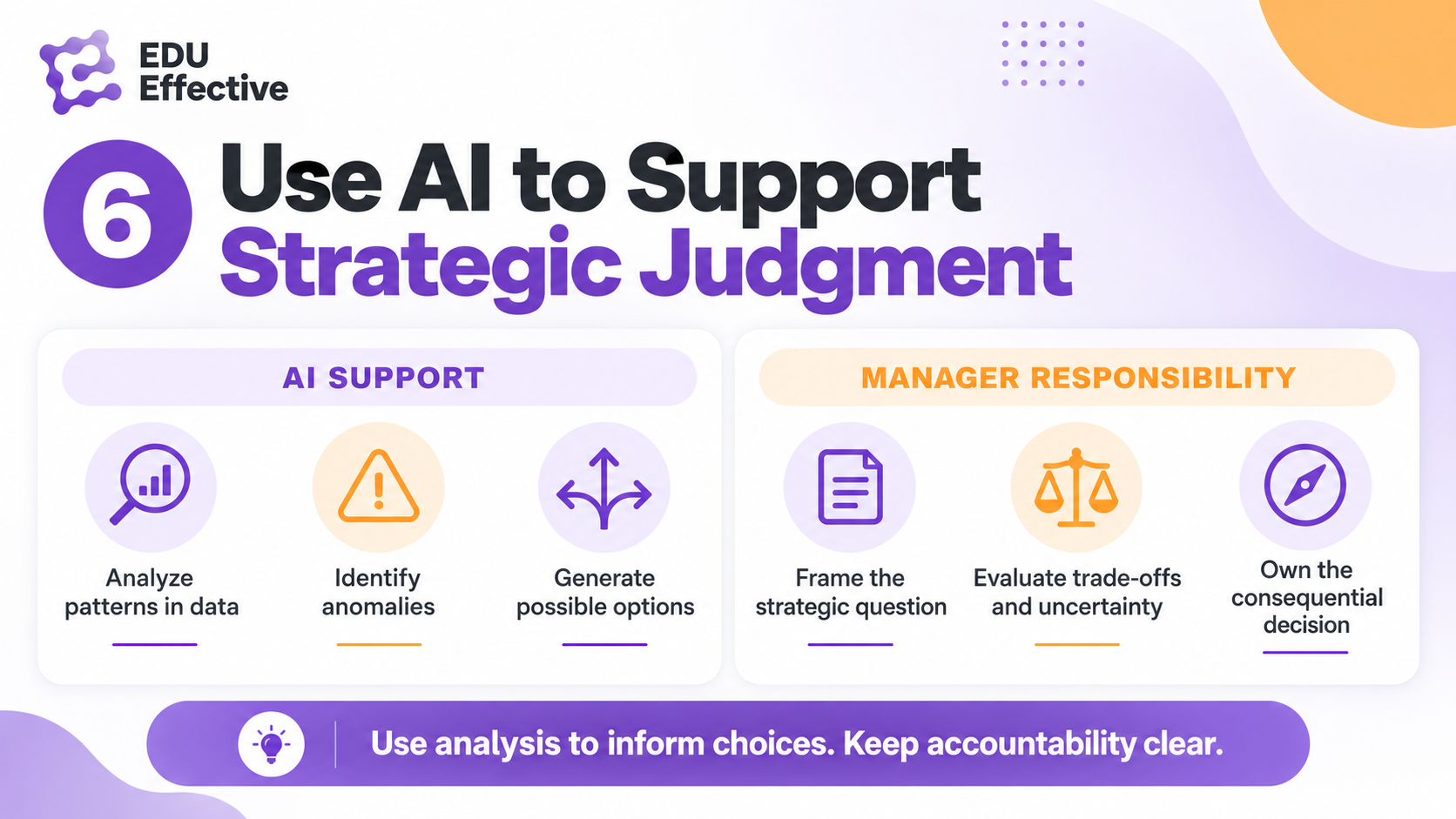
The answer lies in the parts of strategic thinking that are not analytical. AI is excellent at pattern recognition within defined data sets, at identifying anomalies, and at generating options from existing information. It is not good at knowing which patterns matter, at asking whether the problem is actually the problem, or at forming a genuine view about competitive positioning that involves trade-offs, values, and bets about the future.
The managers and executives who will create the most value in AI-integrated organizations are not the ones who can analyze data — machines do that faster. They’re the ones who can ask the right question, identify what the analysis is missing, and make a decision under uncertainty that accounts for what the data can’t tell them. That is strategic thinking, and it is more valuable now than it was before AI was part of the picture.
Key Takeaways
Strategic thinking is now the top leadership competency — ranked first in the MU Executive Barometer for the first time, ahead of adaptability. Springboard’s research found that leaders name strategic and critical thinking the most sorely needed skill in their organizations, with nearly 40% saying the gap is deepening. Yet only 17% of executives in Korn Ferry’s 7,500-person global study were fully confident their organization had the right leadership capabilities to execute its strategic priorities, and 55% rated their leadership development ROI as poor. The distinction between strategic thinking and strategic planning matters: planning documents how to execute; thinking determines whether the execution is aimed at the right target. The five core capacities — systems thinking, long-term orientation, pattern recognition, hypothesis-driven thinking, and reframing — are all developable through deliberate practice. In an AI-integrated environment, the human premium in strategy lies precisely in the capacities AI doesn’t have: framing the right question, navigating genuine uncertainty, and making consequential choices.
About EDU Effective Business School
The Effective MBA: Executive Management & Leadership is built around the decisions managers actually face every week. Runs on 15 minutes a day, completes in 10 months or less and is ASIC accredited.
Sources
- Mercuri Urval / Ipsos — MU Executive Barometer 2025 (167 executives, consumer goods/FMCG/retail) https://mercuriurval.com/en-fr/institute/newsroom/strategic-thinking-and-leadership-skills-in-focus-key-findings-from-the-mu-executive-barometer-2025
- Springboard — The State of the Workforce Skills Gap (1,000+ corporate professionals) https://fortune.com/2024/01/31/leaders-want-strategic-and-critical-thinking-more-than-anything-most-of-their-workers-dont-have-it
- World Economic Forum — Future of Jobs Report 2023 https://www.weforum.org/publications/the-future-of-jobs-report-2023/
- Martin, R. — Playing to Win: How Strategy Really Works (Harvard Business Review Press) https://www.amazon.com/dp/142218739X?lv=shuf&channelId=500&plpRedirect=mhFallback
- IMD Business School / Michael Watkins — The Six Disciplines of Strategic Thinking https://www.amazon.com/dp/0063357968?lv=shuf&channelId=500&plpRedirect=mhFallback