
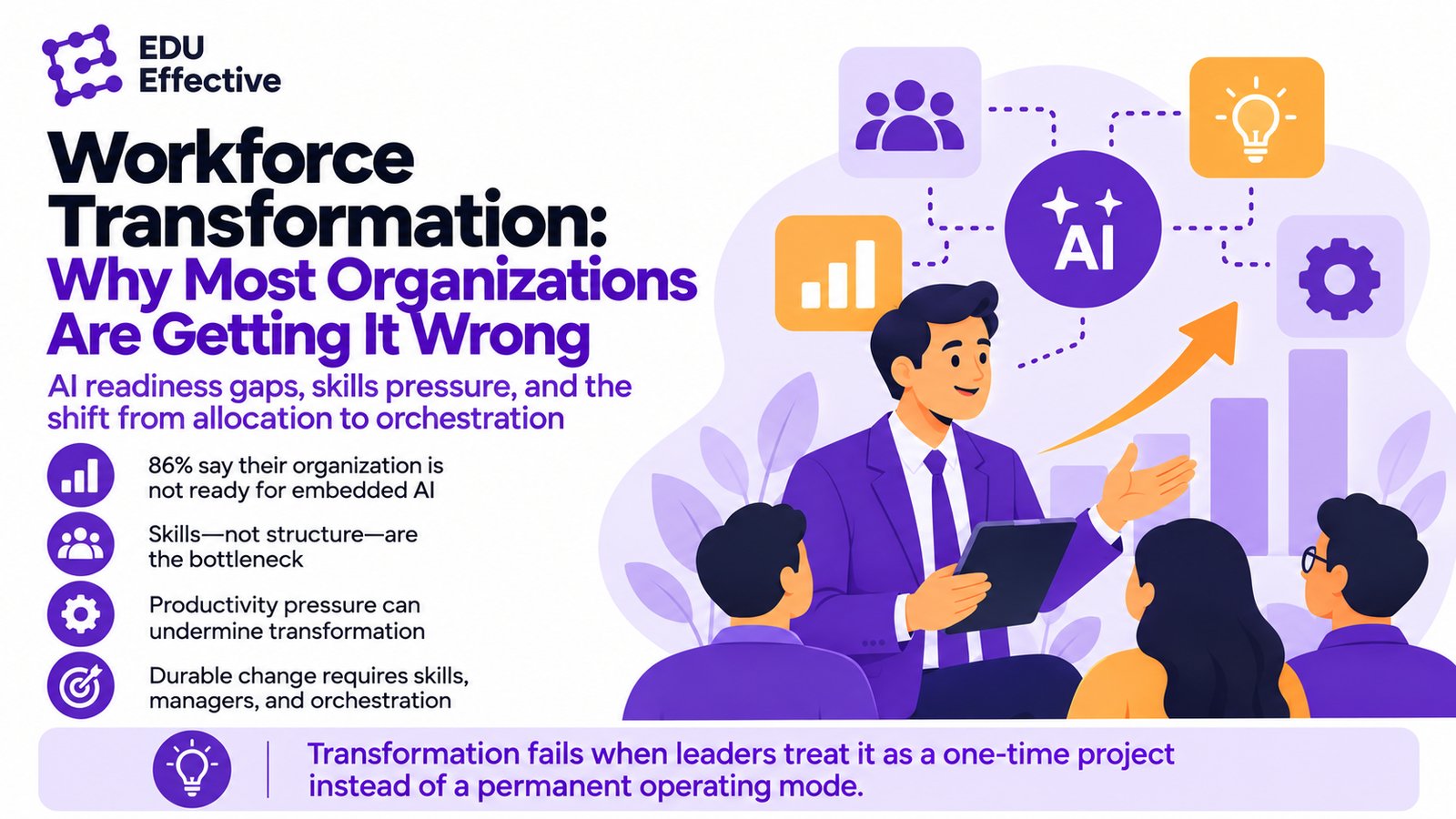

There is a statistic from McKinsey’s State of Organizations 2026 that should make every executive pause. Surveyors asked 10,000 senior leaders a direct question: is your organization properly prepared to embed AI into daily operations? Eighty-six percent said no.
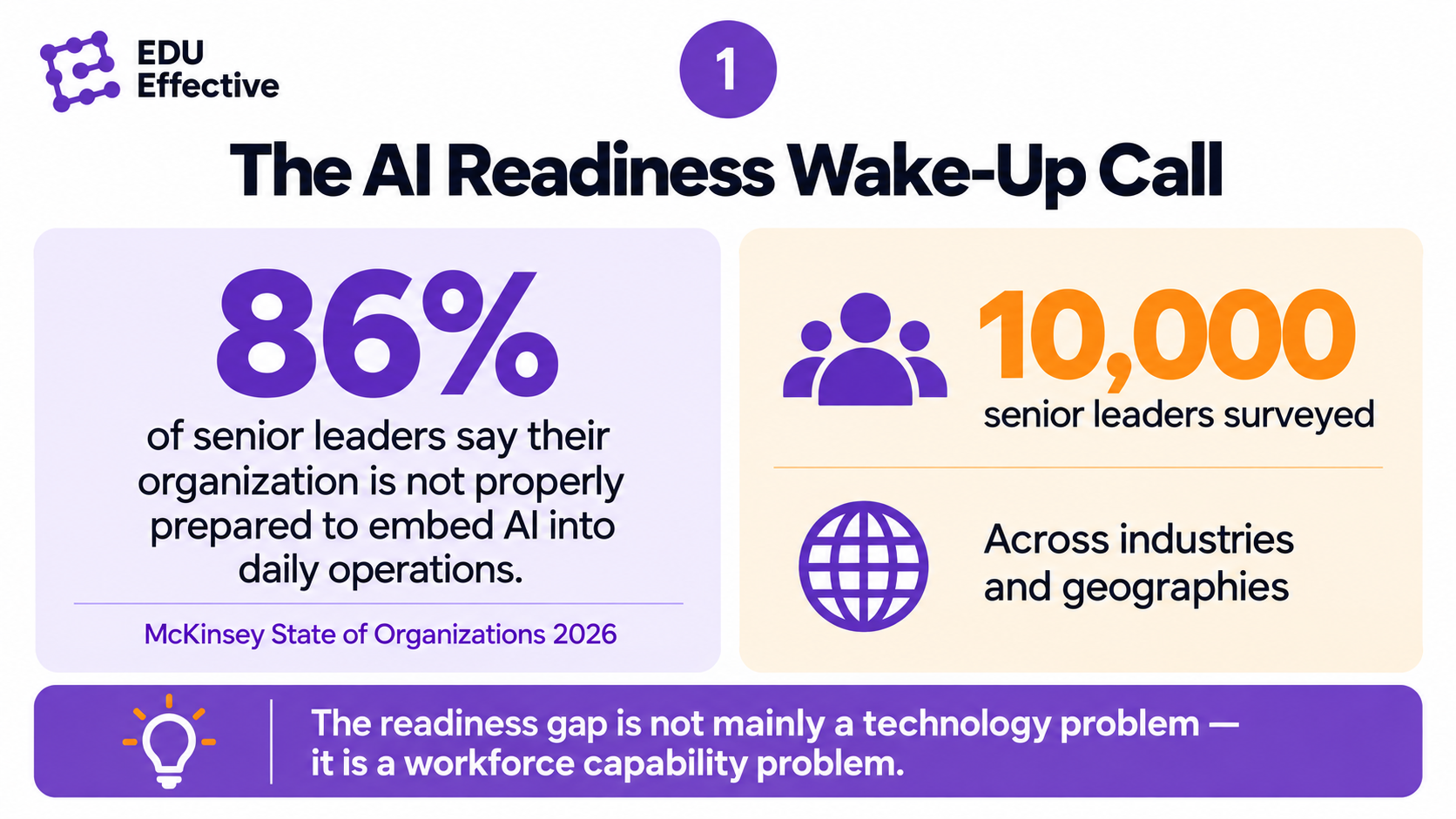
Not “we’re still figuring it out.” Not “we’re making progress.” Eighty-six percent — across industries, across geographies — said their company is not ready for the single most consequential operational shift of this decade.
That number is a symptom. The deeper problem is how organizations think about transformation itself.
The Transformation Trap
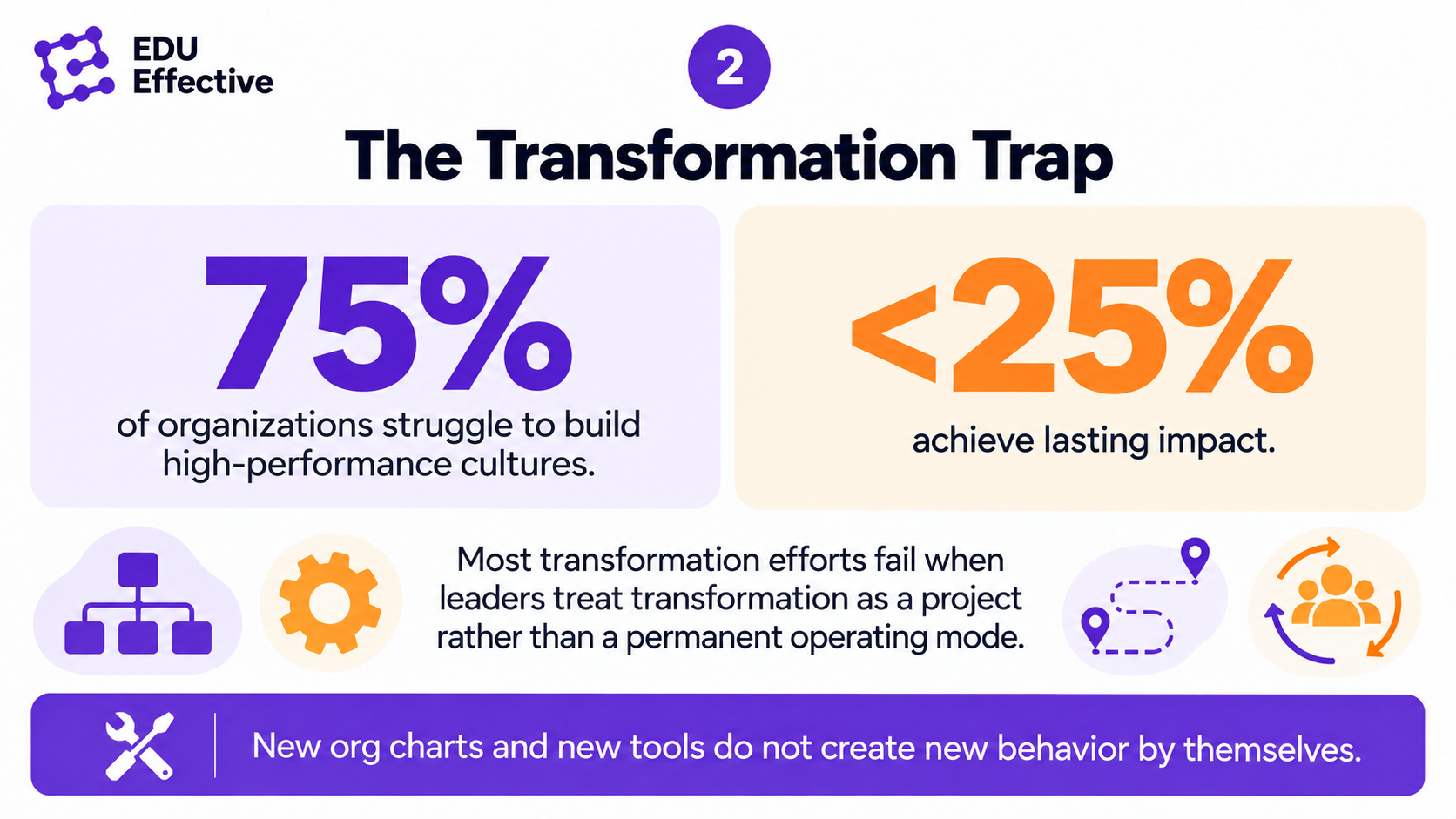
Most workforce transformation efforts fail not because companies lack technology or budget. They fail because leaders treat transformation as a project rather than a permanent operating mode.
The pattern is familiar. A consulting firm gets hired. A roadmap gets built. A launch event happens. Eighteen months later, the organization has a new org chart, a few new tools, and roughly the same behavior as before. McKinsey’s data is blunt about the outcome: 75% of organizations struggle to build high-performance cultures, and fewer than a quarter achieve lasting impact.
The question worth asking is: what separates the 25%?
What the Data Actually Shows
Deloitte’s 2026 Global Human Capital Trends surveyed over 3,000 business and HR leaders across 15 countries, plus 6,000 workers and managers. The findings describe an organization under enormous internal pressure with remarkably few tools to respond.
A third of workers reported 15 major organizational changes in the past year. Not 15 over five years. Fifteen in twelve months. The number is almost absurd, but it reflects something real: the pace of external change has outrun the pace at which most organizations can adapt.
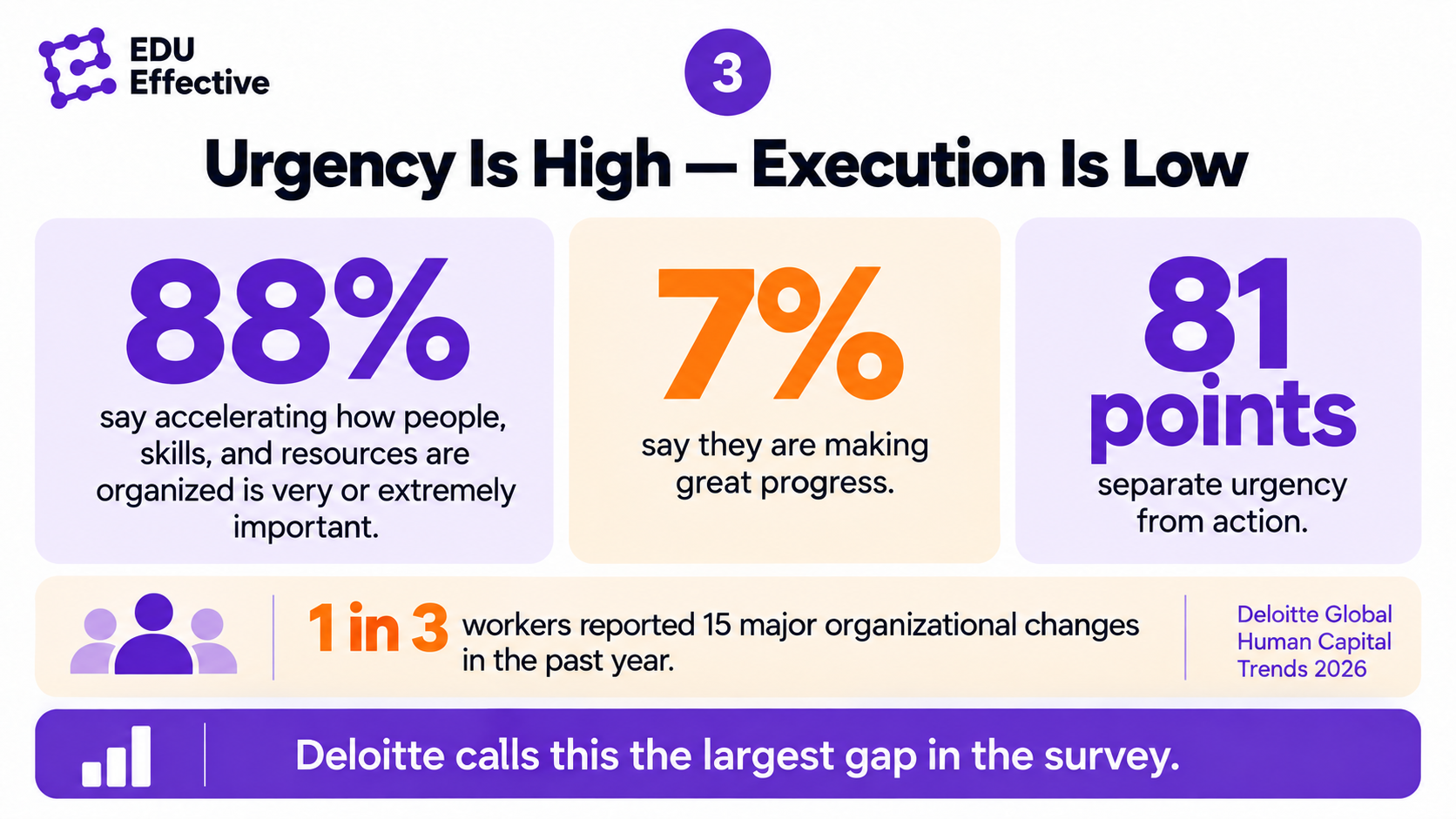
Here is the gap that matters. Deloitte asked leaders how important it is to accelerate how people, skills, and resources are organized. Eighty-eight percent said very or extremely important. Then they asked how much progress those organizations have actually made. Seven percent said they were making great progress.
Eighty-one percentage points separate urgency from action. Deloitte calls this the largest gap in the survey. What it describes is an entire sector of organizations that understand what transformation requires and still cannot execute it.
The Skills Problem at the Center of Everything
When Deloitte asked workers what was driving all this change, the top answer was not AI adoption. It was not market disruption. The top answer, cited by 39% of workers, was a shift in required skills.
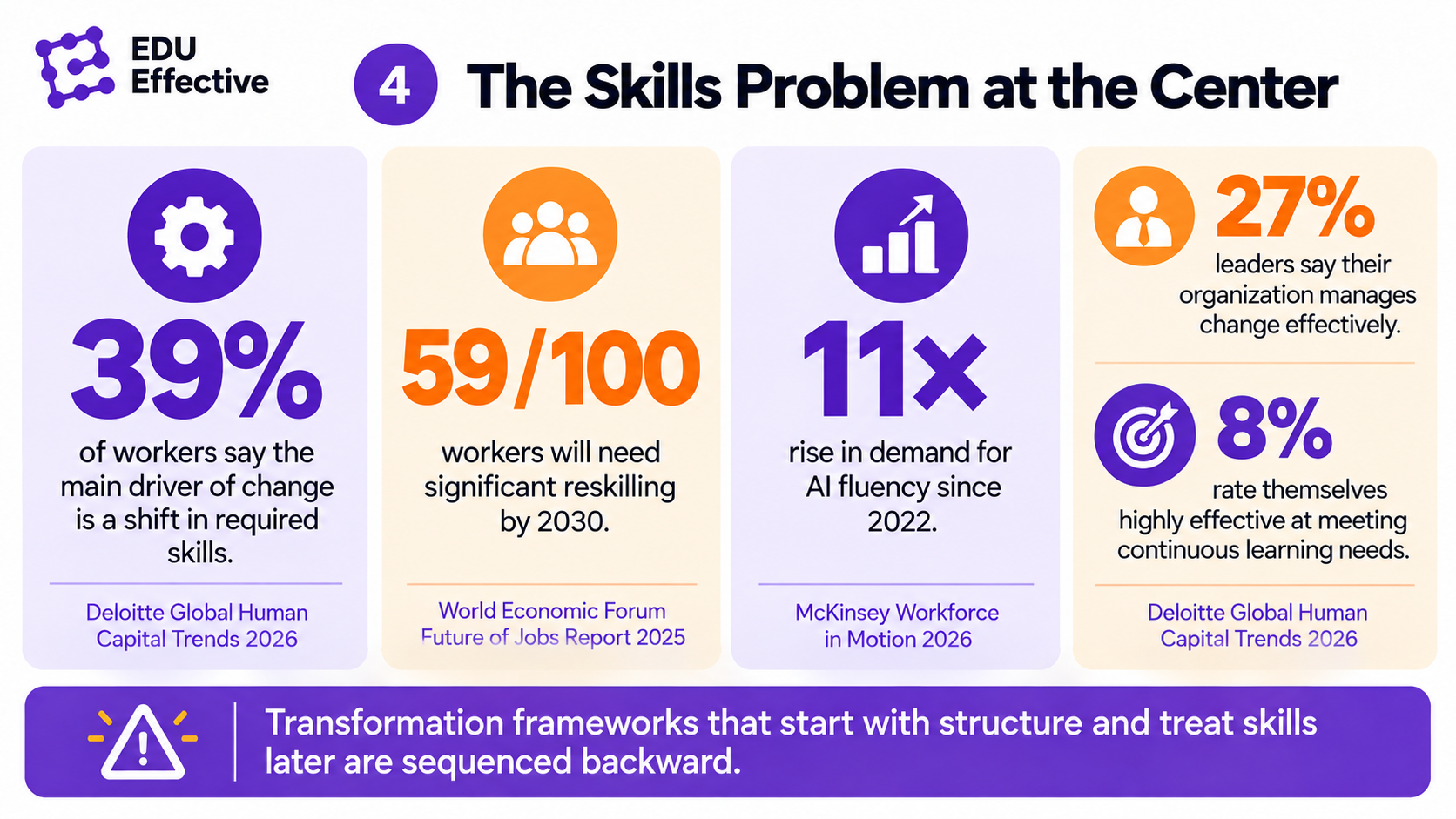
This matters because most organizational transformation frameworks start with structure: reporting lines, headcount, business units. Skills come later, usually as a training budget line. That sequencing is backward.
The World Economic Forum’s Future of Jobs 2025 put the number at 59 out of 100 workers needing significant reskilling by 2030. McKinsey’s Workforce in Motion report from September 2026 found that demand for AI fluency has risen eleven-fold since 2022. These are not gradual shifts. They are structural reorganizations of what work requires, happening faster than most companies can recognize, let alone respond to.
The data on response capacity is not reassuring. Only 27% of leaders in the Deloitte study say their organization manages change effectively. Just 8% rate themselves highly effective at meeting continuous learning needs. Meanwhile, 43% of executives in the McKinsey survey named limited career progression as the biggest internal barrier to high performance — ahead of disengagement, ahead of rigid performance management, ahead of everything else.
Employees are watching career paths close. Organizations are struggling to open new ones fast enough.
The Productivity Pressure Making It Worse
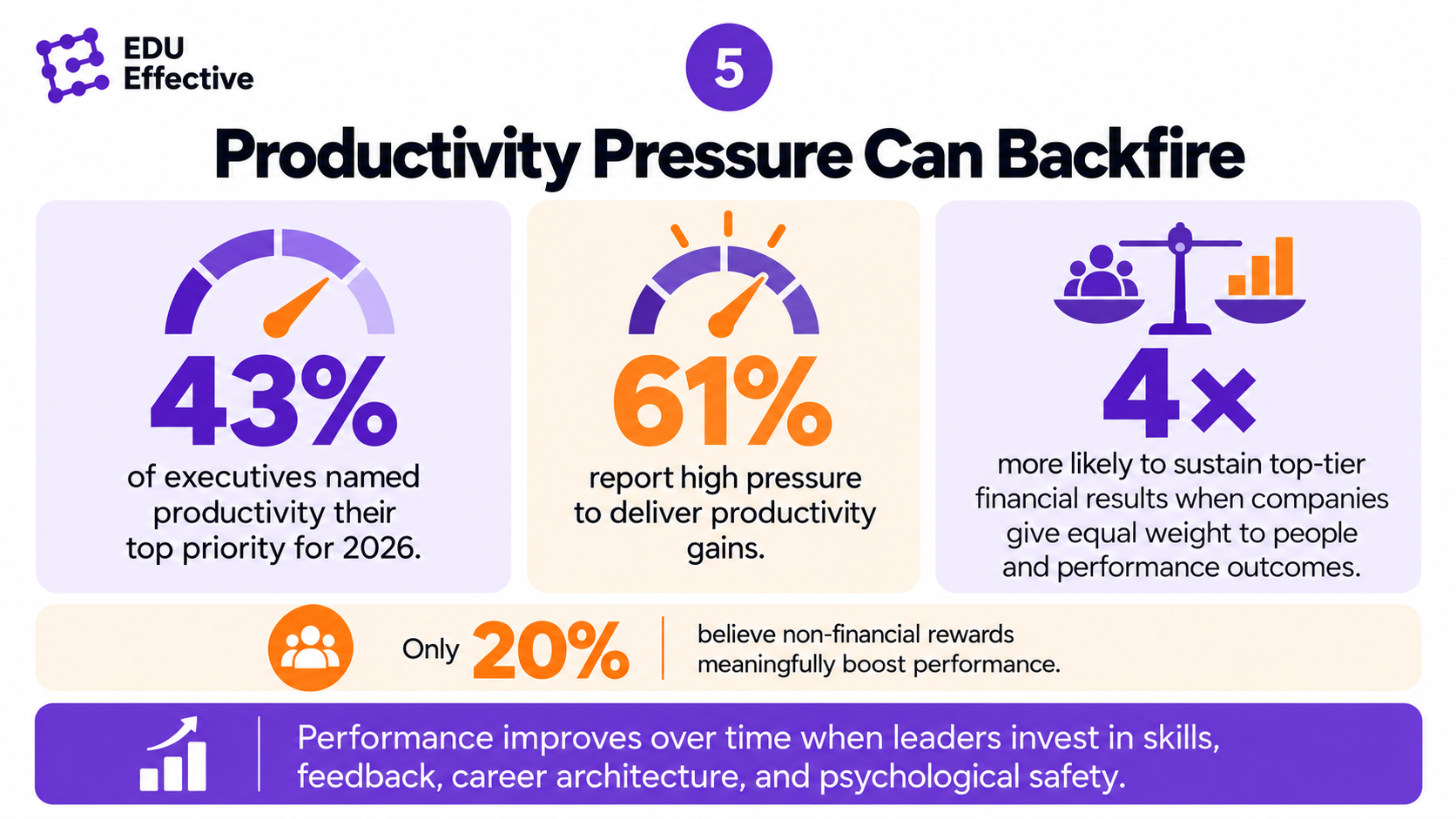
McKinsey’s State of Organizations 2026 adds a layer that most workforce strategy conversations skip. Forty-three percent of executives named productivity as their top priority for 2026. Sixty-one percent report feeling high pressure to deliver productivity gains.
That pressure is not inherently destructive. But it becomes destructive when it overrides the investments required to actually improve productivity over time: skills development, clear career architecture, meaningful feedback, psychological safety.
Here is what the data shows when that trade-off goes wrong. In high-pressure organizations, only 43% of leaders report employee willingness to meet greater demands, compared to 50% in lower-pressure environments. Employee commitment in high-pressure settings sits at 23%, versus 14% disengaged in lower-pressure organizations.
Organizations that push for performance without building the conditions for sustained performance end up with lower performance. The correlation is not subtle.
McKinsey found — across a separate decade-long study of organizational performance — that companies giving equal weight to people and performance outcomes are more than four times as likely to sustain top-tier financial results across nine out of ten years. Equal weight. Not people instead of performance. Both, simultaneously, by design.
Only 20% of leaders in the same study believe non-financial rewards meaningfully boost performance. That is a belief that costs companies considerably.
From Allocation to Orchestration
Deloitte’s 2026 report introduces a concept worth sitting with: the shift from allocation to orchestration. It is a meaningful distinction.
Allocation treats people as resources to be assigned to roles and held there. Orchestration treats people as capabilities to be deployed dynamically — assembled around problems, redeployed as conditions change, measured by skills and outcomes rather than job titles.
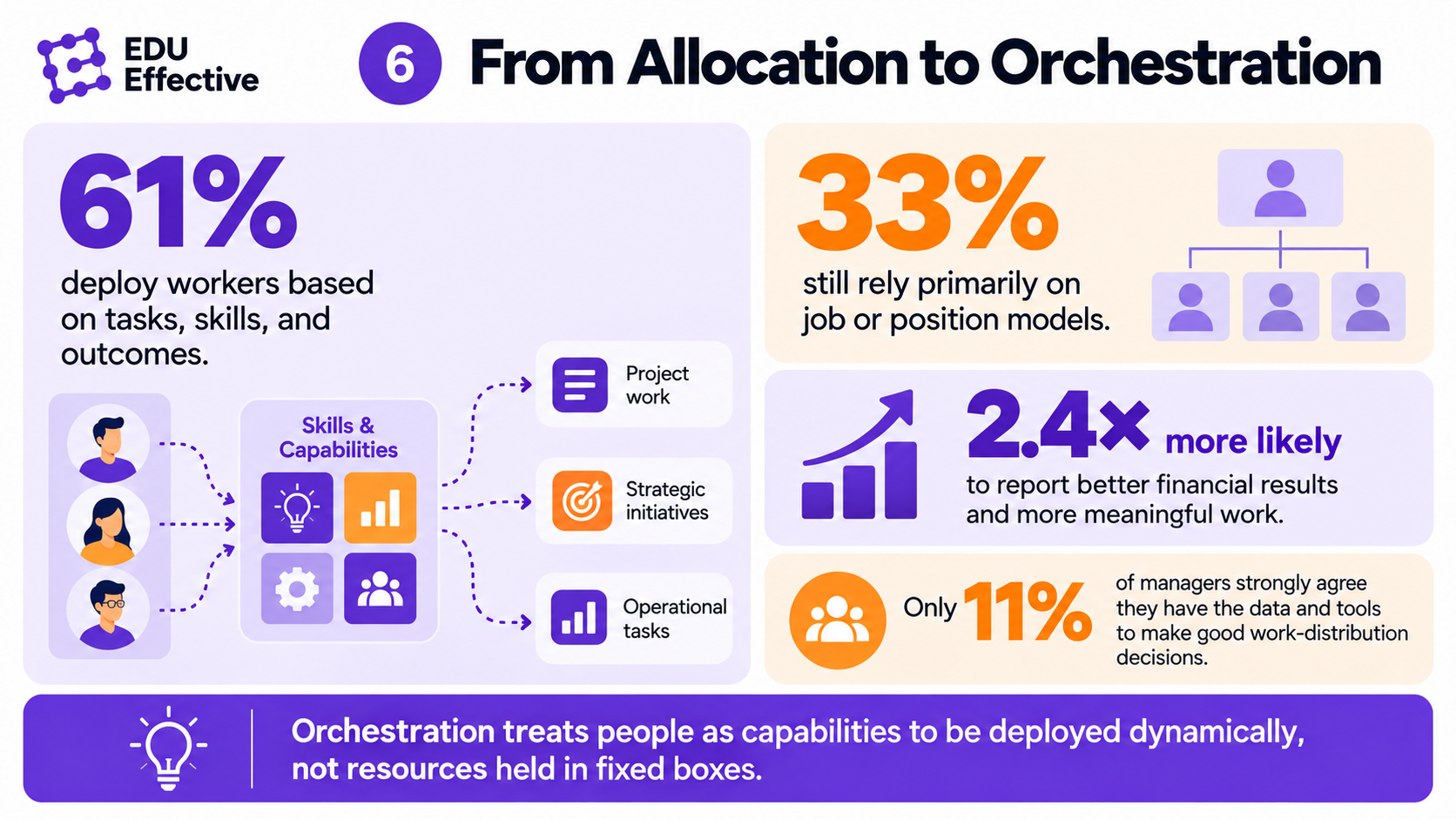
Sixty-one percent of organizations now deploy workers based on tasks, skills, and outcomes, per Deloitte’s data. Thirty-three percent still rely primarily on job or position models. The gap between those two groups in business outcomes is significant: organizations with adaptive, orchestration-ready capability are 2.4 times more likely to report better financial results and more meaningful work.
The Levi Strauss example from the report is useful. When demand signals showed a surge in loose-fit jeans, the company assembled cross-functional teams around that specific opportunity. Sales in the category grew 15% in three months. That is what organizational agility actually looks like: not a value statement in an annual report, but a structural capacity to redirect human capability quickly.
Most organizations cannot do this. The infrastructure reason: only 11% of managers strongly agree they have the data and tools to make good work-distribution decisions. Reliable skills data is the foundation of orchestration, and almost nobody has it. Ninety-five percent of executives report worrying about the accuracy of candidate skills data — and just over a third of workers admit to regularly using AI to embellish their skills profiles. The problem compounds.
The AI Readiness Gap Is a People Problem
Back to that 86% number. Why are so many organizations unprepared to embed AI into operations?
The common answer points to technology: legacy systems, integration complexity, vendor fragmentation. These are real. But the deeper constraint is organizational. AI adoption at scale requires workers who understand what AI can do, managers who can direct humans and AI tools in combination, and leadership that can redesign workflows rather than bolt AI onto existing ones.
All three require investment in human capability. That investment is exactly what gets cut when quarterly productivity pressure spikes.
BCG’s 2026 analysis of AI’s impact on employment found that AI will reshape more jobs than it replaces. The verb matters. Reshaping requires workers and organizations to change what roles actually involve — not eliminate roles but redefine them. That is a harder change to manage than headcount reduction, and it demands more sustained attention from leadership.
The organizations that get this right — the 25% that achieve lasting high performance — treat workforce development as a continuous operating function rather than a one-time investment. They measure skills the way they measure revenue. They track capability gaps the way they track cost variances. They build career architecture before people start leaving because there is nowhere to go.
What Effective Workforce Transformation Actually Requires
Pull the findings together and the picture becomes clear. Organizations achieving durable transformation share three characteristics.
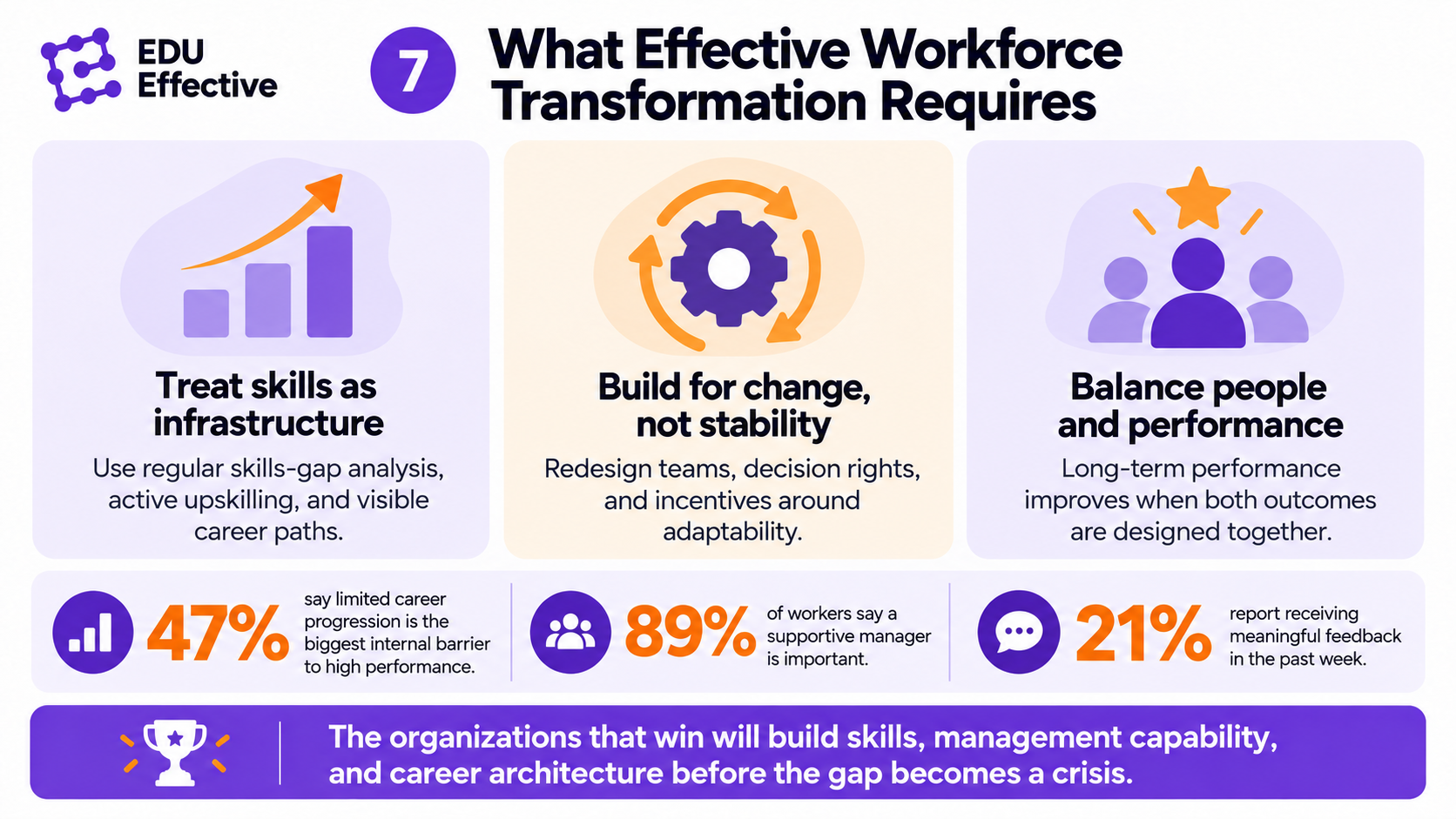
First, they treat skills as infrastructure. Not a benefit, not a cost, not a line in an L&D budget — infrastructure. The way a company maintains its technology stack or its physical assets, it maintains its human capability. This means regular skills gap analysis, active investment in closing gaps before they become critical, and career paths visible enough that employees can see where their development leads.
Second, they build for change, not for stability. Deloitte’s data shows that 67% of executives expect speed and agility to be their main competitive advantage over the next three years, compared to 28% who point to scale. Yet most organizations are still structured for scale. The shift requires redesigning decision rights, team structures, and performance incentives around adaptability.
Third, they take the people-performance equation seriously. McKinsey’s evidence across a decade of organizational performance data is unambiguous: equal weighting of people outcomes and performance outcomes produces better financial results over time. Organizations that treat this as soft or secondary are trading long-term performance for short-term cost savings. The math does not work in their favor.
The Role of Managers
One more finding from the McKinsey survey deserves attention. Forty-seven percent of executives identified limited career progression as the biggest internal barrier to high performance. This is a management problem as much as an organizational one.
Managers are the people closest to where career development either happens or doesn’t. They are the ones who can have the weekly conversations about skills, growth, and direction — or don’t. Gallup’s longitudinal research across workforce engagement consistently finds that the manager relationship accounts for the majority of variance in employee engagement. Not the CEO’s vision statement. Not the office design. The immediate manager.
Owl Labs’ State of Hybrid Work 2025 found that 89% of workers rate having a supportive manager as important to their success. Yet from Gallup’s parallel research, only 21% of employees report receiving meaningful feedback in the past week. There is a significant gap between what workers need from managers and what they are currently getting.
Workforce transformation that ignores this will produce new org charts with the same management behaviors, which produces roughly the same outcomes. The technology changes; the human dynamics don’t, unless they’re addressed directly.
What This Means for Leaders Who Are Preparing Now
The organizations that emerge from this decade of disruption in a strong position will have made specific decisions between 2025 and 2028. They will have built skills-based talent deployment before the skills gap became a crisis. They will have invested in management capability before engagement collapsed. They will have built the organizational infrastructure for continuous reskilling before AI reshaped their roles in ways they couldn’t respond to.
The window to make those investments at controlled cost is narrowing. The 86% of organizations that are not yet embedded with AI have some runway left — but not unlimited runway. The question for every leader reading this is not whether transformation is coming. It’s whether the organization they’re building is capable of moving fast enough when it arrives.
About EDU Effective Business School
EDU Effective Business School keeps its programs short, practical and directly applicable at work. Runs on 15 minutes a day, completes in 10 months or less and is ASIC accredited.
Sources
- McKinsey & Company — The State of Organizations 2026 https://www.mckinsey.com/capabilities/people-and-organization/our-insights/the-state-of-organizations
- Deloitte — Global Human Capital Trends 2026 https://www.deloitte.com/us/en/insights/topics/talent/human-capital-trends.html
- BCG — AI Will Reshape More Jobs Than It Replaces (2026) https://www.bcg.com/publications/2026/ai-will-reshape-more-jobs-than-it-replaces
- World Economic Forum — Future of Jobs Report 2025 https://www.weforum.org/publications/the-future-of-jobs-report-2025/
- McKinsey Global Institute — Workforce in Motion (September 2026) https://www.mckinsey.com/mgi/our-research/workforce-in-motion-skills-and-pathways-to-future-jobs-in-the-united-states