

Three years ago, AI in finance was primarily a vendor promise. Today, 59% of finance functions are actively using it — and the gap between those who have figured out where it creates real value and those still planning their pilot is widening fast enough that “we’re evaluating options” is no longer a neutral position.
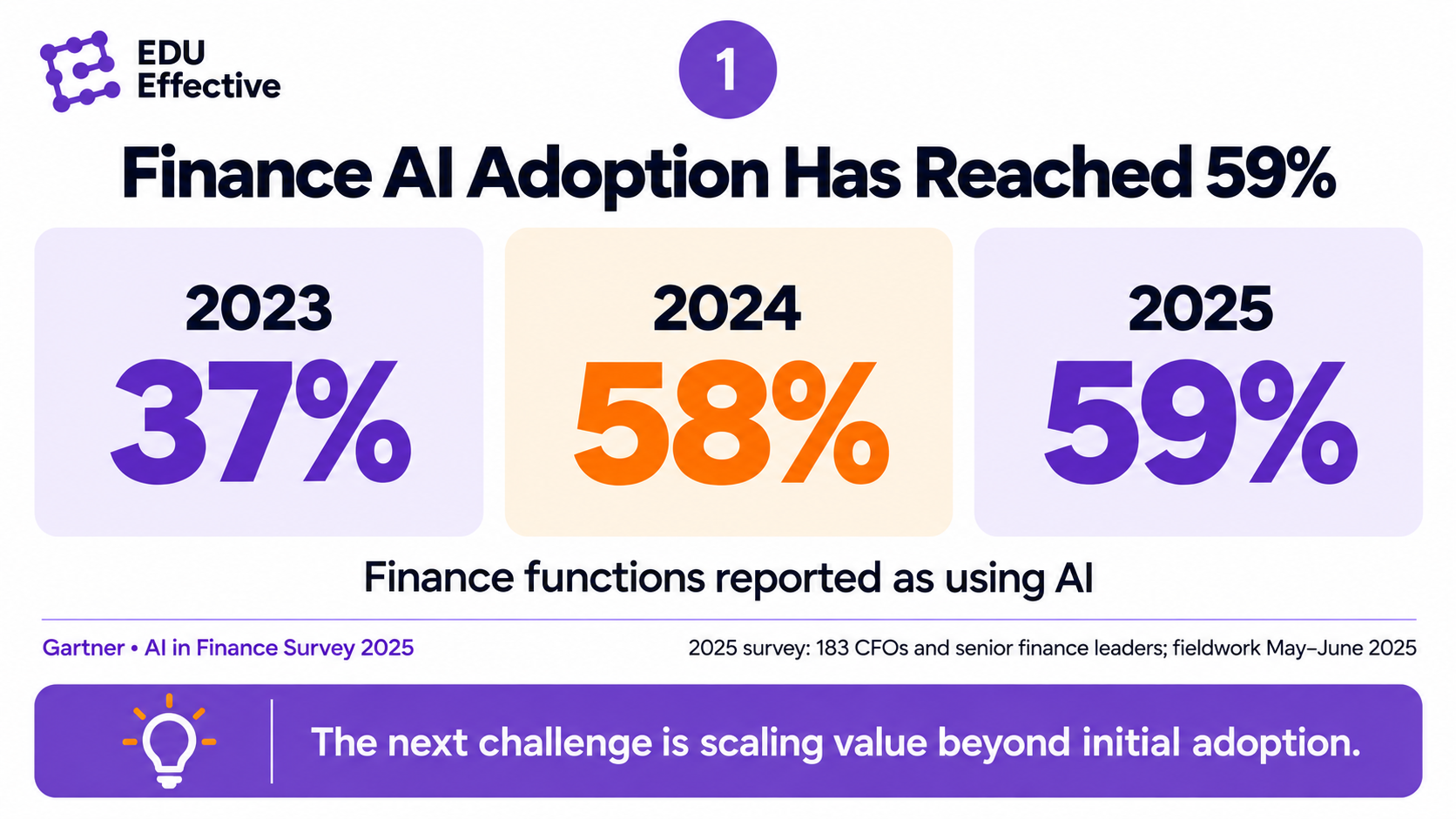
The data comes from Gartner’s survey of 183 CFOs and senior finance leaders. Adoption grew from 37% in 2023 to 58% in 2024 to 59% in 2025. The growth rate has slowed — not because the technology stopped working, but because the organizations that were going to move quickly have already moved. What 2027 is exposing is the distance between that first wave of adopters and everyone else.
This article covers what the data shows about where AI in finance is delivering measurable results, which use cases generate the highest impact, and what separates organizations already compounding those gains from those still running proof-of-concept projects.
Where finance teams are deploying AI — and what the priority order tells you
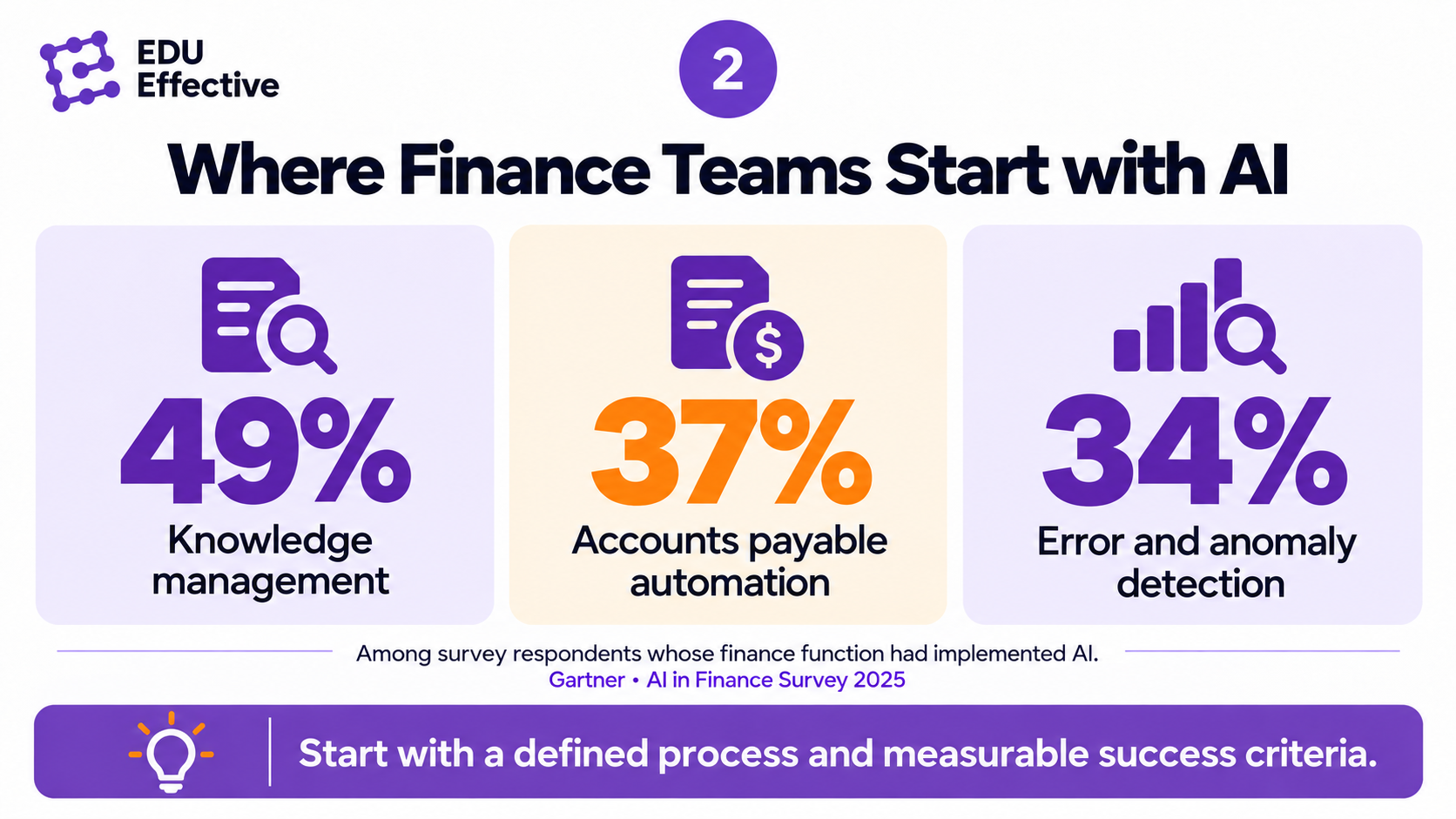
The Gartner survey identified the top use cases in finance by adoption rate: knowledge management leads at 49%, followed by accounts payable automation at 37% and error and anomaly detection at 34%. These three categories share a structural characteristic — the data is well-defined, the processes are repetitive, and the cost of errors is directly measurable.
That is rational sequencing. Accounts payable is a high-volume, rule-intensive process with clear success metrics: processing time, error rate, cost per invoice. Anomaly detection in financial data is a problem where AI genuinely outperforms human review at scale — it scans transaction patterns continuously and flags outliers that a human analyst would catch too late or miss entirely. These are not ambitious stretch applications. They are the natural entry points for a function that runs on data and process.
The most revealing finding from Gartner is which use case finance leaders rank highest for impact despite lower adoption: code generation. Finance professionals who have deployed AI for code generation — building financial models, automating reporting queries, generating data transformation scripts — rate it as the highest-impact application by a significant margin. Adoption rates do not map directly to value. The most impactful applications tend to require more technical setup, which is exactly why they are underrepresented in the numbers while overrepresented in the results of teams that got there.
What CFOs are betting on through 2027
MindBridge’s CFO AI Adoption Survey found that 52% of finance leaders expect AI to be “very critical” or “absolutely essential” for competitive advantage entering 2030 and beyond. 49% describe AI as a top strategic focus with active investment right now.
The detail that changes the framing: 50% of AI initiatives in finance are launched by the CEO or board — not by IT, not by finance itself. That distribution is significant. It means AI in finance has left the category of technology experiments and entered the category of strategic priorities that get board-level attention, budget, and accountability. Organizations where the initiative sits in a middle-management pilot are already operating at a structural disadvantage relative to those where the mandate comes from the top.
The top targeted benefit from AI in finance, per MindBridge, is forecasting and decision-making (55%) — ahead of cost reduction. That ranking matters for how you prioritize your own roadmap. Finance functions that focus exclusively on automation and cost reduction are capturing the smaller share of the available value. The larger opportunity is decision quality: sharper forecasts, faster scenario modeling, anomaly detection that feeds into capital allocation decisions rather than compliance reports.
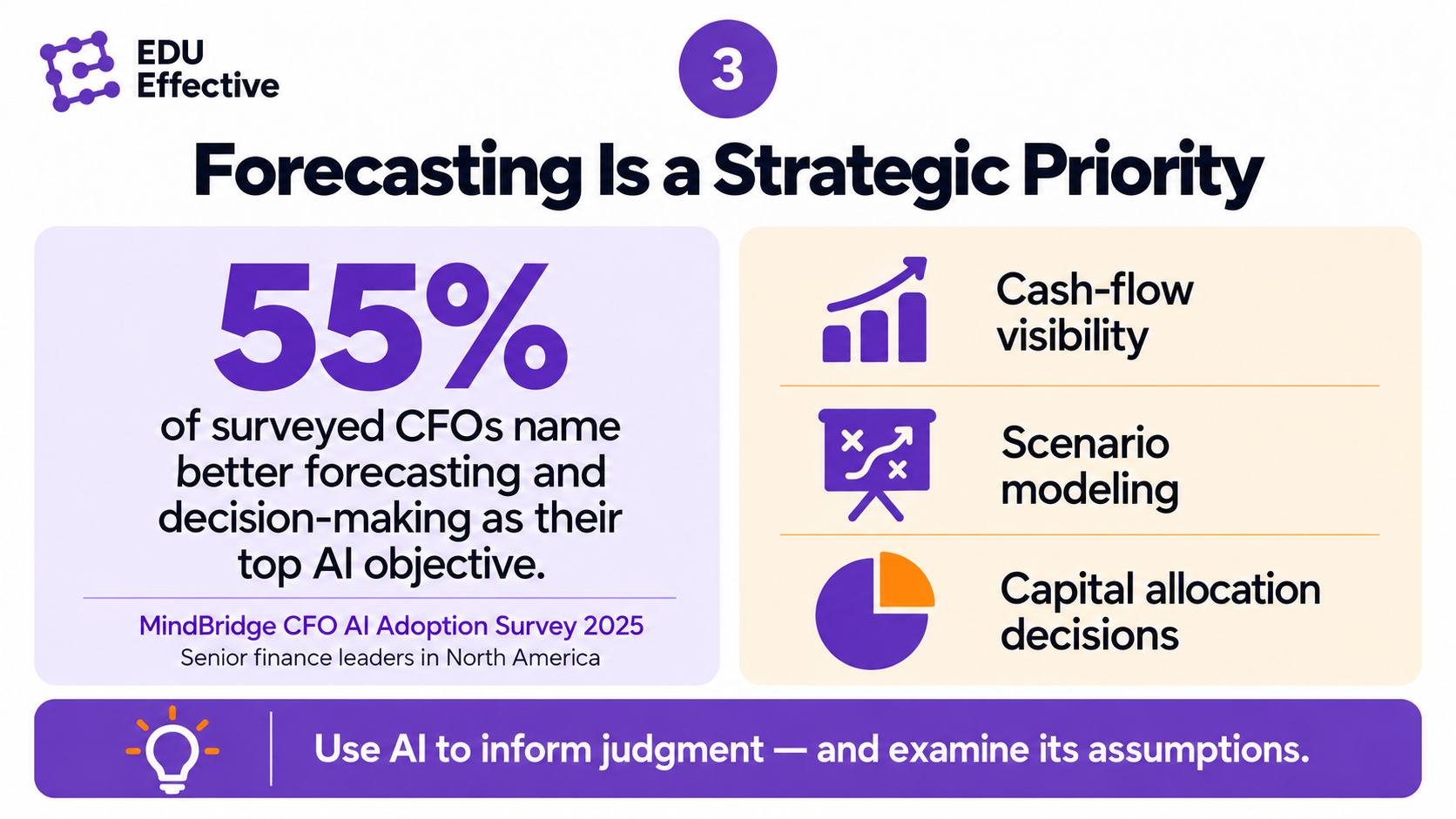
Deloitte corroborates the forecasting priority: over 60% of finance leaders identify cash flow forecasting as the area where generative AI will have its biggest impact. Cash flow forecasting is a domain where inputs are complex, historical patterns are informative but not deterministic, and small improvements in accuracy translate directly into better decisions about working capital, investment timing, and risk management.
Fraud detection: where the performance data is concrete
Fraud detection is the AI in finance application with the most specific published performance data — because the outcomes are easy to measure and financial institutions have an incentive to demonstrate results.
J.P. Morgan reported a 15–20% reduction in account validation rejection rates after deploying AI-driven payment validation screening. Fewer legitimate transactions flagged incorrectly — which matters for customer experience as much as operational cost. Commonwealth Bank of Australia reported a 50% reduction in scam losses after integrating AI fraud prevention, alongside a 30% drop in customer-reported fraud cases. Mastercard reported a 20% increase in fraud detection rates from AI analysis combining transaction patterns with external fraud signals.
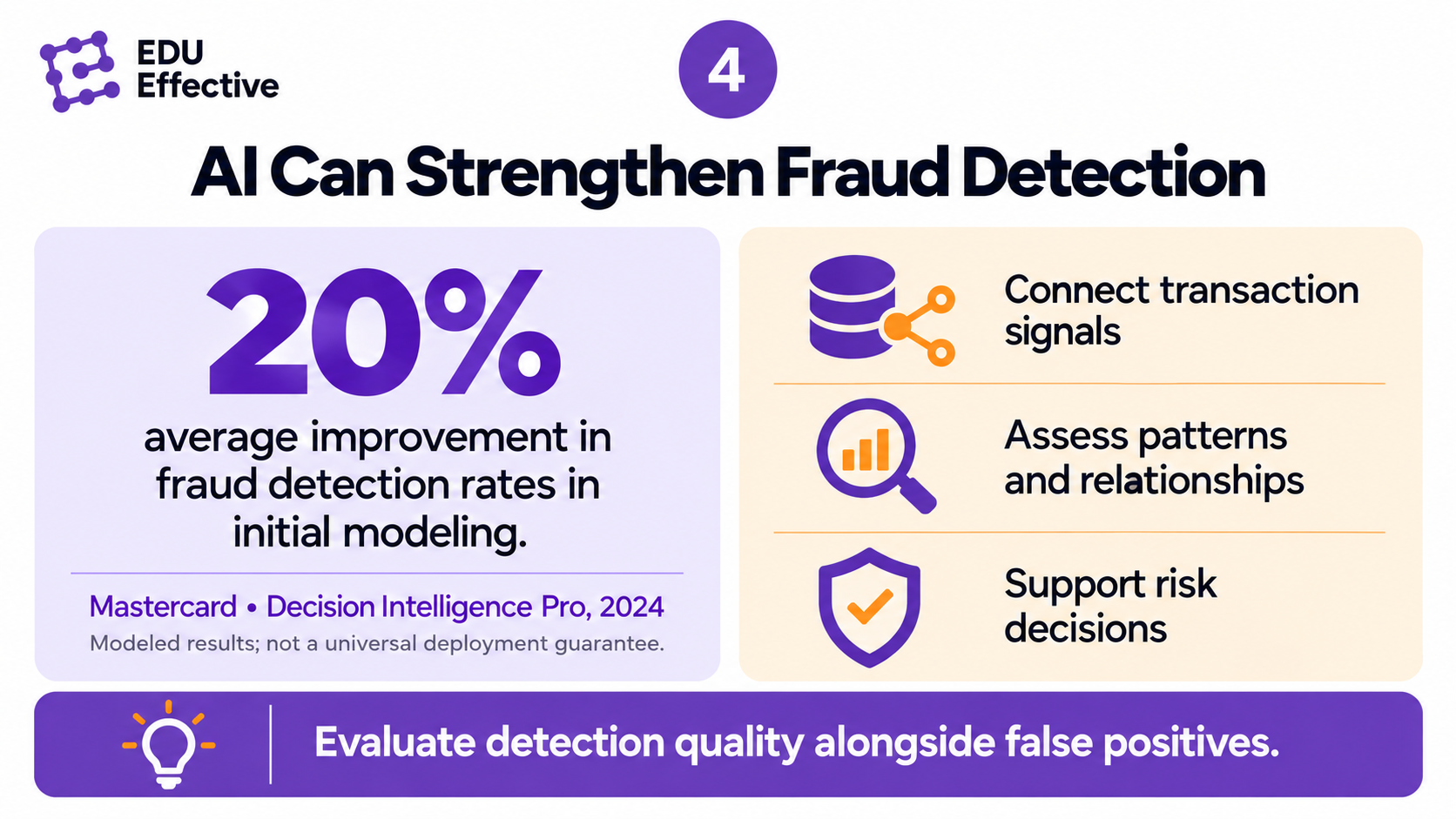
These are enterprise deployments at scale. The numbers published by institutions of this size tend to be conservative — they are not reporting aspirational figures. The pattern across all three is that AI in fraud detection improves both directions simultaneously: it catches more actual fraud and generates fewer false positives. Traditional rule-based systems improve one dimension at the cost of the other. That simultaneous improvement is structurally significant for any finance function running transaction monitoring at volume.
Accounts receivable and working capital
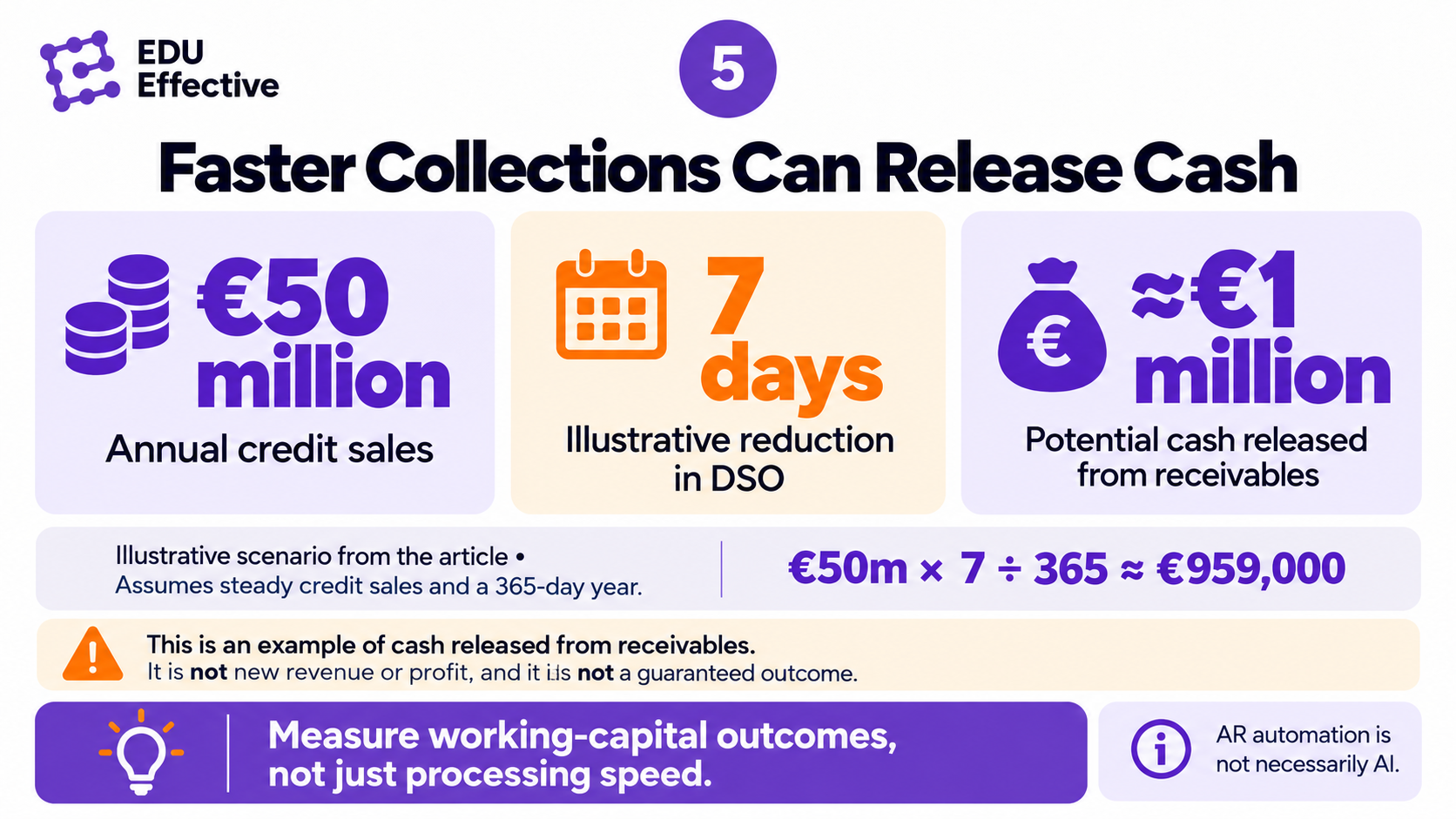
PYMNTS data shows firms with automated payment acceptance carry an average DSO of 40 days versus 47 days without automation — a seven-day improvement with a direct impact on working capital. Combined research from PYMNTS and American Express found automated AR operations can reduce collection times by up to 67%. 87% of businesses with automated AR report a significant boost in process speed.
The business case for a mid-sized organization is not abstract. A company with €50 million in annual revenue reducing DSO by seven days holds roughly €1 million more in available cash at any given time. That is not a technology project return. That is a treasury management outcome that goes directly to CFO-level metrics.
Why 91% see only modest returns at first — and what changes that
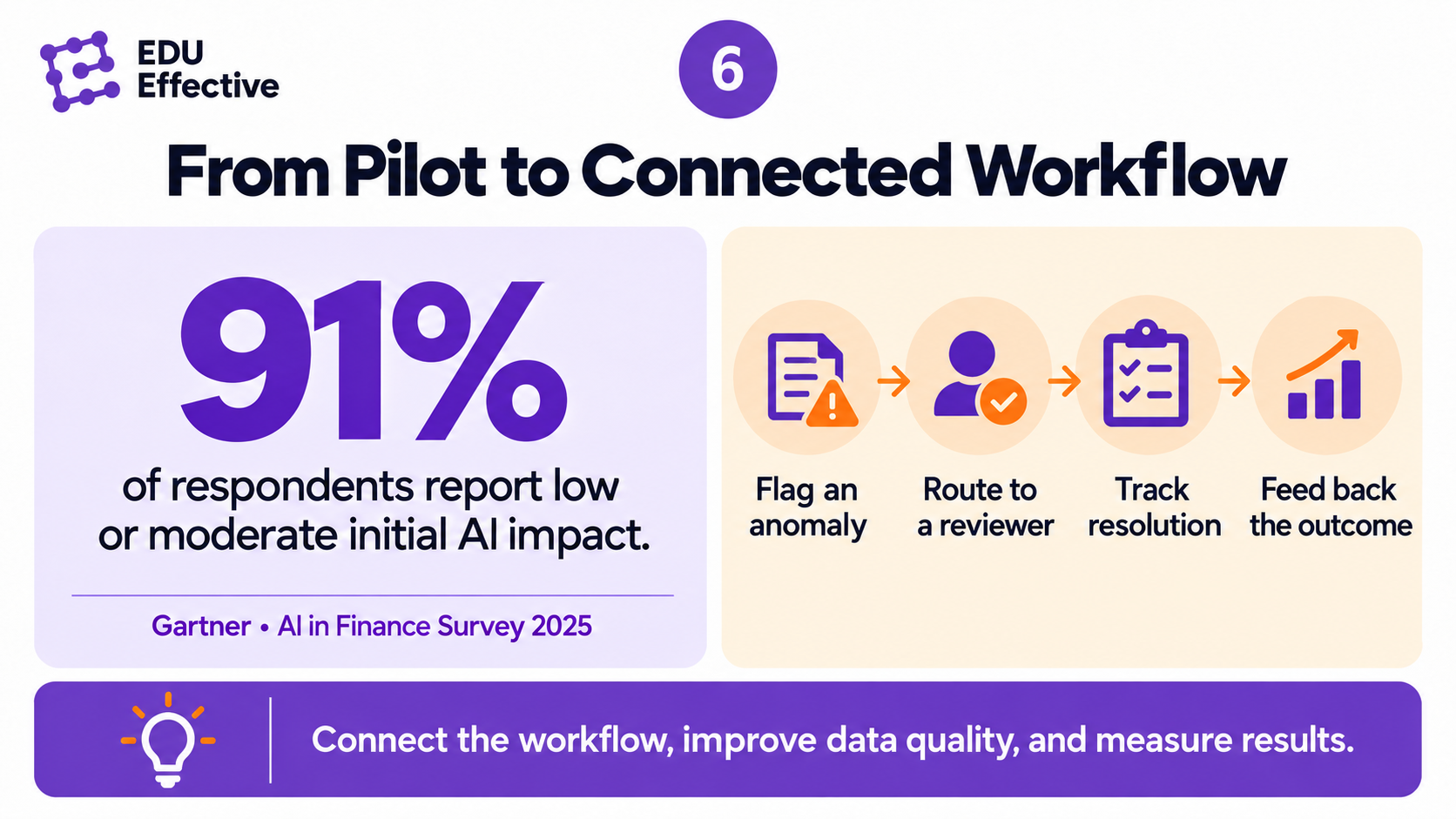
The Gartner survey is honest about the gap between expectation and early reality: 91% of respondents report low or moderate initial impact from AI implementations. Advanced adopters are nearly three times as likely to see high impact compared to early-stage organizations.
The explanation is structural, not technical. Early-stage AI deployments in finance are typically applied to isolated processes without connecting to broader workflow changes. An AI tool that flags anomalies in AP is valuable. An AI tool that flags anomalies, routes them to the right reviewer, tracks resolution, and feeds outcomes back into the detection model is significantly more valuable — but it requires integration work and organizational change that takes time to build.
Gartner identifies data literacy and data quality as the primary barriers to scaling AI in finance. Data quality is the harder problem. Finance functions that have not invested in data infrastructure find that AI amplifies the problems already present in their data rather than solving them. Garbage in, more confident garbage out.
25% of finance organizations say they are unsure how to move from planning to piloting. That is a change management challenge more than a technical one. The technology exists. The path from intent to implementation requires an owner, a specific use case with measurable success criteria, and enough organizational support to survive the first implementation that does not go perfectly. How to run AI pilots that survive delivery: tools and tactics.
The compounding dynamic
Statista projects financial sector AI spending rising from $35 billion in 2023 to $126.4 billion by 2028 — nearly a fourfold increase. That trajectory is driven by what early adopters are discovering: efficiency gains from AI in finance compound when they are connected.
A finance team that automates accounts payable processing gains back analyst time. If that time goes into building better forecasting models, the forecasting improvement feeds better capital allocation. Better capital allocation reduces financing cost and improves ROIC. The chain runs forward in ways that are difficult to attribute fully to the initial AP automation — which is why organizations that measure ROI only at the point of the first deployment consistently underestimate the value they are creating.
MindBridge found 83% of finance leaders report measurable efficiency gains from AI, and 77% report at least 5% cost savings. 10% report savings exceeding 30%. Those outliers share a visible characteristic across the broader adoption data: they deployed AI across multiple connected processes, and they invested in the data quality infrastructure that allows AI to function reliably rather than intermittently.
What finance professionals need to build now
The shift underway is not about replacing finance roles with AI. The Gartner data shows the highest-impact applications augment analytical judgment — forecasting, decision support, scenario modeling — rather than substituting for it. The fraud detection results from J.P. Morgan and Mastercard show AI working alongside human review processes, not replacing them.
What is changing is the skill profile. A finance professional who can interpret AI-generated forecasts, assess the quality of data feeding those models, design the right questions for AI to answer, and translate AI-driven insights for non-technical stakeholders is substantially more valuable than one who cannot. That is not a narrow technical skill — it does not require writing code. It requires understanding what AI can and cannot do reliably in a financial context, and being able to engage critically with its outputs.
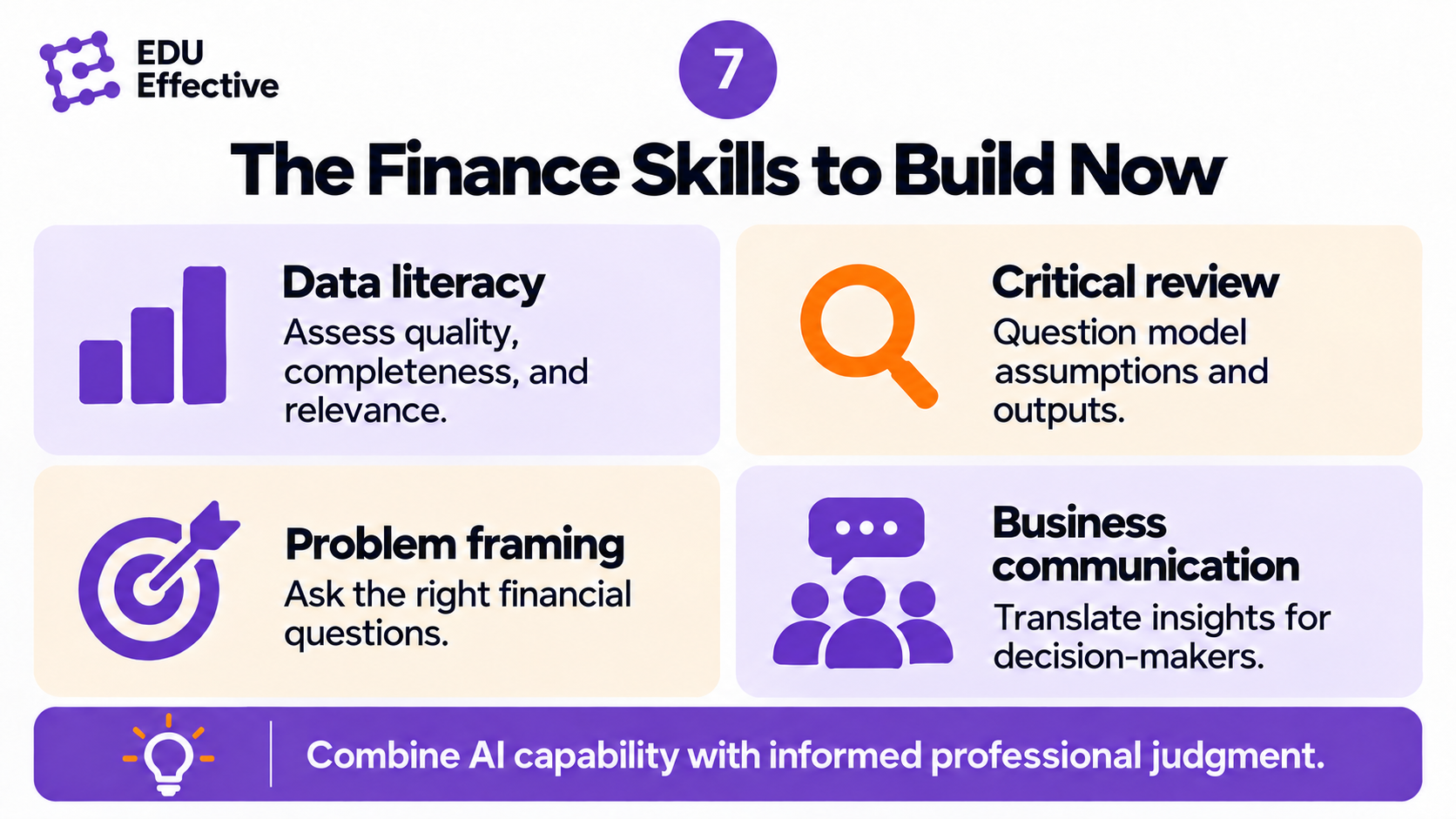
Gartner identifies data literacy as the primary skills gap for finance functions attempting to scale AI. That is not a coincidence. The organizations outperforming in adoption are the ones where finance professionals ask “how was this forecast generated and what assumptions does it rest on” — not ones where AI output is accepted as a black box. That analytical posture is exactly what separates finance professionals who will grow with AI through 2027 from those who will find their scope narrowing.
Build the Finance Judgment AI Cannot Replace
Data literacy, critical review of model outputs, and the ability to translate analysis into decisions are learnable capabilities — and increasingly the difference between finance professionals who direct AI and those who are directed by it. The Effective MBA develops them.
About EDU Effective Business School
The Effective MBA: Applied Artificial Intelligence turns AI capability into decisions a manager can defend. Runs on 15 minutes a day, completes in 10 months or less and is ASIC accredited.
Sources
- Gartner — Finance AI Adoption Survey, November (183 CFOs and senior finance leaders): https://www.gartner.com/en/newsroom/press-releases/2025-11-18-gartner-survey-shows-finance-ai-adoption-remains-steady-in-2025
- MindBridge — CFO AI Adoption Survey: https://www.mindbridge.ai/blog/adapt-or-fall-behind-why-cfos-are-betting-big-on-ai/
- Statista — Financial Sector AI Spending Forecast: https://www.statista.com/statistics/1446037/financial-sector-estimated-ai-spending-forecast/?srsltid=AYCX9vJF5xdV3BE3jHnkgnv_Gqa8NNgUyrN1u_JUfzcladGa95so2sr4
- Deloitte — Generative AI in Finance: https://www.deloitte.com/us/en/what-we-do/capabilities/finance-transformation/articles/generative-ai-in-finance-transformation.html
- PYMNTS / American Express — AR Automation Research: https://www.pymnts.com/report/playbook/b2b-payments-innovation-readiness-american-express-ar-automation/