
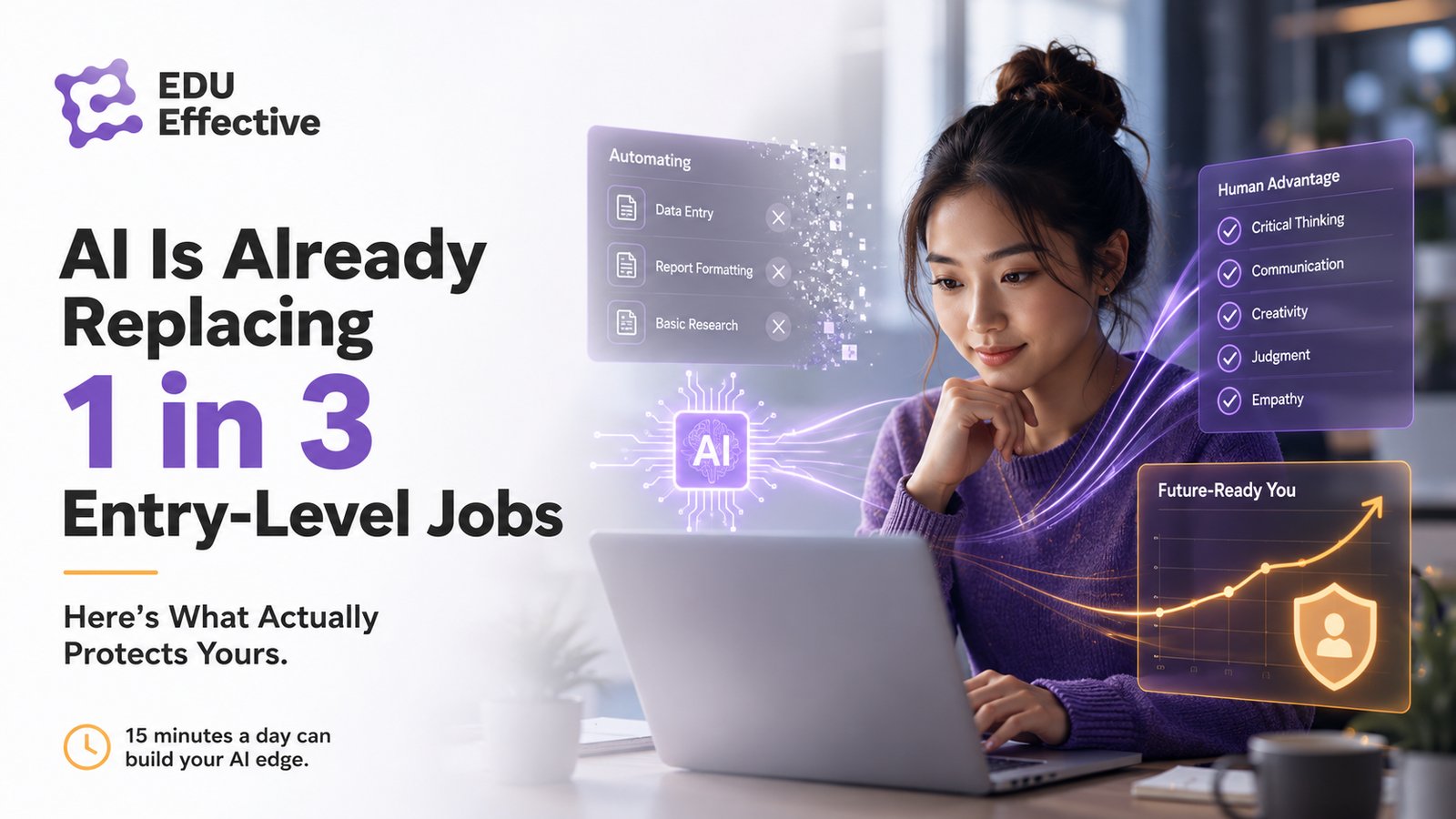

One in three employers already say they're replacing entry-level roles with AI. That's not a prediction — it's what 600 recruiters told the Graduate Management Admission Council in a survey published this June, and more than half of them recruit for Fortune 100 or Fortune 500 companies. In tech, the number jumps to 40%.
A separate report from the World Economic Forum and PwC, published the same month, backs it up with harder numbers: 37% of young workers worldwide now sit in jobs with medium to high exposure to AI-driven task change. In Eastern Asia, it's three in four. In Europe, nearly two in three.
None of this means AI is simply deleting jobs for young workers. What it means is narrower, and more useful: the old proof of readiness — a degree, a couple of years on a CV — is losing its grip, and employers are looking for a new one. This piece walks through what's actually changing, what employers say they want instead, and how to build the kind of AI skill that shows up as evidence, not just a claim.
What's Actually Happening to Entry-Level Jobs Right Now
The WEF's exposure data breaks down by sector, and the pattern is consistent: Financial Services, Information and Communication, and Professional, Scientific and Technical Activities sit at the top of the exposure ranking. Agriculture, construction, and food service sit near the bottom.
Economist Erik Brynjolfsson and colleagues, cited in the WEF report, found a 16% decline in entry-level jobs in AI-exposed fields in the US since late 2022. The report is careful here, and it's worth being careful too: in several sectors, job postings for junior roles started falling before ChatGPT even launched in November 2022. Economic caution and cost discipline are doing real work alongside AI. As one senior people leader told WEF researchers, "AI is often the headline, but the reality is more complex."
Still, AI is now a named factor, not a background one. In the Fortune/GMAC data, technology and manufacturing roles are the most exposed. Sabrina White of GMAC put it plainly: employers are using AI to automate the routine parts of the job — coding, data processing, customer service — while still investing in people who can exercise judgment.
The Productivity Trap
Here's the part that should worry entry-level workers more than headcount numbers: AI is not obviously making their jobs lighter. 68% of entry-level workers report a productivity increase from AI. 45% also report spending more time working because of it. Those two numbers describe the same group of people.
WEF researchers heard a version of this from multiple employers: without deliberate job redesign, AI just accelerates the production of lower-quality work. One leader called it, bluntly, "work slop" — more output, not more value.
The gap between companies that get this right and companies that don't is wide. Only 16% of organizations report having fully redesigned roles, processes, and operating models around AI. But the ones that did are twice as likely to report the strongest AI-driven financial results. Layering AI onto an unchanged job description doesn't produce the same outcome as rebuilding the job around it.
Why a Degree Alone Doesn't Prove Much Anymore
Employers are telling researchers, interview after interview, that a degree signals less than it used to. The WEF report quotes one executive directly: "The skills that people learn at university will not be enough. People need to keep learning as technology evolves." Indeed's own research, cited in the report, found that 68% of Gen Z workers believe they could do their job without a degree.
The GMAC/Fortune data shows the same shift happening at the top of the credential ladder, not just the bottom. Just 13% of employers hired more MBA graduates in 2025 than the year before. The median starting salary for MBA graduates is expected to slip from $125,000 to $120,000 this year. Bachelor's degree starting salaries dipped too, from $75,000 to $72,000.
That doesn't mean credentials stopped mattering. Sabrina White's read is sharper: "What stands out to me is that employers aren't lowering expectations — they're raising them." They still want the judgment and complexity-navigation a good business education builds. They've simply added a second bar: can you show, concretely, that you can turn AI into business results?
What Employers Are Actually Rewarding
A few examples from the WEF report make the new bar tangible.
Dentsu Japan built a four-tier internal AI certification system — AI Basic, AI Facilitator, AI Master, Chief AI Master — and between 2024 and 2026 increased AI training time for new graduates more than tenfold. As of May 2026, 20,000 employees held the entry-level certification. Six held the top one.
Dropbox took a different route: it protected its internship and graduate hiring pipeline instead of cutting it, and found that new hires with strong AI fluency ramp up faster and outperform external hires on retention and promotion. By year two, 65% of Dropbox's interns and new grads had been promoted. By year three, 87%.
And in the GMAC survey, recruiters said something that cuts against the doom narrative: human skills — communication, problem-solving, adaptability — are still ranked as the top hiring priority today. What's shifting is the five-year outlook, where recruiters expect AI proficiency to climb sharply up that same list.
Why Fifteen Minutes a Day Beats a Semester
Deloitte's 2026 Global Gen Z and Millennial Survey, built on responses from more than 22,500 people across 44 countries, offers a useful counterweight to the anxiety. Roughly a quarter of Gen Z and millennial respondents said AI is helping them gain experience faster, and about the same share said it's freeing them up for higher-value work. Framed the right way, AI reads as an accelerant, not a threat.
The format matters here. eLearning Industry's 2026 trends research points to AI-personalized, mobile-first microlearning as the format actually driving completion and retention, ahead of long-form courses that people start and abandon. That's not a coincidence. It matches what the WEF report calls for directly: alternative, applied signals of readiness that sit alongside a degree instead of replacing it, delivered in a way that fits around a full-time job rather than requiring you to leave one.
Two Ways to Build a Signal That Actually Holds Up
Not everyone needs the same depth of AI skill. The data points to two distinct groups, and EDU Effective's two AI programs map onto them directly.
If you lead people, projects, or a function — management, HR, marketing, finance, operations — what you need is the ability to deploy AI tools, prompting, and AI agents to get measurable results, without writing a line of code. That's the Effective MBA: Applied Artificial Intelligence program: 10 modules, 15 minutes a day, built around leadership, workflow automation, and AI use cases across marketing, HR, finance, and project management.
If you sit closer to the technical side — product, data, analytics, or you've already completed Applied AI and want to go further — the value is in understanding how the systems actually work: machine learning, neural networks, NLP, computer vision, and AI governance. That depth is what makes you the person engineers respect and executives rely on. That's the Effective MBA: Mastery in AI program.
Both run the same way: 15-minute daily blocks, 10 modules, no lecture halls, a certificate after every module, and a 14-day money-back guarantee if the format isn't for you.
The Bottom Line
The entry-level ladder isn't gone. It's being redrawn, and the redrawing rewards people who can point to something specific they've built with AI — not just a line on a resume that says they've heard of it. The WEF report's own framing is worth repeating: outcomes here aren't predetermined by the technology. They depend on the choices people make now, while the new rules are still being written.
Sources
- World Economic Forum & PwC, "Artificial Intelligence and the Future of Entry-Level Work" (June 2026)
- Fortune, "Gen Z's hiring hell is real" / GMAC Corporate Recruiters Survey (June 2026)
- Deloitte, Global Gen Z and Millennial Survey (2026)
- eLearning Industry, "Microlearning Trends And Strategies In 2026"