
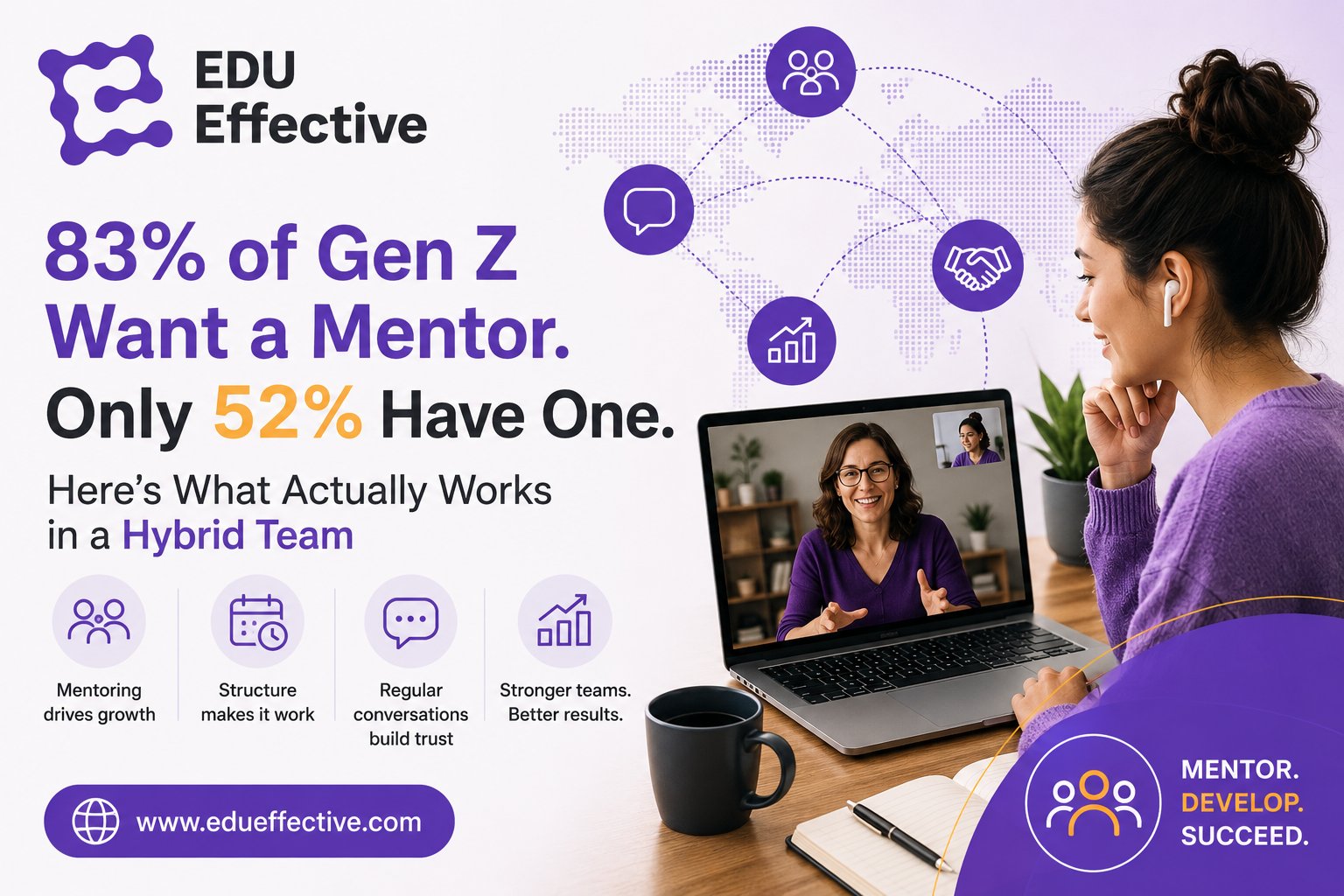

83% of Gen Z workers say having a workplace mentor matters to their career. According to Adobe research cited in Forbes, only 52% have one. That gap isn't closing in 2026. It's widening.
Two connected forces are driving it. The first is hybrid work, which killed off informal mentoring — the hallway chat, the moment a manager catches the uncertainty on someone's face. A 2025 Chronus survey found 65% of people say hybrid work makes it harder to build real mentoring relationships. The second is AI-driven organizational flattening, which is eliminating the exact management layer that mentoring used to live inside.
This piece goes after both — and after what companies that take this seriously are actually doing about it.
Why the Hallway Chat Isn't Coming Back
A Boston Globe investigation from December 2025 found that mentorship for early-career workers is quietly collapsing in the post-pandemic workplace — overworked supervisors, hybrid schedules, and organizational chaos have eroded the informal relationships that once anchored young professionals to their fields.
The consequences are measurable. According to the 2025 Youth Mentorship Access Report from Big Brothers Big Sisters, one in three young adults aged 18 to 25 now report frequent or constant uncertainty about their career future.
This isn't about people not wanting to mentor. It's that the structure which used to carry it on its own — physical proximity — is gone, and nothing has replaced it.
The Manager Squeeze Makes It Worse
Gartner predicted in 2024 that 20% of organizations would flatten their structures by 2026, eliminating more than half of existing middle-management roles. That prediction is playing out. Amazon has cut 30,000 corporate roles across two rounds since October. Google reports 35% fewer managers overseeing small teams year over year. Manager headcount overall is down 6.1% between May 2022 and May 2025.
The managers who remain are covering more people. Gallup data shows the average manager had 8.2 direct reports in 2013. By 2025, that number had climbed to 12.1. And according to Deloitte, managers now spend roughly 40% of their time solving immediate problems and handling administrative work — only 13% goes to developing the people who report to them.
Harvard Business Review described in June 2026 how AI adoption is functioning for middle managers as a workload multiplier, not a relief valve — managers are validating AI outputs, catching errors, and coaching teams on AI skills, all without added support or adjusted expectations.
The result shows up in DDI's 2025 Global Leadership Forecast, built on data from more than 10,000 leaders across 50 countries: trust in immediate managers has fallen to 29%, a 37% decline since 2022. Leadership bench strength sits at 20%. Forty percent of stressed leaders said they'd considered leaving leadership roles entirely.
A similar pattern shows up in this year's World Economic Forum and PwC report on AI's impact on entry-level work: three-quarters of leaders across industries expect significant structural realignment specifically at the entry-level — the same phenomenon, seen from a different angle.
What's Actually at Stake
The retention numbers are unambiguous. A Best Practice Institute study found that mentored employees are 72% more likely to stay at a job than those without a mentor. Mentoring platform Qooper reports that structured mentoring programs boost retention by more than 50%, especially among junior and high-potential employees.
At the same time, only 6% of Gen Z and millennial workers cite reaching a leadership position as their primary career goal — and per Deloitte, that figure held steady in the 2026 edition of the survey.
That creates a loop that tightens on itself: fewer managers means less mentoring, less mentoring means lower trust and engagement, and lower engagement means fewer people want to lead in the first place. The pipeline is narrowing from both ends at once.
Mentoring That Works Isn't Accidental. It's Designed.
Harvard Business Review showed back in 2021 that intentionality is what decides whether hybrid mentoring works — whether it's treated as something designed, not improvised between other tasks. In practice, that comes down to a few concrete moves.
Set an actual framework — goals, communication rules, preferred channels, a consistent style everyone agrees on going in. Use micro-moments deliberately: five minutes right after the daily stand-up, a Monday check-in that's genuinely scheduled, not left to chance. Go asynchronous where it makes sense — video messages, voice notes, a shared doc can replace plenty of live calls that don't need to be live. And use the tools built for this: platforms like MentorcliQ or Chronus track progress, automate check-ins, and give HR visibility it wouldn't otherwise have.
Qooper's 2026 trends research points to where this goes next: AI-powered matching between mentors and mentees based on skills and goals, hybrid and mobile platforms built for global teams, and growing interest in reverse mentoring, where younger employees teach senior leaders — AI tools being a common example.
A concrete example comes from the Allianz case study in the WEF report. The company built new-joiner mentoring "tandems" that pair early-career employees with more experienced colleagues, combined with enterprise-wide AI and data upskilling across generations. Allianz found this approach increases confidence and engagement with AI across the workforce, and accelerates knowledge transfer in a way that doesn't happen on its own across hybrid distance.
The Mentee Is the Point, Not the Company Talking Points
76% of young professionals say they want mentors who understand their own goals — not just what the company wants from them. Mentoring was never meant to be a one-way transmission of corporate priorities. It should reflect the mentee back, challenge them, and actually move them forward.
A good mentor in a hybrid setting listens actively, not just politely. They read what's underneath what's being said. They share experience through actual stories, not generic advice. And they find a way to surface blind spots remotely — video review, screen sharing, whatever works for that relationship.
This Is a Leadership Skill, Not a Personality Trait
Coaching, mentoring, structured feedback, emotional intelligence, leading hybrid and remote teams — none of it is innate talent. It can be trained, the same way the WEF report shows that companies which deliberately redesign roles and processes around new ways of working are twice as likely to see strong results than those that just bolt new technology onto an old structure. The same principle applies to people development: leave mentoring to chance, and you get chance-level results.
That's exactly what the Effective MBA: Coaching, Leadership & Mentoring program is built for. Ten modules, 15 minutes a day, content built around coaching frameworks, mentoring program design, emotional intelligence, and leading hybrid and remote teams — including ethical and inclusive leadership. It's built for team leads and managers moving from directing to coaching, for HR and talent development professionals designing and running mentoring programs, and for independent coaches and consultants who want an internationally accredited qualification.
If a different focus fits you better — AI tools, executive management, online marketing — you'll find the full lineup on the five best-selling Effective MBA programs page.
The Bottom Line
Trust in managers has fallen to 29%. The gap between how many people want a mentor and how many have one runs around thirty percentage points. Mentoring isn't breaking down in 2026 because of AI itself. It's breaking down because companies still treat it as something that happens on its own once you put people on the same video call. It doesn't. It takes a framework, time, and a skill that has to be learned like anything else.
Sources
- Forbes, "Why The Best Brands Are Betting On Mentorship" (2026)
- Forbes, "Management Cuts Today Are Shaping A Leadership Shortage" (2026)
- World Economic Forum & PwC, "Artificial Intelligence and the Future of Entry-Level Work" (June 2026)
- Qooper, "Mentoring Trends 2026"
- Deloitte, Global Gen Z and Millennial Survey
- Chronus, "Effective Mentoring in the Hybrid Workplace" (2025)
- Harvard Business Review, "What Great Mentorship Looks Like in a Hybrid Workplace"
- Adobe, Future Workforce Study
- Best Practice Institute, "Why Mentorship Matters for Young Professionals"
- Big Brothers Big Sisters, Youth Mentorship Access Report (2025)
- Boston Globe, "Mentorship for young office workers is collapsing" (December 2025)