

Most marketing teams send emails. Far fewer have built email automation that functions as a revenue engine rather than a broadcast channel. The gap between the two is not technology — every major platform offers automation. The gap is in how sequences are designed, when they fire, and what they say.
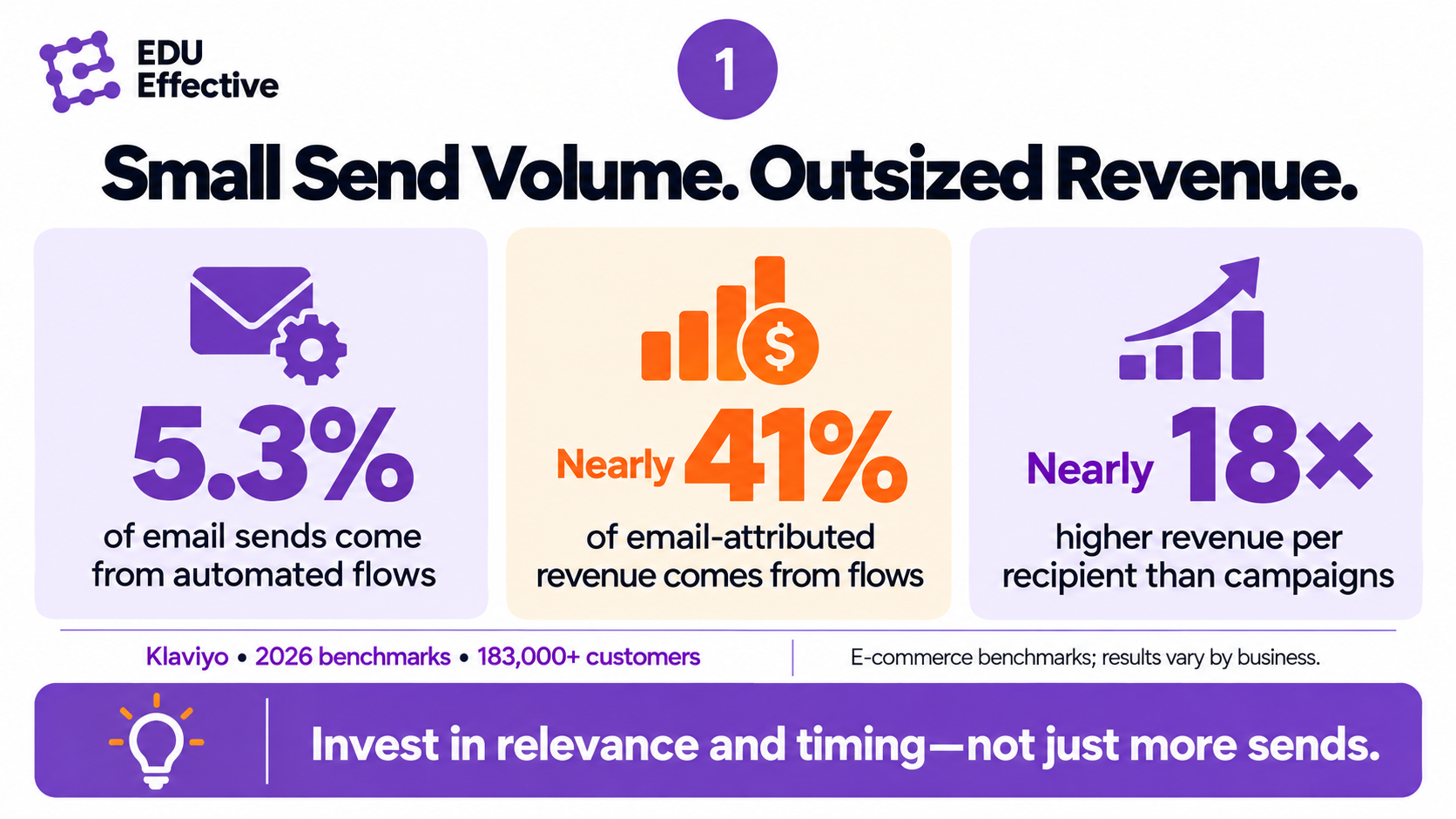
The numbers make the case for closing that gap quickly. Klaviyo’s 2026 benchmark report (183,000+ customers) found that automated flows send only 5.3% of total email volume but generate nearly 41% of email revenue. The revenue per recipient from flows is nearly 18 times higher than from standard campaigns. That is not a marginal difference. It is a structural advantage hiding in plain sight for any business still running primarily batch campaigns.
This article covers what the data shows about email automation in 2026, which sequences drive the most revenue, and how to build them without requiring a team of specialists.
Why triggered emails outperform batch campaigns by every metric
The fundamental logic of triggered email sequences is timing. A batch campaign lands in someone’s inbox when the marketing calendar says so. A triggered email lands when the recipient just did something — browsed a product, abandoned a cart, completed a purchase, hit a specific page three times. The behavioral signal that fires the trigger is also the context that makes the email relevant.
Omnisend’s research quantified what that relevance is worth. Triggered automated emails convert at 1.49% versus 0.08% for standard batch campaigns — roughly 19 times better. Revenue per email: $3.41 for triggered versus $0.155 for batch sends, or about 22 times higher. And that is an average across all automated sequences. Specific flows perform considerably better: back-in-stock emails average $9.14 per send, welcome emails $6.16, and abandoned-cart emails $3.59.
Klaviyo’s 2026 data confirms the pattern at scale. Automated flow click rates run over three times higher than campaign click rates. Placed order rates from flows are approximately 13 times higher. Nearly 48% of flow-driven revenue comes from new buyers, compared to 16% for campaigns — meaning well-built automation is not just retaining existing customers, it is converting prospects who have not bought before.
The implication is clear: the highest-return investment most email programs can make is shifting effort from batch campaigns toward better-designed triggered sequences.
The five sequences worth building first
Not all automation is equal. Some flows are standard plumbing. Others are genuine revenue drivers. These five sequences consistently outperform in the data and cover the highest-value moments in a customer relationship.
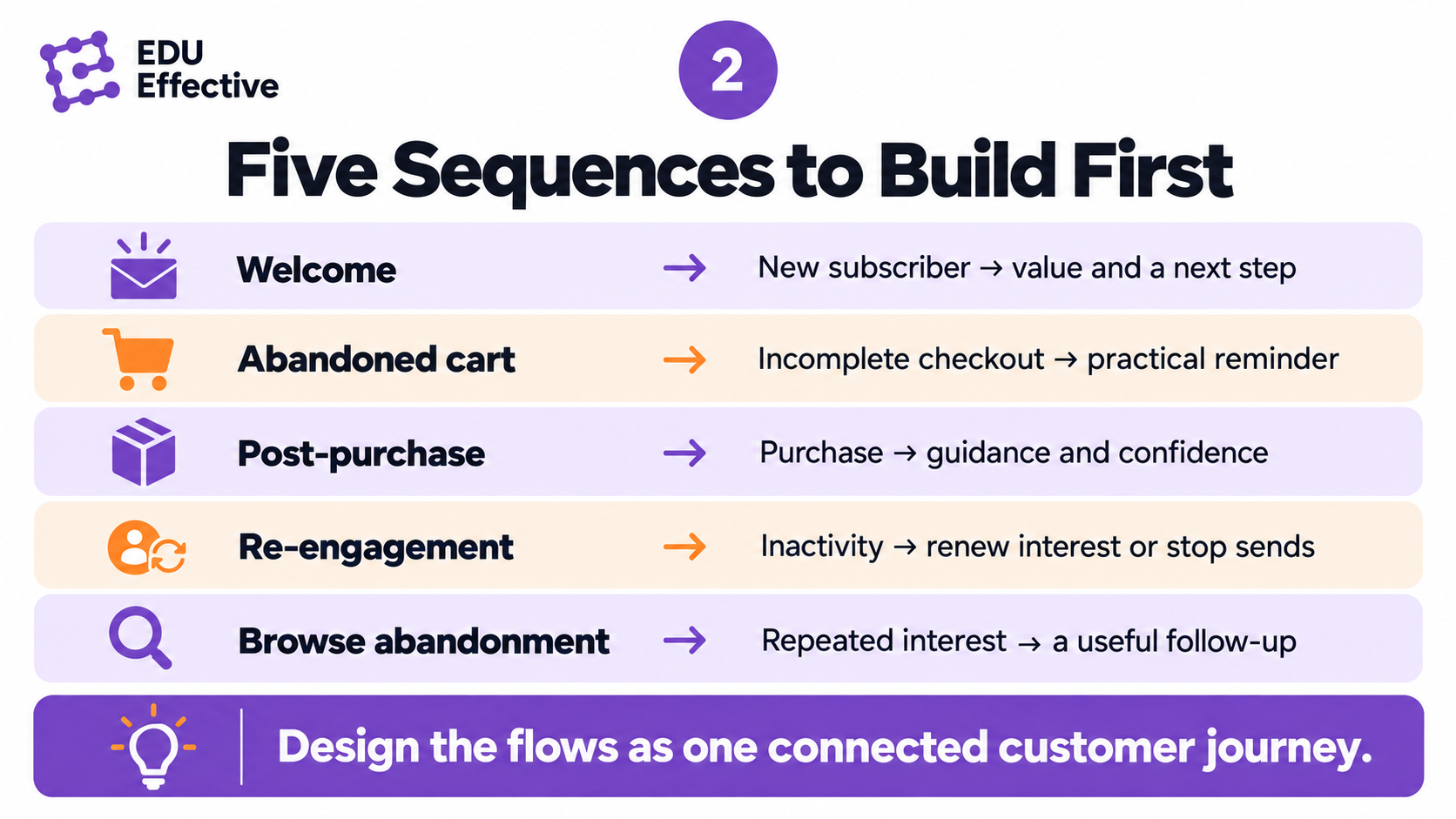
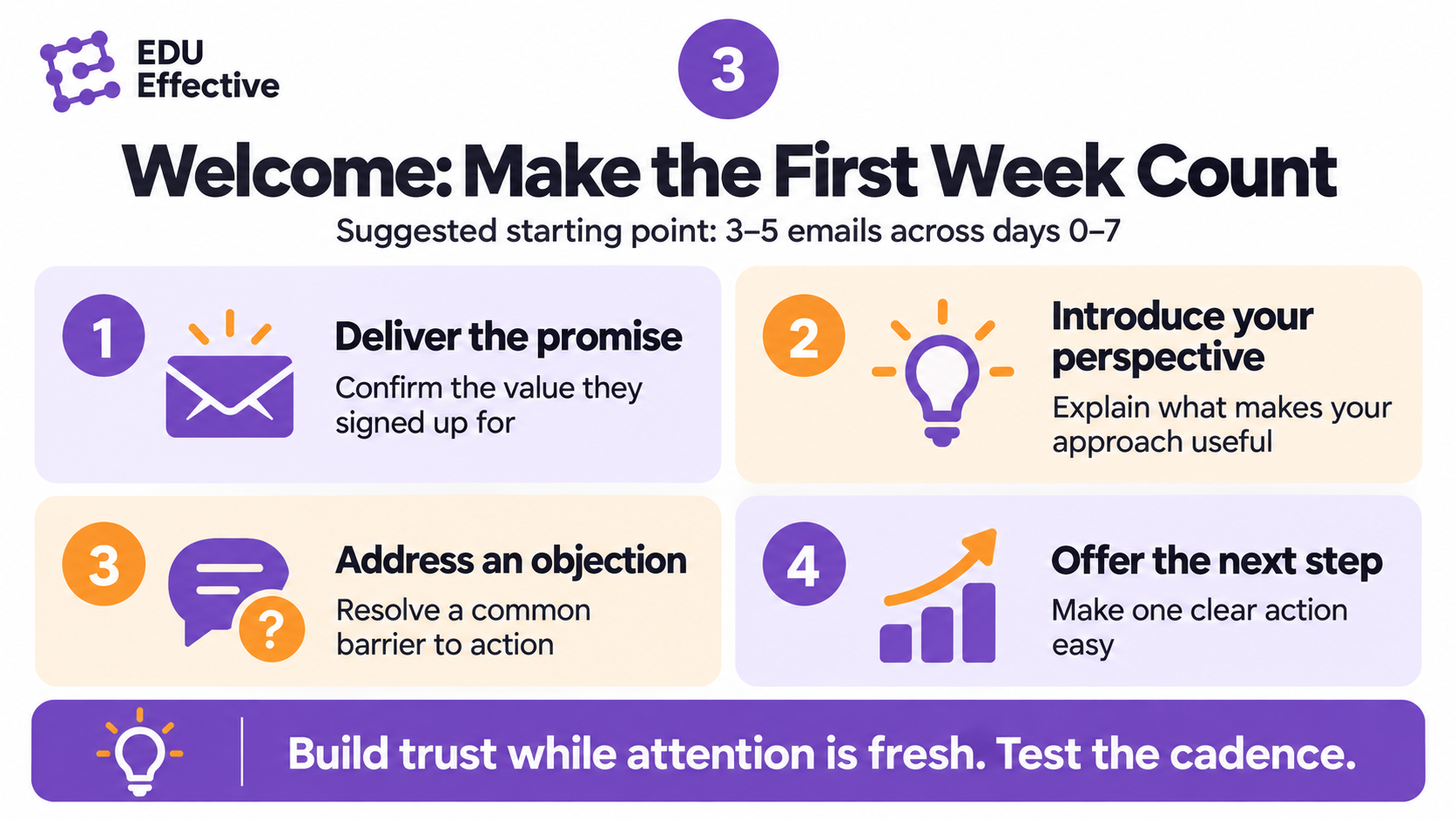
1. Welcome sequence (days 0–7)
The welcome sequence is the highest-leverage automation most businesses underuse. A new subscriber or lead is at peak attention — they just opted in, just signed up, just made their first contact. This is the moment when brand positioning, product clarity, and first conversion are all within reach simultaneously.
A three-to-five email sequence in the first week should accomplish specific things, in order: confirm the value they opted in for, introduce the brand’s point of view (not features — perspective), address the most common objection before purchase, and offer a path to the next step. The error most teams make is compressing all of this into one email or stretching it across six weeks when attention has already dropped.
Klaviyo benchmarks put welcome flow revenue per recipient among the highest of any sequence type. Do not wait for someone to ask why open rates decline after day 30 to build this one.
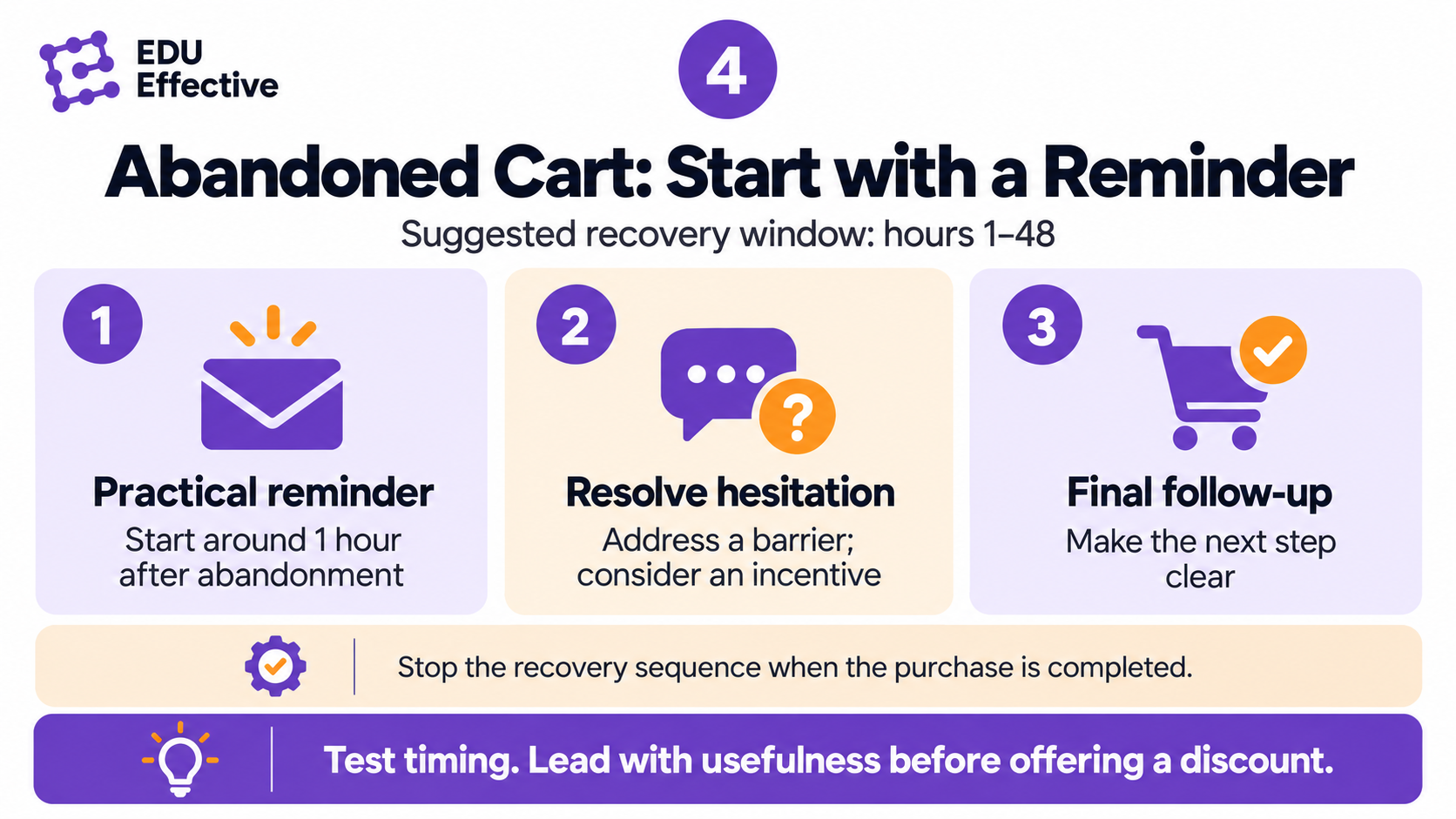
2. Abandoned cart sequence (hours 1–48)
Abandoned cart recovery is perhaps the most cited automation example, which has not reduced how many businesses fail to implement it properly. The sequence should send within one hour of abandonment — not the next day. The first email is a practical reminder, not a discount. The second, if needed, can introduce urgency or a small incentive. The third is a last-chance message with a clear close.
The timing of the first send matters more than the copy. Research consistently shows that recovery rates drop sharply after the first two hours. Omnisend’s data puts average cart email revenue at $3.59 per send — at volume, the difference between a one-hour trigger and a six-hour trigger is measurable in thousands of euros per month.
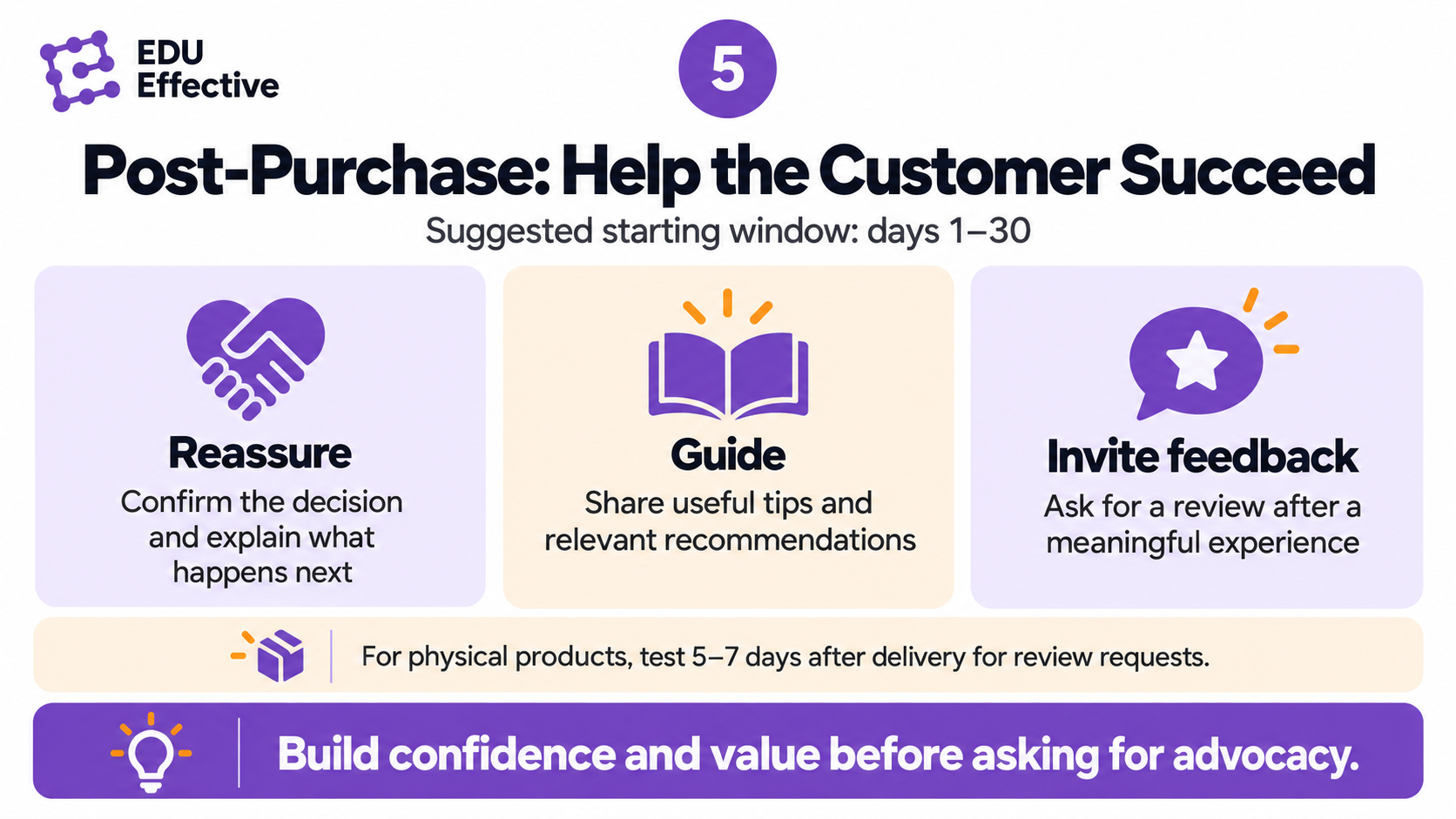
3. Post-purchase sequence (days 1–30)
This is the sequence most businesses skip entirely and almost none build well. The window after a first purchase is when a customer is most likely to become a repeat buyer or an active referrer — and most likely to experience the anxiety that leads to returns.
A post-purchase sequence serves three functions: it confirms the buyer made a good decision (reduces cognitive dissonance and return rates), delivers value in the form of usage guidance or complementary recommendations, and creates the social proof moment — a review request timed to when satisfaction peaks, usually five to seven days after product delivery rather than immediately after purchase.
4. Re-engagement sequence (after 90–120 days of inactivity)
Most email programs accumulate inactive subscribers who depress deliverability metrics without contributing revenue. A re-engagement sequence does two things: it recovers a portion of subscribers who had simply drifted rather than actively disengaged, and it cleanly removes those who will not re-engage, protecting sender reputation.
The sequence should be short — three emails over two weeks is enough. The first email names the inactivity directly (“We haven’t heard from you in a while”) and restates what value they subscribed for. The second offers something worth returning for. The third is explicit: “We’re going to stop sending you emails unless you tell us you’d like to stay.” A percentage will re-engage. The rest should be suppressed, not kept.
5. Behavioral browse-abandonment sequence
Most businesses deploy cart abandonment automation but miss the earlier signal: someone browsed a specific product category or product page multiple times without adding to cart. This indicates interest that has not converted to intent. A browse abandonment sequence — typically one to two emails, lighter in tone than cart recovery — surfaces the product again with a different angle: social proof, complementary use cases, or a question that opens a conversation.
Omnisend’s data shows back-in-stock emails (a related signal-driven trigger) averaging $9.14 per send, the highest of any flow type they reported. Behavioral signals are worth acting on.
AI in email: what is actually working in 2026
Litmus’s State of Email report found that 70% of marketers predict AI will handle up to 50% of email tasks by 2026. Currently, 49% already use generative AI for static email copy. AI-generated images in email grew 340% year over year.
The more interesting data point from Litmus is what marketers identify as the biggest impact of AI: not copy generation, but content and analytics — personalization at scale that was previously too resource-intensive to build manually. Only 29% cite AI-driven content and analytics as the current year’s biggest game-changer, suggesting the majority have not yet put it to work in the ways that generate measurable lift.
Klaviyo’s 2026 benchmarks offer a concrete data point: AI product recommendations lift average click rates to 3.75% for all users, and 8.79% for top-performing accounts. For context, the average campaign click rate without AI recommendations is 1.69%. That is a substantial lift from a capability that is available in the platform without custom development.
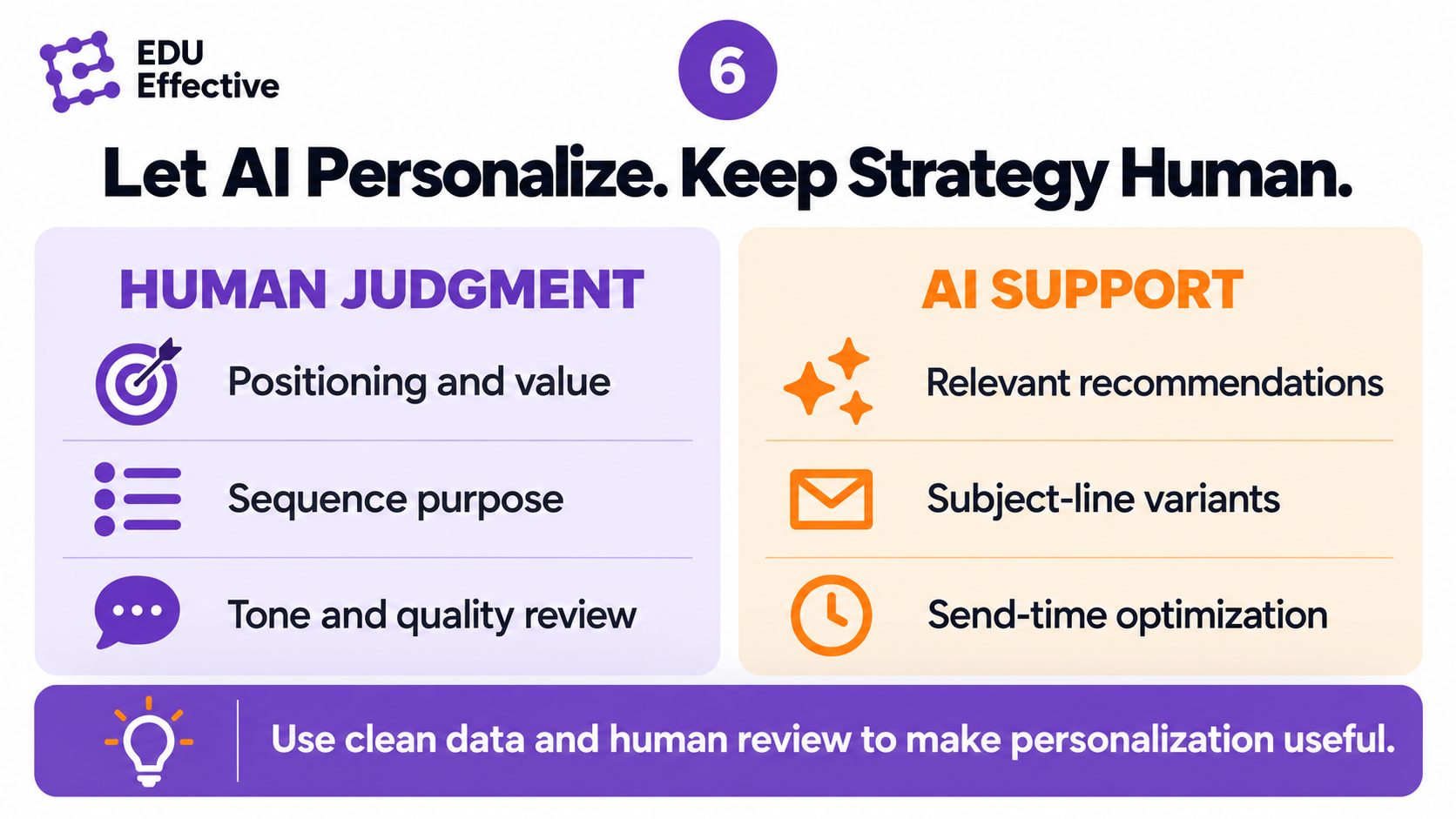
The practical implication is not that AI replaces copywriters or sequence designers. It is that AI handles the personalization layer — what product to show, what subject line variant to use for which segment, what send time to use for which subscriber — while human judgment handles the strategy and positioning. Teams that invert this — using AI for strategy and humans for personalization at scale — are leaving performance on the table. What the data actually shows about content marketing in 2027.
The production bottleneck that kills most automation programs
Here is a finding from Litmus that is easy to overlook: only 6% of teams now need more than two weeks to produce an email, down from 62% in 2024. That is a dramatic compression in production time, driven partly by AI tools and partly by improved processes.
The significance is that production speed used to be the primary constraint on email automation sophistication. Building out a five-sequence automation program with proper personalization required months of content production. That constraint has largely disappeared.
The constraint that remains is data quality and segmentation. Litmus found that data collection and analysis (16%) and measuring impact (15%) are the top personalization hurdles after content development (17%). The bottleneck has shifted from “we can’t build enough emails” to “we don’t have clean enough data to personalize them meaningfully.”
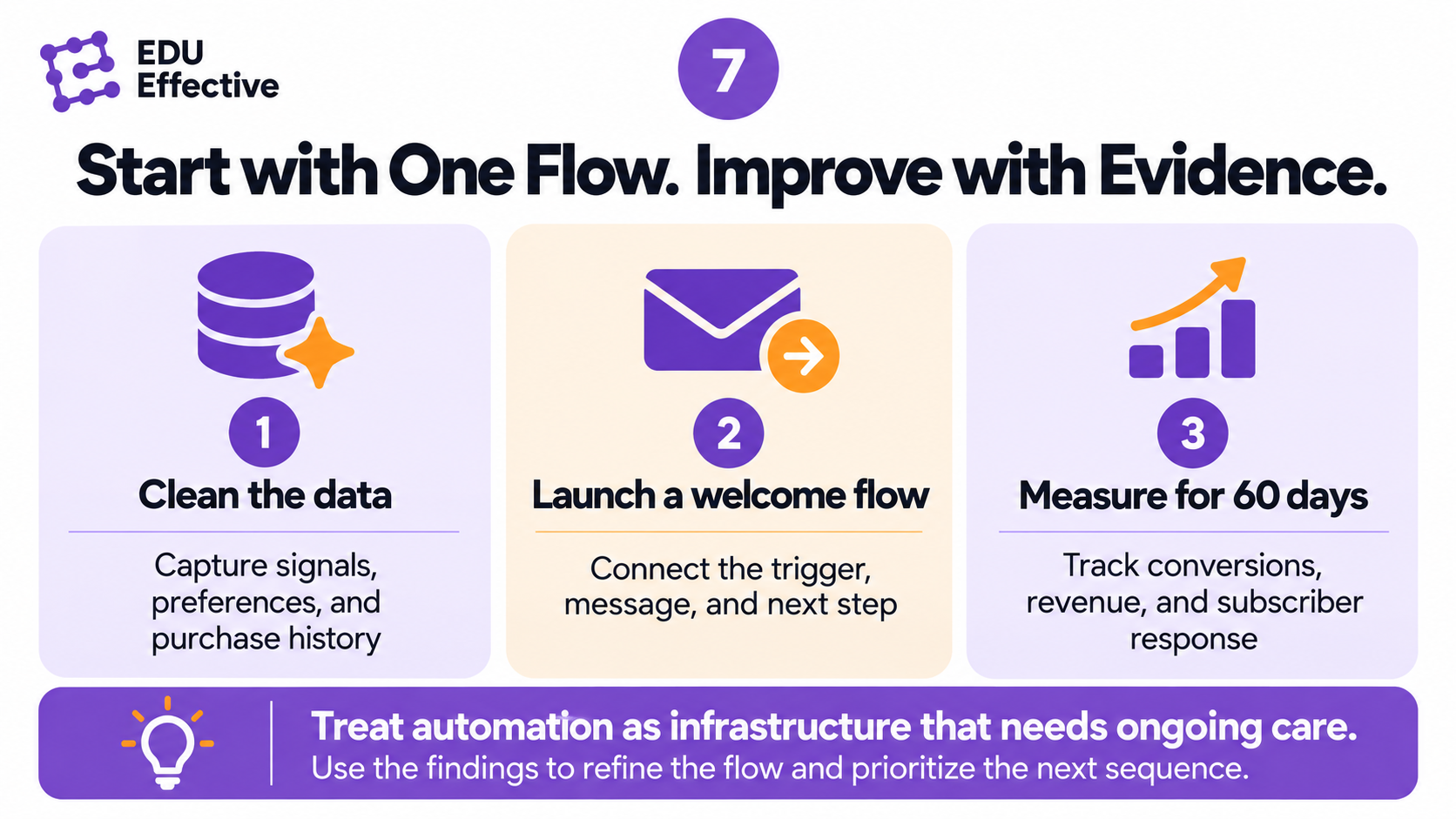
This reorients the investment priority. For most email programs in 2026, the highest-leverage work is not more content — it is cleaner subscriber data: behavioral signals captured correctly, purchase history properly integrated, stated preferences collected and used. The automation infrastructure to act on that data already exists in every major platform.
What most email programs are still getting wrong
Despite the data on automated sequences, most email programs still weight their effort toward batch campaigns. The reasons are partly structural — campaigns have clear calendar hooks, they are easy to plan and brief, and their results are easy to report. Automation requires upfront investment and ongoing maintenance without a weekly deadline driving it.
The Litmus finding that 22% of marketers still cannot measure email ROI helps explain why the structural shift toward automation moves slowly. When ROI measurement is unclear, there is no data pressure to shift resources from the visible (campaign sends, list size) to the high-return but less visible (automated sequences, flow revenue per recipient).
The businesses that are making the shift report a consistent pattern: they start with one sequence, measure it rigorously for 60 days, and use that data to justify building the next. Welcome sequence first, then cart abandonment, then post-purchase. Each one generates enough measurable return to fund the next.
Building automation that compounds
The distinguishing characteristic of well-built email automation is that it compounds. Each subscriber who enters a well-designed welcome sequence is more likely to convert. Each converted customer who moves through a post-purchase sequence is more likely to become a repeat buyer. Each repeat buyer referred through a timely review request expands the list with a warm signal.
The system builds on itself — but only if the sequences are designed as a connected customer journey rather than isolated campaigns. Most businesses treat their welcome flow, their cart recovery, and their post-purchase sequence as separate projects. The businesses in the top decile of Klaviyo’s benchmark data — flow click rates of 10.48%, RPR of $7.79 — treat them as one continuous conversation with each subscriber, informed by everything that subscriber has done.
That shift from isolated campaigns to continuous conversation is the architecture change most email programs have not yet made. The tools for it exist. The data makes the case for it clearly. The remaining obstacle is treating email automation as infrastructure worth investing in, not as a feature to activate once and leave alone.
Build the Marketing Judgment Behind the Automation
Sequences are only as good as the strategy and positioning behind them. Knowing which signal matters, what message earns the click, and how the journey should flow is a marketing skill, not a platform setting. The Effective MBA develops it.
About EDU Effective Business School
The Effective MBA: Online Marketing connects marketing decisions to revenue rather than vanity metrics. Runs on 15 minutes a day, completes in 10 months or less and is ASIC accredited.
Sources
- Klaviyo — 2026 Email Marketing Benchmarks (183,000+ customers): https://www.klaviyo.com/products/email-marketing/benchmarks
- Omnisend — Email Marketing Statistics 2026: https://www.omnisend.com/resources/reports/2026-ecommerce-marketing-report/
- Litmus — State of Email 2026: https://www.litmus.com/landing-page/state-of-email-2026