

Most organizations treat content marketing as a publishing problem. They measure success by the number of pieces produced, the frequency of posts, and how quickly the calendar fills. The real question — whether any of it changes how a prospective buyer thinks — rarely comes up until someone asks why the pipeline is thin.
The data from 2025 and 2026 tells a clear story. Content marketing works. But the gap between teams who use it well and teams who simply produce content is larger than most marketing leaders want to admit.
The Numbers Behind the Discipline
Let’s start with what we actually know.
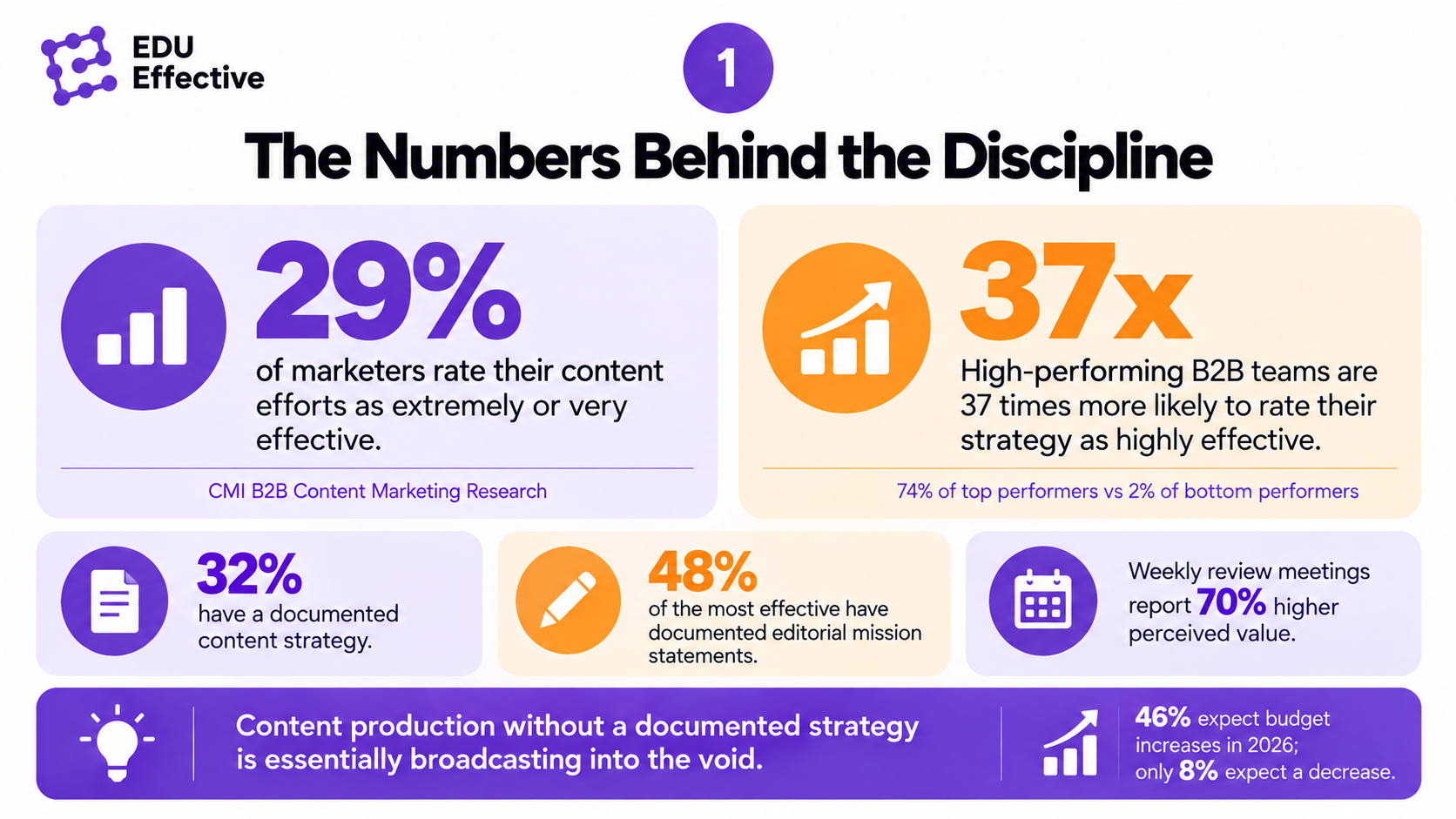
According to the Content Marketing Institute (CMI) B2B Content Marketing Research, only 29% of marketers rate their own content efforts as “extremely or very effective.” That number has not moved much in years. The more striking figure is what separates the top performers from the rest: high-performing B2B content teams are 37 times more likely to rate their strategy as highly effective — with 74% of the top tier calling it effective versus 2% of the bottom tier.
That is not a marginal difference. It is a structural one. The question is what produces it.
The answer, consistently, is documentation and intent. CMI found that only 32% of B2B teams have a documented content strategy. Of the most effective marketers, the figure climbs to 48% with documented editorial mission statements. Teams that meet weekly to review content performance report 70% higher perceived meeting value than those who meet monthly. Content production without a documented strategy is essentially broadcasting into the void.
Meanwhile, 46% of B2B marketers expect their content marketing budget to increase in 2026. Only 8% expect a decrease. Budgets are going up precisely at the moment when many organizations still cannot measure what they are buying.
The AI Inflection Point in Content
The arrival of AI tools in marketing workflows has not simplified the situation — it has made the measurement problem more visible.
85% of B2B marketers now use AI tools in their content work, according to data compiled by Martech and Semrush. 68% of companies using AI report higher content ROI, per HubSpot research. 86% say AI saves them at least one hour daily on creative tasks.
These figures sound like good news. But they come with a serious qualifier.
Despite widespread AI adoption, only 19% of B2B content teams have systematically integrated AI into their daily workflows, per CMI. The rest are experimenting piecemeal — using AI for a draft here, an image there, without a process that consistently connects AI output to business outcomes.
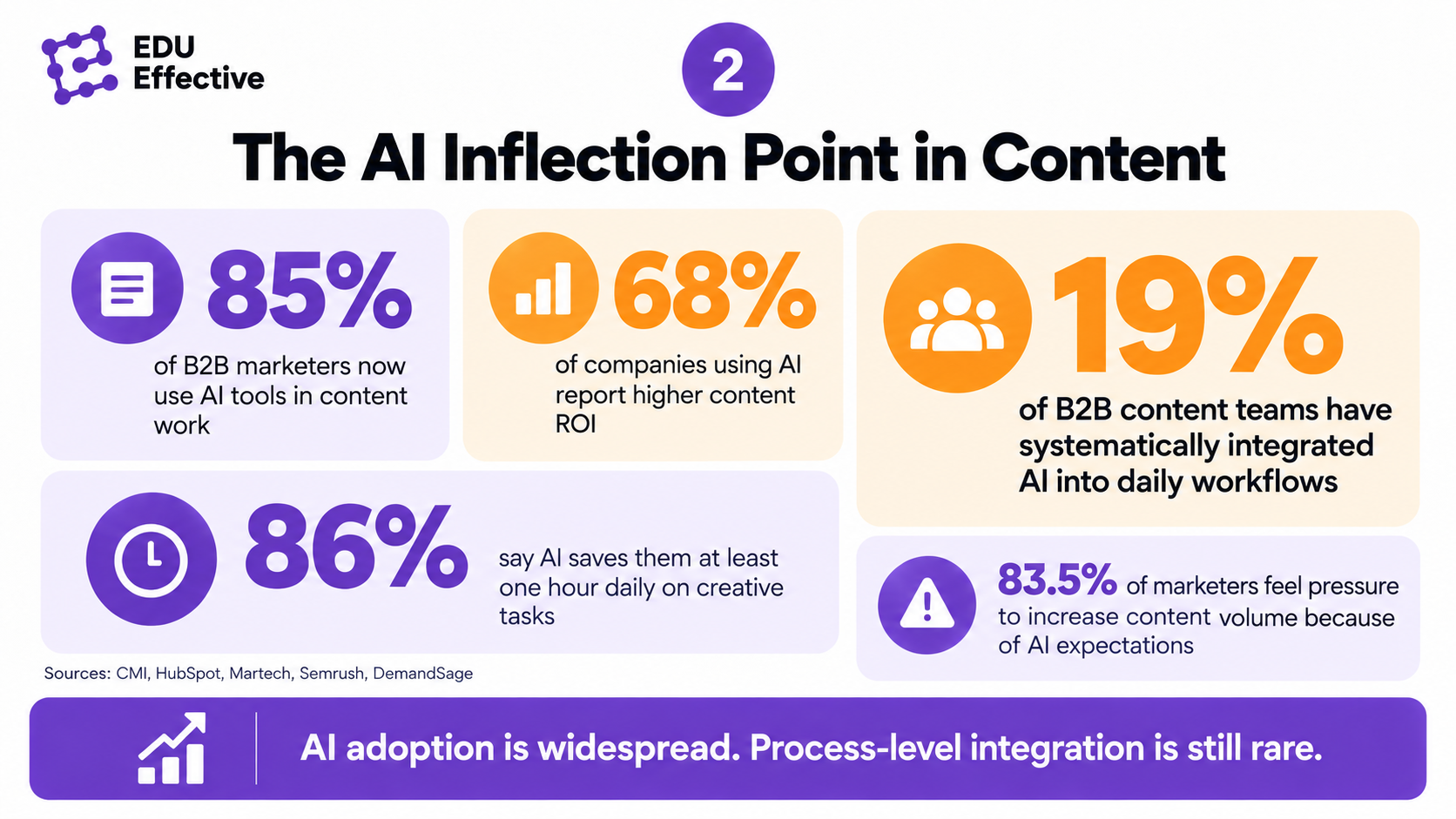
The pressure this creates is real. 83.5% of marketers say they feel pressure to increase content volume because of AI expectations, according to data reported by DemandSage. Producing more content faster is not the same as producing more effective content. If anything, the signal-to-noise problem in most markets is getting worse, not better.
For managers and executives building or overseeing content marketing functions, this is the central tension of 2026 and 2027: AI raises the floor (almost anyone can produce passable content), which means differentiation moves to strategic clarity, real expertise, and trust.
The GEO Problem Nobody Is Talking About Loudly Enough
Here is the shift that will define content marketing strategy for the next two to three years.
50% of consumers now use AI-powered search tools — Perplexity, ChatGPT, Gemini — as their primary research tool, per data cited by DemandSage. This is a significant behavioral shift. When a decision-maker types a question into an AI search engine, the answer they receive is synthesized from content that those systems have indexed and weighted as authoritative. Your article may never appear directly. Your data and your framing may appear in someone else’s summary — or not at all.
This is what practitioners call Generative Engine Optimization (GEO), and it is rapidly becoming as important as traditional SEO. The mechanics differ:
Traditional SEO optimizes for ranking in a list of links. The click is the metric.
GEO optimizes for being cited in an AI-generated answer. The presence in the answer is the metric.
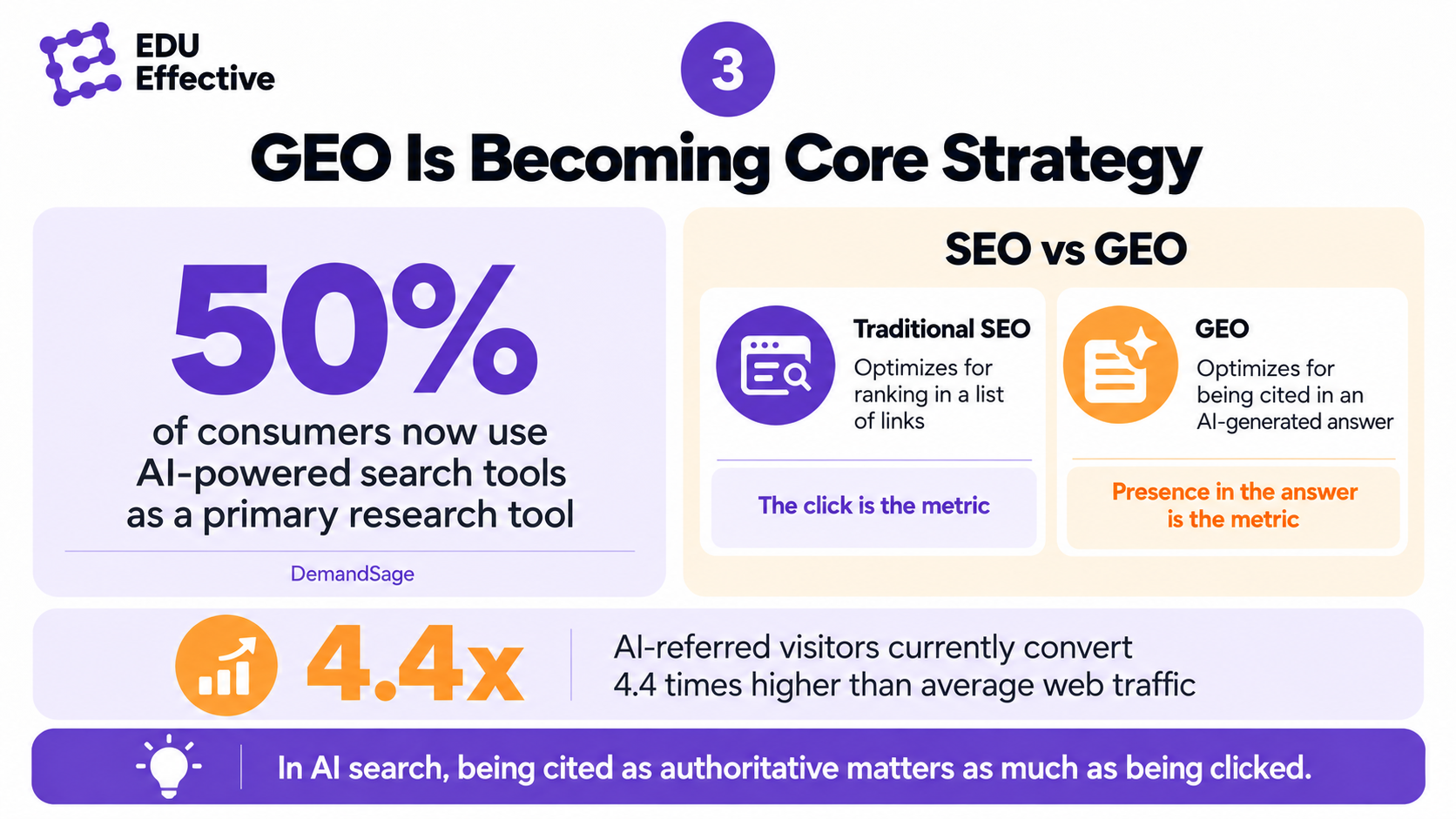
AI-referred visitors currently show a 4.4x higher conversion rate than average web traffic, per data reported by DemandSage. But the volume of AI-referred traffic remains lower than organic. That ratio will shift as AI search tools gain share. The organizations that start building GEO authority now will be in a fundamentally different position in 2027 than those who wait.
What builds GEO authority? The same things that always built real authority: original research, clear expert authorship, specific data, and consistent positions. AI systems favor content that answers questions definitively, cites verifiable sources, and comes from identifiable experts. how AI is reshaping work and skills more broadly — and why the same expertise dynamics show up far beyond marketing
What Formats Are Actually Producing Results
Not all content types are equal in 2025 and 2026. The data is fairly consistent on this.
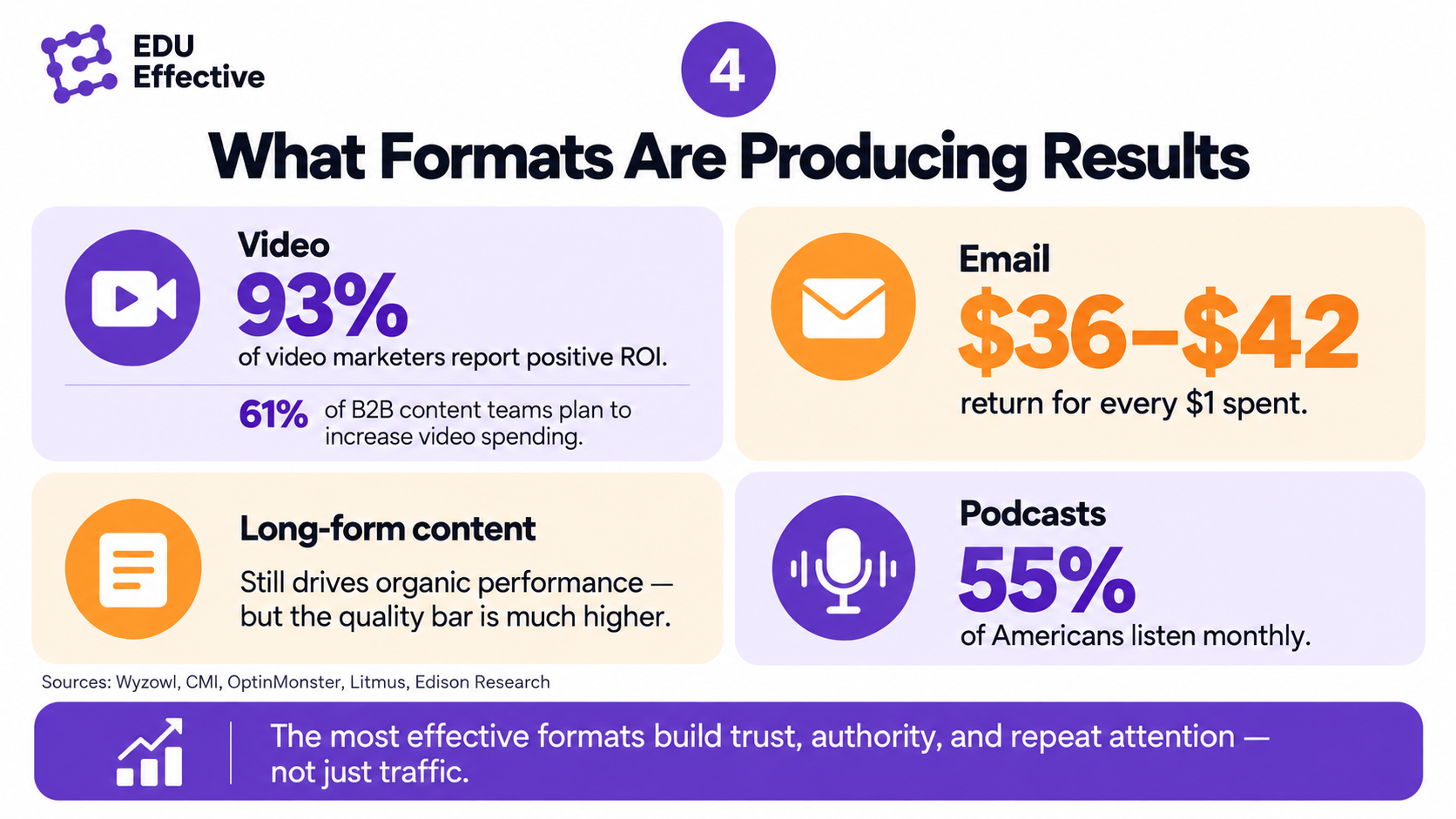
Video is the leading format by most measures. 93% of video marketers report positive ROI, per Wyzowl research. 61% of B2B content teams plan to increase video spending — the largest single category of planned budget increase, per CMI. The reason is straightforward: video communicates expertise, personality, and trust faster than any text format. A six-minute expert interview does more credibility work than a 2,500-word article for many audiences.
Email remains the highest-return channel when measured in direct revenue. The commonly cited figure is $36 to $42 return for every dollar spent, sourced to OptinMonster and Litmus. This is a mature channel with a well-understood ROI model, which is precisely why it still gets budget even from teams that have cut everything else.
Long-form written content — articles, guides, white papers — continues to drive organic search performance. This is the format most directly affected by AI search disruption, but it has not lost its value. What has changed is the quality bar. Content that exists primarily to rank for a keyword, with no original insight, is losing ground. Content that answers a question more completely and credibly than anything else available continues to earn links, citations, and authority.
Podcasts are worth noting. 55% of Americans listen to podcasts monthly, per Edison Research (2024 data). For B2B audiences, the podcast format has become a significant channel for longer-form thought leadership — not because it drives direct conversions, but because it builds familiarity and trust over time in a way that no other format replicates at the same cost. what actually works for professional brands across channels in 2027
The Attribution Problem Has Not Been Solved
56% of content teams struggle to attribute ROI, per CMI. This is not a new problem. It is a persistent one that gets worse as the buyer journey gets longer and more fragmented.
A decision-maker at a mid-sized company might read a blog post in March, download a guide in June, listen to a podcast episode in August, and sign a contract in September. The CRM records the September touchpoint. The blog post from March gets zero credit. If the team cuts that blog post series because it “doesn’t convert,” they may be cutting the first touchpoint for a significant portion of their pipeline.
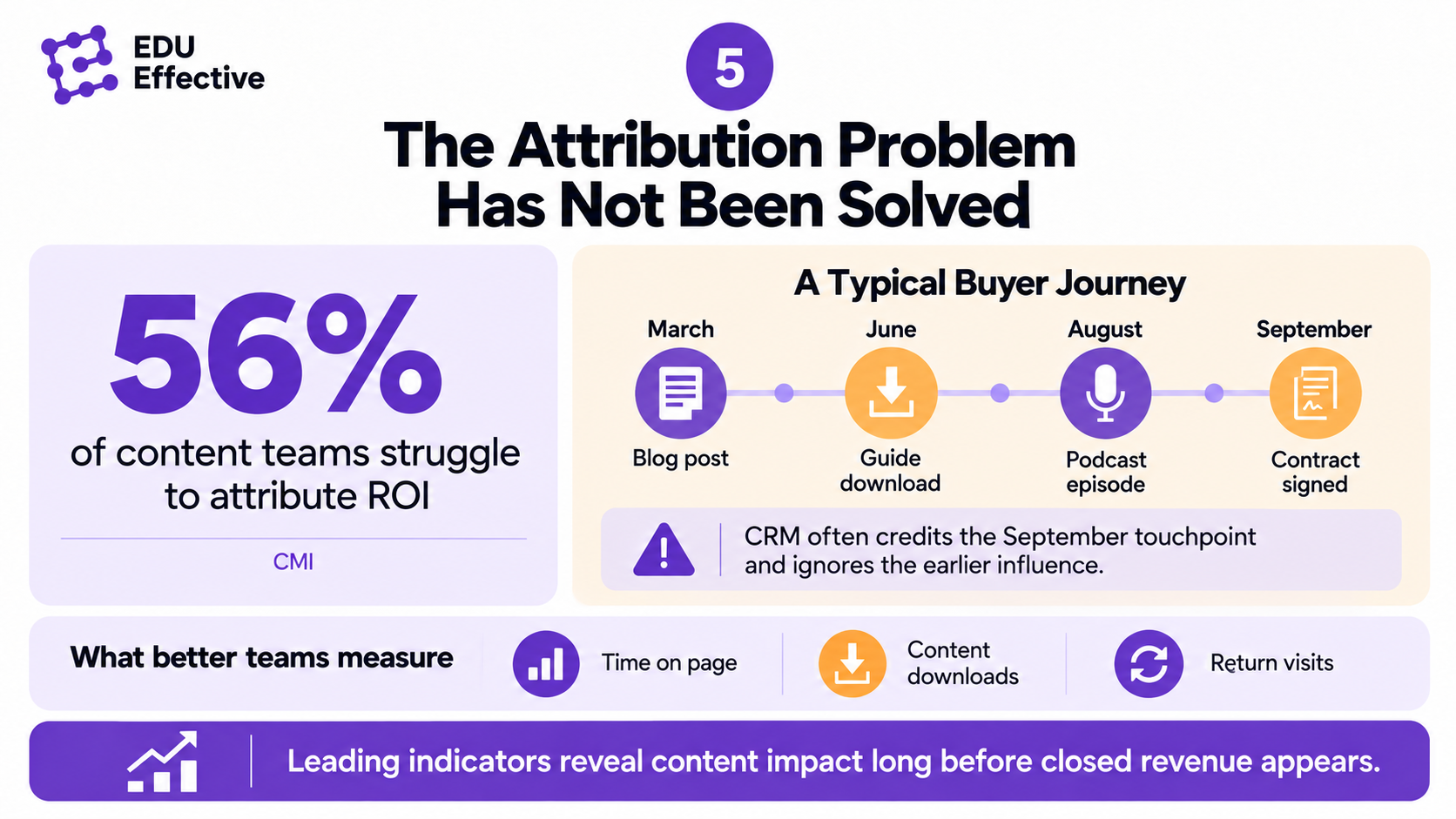
The organizations that are solving this problem are not doing so with better attribution software alone. They are doing it by building content strategies tied to specific stages of buyer intent, and measuring engagement signals — time on page, content downloads, return visits — as leading indicators rather than waiting for closed revenue to validate the content decision.
This requires a degree of patience that is genuinely difficult when quarterly targets are the primary lens.
What the Gap Between Good and Average Content Teams Looks Like in Practice
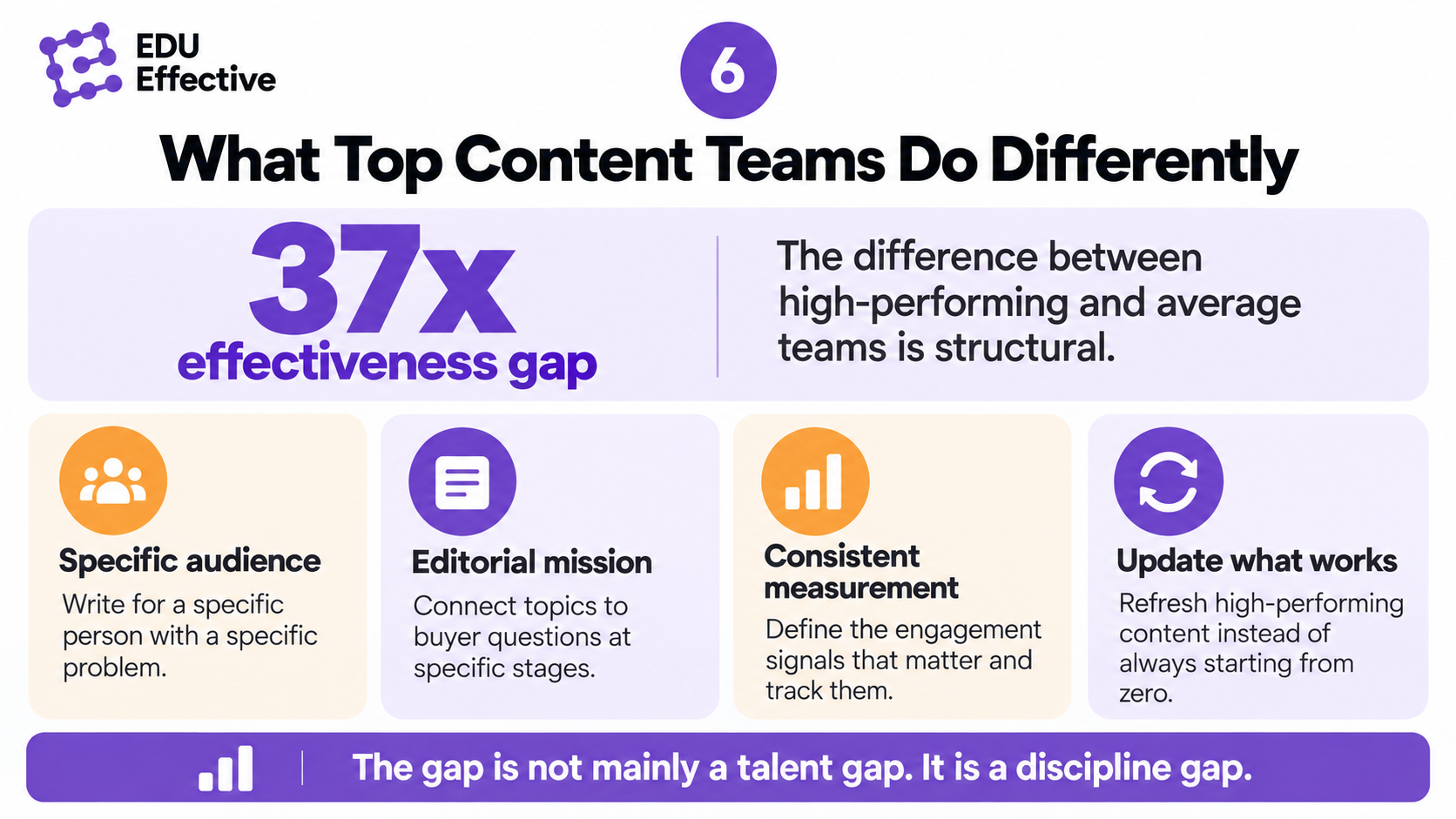
The CMI data on the 37x effectiveness gap is worth sitting with. What do the top 29% actually do differently?
Several patterns emerge consistently across the research:
They write for a specific person with a specific problem, not for a broad demographic. An article titled “How CFOs at manufacturing companies with 500-2,000 employees evaluate ERP vendors” will outperform “How to Choose ERP Software” every time, for the right audience.
They publish with a documented editorial mission that connects content topics to buyer questions at specific stages. Not every article is trying to close a sale. Some are trying to make someone aware that a problem exists. Some are trying to help someone build the internal business case. Treating all content as demand generation is a category error.
They measure consistently. Not perfectly — the attribution problem is real — but they define what engagement signals matter for their goals and they track them.
They update existing content rather than only producing new content. A high-performing article from two years ago, updated with current data and expanded with a new section, often outperforms a brand-new article on the same topic. The reason: established content has existing backlinks, domain trust, and indexed history. Compounding those assets is more efficient than starting from zero.
What This Means for the Manager or Executive Reading This
Content marketing is a legitimate strategic function. The 37x effectiveness gap is not primarily a talent gap. It is a discipline gap — between teams with documented strategies, clear editorial missions, and measurement frameworks, and teams that are producing content because they know they should.
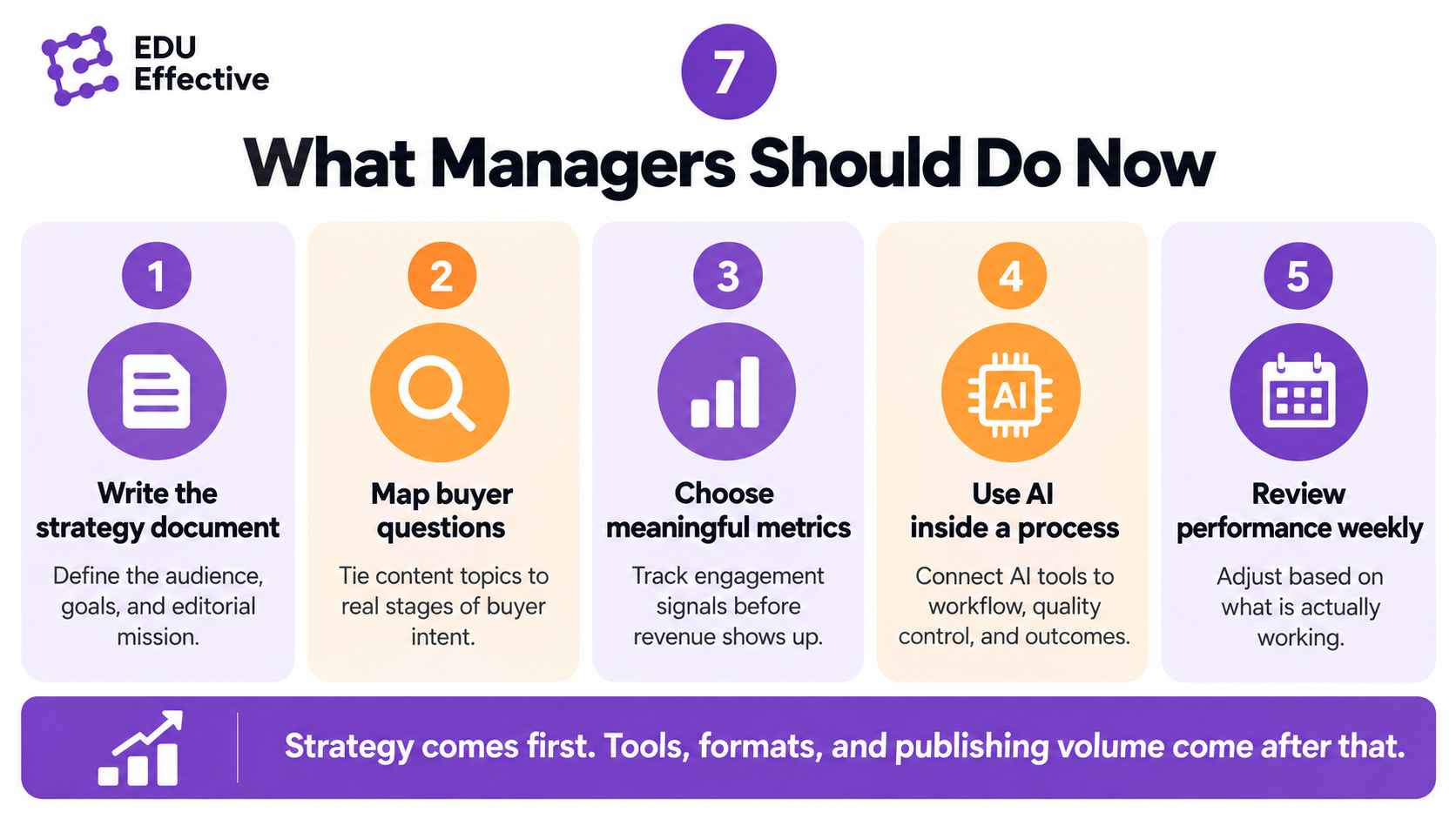
If you are a manager responsible for a content marketing function, or an executive who needs to evaluate whether your team’s investment is producing real returns, the starting point is a single honest question: does your team know what a successful content strategy looks like, and could they describe it in writing?
If the answer is no, that is where to start. Not with AI tools, not with format experiments, not with a bigger publishing calendar. The strategy document comes first.
MBA programs that cover digital marketing strategy, content operations, and data-driven decision-making give managers the framework to ask these questions from a position of knowledge — and to build content functions that compound rather than just produce.
What to Expect in 2027
Three things will define content marketing in 2027:
GEO will become a standard discipline. Teams that treat AI search optimization as optional will find themselves increasingly invisible in the research phase of the buyer journey. This will become measurable.
Expertise will become a moat. AI lowers the cost of generic content to near zero. Content that requires genuine domain expertise — original research, specific case studies, named experts making specific claims — becomes more valuable as generic content floods every channel. what actually builds executive authority and a personal brand that compounds
Measurement will improve, but slowly. Better multi-touch attribution tools are being developed, but the organizational discipline to use them well will lag the technology. Teams that invest in measurement frameworks now will have a real advantage as the tools improve.
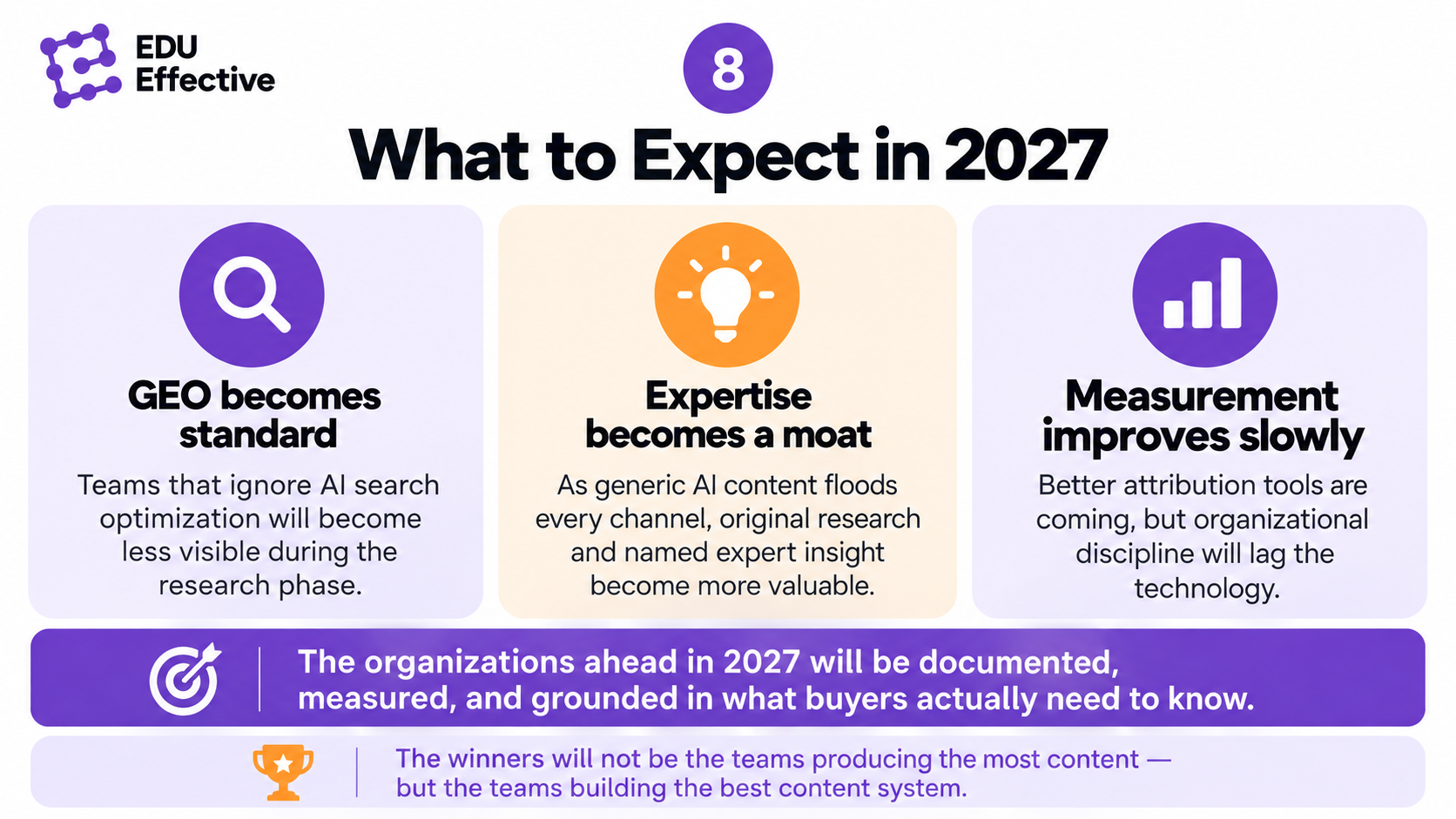
The organizations that will be ahead in 2027 are not the ones producing the most content today. They are the ones building content strategies that are documented, measured, and grounded in what their buyers actually need to know.
Take Your Marketing Skills Further
The gap between a content marketing function that compounds and one that just produces comes down to strategic clarity. The Effective MBA: Online Marketing develops that strategic foundation — covering content strategy, digital marketing analytics, buyer journey design, and data-driven decision-making at a professional level.
About EDU Effective Business School
The Effective MBA: Online Marketing is built for professionals who need marketing that produces measurable results. Runs on 15 minutes a day, completes in 10 months or less and is ASIC accredited.
Sources
- Content Marketing Institute — B2B Content Marketing Research (2025-2026 annual cycle): https://contentmarketinginstitute.com/research/b2b-research
- HubSpot — State of Marketing: https://www.hubspot.com/state-of-marketing
- Wyzowl — State of Video Marketing: https://www.wyzowl.com/video-marketing-statistics/
- Litmus — State of Email: https://www.litmus.com/state-of-email
- Semrush — State of Content Marketing: https://www.semrush.com/blog/content-marketing-statistics/
- DemandSage — Content Marketing Statistics (aggregated, primary sources cited per figure): https://www.demandsage.com/content-marketing-statistics/