

Every few months a new study arrives with a headline about how many jobs AI will eliminate by a specific year. The numbers range from alarming to catastrophic. Most of them are wrong — not because AI isn’t reshaping work, but because the question being asked is the wrong one.
The right question is not how many jobs will disappear. It is how the content of work is changing, which skills are becoming more valuable as a result, and what that means for professionals who want to be on the right side of that shift.
The data on this is more nuanced — and more actionable — than the headlines suggest.
What the WEF Actually Found
The World Economic Forum’s Future of Jobs Report 2025 surveyed over 1,000 employers representing more than 14 million workers across 22 industry clusters and 55 economies. It is the most comprehensive forward-looking workforce study available, and its findings are specific enough to be useful.
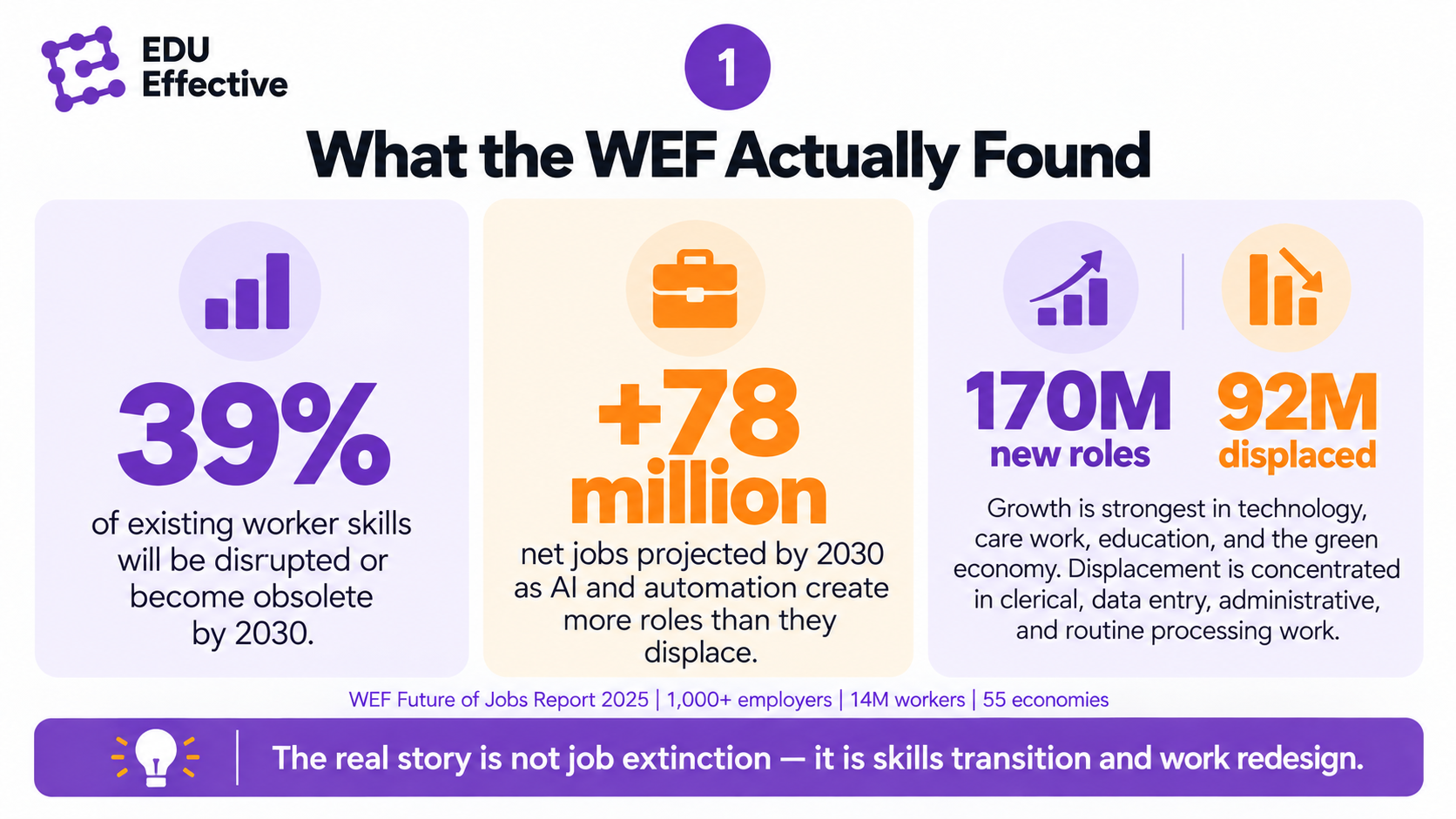
The headline number that circulated widely: 39% of existing worker skills will be disrupted or become obsolete by 2030. That sounds alarming. The fuller picture is different. The same report projects that AI and automation will create 78 million more jobs than they displace over the same period — a net positive in employment terms, even accounting for the roles that will be reduced or eliminated.
The distribution of that change matters. WEF projects 170 million new roles will be created while 92 million existing roles are displaced. The new roles are concentrated in technology, care work, education, and green economy functions. The displaced roles are concentrated in clerical, data entry, administrative, and routine processing work.
For employed professionals, the key data point is not the aggregate — it is the skills transition. WEF identifies analytical thinking as the number one core skill for 2025 and beyond, ahead of creative thinking, technological literacy, and AI and big data skills. Leadership and social influence is projected to rise 22 percentage points in importance. AI and big data rises 17 percentage points.
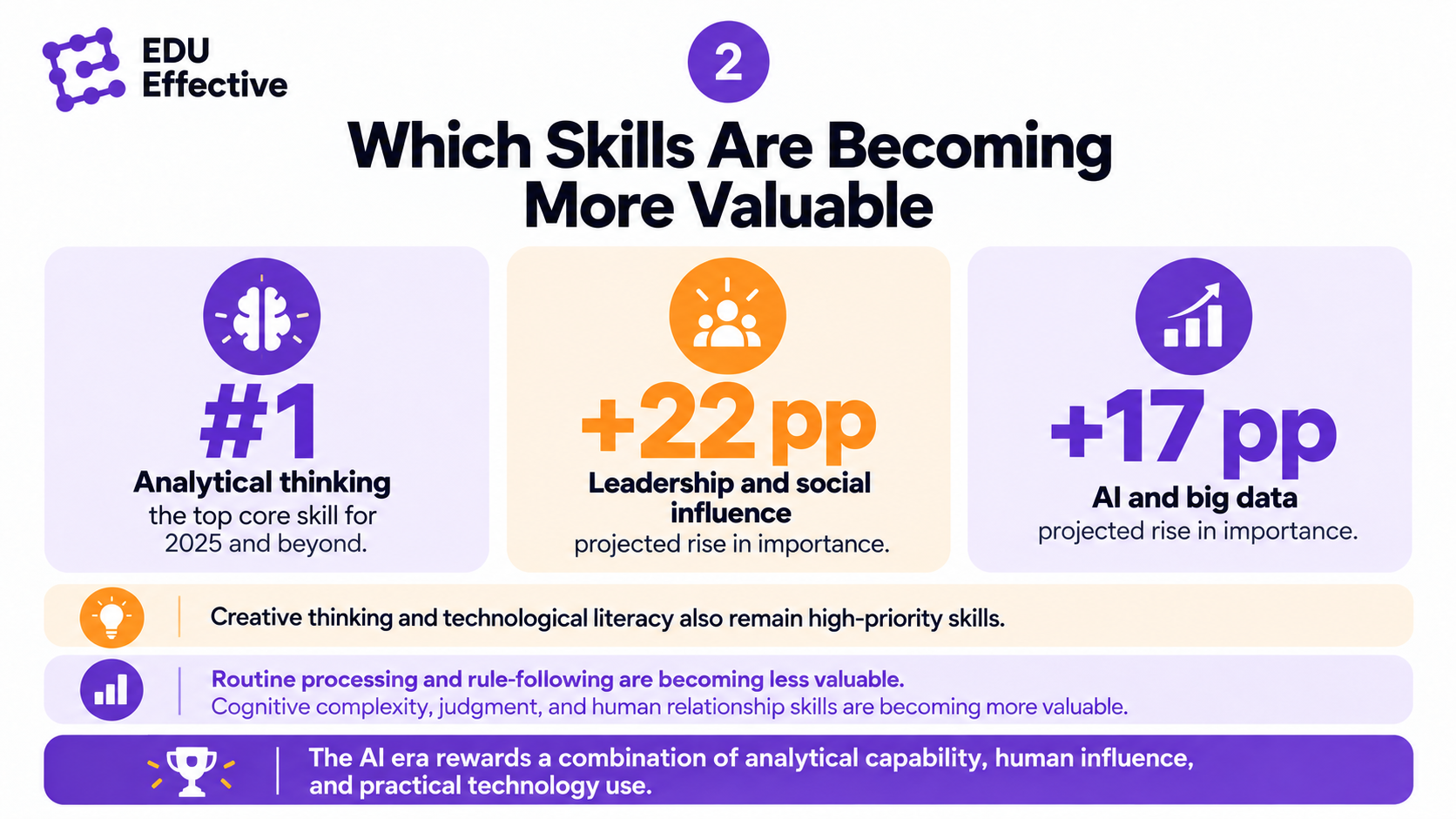
The pattern is clear: cognitive complexity, judgment, and human relationship skills are becoming more valuable. Routine processing and rule-following are becoming less valuable. This is not a prediction — it is already visible in labor market data. which specific skills employers will actually pay for by 2027 — and how the WEF core-skills ranking translates into hiring criteria
The Eleven-Fold Demand Surge
McKinsey Global Institute’s Workforce in Motion report from September 2026 found that demand for AI fluency has risen eleven-fold since 2022. That is not a projection — it is a measurement of what employers are currently asking for in job postings, hiring criteria, and skills assessments.
The same report found that the occupations showing the fastest employment growth have, on average, 68 distinct skills in growing demand. Declining occupations average 47. The gap is not primarily in technical skills — it is in the combination of technical and human capabilities that AI-era work requires.
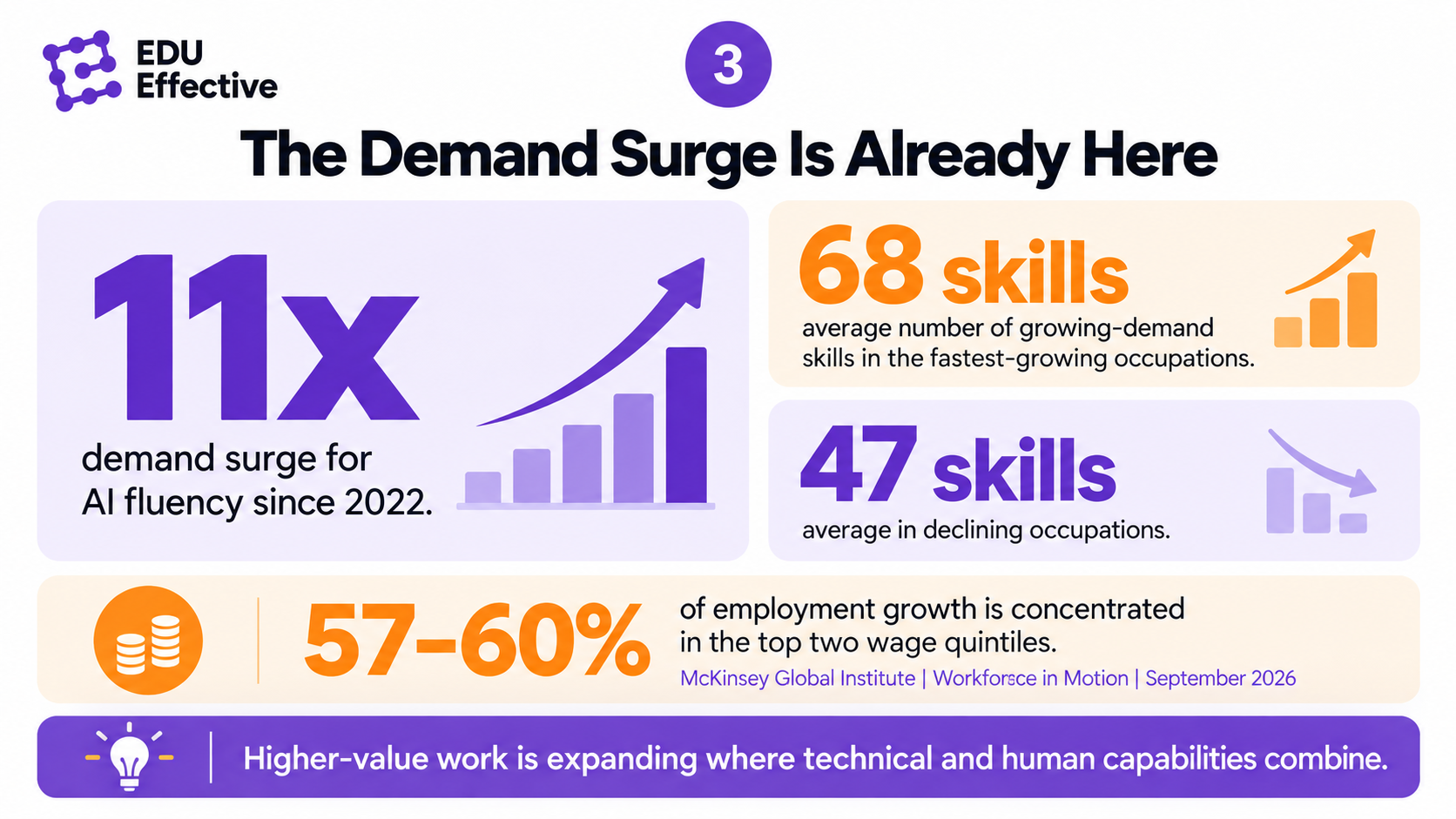
Fifty-seven to sixty percent of employment growth is concentrated in the top two wage quintiles. Work that pays well is expanding. Routine middle-skill work is compressing. AI is accelerating a long-running labor market trend, not creating it from scratch.
What “AI Fluency” Actually Means for Non-Technical Professionals
The eleven-fold demand surge for AI fluency creates an obvious anxiety: if you are not a data scientist or an engineer, does this apply to you?
It does — but not in the way the anxiety suggests.
AI fluency for most professional roles does not mean building models or writing code. It means understanding what AI tools can reliably do and what they cannot, being able to direct those tools toward specific problems, evaluating the quality of AI-generated outputs critically, and redesigning workflows to incorporate AI where it adds genuine value.
A manager who can look at an AI-generated analysis and identify where the assumptions are questionable is more valuable than one who either blindly trusts it or refuses to engage with it. A marketing professional who can direct an AI content tool to produce first drafts that align with brand positioning — and then judge whether those drafts actually do — is more productive than one working without the tool. A project manager who understands which parts of reporting and tracking can be reliably automated and which require human judgment is managing time better.
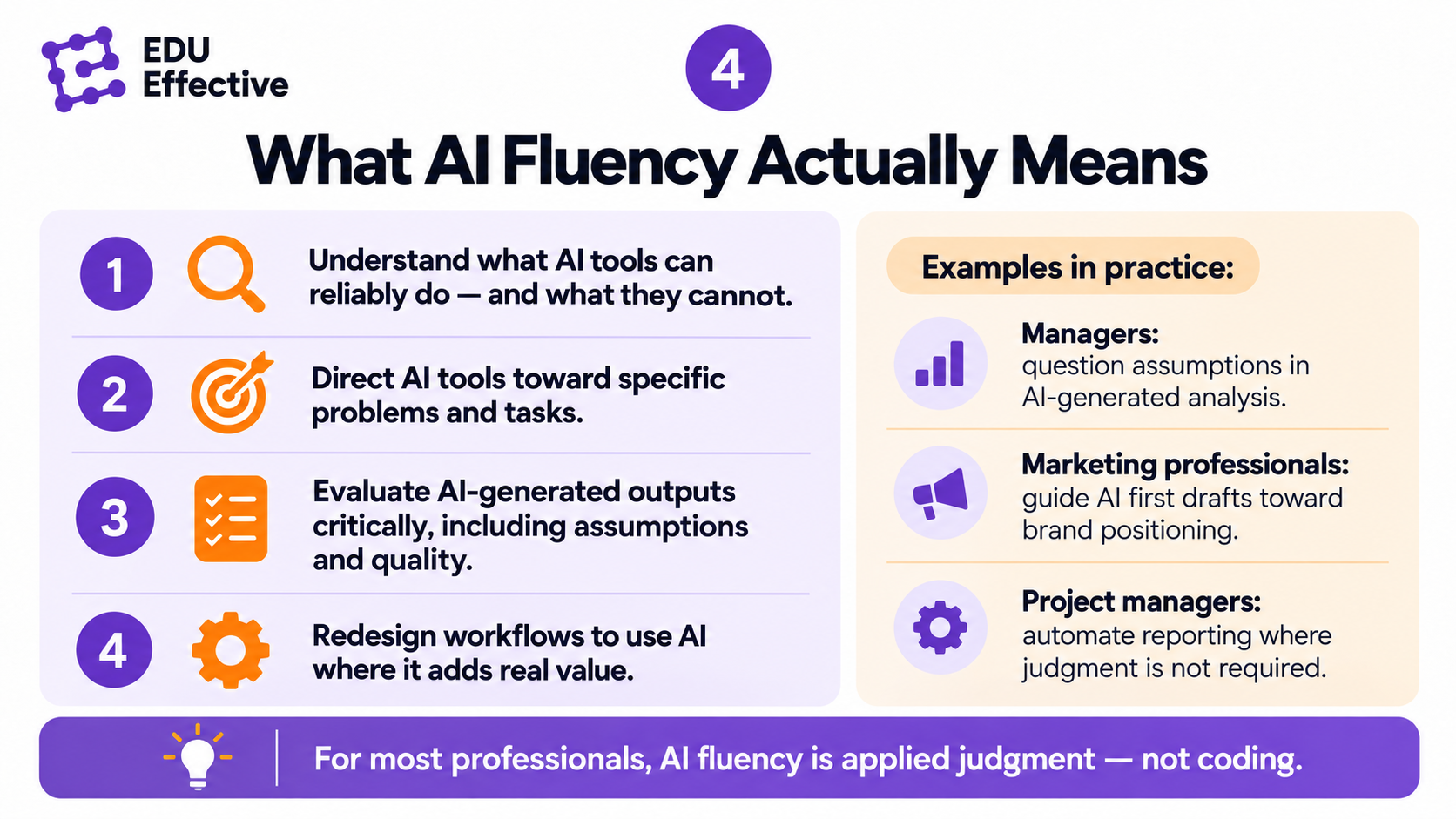
None of this requires deep technical training. It requires enough understanding of how AI systems work to use them intelligently — which is what AI fluency means in practice for the majority of professional roles. In commercial teams, that fluency is already separating high performers from the rest. what the 2026 sales data shows about the gap between AI adoption and real commercial results — and why tool access alone is not the differentiator
The Jobs That Are Actually Growing
LinkedIn’s analysis of its 1.3 billion member platform found that AI-skilled members grew twenty-fold since 2022. Job descriptions mentioning AI literacy grew six times faster than average job postings over the same period.
The roles seeing the strongest demand growth share a common characteristic: they require domain expertise combined with the ability to work alongside AI tools. A financial analyst who can interpret AI-generated market models. An HR professional who can design AI-assisted hiring processes while managing the bias risks those systems introduce. A logistics manager who can oversee AI-optimized routing while making the judgment calls that fall outside the model’s parameters.
Domain expertise is not being devalued. It is being elevated — because professionals who have it can operate AI tools that amplify their specific knowledge in ways that generalist AI users cannot replicate. Ten years of supply chain experience is the context that makes an AI supply chain tool genuinely powerful. Without that human expertise, it is a generic system. With it, a precision instrument.
What Is Not Changing
Amid the genuine transformation, some things are holding remarkably stable.
Trust is still built between people. Complex negotiations, sensitive performance conversations, organizational change management, strategic decisions under uncertainty — these remain domains where human judgment, relationship capacity, and contextual awareness drive outcomes.
WEF’s data is explicit: leadership and social influence is rising in importance. As more routine and analytical work is handled by AI tools, the work that remains distinctly human becomes more concentrated — and more valued. The ability to align a team around a shared direction, navigate conflict productively, hold people accountable while maintaining their engagement, and make judgment calls in situations the model was not trained on — these are not declining skills. They are the premium skills of the AI era. why most organizations get workforce transformation wrong — and why the human side of change is where transformation programs actually fail
Creativity in its deepest form — identifying the genuinely novel problem that needs solving, or the unexpected connection between domains that produces a new category — remains a distinctly human capability. AI tools are excellent at making existing approaches more efficient. They are not reliably good at questioning whether the existing approach is the right one.
The Professional Imperative Between Now and 2027
WEF’s data shows that 59 out of 100 workers will need significant reskilling by 2030. For professionals currently in the workforce, the practical horizon is closer: the skills that make a significant difference to career trajectory over the next two to three years are being determined now.
The professionals who will be well-positioned in 2027 are building three things in parallel. First, AI fluency in their specific domain — not generic AI literacy, but the ability to apply AI tools to the specific problems their field involves. Second, the distinctly human skills that become more valuable as AI handles more of the analytical layer: leadership, communication, judgment in complex situations. Third, the business acumen to connect both to organizational outcomes — so the value they create is visible, legible, and attributable.
The Speed Problem
The most challenging aspect of the future of work shift is not the direction. It is the speed.
McKinsey found that 39% of workers named a shift in required skills as the top driver of change in the past year — ahead of AI adoption itself. Only 27% of leaders say their organization manages change effectively, per Deloitte’s 2026 Human Capital Trends research. Just 8% rate themselves highly effective at meeting continuous learning needs.
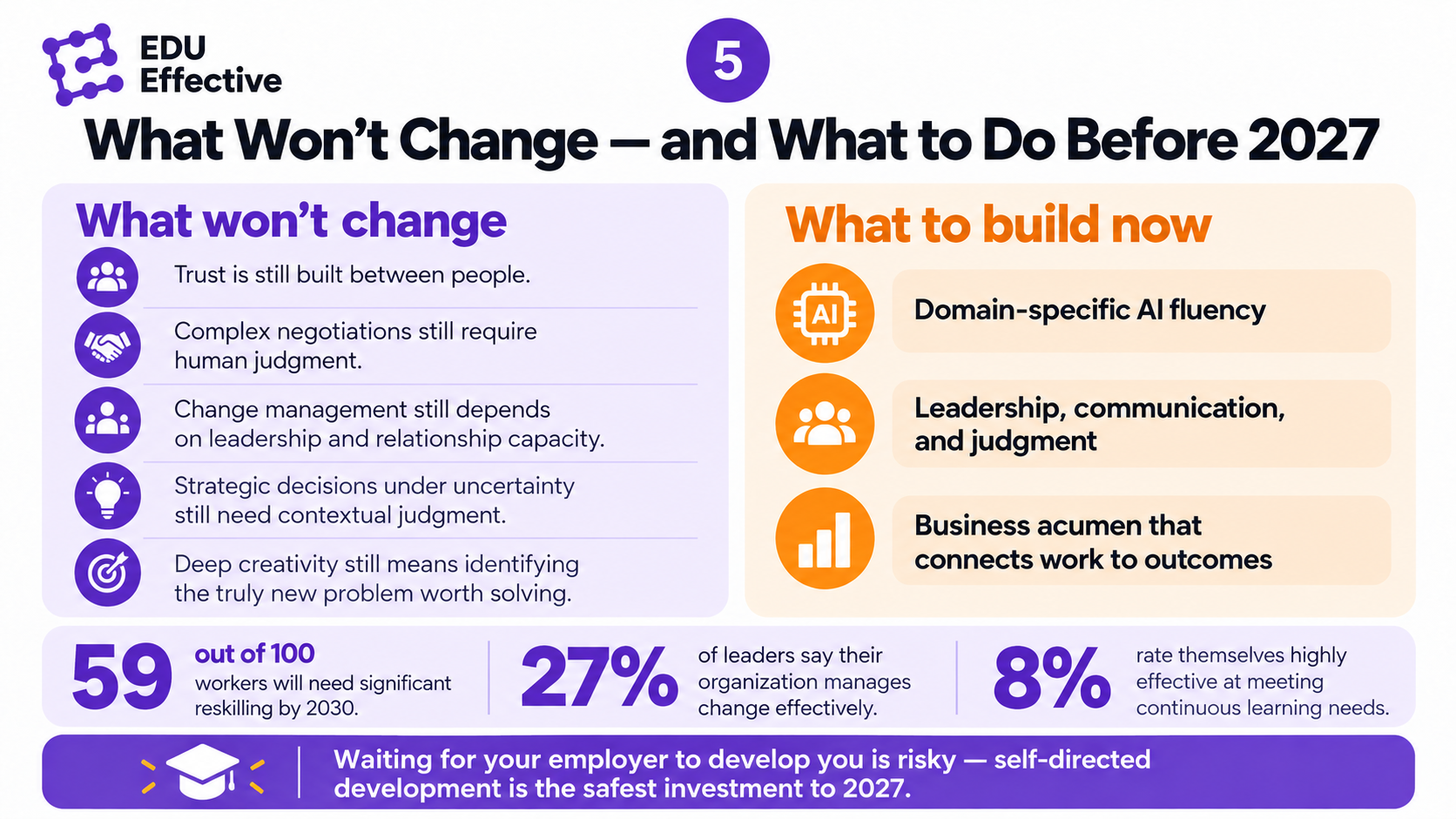
This means that waiting for your employer to develop you is a strategy with significant execution risk. The initiative to develop AI fluency and the human skills that complement it will, for most professionals, need to come from within. That is not pessimism — it is an accurate description of the situation in which self-directed professional development becomes the most reliable investment available.
How EDU Effective Prepares Professionals for the AI Era
EDU Effective Business School builds the combined capability that AI future of work research consistently identifies as the differentiator: domain expertise, AI fluency, and the leadership and business skills that make both valuable at organizational scale.
The Effective MBA: Artificial Intelligence in Business is designed for professionals who want to develop AI fluency in a business context — understanding AI’s capabilities, limitations, and strategic implications without requiring a technical background.
The Effective MBA: General Management builds the leadership, analytical, and strategic communication skills that WEF identifies as the highest-growth core capabilities of the current decade.
All programs are 100% online, micro-learning format, and designed for employed professionals developing while working full-time.
The shift is happening on a timeline you can still position yourself ahead of.
Join EDU Effective Business School and build the skills that the AI era is making indispensable.
EDU Effective MBA Programs:
- Effective MBA: General Management
- Effective MBA: Human Resources Management
- Effective MBA: Artificial Intelligence in Business
- Effective MBA: Digital Marketing
- Effective MBA: Project Management
About EDU Effective Business School
EDU Effective Business School designs practical business education for professionals who are already working. Runs on 15 minutes a day, completes in 10 months or less and is ASIC accredited.
Sources
- World Economic Forum — Future of Jobs Report 2025. https://www.weforum.org/publications/the-future-of-jobs-report-2025/
- McKinsey Global Institute — Workforce in Motion, September 2026. https://www.mckinsey.com/mgi
- LinkedIn Economic Graph — Work Change Report 2025. https://economicgraph.linkedin.com/content/dam/me/economicgraph/en-us/PDF/Work-Change-Report.pdf
- Deloitte — Global Human Capital Trends 2026. https://www.deloitte.com/us/en/insights/topics/talent/human-capital-trends.html