

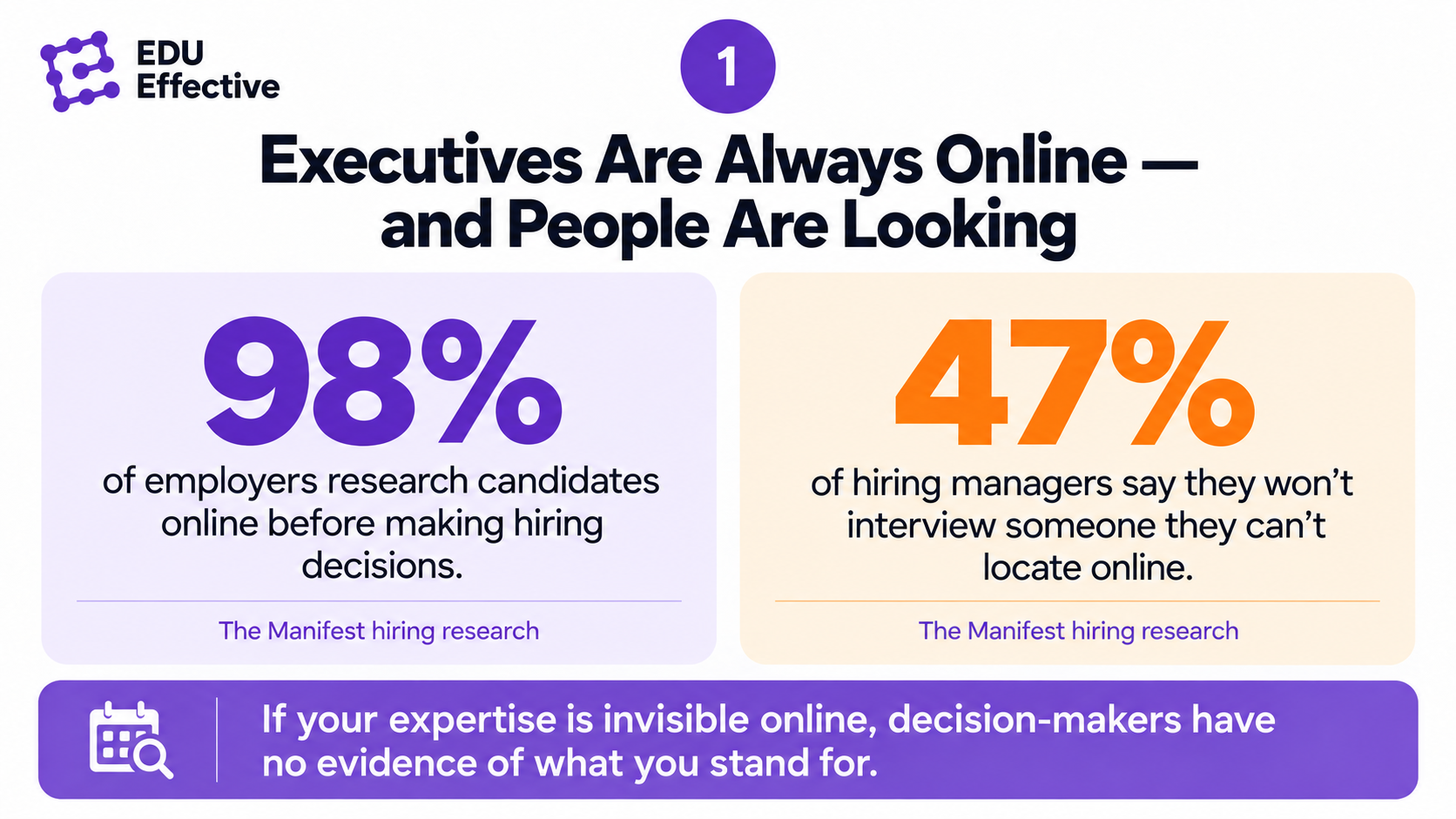
Ninety-eight percent of employers research candidates online before making hiring decisions. That number comes from The Manifest’s hiring research and it has held remarkably stable for several years. What has changed is what those searches find — and what they cost candidates who have nothing there to find.
Forty-seven percent of hiring managers say they won’t interview someone they can’t locate online. Not because they’re lazy. Because an executive with no visible presence is, from the outside, an executive with no record. No thinking, no positions, no evidence of what they stand for.
This is the baseline problem personal branding for executives is designed to solve. But the real case for it is not defensive. It’s about what becomes possible when you build one deliberately.
The Market Value Argument
Weber Shandwick’s long-running research on executive reputation found that executives attribute 44% of a company’s market value to the CEO’s personal brand and reputation. Not the product. Not the balance sheet. The person leading the organization and how they are perceived.
That number is not about social media follower counts. It’s about trust — specifically, whether people outside the organization believe the leader has a coherent perspective, sound judgment, and something worth listening to.
Eighty-two percent of consumers say they trust companies more when executives are active on social media, per Krailo Socials research. Eighty-four percent believe a company’s reputation is shaped by its employees’ personal brands. These numbers describe the same mechanism: in a market full of organizations saying similar things about themselves, it is the humans behind those organizations who differentiate.
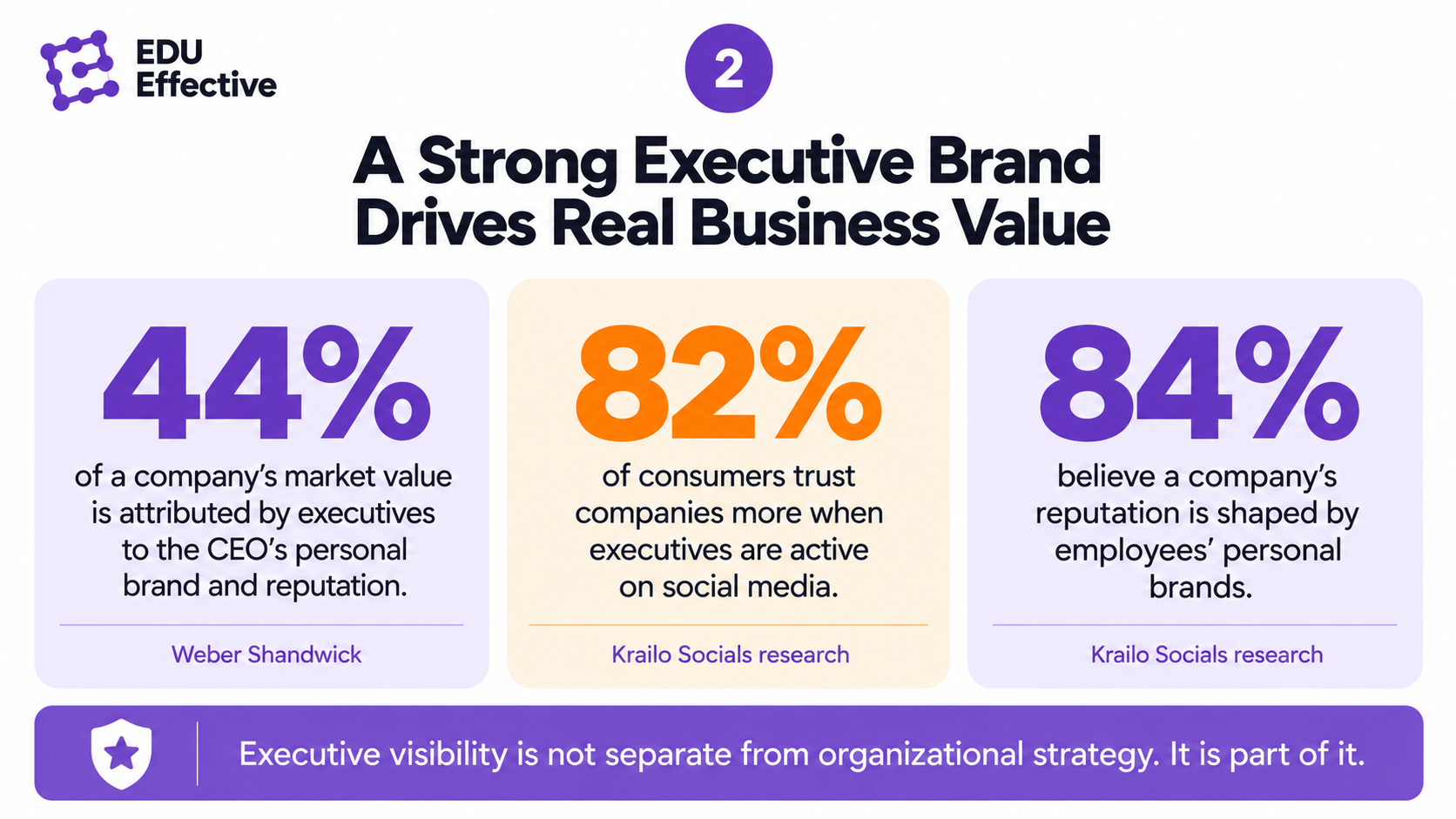
The implication for anyone managing or leading at scale is that executive visibility is not separate from organizational strategy. It is part of it.
What Thought Leadership Actually Does in a B2B Context
The Edelman-LinkedIn 2025 B2B Thought Leadership Impact Report is worth reading in full. The survey covers buyers and decision-makers, not marketers or content strategists, which makes the findings more useful for anyone trying to understand how thought leadership actually functions in professional purchasing.
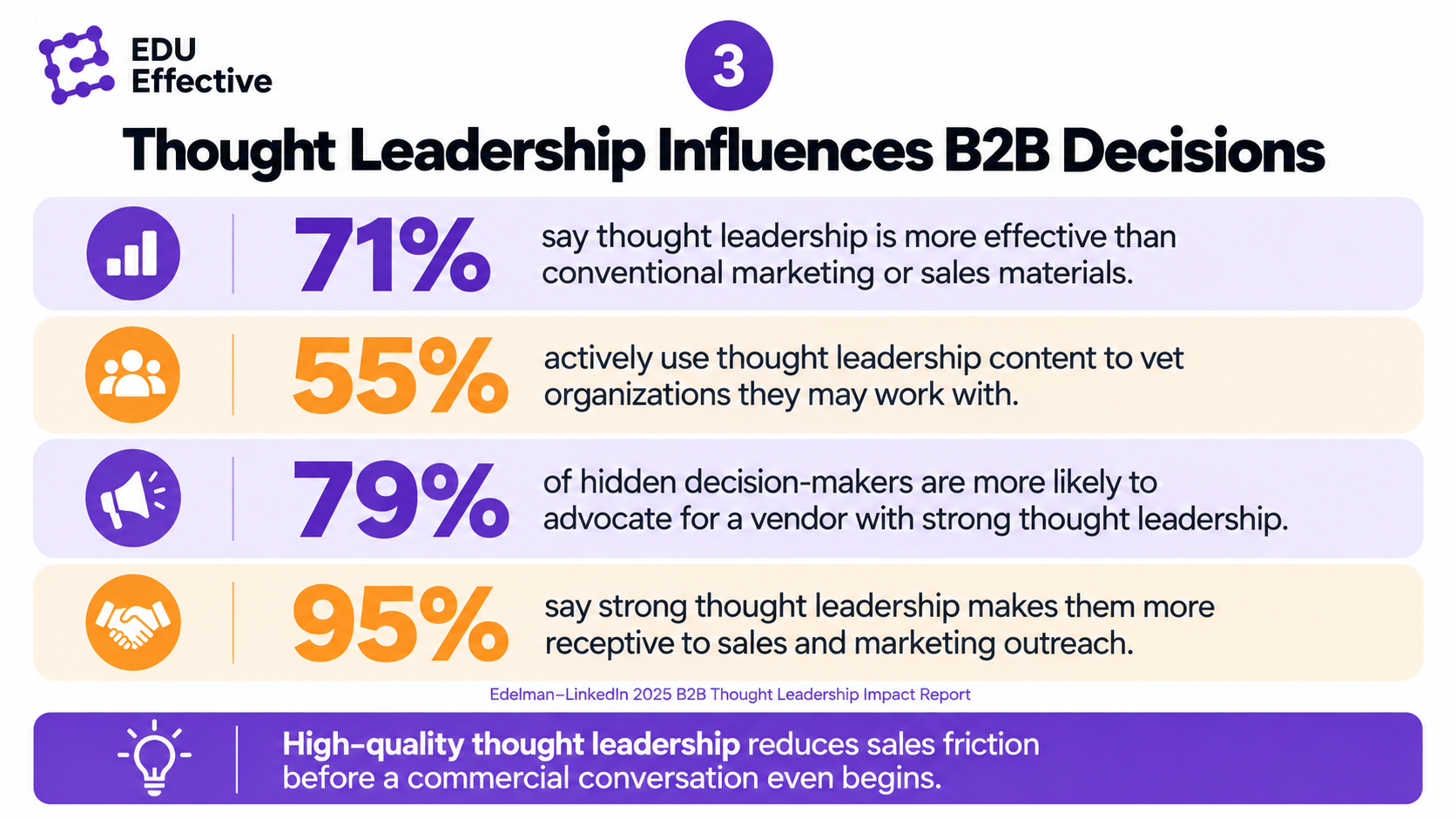
Seventy-one percent of respondents say thought leadership is more effective than conventional marketing or sales materials at demonstrating a vendor’s value. Not supplemental. More effective. Fifty-five percent actively use thought leadership content to vet organizations they may work with — using it the way a recruiter uses a reference check.
The number that should change how executives think about content: 79% of hidden decision-makers say they’re more likely to advocate for a vendor’s proposal in the RFP process if the vendor consistently produces high-quality thought leadership. Hidden decision-makers are the people in organizations who influence purchase decisions without being the named contact. They are often the hardest people to reach with direct sales outreach. Consistent, credible content reaches them when nothing else does.
Ninety-five percent say strong thought leadership makes them more receptive to sales and marketing outreach. That is not a soft influence — it is a measurable reduction in sales friction for everyone in the organization. The executive who publishes thoughtfully is reducing the cost of commercial conversations for the whole company.
LinkedIn: Where the Attention Is
There are arguments for building an executive presence on multiple channels. Most of them are theoretical. The practical reality for B2B executives in 2026 is that LinkedIn is where the attention that matters is concentrated.
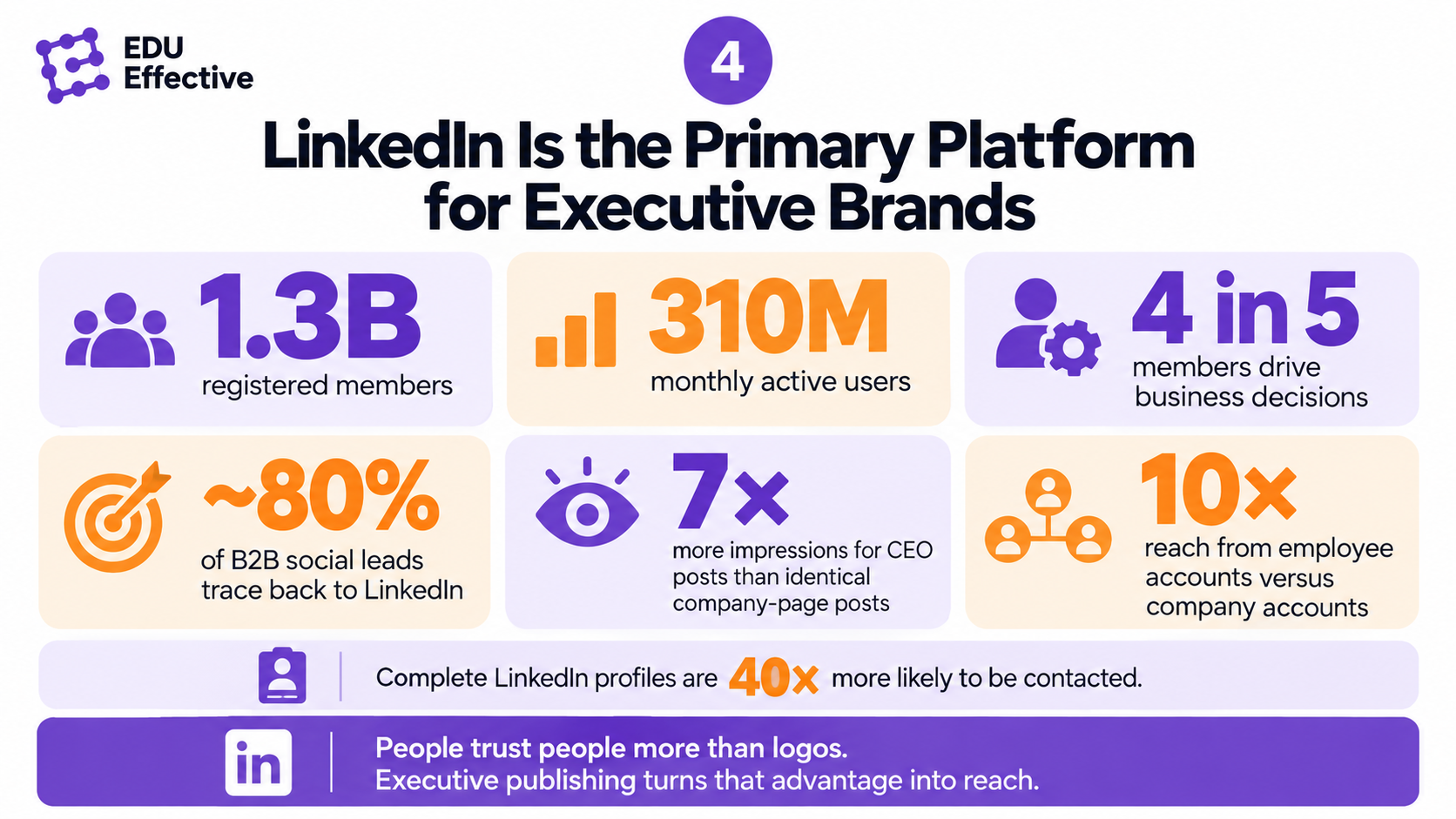
The platform has 1.3 billion registered members and approximately 310 million monthly active users. Four in five members drive business decisions, per LinkedIn’s own advertising data. Roughly 80% of B2B social media leads trace back to LinkedIn. These are vendor-adjacent figures from LinkedIn’s own marketing, so treat them as directional — but the directional is consistent across independent research.
What is harder to dismiss: CEO posts on LinkedIn generate seven times more impressions and four times more engagement than identical content published on a company page. This is the core structural argument for executives publishing personally rather than delegating everything to the corporate account.
Employee accounts have ten times the reach of company accounts in general. Leads from employee posts convert seven times more, per LinkedIn and Oktopost research. The mechanism is not complicated — people trust people more than they trust organizations. Content from a named human with a point of view lands differently than content from a logo.
LinkedIn users with complete profiles are 40 times more likely to be contacted through the platform. For executives managing a career or building a business development pipeline, that is a significant asymmetry to leave on the table.
What Builds a Credible Executive Brand
The mistake most executives make with personal branding is treating it as a marketing exercise rather than a thinking exercise. The question is not “what should I post?” The question is “what do I actually believe, and who needs to hear it?”
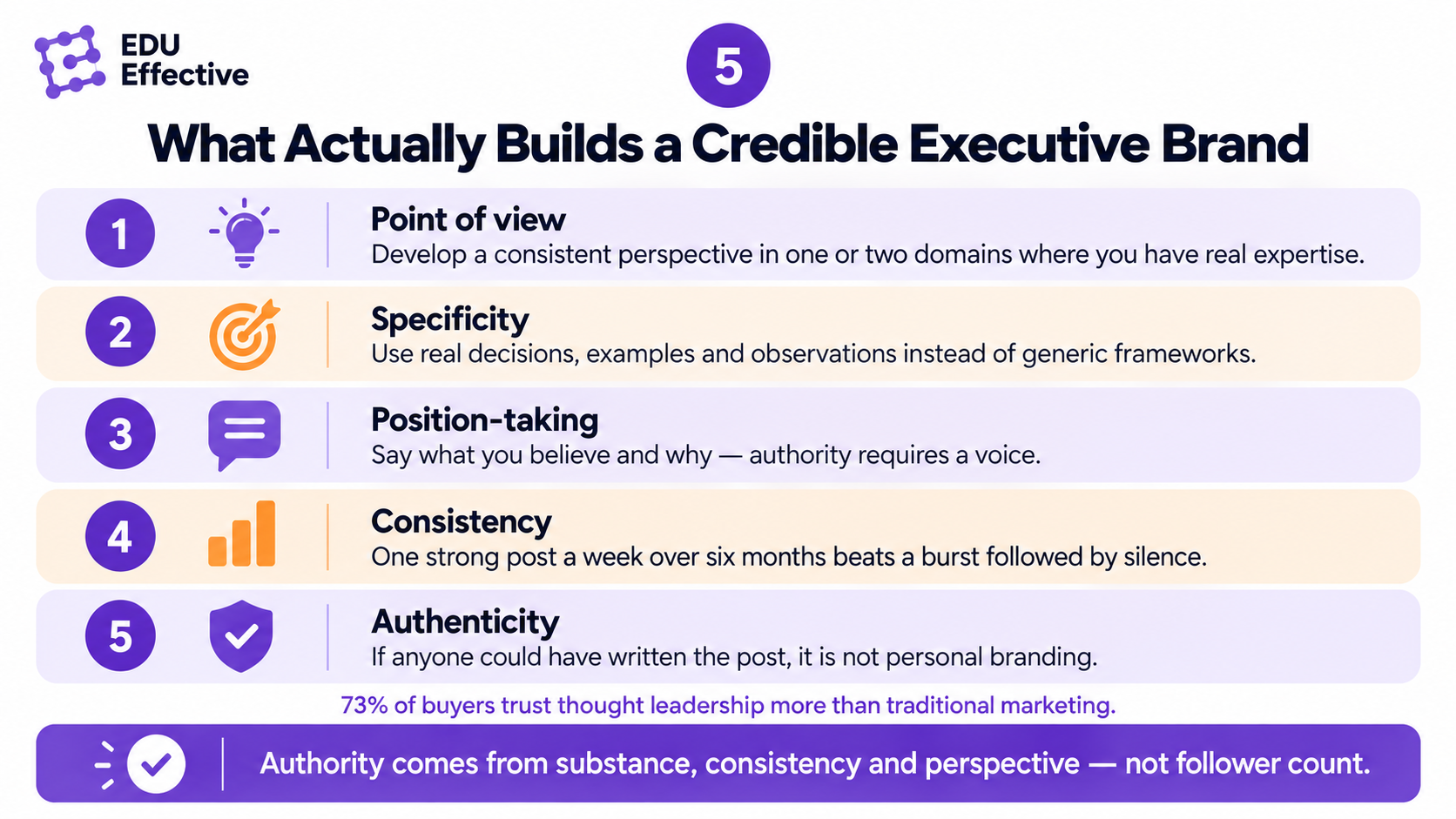
Credible executive presence starts with a point of view. Not opinions on every topic — a consistent, developed perspective on one or two domains where you have genuine expertise and something original to contribute. The executives who build real authority on LinkedIn are not posting about everything. They are posting consistently about something specific, drawing from direct experience, and taking positions that can be disagreed with.
Seventy-three percent of buyers trust thought leadership more than traditional marketing, per Edelman. What they distrust is thought leadership that isn’t actually thought leadership — content assembled to look authoritative without genuine expertise behind it. The difference is usually visible within three posts.
A few things that consistently work at building LinkedIn authority for executives, based on current platform behavior:
Specific observations from real situations outperform generic frameworks. A post describing a decision you faced, what you considered, and what you concluded will generate more meaningful engagement than a post summarizing someone else’s research. Authentic specificity is the scarce resource.
Taking a position works better than presenting balanced perspectives. Balance is appropriate for analysis. Personal branding requires a voice. A post that says “here is why I disagree with the conventional wisdom on X” will reach and affect people more than one that says “there are arguments on both sides.”
Consistency matters more than volume. One substantive post per week, published reliably over six months, builds more credibility than fifteen posts in a burst followed by silence. The algorithm rewards consistency; more importantly, so does human memory.
The Internal Brand Is Half the Equation
Most of the public conversation about executive personal branding focuses on external visibility — media, LinkedIn, speaking engagements. The internal dimension is equally important and often neglected.
Seventy percent of employers say a personal brand matters more than a résumé in hiring decisions. Seventy-eight percent of creative leaders say they offer higher pay or faster promotions to candidates with well-developed personal brands, per GDUSA research. These are not just hiring decisions — they are patterns of how organizations identify and advance their people.
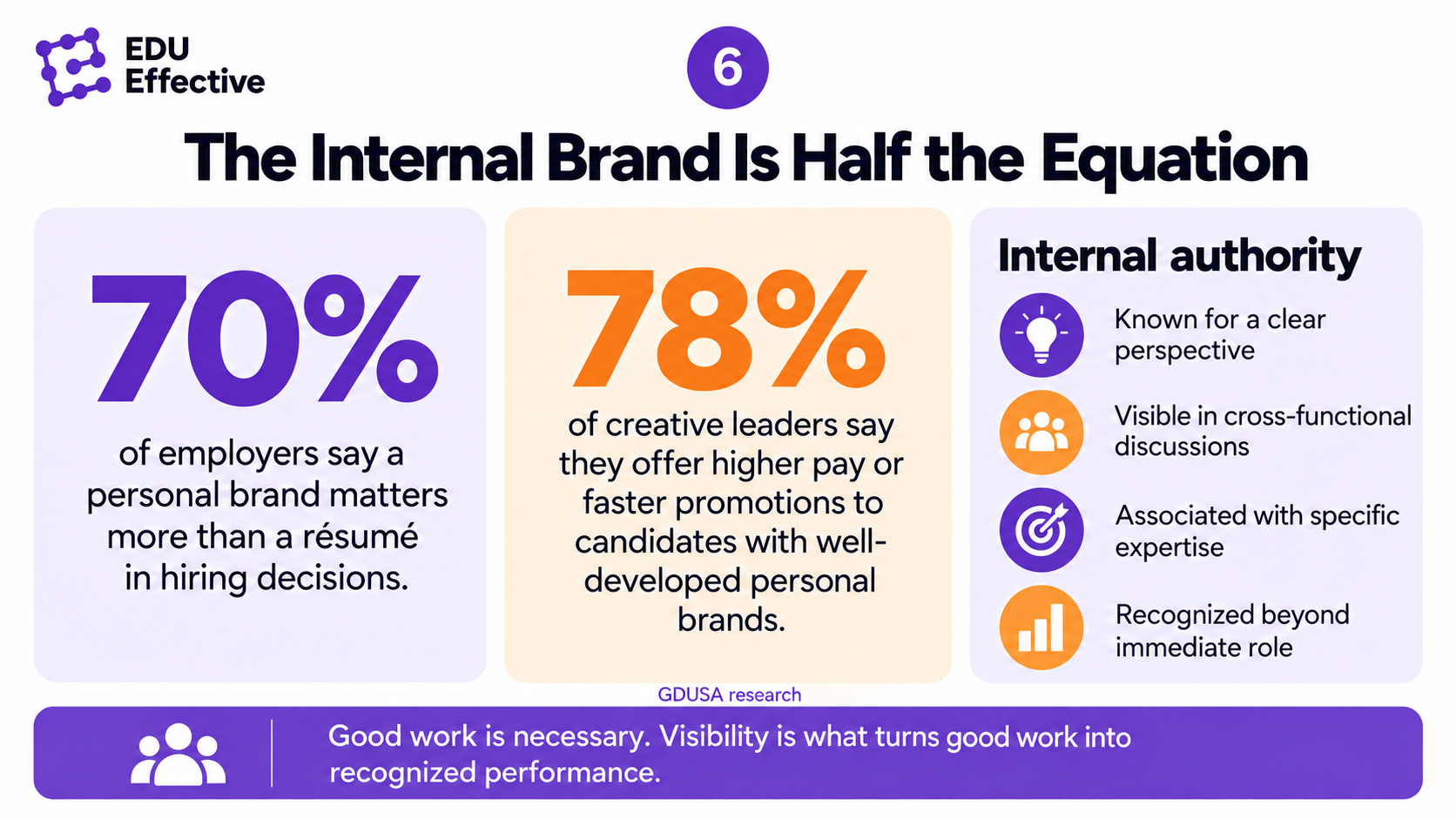
An executive with strong internal visibility — someone known for a clear perspective, recognized as a go-to resource on specific questions, visible to leadership above them — progresses differently than one who does equally good work invisibly. The work quality is necessary but not sufficient. The visibility is what converts good work into recognized performance.
This applies at every level of leadership, not just the C-suite. A director or VP who writes internal thought pieces, presents clear analyses in cross-functional meetings, and is consistently associated with specific expertise is building an internal brand that affects every promotion and assignment decision around them.
The Authenticity Problem
Sixty-two percent of business leaders say personal and brand storytelling improves client retention and lifetime value. Eighty-six percent of consumers say authenticity influences which brands they support.
These numbers describe a real dynamic. They also describe why executive personal branding done poorly produces nothing useful. Generic content, borrowed frameworks, and posts that could have been written by anyone about anything create visibility without credibility. They can actually damage perception by signaling that the executive has nothing original to say.
The credibility test is simple: could someone else have written exactly this? If yes, it is not personal branding. It is content production.
The executives who build real authority have a recognizable voice, take positions, describe specific experiences, and maintain consistency over time. Their brand is not a polished version of themselves — it is an accurate version, made visible. That distinction matters because audiences, especially professional ones, are good at detecting the difference.
Where to Start if You Haven’t
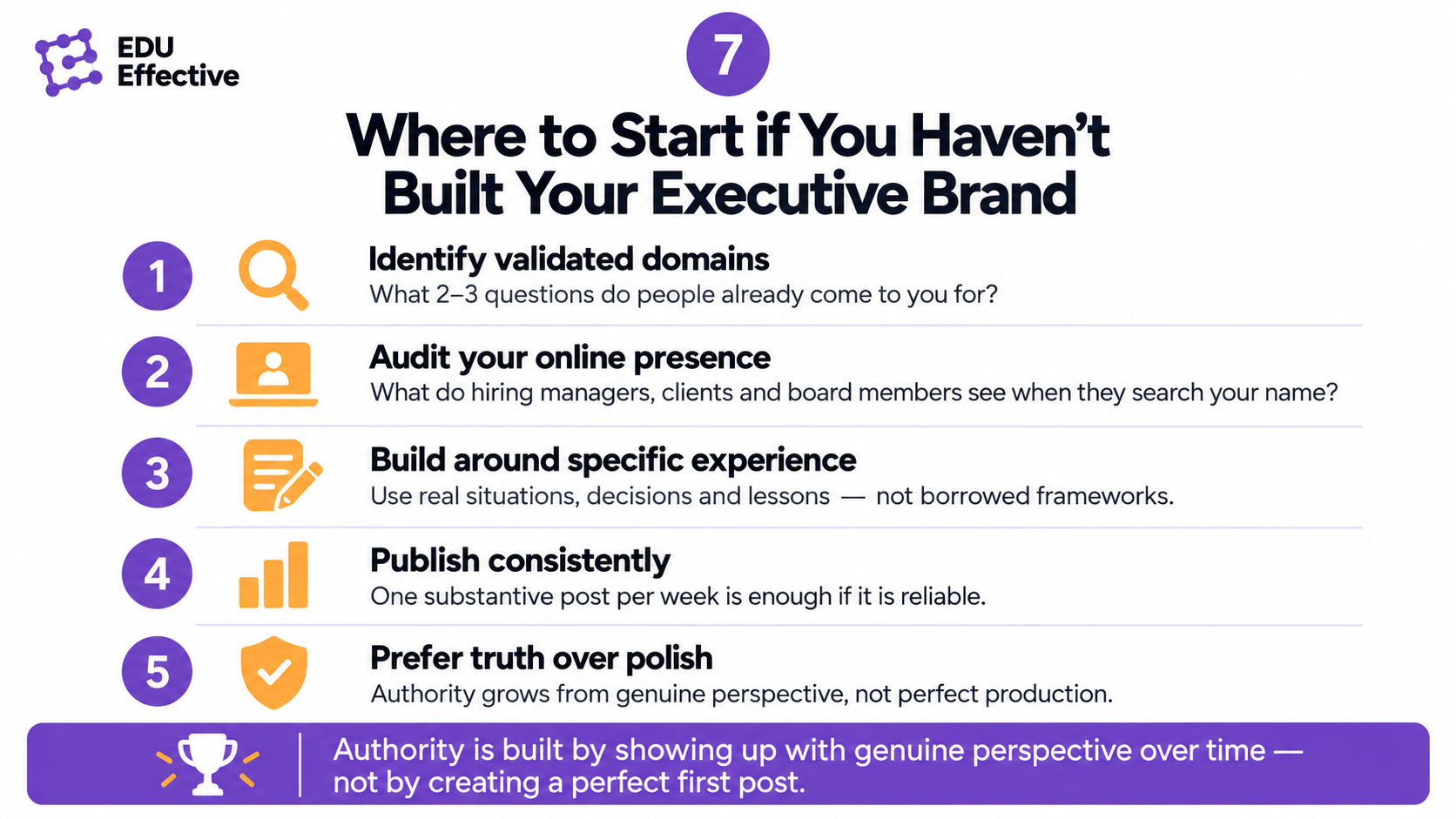
The practical starting point for any executive building a LinkedIn presence from scratch is to identify two to three questions people ask you in professional settings — problems you are routinely brought into, areas where colleagues or clients seek your perspective. These are the domains where your thought leadership is already validated by real demand. Start there.
The second step is to audit what currently exists under your name online. This is what hiring managers, prospective clients, and board members see when they search for you. If what exists is thin or outdated, the gap between your actual expertise and your visible expertise is a liability.
The third step is consistency over performance. The biggest error executives make when they start publishing is trying to produce something impressive. The more useful goal is producing something true and specific, reliably. Authority is built by showing up with genuine perspective over time — not by producing the perfect first post.
For a channel-level playbook on how professional brands earn attention, see our guide to what works on social media for professional brands.
How EDU Effective Supports Executives Building Visibility
Building executive presence and personal brand alongside professional leadership capability is exactly what the EDU Effective programs are designed for.
The Effective MBA: Online Marketing covers the strategic and tactical dimensions of content, positioning, and audience development — including the LinkedIn and thought leadership frameworks that drive B2B executive visibility.
The Effective MBA: Executive Management & Leadership builds the leadership and strategic communication frameworks that underpin credible executive presence across internal and external audiences.
All programs are 100% online, micro-learning format, and built for working professionals who cannot step away from their roles to study.
The visibility that creates opportunity doesn’t build itself. Join EDU Effective Business School and develop the expertise and presence that puts you in rooms you aren’t currently in.
About EDU Effective Business School
EDU Effective Business School exists for professionals who want measurable progress inside their own organization. Runs on 15 minutes a day, completes in 10 months or less and is ASIC accredited.
Compare the programs · Read student reviews · Request a place
Sources
- Edelman / LinkedIn — 2025 B2B Thought Leadership Impact Report Survey of B2B buyers and decision-makers; findings on thought leadership ROI, vendor vetting behavior, and sales receptiveness. https://www.edelman.com/expertise/Business-Marketing/2025-b2b-thought-leadership-report
- Weber Shandwick — Executive Reputation research CEO personal brand and market value attribution data. https://webershandwick.com/wp-content/uploads/2026/03/ceo-reputation-premium-executive-summary-3.pdf
- CareerBuilder — Online presence and interview decisions research https://www.careerbuilder.com/advice/blog/not-getting-job-offers-tips-for-social-media-and-job-hunting
- GDUSA — Creative leaders survey on personal branding and compensation decisions https://gdusa.com/lucy-marino-2026-salary-and-compensation-trends-for-creatives/
- LinkedIn / Oktopost — Employee advocacy reach and conversion data https://www.oktopost.com/blog/employee-advocacy-statistics-2026/
- Wave Connect — Personal Branding Statistics You Should Know in 2026 https://wavecnct.com/blogs/personal-branding-statistics