

There is a threshold that every manager eventually faces. The techniques that made them effective as a team lead — clear instructions, close oversight, personal technical expertise — stop working as reliably as the scope of responsibility grows. The team gets larger. The decisions get more consequential. The environment gets more uncertain. And the leadership style that worked well in a defined, stable role starts to create friction in a broader, more complex one.
This threshold is where executive management begins. And in 2026, crossing it successfully requires a different and more demanding set of skills than it did even five years ago.
What executive management actually means
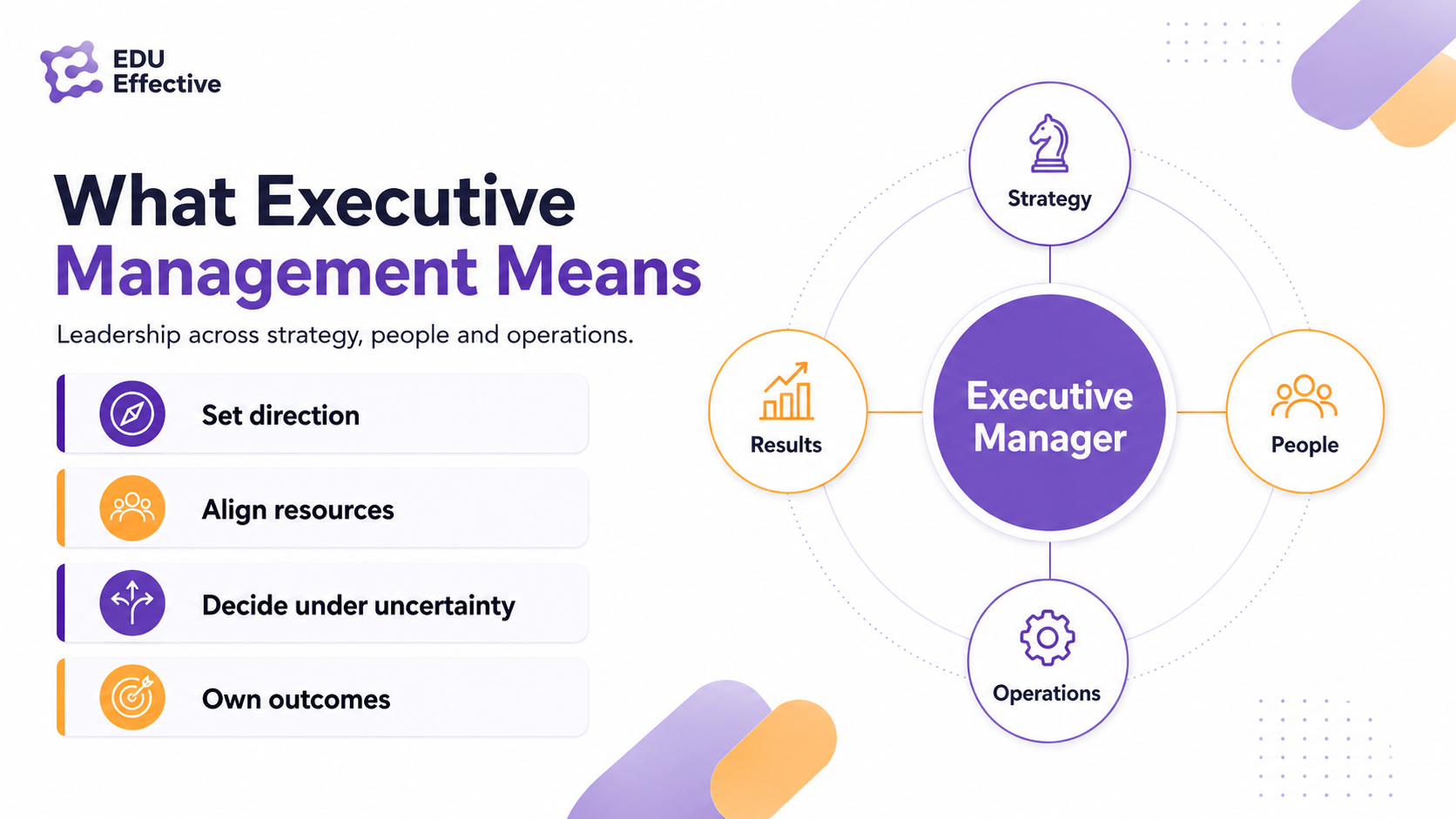
Executive management refers to the leadership and coordination of an organisation's — or a significant part of an organisation's — strategy, people, and operations by senior leaders who are accountable for results across functions, teams, and time horizons.
The term "executive" signals the scope: executive managers are not just responsible for their own outputs or their immediate team's performance. They are responsible for aligning people, resources, and processes toward strategic objectives that extend beyond any single project or quarter. They set direction, make high-stakes decisions with incomplete information, build organisational culture, and are ultimately accountable for outcomes they cannot fully control.
This is a meaningfully different challenge from management at the team level — and it requires a meaningfully different skill set.
Strategic thinking: the foundational executive skill
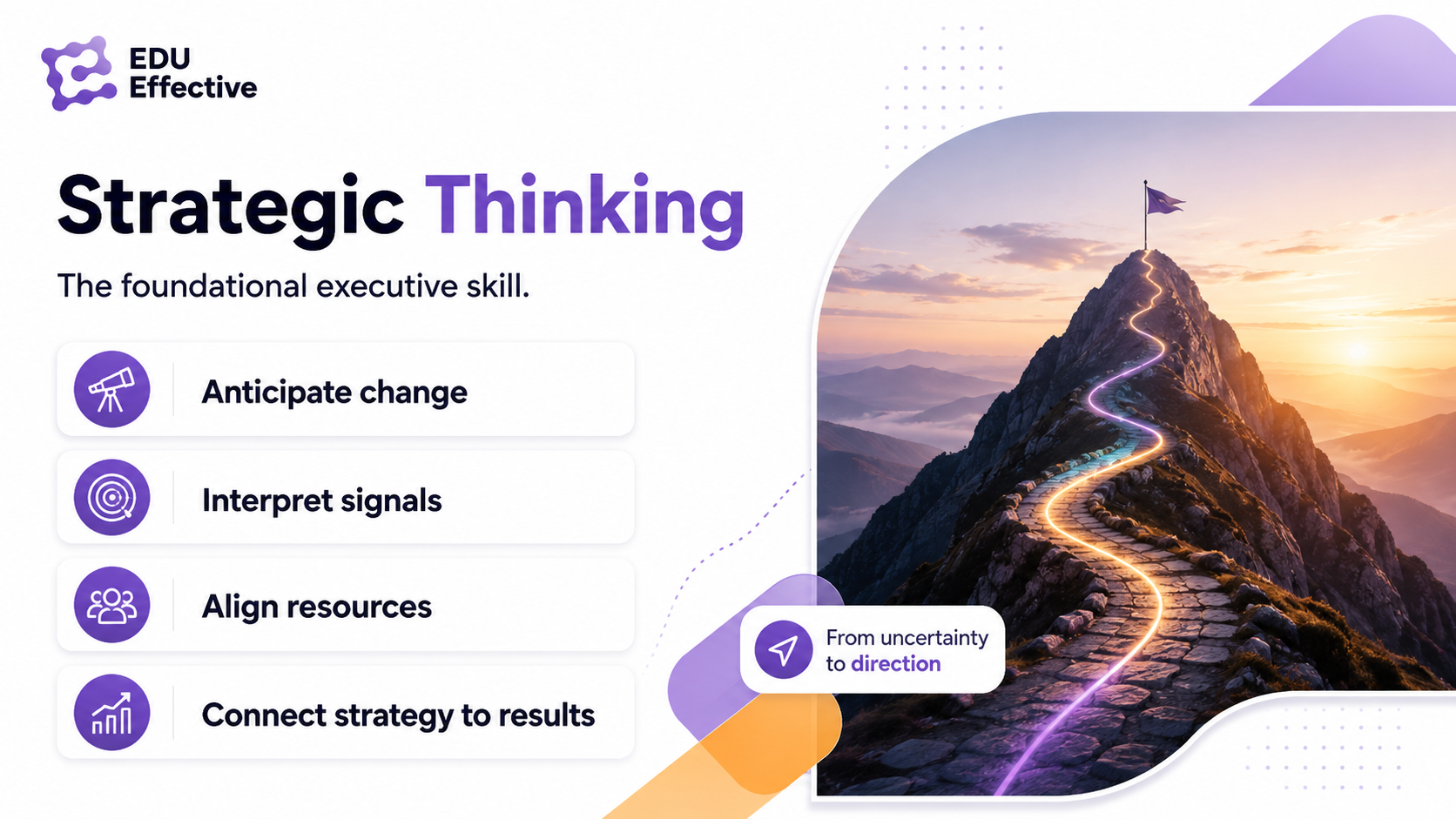
The most consistently cited differentiator of effective executive leaders in 2026 is the capacity for strategic thinking. DDI's 2026 Leadership Trends research identifies adaptability as the defining capability separating leaders who thrive from those who stall — particularly as organisations flatten their structures and demand broader cross-functional credibility from every senior leader.
Wharton School researchers Schoemaker, Krupp, and Howland, working with more than 20,000 executives, identified six skills that allow leaders to navigate uncertainty: the abilities to anticipate, challenge, interpret, decide, align, and learn. According to BCG's 2026 "AI at Work" survey, 78% of managers and executives now use AI regularly — but the leadership behaviours that make AI adoption stick (workflow redesign, team trust-building, governance) depend on the strategic thinking that distinguishes executive management from operational management.
McKinsey research on large-scale organisational transformations consistently shows that execution challenges remain one of the most common barriers to successful change. This has increased demand for leaders who can translate strategy into consistent operational execution — not just articulate a direction, but align people, resources, and processes to actually deliver it.
The World Economic Forum's Future of Jobs Report 2025 found that employers expect 39% of workers' core skills to change by 2030. In that environment, strategic thinking — the ability to anticipate change, interpret ambiguous signals, and make sound decisions under uncertainty — has become the competency that separates leaders who adapt from those who stall.
Strategic thinking also connects to the financial and marketing foundations that executive managers need: the ability to read a P&L, understand how resource allocation decisions translate into business outcomes, and evaluate market opportunities against organisational capability. Strategy without financial literacy is aspiration without accountability.
Leadership in the executive context: what changes at the top
Leadership at the executive level operates differently from leadership at the team level — not in its human essentials, but in its practical demands and consequences.
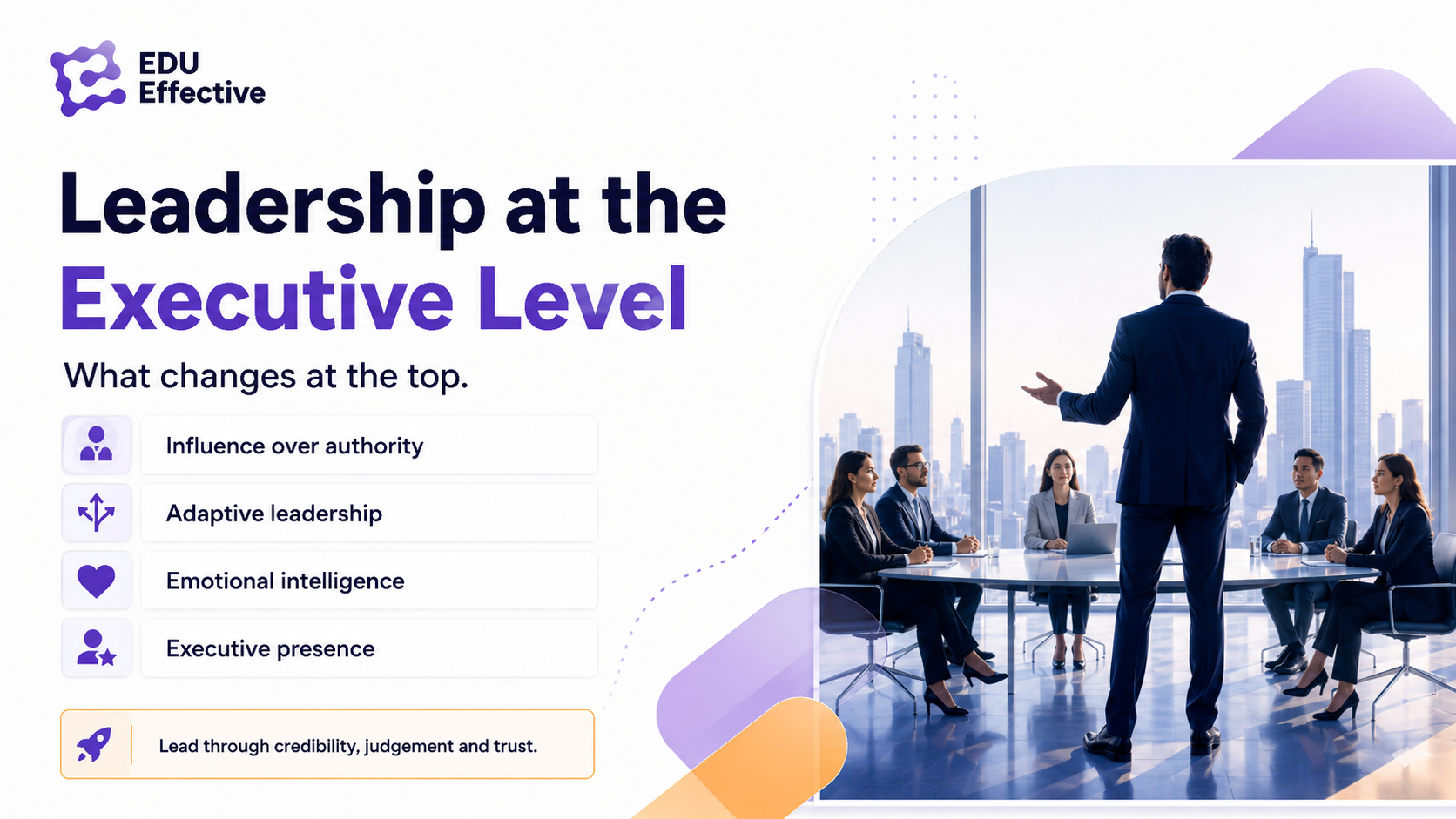
Influence becomes more important than authority. Executive leaders in 2026 typically need to achieve outcomes through people they do not directly manage: cross-functional peers, external partners, board members, regulators, and senior stakeholders with their own agendas. The ability to build credibility, communicate with clarity and impact, and persuade without coercing is not a soft skill — it is a core executive competency.
The leadership styles that produce the best results at executive level in 2026 tend to be adaptive rather than fixed. Research from DDI and IMD shows that leaders who navigate change most effectively are those who can shift between directive and collaborative approaches depending on context — being decisive when speed matters, consultative when buy-in matters, and coaching-oriented when development matters. Rigidity in leadership style is increasingly a liability.
Emotional intelligence — the capacity to read and regulate one's own emotional responses, and to accurately read and respond to the emotional states of others — has become a premium differentiator at the executive level. As AI systems take over more analytical and operational tasks, the irreducibly human capabilities of empathy, communication, connection, and contextual judgement become the primary source of executive value add. Culture alignment, executive presence, and stakeholder influence cannot be automated.
The AI imperative: what executive managers must understand in 2026
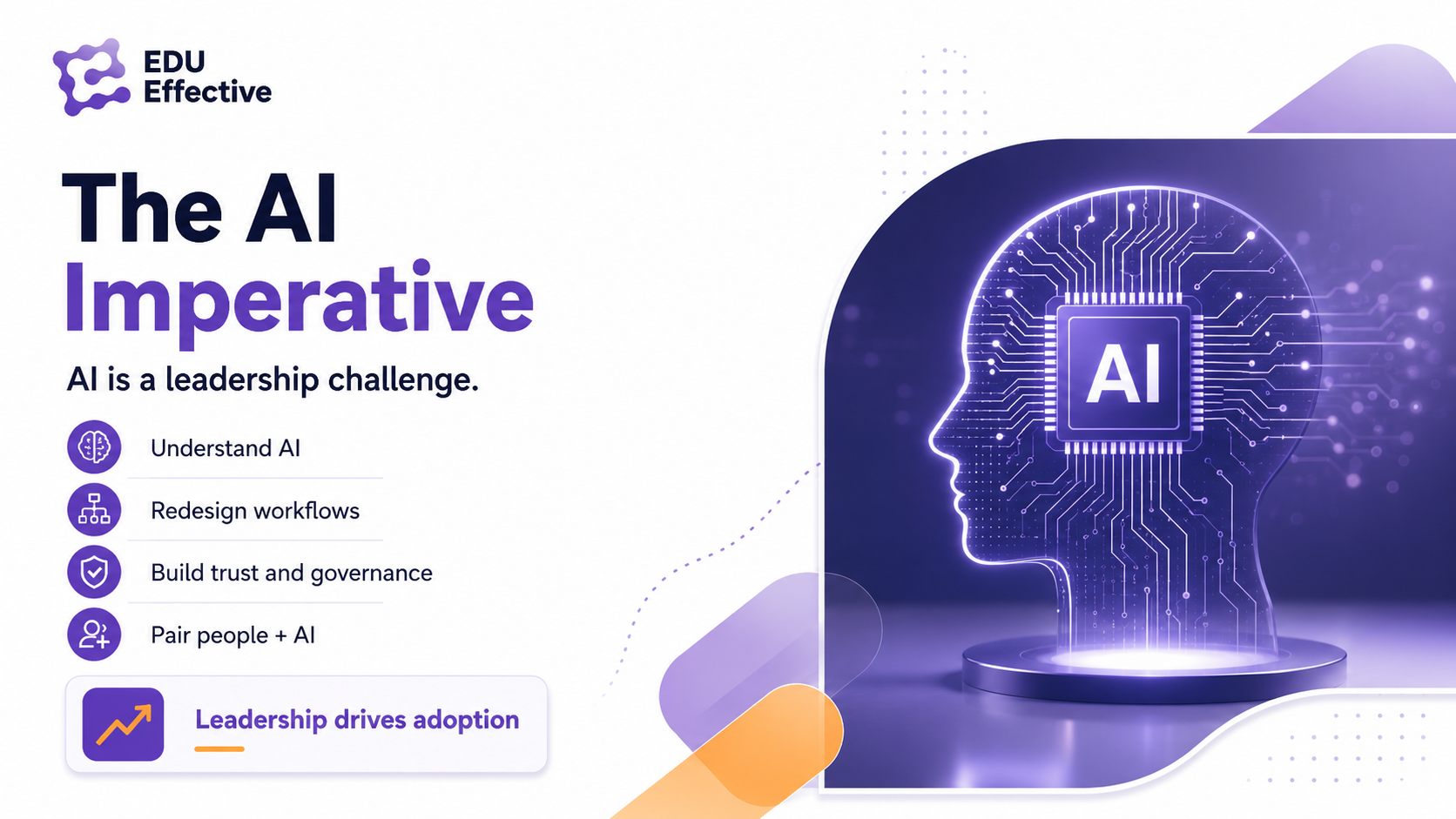
No treatment of executive management in 2026 is complete without addressing AI — not as a technology topic but as a leadership challenge.
75% of CEOs are now their organisation's primary decision-maker on AI strategy, according to BCG research. Companies expect to roughly double AI spending in 2026, from approximately 0.8% to 1.7% of revenue. According to PwC's 2026 AI Business Predictions, technology contributes only 20% of the value of an AI initiative — the remaining 80% comes from redesigning work so that AI handles routine tasks and humans focus on strategic priorities. That redesign is an executive management responsibility, not a technology department decision.
McKinsey's 2025 global survey found that nearly nine in ten organisations now use AI, yet two-thirds have not scaled it enterprise-wide. The high performers are those redesigning workflows and pairing efficiency gains with growth and innovation objectives — and this kind of redesign is led by managers, not technologists.
"Change fitness" — the ability to lead people through continuous transformation rather than one-time change programmes — has been identified by DDI, Gartner, and IMD as one of the most significant differentiators of effective executive leadership in 2026. Edelman's 2025 research shows significant divides by geography and income in how workers experience AI in the workplace — and clear evidence that positive workplace experiences with AI raise confidence while negative ones entrench resistance.
Managing hybrid and remote teams: the new executive default
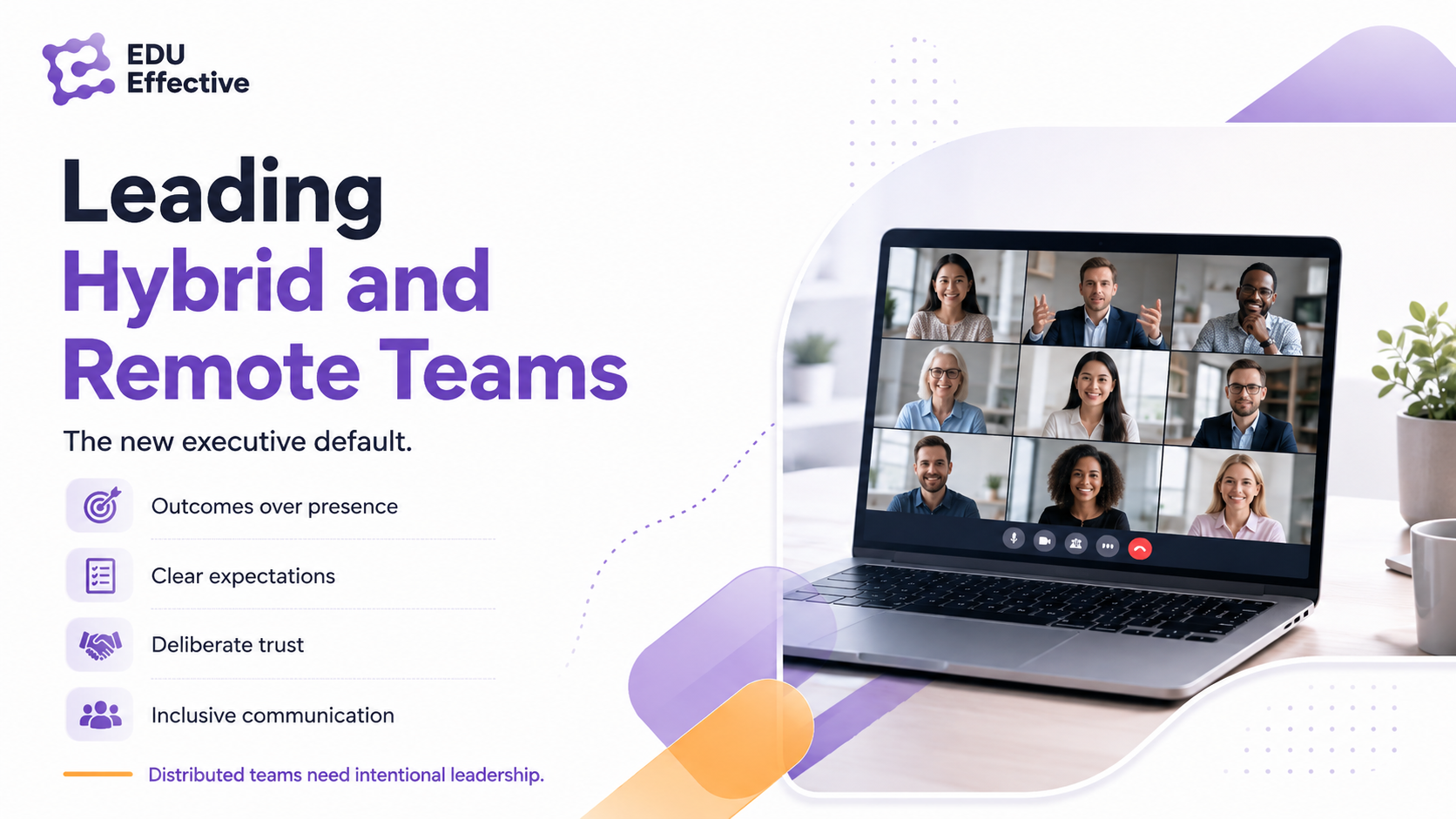
The normalisation of hybrid and remote work has fundamentally changed what executive management requires in practice. Leading teams that are geographically distributed, working across different time zones, and communicating primarily through digital channels demands different skills than leading a team in a shared office.
Hybrid performance management has shifted from presence-based to outcomes-based: the relevant question is no longer "is this person at their desk?" but "is this person delivering the outcomes we agreed, and growing in the direction we need?" Executive managers must define outcomes clearly, communicate expectations explicitly rather than assuming they are understood from cultural proximity, and develop the ability to spot performance problems — and performance potential — through digital signals rather than physical observation.
Trust becomes the operational currency of distributed teams in ways that collocated teams can take for granted. Instep UK's 2026 leadership research identifies hybrid performance management, inclusive practices, and deliberate trust-building as the three capabilities that most distinguish high-performing hybrid teams from struggling ones. Building psychological safety in a distributed environment requires structured check-ins, explicit inclusion practices, recognition of collaborative rather than only individual achievement, and consistent follow-through on commitments.
Decision-making under pressure and uncertainty
Senior managers make decisions faster, with less information, and with higher consequences than managers at earlier career stages. The quality of those decisions is one of the primary differentiators of executive performance.
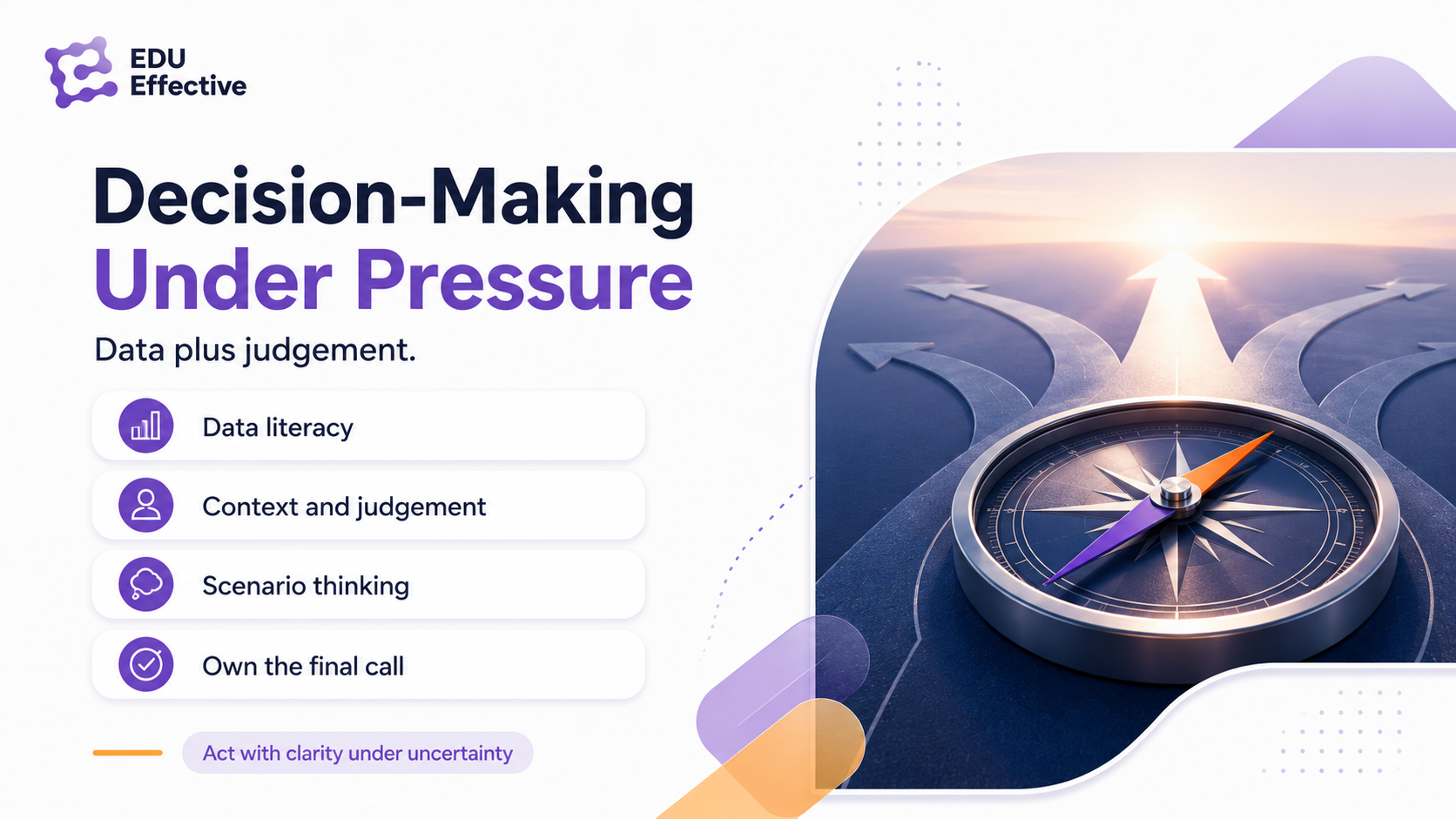
Effective executive decision-making in 2026 integrates two capabilities that were previously considered separate. Data literacy — the ability to extract meaningful signal from large volumes of data, question the assumptions behind analytics outputs, and understand the limits of data-driven conclusions — is now a baseline requirement at senior leadership level. Regents Training Centre's 2026 leadership competency research confirms that organisations specifically seek managers who can act without perfect data and adjust quickly as conditions change.
And judgement — the human capacity to weigh competing values, read context, apply ethical reasoning, and take accountability for decisions that data alone cannot determine — remains irreplaceable. AI-powered decision support tools are valuable, but they surface insights, not decisions. The executive manager's role is to take responsibility for the final call, with full awareness of what the data shows, what it cannot show, and what values are at stake in the choice.
Communication and executive presence
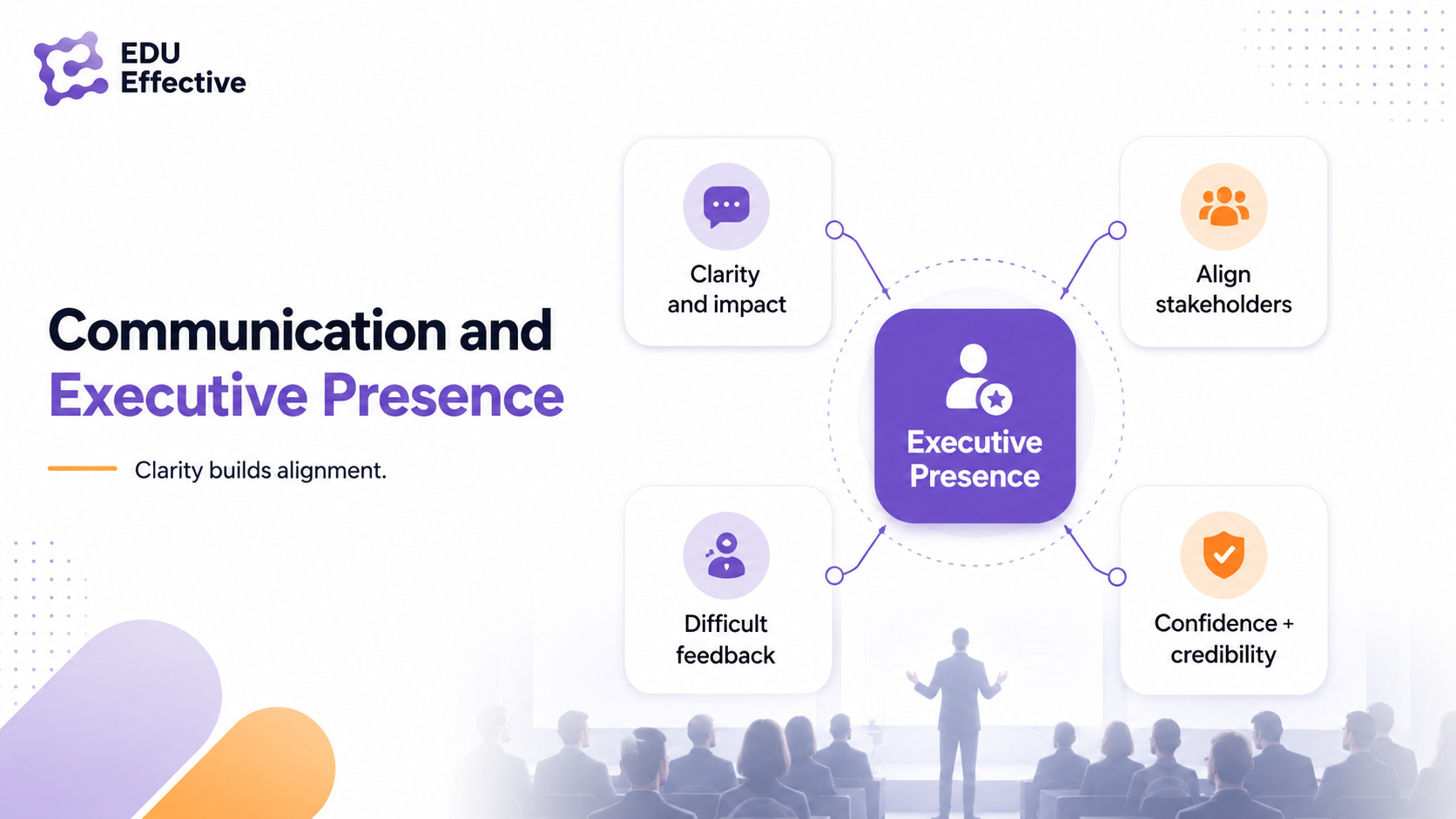
The ability to communicate with clarity and impact — in one-to-one conversations, team meetings, board presentations, organisational all-hands, and external stakeholder relationships — is consistently rated among the highest-priority executive management skills.
The World Economic Forum notes that communication has grown in strategic importance precisely as teams work across more locations, platforms, and departments than ever before. Strong executive communicators can simplify complex ideas, align teams around shared goals, and give difficult feedback in ways that build rather than damage the relationship.
Executive presence — the combination of confidence, composure, credibility, and authenticity that enables a leader to command attention and inspire trust — develops through experience but can also be deliberately built through structured feedback and practice. It is not a personality type. It is a set of behaviours and communication habits that can be learned and systematically improved.
Performance management: the most underdeveloped executive skill
Gartner's HR research found that 60% of employees are not getting the on-the-job coaching they need for skill development. This gap sits directly with managers — and at the executive level, the consequences compound across entire departments and organisations.
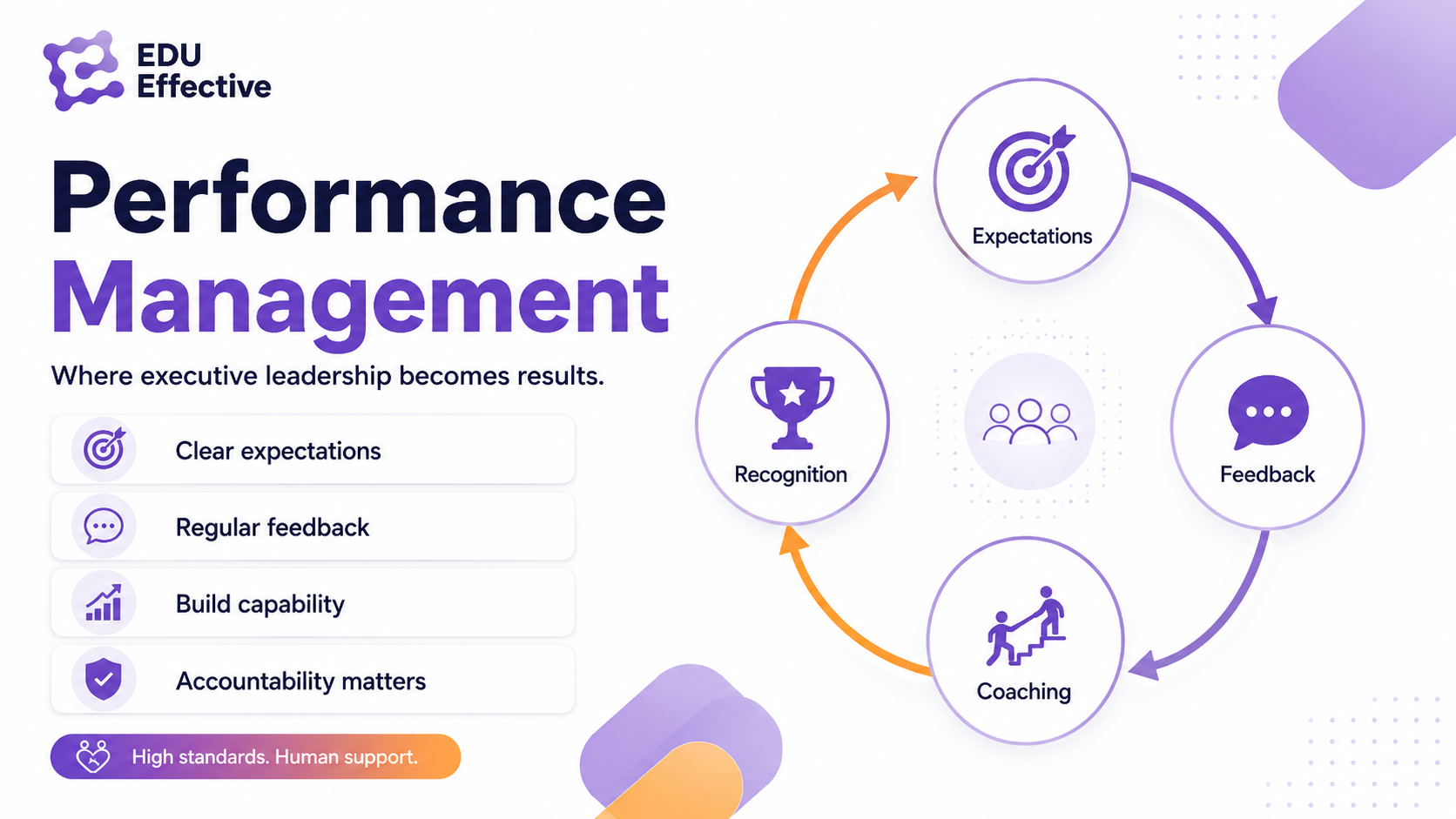
Executive managers who create a culture of clear expectations, honest feedback, and genuine accountability build teams that outperform consistently. Those who avoid performance conversations, provide only positive feedback, or allow underperformance to persist without intervention erode performance culture in ways that are slow to build and fast to damage.
Effective performance management in 2026 integrates regular structured feedback with genuine developmental intent — the aim is not simply to evaluate but to build capability. The executive who coaches team members through performance conversations rather than simply issuing assessments creates better outcomes for individuals, teams, and organisations simultaneously. Organisations that invest in manager coaching quality see measurably higher productivity in hybrid environments and faster, safer AI adoption — the leadership capability that compounds most reliably across functions.
Ready to build your executive management skills professionally?
If this article has made clear that executive management and leadership is a discipline — not just an experience — worth investing in deliberately, the Effective MBA: Executive Management & Leadership at EDU Effective is built precisely for this purpose.
The programme covers all 10 dimensions of modern executive management: strategic business foundations, managerial skills, leadership styles, coaching and mentoring, managerial communication, team management, remote team management, performance management, decision-making, and AI in management practice. Content draws on insights from practitioners at Google, Amazon, Microsoft, LinkedIn, Netflix, McKinsey, Goldman Sachs, Yale University, Stanford University, Princeton University, and many more — curated and structured for immediate application in your own role.
It is EDU Effective's bestselling programme — and with 75+ hours of required content delivered in 10–15 minute daily micro-modules, it is built specifically for the working professional who cannot take six months out of their career to study.
EDU Effective Business School — professional development for your long-term success.
All five best-selling Effective MBA programs are built on the same educational model — designed for working adults who need learning that fits real professional life:
- Effective MBA: Executive Management & Leadership
- Effective MBA: Applied Artificial Intelligence
- Effective MBA: Coaching, Leadership & Mentoring
- Effective MBA: Mastery in AI
- Effective MBA: Online Marketing
Every programme runs on 15 minutes a day, completes in 10 months or less, is ASIC accredited, and starts from €990.
These are professional programmes, not academic ones — built for working adults to apply what they learn directly in their own business, not to collect a scholarly credential.
Join more than 9,000 students in over 120 countries who are investing in their professional development and career success. Read the experiences of our graduates here.
Apply now — from €990 · Talk to a Study Advisor
Study with NO risk: 14-day money-back guarantee, no questions asked.
Sources
- DDI — Leadership Trends 2026
ddi.com/blog/leadership-trends-2026 - USAII — AI Leadership Trends 2026: What Executives Need to Know
usaii.org/ai-insights/ai-leadership-trends-2026-what-executives-need-to-know - Skyline G — Top 5 Leadership Trends for 2026: How AI is Reshaping Executive Coaching
skylineg.com/resources/blog/how-ai-reshaping-executive-coaching - Instep UK — 7 Key Leadership and Management Skills in 2026
instepuk.com/article/leadership-and-management-skills/ - Regents Training Centre — Future Leadership Competencies Companies Will Pay For in 2026
regentstc.com/knowledge-hub/blog/future-leadership-competencies-companies-will-pay-for-in-2026 - Rowan Blog — Leadership Skills for 2026: What Professionals Need
rowanblog.com/2026/06/skills-every-leader-needs/ - Constellation Search — The Future of Executive Search: Trends to Watch in 2026
constellationsearch.net/resources/blog/future-of-executive-search-trends-2026/ - Wavelength Leadership — Leadership Trends 2026: 5 Critical Shifts
wavelengthleadership.com/general/leadership-trends-2026-the-5-strategic-shifts-defining-the-future/ - TTI Success Insights — Top Workforce Trends for Leaders in 2026
ttisi.com/blog/top-workforce-trends-for-leaders-in-2026/ - Forbes — 5 Leadership Trends That Could Shape 2026
forbes.com/sites/sallypercy/2025/12/08/5-leadership-trends-that-could-shape-2026/ - Breakfast Leadership / Gartner — Adaptive Leadership in a Volatile World
breakfastleadership.com/blog/adaptive-leadership-in-a-volatile-world-lessons-from-gartners-q4-2025-report - World Economic Forum — Future of Jobs Report 2025
weforum.org/publications/the-future-of-jobs-report-2025/