
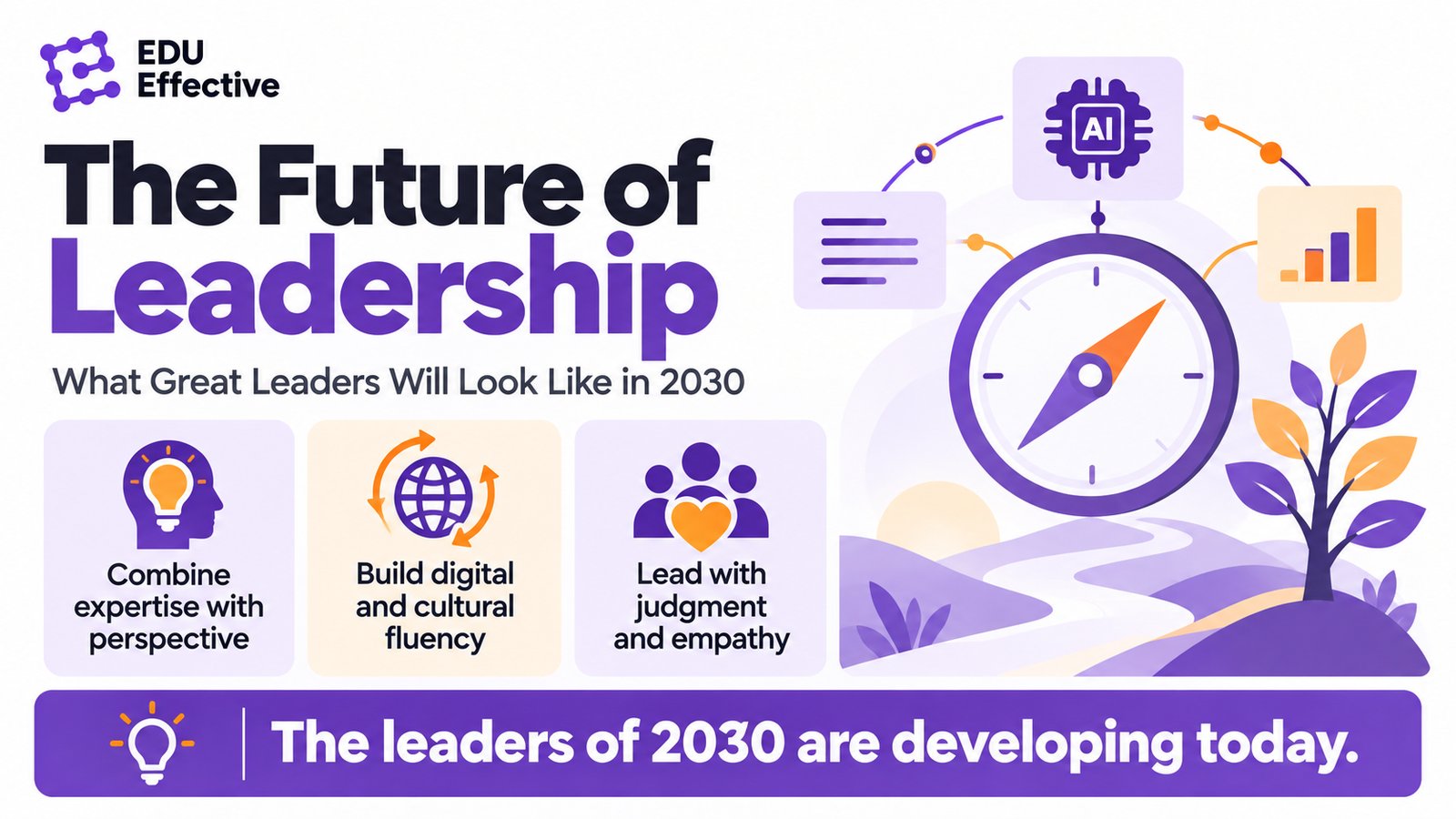

Leadership has always been hard to define precisely. But the gap between what made a great leader in 2015 and what will make one in 2030 is wider than most organizations are ready to acknowledge.
The World Economic Forum's Future of Jobs Report 2025 identified leadership and social influence among the fastest-growing skill categories through 2030. That sounds reassuring, until you look at what that actually means in practice. It's not a validation of leadership as we've known it. It's a signal that leadership is being redefined around capabilities most current managers were never developed for.
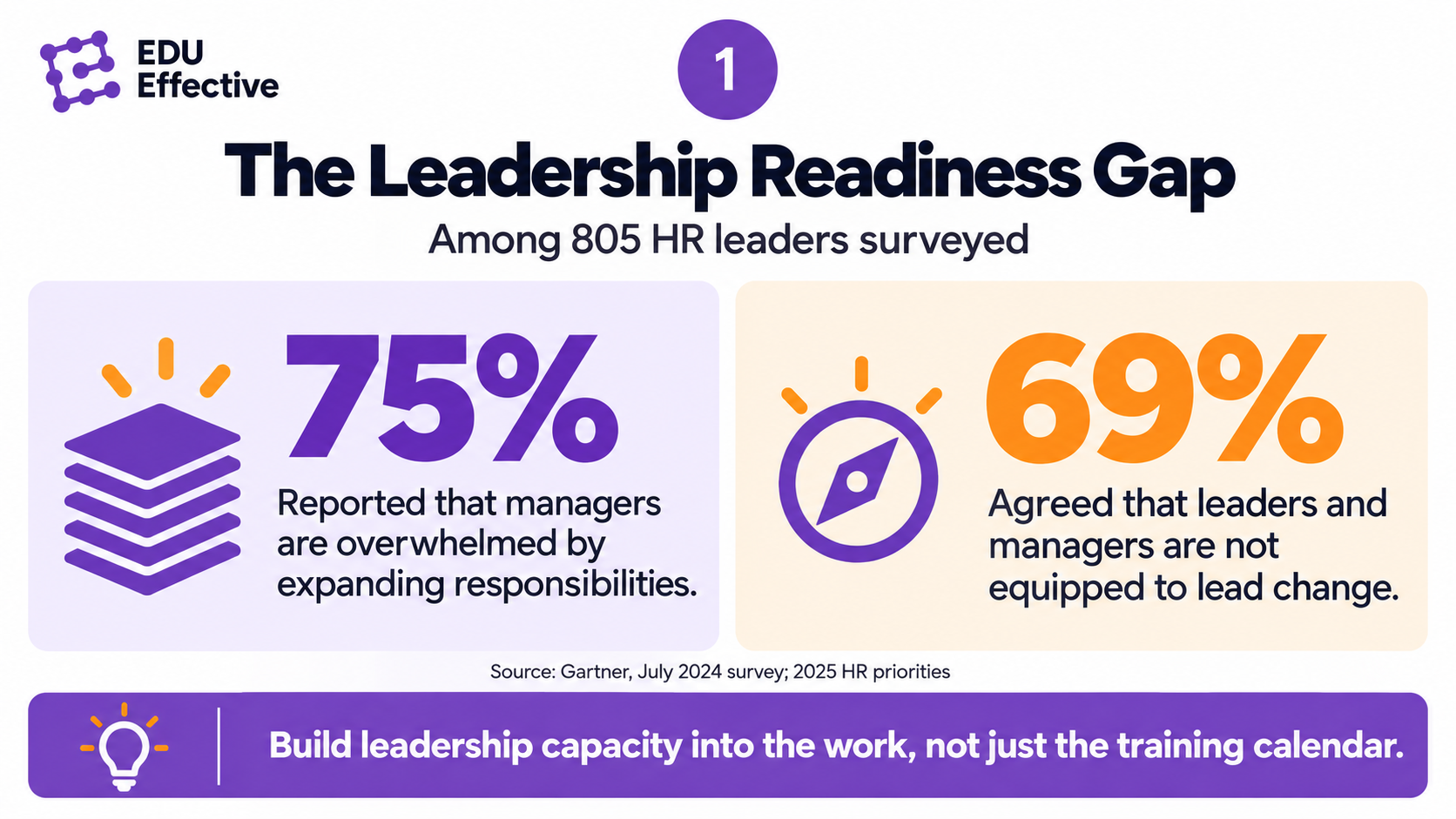
Gartner's 2025 survey of 1,403 HR leaders put leader and manager development at the top of HR priorities for the third consecutive year. 75% of organizations have made significant updates to their leadership development programs, and more than half are spending more on it than before. The uncomfortable finding: they are not seeing results. Traditional development formats, seminars, lectures, one-off workshops, show negative effects on actual development, according to Gartner's analysis.
The model isn't working. What replaces it matters enormously.
What's actually changing
Three structural forces are reshaping what leadership requires.
AI is absorbing analytical and operational work. The tasks that used to signal managerial competence, such as synthesizing information, tracking project status, running variance analysis, drafting communications, are increasingly handled by AI systems. This doesn't eliminate the need for leaders. It changes the premium. If AI handles the analytical layer, the leader's distinctive contribution has to come from judgment, context, and human connection, the things AI cannot replicate.
Organizational structures are flattening and becoming more fluid. Hybrid work, distributed teams, project-based structures, and faster organizational change cycles mean that positional authority, telling people what to do because of your title, works less reliably. Influence, trust, and clarity of direction matter more than hierarchy.
The workforce expects something different. Younger employees don't separate their professional development from their sense of meaning at work. They expect leaders who invest in their growth, explain decisions rather than just announce them, and create environments where they can contribute rather than just execute. Gallup's research has documented for years that the most powerful driver of employee engagement is the quality of the relationship with the immediate manager, not company strategy, culture initiatives, or compensation.
The five competencies that define 2030 leadership
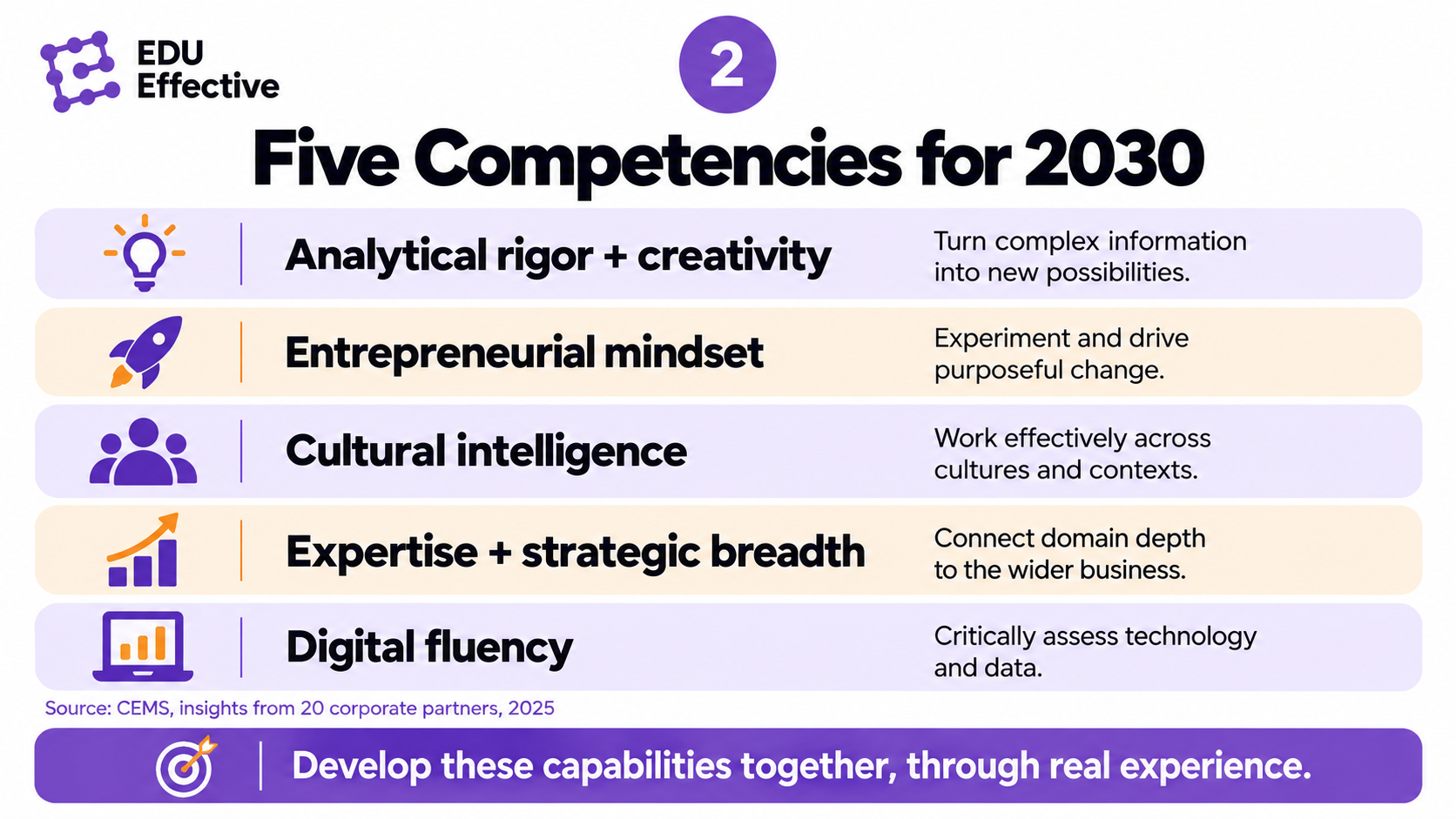
CEMS, the Global Alliance in Management Education, a network of 34 business schools, interviewed 20 multinational corporate partner organizations and identified five leadership competencies that employers now see as genuinely differentiating. Not hygiene factors. Not nice-to-haves. The skills that will separate effective leaders from technically capable managers.
1. Analytical rigor combined with creative application
Data literacy is now a baseline expectation, not a differentiator. What sets leaders apart is what they do with data: the ability to translate complex, ambiguous information into bold decisions under uncertainty. CEMS corporate partners explicitly identified creative thinking as a key differentiator from AI-driven decision-making. The leader who asks better questions, challenges the model's assumptions, and synthesizes quantitative signals with qualitative context will outperform the leader who optimizes within the existing frame.
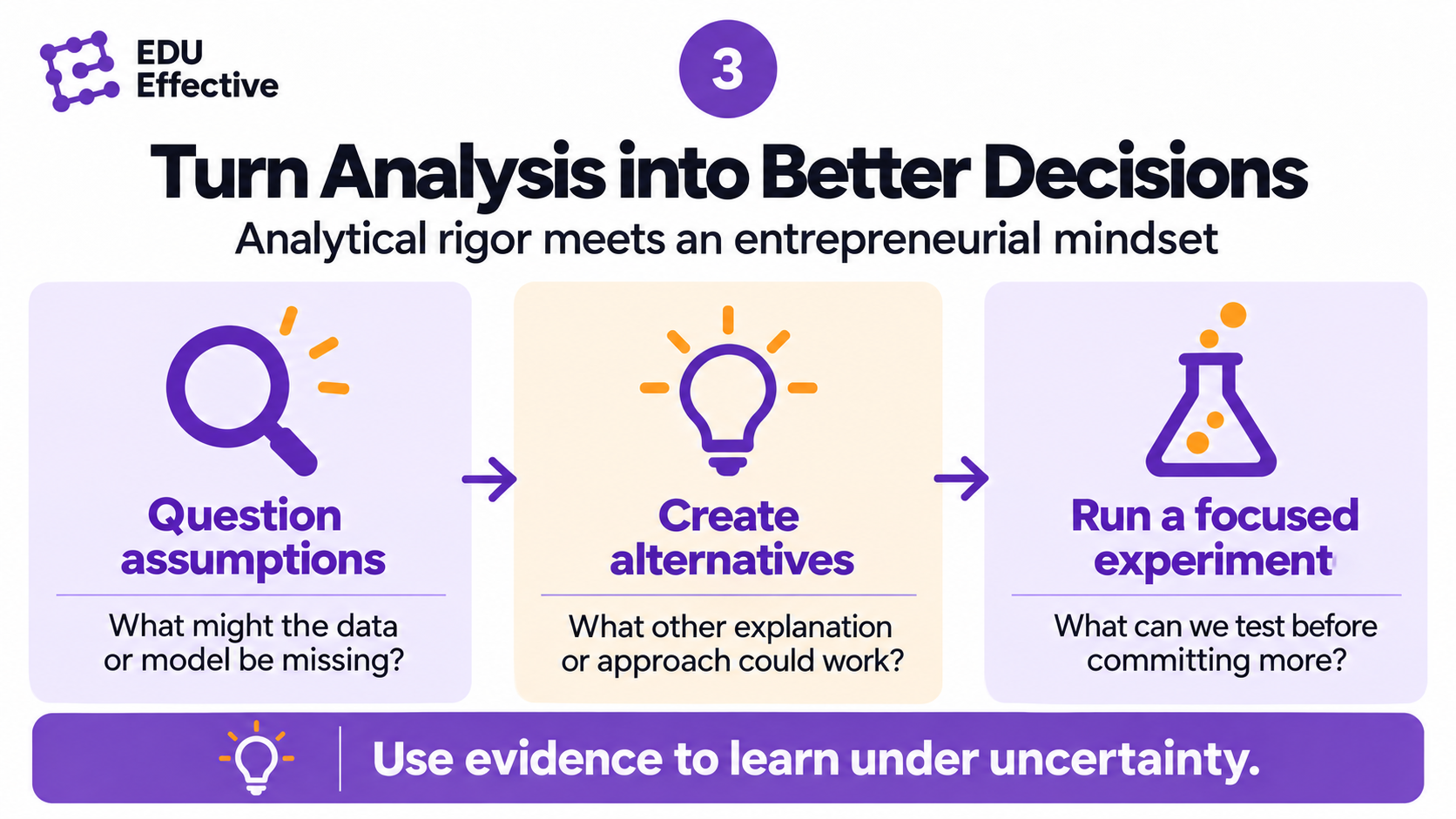
This combination, analytical depth with creative application, is rare precisely because most development programs optimize for one or the other, not both.
2. Entrepreneurial mindset
The organizations that participated in the CEMS study weren't asking for founders. They were asking for leaders who question traditional business models, stay resourceful in ambiguous conditions, and drive purposeful change without waiting for perfect information or explicit permission.
Entrepreneurial mindset in a corporate leader looks like: identifying problems the organization hasn't articulated yet, proposing experiments rather than polished plans, tolerating the discomfort of uncertainty longer than peers, and treating failure as data rather than verdict. These aren't personality traits. They're behaviors that can be developed, and that most traditional management training actively discourages.
3. Cultural intelligence
Cultural intelligence (CQ), the ability to work effectively across national, professional, and generational cultures, is moving from a nice credential to a structural requirement. Global supply chains, distributed teams, international markets, and workforces spanning four generations mean that a leader who can only function in their own cultural context is limited in ways that directly constrain the organization.
CEMS corporate partners see this as foundational for building consensus in a more fragmented world. The leaders who succeed in complex multi-stakeholder environments, navigating regulatory differences, managing internationally distributed teams, building coalitions across functions with competing priorities, are the ones with practiced cultural fluency. That fluency is built through experience, not lectures.
4. Deep expertise combined with strategic breadth
The old tension between the specialist and the generalist is being resolved, not by picking one, but by requiring both. CEMS employers expect leaders to bring genuine depth in their domain alongside the strategic, ethical, and systems-level thinking that connects that depth to broader organizational context.
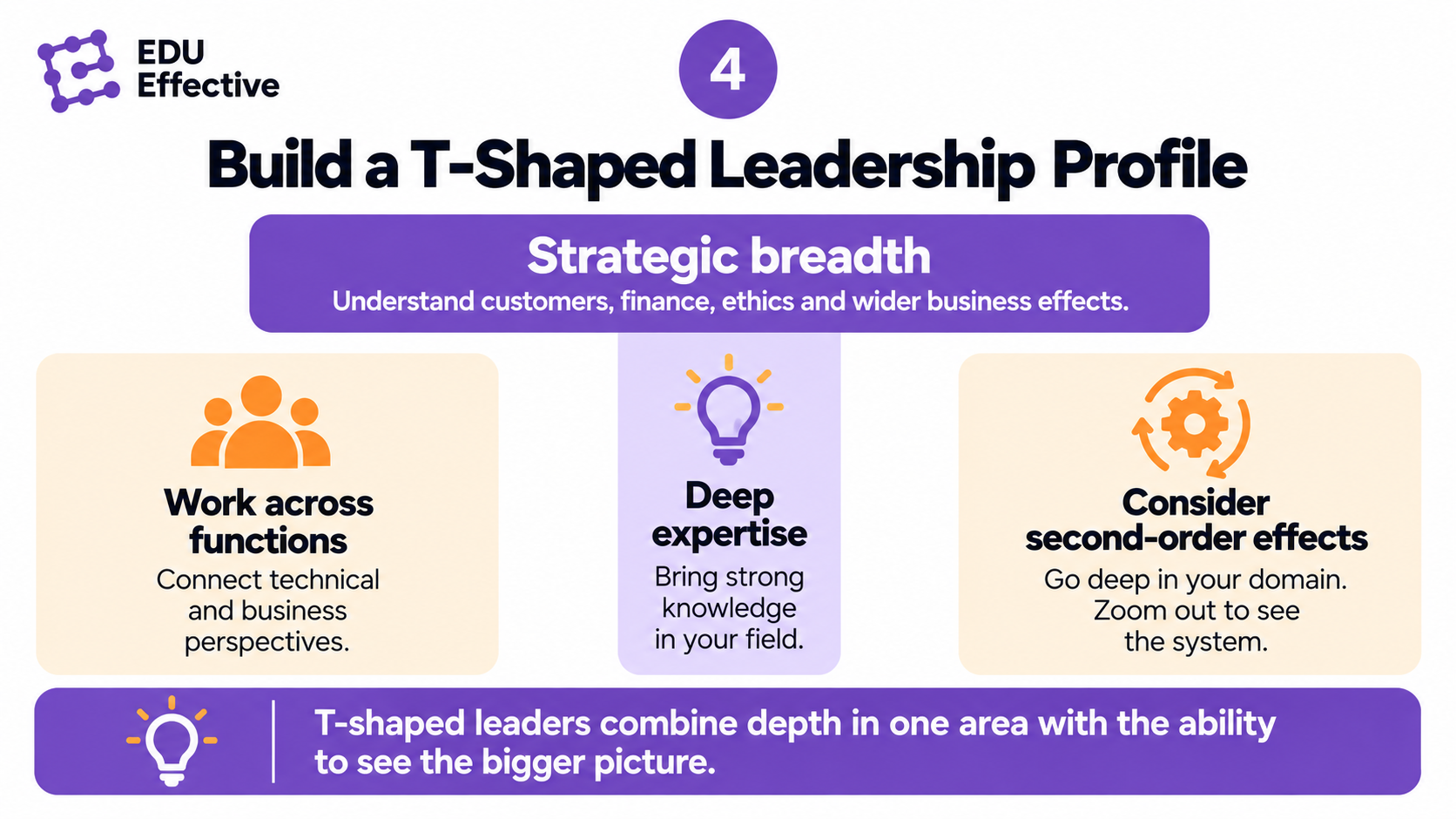
This describes what is sometimes called the T-shaped leader: deep vertical expertise in one area, combined with enough horizontal breadth to collaborate across functions, understand the second-order effects of decisions, and translate between technical and business frames. Neither specialist nor generalist alone is sufficient. The ability to go deep and then zoom out, and to do it quickly, is the specific capability that creates value at senior levels.
5. Digital fluency
Digital fluency is not the same as technical skill. Leaders don't need to code. They need to understand what AI and data systems can and can't do, ask informed questions about their limitations, and make decisions about where and how to deploy them, without being dependent on engineers to translate.
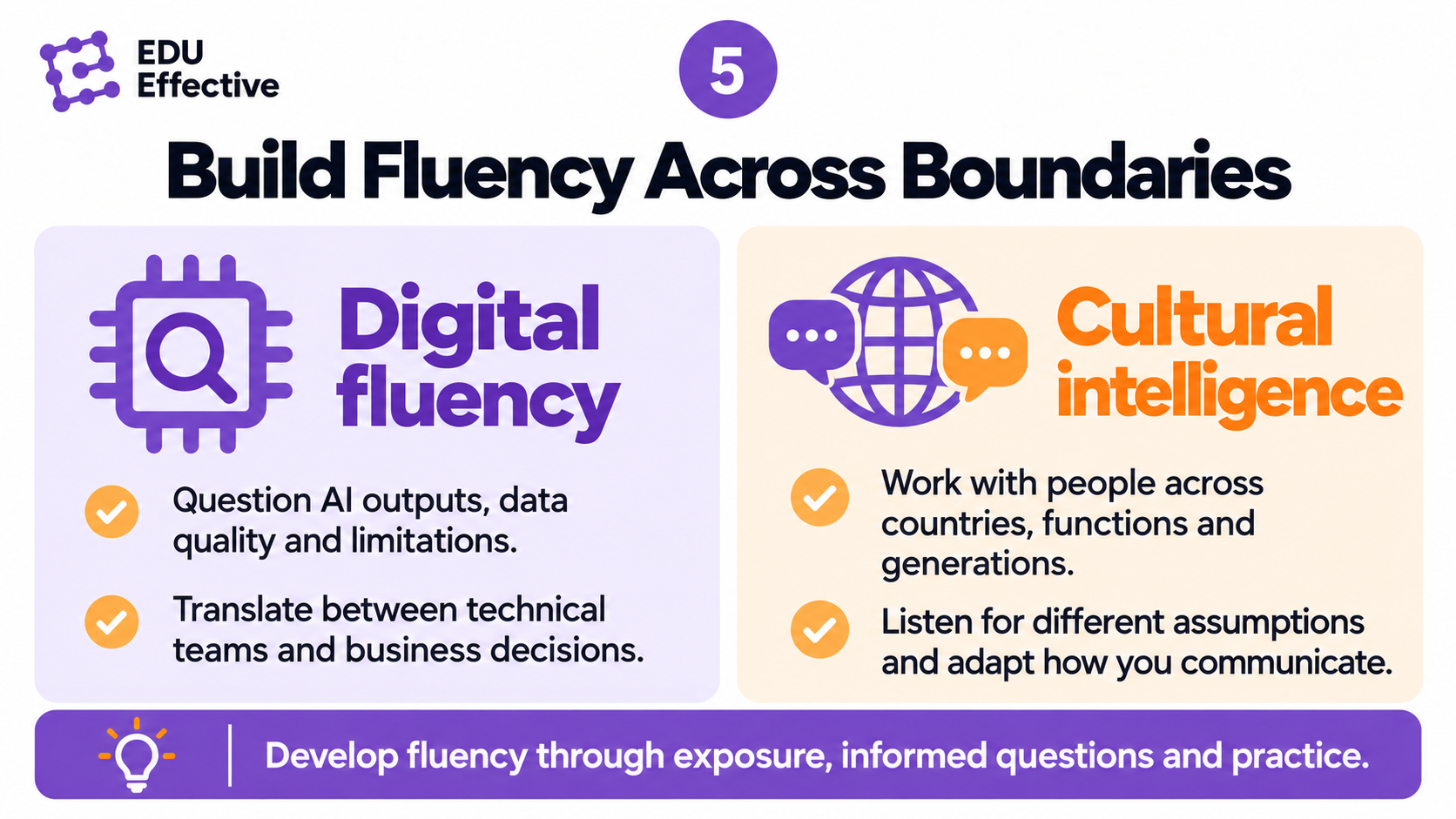
Gartner found that 69% of HR leaders believe leaders and managers are not equipped to lead change, and much of the change they're not equipped for is technological. The leader who understands enough about machine learning to question a model's training data, or enough about automation to identify where it would break a workflow rather than improve it, has a real advantage over the leader who nods at technical presentations without actually understanding them.
The human-centered layer: what doesn't change
Every source on future leadership eventually arrives at the same conclusion: the competitive advantage of human leaders over AI systems is irreducibly human. Empathy, moral judgment, genuine presence, the ability to hold paradoxes and sit with ambiguity, these are the capabilities that AI augments but cannot replace.
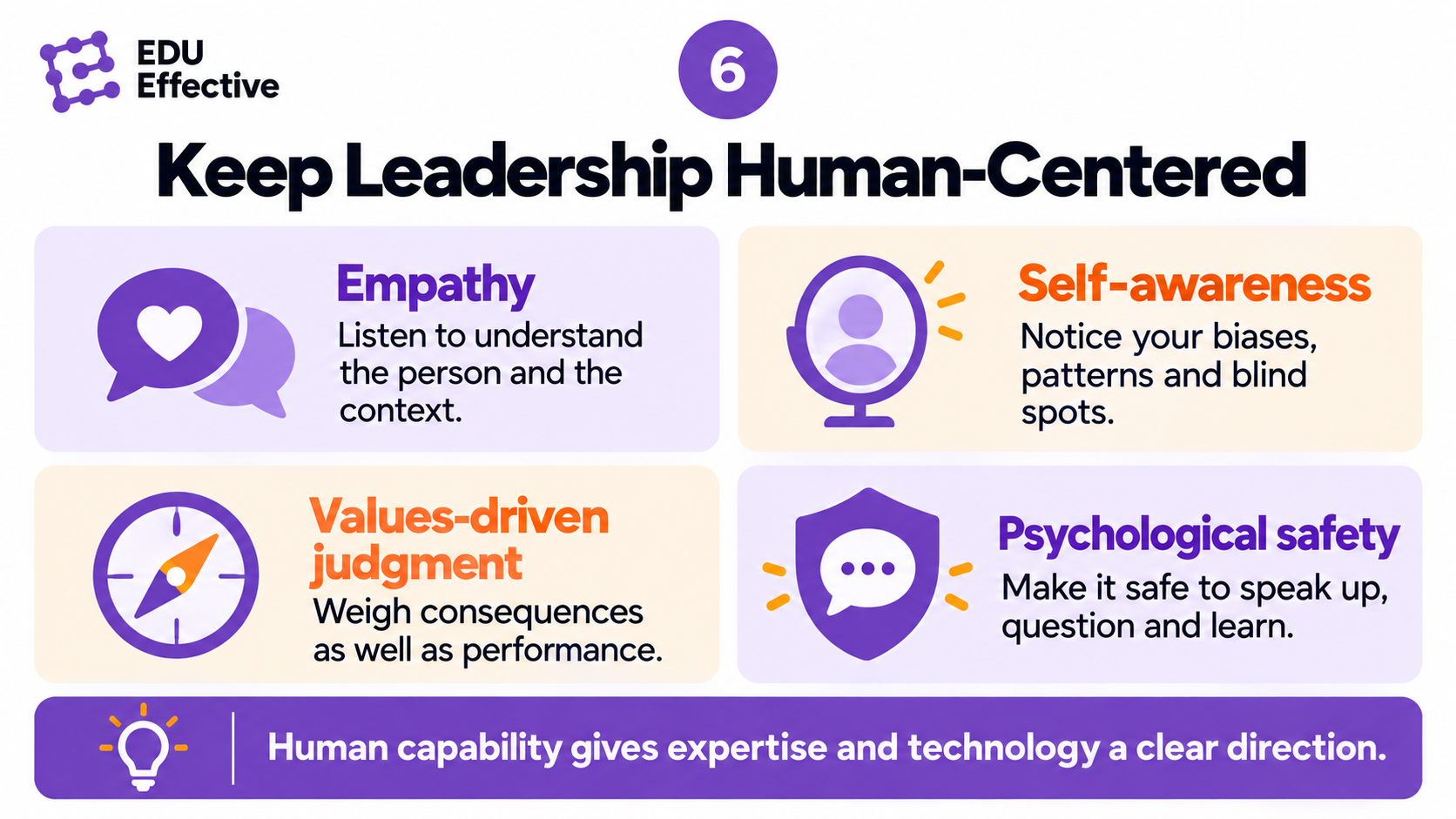
CEMS corporate partners consistently named resilience, adaptability, humility, emotional intelligence, and values-driven leadership as foundational for 2030. These aren't soft competencies in contrast to hard ones. They're the substrate on which everything else rests.
Self-awareness was specifically highlighted, the ability to understand your own patterns, biases, and blind spots clearly enough to adjust them. Leaders who lack self-awareness make confident decisions based on distorted information. Leaders who cultivate it make better decisions and develop others more effectively.
Psychological safety, the environment leaders create rather than the skills they have, emerged consistently as a condition for high performance. Google's Project Aristotle research identified it as the most important factor in team effectiveness, above talent density, process quality, or resource availability. A leader who has every competency on the CEMS list but creates an environment where people are afraid to speak up will underperform a leader with average competencies who creates genuine safety.
Why current leadership development is failing
Gartner's finding that traditional leadership development formats have a negative effect on development is worth sitting with. More than 75% of organizations have updated their programs. More than half are spending more. And they're not seeing results.
The structural problems:
Classroom learning doesn't transfer. A two-day seminar on executive presence or change management produces self-reported confidence gains that fade within 90 days without reinforced application. The learning was real; the transfer was absent.
Development is event-based, not continuous. Leaders are sent on programs once a year. The remaining 48 weeks, the development stops. High-performing development systems embed learning into the rhythm of work: regular reflection, peer feedback, structured experience-based challenges, coaching conversations that happen weekly rather than annually.
Managers are too overwhelmed to develop. Gartner found that 75% of HR leaders say managers are overwhelmed by expanded responsibilities. A manager running 10 direct reports, delivering on quarterly targets, and navigating organizational change doesn't have cognitive capacity for development programs that add to the load. Effective development reduces load while building capacity. It doesn't add another obligation.
The content targets the wrong capabilities. Programs designed for 2010 leadership challenges are still running in 2026. Digital fluency, AI literacy, managing distributed teams, and navigating AI-driven organizational change are underrepresented in most corporate curricula.
What effective leadership development looks like
Gartner recommends building repeated peer connections through networking and team building as the most effective development mechanism, not programs, peer relationships. CEMS corporate partners emphasized hands-on international experience as the primary way to build cultural intelligence. Both point in the same direction: development through experience and connection, not content consumption.
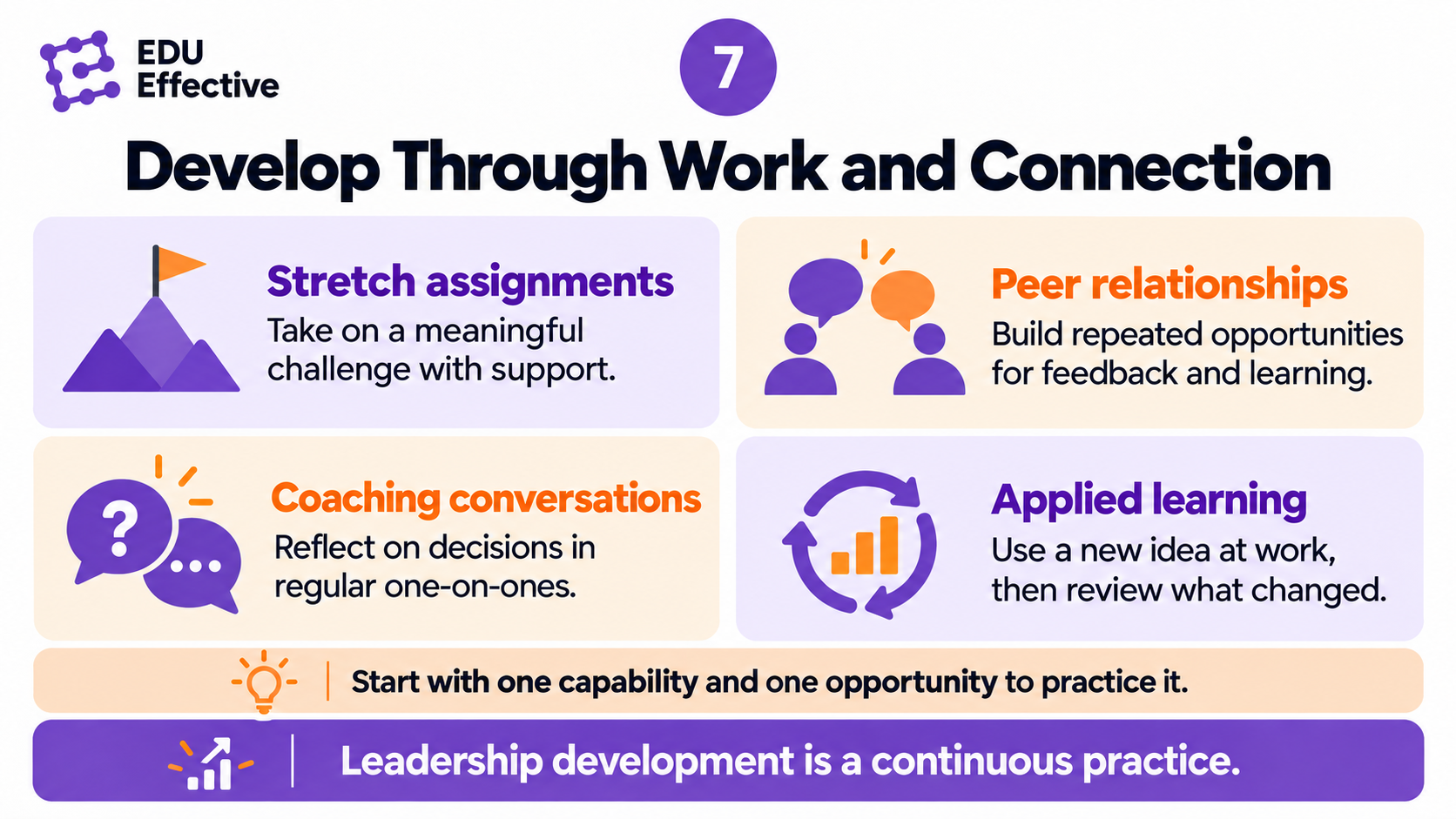
The practical implications for individuals and organizations:
Stretch assignments over seminars. The fastest development happens at the edge of capability, assignments that require skills just beyond current competency, with enough support to succeed and enough challenge to learn. This is how leadership capabilities are built, not through lectures about them.
Coaching integrated into regular work. A manager-as-coach model, where development conversations are embedded in weekly one-on-ones rather than reserved for formal reviews, creates continuous development at no marginal cost. If you want to build that habit deliberately, our guide to building a coaching culture covers the mechanics.
Cross-functional exposure. Leaders who have worked in multiple functions understand second-order effects that specialists miss. Rotating assignments, cross-functional project leadership, and deliberate lateral moves build the strategic breadth the T-shaped leader requires.
Formal education that connects theory to practice immediately. The microlearning model, applied, structured, connected to real work, addresses the transfer problem. When learning is designed for immediate application, the gap between insight and behavior change closes faster.
The 2030 leader is being built now
The leaders who will be running organizations in 2030 are mid-career managers today. Their development window is the next four years. Organizations that recognize this and invest now, through coaching cultures, better development systems, and leadership programs built for 2030 challenges rather than 2010 ones, will have a structural advantage.
Individuals who recognize it have a clearer personal roadmap. Build the analytical-creative combination. Cultivate cultural intelligence through deliberate exposure. Develop digital fluency beyond surface familiarity. Invest in self-awareness as seriously as technical skills. And find ways to practice, not just learn about, adaptive leadership under real uncertainty.
The leaders who thrive by 2030 won't be the ones who accumulated the most certifications. They'll be the ones who combined domain expertise with genuine human capability, and kept developing both through a period of profound change.
Key takeaways
Great leadership in 2030 will require five differentiated competencies: analytical rigor with creative application, entrepreneurial mindset, cultural intelligence, T-shaped expertise, and digital fluency. These sit on top of irreducibly human capabilities: empathy, self-awareness, psychological safety, and values-driven judgment. Gartner's 2025 research shows that most organizations are spending more on leadership development without getting results, because traditional formats don't produce behavioral change. Development that works is experience-based, continuous, and integrated into daily work, not event-based. The leaders who will define 2030 are in development right now. The window to build those capabilities is open, but it won't stay open indefinitely.
About EDU Effective Business School
The Effective MBA: Executive Management & Leadership is built around the decisions managers actually face every week. Runs on 15 minutes a day, completes in 10 months or less and is ASIC accredited.
Sources
- Gartner, Top HR Focus Areas for 2025: Leader and Manager Development https://www.gartner.com/en/articles/top-hr-focus-areas-for-2025
- CEMS / Stockholm School of Economics, Expertise and Business Acumen Will Not Be Enough for Successful Leaders of 2030 https://www.hhs.se/news/sse/2025/expertise-and-business-acumen-will-not-be-enough-for-successful-leaders-of-2030-cems-study-finds/
- AACSB Insights, What Next-Level Skills Will Leaders Need by 2030? https://www.aacsb.edu/insights/articles/2025/12/what-next-level-skills-will-leaders-need-by-2030
- World Economic Forum, Future of Jobs Report 2025 https://weforum.org/press/2025/01/future-of-jobs-report-2025-78-million-new-job-opportunities-by-2030-but-urgent-upskilling-needed-to-prepare-workforces/