

Ms. Klara Mouchova has worked in social media for 13 years, primarily helping small business owners and brands with limited budgets. Last year, she also completed the Effective MBA specialization in Executive Management at EDU Effective. In her latest webinar for EDU Effective, she explored what genuinely works on social media today — and why striving for perfection can often work against you.
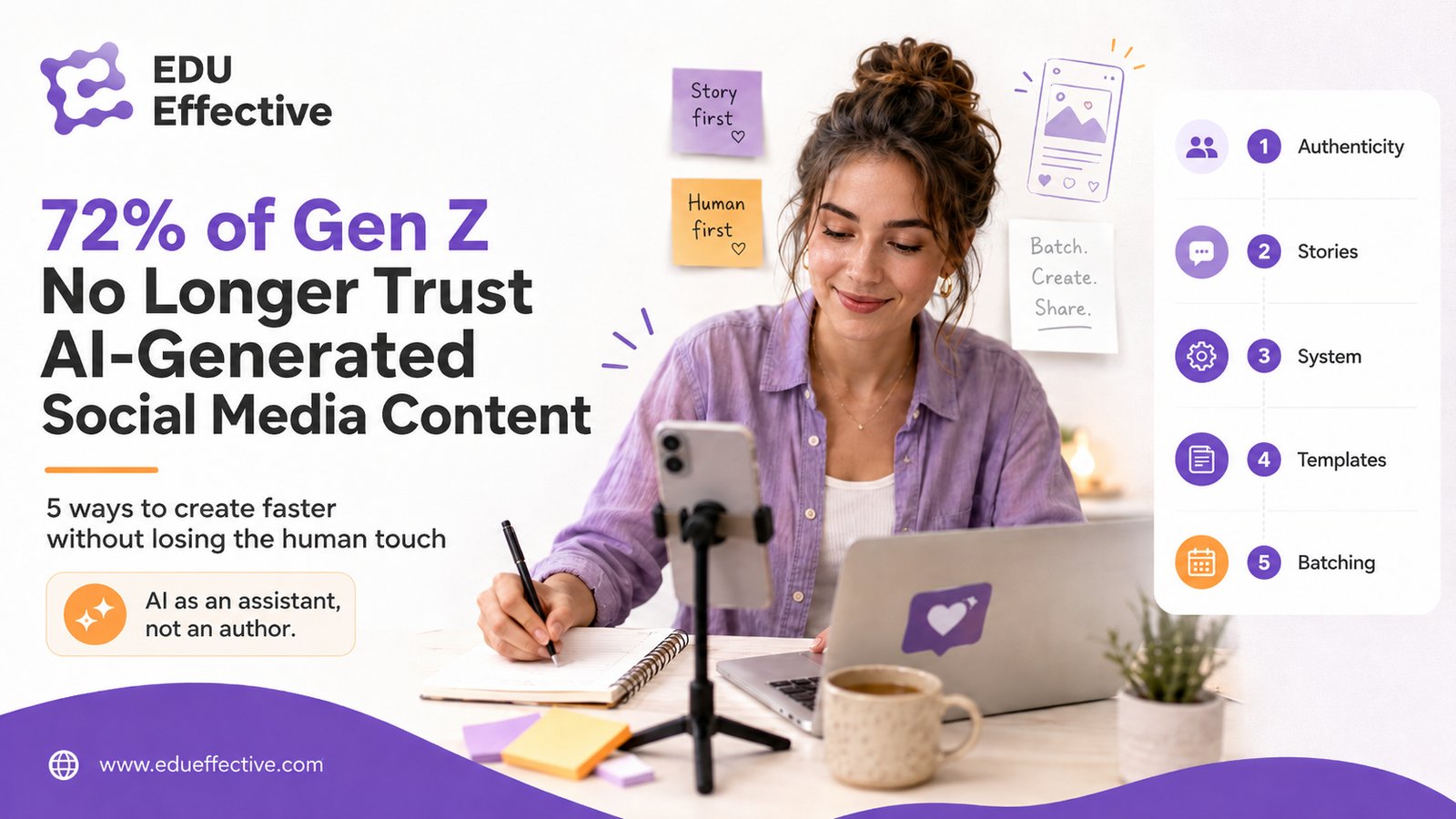
According to a 2026 Attest survey of 1,000 young Americans, 72% of Gen Z have a negative or cautious attitude toward AI-generated content. Forty-one percent actively dislike it and describe it as "AI slop," while another 31% admit they can no longer tell what is real. Only 28% view it positively. This shift helps explain why highly polished, seemingly perfect graphics may now do more harm than good.
Perfect Content Can Do More Harm Than Good
Klara stresses that this is not about creating content without value. It is about no longer chasing flawless graphics and complex editing simply because those techniques used to make a difference. A carousel made from screenshots of notes on your phone can now outperform something that took hours to design in Canva because it is clearly the work of a real person, not AI or a production team. One of her clients replaced two hours of graphic design with a 20-minute carousel based on a mobile photo — and achieved better results than before.
This also reflects an idea from Brendan Kane's book One Million Followers (Kane is also the author of Hook Point): creating social media content is an endless process of A/B testing. The faster and more frequently you publish, the sooner you discover what works — far sooner than if you spend five hours perfecting a single post.
We Remember Stories 22 Times Better Than Facts
Stanford marketing professor Jennifer Aaker asked students to deliver one-minute pitches. Nine out of ten relied on facts and figures; only one used a human story. Later, the audience remembered a statistic in just 5% of cases, while 63% remembered the story. According to Aaker's own summary, stories can be remembered up to 22 times better than facts alone because the brain processes them differently, activating sensory and motor regions rather than only the language centers used to understand text.
Instead of a generic post such as "3 Tips for Losing Weight," a micro-story is more effective: what specifically helped a client lose 8 kg, how long she was afraid to try something, and what changed when she finally did. Klara puts it simply: self-centeredness is one of the biggest content killers on social media. People are not primarily interested in what you have achieved. They want to know what they can take from your post and apply in their own lives.
Do Not Let Inspiration Slip Away
The brain does not hold on to ideas for very long, so Klara recommends having one clearly defined place for every small idea — whether that is your phone notes, Notion, or another tool that suits you. The important thing is to use one central repository. She draws inspiration from Tiago Forte's book Building a Second Brain, which encourages people to save unfinished fragments and share work before it feels "perfect." It is the same low-production-value principle applied to the entire creative process.
Templates and Workflows Can Save You Hours
Clients without a system often have ideas scattered across five different places and spend 20 minutes searching their photo gallery instead of creating. A simple solution is to use one folder for photos and three types of Canva templates: a photo with a simple brand element, a photo or video with a headline for Reels and carousels, and a text-only template. EDU Effective follows this approach with its recurring purple-and-orange bubbles. That recognizable element is often enough; a logo in the corner of every post is no longer always necessary.
Create Content Like a Production Line
According to Sprout Social's 2026 guide to content batching, 94% of social media professionals agree that they need to be "chronically online," while 33% say burnout and creative fatigue are their greatest concerns. Content batching — recording five videos instead of one, writing five captions at once, or creating five graphics in one session — is an effective way to work. Klara blocks out two hours each week for this and schedules a dedicated shooting day every two weeks. When a child becomes ill or a particularly busy week arrives, she can draw on partially completed content instead of letting her social channels go silent for three weeks.
Use AI as an Assistant, Not an Author
Klara does not reject AI. She simply recommends setting clear boundaries. In practice, that can look like this:
- Teach AI your personal style. Klara uploaded dozens of pages of her own writing to Claude and used them to create what she calls a "skill set." It is loaded before the writing process begins and helps the AI stay consistent with her tone of voice.
- Dictate your brief instead of typing it. A detailed voice prompt explaining what happened, who was involved, and why the idea matters will produce a much better result than a flat instruction such as "write a post with five weight-loss tips."
- The human creates the story; AI only polishes it. When AI is asked to invent the entire story, the result is usually generic filler that your competitors could generate just as easily.
- Use AI freely for editing and captions. Today's AI tools can reliably remove verbal slips and generate subtitles for talking-head videos, saving hours of work.
What This Means for Your Business
The principles above — authenticity over perfection, stories over facts, and systems over chaos — are exactly what EDU Effective teaches in practice through specializations such as:
- Effective MBA: Online Marketing, whose ten modules include Strategic Social Media Marketing, Branding, Community & Growth, Personal Brand, Audience Growth, and much more.
- Effective MBA: Applied Artificial Intelligence, which explores AI as a personal assistant through topics such as Advanced AI Prompting, Generative AI, and AI Agents in practice — without requiring programming skills.
Both programs follow the same model as all Effective MBA programs: 15 minutes of microlearning a day, completion in 10 months or less, international ASIC accreditation, and tuition starting from €990.
Klara is living proof that work, personal interests, and study can be combined successfully. She completed her Effective MBA while working full time, and her clients see the same principles reflected in her own content: less perfection, more humanity, and more real stories.
What did another graduate say about studying with EDU Effective?
"Very good topics and instructors, interesting and useful information, and a flexible tool for learning and managing your time." — Josef P., Effective MBA graduate
Read more student reviews and graduate stories here.
Perfection Can Wait. Content Cannot.
The crisis of trust in online content will not disappear on its own, and the volume of AI-generated material will only continue to grow. That is precisely why content that feels human is now outperforming content that merely looks perfect. The simplest first step is to publish a little faster, accept a little more imperfection, and see what happens.
Apply now — from €990 · Talk to a Study Advisor
Study with NO risk: 14-day money-back guarantee, no questions asked.
Sources
- Attest — Gen Z Media Consumption 2026: https://www.askattest.com/blog/research/gen-z-media-consumption
- Stanford VMware Women's Leadership Innovation Lab — Harnessing the Power of Stories (Jennifer Aaker): https://womensleadership.stanford.edu/resources/voice-influence/harnessing-power-stories
- Summary of Klara Mouchova's EDU Effective webinar: "Simplify Your Social Media Content Creation"
- Sprout Social — Social Media Content Batching: 2026 Guide: https://sproutsocial.com/insights/social-media-content-batching/