


More than 400 AACSB-accredited institutions now offer an MBA partially or fully online, up from roughly 150 a decade ago. The online MBA market has expanded faster than almost any other segment of higher education — driven by a genuine shift in how working professionals think about graduate business education, accelerated by the post-2020 normalisation of remote learning, and now complicated by the sheer volume of options competing for the same prospective student's attention.
The problem is not that good online MBA programmes do not exist. They do. The problem is that good and bad programmes use identical marketing language, similar price points, and comparable credential descriptions — making it genuinely difficult to distinguish between a programme that will produce the career outcome you want and one that will produce a qualification of limited practical value at significant cost.
This guide is about the criteria that actually matter — and equally about the criteria that are frequently used as decision-making proxies but are poor predictors of whether a programme will work for your specific situation.
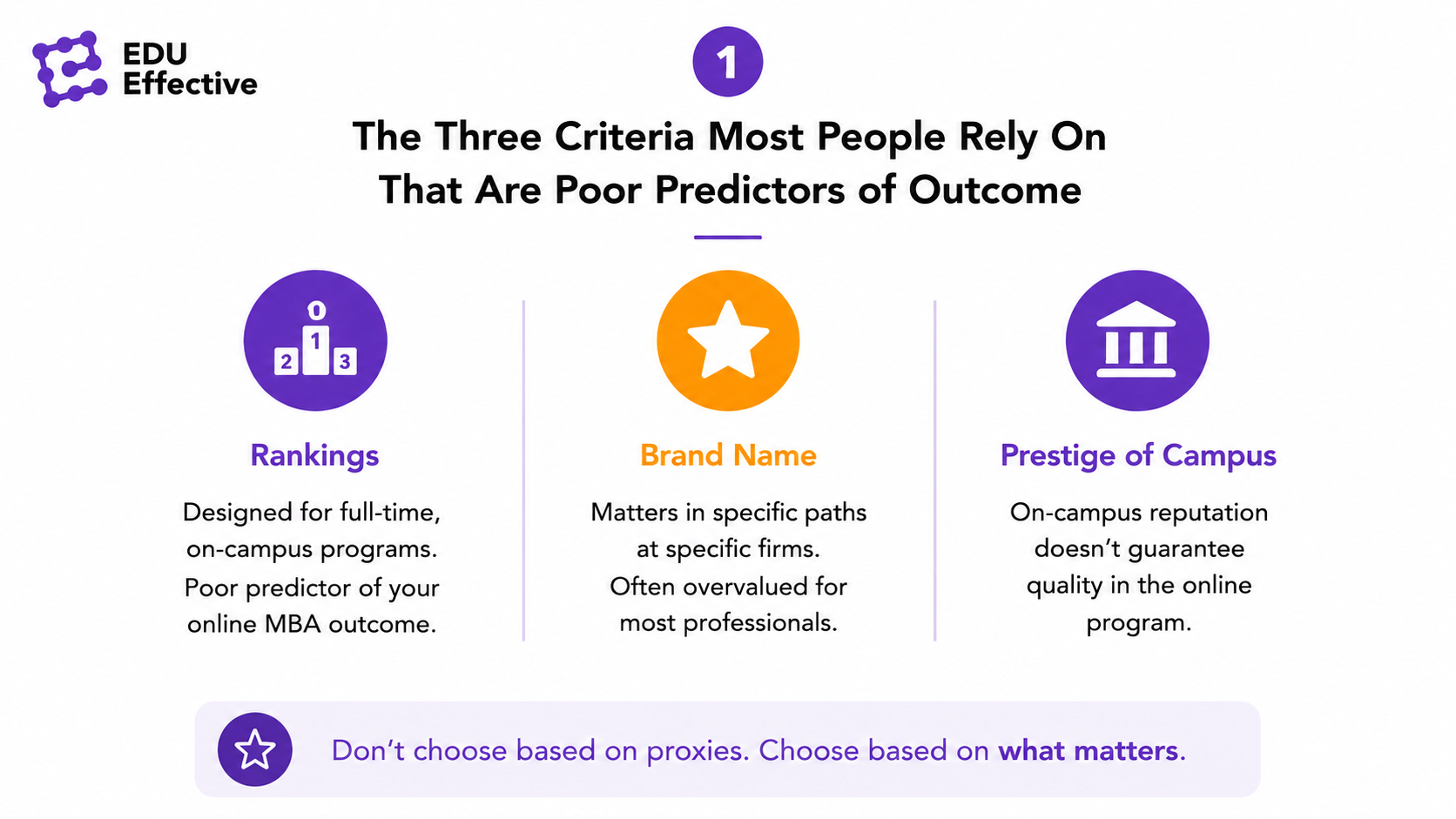
The three criteria most people rely on that are poor predictors of outcome
Before examining what matters, it is worth being direct about what matters less than most guides suggest.
Rankings. Rankings measure a set of inputs and outputs that are relevant to full-time, on-campus programmes at traditional business schools — faculty research output, admissions selectivity, average GMAT scores, starting salaries for graduates entering specific career paths. For online MBA programmes aimed at working professionals, many of these inputs are structurally different or irrelevant. A rankings position that reflects research faculty quality tells you little about the quality of content delivery, flexibility, or career outcomes for someone who is not entering management consulting after graduation. Rankings are useful for narrowing a field of options. They are poor as a primary decision criterion.
Brand name. The brand value of a business school is real and has genuine labour market implications — in specific career paths, at specific firms, in specific hiring contexts. A Wharton online MBA carries more weight in an investment banking application than a less well-known alternative. But for the majority of online MBA candidates who are not targeting those specific institutional career paths, brand name is a weaker predictor of outcome than programme fit, cost, and flexibility. Paying a brand premium for an outcome that does not require that brand is not a sound investment.
Prestige of the physical campus. The on-campus reputation of an institution does not automatically transfer to its online programmes. Some institutions with strong campus reputations offer online MBAs of comparable quality. Others treat online as a revenue stream separate from their core academic offering, with different faculty, different content standards, and different student support. The institutional brand and the online programme quality should be evaluated separately.
The eight criteria that actually predict whether an online MBA will work for you
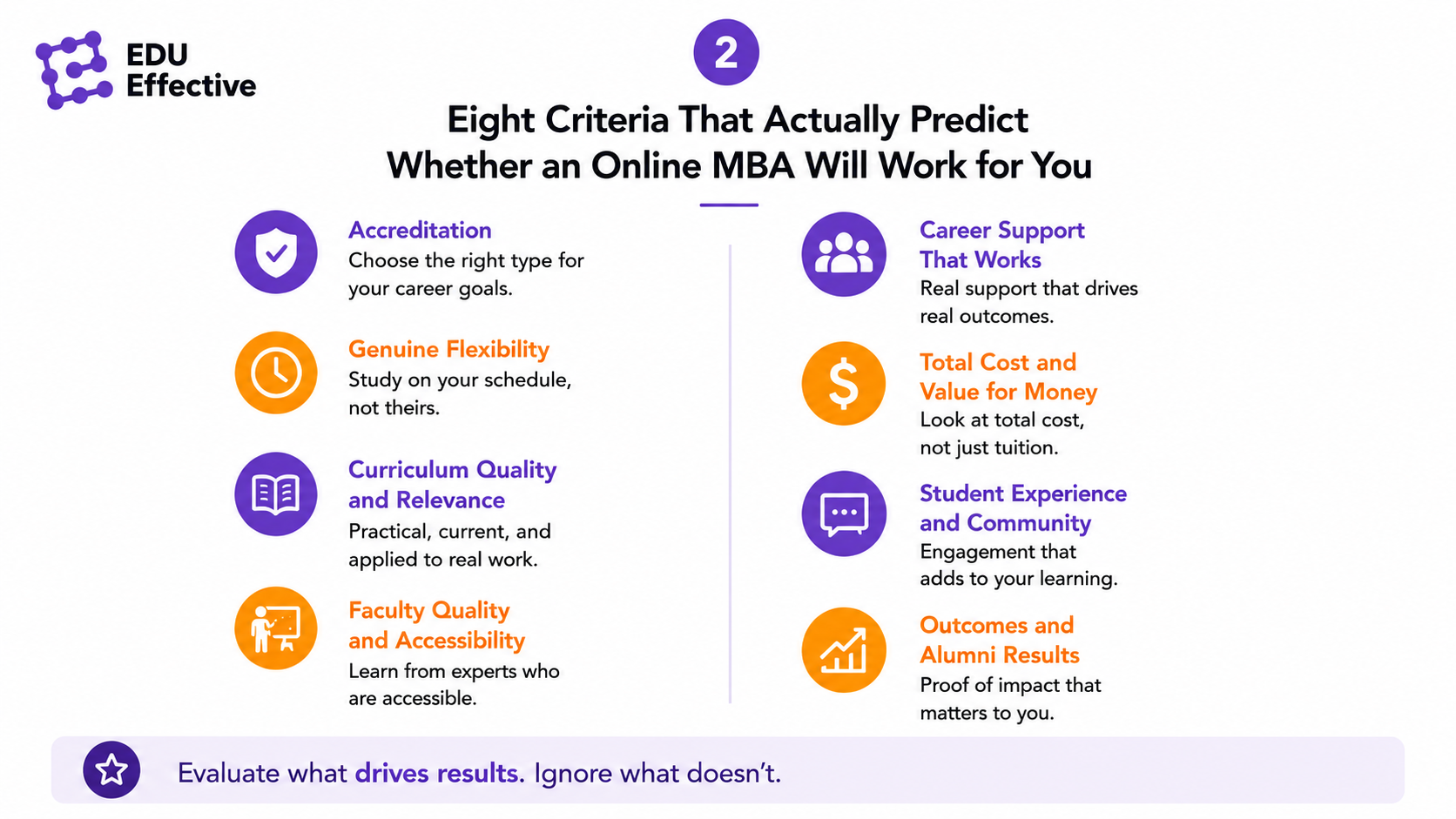
1. Accreditation — and which type matters for your specific outcome
Accreditation is the most important single criterion in online MBA selection — but the type of accreditation matters more than the presence of any accreditation label.
Three bodies accredit MBA programmes with global recognition. ASIC (Accreditation Service for International Colleges), the accreditation held by EDU Effective, is a UK-based accreditation body recognised by the UK Home Office, the Quality Assurance Agency (QAA), and professional bodies across multiple countries. It provides professional rather than academic accreditation — signalling programme quality and international recognition for professional credentials rather than academic degrees within the university system. The distinction is important: ASIC-accredited programmes produce professionally recognised credentials, not academic degrees within the AACSB/AMBA framework.
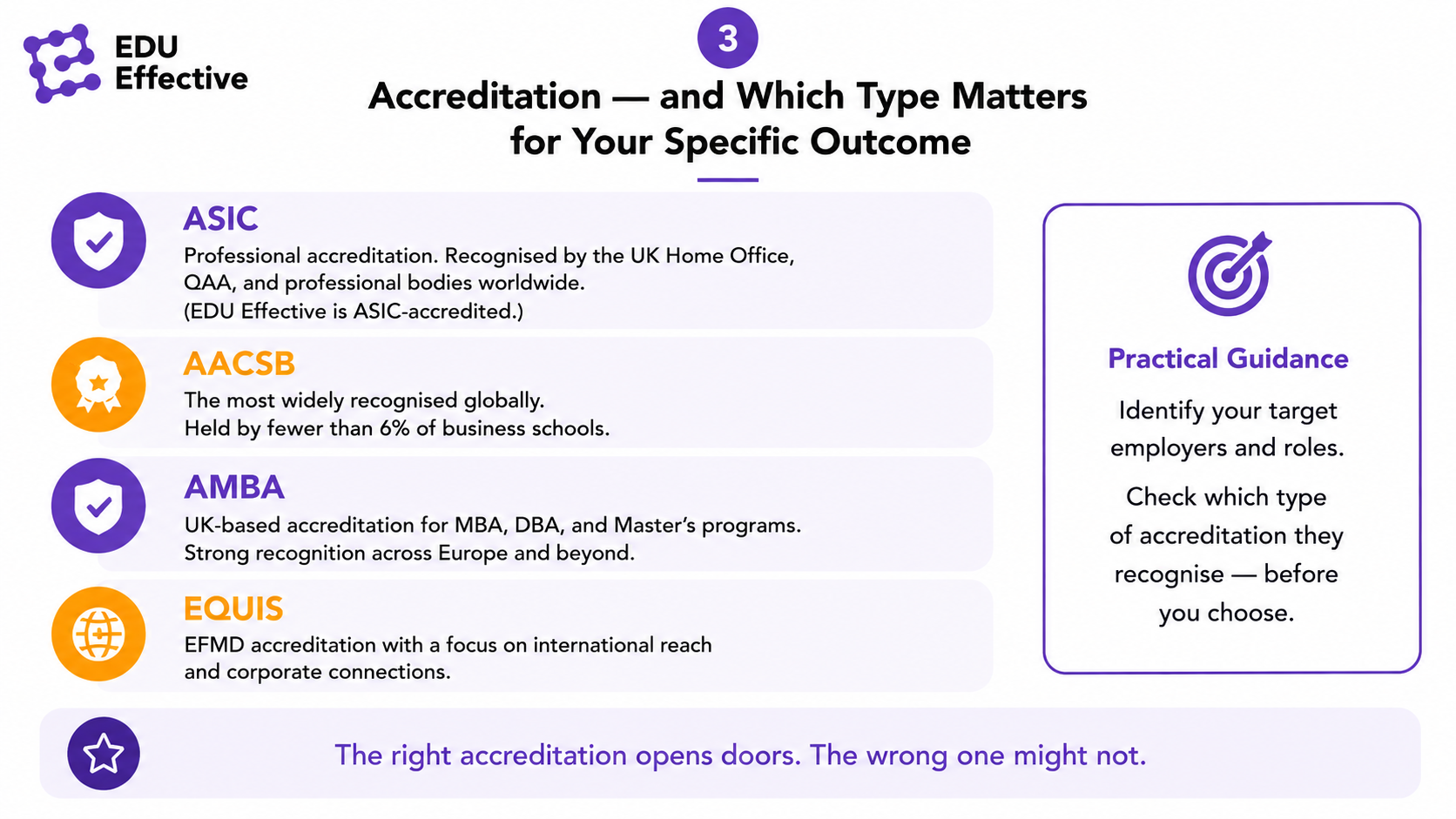
AACSB (Association to Advance Collegiate Schools of Business) is the most widely recognised, particularly in North American and multinational employer contexts. Fewer than 6% of business schools globally hold AACSB accreditation. AMBA (Association of MBAs) is the UK-based body that accredits MBA, DBA, and Master's programmes specifically, with recognition across European and international employers. EQUIS (European Quality Improvement System), administered by EFMD, accredits business schools with particular emphasis on international reach and corporate connections. Schools holding all three — the "triple crown" — represent less than 1% of business schools globally.
For professionals working in or targeting roles at large multinational organisations, AACSB or AMBA accreditation is the most widely employer-recognised signal. For roles at European organisations or in international business contexts, EQUIS and AMBA both carry strong recognition.
The practical guidance: before selecting a programme, identify the specific employers and roles you are targeting after completion, and verify whether they specify a type of accreditation. Many employers simply require "an accredited MBA" without specifying which body. Others, particularly at elite consulting and banking firms, expect AACSB or equivalent academic accreditation. Knowing which applies to your situation before choosing a programme prevents an expensive mismatch.
2. Genuine flexibility — not marketing flexibility
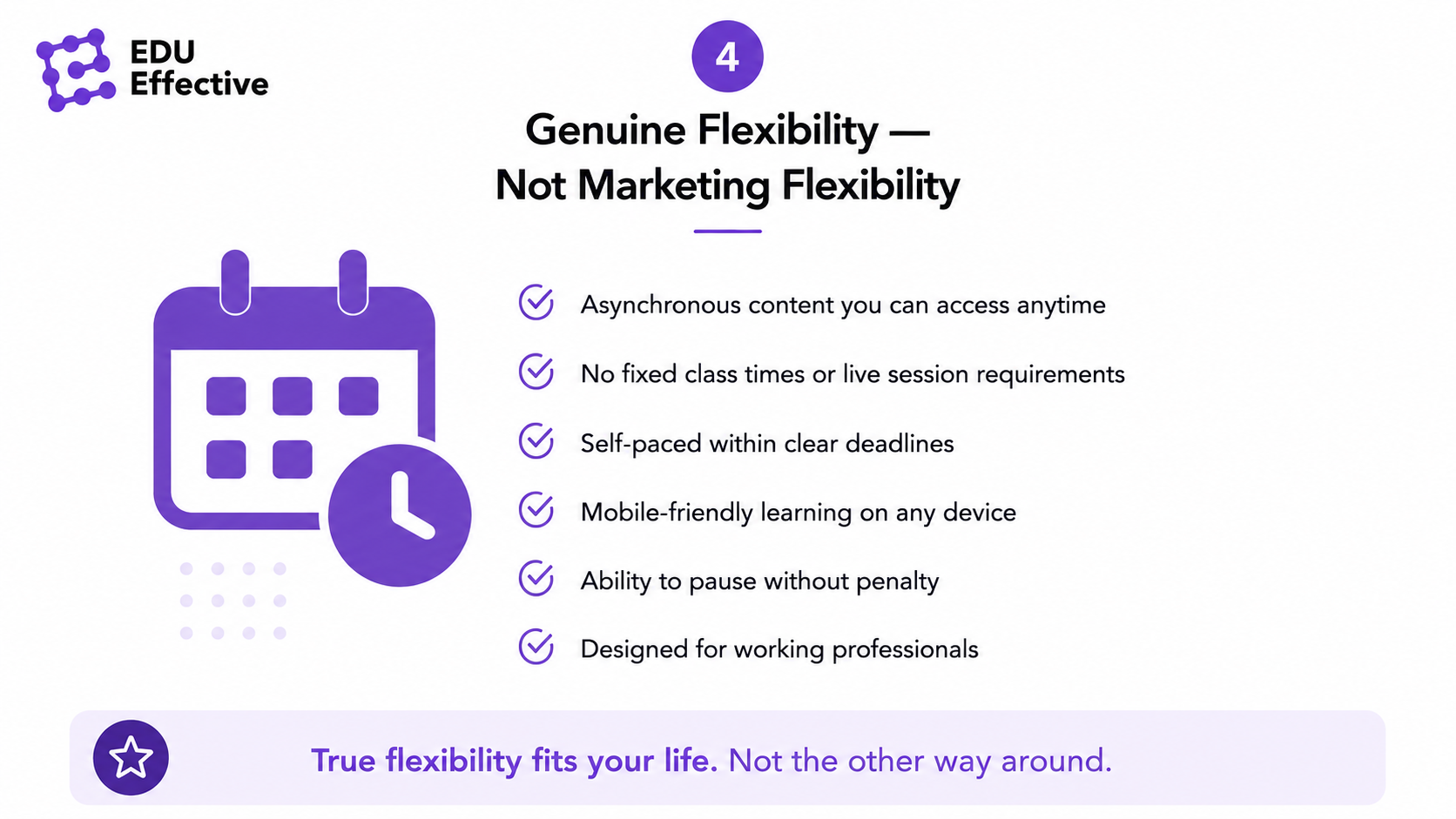
Every online MBA programme describes itself as flexible. The meaningful question is what flexibility actually means in practice — and whether it is compatible with your life.
Genuine flexibility means: content is asynchronous and available at any time on any device; there are no mandatory live sessions that require blocking specific calendar time in advance; study can be paused during particularly demanding work periods without academic penalty; and the daily time commitment is predictable and manageable within a normal working schedule.
Marketing flexibility often means: classes are recorded but require viewing within a specific window; live sessions are "optional" but disadvantage students who do not attend; the nominal weekly time commitment is understated relative to the actual workload; and flexibility applies to location but not to schedule.
The most reliable way to assess genuine flexibility is to ask current students — not admissions representatives — about their actual weekly experience. How many hours per week does the programme require in a typical week? In a heavy week? What happens if you travel for work during a term? Can you complete coursework on a mobile device? The answers to these questions tell you more about flexibility than any programme description.
3. Total time commitment — not just weekly hours
Most online MBA programmes advertise a weekly study time in the range of 15 to 20 hours per week. This figure is frequently understated and rarely includes the full picture of what participation actually requires.
The meaningful time assessment for any online MBA is: weekly hours for content consumption, weekly hours for assignments and assessments, time for group projects and peer collaboration (which is often asynchronous but still time-consuming), time for any required residentials or synchronous sessions, and the duration of the programme across months. A programme requiring 15 hours per week for 24 months is a very different commitment from one requiring 15 minutes per day for 10 months — even if both use the word "flexible" in their descriptions.
Before committing to any programme, calculate the total hours across the full duration and assess that against your actual available capacity. Be honest about what your life looks like in a heavy work period. A programme that requires 15 hours per week will be sustainable in most normal weeks and difficult to sustain during periods of high work demand.
4. Cost — including all costs
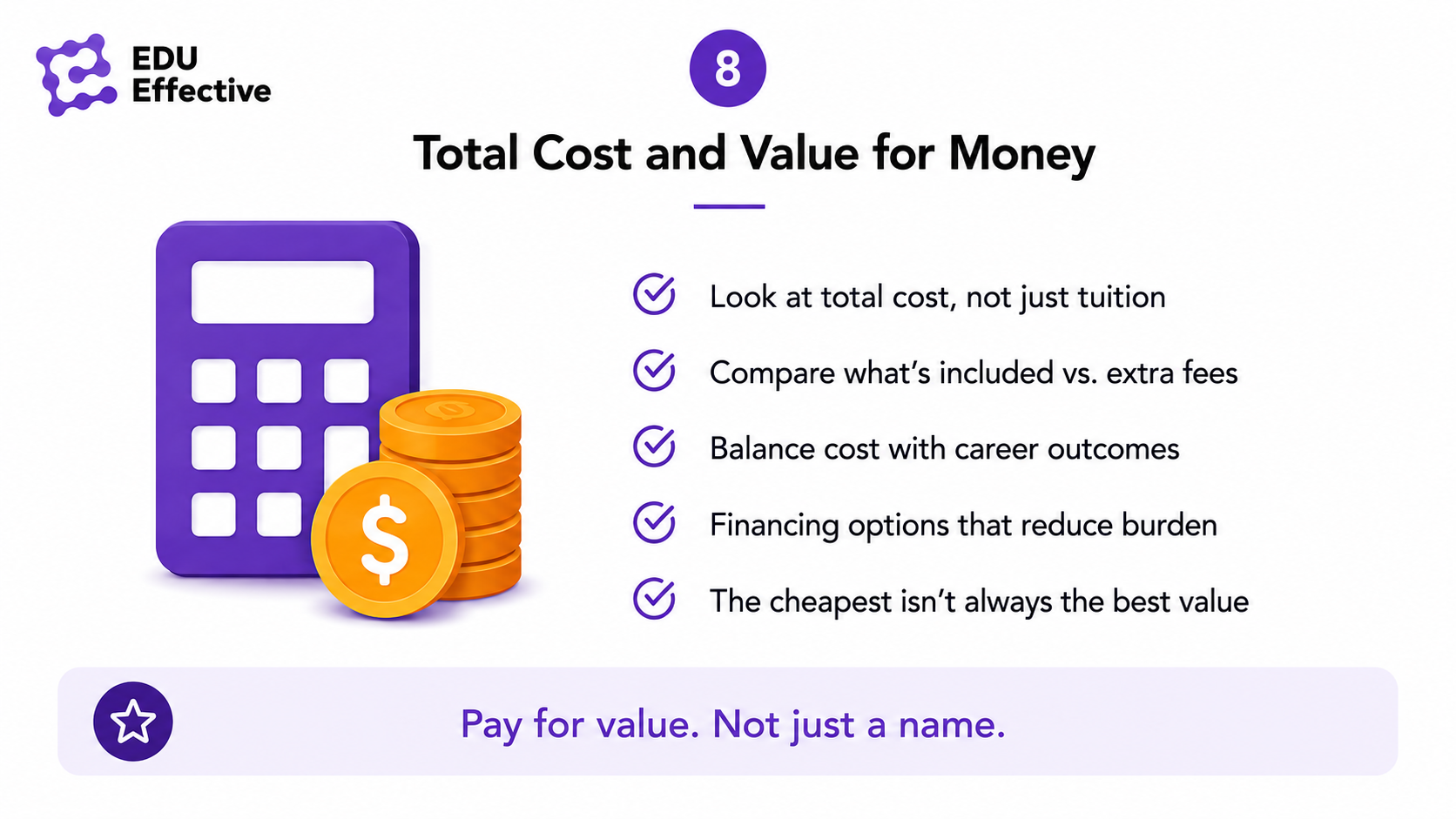
As established in more detail in our MBA cost and ROI guide, the tuition figure advertised for any MBA programme understates the true cost. Additional fees, technology costs, any required textbooks or materials, travel for residentials, and the opportunity cost of time spent studying (which has a real economic value even if it is not a direct financial outlay) all contribute to the total investment.
For online MBA programmes specifically, the key cost questions to ask before enrolling are: what is the total programme cost including all fees, not just tuition? Are there additional costs for materials, technology access, or residentials? Does the programme have a no-questions-asked money-back guarantee, and for how long? And does the programme offer modular credentials — certificates for individual modules completed — that have independent value even if you do not complete the full programme?
Online MBA tuition in 2026 ranges from under €1,000 for professional programmes to over €130,000 for brand-name academic programmes. The relevant comparison is not which programme is cheapest but which programme, at its specific cost, is most likely to produce the outcome you need.
5. Content quality and currency
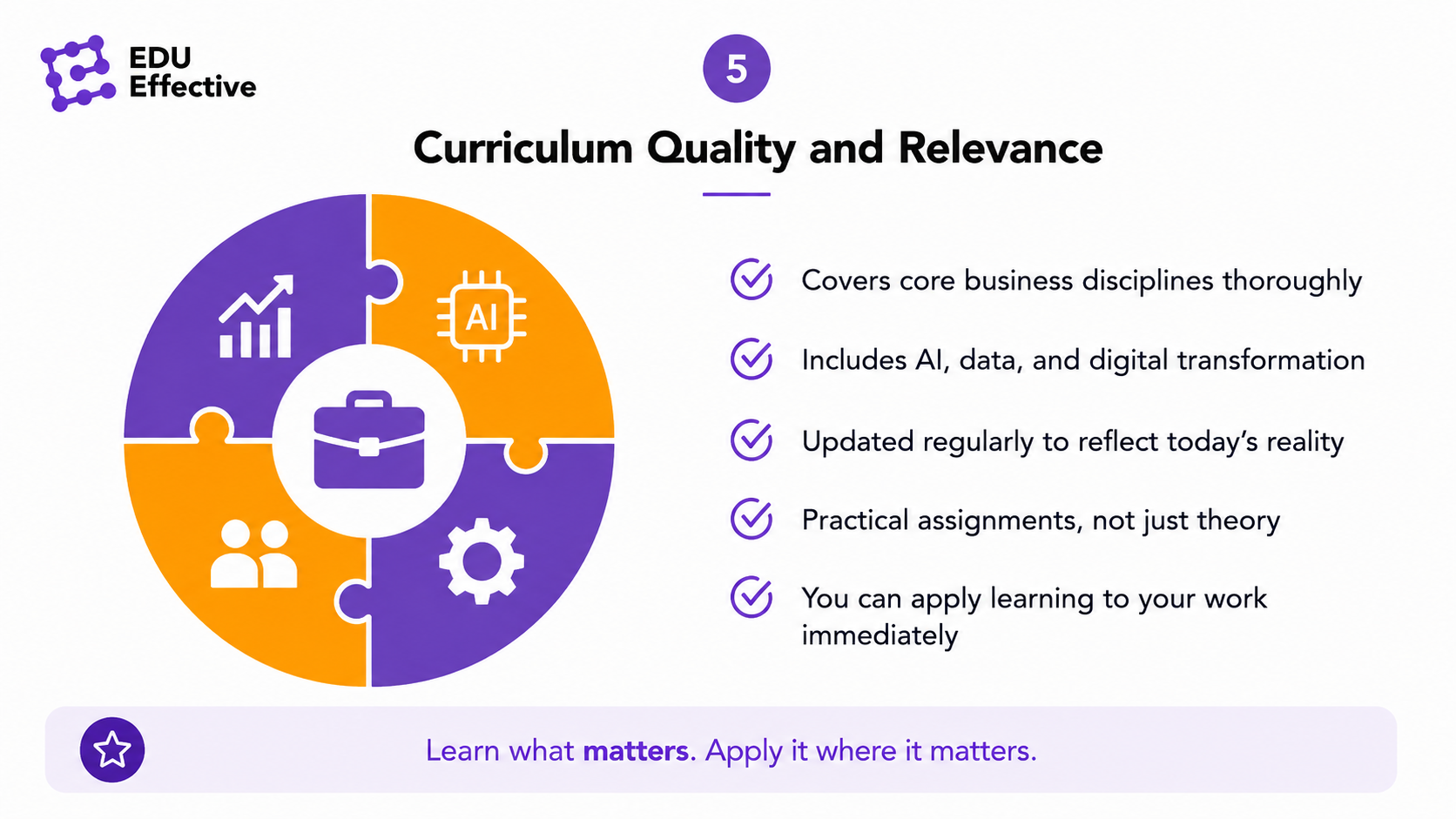
The content of an MBA programme — who teaches it, what sources it draws on, and how recently it has been updated — is a more direct predictor of whether the programme will develop useful capabilities than its accreditation or ranking.
For academic programmes, content quality signals include: faculty credentials and industry experience (not just research output), the recency of case studies and materials, whether the curriculum addresses current business challenges including AI adoption, and whether the programme has updated its content within the past two to three years.
For professional programmes, the relevant signals are: whether content draws on practitioners with current industry experience rather than only academic faculty, whether the source library is continuously updated, and whether the curriculum maps specifically to skills in high demand in the current labour market.
In both cases, the most reliable signal of content quality is not what the institution says about its curriculum but what recent graduates say about the practical applicability of what they learned to their actual work. Verified reviews from recent graduates, accessible on platforms like Trustpilot, LinkedIn, or programme-specific review forums, provide information that programme descriptions cannot.
6. Career outcome data — and how to read it
Career outcome statistics published by MBA programmes are among the most selectively presented figures in professional education marketing. "90% of graduates employed within three months" sounds impressive until you discover that the figure includes graduates who remained in their pre-MBA roles, and that "employment" encompasses any job regardless of relevance to the MBA.
The career outcome data that is actually meaningful for online MBA candidates is: what proportion of graduates who were seeking career advancement or a career change achieved it within 12 months of completion? What is the average salary increase for graduates who were employed during study? And what specific roles are graduates moving into?
This data is rarely presented proactively by programmes — because the honest answers are frequently less impressive than the headline statistics. Asking for it directly, or finding it through alumni conversations and verified reviews, is the most reliable way to assess whether a programme will produce the outcome you are pursuing.
7. Format compatibility with your learning style
Online MBA programmes deliver content through very different formats: video lectures, written materials, case studies, live discussions, peer group projects, AI-assisted learning platforms, and various combinations of these. Not all formats work equally well for all learners — and choosing a programme whose delivery format does not suit how you learn is a fast path to disengagement regardless of content quality.
Before committing, access trial content if it is available — most reputable programmes offer either a free trial module or a sample lesson. Assess whether the format is one you will sustain across ten months or two years, not just whether it seems acceptable in a single sample. The format that sustains engagement across a full programme is more valuable than the most impressive-sounding curriculum in a format you will stop using after six weeks.
8. Money-back guarantee and risk management
The professional risk of choosing the wrong MBA programme is primarily financial — you invest time and money in a programme that does not match your expectations, and either complete it despite that mismatch or exit without recovering your investment.
A genuine money-back guarantee — one that allows you to exit within a specified period without financial penalty, no questions asked — transfers the risk from student to programme provider. Its presence signals confidence that the programme delivers what it promises. Its absence signals either that the provider does not expect the programme to match its descriptions, or that it prefers the one-directional commitment of a signed enrolment over the accountability of a guaranteed offer.
For any online MBA programme, the questions to ask about risk management are: what is the cancellation and refund policy? How long do you have to assess whether the programme meets your expectations? And what percentage of enrollees who have tried the programme have requested a refund? The last question is rarely answered proactively — but it is one of the most revealing signals of programme quality available.
At EDU Effective, fewer than 0.7% of enrolled students have used the 14-day money-back guarantee. That figure is more informative about programme satisfaction than any marketing claim.
The question that should come before all of these
Every criterion above assumes that you have already answered the prior question: what specific outcome are you trying to produce, and does an online MBA — of any type — produce it?
The outcome question determines which type of accreditation matters, which content areas are most relevant, how much cost is justified, and what career outcome data is worth evaluating. A professional who wants to develop leadership and management capabilities for their current role needs a different programme from one targeting a role at McKinsey. A professional building AI fluency for a marketing function needs different content from one transitioning into finance.
The most common and most expensive mistake in online MBA selection is choosing a programme based on a comparison across generic criteria — cost, accreditation, rankings — without first identifying the specific outcome the programme needs to produce and then assessing each programme against that specific outcome.
At EDU Effective, the Effective MBA is a professional programme built for a specific outcome: developing immediately applicable business capabilities in leadership, AI, marketing, or coaching for working professionals who need to advance in their current field — in 15 minutes a day, without pausing a career. Explore our programs →
At EDU Effective, we build programs for professionals who want to work smarter — not just harder. Explore our programs →
EDU Effective Business School = professional development for your long-term success.
All best-selling Effective MBA programs are built for working adults: 15 minutes a day, 10 months or less, ASIC accredited, from €990.
- Effective MBA: Executive Management & Leadership
- Effective MBA: Applied Artificial Intelligence
- Effective MBA: Coaching, Leadership & Mentoring
- Effective MBA: Mastery in AI
- Effective MBA: Online Marketing
These are professional programs, not academic ones — built for working adults to apply what they learn directly in their own business, not to collect a scholarly credential.
Join more than 9,000 students in over 120 countries who are investing in their professional development and career success.
Read the feedback and experiences of our students and the stories of our graduates here.
Apply now — from €990 · Talk to a Study Advisor
Study with NO risk: 14-day money-back guarantee, no questions asked.
Sources
- GMAC — 2026 Prospective Students Survey: Online MBA Demand and Growth https://www.gmac.com/market-intelligence-and-research/research-library/admissions-and-application-trends/2026-gmac-prospective-students-survey-report
- GMAC — 2025 Corporate Recruiters Survey: Employer Recognition of Online MBAs https://www.gmac.com/market-intelligence-and-research/research-library/employment-outlook/2026-corporate-recruiters-survey-report
- AACSB — Business School Accreditation: Global Statistics 2026 https://www.aacsb.edu/accreditation
- AMBA — MBA Accreditation Standards and Recognition https://www.associationofmbas.com/business-schools/accreditation
- ASIC — Accreditation Service for International Colleges: Recognition and Standards https://asic.org.uk/
- SHRM — Employee Benefits Survey: Tuition Assistance (48% of employers) https://www.shrm.org/topics-tools/research/employee-benefits-survey
- PwC — 2026 Global AI Jobs Barometer: Skills Premium and Employer Demand https://www.pwc.com/gx/en/news-room/press-releases/2026/pwc-2026-ai-jobs-barometer.html
- US Bureau of Labor Statistics — Management Occupations: Salary and Employment Data https://www.bls.gov/oes/current/oes110000.htm
- EDU Effective — Under 0.7% Use Our Money-Back Guarantee. Here's Why. /blog/money-back-guarantee-what-0-7-percent-actually-proves