

Most managers have sat through a strategy offsite. Two days of Post-it notes, a SWOT matrix the size of a bedsheet, and a 47-page document nobody opens in February. That's not strategy. That's planning theater.
Strategy is a set of deliberate choices about where you will compete, how you will win, and what you will not do. It's uncomfortable by definition, because saying yes to one direction means saying no to three others. Managers who avoid that discomfort end up with a document full of goals and empty of decisions.
This guide skips the theory. It walks you through how to actually write a business strategy that works, one your team understands, can execute, and won't abandon by Q2.
Why most strategies fail before they start
The numbers are damning. McKinsey surveyed nearly 800 executives and found only 45% were satisfied with their strategic-planning process. More striking: just 23% said major strategic decisions were actually made within the planning process. The rest? Made informally, outside the room, after the document was already written.
AchieveIt's State of Strategy Execution report, covering over 250 leaders, found that 91% named a lack of strategic vision as a key reason plans fail. Yet most organizations still have a formal strategy document. The gap isn't in having a strategy. It's in writing one that connects vision to daily decisions.
Three structural failures show up repeatedly:
First, strategy is treated as an annual event instead of a living system. 79% of companies that collect update data manually say it slows their response to strategic shifts.
Second, goals aren't aligned. About one-third of respondents say their team goals don't connect to departmental objectives. A strategy nobody aligns to is just ambition on paper.
Third, execution is measured by outputs, not outcomes. Only 56% use KPIs or metrics to track plans. The rest rely on status updates, which measure activity, not progress.
Knowing these failure modes is useful. But what does a strategy that avoids them actually look like?
Step 1: Define the strategic question, not the goal
Before you write a single word of your strategy, you need to name the central question it answers.
Not: "We want to grow revenue by 30%."
That's a goal. A strategic question sounds like:
"How do we become the preferred vendor for mid-size logistics companies in Central Europe within three years?"
"How do we retain senior talent in a market where competitors are offering 20% salary premiums?"
"How do we grow our digital revenue to 40% of total without cannibalizing existing channels?"
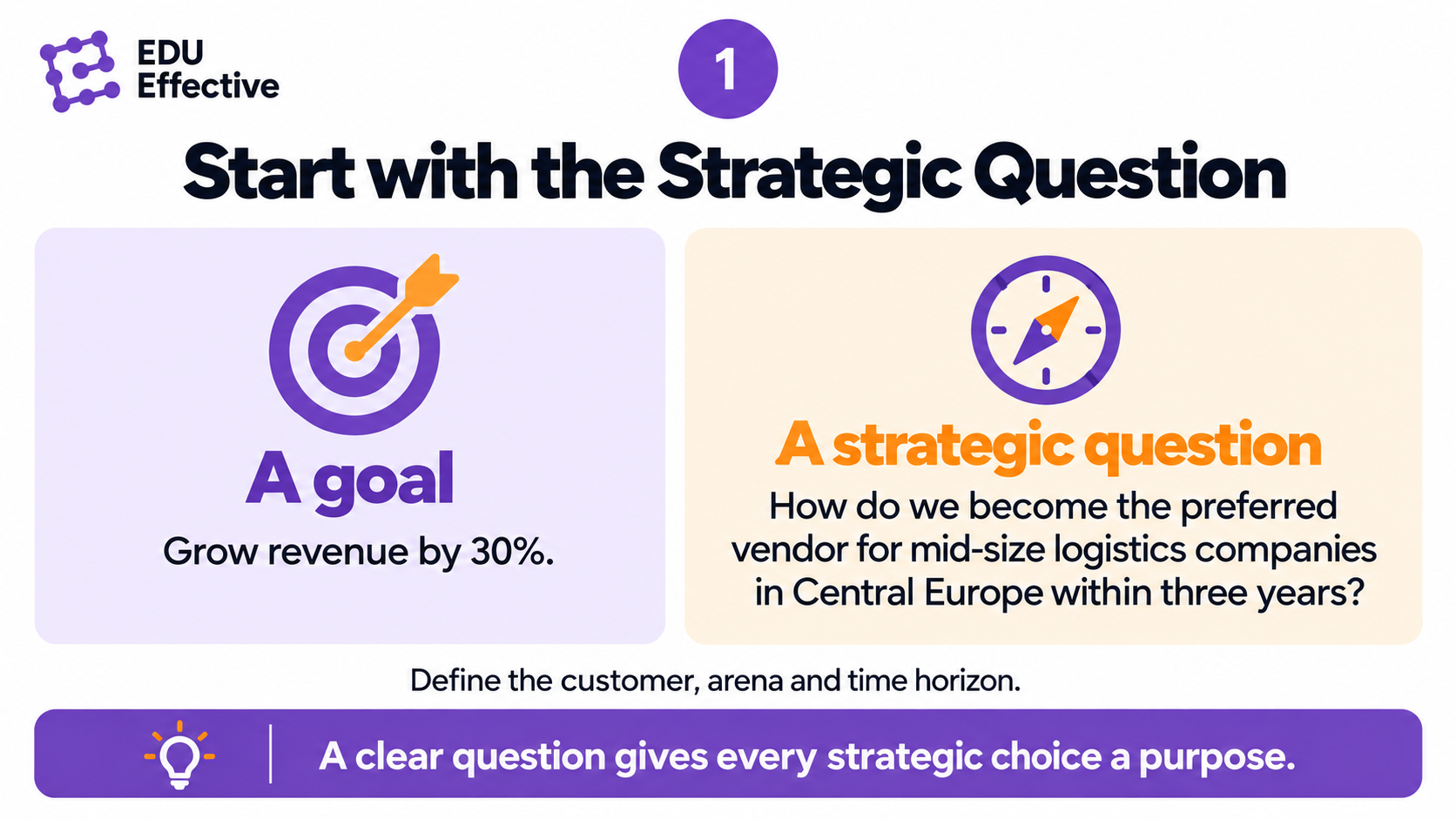
The question forces specificity. It defines the scope of your choices. Everything in your strategy is either an answer to this question or noise.
If you can't write the question in one sentence, the strategy isn't ready to write yet. Go back and talk to your CEO, your customers, and your frontline managers. The question will emerge from those conversations.
Step 2: Audit where you actually stand
Strategic planning built on wishful thinking fails fast. Before writing where you're going, audit where you are, honestly.
This is not a SWOT matrix. It's three focused questions:
What do you win on? Not what you believe you're good at. What do customers pay you for specifically, and why do they choose you over alternatives? Pull your last 10 wins and look for the pattern.
Where are you losing ground? Revenue trends, customer churn data, NPS scores, talent attrition rates. Pick three metrics that signal organizational health and look at the 24-month trend, not the last quarter.
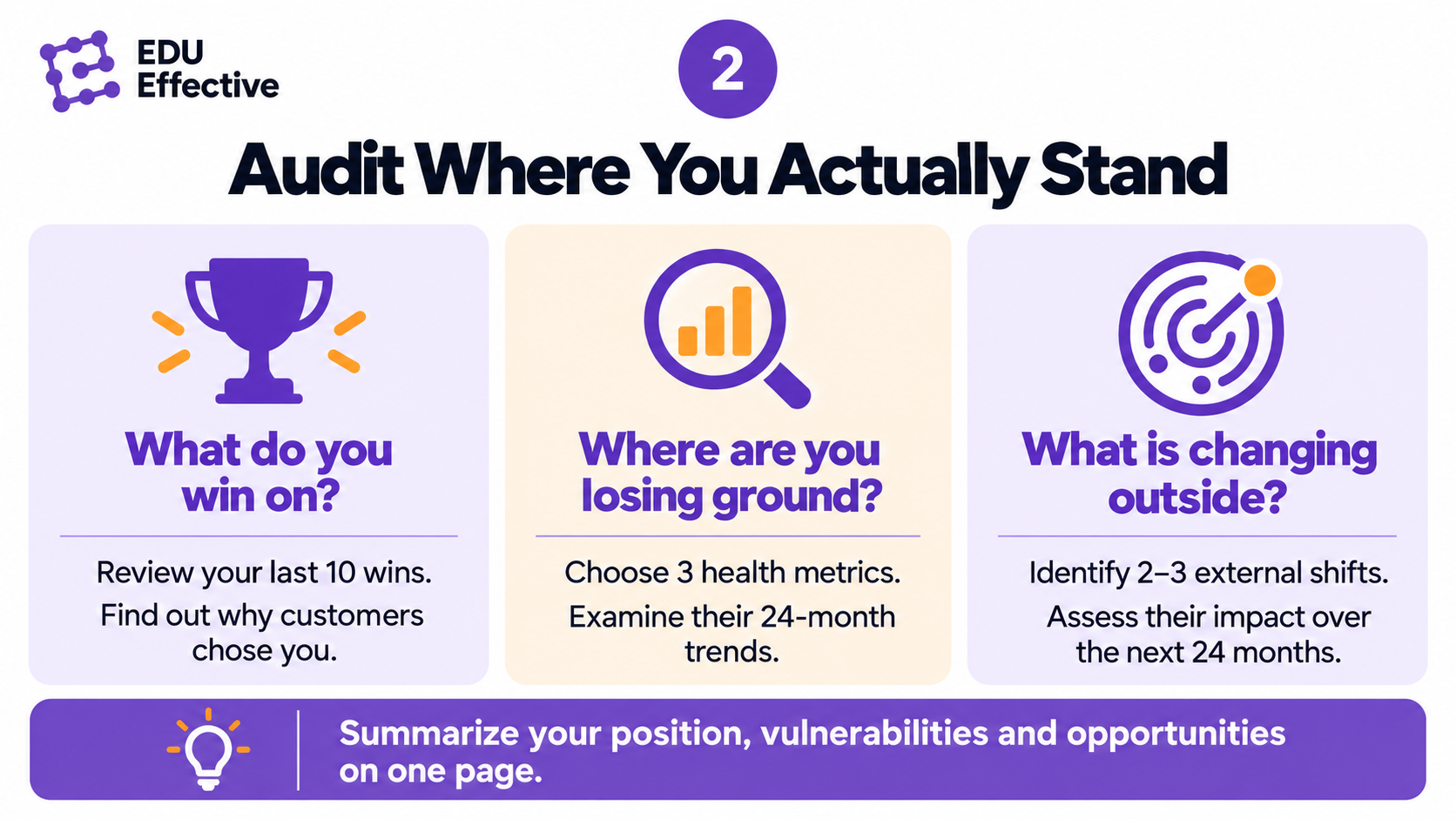
What are the external forces you can't ignore? This is where market analysis comes in. Identify the two or three shifts, regulatory, technological, competitive, that will materially change your operating environment in the next 24 months. Not ten forces. Two or three that matter.
This audit takes a week if you do it seriously. The output is a one-page document: current competitive position, three key vulnerabilities, two structural opportunities.
Step 3: Make the three core strategic choices
Roger Martin, former Dean of Rotman School of Management and co-author of Playing to Win, argues that strategy reduces to five choices. For working managers, three matter most:
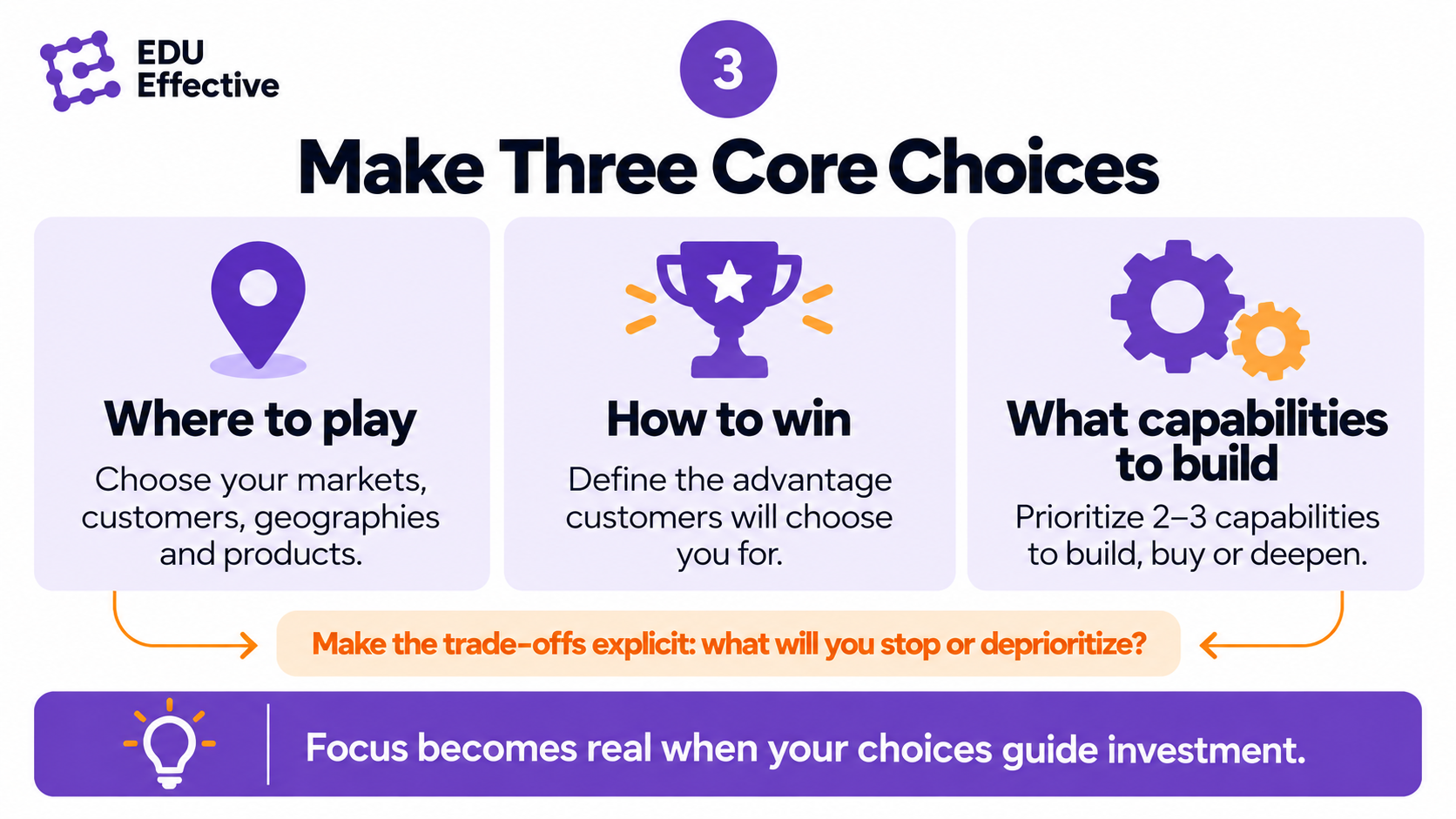
Choice 1: Where to play. Which markets, customer segments, geographies, or product categories will you focus on? And, equally important, which will you explicitly exit or deprioritize? A strategy that tries to serve everyone serves no one well.
Choice 2: How to win. What is your specific competitive advantage in the spaces you've chosen? Cost leadership (you deliver comparable value cheaper), differentiation (you deliver superior value at a premium), or focus (you serve a narrow segment better than generalists can). You can't be all three. Companies that try end up stuck in the middle.
Choice 3: What capabilities are required. Given your winning aspiration and your chosen arena, which two or three capabilities need to be built, bought, or deepened? These become your investment priorities. Everything else is maintenance.
Write these choices down explicitly. If your draft strategy document doesn't have a clear answer to each of these three questions, it isn't a strategy. It's a list of priorities.
Step 4: Translate strategy into annual objectives
Strategic objectives are the bridge between your three-year direction and the work that happens in Q3 of next year. Most organizations skip this translation step, which is why 91% of leaders cite lack of strategic vision as a failure cause. The vision exists, but it never reaches the work.
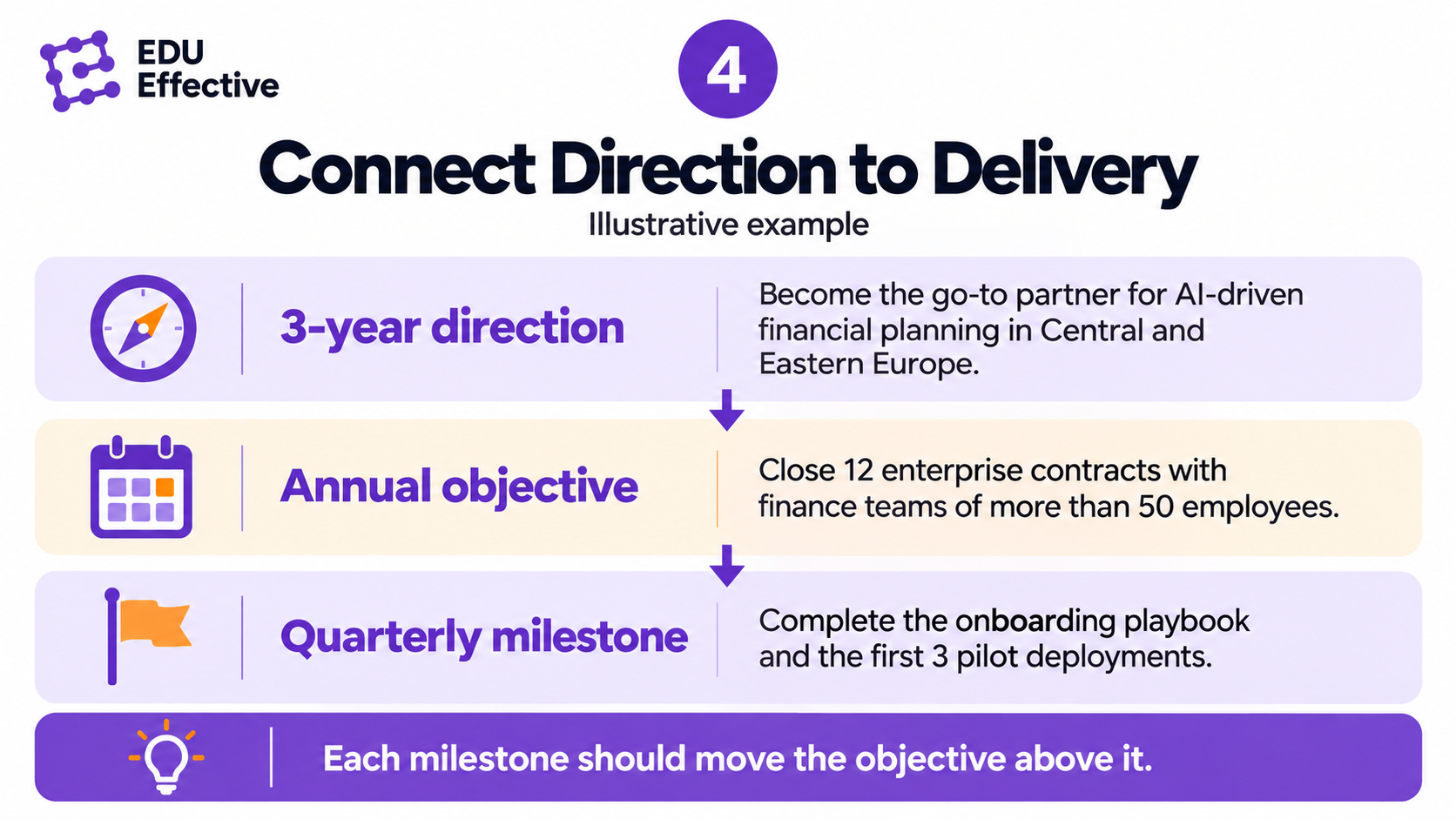
The structure that works:
3-year strategic goal (directional, qualitative): "Become the go-to partner for AI-driven financial planning in the CEE region."
Annual objective (measurable, time-bound): "Close 12 enterprise contracts with finance teams above 50 employees by December 2026."
Quarterly milestone (team-level, assignable): "Complete onboarding playbook and first three pilot deployments by March 31."
Each level should cascade from the one above. If your quarterly milestone doesn't move the annual objective, you're working on the wrong thing.
OKRs are one framework for this. Balanced Scorecard is another. The specific system matters less than the discipline of connecting strategy to execution at every level. If you are choosing between the two most common options, OKR vs KPI explains which one fits which kind of goal.
Step 5: Assign ownership, one name per initiative
The State of Strategy Execution research found that 75% of organizations say limited cross-department visibility hinders execution. The root cause is almost always ownership ambiguity. A team owns an initiative, which means nobody does.
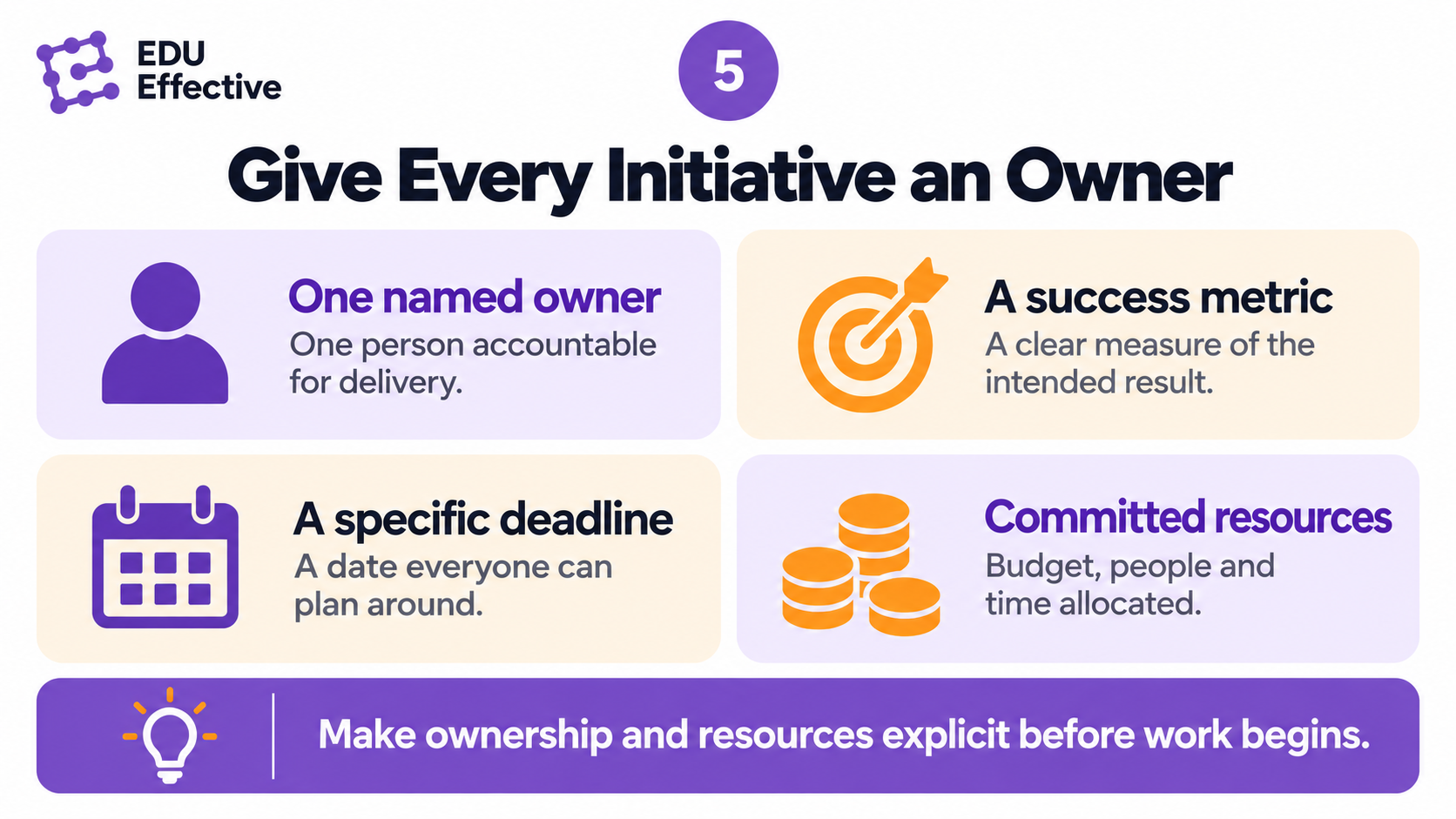
For every strategic initiative, assign:
- One named owner, not a team, not a department, one person
- A clear success metric, what does "done" look like?
- A deadline, not a range, a specific date
- A resource commitment, budget, headcount, or time allocation
This is where strategies die most often. A beautifully written strategy document with committee ownership and "to be determined" resource allocation is a strategy in name only.
McKinsey found that organizations linking compensation to strategic initiatives, even partially, saw significantly better execution. One services company tied 20% of senior manager pay to specific strategic outcomes. That's accountability with teeth.
Step 6: Build the review cadence
A strategy without a review process is a document, not a system.
AchieveIt's research found that organizations conducting at least annual plan evaluations reported 82% higher goal achievement. Those using real-time dashboards were about 10 times more likely to see increased goal achievement. The mechanism matters. Passive documents don't move.
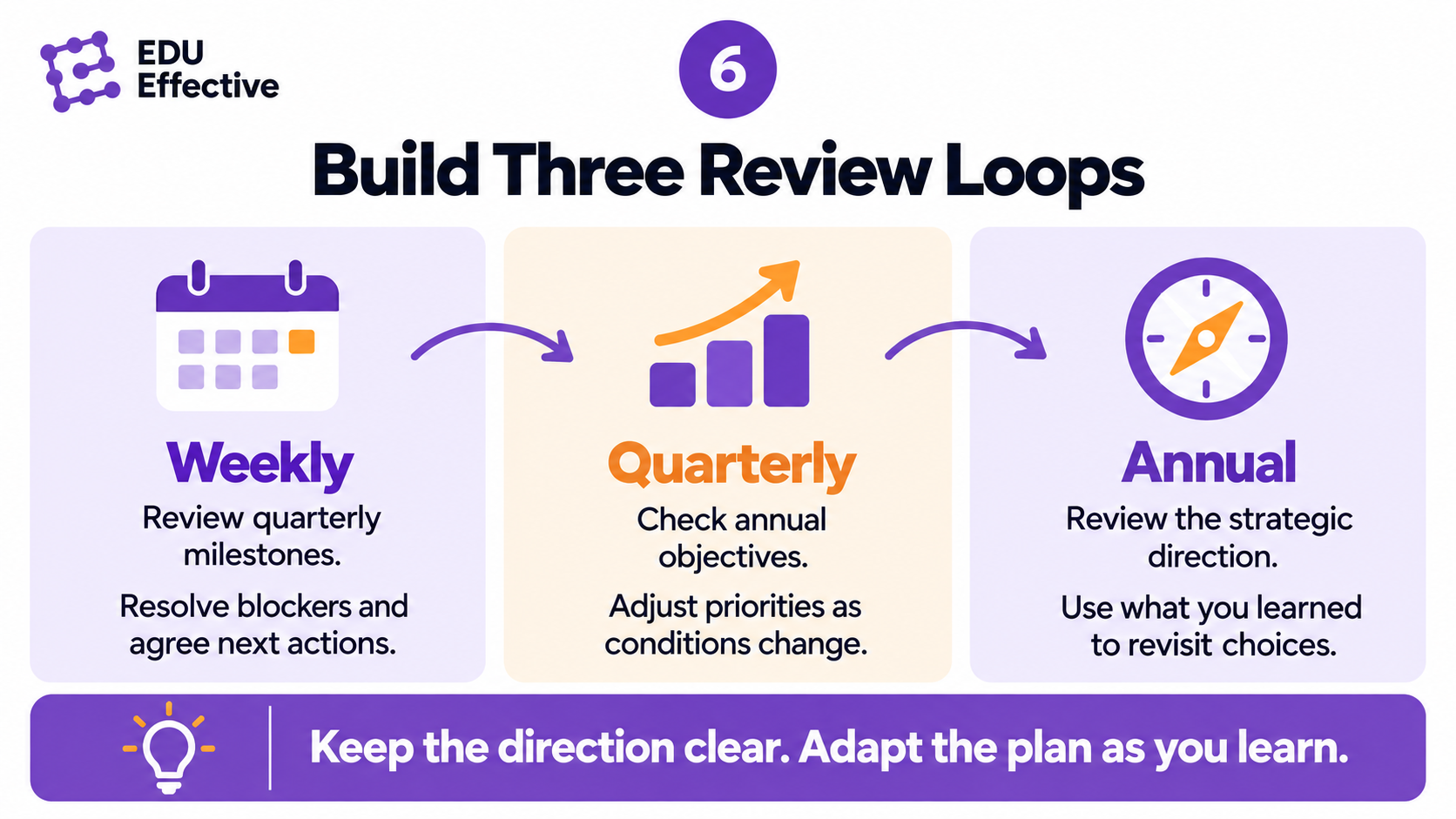
Build three review loops:
Weekly: Progress on quarterly milestones. What's moving? What's stuck? This is a 30-minute conversation, not a reporting exercise.
Quarterly: Are the annual objectives still the right objectives? Have market conditions shifted enough to warrant adjusting priorities? This is the moment to change course before you've spent 12 months heading in the wrong direction.
Annual: Full strategic review. Does the three-year direction still hold? What did you learn this year that should change your choices next year?
The quarterly review is the one most organizations skip. They write the annual plan, they check it at year-end, and they wonder why execution drifts. The quarterly conversation is where strategic agility is built, the ability to hold direction while adjusting tactics.
Step 7: Communicate the strategy until it's obvious
Strategy communication is where most leadership teams underinvest. You've said it in the offsite. You've put it in the all-hands deck. That's not enough.
Research on organizational communication consistently shows that employees need to hear a message seven to twelve times before it changes their behavior. One all-hands presentation and a Confluence page won't move anyone.
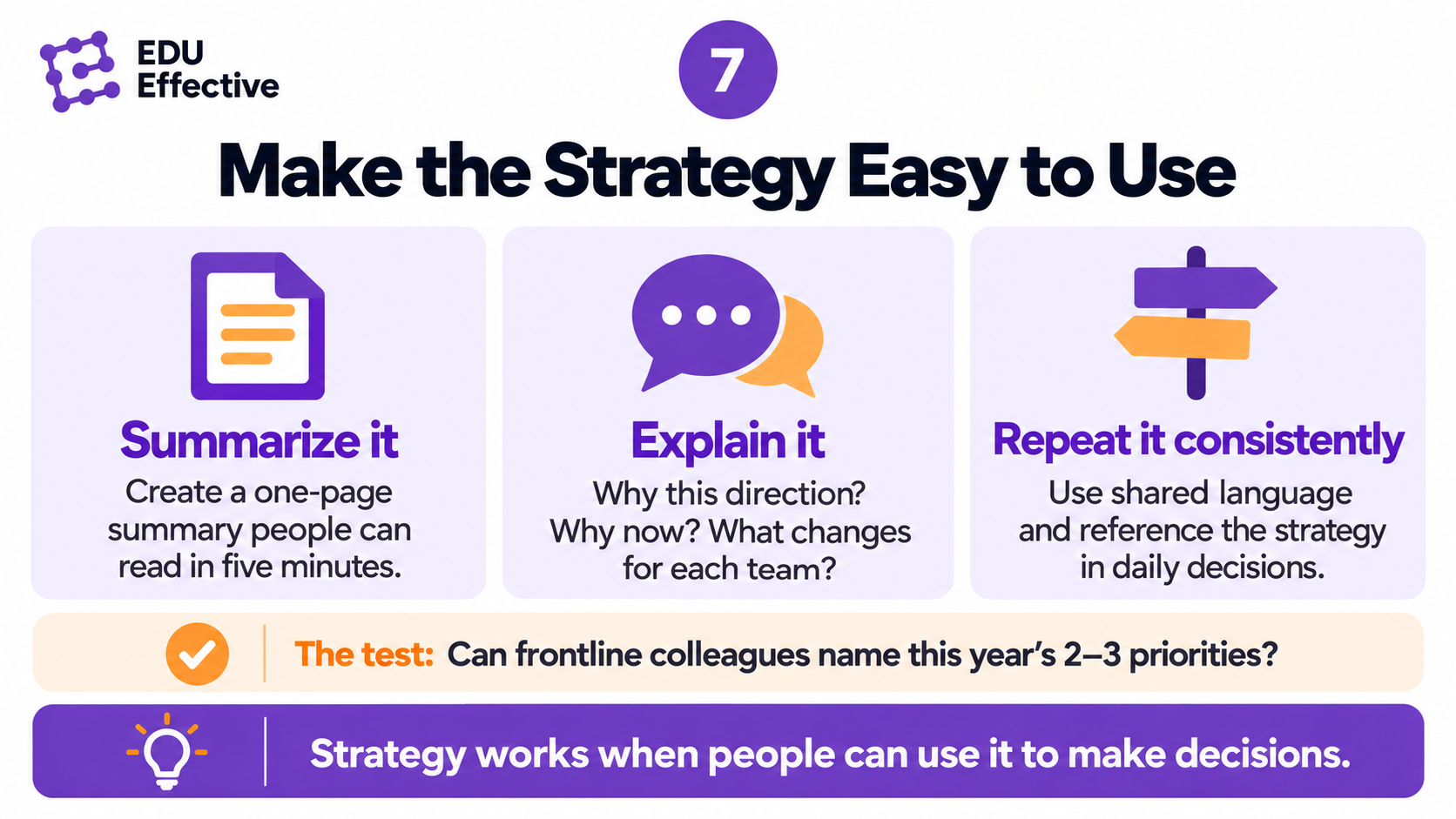
Build a communication plan alongside the strategy itself:
- A one-page strategy summary every employee can read in five minutes
- A specific narrative: why this direction, why now, what changes for each team
- Consistent language used by all leaders, so the message isn't reframed differently by each layer of management
- Regular references back to the strategy in operational reviews: "Does this decision support or contradict our direction?"
The test: can your frontline team members articulate the two or three things your company is prioritizing this year? If they can't, the strategy hasn't landed.
The strategy document: what it actually contains
Strip away the padding. A working strategy document has six sections:
- The strategic question, one sentence
- Situation assessment, current position, key vulnerabilities, key opportunities (one page)
- Strategic choices, where to play, how to win, required capabilities (one page)
- Annual objectives and milestones, with owners and metrics (table format)
- Resource allocation, where are you investing more, where are you cutting?
- Review cadence, scheduled dates for quarterly reviews
That's it. If your strategy document is longer than 10 pages, it contains either padding or operational plans that belong in separate documents. Keep the strategy document strategic: choices, not tactics.
Common mistakes executives make
Mistaking consensus for strategy. If everyone agrees immediately, you haven't made a choice, you've found the comfortable middle. Real strategic choices create internal tension because they deprioritize something someone cares about.
Writing the strategy in isolation. The people who execute strategy should help develop it. McKinsey found that organizations where those who execute have input into planning reported consistently higher satisfaction with the planning process.
Confusing busyness with progress. Only 40% of organizations use metrics to hold employees accountable for strategic progress. The rest rely on activity reports. Activity is not progress.
Ignoring the not-to-do list. Every strategy needs an explicit list of what you will not pursue. Without it, every new idea becomes a strategic priority and focus dissolves.
Over-planning for certainty. The goal of strategic planning isn't a perfect roadmap. It's a framework for making better decisions faster when conditions change.
Strategy and management development
Writing strategy is a learnable skill. Most managers are never taught it formally. They absorb patterns from watching others, often inheriting the dysfunctional habits of whoever wrote the strategy before them.
Management education that covers strategic frameworks, decision-making under uncertainty, and execution design gives managers a vocabulary and a toolkit that changes how they approach their work. The ability to frame a strategic question, make an explicit choice, and build a system to execute it: these aren't innate leadership traits. They're skills.
Professionals who build this competency become the managers who get promoted to run business units, because they can translate organizational direction into team execution in a way that most of their peers cannot.
Key takeaways
Business strategy is a set of deliberate choices: where to compete, how to win, what to stop doing. It fails when treated as an annual document rather than a living decision system. The steps that separate working strategies from planning theater: define the real strategic question, audit your actual position, make explicit choices on where to play and how to win, cascade those choices into annual objectives with named owners, build a quarterly review cadence, and communicate until the direction is obvious to everyone in the organization.
Forty-five percent of executives are unsatisfied with their strategic-planning process. The gap isn't effort. It's structure.
About EDU Effective Business School
The Effective MBA: Executive Management & Leadership develops the judgment behind everyday management decisions. Runs on 15 minutes a day, completes in 10 months or less and is ASIC accredited.
Sources
- McKinsey & Company, How to Improve Strategic Planning https://www.mckinsey.com/capabilities/strategy-and-corporate-finance/our-insights/how-to-improve-strategic-planning
- AchieveIt, State of Strategy Execution https://www.achieveit.com/?p=57194