
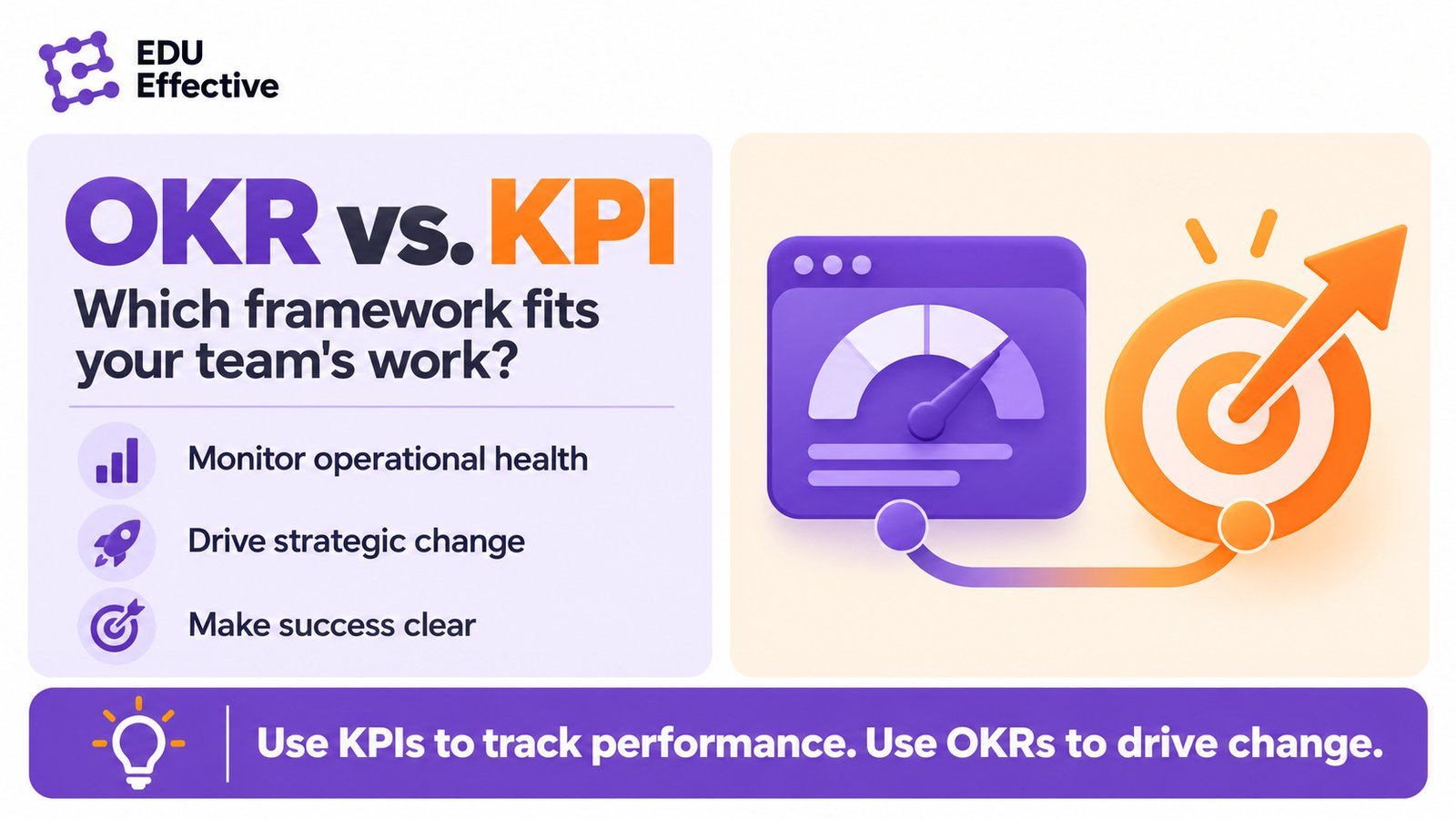

The argument about OKRs versus KPIs tends to happen at the wrong level. Teams debate methodology, format, and quarterly versus annual cycles while the underlying problem — that most people in most organizations do not know what they are actually supposed to be delivering, or why it matters — goes unaddressed.
The data from 2025 is unusually precise about this. Gallup surveyed nearly 79,000 U.S. workers and found that only 32% of leaders strongly agree they have a clear definition of what exceptional performance looks like. Among individual contributors, the figure is 22%. The engagement gap between those with clarity and those without is almost threefold: leaders who know what exceptional performance looks like are engaged at 81%, versus 28% for those who do not.
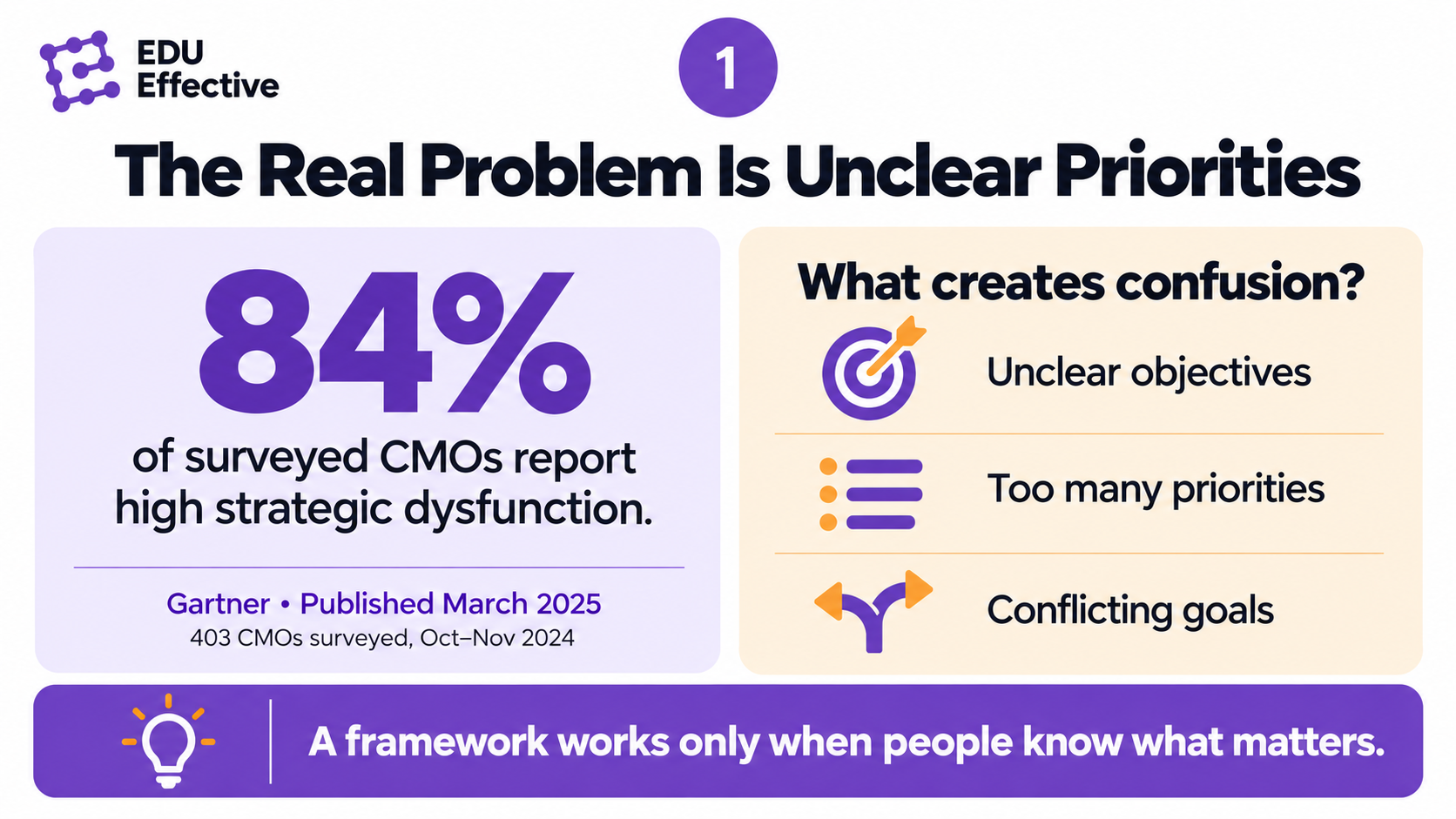
Gartner surveyed 403 CMOs in late 2024 and found that 84% report high levels of strategic dysfunction — defined as confusion and conflict from unclear, too numerous, or conflicting organizational objectives. Organizations with high dysfunction are 36% less likely to report strong business performance. What the data says about organizational performance and transformation.
Neither OKRs nor KPIs solve these problems automatically. Both can make them worse if implemented without the underlying management discipline they require. The question is not which framework is better. It is which framework fits what your organization is actually trying to do — and what it will take to make either one work in practice.
What KPIs Actually Are (and What They Are Not)
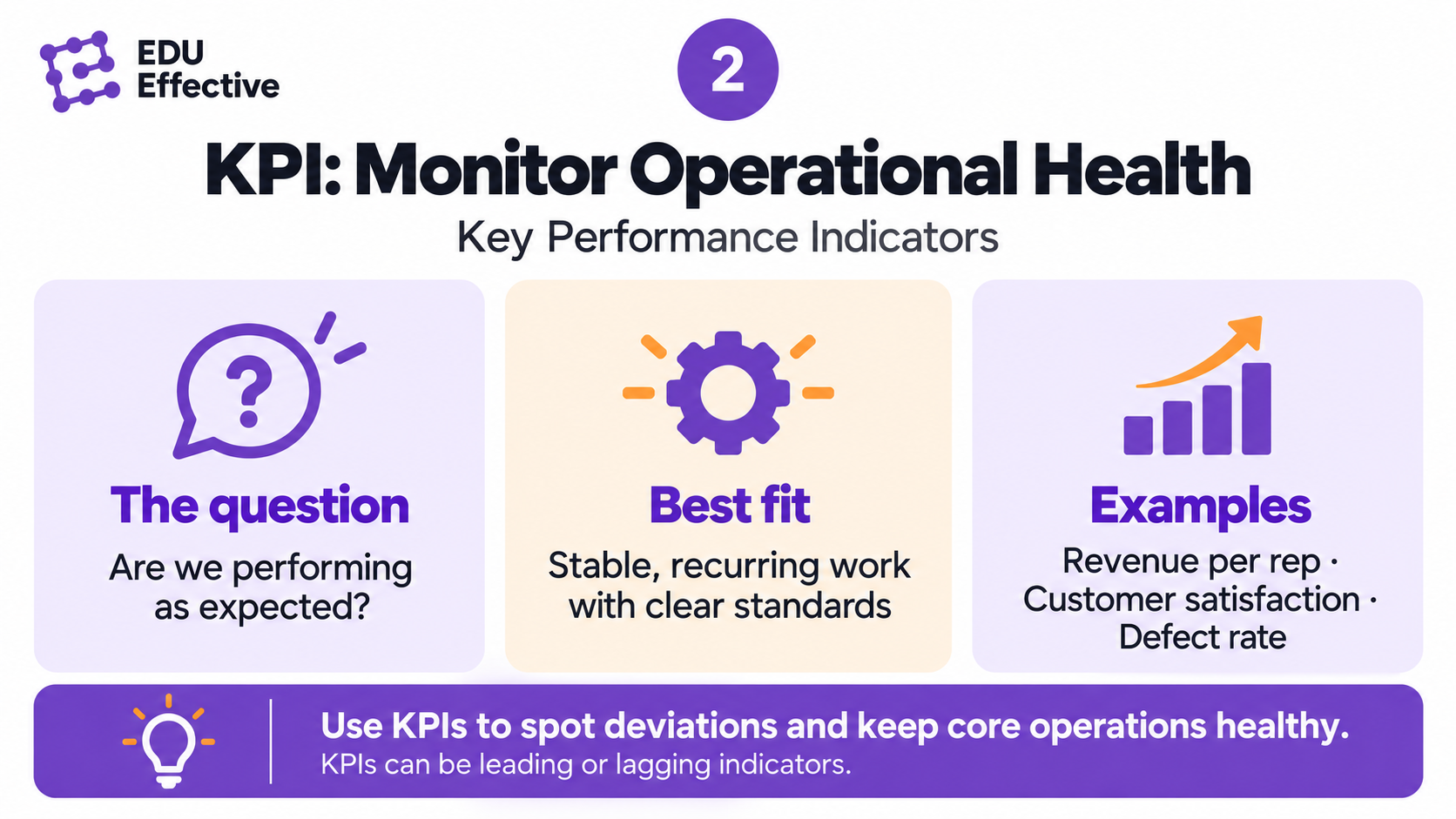
KPIs — Key Performance Indicators — measure the health of a process or function. They answer the question: is this operating the way it should?
A KPI is a lagging or leading indicator of performance that already exists. Revenue per sales rep, customer satisfaction score, defect rate per production run, employee turnover percentage — these are measures of how a function is performing against a defined standard. They tell you whether something is working, not where to go next.
KPIs are most useful when:
- You have a stable, recurring process with known performance standards
- You need to monitor ongoing operations rather than drive change
- Accountability is at the functional or individual level
- Performance expectations are already defined and the question is whether they are being met
The limitation of KPIs as a goal-setting framework is that they measure what is already happening. They are not designed to drive an organization toward something new. A sales team hitting its revenue KPI every quarter may be executing perfectly against last year’s model while missing the market shift that will make that model obsolete in 18 months.
What OKRs Actually Are (and Where They Break Down)
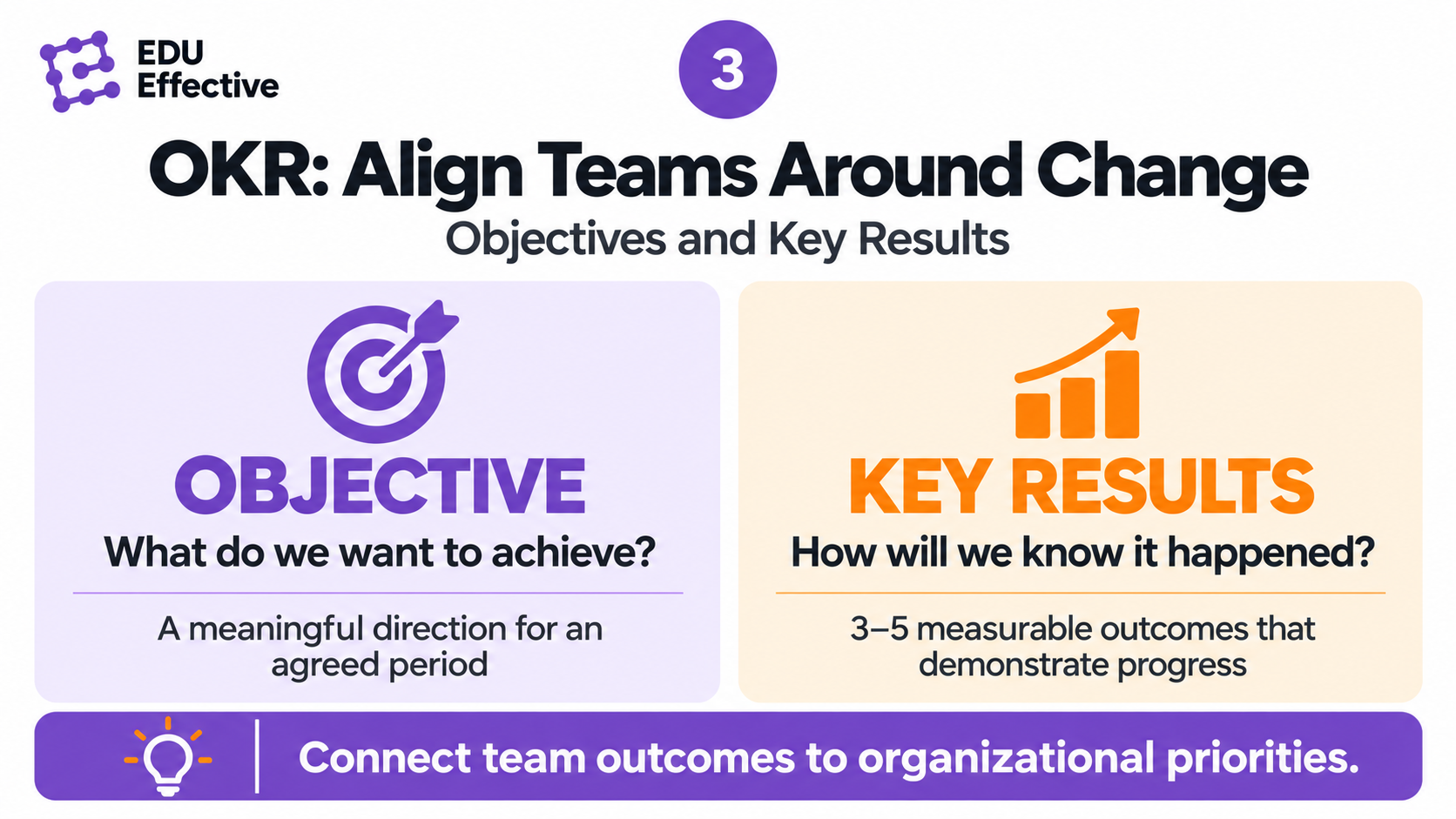
OKRs — Objectives and Key Results — are a goal-setting framework designed to align an organization around ambitious, time-bound priorities and create a clear line of sight between individual work and organizational direction.
The structure is deliberately simple. An Objective is a qualitative description of what you want to achieve — ambitious, meaningful, and time-bound. Key Results are three to five measurable outcomes that prove the objective was reached. The distinction from a KPI is intentional: a Key Result is an outcome (what changed), not a metric (what we measured). “Reduce average customer onboarding time from 14 days to 7 days” is a Key Result. “Average onboarding time” is a KPI.
OKRs are most useful when:
- The organization is navigating change or needs to move in a new direction
- Cross-functional alignment is a problem — teams are pulling in different directions
- You need people to understand not just what to do but why it matters
- You want to create accountability at the team level, not just the individual level
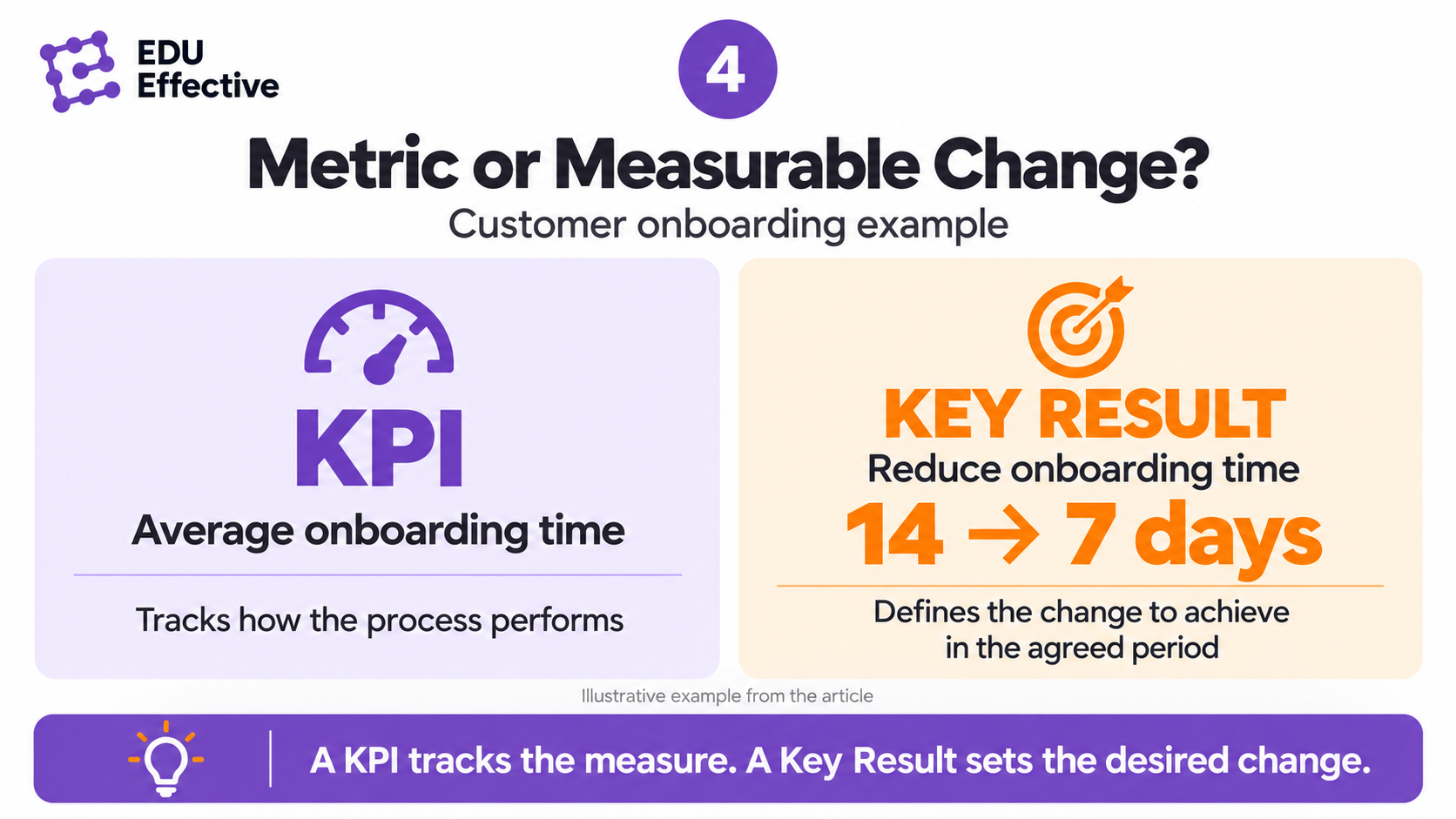
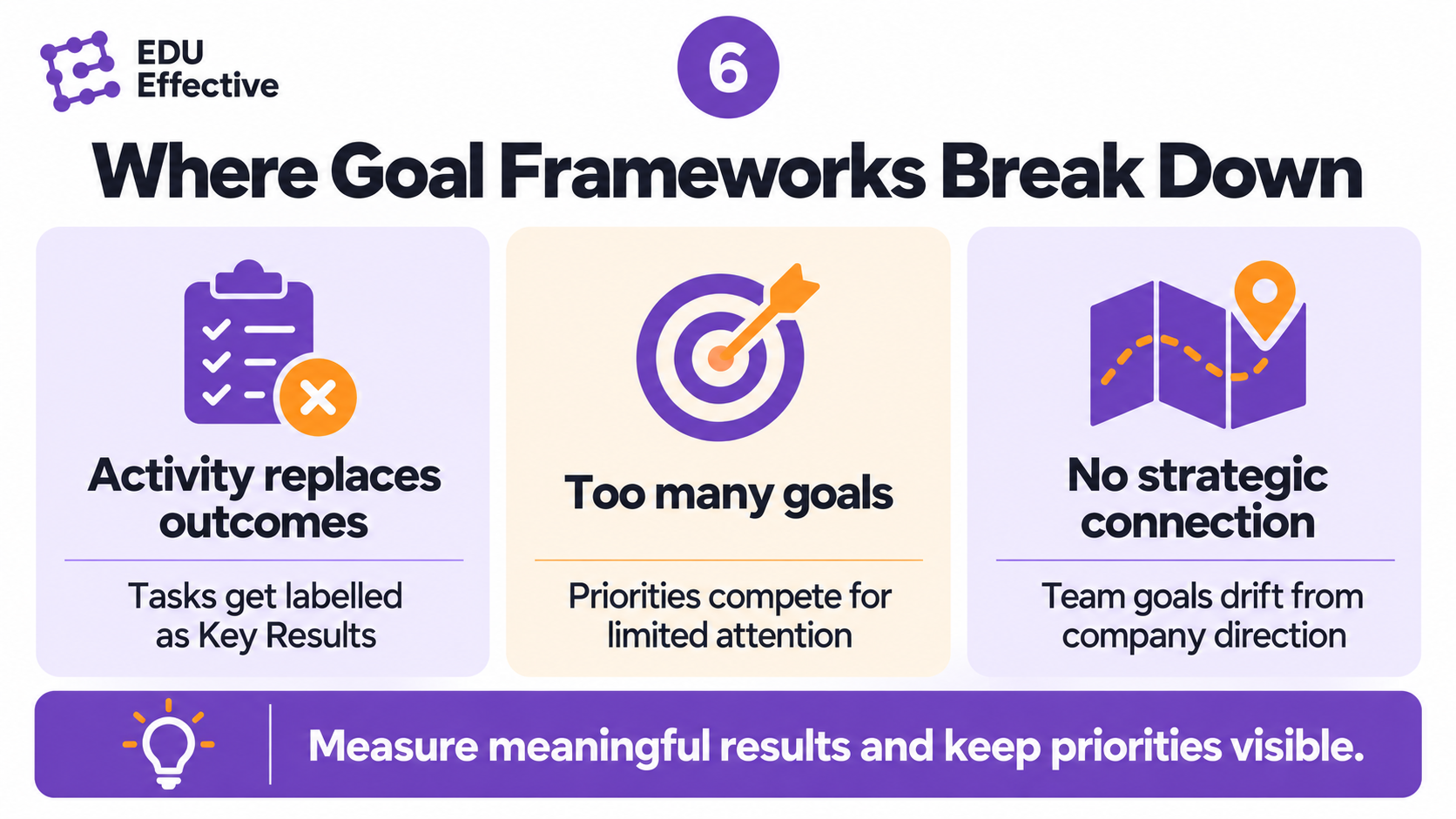
Where OKRs break down is well-documented. Research from OKRs Tool — based on analysis of 876 organizations — found that 52% of Key Results written by teams are actually tasks or KPIs rather than outcomes. Teams write “Launch new product by Q3” (a task) or “NPS score above 50” (a KPI) and call them Key Results. The framework looks like it is running. It is not.
The same research found that 65% of teams say their OKRs are not clearly linked to company goals — which defeats the primary purpose of the framework. And 86% of companies report that most employees cannot name the top strategic priorities unprompted.
Gartner’s finding that 94% of CMOs say translating enterprise strategic directives into actionable plans is a challenge describes exactly this failure mode at scale: the framework exists, the objectives are written, but the translation from organizational direction to individual understanding has broken down somewhere in the hierarchy.
The Real Difference Between the Two Frameworks
The fundamental distinction is not complexity or ambition. It is the direction of the question each framework is designed to answer.
KPIs ask: are we performing as expected? They look backward at a defined standard.
OKRs ask: are we moving toward where we want to be? They look forward at a desired change.
A mature organization needs both. KPIs to monitor whether core operations are healthy. OKRs to drive the changes that the organization’s strategy requires.
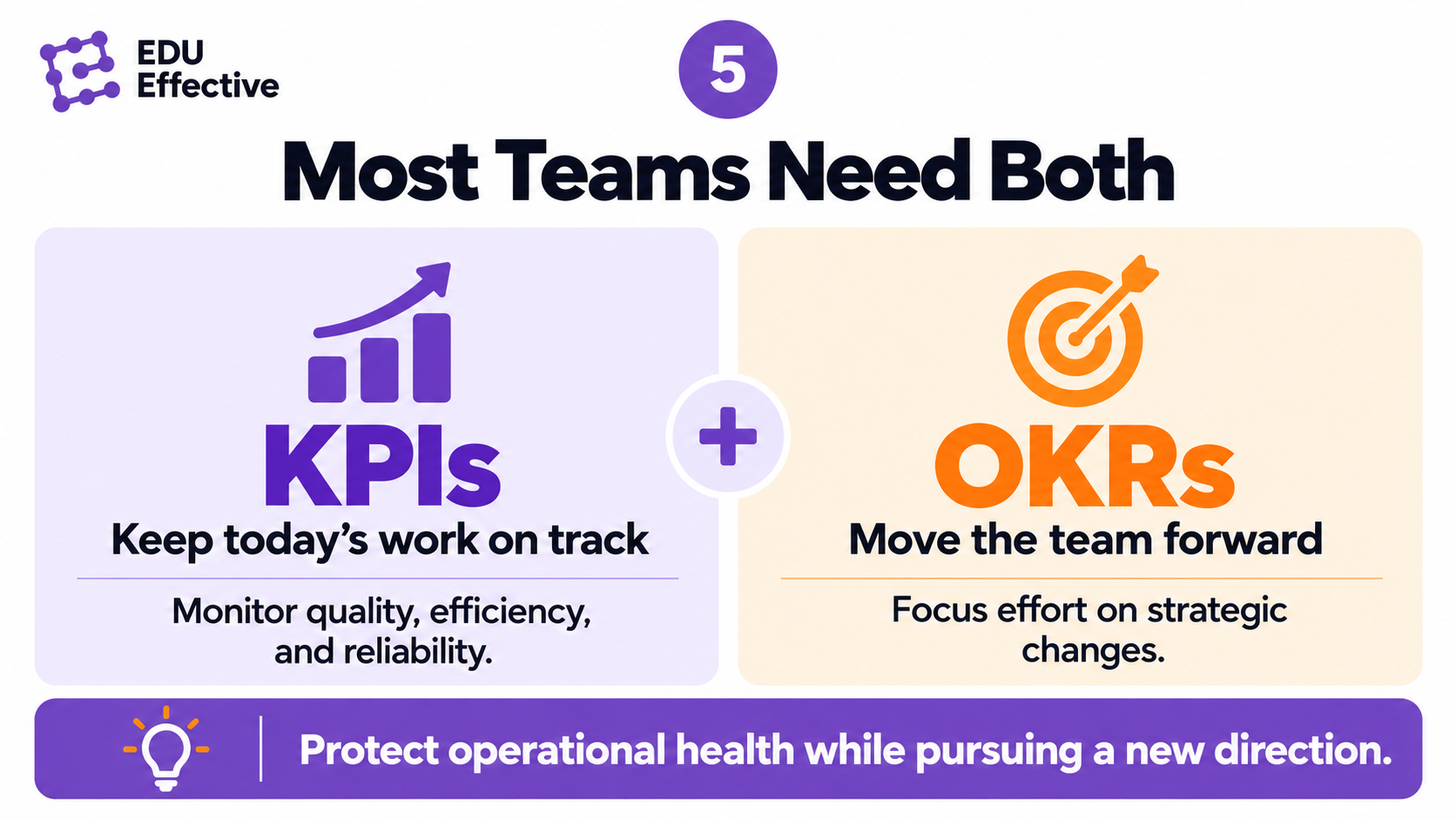
The mistake — common in both directions — is treating them as substitutes. Organizations that run everything through KPIs can be highly efficient at executing last year’s model with no mechanism for directional change. Organizations that replace all KPIs with OKRs often lose visibility into operational health while chasing ambitious targets that nobody is checking against day-to-day reality.
The practical question for any manager is not which framework to choose. It is which layer of their work needs each one.
What the Evidence Says About Making Either Framework Work
The Gallup data from 2025 is the most important context for this question, and it is not specific to either OKR or KPI implementation. It is about whether people know what exceptional performance looks like.
Only 22% of individual contributors strongly agree they have that clarity. The engagement implications are severe: people managers whose teams have clarity are engaged at 71% versus 19% without it. Project managers show the same pattern: 63% engaged with clarity, 19% without.
The framework matters less than whether people understand what success looks like in their specific role. A well-written OKR or a well-defined KPI both provide that clarity. Poorly implemented versions of either fail at the same point — they exist on paper without changing what any individual knows they are supposed to deliver.
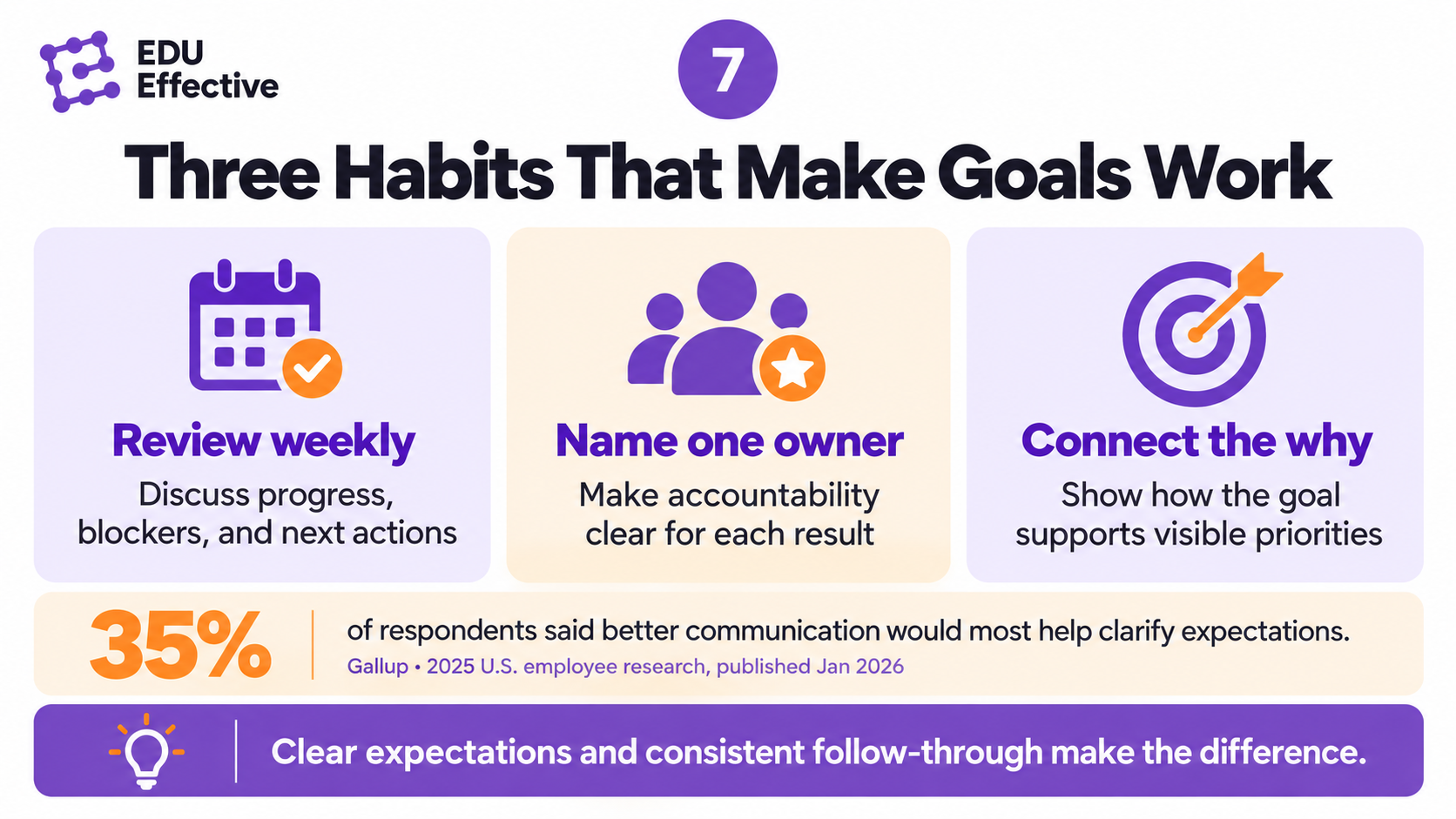
Gallup also found that 35% of employees say better communication would help most with clarifying expectations. Not new tools, not new frameworks — clearer communication from managers about what is expected and why.
Three practices consistently separate organizations where goal-setting frameworks produce results from those where they produce paperwork:
Weekly review disciplines. The OKRs Tool benchmark data found 43% higher goal completion for teams with weekly check-ins versus those without. The same pattern holds for KPIs: operational metrics that are reviewed weekly catch problems in time to address them. Metrics reviewed monthly or quarterly are historical records.
Single ownership of each result. The same research found 26% higher completion when each Key Result has a single named owner. Shared ownership of goals is one of the most reliable predictors of no accountability — when everyone is responsible, nobody is.
Connecting goals to visible priorities. Gartner’s finding that CMOs who plan 18 months or more ahead are 1.5 times more likely to report strong performance points toward the same underlying mechanism: organizations that can translate a multi-year direction into near-term goals produce better outcomes than those optimizing only for the current quarter. OKRs are designed to create this line of sight. They fail when the top-level objectives are too vague or too numerous to drive meaningful prioritization. How to write a business case that gets approved over that planning horizon.
How to Choose for Your Team
The practical answer for a manager running a team of 5 to 50 people is usually a combination, but the emphasis depends on the nature of the work.
If your team runs a stable, well-defined function — operations, finance, customer service, production — KPIs are the right primary tool. You know what good performance looks like. The job is to measure it consistently, set clear standards, and respond to variance.
If your team is being asked to do something meaningfully different from what it did last year — launch a new product, enter a new market, transform how a process works, build a new capability — OKRs give you a better framework for creating shared direction and measuring whether you are actually moving toward the goal rather than just staying busy.
Most teams need both: KPIs to ensure the current work stays on track, and OKRs for the one or two strategic changes the team needs to drive this year.
The number matters. OKRs Tool found that too many goals per team is the second most common reason OKR implementations fail, cited by 20% of teams that abandoned the framework. The original design from John Doerr — who introduced OKRs at Google in the late 1990s — recommends three to five objectives per quarter, with three to five Key Results each. Most teams that struggle with OKRs have written twice as many and have no mechanism for prioritizing which ones to protect when time is scarce.
The Question Underneath the Framework Question
The Gartner finding that 84% of CMOs report strategic dysfunction — from unclear, too numerous, or conflicting objectives — is the context for why this conversation matters.
Both OKRs and KPIs are answers to the same underlying problem: organizations are complex, people have limited attention, and without a disciplined mechanism for communicating what matters most and measuring whether it is happening, that attention distributes across hundreds of competing demands with no clear hierarchy.
The framework does not solve the problem. The management discipline to use it consistently, review it regularly, and make it the actual basis for decisions does. How managers build that discipline through self-coaching.
Gallup’s 2025 data found that knowing what is expected at work has declined 9 percentage points among younger workers over five years. The trend is not about OKRs or KPIs specifically. It is about whether managers are doing the fundamental work of making priorities clear and connecting individuals to the larger direction. Any framework that supports that work is the right framework. Any framework that replaces the work with process theater is not.
Build the Strategic Thinking That Makes Frameworks Work
Goal-setting frameworks are tools. What determines whether they produce results is the quality of strategic thinking behind them — the ability to identify what genuinely matters, translate it into clear priorities, and create alignment across a team or organization. The Effective MBA develops that capability.
About EDU Effective Business School
EDU Effective Business School keeps its programs short, practical and directly applicable at work. Runs on 15 minutes a day, completes in 10 months or less and is ASIC accredited.
Browse the programs · Read student reviews · Request a place
Sources
- Gallup — Employee Engagement in the U.S. (78,945 respondents): https://www.gallup.com/workplace/701486/employee-engagement-declines-2020-peak.aspx
- Gartner — Survey: 84% of CMOs Report High Levels of Strategic Dysfunction (403 CMOs): https://www.gartner.com/en/newsroom/press-releases/2025-03-25-gartner-survey-reveals-84-percent-of-cmos-report-high-levels-of-strategic-dysfunction
- OKRs Tool — OKR & Strategy Statistics 2026 (original research: 876 organizations, 20,952 Key Results, 330 organizations): https://www.okrstool.com/blog/okr-statistics
- Mooncamp / Haufe Talent — OKR Impact Report (40 organizations): https://mooncamp.com/blog/okr-statistics
- OKR Institute — Why OKRs Fail: https://okrinstitute.org/why-okrs-fail/