

Most organizations invest heavily in leadership development at the senior level and almost nothing at the middle. The gap is not accidental — executive coaching is expensive, development programs are time-consuming to design, and middle managers are the people the business runs on day-to-day and cannot afford to have away from their desks. So they keep running. And the development doesn’t happen.
The result is a large group of capable people in demanding roles who are learning mostly from experience — which is valuable, but incomplete. Experience without structured reflection produces habit, not growth. You repeat what worked last time, refine it slightly, and call that development.
Self-coaching is the practice of applying coaching methods to yourself: asking the questions a good coach would ask, creating the structure a coach would provide, and holding yourself accountable to the commitments a coach would track. It does not replace external coaching. But it is something every manager can do, without budget approval or calendar coordination, starting now.
Why the Underlying Mechanics Work
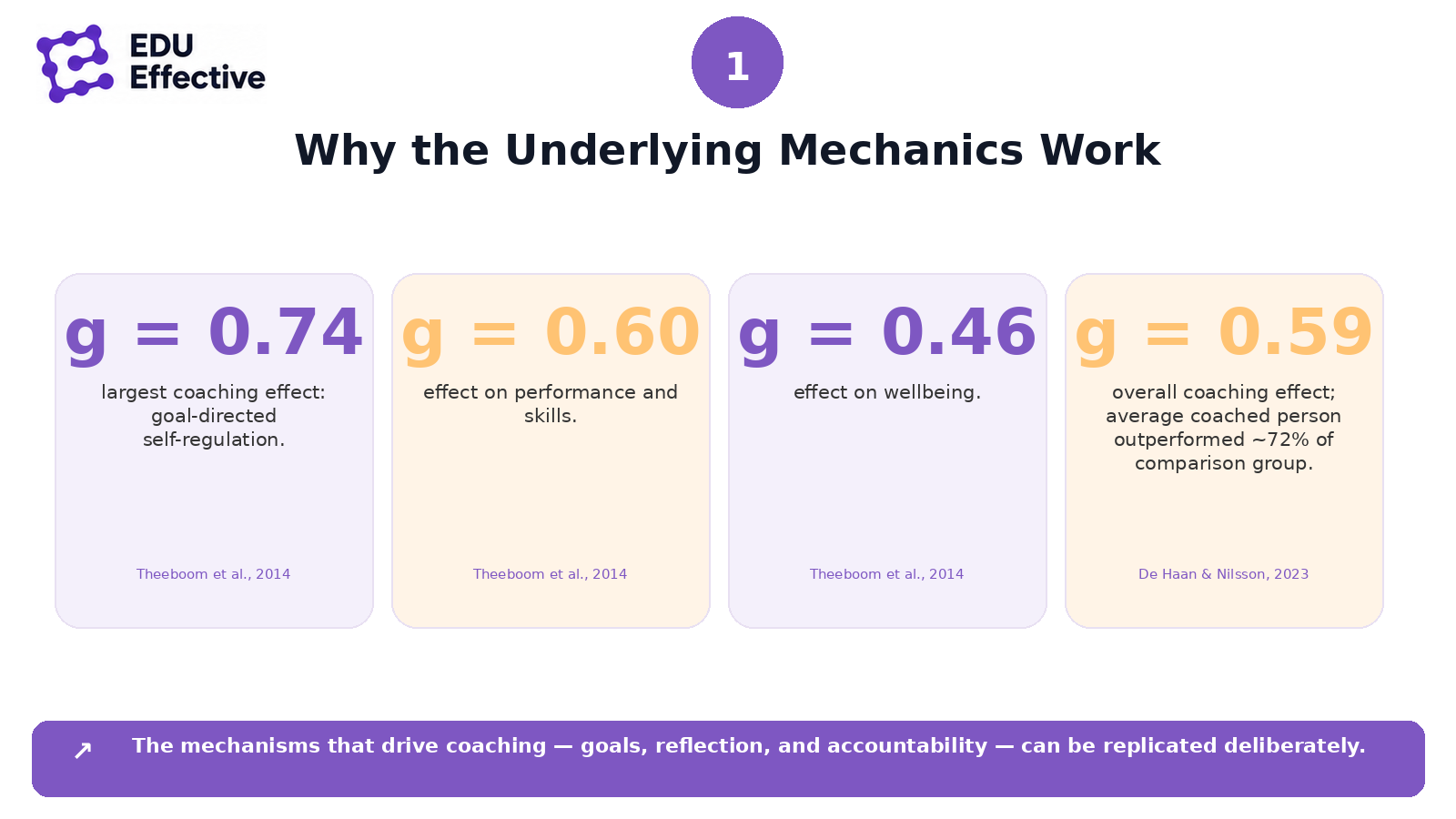
The strongest evidence for self-coaching comes from the research on coaching’s effect on goal-directed self-regulation. A 2014 meta-analysis by Theeboom, Beersma, and van Vianen across 18 workplace coaching studies found that coaching produced its largest effect in exactly this domain — with an effect size of g = 0.74, which places goal follow-through as the most reliably improved outcome across all coaching research. Performance and skills followed at g = 0.60. Wellbeing at g = 0.46.
A 2023 meta-analysis by De Haan and Nilsson across 37 randomized controlled trials and 2,528 participants found an overall coaching effect of g = 0.59 — meaning the average coached person outperformed approximately 72% of the comparison group. This is a real, moderate, consistent effect — not transformation, but meaningful development.
What matters for self-coaching is understanding which elements of coaching actually drive that effect. Research consistently points to three: structured goal-setting with specific accountability, regular reflective practice that surfaces patterns in thinking and behavior, and deliberate attention to the gap between current state and desired state.
All three are replicable without an external coach. They require commitment and a method — not a budget line.
The Reflection Problem
The most common reason managers don’t develop as fast as their roles require is not lack of intelligence or motivation. It is lack of time and structure for reflection.
Gallup’s workforce research consistently finds that only 21% of employees receive meaningful feedback in the past week. For managers, the problem compounds: they are supposed to give feedback, but they rarely receive it. Most managers go months without anyone asking them how they are developing — what is working, what they are avoiding, what patterns they keep falling into.
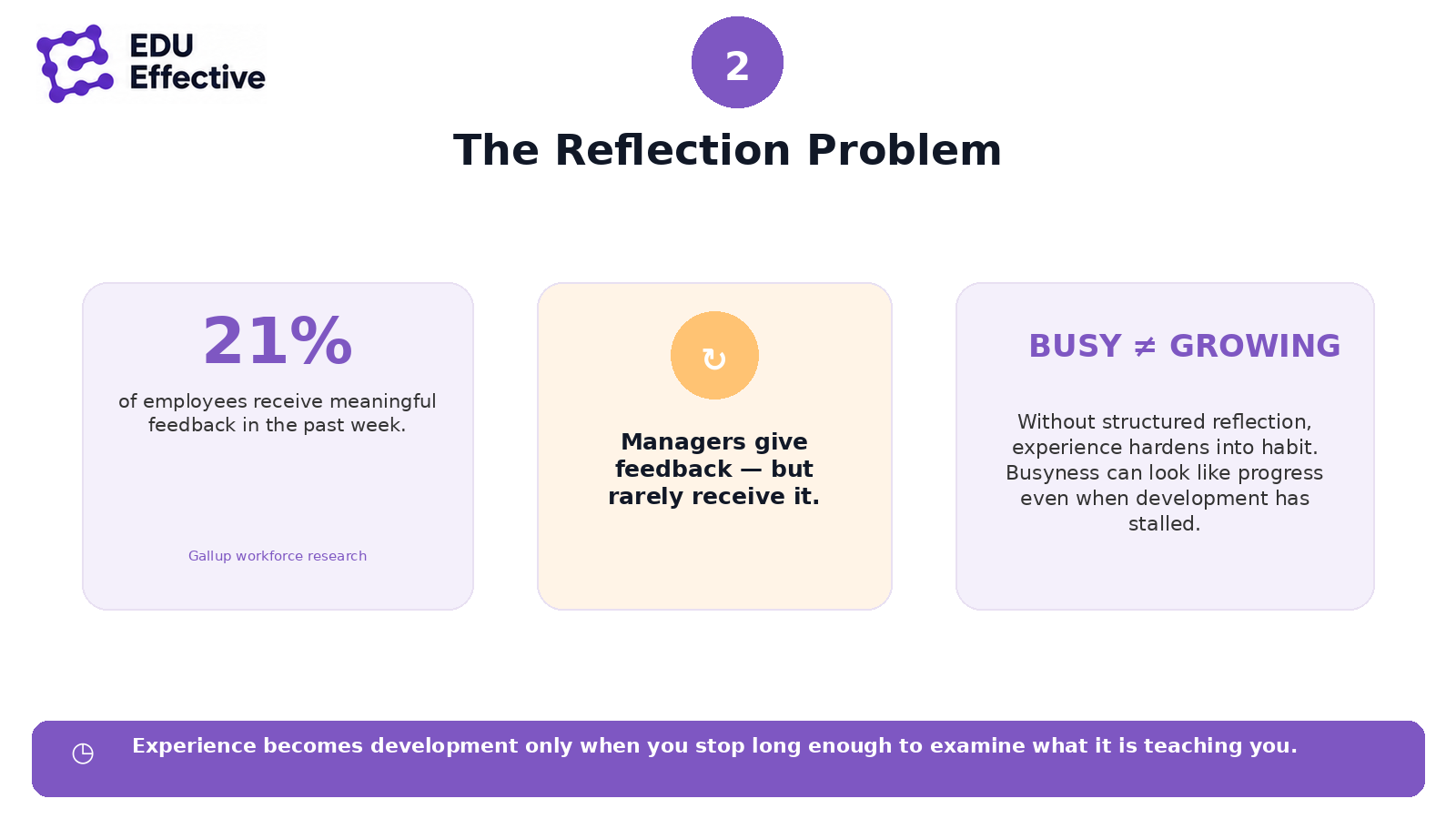
Without that external input, the default is to stay busy and assume that busyness equals progress. It rarely does.
Structured self-reflection breaks the pattern. Not journaling for its own sake — a reflective practice specifically aimed at the questions that produce insight about professional performance. Those questions are different from the ones most people naturally ask themselves.
The Questions That Actually Produce Development
A coaching conversation has a specific structure — not therapeutic exploration, not advice-giving, but a sequence of questions that moves from current situation to desired outcome to obstacles to specific next actions. The GROW model (Goal, Reality, Options, Will) describes this sequence in its simplest form.
Applied as self-coaching:
Goal: What specifically am I trying to develop? Not “be a better communicator” — that is too broad to be useful. “Get clearer and more direct in performance conversations, specifically when the message is uncomfortable.” That is a goal you can actually work toward and measure.
Reality: What is actually happening now? Not what you wish were happening, not what should be happening — what is the current pattern? A useful reality check requires honesty about what you are doing, not just what you intend. If the goal is direct performance conversations and you have postponed the difficult conversation with the same team member for three weeks, that is the reality to name.
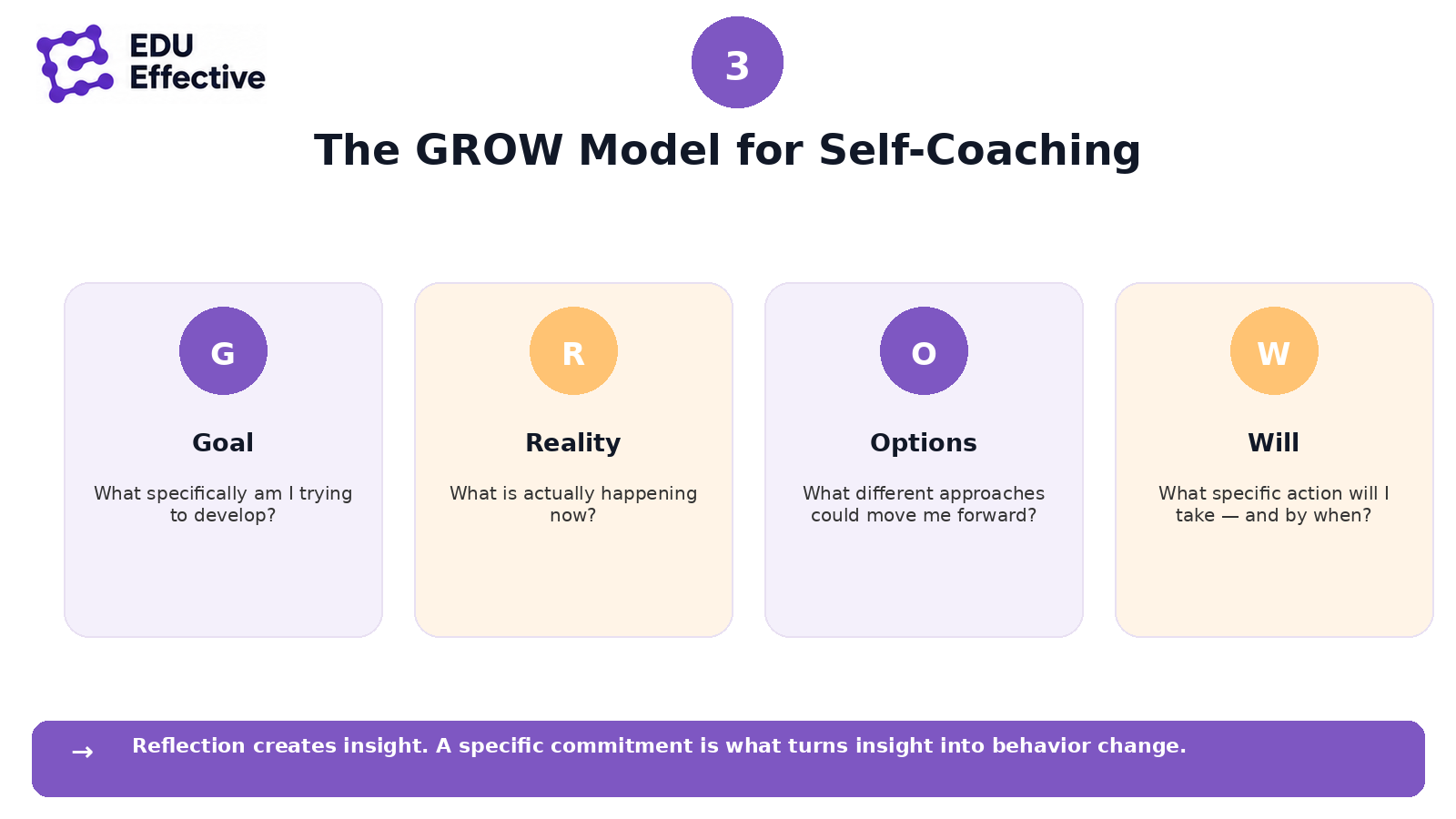
Options: What are the possible ways to move from current reality toward the goal? Generate more than one. The natural tendency is to identify the approach you already prefer and stop there. Forcing yourself to generate three or four options — including ones you find uncomfortable — is where new thinking happens.
Will/Way forward: What specific action will you take, by when? This is where most self-coaching fails. The reflection produces insight; the insight does not automatically produce behavior change. A specific commitment — “I will have that conversation Tuesday before 11am and will prepare by writing three key points beforehand” — is the bridge between insight and action.
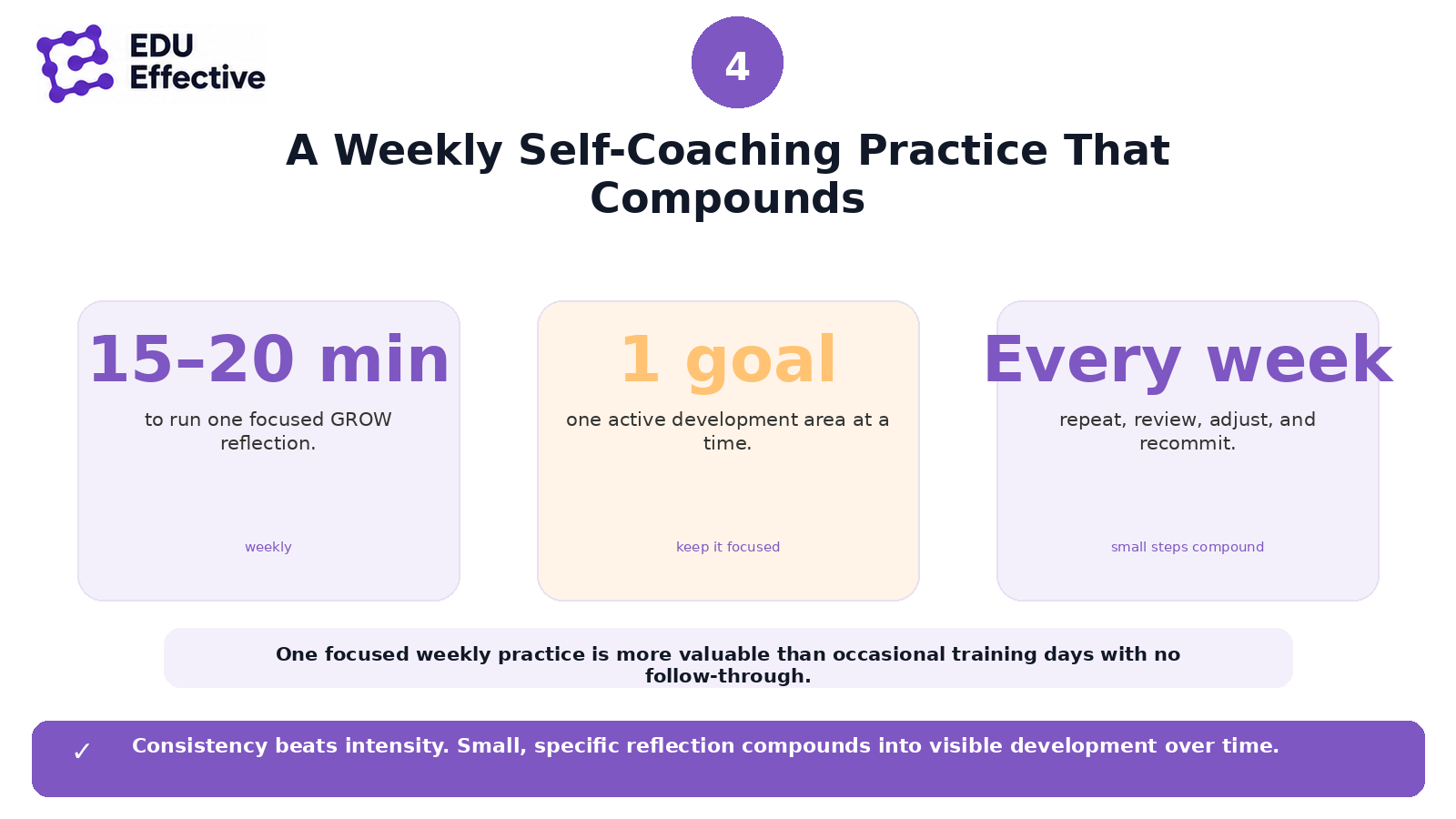
Running this sequence takes fifteen to twenty minutes. Done weekly on one focused development area, it compounds over time in ways that occasional training days do not.
Building a Feedback System When You Don’t Have a Coach
One of the things an external coach provides that is genuinely hard to replicate alone is perspective — specifically, the ability to see patterns in your behavior that you cannot see because you are inside them.
Self-coaching addresses this through deliberate feedback collection. Not waiting for feedback to arrive (it mostly won’t), but actively soliciting specific observations from specific people about specific situations.
The most effective version of this is targeted and narrow. “After that team meeting yesterday — what did you notice about how I handled the disagreement between Sarah and Marcus?” is a question that might produce useful data. “How am I doing as a manager?” will produce either reassurance or silence.
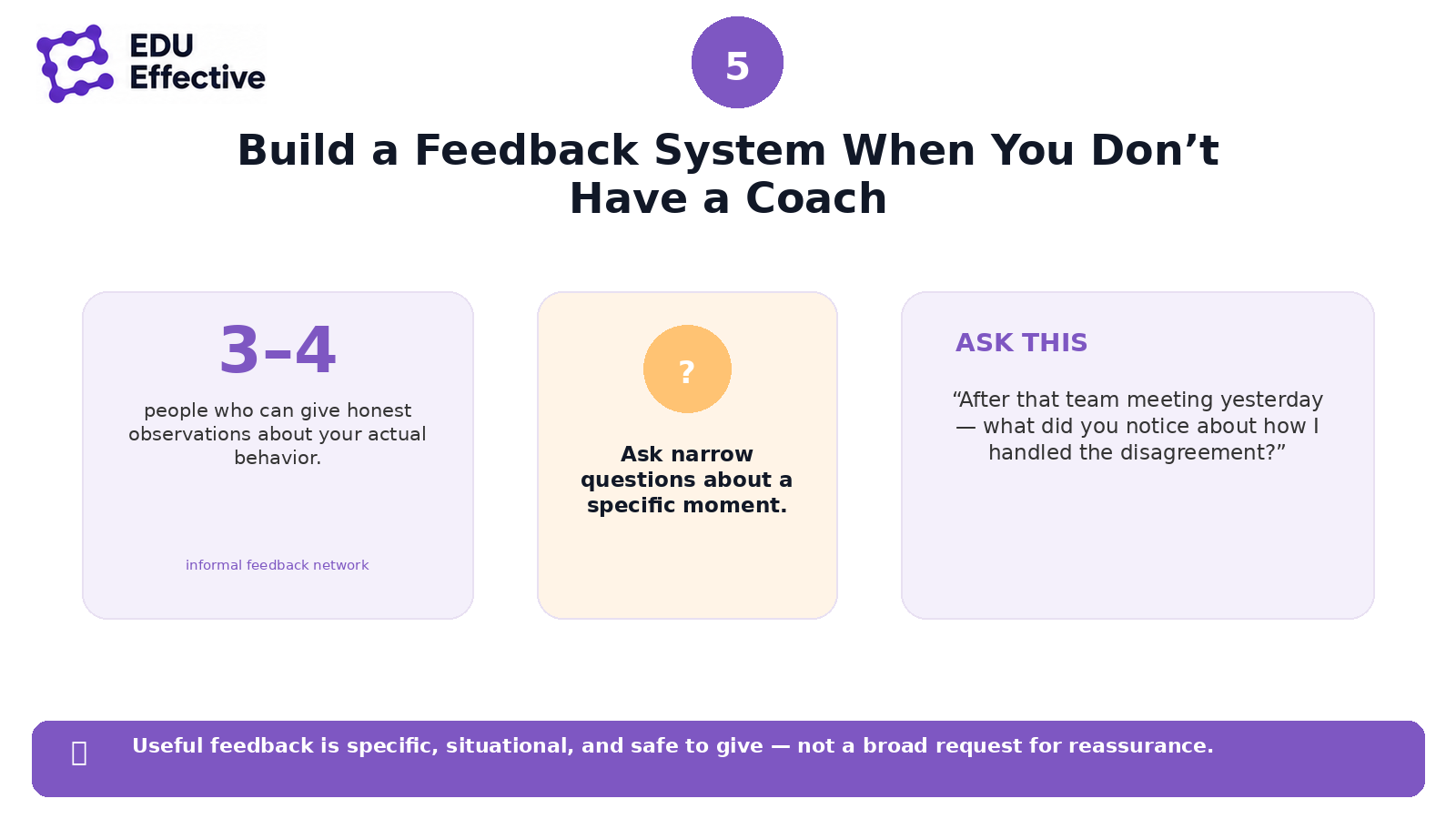
Three or four people who can give you honest observations about your actual behavior — peers, direct reports who trust you enough to be straight, a manager you have relationship with — form an informal feedback network that partially substitutes for what a coach would observe. The practice requires you to make it safe for those people to tell you things you might not want to hear, which is itself a development edge for most managers.
The Learning Log as a Development Tool
Professional athletes review game footage. Surgeons review complication data. Most managers review nothing.
A learning log — not a diary, not a to-do list, but a structured record of professional observations — creates the raw material for self-coaching review. The practice is simple: after a significant meeting, conversation, decision, or situation, take five minutes to note three things. What happened. What you did. What you noticed about the gap between what you intended and what actually occurred.
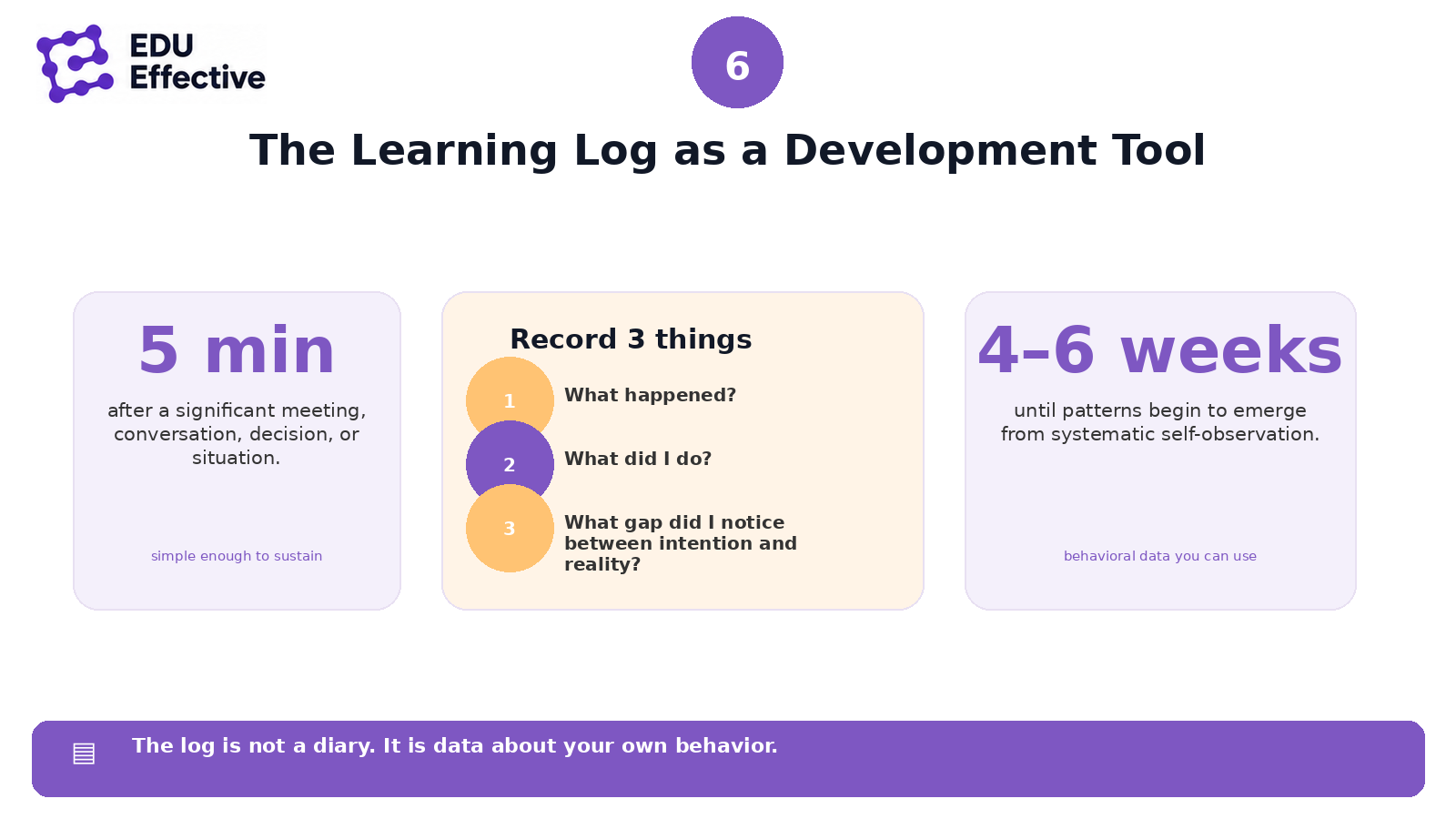
Over four to six weeks, patterns emerge that are invisible in the daily stream of events. You discover that you consistently talk more in meetings than you intend to when you feel uncertain. That you tend to solve problems for your team rather than asking questions that would help them solve problems themselves. That your energy visibly drops in the second half of the afternoon and your communication becomes less precise as a result.
These are not insights a performance review will give you. They come from systematic self-observation. And they are the specific, behavioral, concrete observations that make coaching interventions effective — whether the coaching comes from someone else or from yourself.
The Accountability Structure
External coaching works partly because the coach creates accountability — you made a commitment last session and the coach will ask about it. Self-coaching requires you to create that structure for yourself, which is harder.
Several approaches work in practice. A development partner — a peer who is doing a similar structured self-development practice — creates mutual accountability without requiring professional coaching expertise. A monthly self-review against explicit development goals, scheduled in the calendar like any other meeting, creates the structure even without a partner. Committing a specific development goal to a trusted senior colleague and inviting their ongoing observations creates both accountability and a feedback channel.
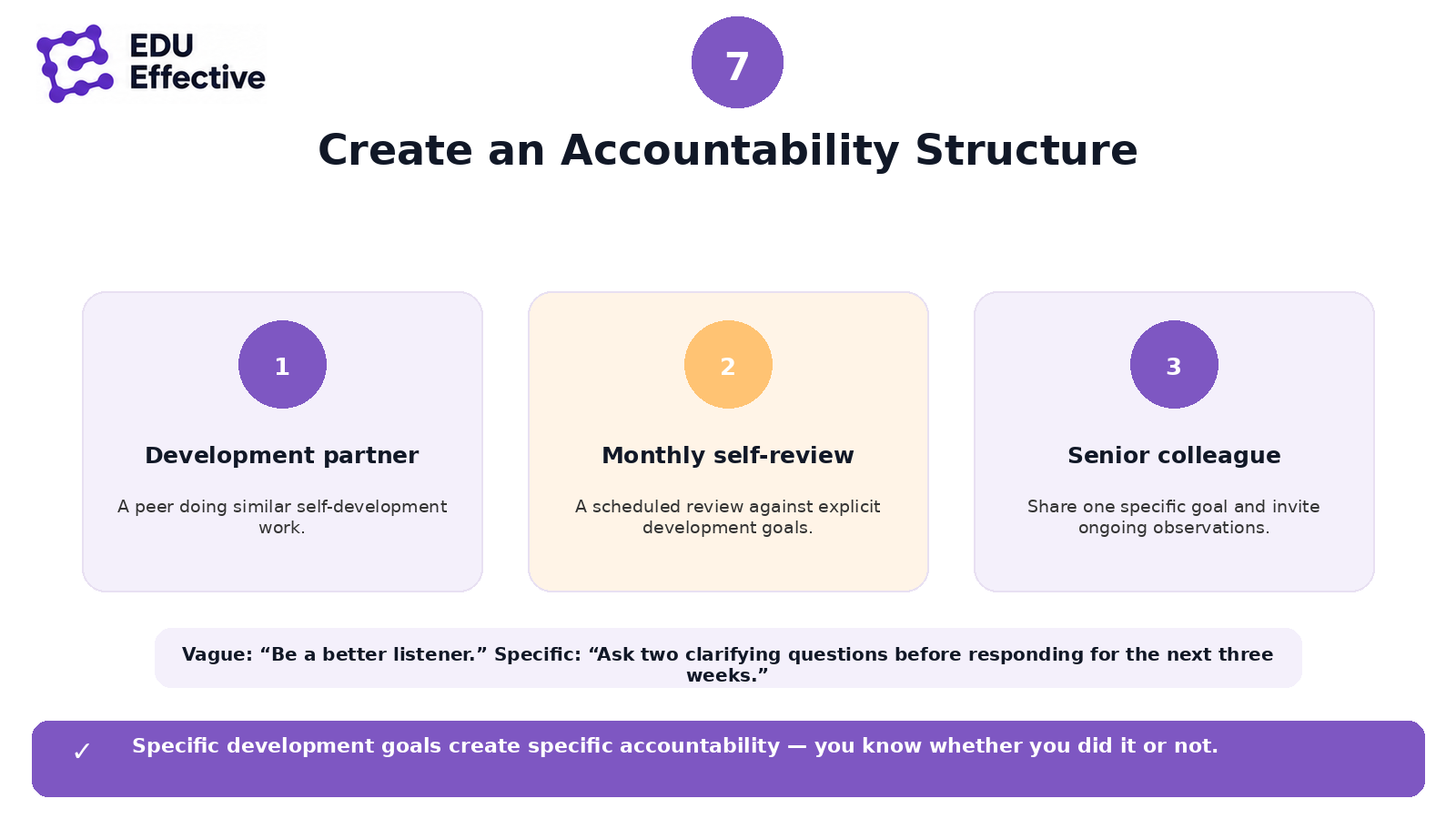
The key element in all of these is specificity. Vague development goals produce vague accountability. “Be a better listener” is not accountable. “In the next three weeks, ask at least two clarifying questions before responding in situations where I usually respond immediately” is accountable — you know exactly whether you did it or not.
Managers who coach their people through one-to-ones already know half of this system from the other side. how coaching remote teams works in practice — and how the same GROW-style questioning that develops your people doubles as the structure you can turn on yourself.
What Self-Coaching Cannot Replace
The peer-reviewed meta-analyses are clear that professional coaching produces a real, consistent effect — and that effect is meaningfully larger than what most self-directed learning achieves in comparable timeframes. De Haan and Nilsson’s 2023 findings confirm what practitioners observe: having someone skilled who can see what you cannot see, who asks questions you would not ask yourself, and who maintains the accountability structure consistently, produces outcomes that self-coaching alone does not fully replicate.
The ICF’s global coaching research found the industry at $5.34 billion annually, with 122,974 practitioners worldwide. That is a large market serving a real need. Self-coaching is not an argument against professional coaching — it is an argument for continuous development in the long stretches between formal coaching engagements, or in contexts where formal coaching is not available.
Think of it as the practice that keeps the gains from external coaching from eroding, and that prepares you to use external coaching more effectively when you do have access to it.
Starting Point
The most common mistake in beginning a self-coaching practice is designing something too elaborate to sustain. A weekly fifteen-minute GROW reflection on one active development goal, combined with a brief daily log of notable professional observations, is more valuable than a comprehensive system that gets abandoned after ten days.
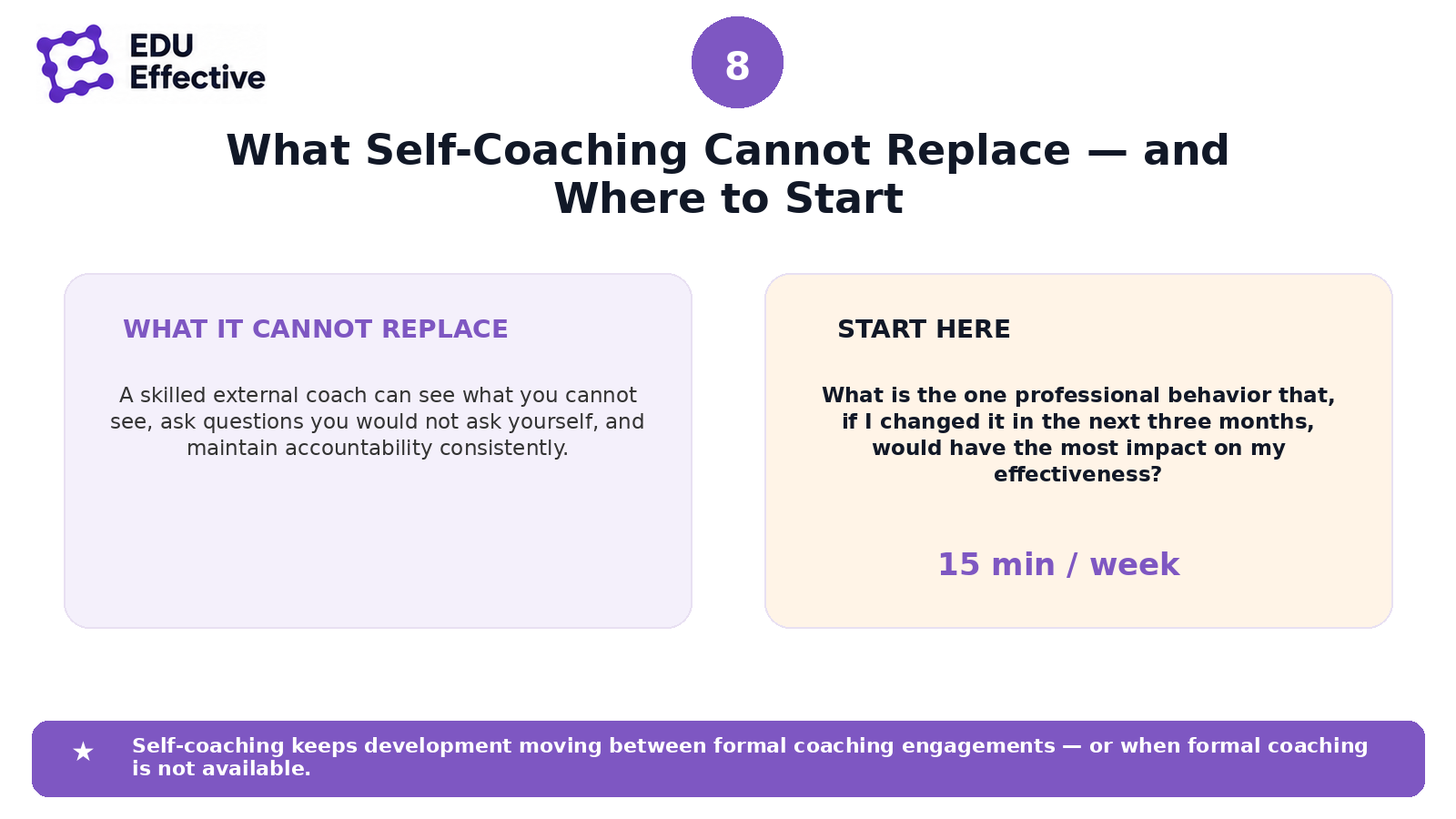
Start with one question: what is the one professional behavior that, if I changed it in the next three months, would have the most impact on my effectiveness? That question has an answer. Most managers know it already — they just haven’t created the structure to work on it systematically.
That structure is what self-coaching provides.
EDU Effective Business School — professional development for your long-term success.
All five Effective MBA programs are built on the same educational model — designed for working adults who need learning that fits real professional life:
About EDU Effective Business School
The Effective MBA: Coaching, Leadership & Mentoring turns coaching from a technique into a management habit. Runs on 15 minutes a day, completes in 10 months or less and is ASIC accredited.
Sources
- De Haan, E. & Nilsson, V. — “Evaluating Coaching Behavior in Managers, Consultants and Coaches,” Academy of Management Learning & Education.
- Theeboom, T., Beersma, B. & van Vianen, A.E.M. — “Does coaching work? A meta-analysis on the effects of coaching on individual level outcomes in an organizational context,” Journal of Positive Psychology.
- International Coaching Federation (ICF) — Global Coaching Study 2025 (coachingfederation.org).
- ICF / Human Capital Institute — “Defining New Coaching Cultures”. Employee engagement and approval data.
- Gallup — Workforce engagement and feedback research (gallup.com). Weekly meaningful feedback and engagement correlation data.