


Business Skills Series, Part 2
Most business cases fail before anyone reads the financial model. They fail in the first two pages, where the author explains what they want to do rather than why it matters to the person holding the budget.
This is not a writing problem. It is a thinking problem — specifically, a failure to work backwards from the decision-maker’s actual concerns before constructing an argument. The mechanics of a business case are straightforward. What separates the ones that get approved from the ones that stall in a queue is the thinking behind the document, not the document itself.
The Numbers That Make the Skill Worth Learning
McKinsey and Oxford University’s Saïd Business School analyzed over 5,400 large IT projects and found that the average large project ran 45% over budget, 7% over time, and delivered 56% less value than originally projected. Seventeen percent were catastrophic enough to threaten the financial viability of the organization funding them.
PMI’s Pulse of the Profession research found that organizations waste 9.9 cents of every dollar invested in projects — money that goes to scope failures, rework, and initiatives that should never have been approved in the first place. 43% of projects finish over budget. 48% finish late. 31% miss their original goals entirely.
The Standish Group’s CHAOS Report puts large project success on original scope, schedule, and budget at under 10%.
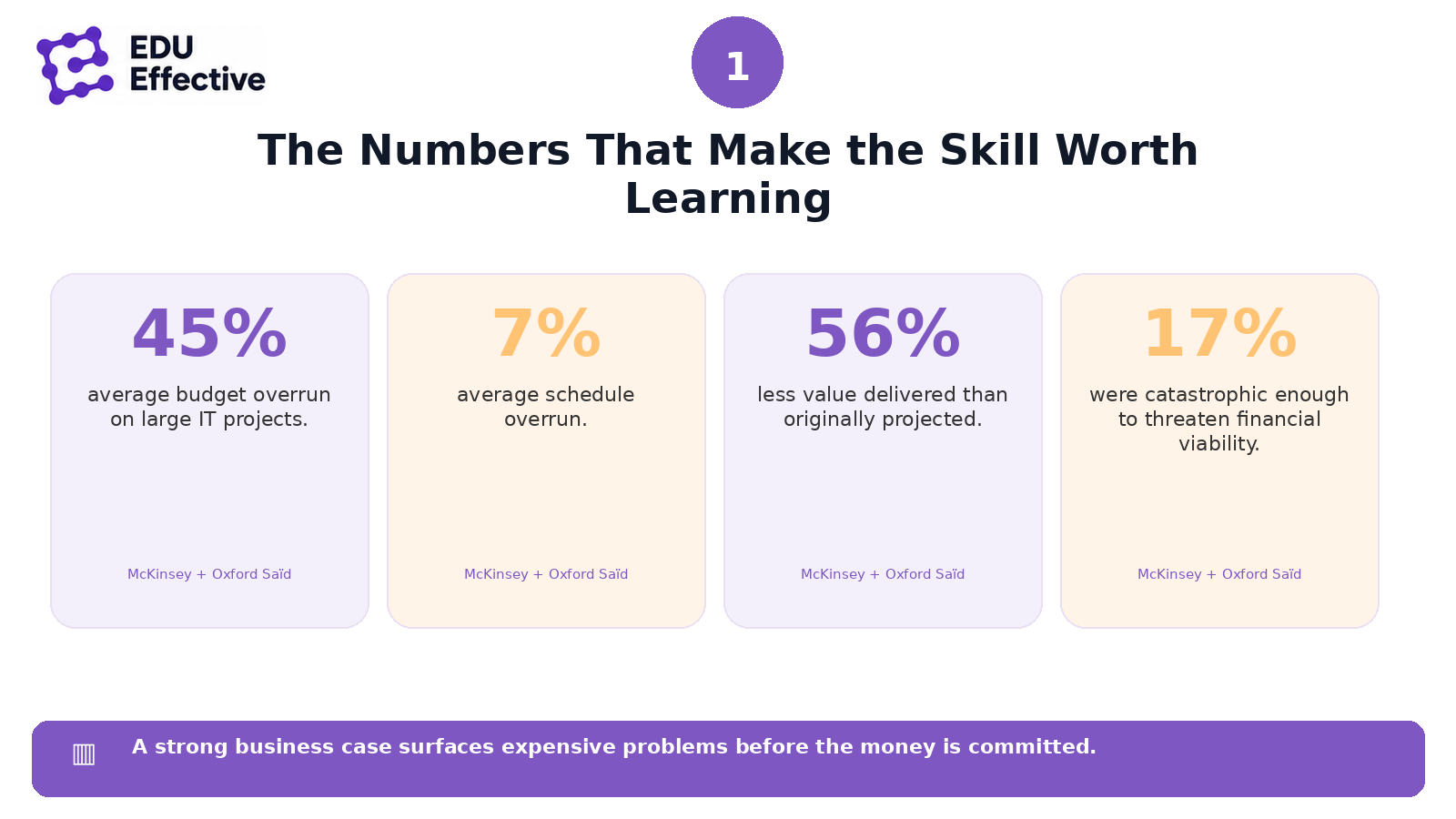
These numbers describe the consequences of bad project approval decisions — investments made without rigorous justification, scope defined too loosely, assumptions left unexamined. A strong business case is the document that surfaces those problems before the money is committed, not after it is spent.
What Decision-Makers Are Actually Looking For
Gartner research found that 63% of executives are more likely to approve investments backed by solid data and analytics. PwC found that 72% of executives prioritize projects that fit their strategic roadmap. These numbers tell you what the decision-maker’s frame is: not “is this a good idea?” but “does this serve a priority we have already committed to, and can you prove it with numbers?”
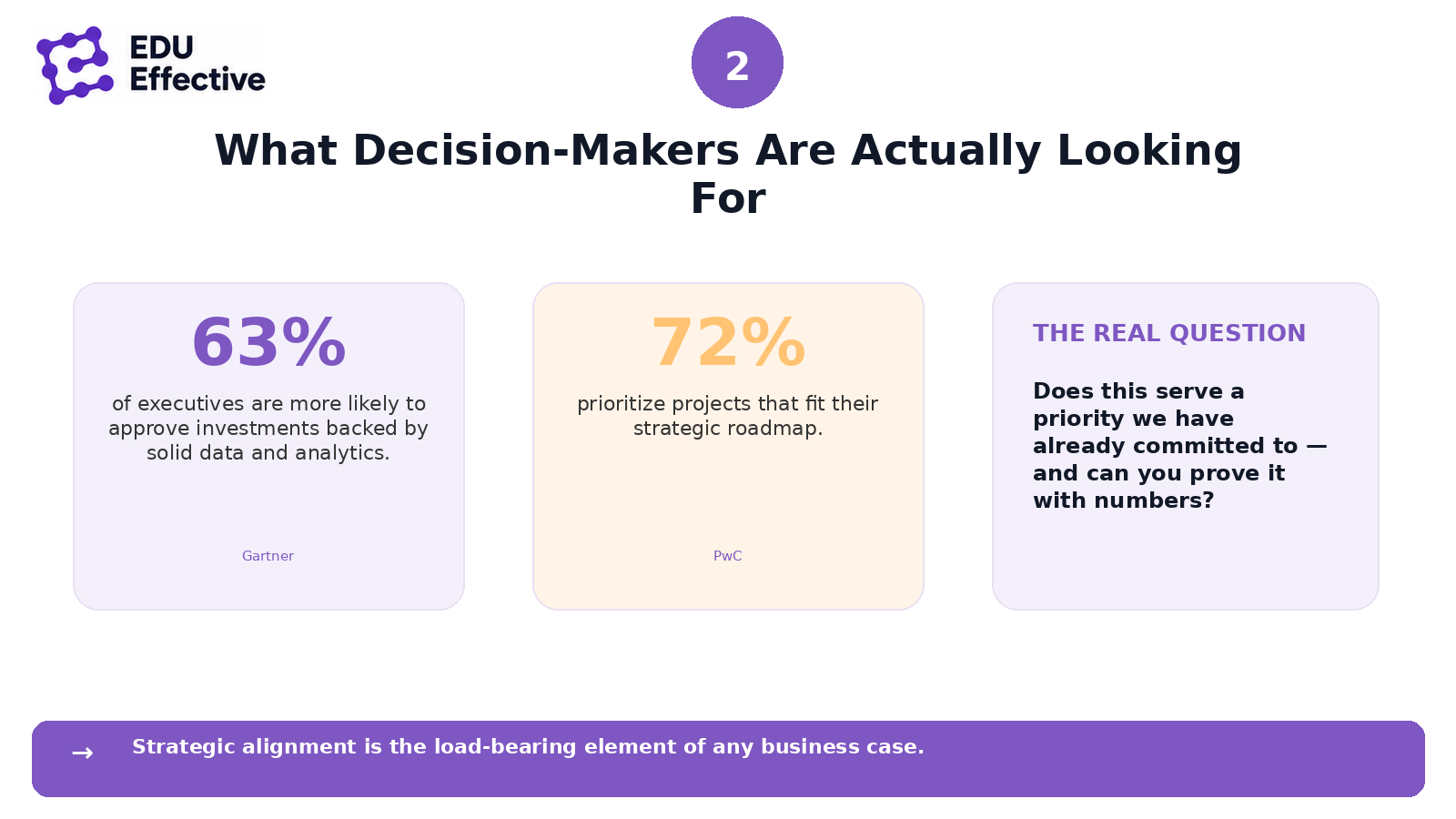
The implication is direct. A business case that begins with an explanation of the problem you want to solve is starting in the wrong place. The first question a decision-maker asks is whether the proposed investment connects to something they already care about. If the answer to that question isn’t immediately visible, the case gets deprioritized.
Strategic alignment is the load-bearing element of any business case. The investment has to be anchored to an organizational priority that already has executive sponsorship — cost reduction, revenue growth, risk mitigation, regulatory compliance, competitive positioning. Not all four simultaneously. One, clearly stated, with evidence that the proposed project meaningfully moves that specific needle.
That alignment logic explains why so many large transformation investments stall: the case was built around the initiative rather than around the priority it serves. why most organizations get workforce transformation wrong — and how the same misalignment between initiative and organizational priority derails budgets at scale
The Structure That Works
A business case that gets approved typically follows a clear sequence. The structure is not arbitrary — each section answers a specific question the decision-maker has, in the order those questions arise.
The executive summary comes first and carries the whole argument. Most decision-makers read only this. It should state: what is being proposed, what problem it solves or opportunity it captures, what it costs, what the return is, and what happens if the organization does nothing. Three to four paragraphs. No preamble. The full document supports this summary — it does not build up to it.
The problem or opportunity statement is where most authors spend too little space. The natural instinct is to rush to the solution. The decision-maker needs to believe the problem is real, significant, and worth addressing before they will evaluate the proposed solution. Quantify the cost of the current situation: revenue lost, time wasted, risk exposure, competitive disadvantage. Make inaction feel costly — because it usually is.
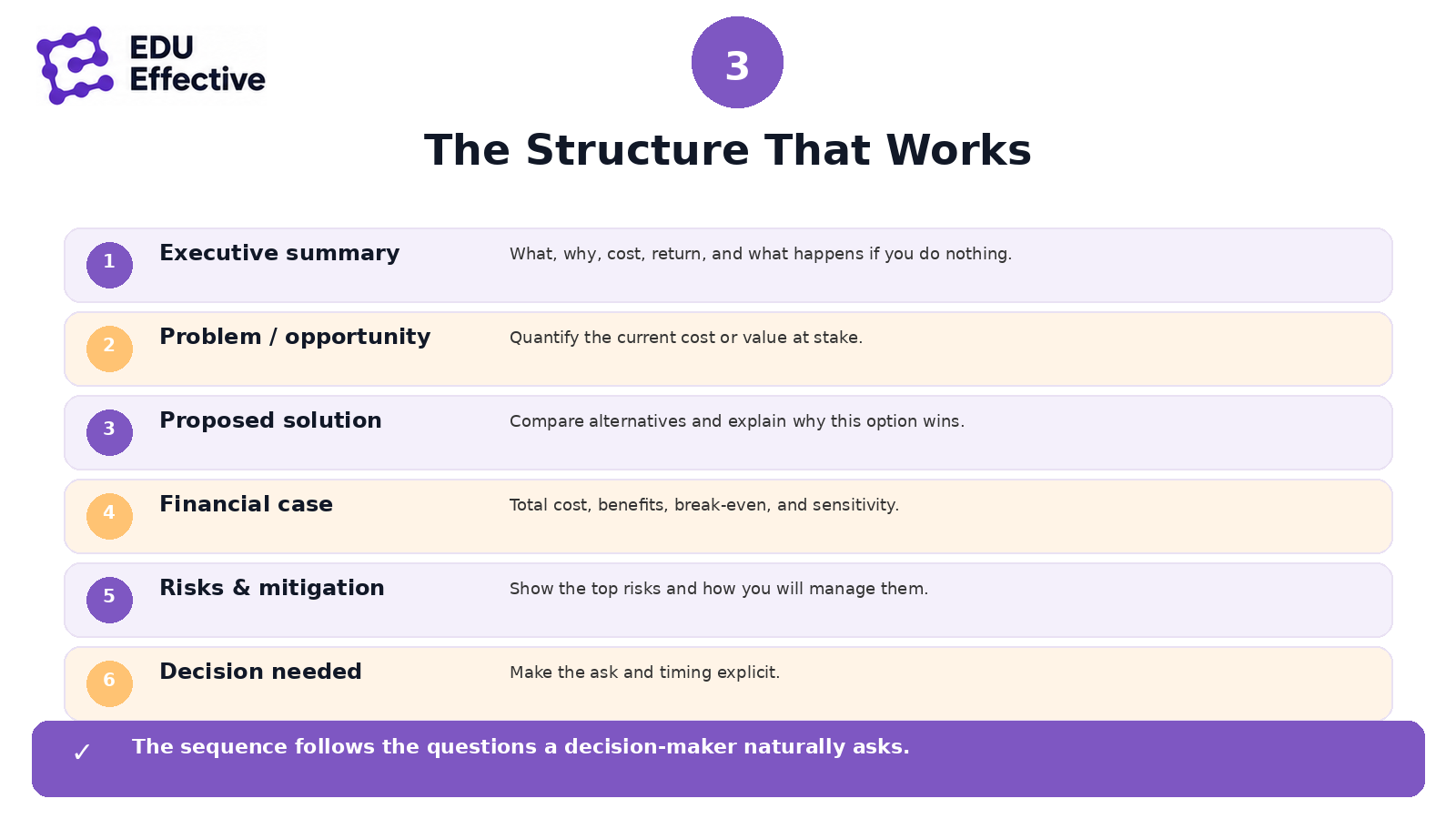
The proposed solution section describes what you are recommending and why it addresses the stated problem more effectively than alternatives. The alternatives matter. A business case that presents only one option signals that the author hasn’t done the analytical work to justify their recommendation. Consider two or three alternatives explicitly — including doing nothing — and explain why the recommended approach is superior on the dimensions that matter most to the decision-maker.
The financial case is where most people spend the most time and where many cases go wrong. The goal is not to produce the highest possible projected ROI. It is to produce a credible, defensible set of numbers that the decision-maker can scrutinize without finding holes. McKinsey’s research shows that overly optimistic projections — the 56% less value delivered finding — come precisely from business cases that optimized for approval rather than accuracy. Decision-makers who have been burned by this become skeptical of ambitious projections, and rightly so.
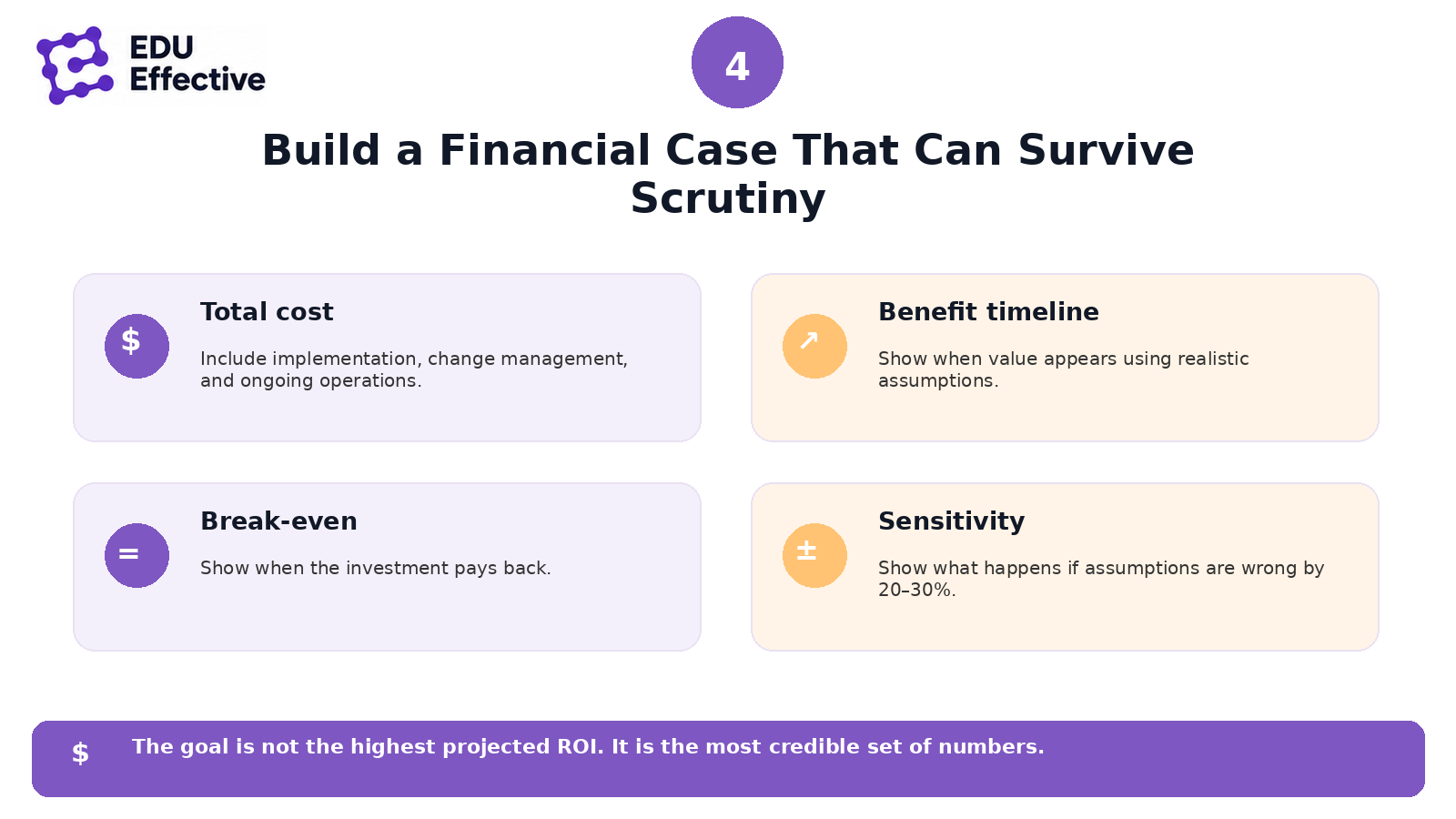
A credible financial case includes: total cost of investment across all phases including implementation, change management, and ongoing operations; expected benefit timeline with realistic assumptions clearly stated; a break-even analysis; and a sensitivity analysis showing what happens if key assumptions are wrong by 20% or 30%. That last element is what separates a financial case from a spreadsheet exercise — it demonstrates that the author has stress-tested their assumptions rather than just optimized the base case.
The Cost of Inaction Is Underused
One of the most effective elements in a business case — and one of the most consistently underused — is a rigorous treatment of what happens if the organization does nothing.
Cost of inaction analysis shifts the framing of the decision. Instead of evaluating whether the investment is worth making, the decision-maker is now evaluating which of two paths they want to take. That is a more complete frame, and it works in the author’s favor when the status quo carries real costs.
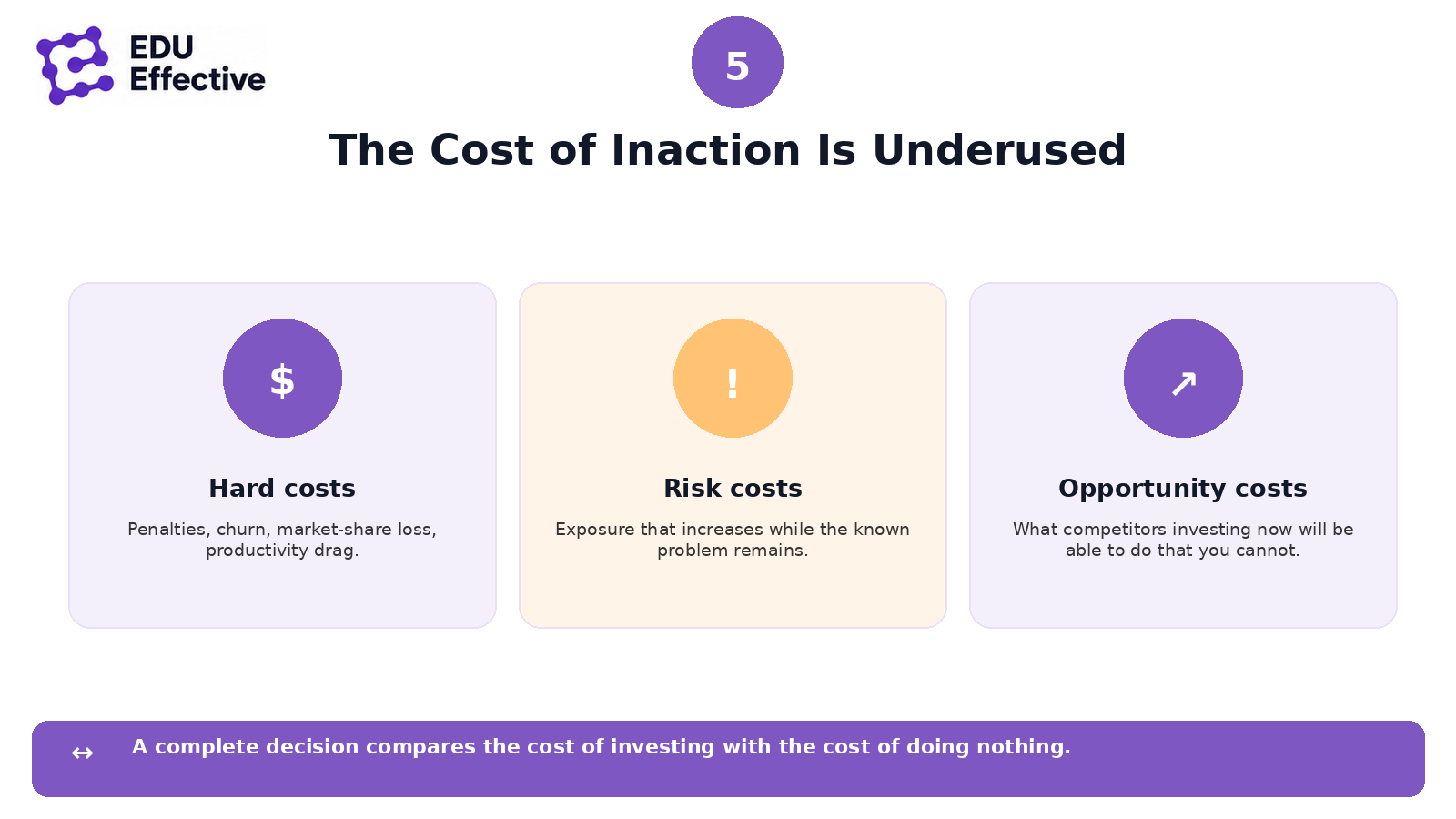
Cost of inaction can include hard costs: regulatory penalties, customer churn, market share loss, productivity drag from existing inefficient processes. It can include risk costs: the exposure that increases over time if a known problem is not addressed. And it can include opportunity costs: what competitors who are investing in this area will be able to do that you won’t.
The analysis doesn’t need to be exhaustive. It needs to be credible and specific enough that the decision-maker feels the asymmetry — that the cost of approving this investment is well-understood, and the cost of not approving it is also real and quantifiable.
What Kills Business Cases That Should Be Approved
Several patterns reliably kill otherwise strong cases.
Excessive length. A business case for a mid-sized investment should not run forty pages. Every page past the point where the core argument is complete reduces the probability of approval by increasing the cognitive burden on a busy executive. The right length is the minimum required to make the case credibly. For most investments, that is ten to fifteen pages plus supporting appendices for anyone who wants the detail.
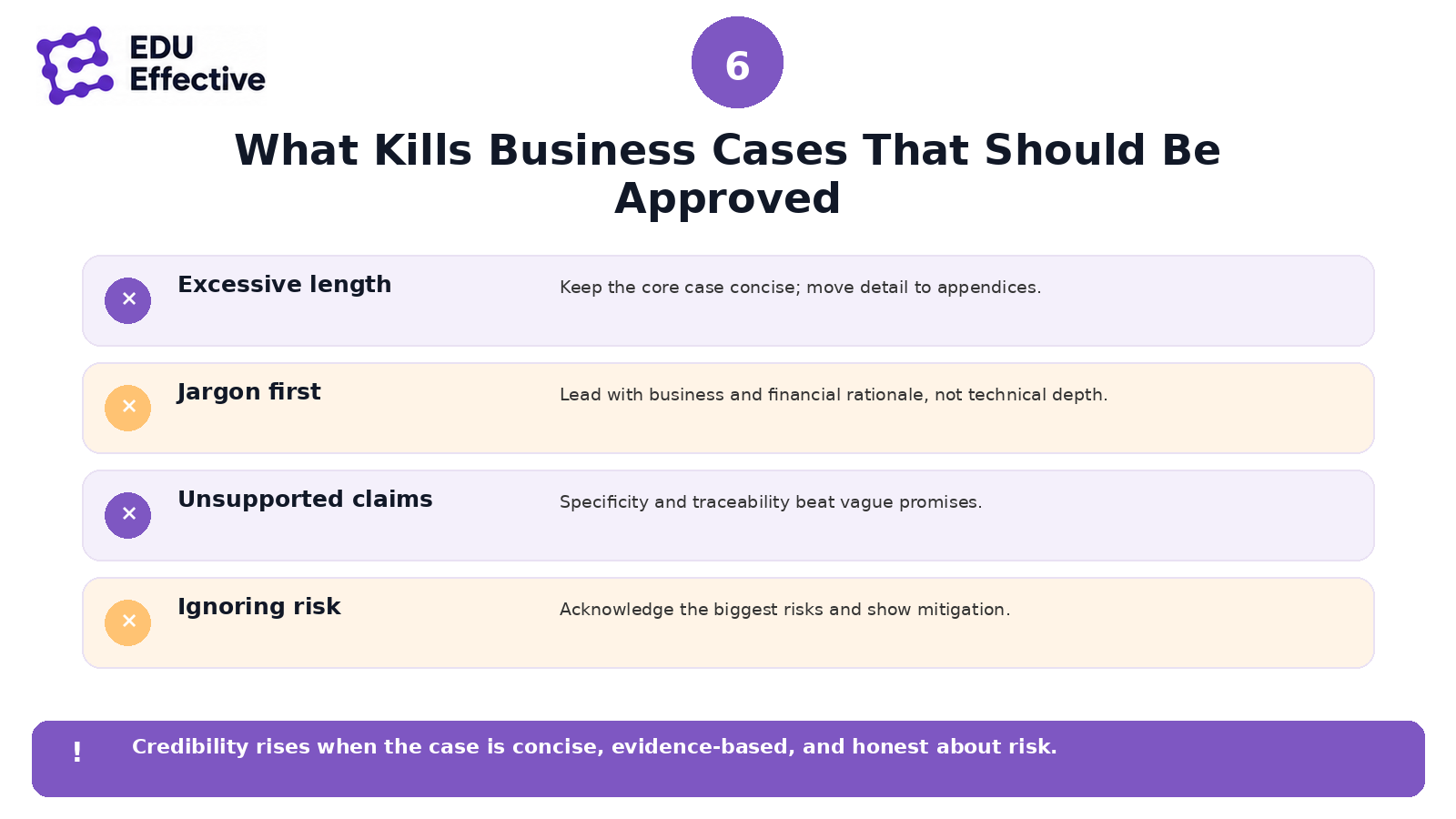
Jargon and technical depth front-loaded for an audience that doesn’t need it. The decision-maker for most business cases is not a technical expert — they are a P&L owner or a functional leader. A case that leads with technical architecture, detailed methodology, or implementation specifics before establishing the strategic and financial rationale has the structure backwards.
Unsupported claims. “This will improve customer satisfaction” without a mechanism and a metric is not an argument. “Based on our current NPS of 34 and the documented 12-point improvement seen in comparable implementations, we project reaching 46 within 18 months, which our modelling shows corresponds to a 7% reduction in churn” is an argument. The difference is specificity and traceability.
Ignoring risk. A business case that presents only upside appears naive. Decision-makers know that projects carry risk. A case that acknowledges the three most significant risks — with mitigation strategies for each — reads as credible. One that doesn’t reads as incomplete.
The Approval Meeting Is Not the End
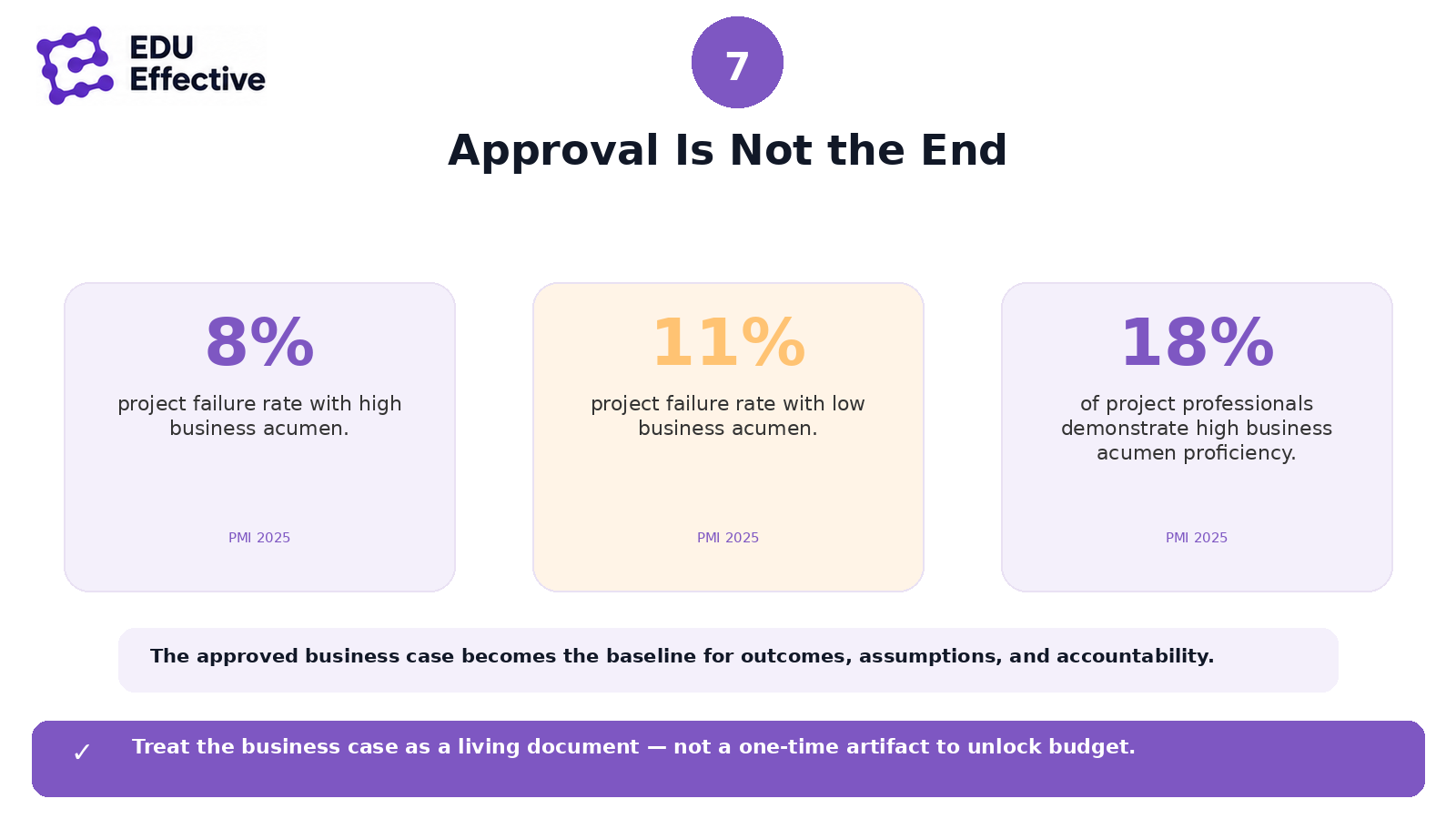
PMI’s 2025 Pulse of the Profession research found that projects led by professionals with high business acumen show an 8% failure rate compared to 11% for those with low business acumen — a 27% relative difference in project failure. Budget adherence is 73% versus 68%. Goal achievement is 83% versus 78%.
Business acumen, as PMI defines it, includes the ability to connect project outcomes to organizational goals, communicate financial implications clearly, and make credible projections. Only 18% of project professionals demonstrate high business acumen proficiency by this measure. Eighty-two percent do not.
This is the capability gap that business case writing addresses — not just the skill of producing the document, but the underlying ability to think through an investment decision from the decision-maker’s perspective, build a credible financial argument, and track the business outcomes of what gets approved.
An approval is not the end of the business case process. The document becomes a baseline against which actual performance is measured. The assumptions in the financial model become commitments. The metrics defined in the case become the accountability framework for the project team. Organizations with strong project governance treat the business case as a living document, updated at each project stage gate, not a one-time artifact produced to unlock budget.
Building This Capability
Business case writing is a skill that develops through structured practice on real problems. Reading frameworks helps. Writing several cases — getting feedback, refining the financial modelling, learning which arguments land and which get challenged — builds the capability faster.
The underlying competencies are financial literacy (understanding ROI, NPV, payback period, and what makes financial projections credible), strategic thinking (connecting operational initiatives to organizational priorities), and communication (structuring an argument for a specific audience with a specific decision to make).
These are management fundamentals. They are also the skills that distinguish professionals who get budgets approved from those whose good ideas never quite make it past the review committee.
EDU Effective Business School — professional development for your long-term success.
All five Effective MBA programs are built on the same educational model — designed for working adults who need learning that fits real professional life:
About EDU Effective Business School
EDU Effective Business School focuses on applied business education rather than academic theory. Runs on 15 minutes a day, completes in 10 months or less and is ASIC accredited.
See all five Effective MBA programs · Student experiences · Request a place
Sources
- McKinsey & Company / University of Oxford (Saïd Business School) — Large IT project analysis: 5,400+ projects, budget overrun, value delivery, and organizational risk data. https://thinkpieces.stavros.io/posts/how-organizations-consistently-underinvest-in-the-ability-to/
- PMI — Pulse of the Profession. Business acumen and project performance data; project success, budget, and schedule statistics. Survey of 2,841 project professionals globally. https://www.pmi.org/learning/thought-leadership/boosting-business-acumen
- Standish Group — CHAOS Report. Software project success rates by project size. https://budgetoverrun.com/studies/standish-chaos-report
- Gartner — Executive investment approval and data-backed decision-making research. https://www.gartner.com/en/newsroom/press-releases/2026-07-20-gartner-survey-shows-45-percent-of-cfos-say-their-ai-investments-lean-towwards-productivity-while-20-percent-say-these-investments-lean-towards-decision-quality
- PwC — Executive strategic alignment and investment prioritization research. https://www.pwc.com.au/operations/performance-alignment.html
- Wellingtone — State of Project Management 2026. On-time project completion rates. https://wellingtone.co.uk/publications/state-of-project-management-research/