
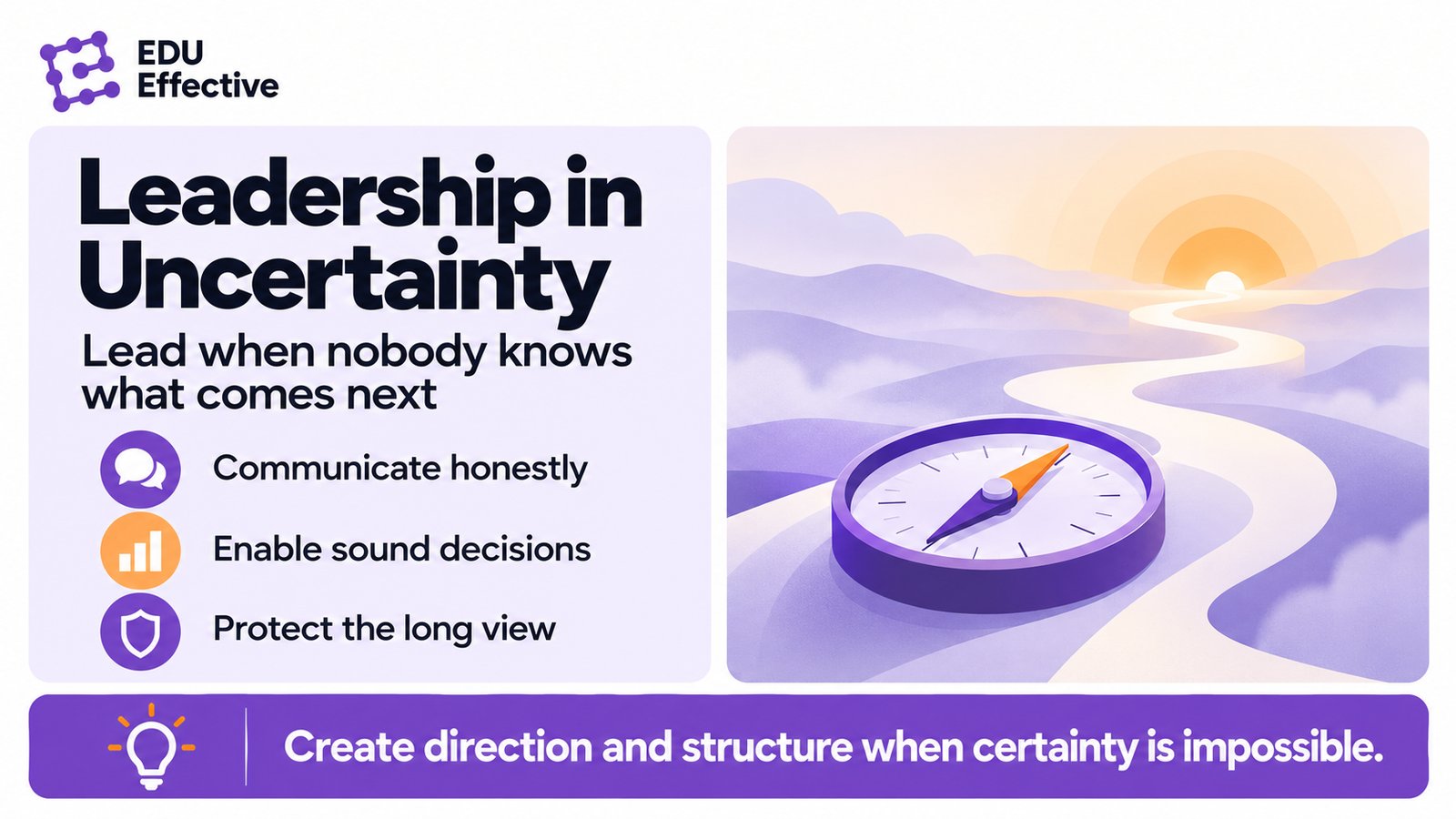

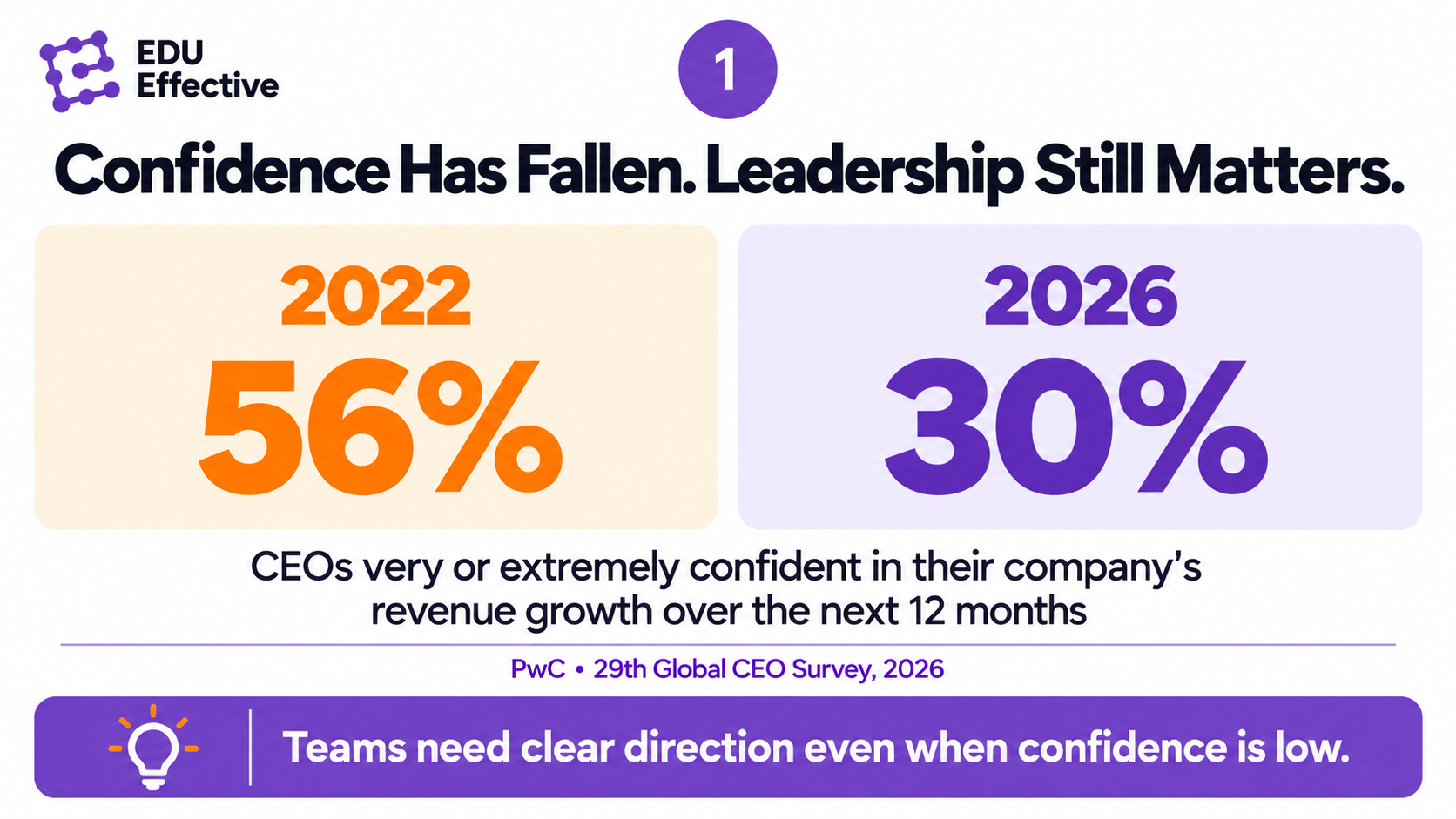
Only 30% of CEOs said they were very or extremely confident in their own revenue growth going into 2026. That number was 56% in 2022. In the same span, geopolitical instability moved from background noise to the dominant concern in boardrooms worldwide. And yet — organizations still need to be led. Decisions still need to be made. People still need direction from someone.
Leading through uncertainty is no longer a specialty skill reserved for crisis managers. It is the baseline requirement for anyone in a leadership role today.
This article is not about motivational frameworks or reassuring mantras. It is about what the data actually shows about how leaders behave under pressure, what distinguishes the ones who keep organizations functional from those who freeze or overcorrect, and what you can do differently starting this week.
Why the current environment is genuinely harder than five years ago
Before getting tactical, it helps to name what changed — and why experience from calmer periods does not automatically transfer.
PwC’s 29th Global CEO Survey (fieldwork September–November 2025, 4,454 CEOs across 109 countries) found that 66% of CEOs experienced stakeholder trust concerns at least moderately over the prior year. Not a single stakeholder group — all of them, simultaneously. Customers uncertain about pricing. Employees uncertain about job security. Boards uncertain about strategy. Investors uncertain about returns.
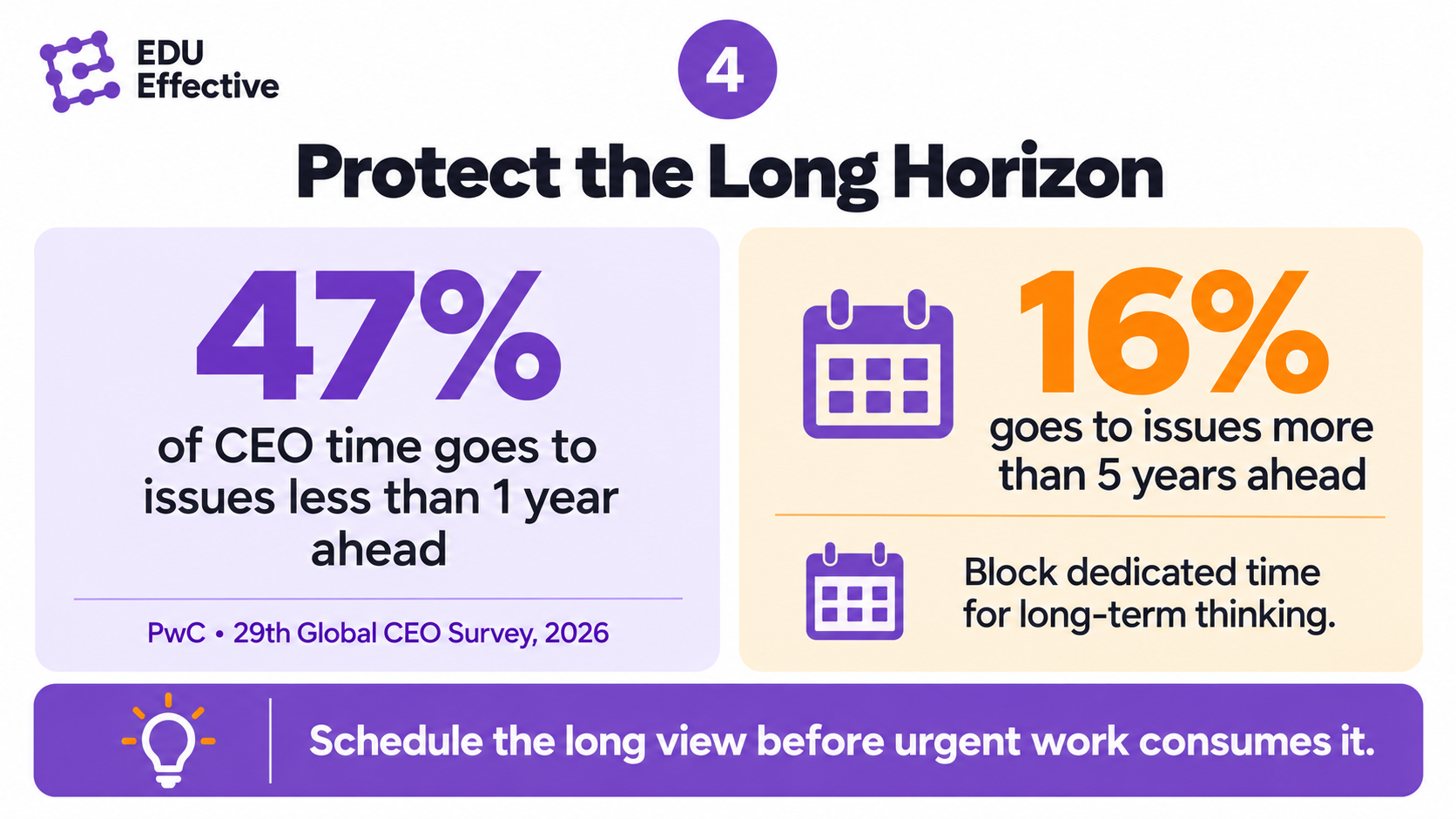
The same survey found that CEOs now spend 47% of their time on issues with horizons under one year. Only 16% of their time goes to anything beyond five years. PwC calls it “the tyranny of the urgent” — a structural pull toward short-term firefighting that makes coherent long-term leadership increasingly difficult.
Meanwhile, Deloitte’s CEO Survey (April 2025, 111 CEOs) showed that CEO optimism about their own company’s performance dropped from 84% to 60% in under six months. Optimism about their industry fell from 61% to 32% in the same window. These are not small shifts. They signal that confidence — the psychological foundation of decisive leadership — is eroding faster than organizations can rebuild it.
Edelman’s Trust Barometer 2025 added another layer: trust in business leaders and employers fell globally. The proportion of employees who trust their employer to do the right thing has declined. At the same time, employees increasingly expect their employers to be the most reliable institution in their lives — more stable than government, more honest than media. Leaders are now asked to fill a trust vacuum that used to be distributed across several institutions.
This is the actual environment. Not a temporary disruption, but a sustained condition of compressed timelines, elevated scrutiny, and eroded institutional trust. The question is what effective leadership looks like inside it.
What separates leaders who function from those who stall
The Russell Reynolds Global Leadership Monitor H2 2025 studied how senior leaders actually behave under pressure. One finding stands out: 87% of the most effective CEOs reported being comfortable with being imperfect. They did not wait for certainty before communicating. They did not delay decisions until conditions clarified. They moved on incomplete information and acknowledged it openly.
This matters because the instinct under pressure is the opposite. Leaders tend to either overcommunicate false certainty — projecting confidence they do not feel — or go quiet, waiting until they have something definitive to say. Both responses damage trust faster than honest uncertainty does.
The Russell Reynolds research identified 52% of senior leaders naming strategic thinking as the single most important skill in periods of disruption. Not operational execution. Not communication. Strategic thinking — the ability to hold multiple possible futures simultaneously and make decisions that remain coherent across scenarios.
That is different from planning. Plans assume a knowable future and optimize for one outcome. Strategic thinking under uncertainty assumes the future is unknowable and builds flexibility into every decision. Organizations run by leaders who confuse these two modes tend to build elaborate plans that become liabilities the moment conditions shift.
The five practices that actually matter
These are not theoretical. They come from behavioral data across thousands of leaders in comparable conditions.
1. Communicate at higher frequency with lower certainty claims
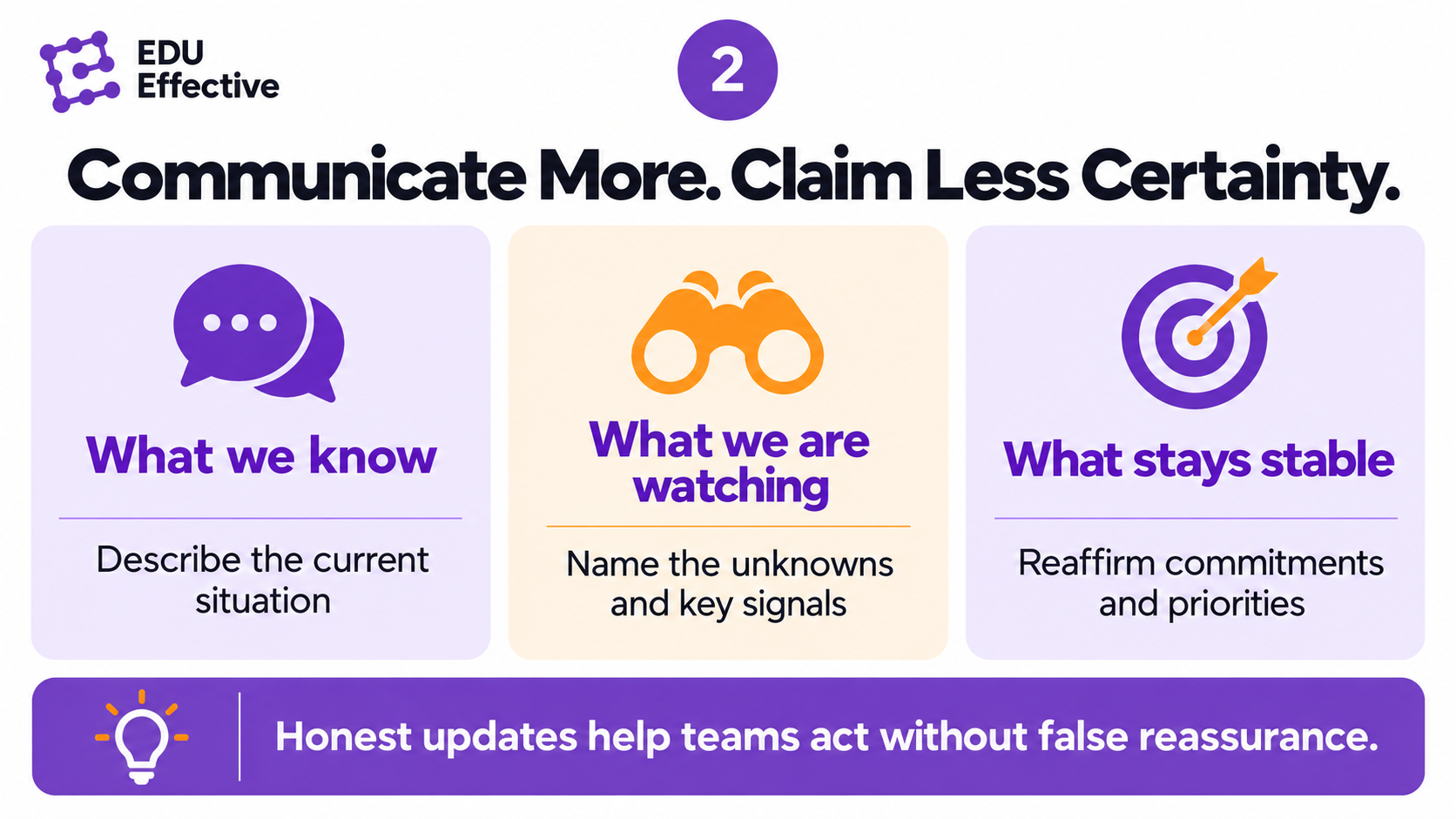
The instinct is to wait until you have clarity before communicating. The research inverts this. Russell Reynolds found that effective leaders in uncertain conditions increase communication frequency while explicitly reducing the certainty of what they say. They describe the situation accurately, including what they do not know, and they update frequently as conditions evolve.
Why it works: people do not need certainty to stay functional. They need to feel that someone is paying attention and will tell them when something changes. Silence — even brief silence — fills with speculation that is almost always worse than the actual situation.
Practically: replace the monthly all-hands with weekly brief updates. Replace long strategy documents with short “here is what we know, here is what we are watching, here is what does not change” messages.
2. Distribute decision-making authority — and mean it
The Deloitte CEO data showed that 55% of CEOs increased employee engagement practices in the six months leading to April 2025. The reason is not altruistic. Leaders under pressure were discovering that centralized decision-making became a bottleneck when the pace of change exceeded one person’s cognitive bandwidth.
Distributed leadership is not the same as delegation. Delegation assigns tasks. Distributed leadership assigns judgment — the authority to assess situations and decide within defined parameters, without escalation.
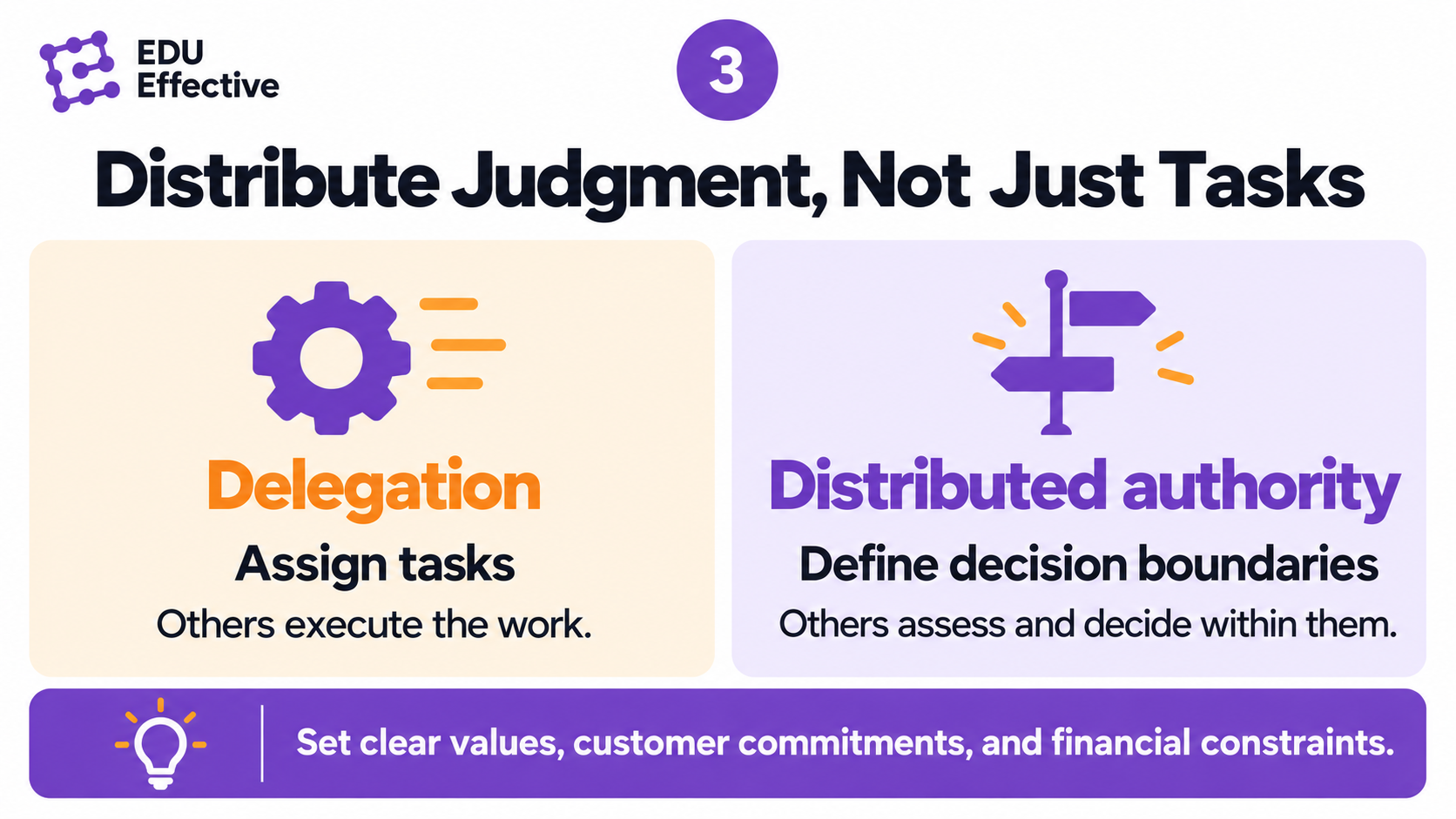
The practical precondition is clarity about what does not change. If your team knows which values, which customer commitments, and which financial constraints are non-negotiable, they can make decisions in any direction within those boundaries. Without that clarity, distributed authority creates chaos.
3. Protect the long horizon — mechanically
PwC’s finding that CEOs spend only 16% of their time on issues beyond five years is a structural problem, not a personal failing. The urgencies are real. The pressure to respond to short-term signals is real. The long horizon disappears not because leaders do not value it but because there is always something more immediate.
The solution is mechanical, not motivational. Block time for long-horizon thinking the same way you block time for board meetings. Treat it as non-negotiable. One leadership team we know schedules a four-hour “horizon session” on the first Friday of every month. No operating issues. No quarterly numbers. The only agenda is: what are we watching that matters in three-plus years?
This is not optional in volatile conditions. The leaders who maintain some portion of their attention on the long view are the ones who recognize structural shifts before they become crises.
4. Name what is stable — repeatedly
When conditions change fast, people scan for what is constant. They need anchors. Effective leaders in disruption identify three to five things that genuinely do not change — core values, primary customer commitments, fundamental operating principles — and reference them constantly.
This is not empty reassurance. It is cognitive scaffolding. When people know what is stable, they can process what is changing without losing their footing.
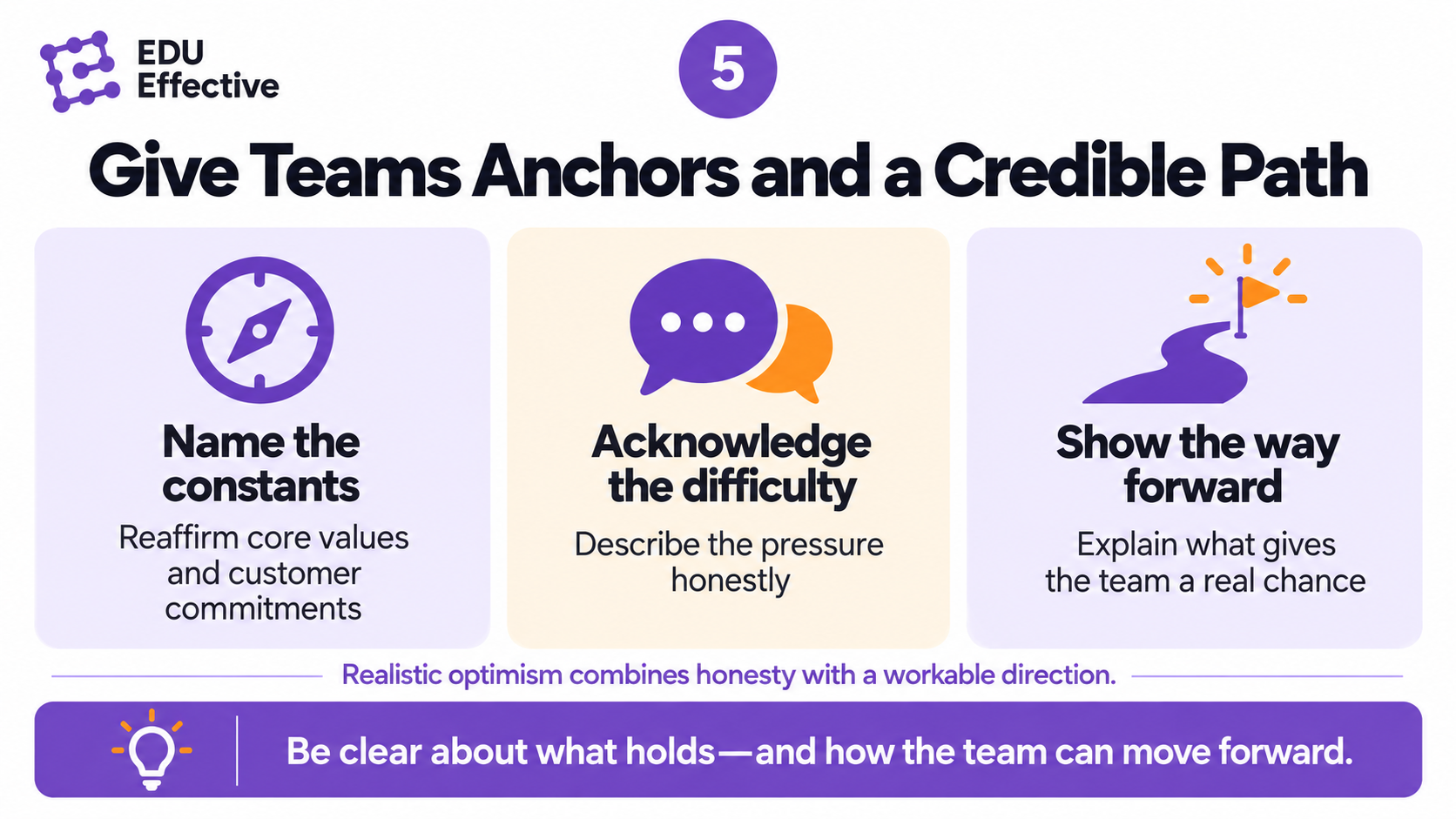
The Russell Reynolds research frames this as “focus on core values” as one of its ten leadership lessons for uncertainty. The leaders who name the constants clearly and return to them consistently report fewer morale crises and faster adaptation in their teams.
5. Acknowledge the weight of it
87% of effective CEOs being comfortable with imperfection does not mean performing vulnerability for optics. It means not pretending the situation is easy when it is not. There is a specific skill here — what the research sometimes calls “realistic optimism” — which is distinct from both false positivity and pessimism.
Realistic optimism sounds like this: “The situation is genuinely difficult and I am not going to pretend otherwise. Here is what I think gives us a real chance.” It names the difficulty without dwelling in it. It names the path forward without overpromising. And it does it in the same breath, so people do not mistake honesty for helplessness.
Leaders who skip the honest acknowledgment — who jump straight to the optimistic part — are not believed. The data from Edelman is clear: employees trust leaders who they perceive as dealing with the same reality they are experiencing, not leaders who seem insulated from it.
The AI variable
Deloitte’s April 2025 survey found that 89% of CEOs were exploring, piloting, or implementing agentic AI — an almost unanimous response across industries. This is relevant to leadership in uncertainty for a specific reason: AI is simultaneously reducing and creating uncertainty in the same organizations.
It reduces uncertainty by processing more information faster, identifying patterns in data that humans miss, and automating decisions that previously required judgment. It creates uncertainty by changing job structures, shifting competitive dynamics, and introducing failure modes that are hard to predict.
PwC found that only 30% of CEOs reported added revenue from AI over the prior 12 months. 56% reported neither higher revenue nor lower costs. This is not a story about AI failing — it is a story about transformation lag, the gap between adopting a technology and developing the organizational capability to use it well.
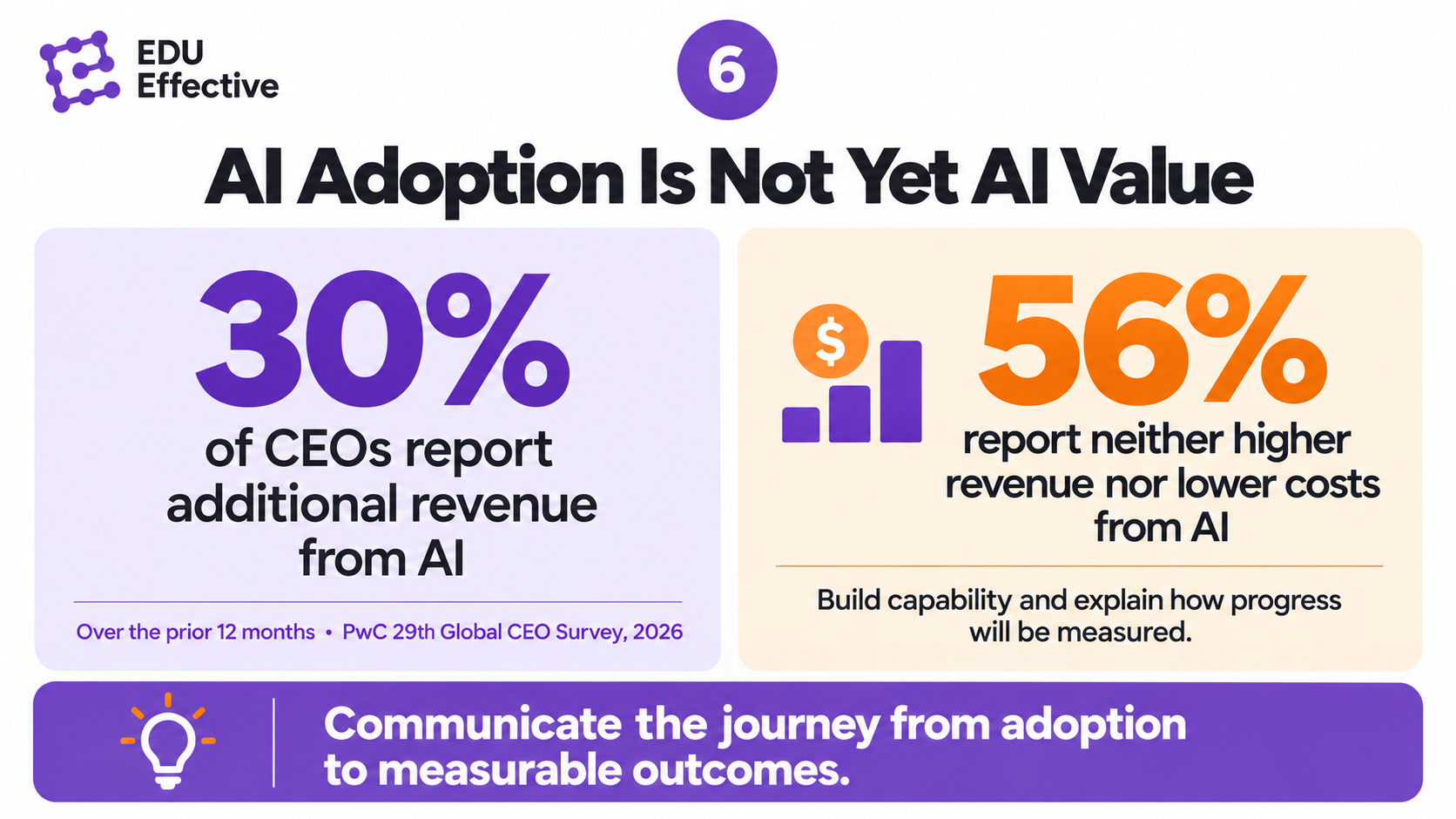
Leading organizations through that lag is a specific uncertainty challenge. The technology is real. The eventual value is likely real. The path from here to there is genuinely unknown. Leaders who communicate that honestly — we are building capability, this takes time, here is how we will know it is working — tend to get more patience and more cooperation than those who either oversell or underexplain.
What this means for your own development
The research consistently shows that leadership under uncertainty is a learnable capability, not a fixed trait. The leaders who handle it well are not people with superior tolerance for ambiguity — they have built specific practices that create structure inside unstructured conditions.
Three things distinguish leaders who improve in this area from those who do not:
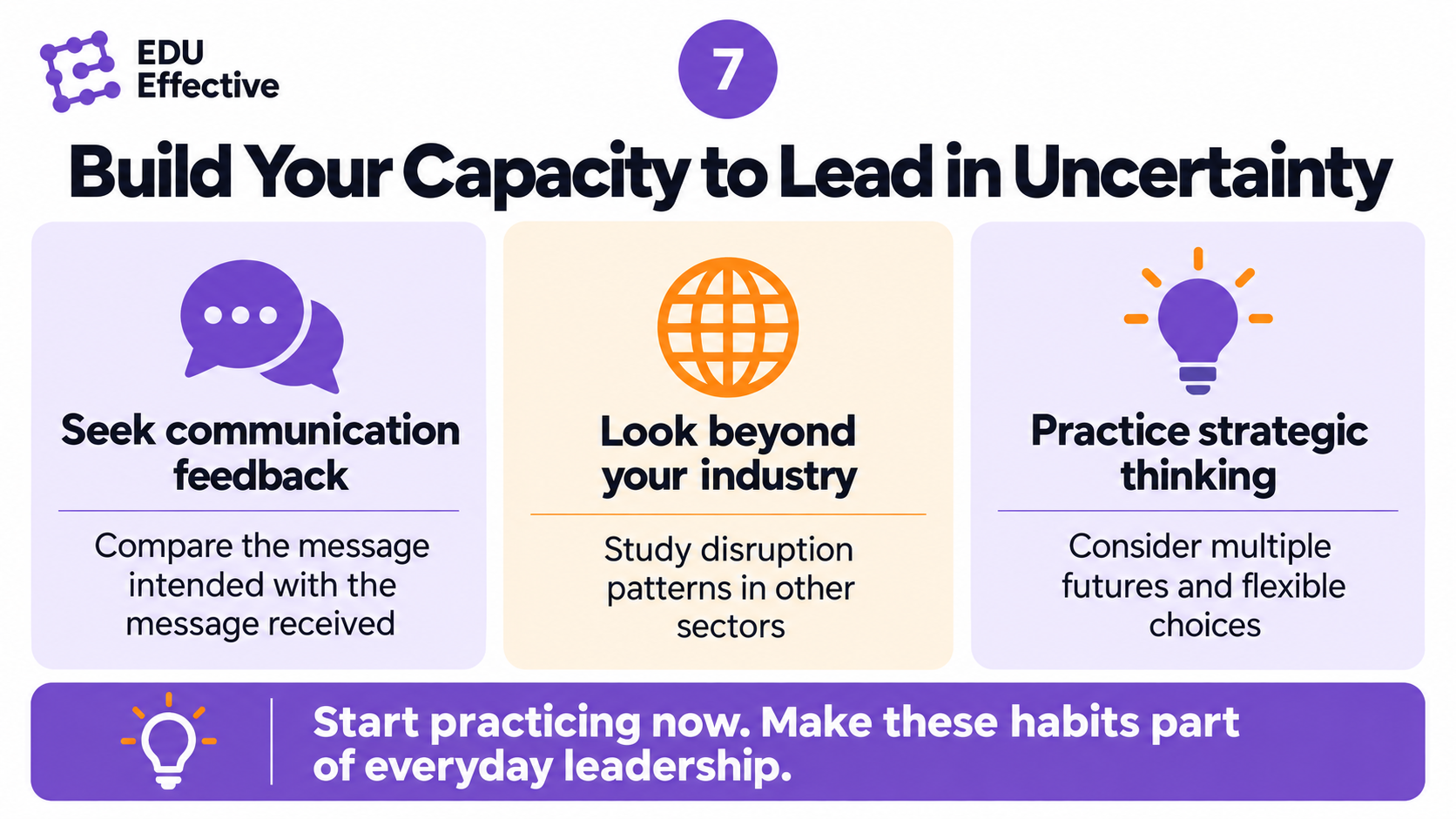
- They seek feedback on how they communicate under pressure, not just on what they decide. The message received is often very different from the message intended.
- They study conditions outside their industry. The patterns of disruption in one sector tend to arrive in others with a delay. Leaders who read broadly see them coming.
- They invest in their own strategic thinking capability continuously — not just in periods of relative calm, but especially under pressure. Strategic thinking is a skill. It degrades without use and strengthens with deliberate practice.
Development of that kind rarely happens in isolation. Structured coaching and mentoring relationships are how most leaders convert feedback into changed behaviour — see what actually moves careers forward: mentoring or sponsorship.
The honest summary
Leading through uncertainty is not about having answers others lack. It is about maintaining the practices — frequent honest communication, distributed judgment, protected long-horizon thinking, named constants, realistic acknowledgment — that keep organizations functional when conditions make certainty impossible.
The data from Deloitte, PwC, and Russell Reynolds converges on the same conclusion: the leaders who perform best in volatile conditions are not the most confident ones. They are the ones who are most honest about confidence — when they have it and when they do not — and who build structures that reduce their team’s dependence on any single person knowing the answer.
That is a learnable capability. And the time to practice it is now, not during the next crisis.
Build the Leadership Capability That Holds Under Pressure
Strategic thinking, honest communication, and the discipline to protect the long horizon are not personality traits. They are skills that can be developed deliberately. The Effective MBA develops them.
About EDU Effective Business School
The Effective MBA: Executive Management & Leadership is built around the decisions managers actually face every week. Runs on 15 minutes a day, completes in 10 months or less and is ASIC accredited.
Sources
- Deloitte CEO Survey — https://www.deloitte.com/us/en/programs/chief-executive-officer/articles/ceo-survey.html
- Russell Reynolds Global Leadership Monitor — https://www.russellreynolds.com/en/insights/reports-surveys/global-leadership-monitor
- PwC 29th Global CEO Survey — https://www.pwc.com/gr/en/publications/specific-to-all-industries-index/ceo-survey.html
- Edelman Trust Barometer — https://www.edelman.com/trust/2025/trust-barometer