
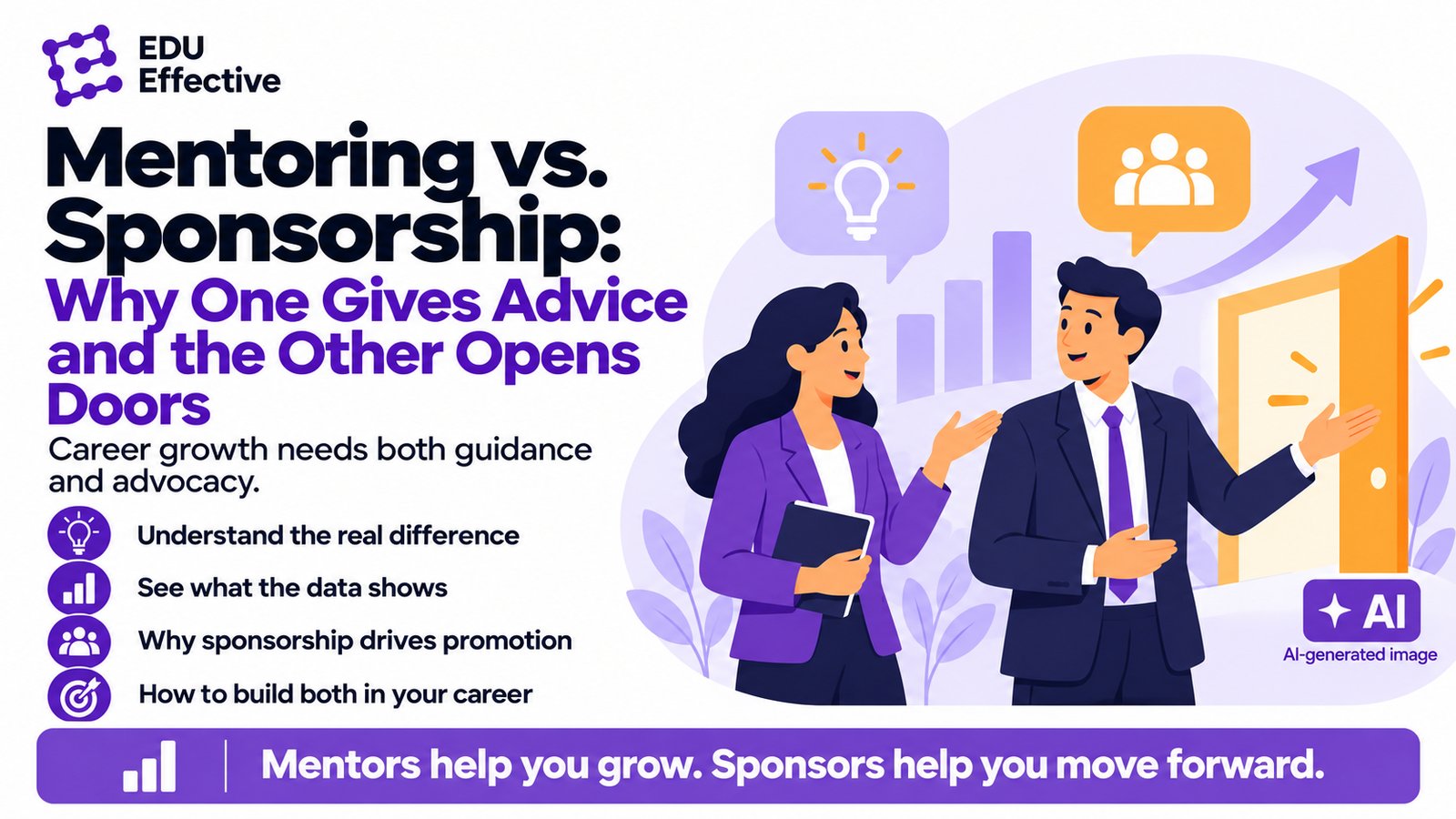

Most professionals who think they have a sponsor actually have a mentor. The two are not the same thing, and confusing them is one of the most common and costly mistakes in career development planning — both for individuals trying to advance and for organizations trying to retain and promote the right people.
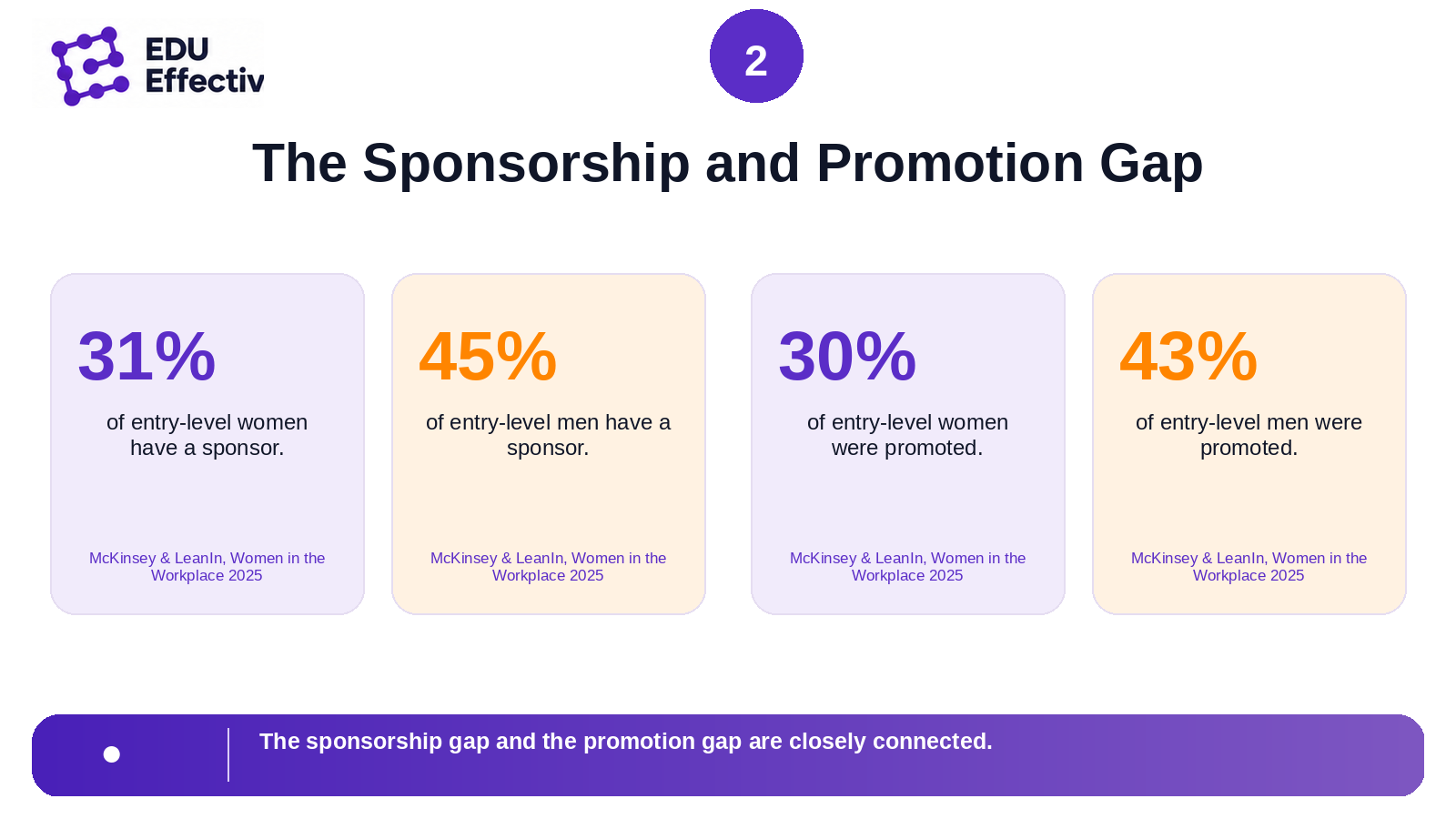
The data from 2025 is instructive. According to McKinsey and LeanIn’s Women in the Workplace 2025 report, only 31% of entry-level women have a sponsor, compared to 45% of entry-level men. In the same population, 30% of entry-level women were promoted versus 43% of men. The sponsorship gap and the promotion gap are not identical, but they are closely correlated — and that pattern has been consistent across research cycles for a decade.
Understanding why requires drawing a sharp line between two relationships that look similar from the outside and feel similar to the people in them, until the moment of a real opportunity.
The Actual Difference
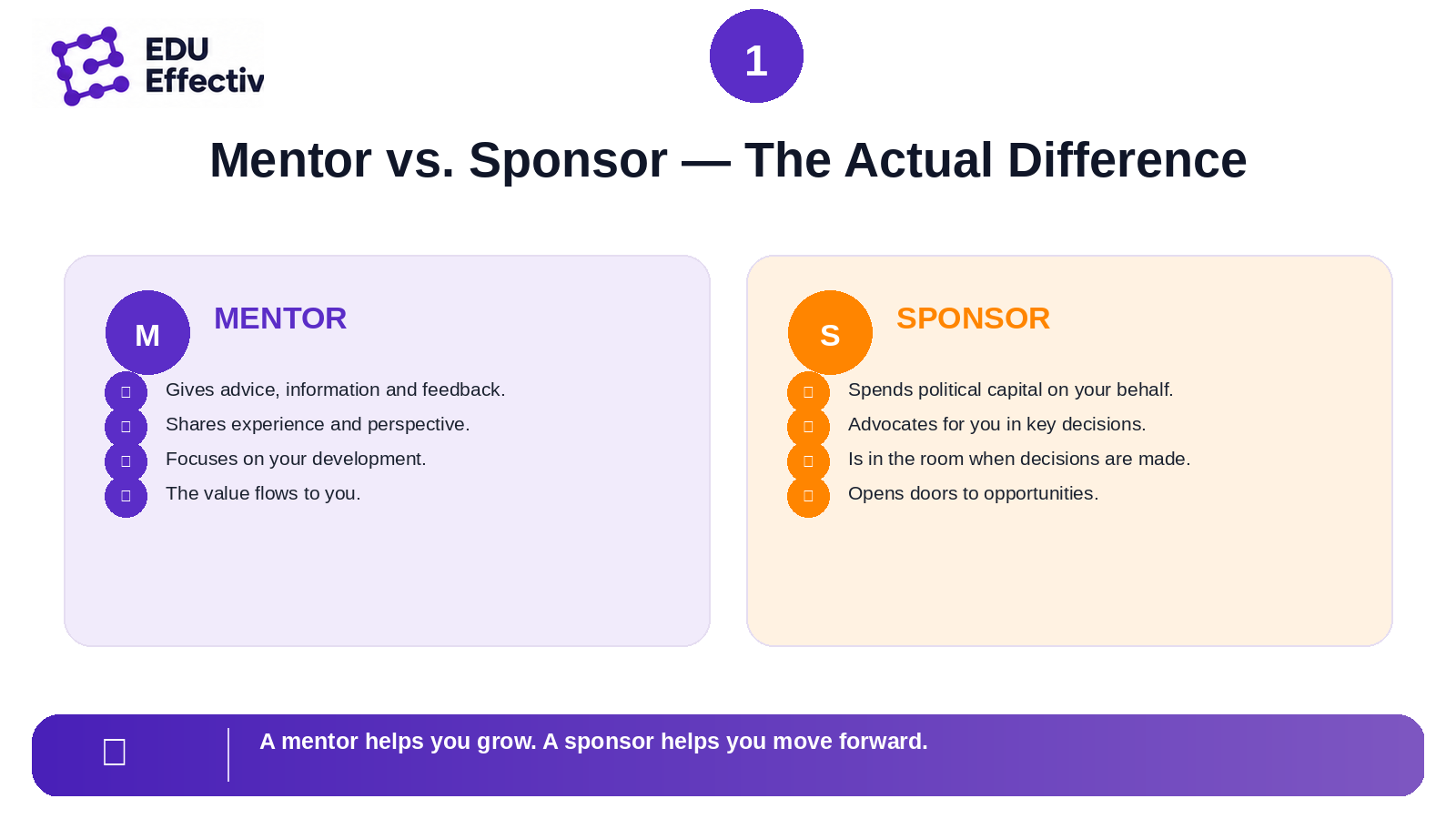
A mentor gives you information, perspective, and feedback. A mentor answers your questions, reflects on your situation, and shares experience you have not yet had. The relationship is primarily about your development. Its value flows to you.
A sponsor spends capital on your behalf. A sponsor sits in the room where decisions are made — hiring committees, promotion discussions, project assignments — and says your name when it matters. The relationship is not primarily about conversations between the two of you. It is about what the sponsor does when you are not in the room.
This distinction sounds simple. In practice, it is consistently blurred.
The Center for Talent Innovation (now Coqual) found in research covering over 3,000 white-collar employees that only 27% of sponsors advocate for their protégé’s promotion — which is, by any reasonable definition, the core function of sponsorship. The remaining 73% are largely functioning as mentors with a different label attached.
Why Sponsorship Is Rarer Than It Appears
The supply problem is structural. Most people with the organizational influence to act as sponsors — senior leaders, department heads, people on promotion committees — accumulate influence over years of demonstrated performance. They tend to extend it to people who remind them of themselves at an earlier stage, or with whom they have built trust through direct working relationships.
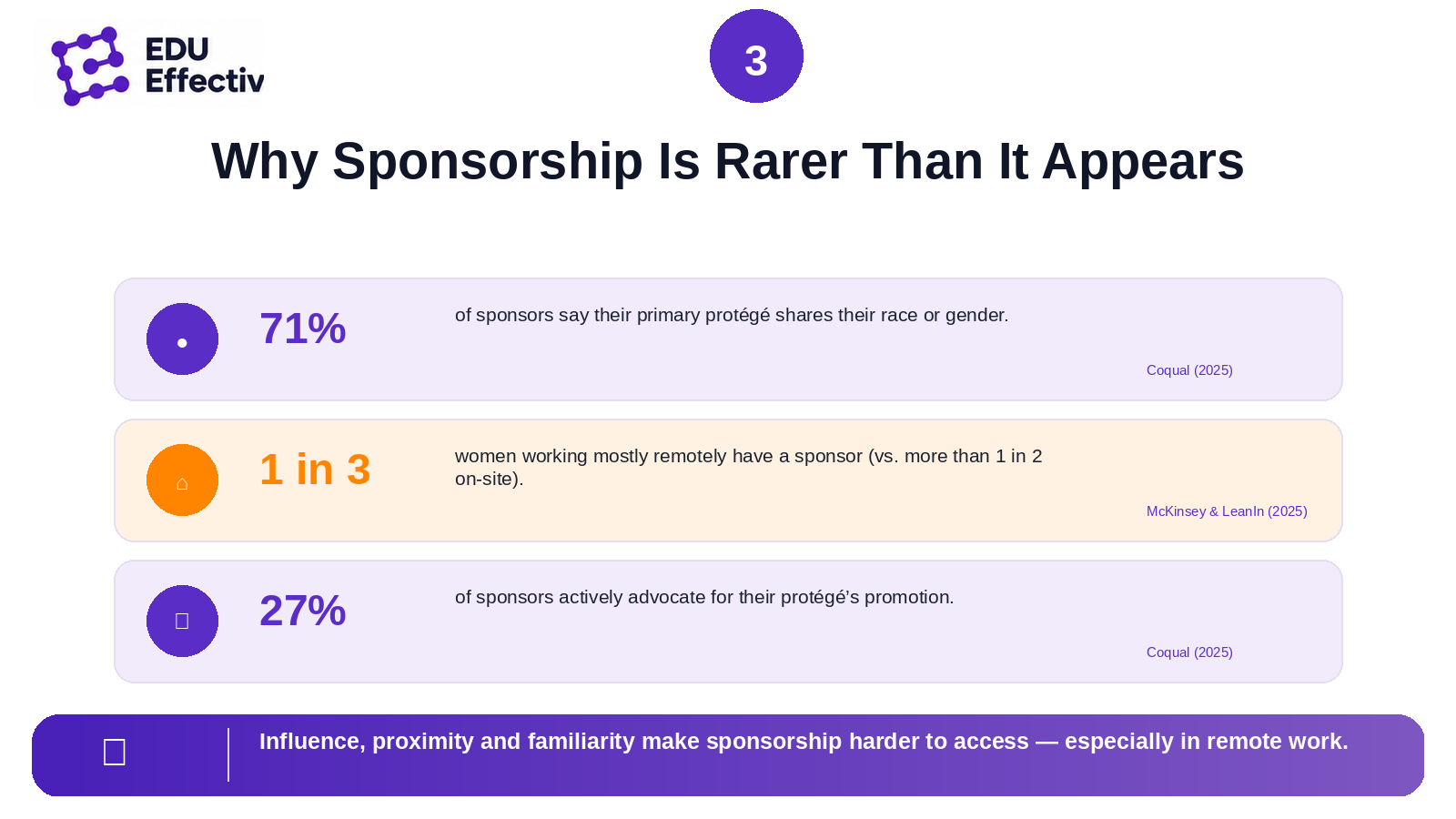
Coqual’s research found that 71% of sponsors say their primary protégé shares their race or gender. This is not primarily about explicit bias. It is about how trust and familiarity form. People sponsor those they have seen perform under pressure, in contexts they can interpret. Remote and hybrid work has made this harder — you cannot observe someone navigate a difficult client meeting from two time zones away.
McKinsey and LeanIn’s 2025 data makes the structural consequence visible: women who work mostly remotely have a sponsorship rate of roughly one in three, while women who work mostly on-site exceed one in two. The proximity effect is real and is not offset by any particular intentional program unless that program is explicitly designed to create sponsorship relationships across distance.
What Mentoring Actually Delivers
None of this means mentoring is without value. The evidence base for workplace mentoring is substantial.
Research on Sun Microsystems’ mentoring program — conducted by Gartner and widely cited, though the data originates from 2006 — found that mentees were promoted five times more often than non-participants, and mentors six times more often. Retention among both groups ran at 72% and 69% respectively, against 49% for non-participants. A separate study of Cox Automotive’s mentoring program found that participants were 23% more likely to be promoted and had a retention rate of 79% versus 67% company-wide, according to data reported by Chronus.
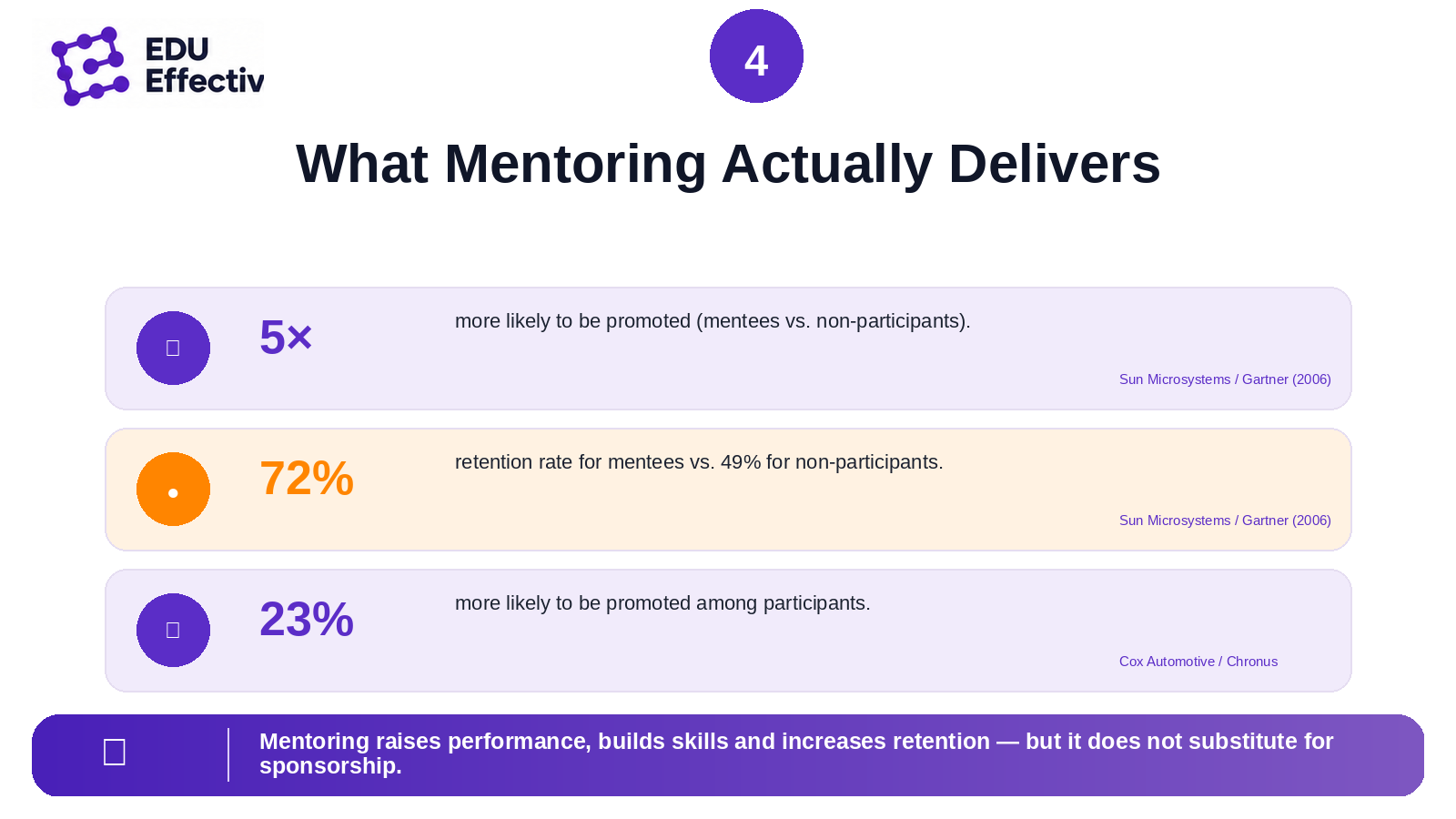
These are significant effects. But the mechanism is different from sponsorship. Mentoring tends to raise performance, build skills, increase engagement, and reduce the likelihood that a talented person leaves before reaching their potential. What it does not reliably do is substitute for someone in a position of power actively advocating for a specific individual at a specific decision point. how managers can keep developing themselves when no one is developing them
The two effects compound. A person who has both a strong mentor and an active sponsor has a materially different career trajectory than someone who has only one — or neither.
The Broken Rung and the Sponsorship Gap
McKinsey and LeanIn’s Women in the Workplace 2025 report documents what they call the “broken rung” — the gap at the first step into management where the promotion rate diverges. For every 100 men promoted to manager, only 93 women were promoted. For Asian women and Latinas the figure was 82. For Black women, 60.
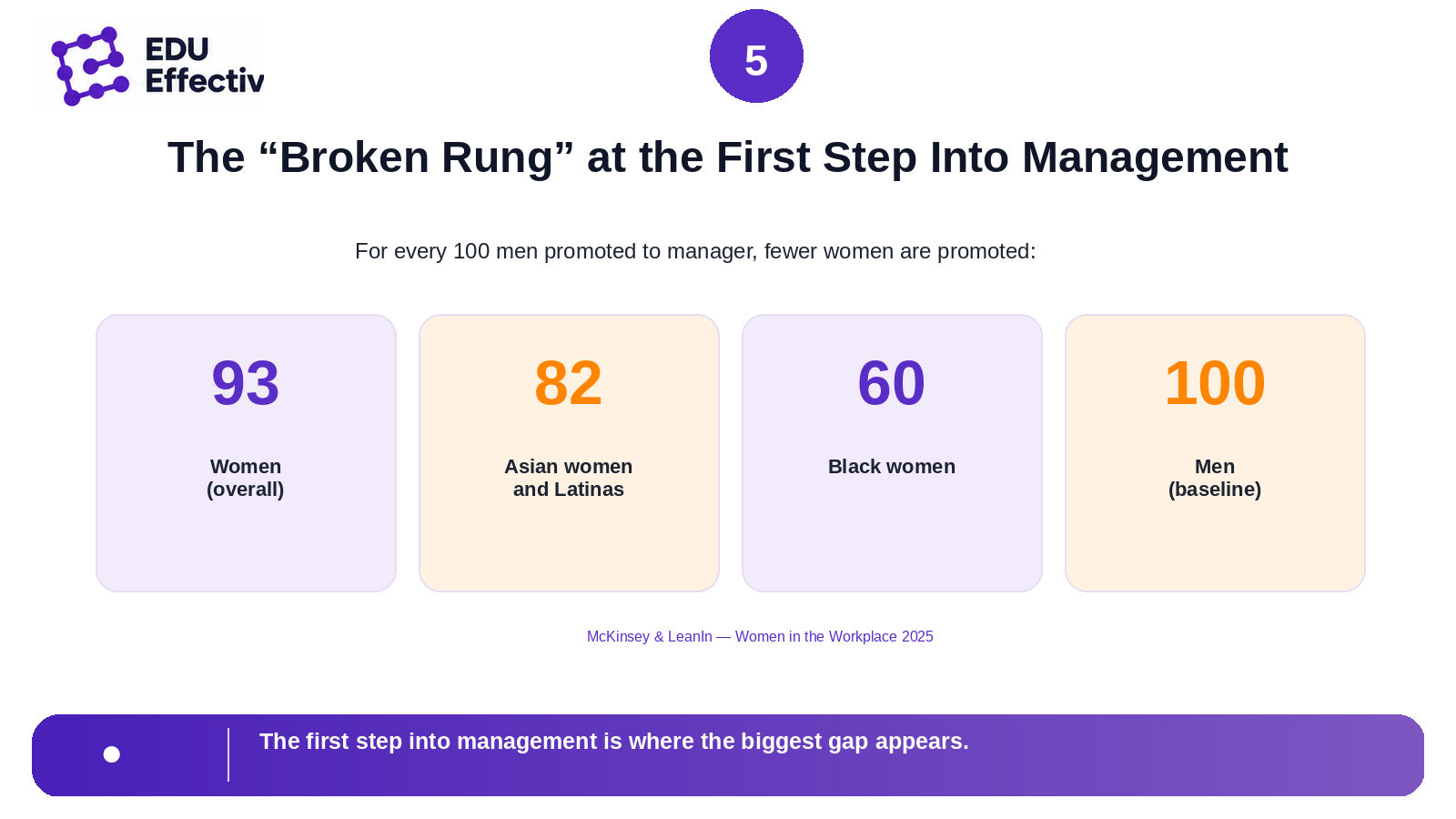
This is not primarily a performance gap. Research consistently shows that women and underrepresented groups are not less capable, less ambitious, or less committed. The same 2025 report found that 80% of women want to be promoted to the next level — a gap of only six percentage points versus 86% of men, which does not come close to explaining the actual promotion gap.
The sponsorship deficit is a significant part of the explanation. Promotion decisions at every level involve someone with influence choosing to put their credibility behind a candidate. When that advocacy is distributed unevenly — along lines of familiarity, shared identity, and proximity — the outcomes are uneven.
How to Build a Sponsorship Relationship
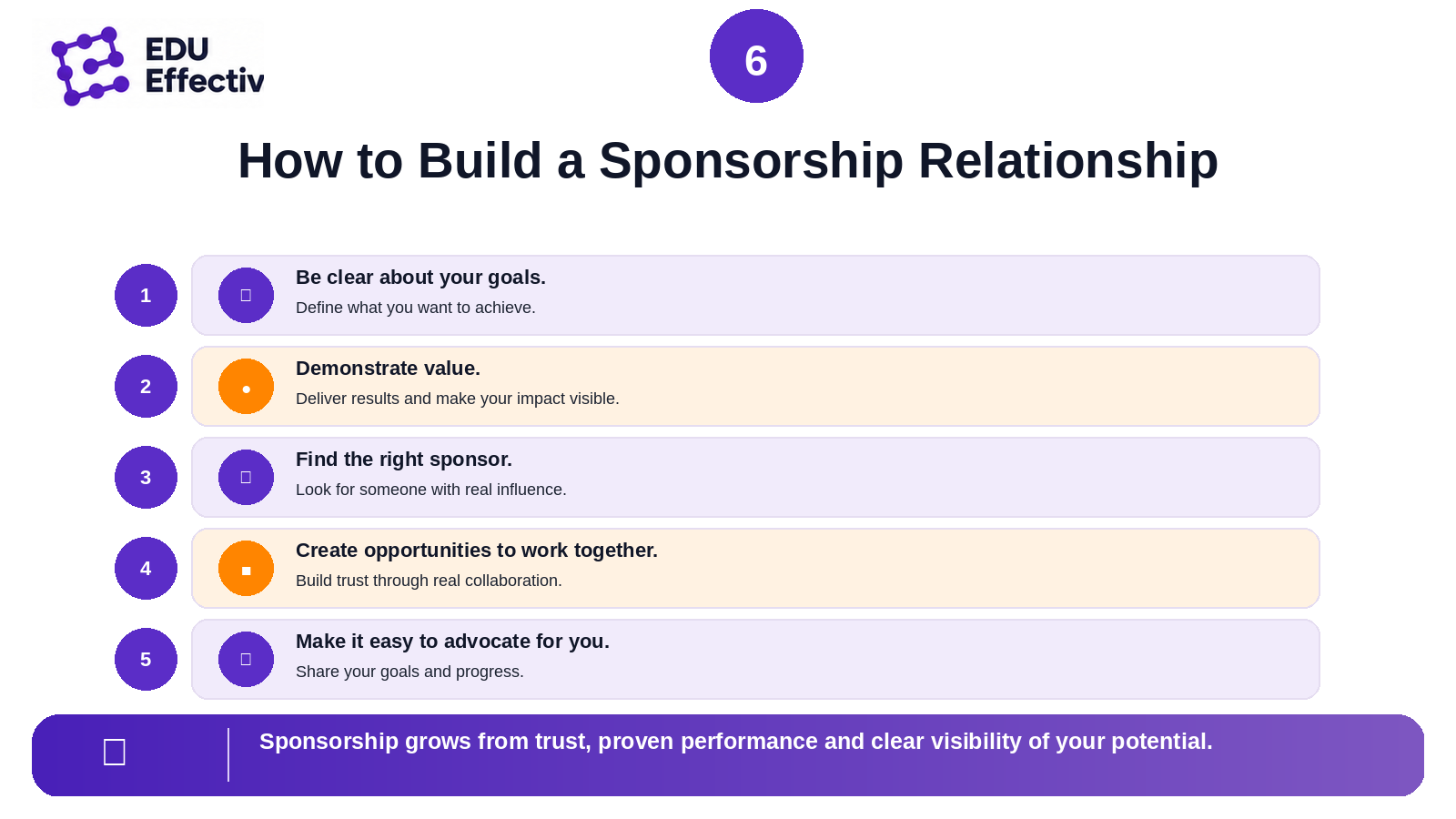
This is the practical problem. Sponsorship cannot be assigned the way mentoring can. A program can create a mentoring relationship; it cannot legislate that a senior leader will genuinely advocate for a specific person. What programs can do is create the conditions — access, visibility, and observed performance — that make sponsorship more likely to form.
From an individual’s perspective, several things matter:
Visibility in the right rooms. Sponsors need material to work with. Before someone will spend their credibility on your behalf, they need to have seen you perform in a high-stakes context. This means taking on stretch assignments, leading visible projects, and being present in situations where senior stakeholders are watching. Competent work done quietly in the background does not generate sponsors. what actually builds executive authority and a personal brand that compounds
Direct investment in the relationship. Sponsorship relationships form when a senior leader has a reason to be personally invested in a particular person’s success. That often starts with a mentoring dynamic that deepens over time. It can also start with working closely together on a high-stakes project. The key is that the senior person needs to experience your work directly, not just hear about it.
Explicit clarity about your ambitions. Sponsors need to know what you want. A common failure mode is that a talented person has access to a senior leader who would advocate for them, but the senior leader does not know the person wants to be considered for a specific role or promotion. The conversation about ambition has to happen. It feels uncomfortable, and most people avoid it until the opportunity has passed.
Being useful to the sponsor’s agenda. Sponsorship is not purely altruistic. It tends to form when the person being sponsored makes the sponsor look good — by delivering results, representing the sponsor’s team or function well, or contributing to something the sponsor is trying to accomplish. This does not mean performing for the wrong reasons. It means understanding that organizational relationships work in both directions.
What Organizations Can Do
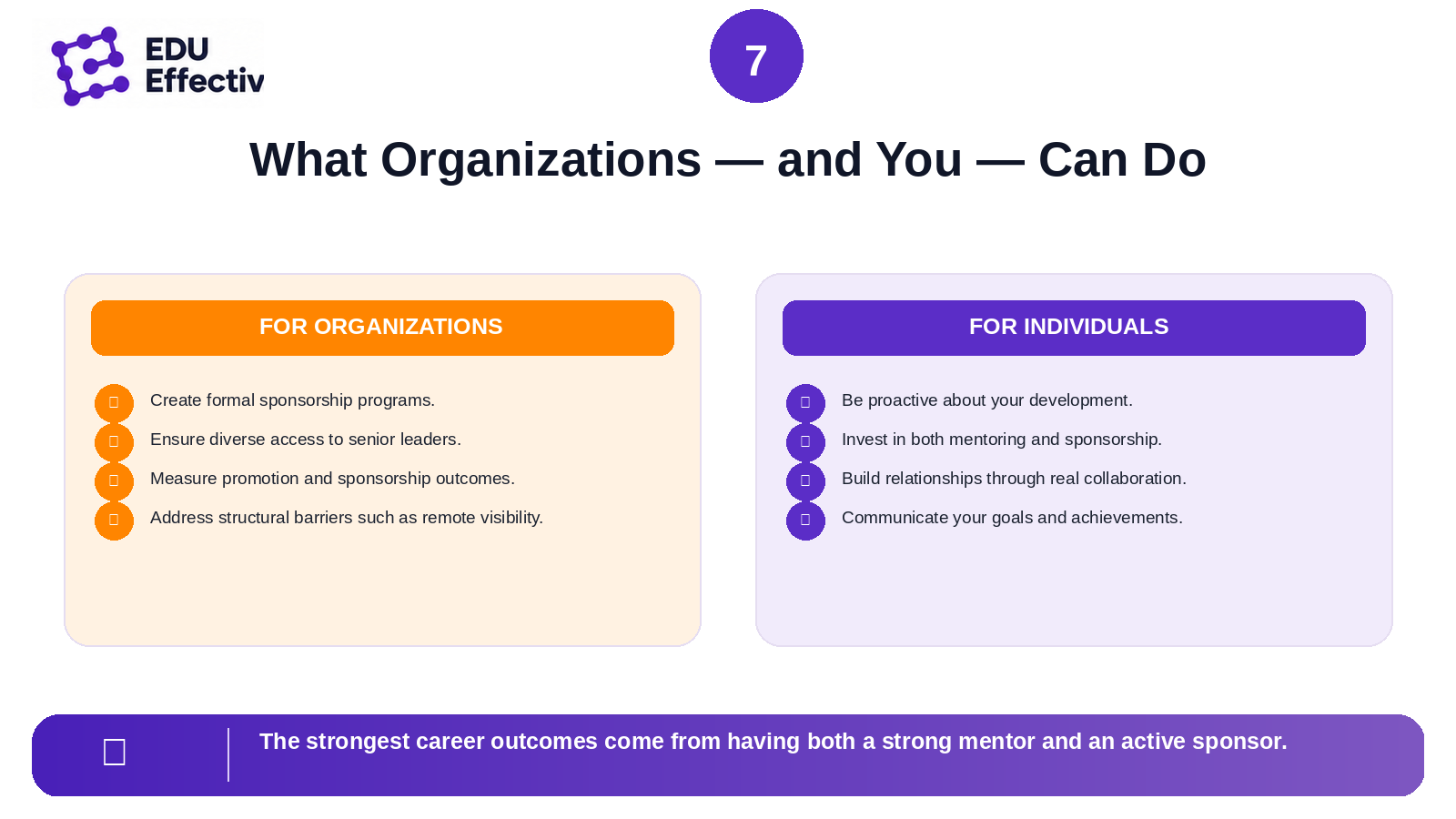
The individual strategies above matter, but they operate within structures that organizations set. Three things have consistent evidence behind them.
Structured exposure programs. Rotating high-potential employees through assignments with different senior leaders — stretch projects, cross-functional task forces, leadership development programs that include direct contact with executives — creates the observed-performance conditions that sponsorship needs. These programs are most effective when they are intentional about including people who would not naturally be in senior leaders’ networks.
Sponsorship accountability. Some organizations have begun explicitly asking senior leaders to name one or two people they are actively sponsoring — not mentoring, but sponsoring — and to report on what they have done. Making sponsorship visible as a leadership behavior, rather than leaving it as an informal and untracked practice, changes how seriously it is taken.
Measuring the gap. You cannot manage what you do not measure. Organizations that track promotion and retention rates by demographic group, and correlate them with participation in mentoring and sponsorship programs, have the data to know whether their programs are closing gaps or merely existing. The McKinsey/LeanIn broken rung data is a useful benchmark; the more important question is what your own organization’s data shows at each promotion stage. why most organizations get workforce transformation wrong — and what the data says about fixing it
What This Means for Your Own Career
If you are a manager or a professional mid-career, the practical implication is this: take an honest inventory of the relationships you have been calling developmental.
Who in your network actually knows what you are trying to accomplish in the next two years? Who has the organizational influence to say your name in a room you are not in? And who, of the people in that second category, has seen you do something impressive enough that they would be willing to put their credibility behind you?
If the answer to the last question is a short list, the work is not to attend another networking event. It is to get in front of situations where people with influence can watch you deliver.
Mentoring gives you the skills and perspective to do the work well. Sponsorship is what happens when someone with power decides you deserve the opportunity to show it. Both matter. Only one has been systematically underinvested.
Build the Leadership Foundation That Earns Both
Managers who understand organizational dynamics, talent development, and career architecture lead teams that develop people more effectively — and create the conditions where sponsorship is more likely to form. The Effective MBA develops that foundation.
About EDU Effective Business School
The Effective MBA: Executive Management & Leadership develops the judgment behind everyday management decisions. Runs on 15 minutes a day, completes in 10 months or less and is ASIC accredited.
Sources
- McKinsey & Company / LeanIn.Org — Women in the Workplace 2025: https://leanin.org/women-in-the-workplace
- Coqual (formerly Center for Talent Innovation) — The Sponsor Dividend (survey of 3,213 employees, conducted by NORC): https://coqual.org/wp-content/uploads/2021/04/The-Sponsor-Dividend-Press-Release-Updated.pdf
- Mentorloop — Mentoring Statistics 2026 (secondary compilation): https://mentorloop.com/blog/mentoring-statistics/