
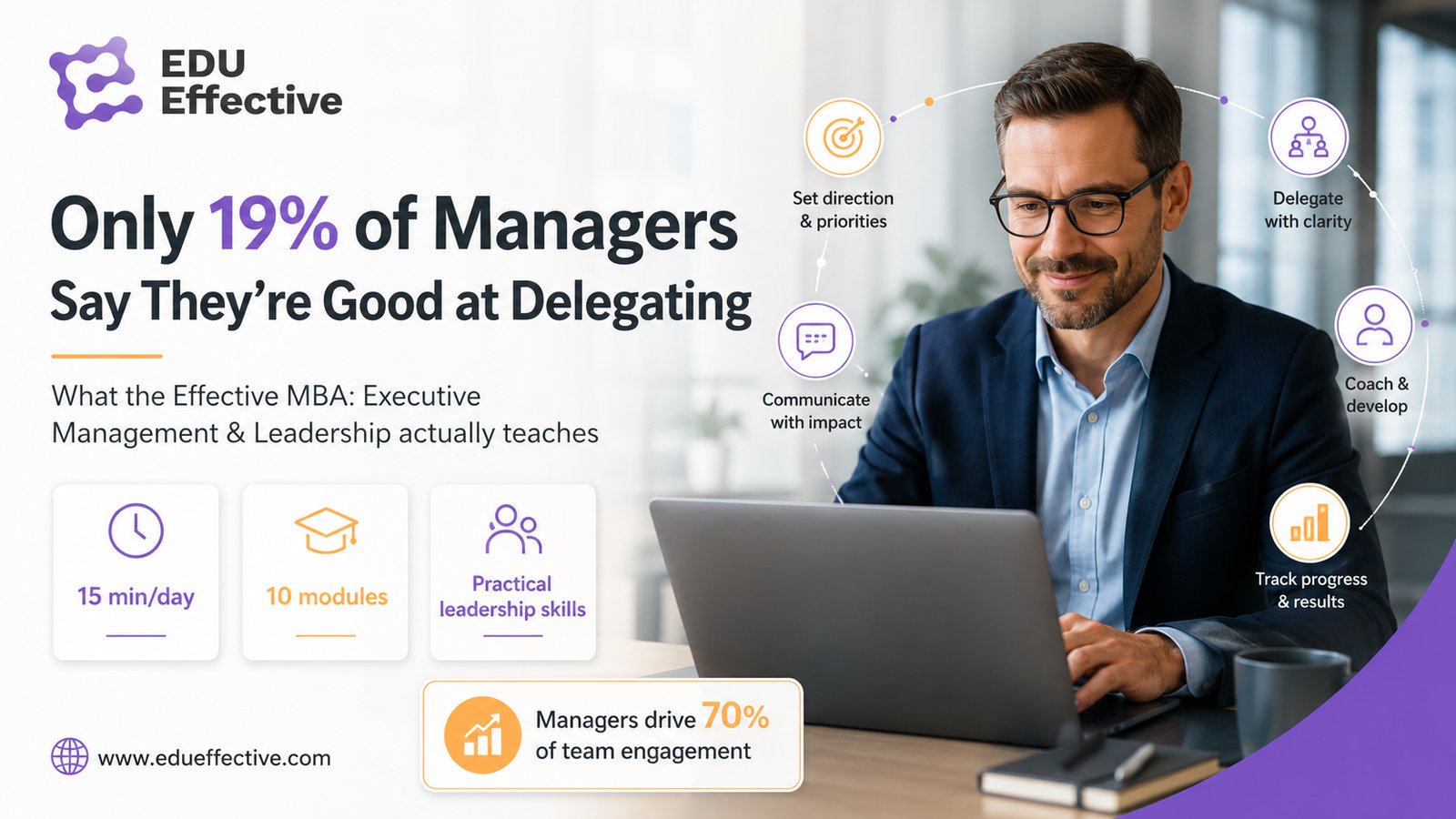

DDI's Global Leadership Forecast 2025 surveyed nearly 11,000 leaders across 2,000+ organizations and found that only 19% report strong delegation skills. The two biggest self-reported skill gaps overall: setting strategy, and managing change. Meanwhile Gallup's latest workplace report puts a number on why that matters — managers account for 70% of the variance in how engaged their teams are, and global disengagement is now costing the world economy roughly $10 trillion a year.
None of that is a talent shortage. It's a training gap — and it's the specific gap the Effective MBA: Executive Management & Leadership program is built to close.
Everyone Prioritizes Leadership Training. Few Execute It Well
LinkedIn's 2025 Workplace Learning Report names leadership development the top L&D priority in every organization it surveys — and then shows why that priority isn't translating into results: only 36% of leaders are highly effective at change management, 26% at talent development, 24% at talent management, and 19% at employee engagement. The problem isn't that companies don't value leadership training. It's that most of it doesn't change what a manager actually does on a Tuesday afternoon.
If you're also navigating the wider pressures on managers — shrinking middle-management layers, Gen Z talent pipelines, hybrid teams — our piece on what actually works for mentoring in hybrid teams covers exactly that ground.
What the Effective MBA: Executive Management & Leadership Program Actually Covers
Ten modules, each built around a skill gap the research above names directly:
- 1. Strategic Business Foundations
- 2. Managerial Skills for Success
- 3. Leadership
- 4. Coaching & Mentoring
- 5. Effective Managerial Communication
- 6. Team Management
- 7. Remote Team Management
- 8. Performance Management
- 9. Decision Making
- 10. AI: Trends, Case Studies & Productivity
Content draws on practitioners associated with Google, Amazon, Microsoft, TED, LinkedIn, Netflix, McKinsey, Deloitte, JPMorgan, Goldman Sachs, and academics from Yale, Stanford, Princeton, Cornell, and many more.
Who It's Actually Built For
- Mid-level managers — ready to step into senior roles, sharpening leadership style and decision-making before the promotion, not after.
- Team leaders and people managers — need practical coaching, mentoring and conflict-resolution skills, including for hybrid and remote teams.
- Entrepreneurs and founders — scaling operations and building teams without a management background to fall back on.
- Experienced professionals moving into leadership — specialists who need a credible, accredited foundation in strategic thinking and managerial communication.
15 Minutes, Real Output
The program runs on the same microlearning format as every Effective MBA: 75+ hours of required video, 40+ hours of optional material, 50+ recommended e-books and audiobooks, and action plans built to transfer directly into the job — how to lead a hybrid team, how to structure feedback that actually lands, how to apply AI tools in day-to-day management. eTests check what's genuinely understood rather than just watched.
"I have now completed my second MBA at EDU Effective. The content is very practical and easy to understand. I will complete another MBA in the next few years and it will again be with EDU Effective. 100% satisfaction."
— Ingo T., Effective MBA Graduate, Germany
What You Actually Walk Away With
The credential carries international ASIC accreditation, and it's a professional program, not an academic one — built to change what a manager does immediately, not to sit on a shelf. Graduates move into roles like Strategic Planning Manager, Team Leader, Department Head, and Change Management Consultant, backed by a community of 9,000+ students across 120 countries and a 4.9/5 Google reviews rating.
Still weighing whether an online MBA delivers on its promises? We've fact-checked the most common doubts in our piece on 7 myths about the Effective MBA — and what's actually true.
The Data Isn't Waiting
Delegation, change management, and team engagement aren't going to fix themselves while the next performance review cycle passes. The gap DDI, LinkedIn and Gallup all measured this year is closeable — starting with 15 minutes today.