
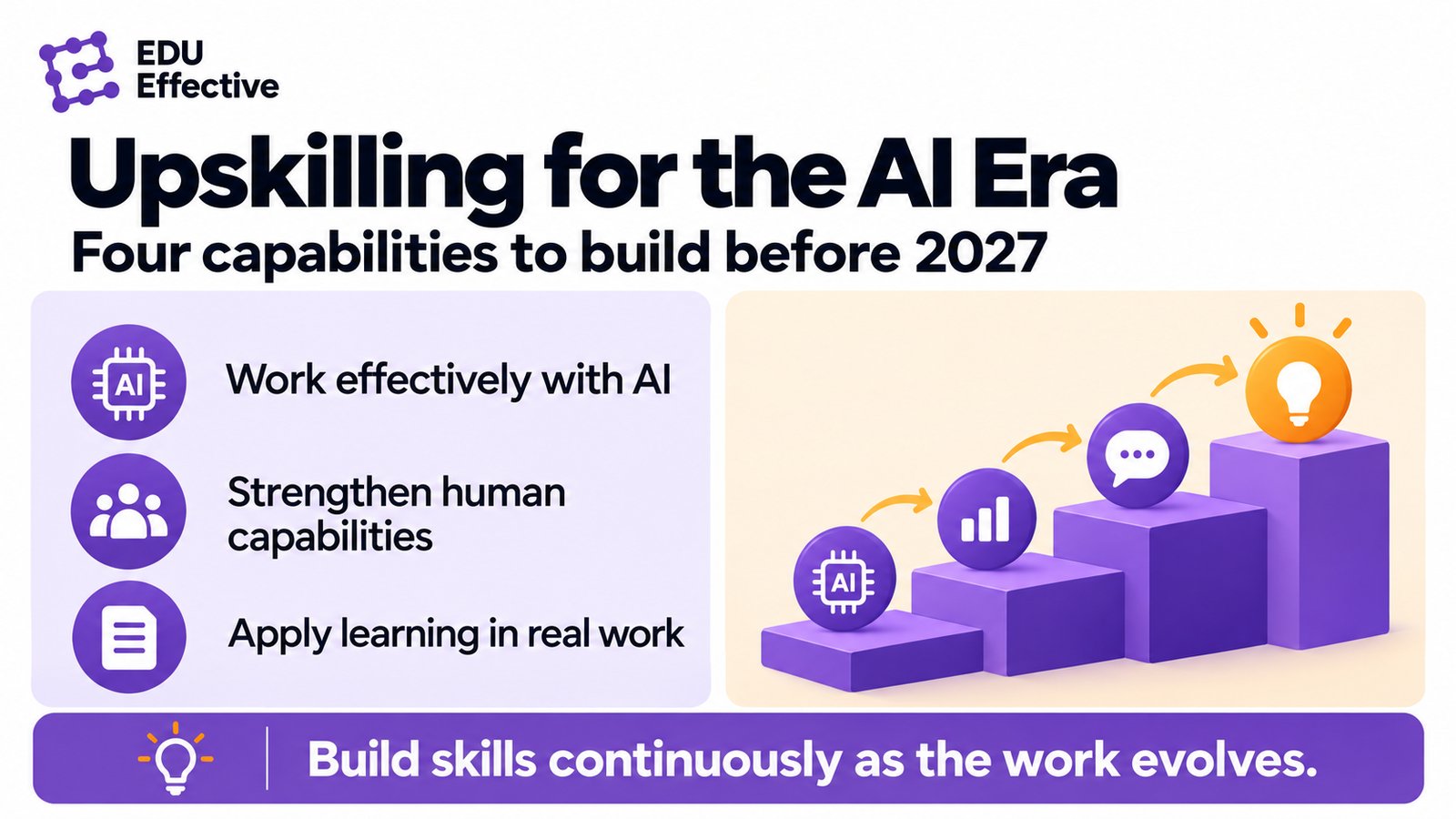

Six in ten employees will need significant retraining before 2027. Only half currently have access to appropriate learning opportunities. This is not a projection from a think tank operating in abstraction. It comes from World Economic Forum's Future of Jobs Report 2025, which surveyed more than 1,000 companies across 22 industries and 55 economies.
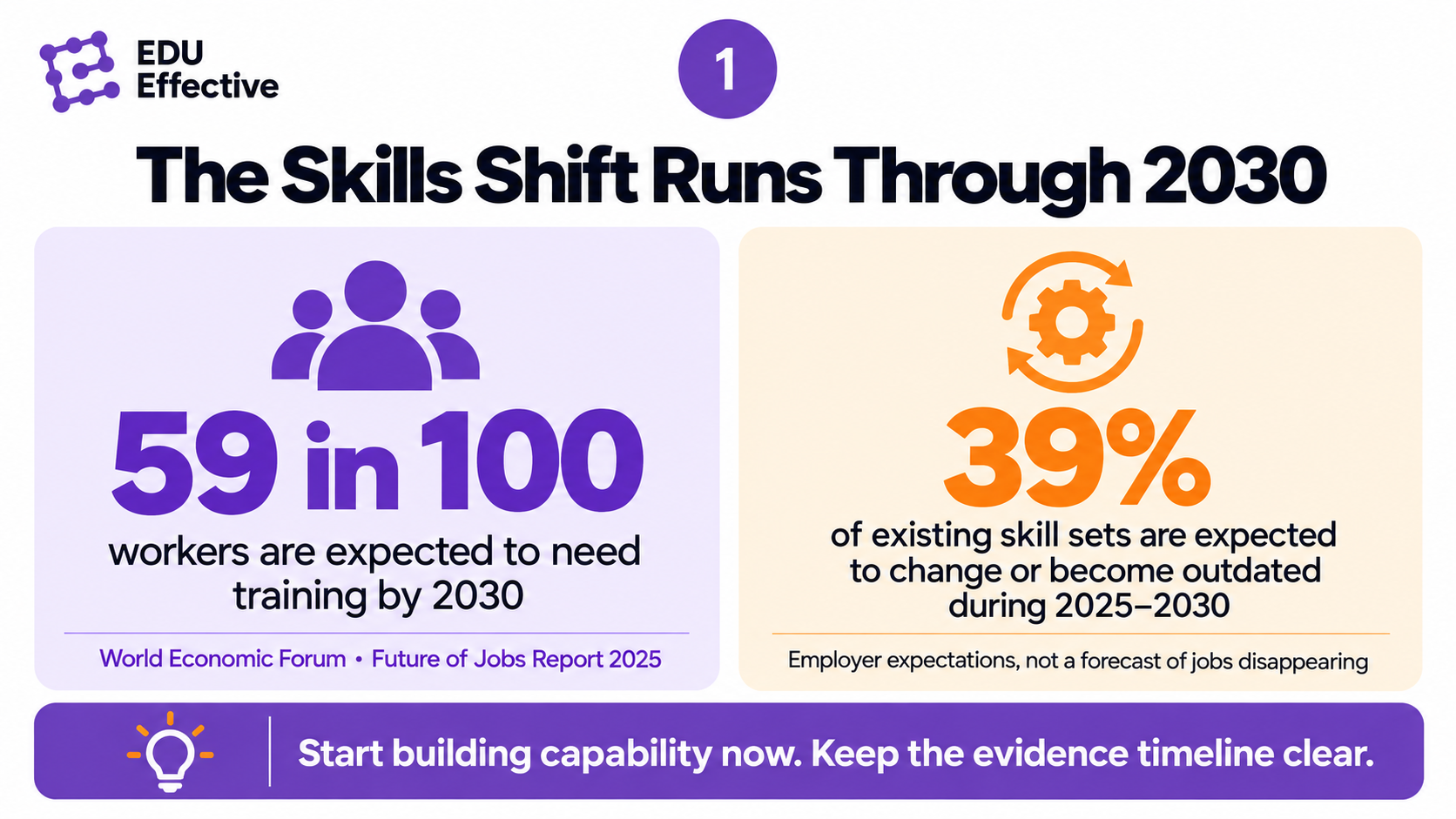
The math is not comfortable. Of every 100 workers, 59 will need reskilling or upskilling by 2030. 29 can be retrained in their current roles. 19 can be redeployed elsewhere with new skills. 11 are unlikely to be retrained at all, putting over 120 million workers at medium-term risk of redundancy. The gap is not between workers who want to learn and those who do not. 78% of employees say they want to upskill, and 80% want their organizations to invest more in it. The gap is between the urgency of the shift and the pace at which organizations and individuals are actually moving.
Upskilling for the AI era is not a generic professional development initiative. It is a specific, time-sensitive response to a structural change in what work requires. This article covers which skills the data identifies as most valuable before 2027, why the combination of technical and human capabilities matters more than either alone, and how to prioritize learning when time is the real constraint.
What the skills demand data actually shows
WEF's Future of Jobs Report 2025 identifies the fastest-growing skill categories as AI and big data, networks and cybersecurity, and technological literacy on the technical side, alongside analytical thinking, resilience, flexibility, leadership, and social influence on the human side. The report is explicit that both dimensions are growing simultaneously. Organizations are not replacing human skills with technical ones. They are raising the floor on both.
LinkedIn's Skills on the Rise 2025 gives a more granular view of what is actually appearing in job postings and professional profiles. The five fastest-growing skills globally are creativity and innovation, code review, problem-solving, pre-screening, and strategic thinking. AI literacy ranks ninth, but with a specific growth signal attached: it is appearing in job descriptions six times more frequently than a year ago. Members adding AI skills to their profiles have grown 20-fold since 2016.
The WEF finding that nearly 40% of on-the-job skills are expected to change by 2030 is worth sitting with. It does not mean 40% of jobs disappear. It means the specific competencies required to perform existing roles are being replaced, faster in some functions than others, but across virtually every sector. A marketing manager in 2027 needs a materially different skill set than the same role required in 2023. So does a finance analyst, an operations director, and a product manager.
The four skill categories that matter most before 2027
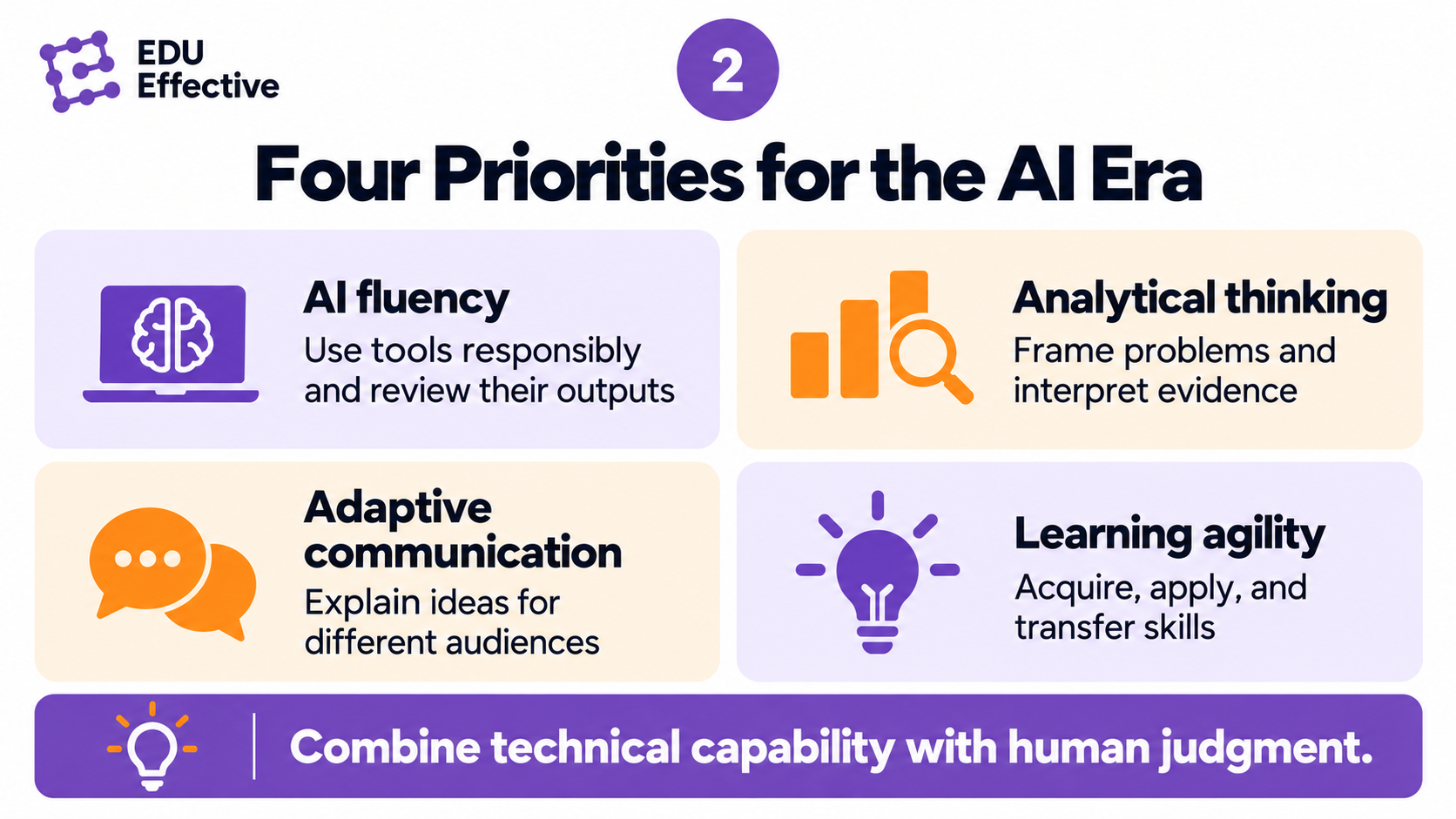
Not all upskilling investment pays off equally. The data points to four categories where the return, in employment security, compensation, and professional leverage, is clearest and most consistent.
1. AI fluency, not AI expertise
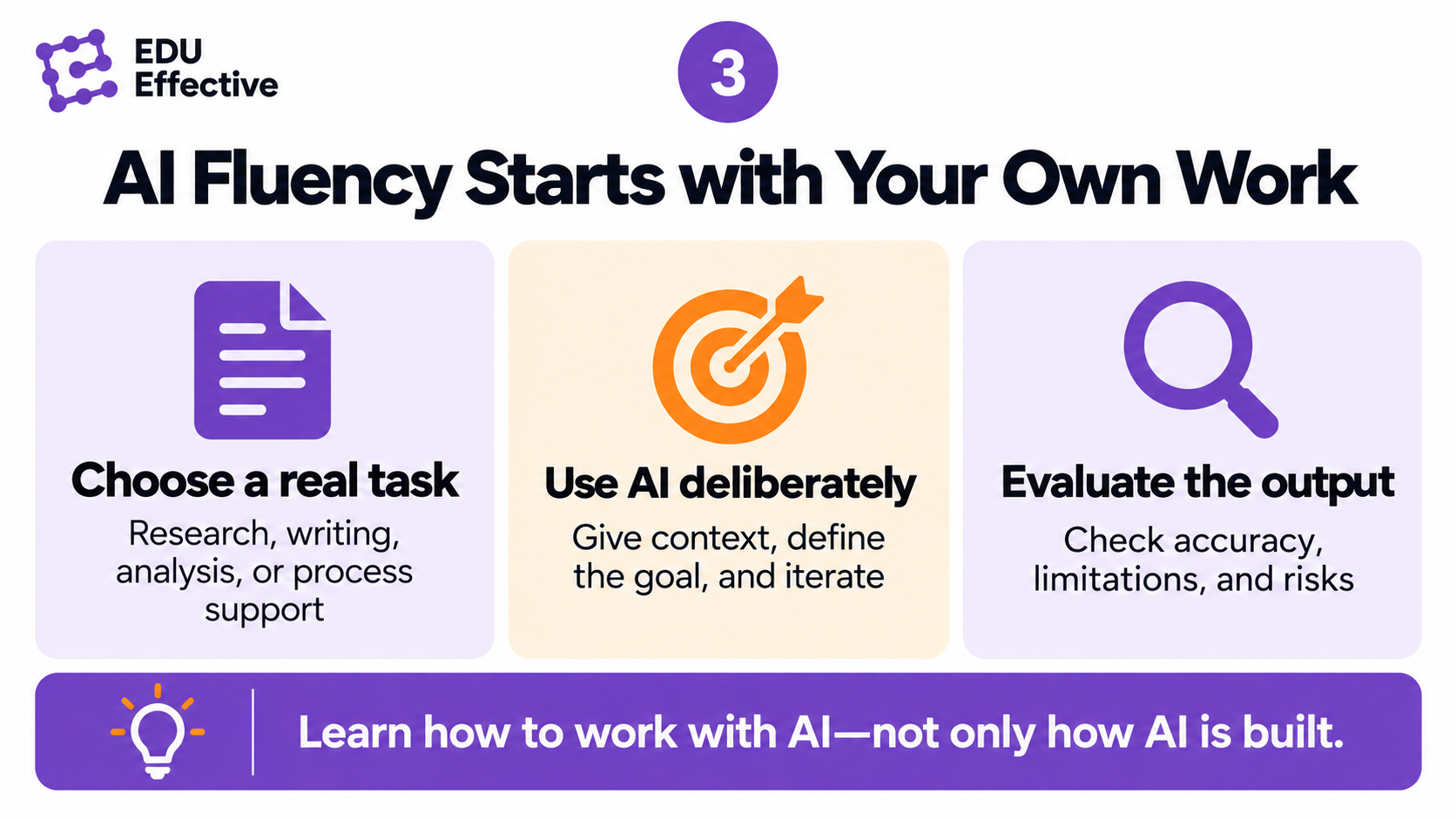
There is an important distinction between AI fluency and AI expertise. AI expertise means building models, writing code, training systems. That matters for a specific set of roles. AI fluency means understanding what AI can and cannot do reliably, knowing how to use AI tools effectively in your own domain, being able to evaluate AI-generated outputs critically, and understanding the risks and failure modes well enough to use AI responsibly.
LinkedIn found AI literacy in job descriptions growing 6x year over year. WEF identifies AI and big data as the single fastest-growing skill cluster through 2030. Gartner's finance data found data literacy as the primary skills gap blocking AI adoption in finance functions. The pattern across all three sources is consistent: organizations need people who can work with AI competently, not just people who can build it.
For most professionals, the practical investment is in tool-level fluency: how to use AI effectively for research, writing, data analysis, process automation, and decision support in their specific field. This is learnable in weeks, not years, and its absence is already visible in hiring and promotion decisions.
2. Analytical thinking and data literacy
WEF ranks analytical thinking as the top human skill growing in demand. This is distinct from technical data skills. It is the ability to structure ambiguous problems, identify the right questions to ask of data, distinguish correlation from causation, and make defensible decisions under uncertainty.
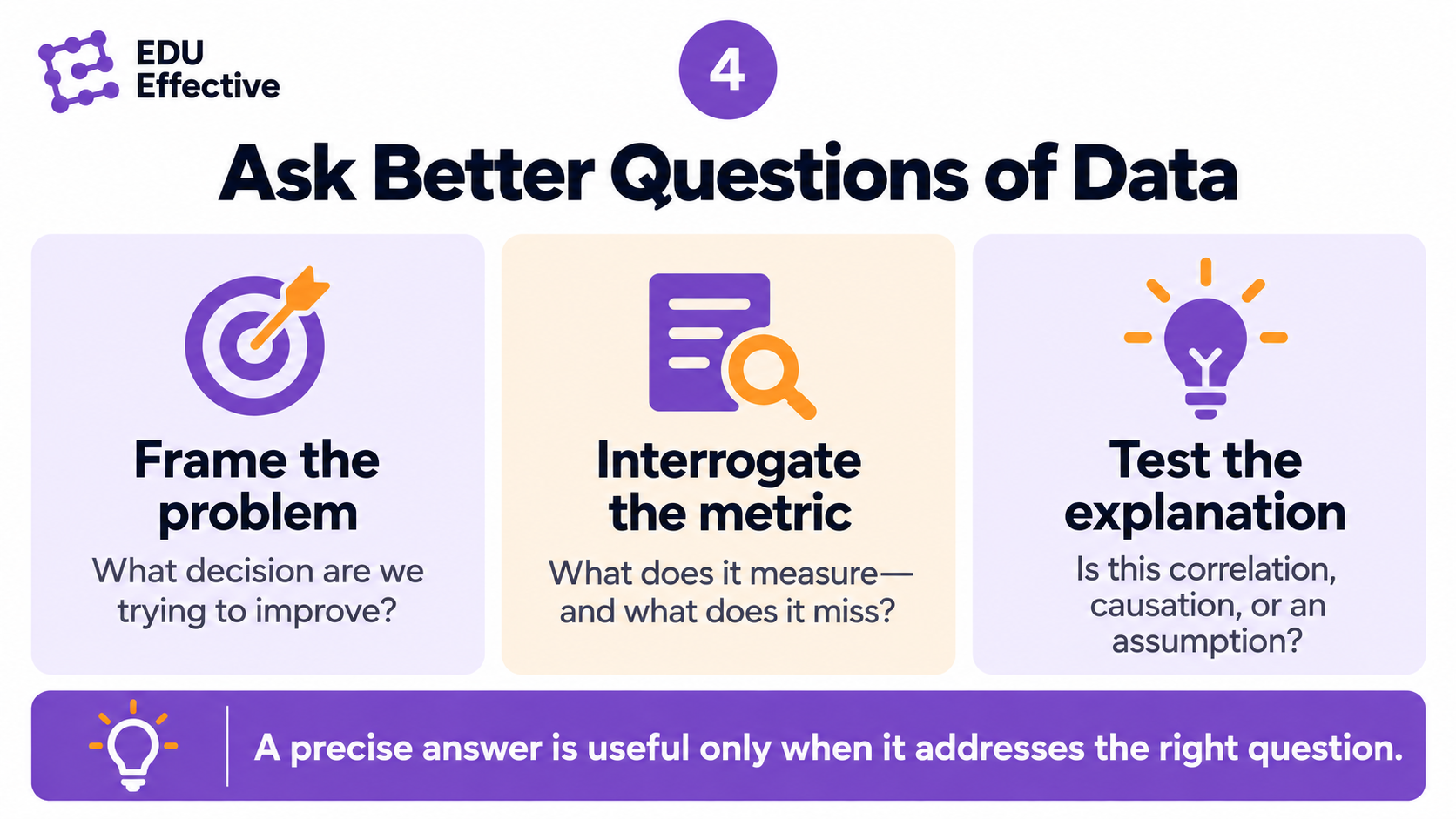
Data literacy as a subset means being able to read and interpret dashboards, understand what metrics actually measure versus what they proxy, identify when data is being used selectively, and communicate quantitative findings to non-technical audiences. Gartner identifies this as a critical gap in finance. The same gap shows up in marketing, operations, and general management.
The reason analytical thinking ranks above purely technical skills in most employer surveys is that it compounds with everything else. A manager with strong analytical thinking who learns a new technical tool becomes more effective immediately. A manager with strong technical skills but weak analytical thinking often produces precise answers to the wrong questions.
3. Adaptive communication and influence
LinkedIn's Skills on the Rise data puts creativity, problem-solving, and strategic thinking at the top of the fastest-growing list, all of which depend on communication as the delivery mechanism. Research consistently finds that ideas which are not communicated persuasively do not get implemented, regardless of their quality.
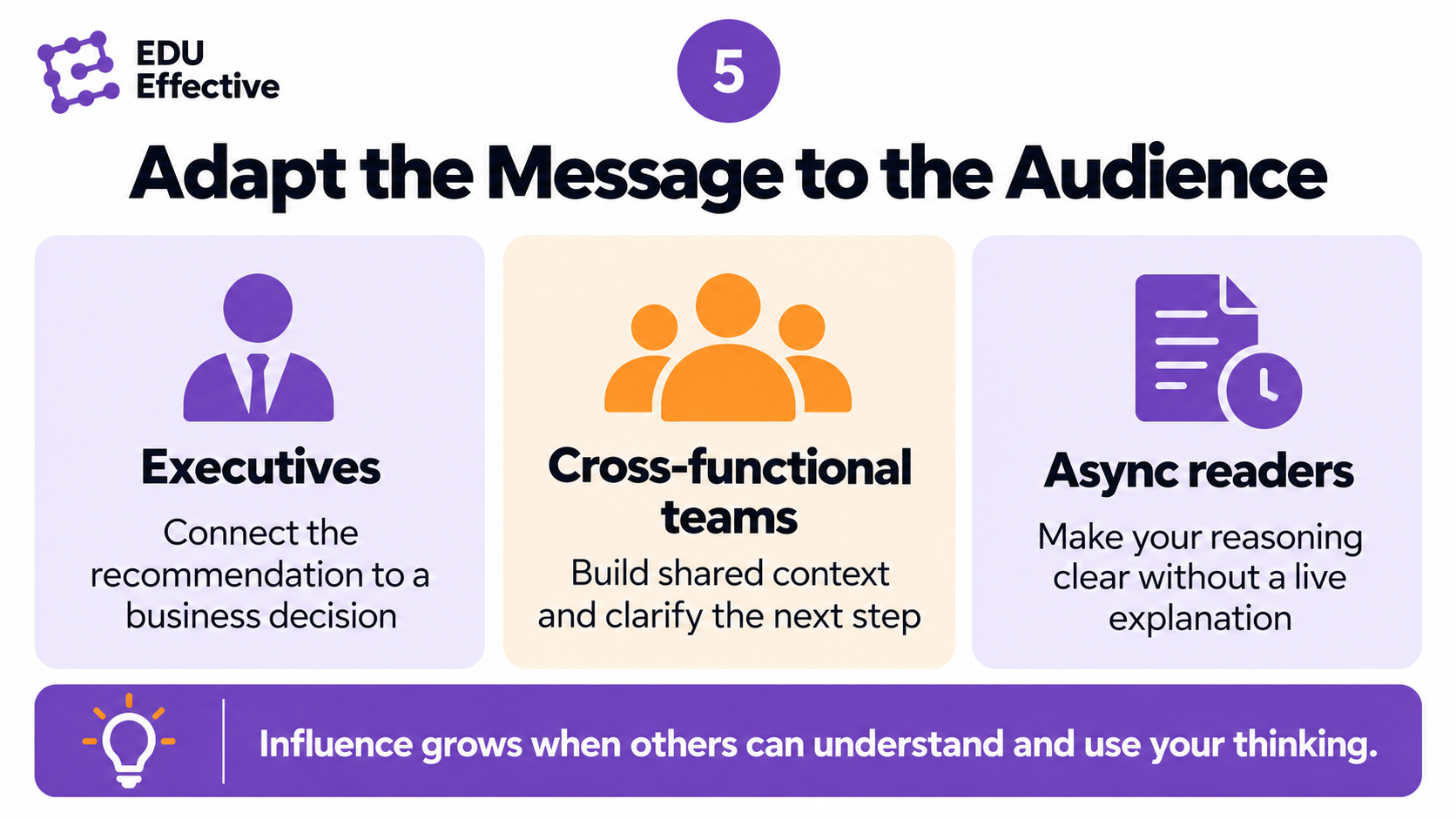
Adaptive communication specifically, the ability to adjust how you communicate based on audience, context, and medium, is becoming more valuable as work becomes more distributed and more cross-functional. A professional who can explain a technical decision to a non-technical executive, run a productive cross-cultural remote meeting, and write clearly enough that their reasoning survives being read asynchronously has a structural advantage over one who communicates well only in their native format.
This category also includes the ability to influence without authority, relevant for anyone working in matrix organizations, cross-functional projects, or client-facing roles where formal hierarchy does not determine outcomes.
4. Learning agility, the meta-skill
The WEF report identifies resilience, flexibility, and the willingness to engage with change as critical skills through 2030. These point to something more fundamental: the ability to learn effectively, adapt quickly, and remain functional during periods of significant disruption.
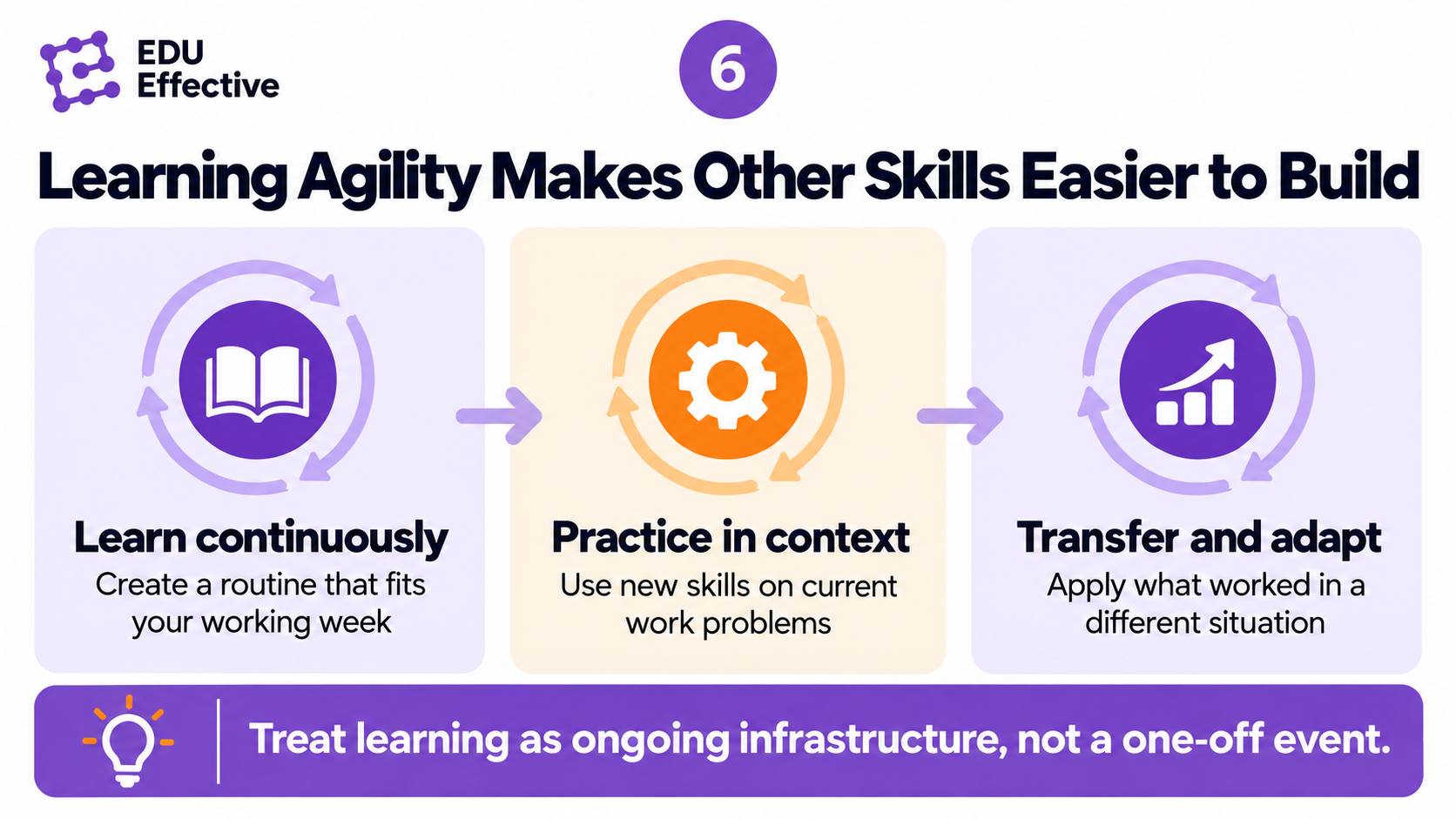
Learning agility as a professional capability means knowing how you learn best, building habits that sustain continuous development rather than episodic training, being able to transfer knowledge from one context to another, and maintaining effectiveness while operating in areas of genuine uncertainty. It is the meta-skill that determines how quickly someone can acquire all the other skills on this list.
The relevance before 2027 is direct. The pace of change in tools, processes, and role requirements is not going to slow down. A professional who treats their current skill set as a permanent asset is already falling behind. One who treats learning as ongoing infrastructure, something that runs continuously rather than occasionally, is positioned to stay ahead regardless of which specific capabilities become most valuable next.
What most upskilling programs get wrong
WEF found that 63% of employers cite the skills gap as their main barrier to transformation, yet only 26% of U.S. workers say their companies strongly encourage learning new skills (Gallup). The gap between organizational priority and individual experience is a program design failure. It is also why a real skills gap analysis has to come before any training plan.
Most corporate upskilling initiatives fail for predictable reasons. They are episodic rather than continuous, a training day or a course rather than a learning system embedded in work. They are generic rather than role-specific, the same content delivered to everyone regardless of what would actually make them more effective. And they measure completion rather than application, tracking who finished a module rather than who changed how they work.
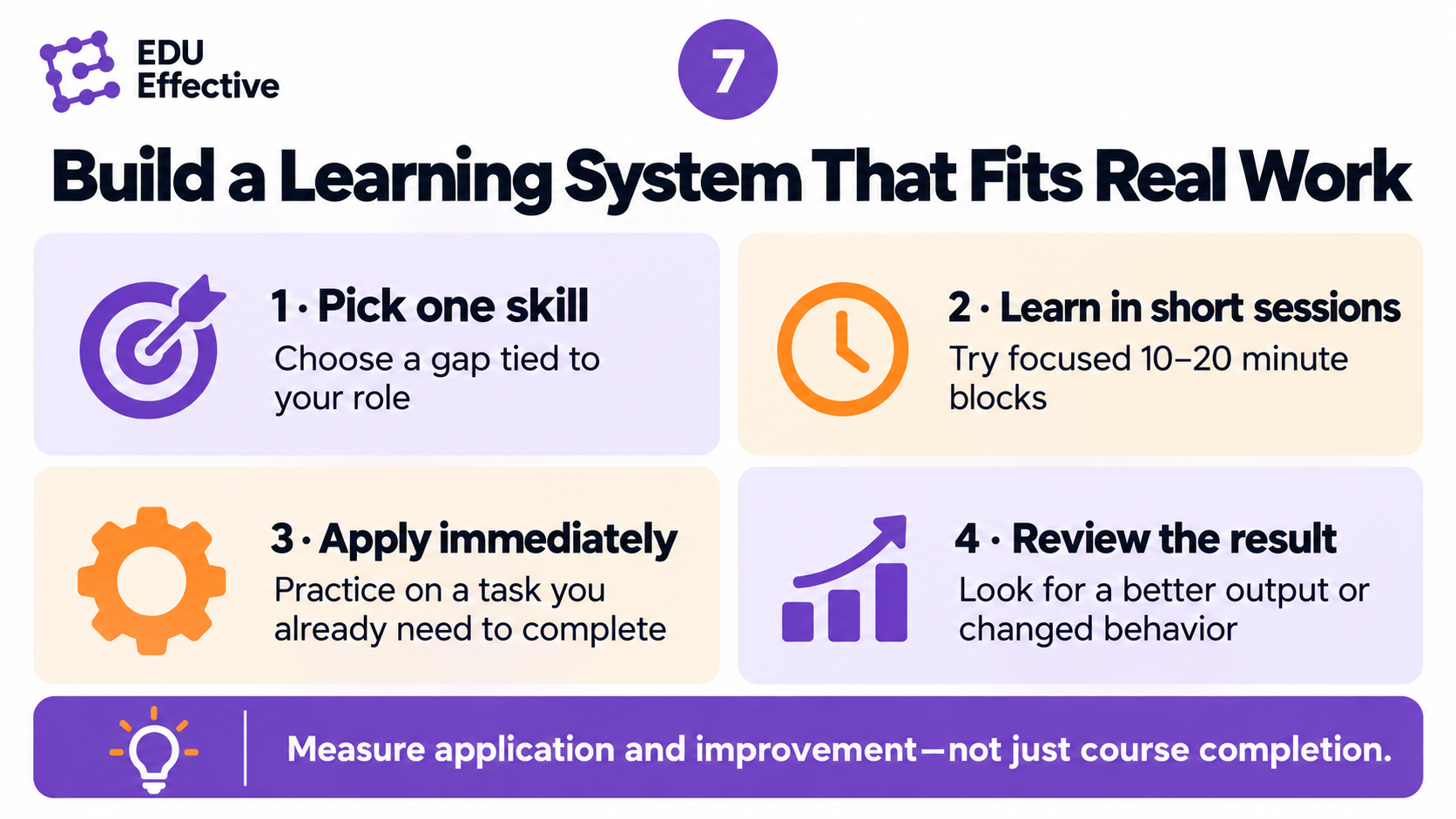
The upskilling that generates measurable returns is different in structure. It is short-format and frequent enough to fit into actual work schedules. It is applied immediately, skills practiced in the context of real work problems rather than abstract exercises. And it is connected to specific role demands rather than general capability lists. The microlearning approach, learning delivered in 10-20 minute segments that can be applied directly, consistently shows stronger retention and application rates than multi-hour training formats, precisely because it fits the cognitive and schedule constraints of working adults.
The individual investment case
77% of employers plan to upskill their workforce before 2030 (WEF). 41% plan to reduce headcount as AI automates tasks. These two figures exist simultaneously, meaning the workers who get retrained and those who get displaced will not be random. They will be differentiated by who has built the capabilities that remain valuable and who has not.
The individual case for upskilling before 2027 is straightforward. AI literacy, analytical thinking, adaptive communication, and learning agility are not specialized credentials that take years to acquire. They are capabilities that can be developed with focused, consistent effort over months. The window before they become table stakes, required rather than differentiated, is shorter than most people assume.
LinkedIn's data showing AI literacy appearing 6x more frequently in job postings is a leading indicator, not a current requirement. The professionals who build it now are building it while it still confers competitive advantage. Those who wait until it is required are building it while it is being used to screen them out.
About EDU Effective Business School
EDU Effective Business School designs practical business education for professionals who are already working. Runs on 15 minutes a day, completes in 10 months or less and is ASIC accredited.
Sources
- World Economic Forum, Future of Jobs Report 2025 (1,000+ companies, 22 industries, 55 economies) https://weforum.org/press/2025/01/future-of-jobs-report-2025-78-million-new-job-opportunities-by-2030-but-urgent-upskilling-needed-to-prepare-workforces/
- LinkedIn, Skills on the Rise 2025 https://www.linkedin.com/business/learning/blog
- Gallup, U.S. Workplace Learning Survey https://www.gallup.com/workplace/