
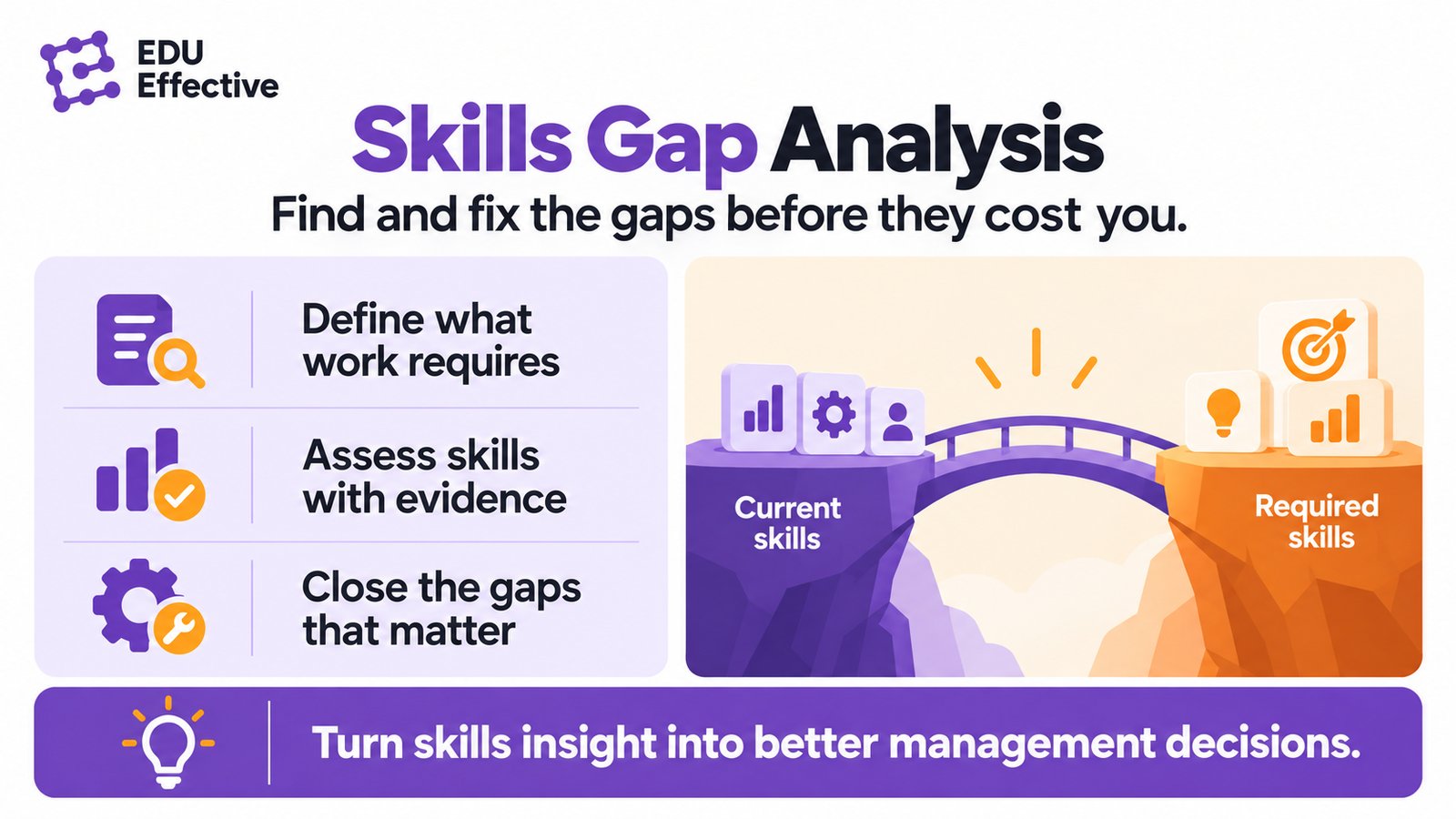

Most managers find out about a skills gap the hard way. A project stalls because nobody on the team knows how to do the critical piece. A hire leaves after three months because the role turned out to require capabilities that were never properly defined. A strategic initiative gets quietly shelved because the organization cannot execute it.
These are not surprises. They are the predictable result of not knowing, with any precision, what skills your team actually has versus what the work requires.
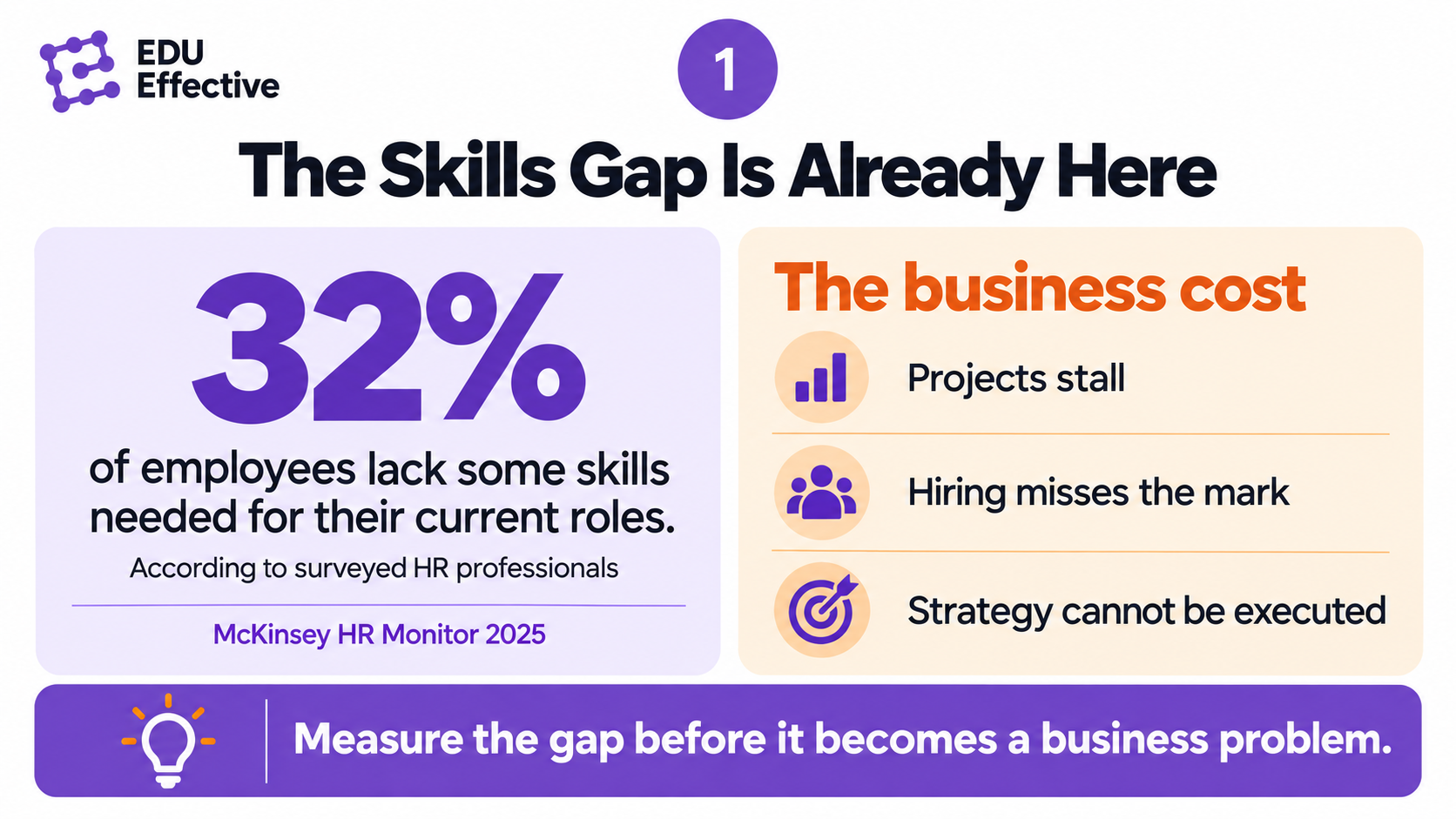
59% of organizations report critical or significant skill shortages, up from 44% the year before, according to ManpowerGroup’s 2026 Talent Shortage Report. Meanwhile, McKinsey’s HR Monitor 2025 found that 32% of employees lack the skills needed for their current roles — and that is according to the HR leaders themselves, not external auditors. The gap is real, it is growing, and most organizations are measuring it badly or not at all.
A skills gap analysis is the structured way to change that. Done properly, it tells you exactly where the distance is between what your team can do and what your strategy requires — and gives you a defensible basis for decisions about hiring, training, and role design.
Why Most Skills Assessments Fail Before They Start
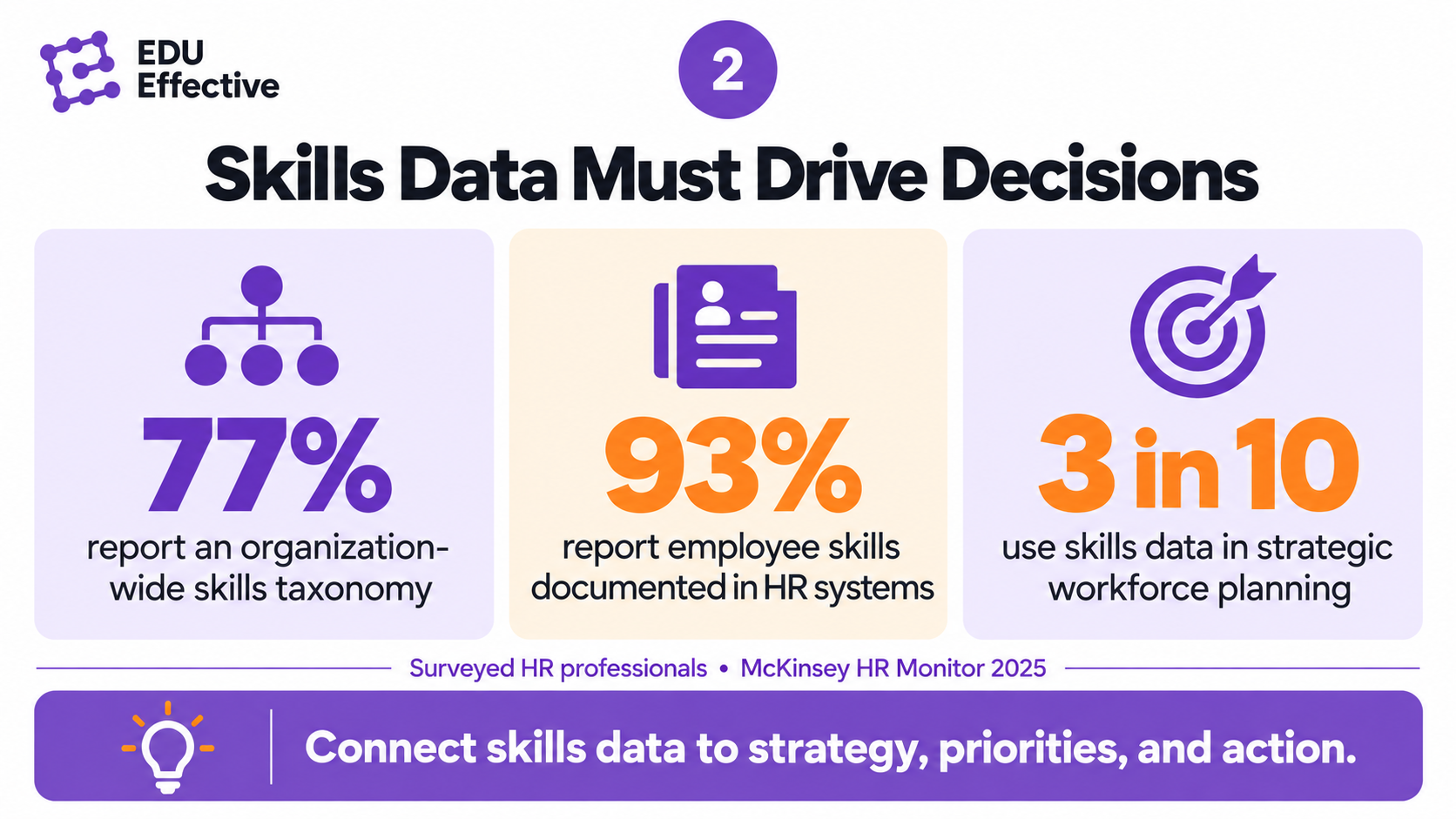
McKinsey’s HR Monitor 2025 found that 77% of HR functions have skills taxonomies and 93% document employee skills in HR systems. On the surface, that sounds like organizations are measuring skills well. The catch: only three in ten of those organizations actually use that skills data in strategic planning.
Data that exists but does not inform decisions is not an asset. It is administrative overhead.
The reason skills data rarely reaches strategic planning is usually one of two things. Either the taxonomy is too abstract to be useful — broad categories like “communication” or “leadership” that tell you nothing about what a specific person can actually do in a specific context — or the data collection was a one-time exercise that is now 18 months out of date and nobody has updated it.
A skills gap analysis that changes decisions has three properties that most routine HR assessments lack: it is anchored to a specific strategic objective, it measures skills at a behavioral level rather than a categorical level, and it is updated regularly enough to reflect what the team’s work is actually requiring right now.
Step One: Define What the Work Will Require
This is the step most managers skip, which is why their skills assessments produce generic results.
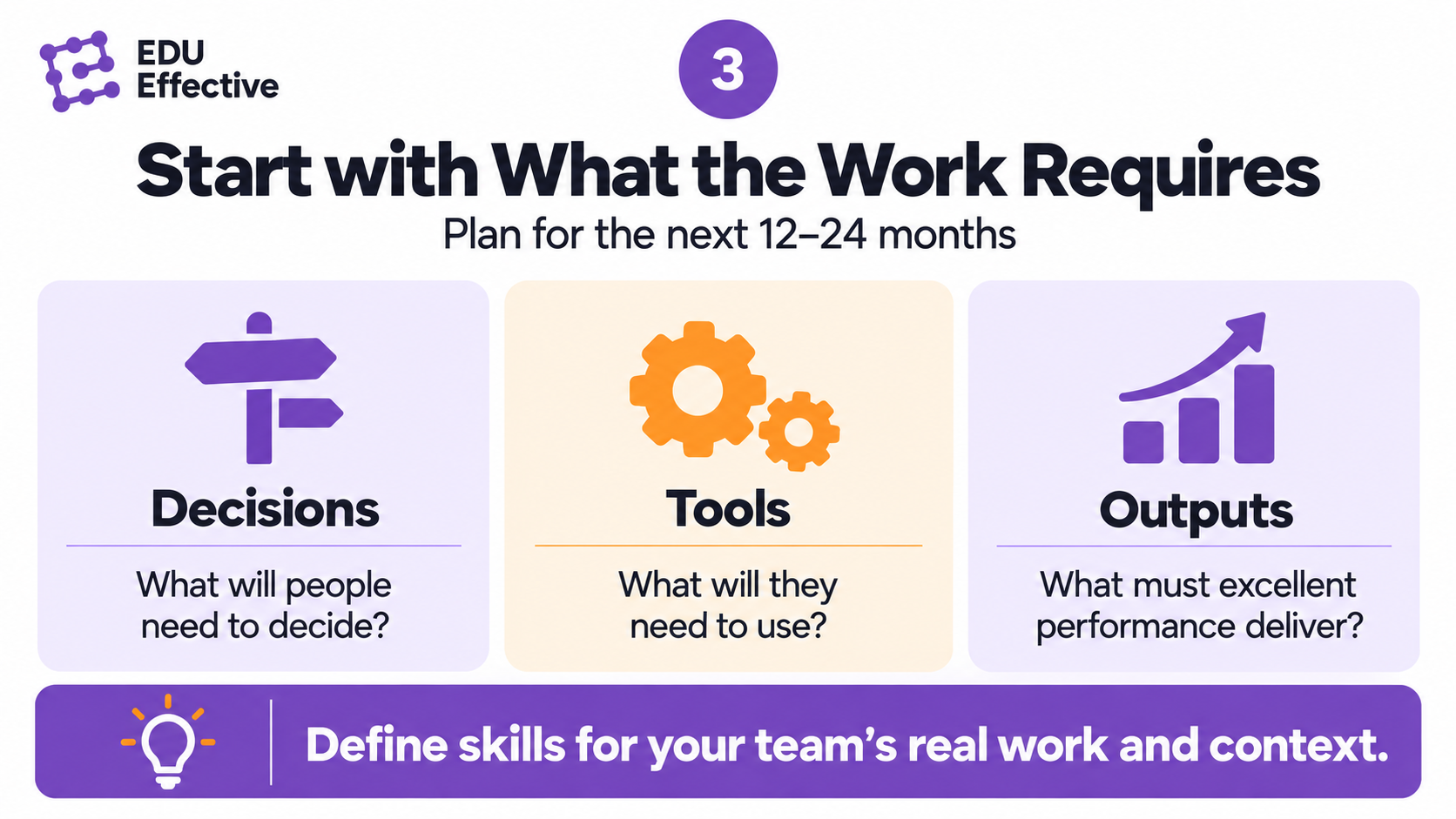
Before you assess what your team can do, you need to be precise about what the work will demand over the next 12 to 24 months. Not at the job description level — job descriptions are written for hiring and tend to be aspirational. At the operational level: what decisions will people on this team be making, what tools will they be using, what outputs will they be responsible for, and what will distinguish adequate performance from excellent performance?
The WEF Future of Jobs Report 2025 — covering more than 1,000 major employers representing over 14 million workers — identified the fastest-growing skill demands through 2030 as AI and big data literacy, networks and cybersecurity, and technological literacy, alongside more durable capabilities like analytical thinking, resilience, and leadership. These are directionally useful but too broad to use as a team-level assessment framework.
The more useful exercise is sector- and role-specific. A skills gap analysis for a finance team looks different from one for a marketing team or a project management function. The question is always the same — what does excellent look like in this role, in this organization, over this planning horizon — but the answer is specific to your context.
Step Two: Assess What Your Team Currently Has
Once you know what the work requires, you can measure the distance between that and where your team actually is.
There are three methods, each with different tradeoffs.
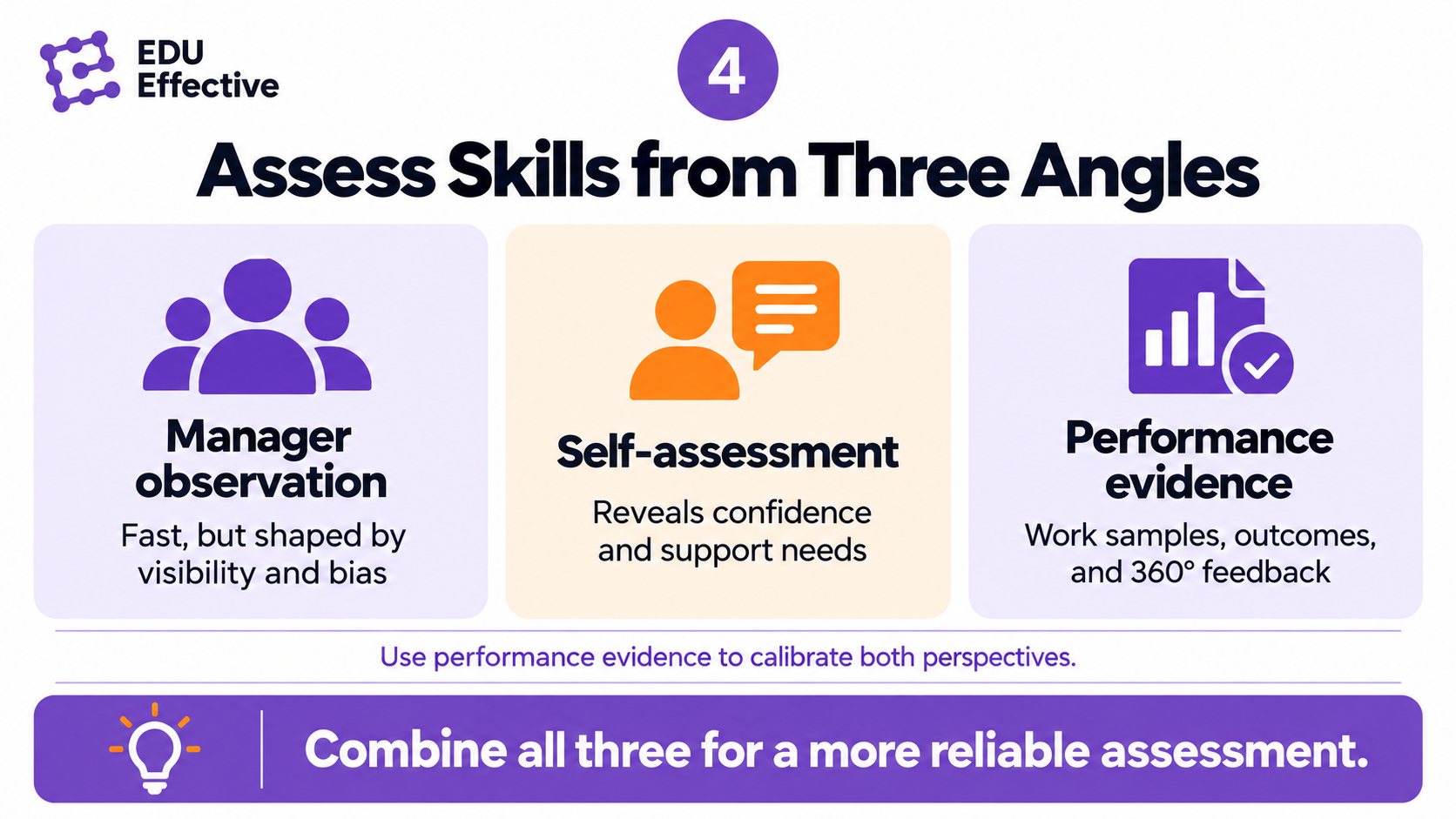
Manager observation is the fastest and most biased. A manager’s view of a team member’s skills is shaped by visibility, by the types of work the person has been assigned, and by the manager’s own skill profile. People get rated highly on skills the manager values and can observe, and rated poorly or not at all on skills the manager cannot easily evaluate. It is a useful input but should not be the only one.
Self-assessment has the opposite problem. Research consistently shows that people are least accurate at self-assessing in areas where they are weakest — which is precisely the area where accuracy matters most. Self-assessment is useful for identifying where individuals feel under-supported, but it systematically underestimates gaps. how managers can build a self-coaching practice that keeps development moving
Structured performance evidence is more reliable: work samples, project outcomes, 360-degree feedback from people who have actually worked with the individual on relevant tasks. This takes longer to collect and analyze, but it produces assessments that hold up when challenged and that point toward specific, actionable development rather than vague improvement goals.
For most teams, the right approach combines all three — manager observation as the frame, self-assessment as a signal about where someone wants to develop, and performance evidence to calibrate both.
Step Three: Map the Gap
Now you have two things: what the work requires, and what the team currently has. The skills gap is the distance between them.
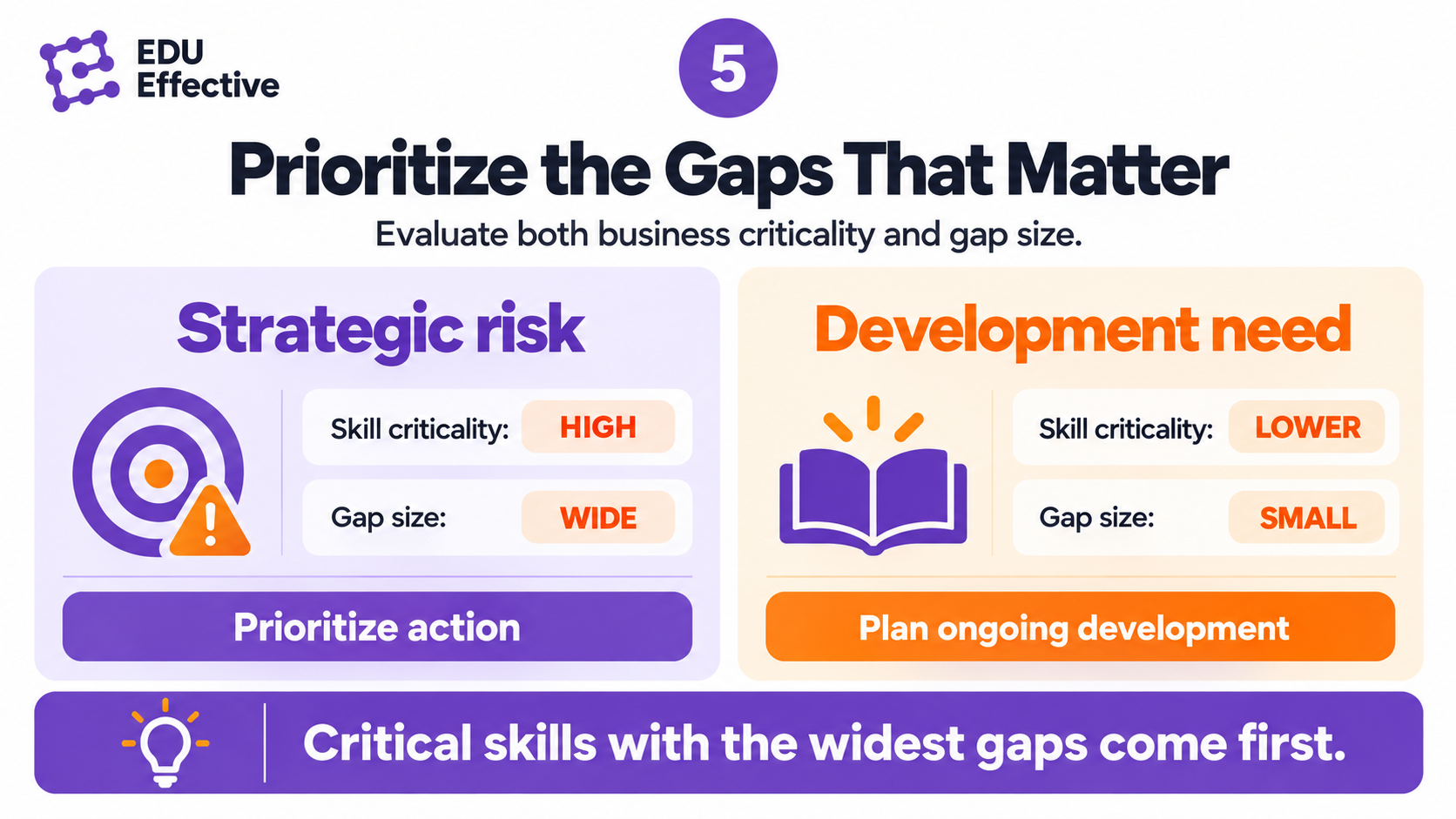
Not all gaps are equal. Before deciding what to do, classify each gap along two dimensions: how critical is this skill to delivering the team’s primary objectives, and how wide is the current gap between what is needed and what exists?
A skill that is critical and widely missing is a strategic risk. A skill that is nice-to-have and slightly below target is a development conversation. Treating both the same way — with a training program, a hire, or a restructured role — is a resource allocation error.
The McKinsey HR Monitor 2025 found that only 9% of organizations do strategic workforce planning with a three-to-five-year horizon. 73% do short-term, operational planning only. This creates a structural problem: by the time a skill gap becomes visible in operational data, the organization is already behind. Korn Ferry projects a global skilled-worker shortage of up to 85 million by 2030. The organizations that will be in the best position when that shortage arrives are those doing strategic skills planning now, not those responding reactively when roles go unfilled.
Step Four: Decide What to Do About It
Once you have a mapped and prioritized list of gaps, you have four options. Each is appropriate in different circumstances.
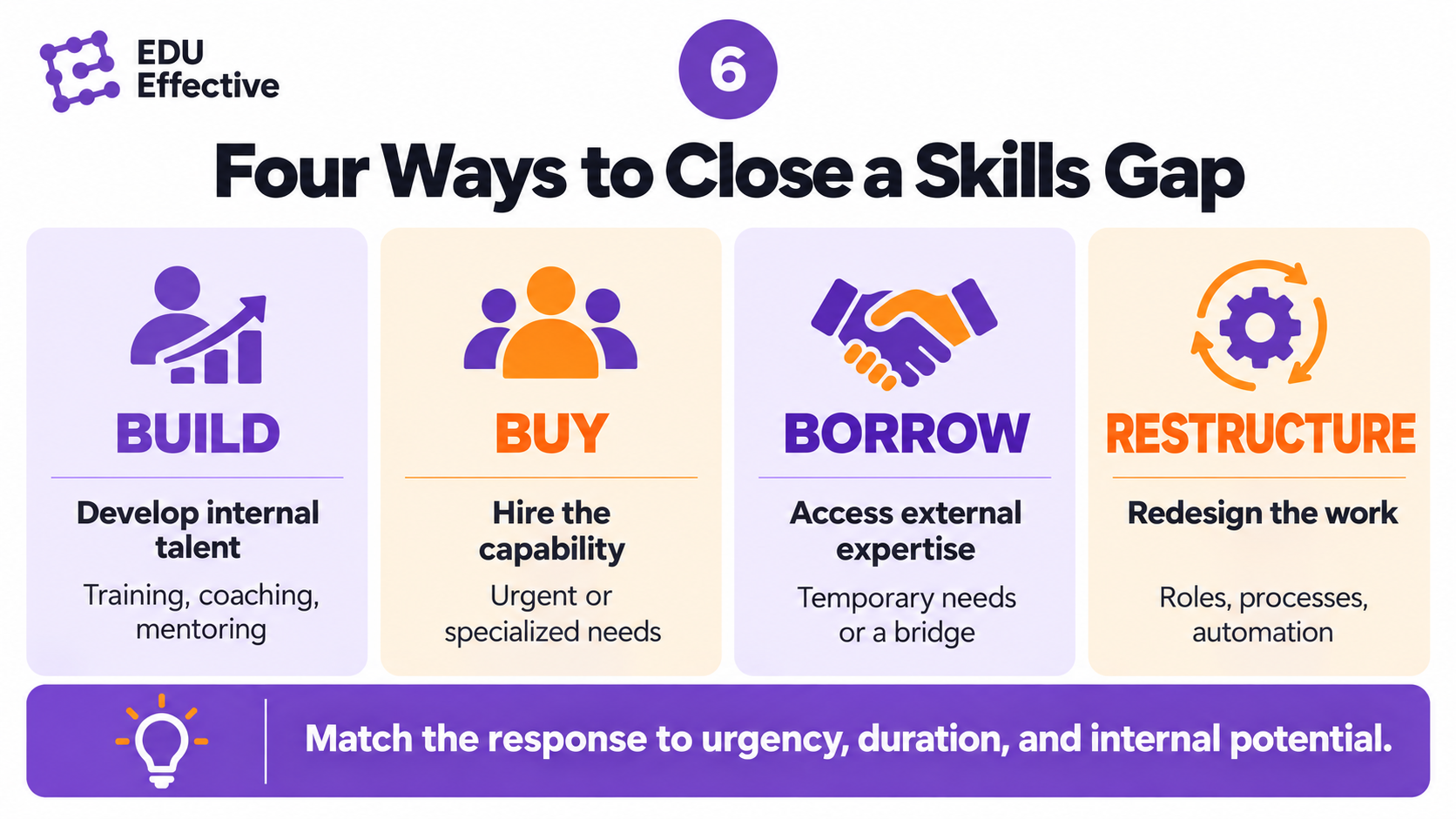
Build — develop the skill internally through structured training, coaching, mentoring, or stretch assignments. This is usually the right choice for skills that are moderately critical, that take time to develop, and where the organization has existing talent with the foundation to develop further. It is slow and requires sustained investment. why mentoring builds skills and sponsorship opens doors — and why the two are not interchangeable
Buy — hire someone who already has the skill. The right choice when the gap is urgent, the skill is specialized, and the internal development path is too long to meet the organization’s timeline. Hiring is expensive and risky; it is the default option for many organizations when it should be the last resort after build and borrow have been genuinely evaluated.
Borrow — bring in the capability through contractors, consultants, or cross-functional secondments. Appropriate when the need is time-limited, the skill is highly specialized, or when you need to fill a gap while internal development catches up.
Restructure — redesign roles, teams, or processes so that the skill gap matters less. Sometimes the right answer to a skills gap is not to fill it but to change what the work requires. AI and automation are increasingly relevant here: ManpowerGroup’s 2026 data found that 51% of organizations say they lack the right AI talent, but a portion of that gap can be addressed by changing what tasks humans need to perform at all.
The McKinsey HR Monitor 2025 found a significant disconnect between what HR leaders prioritize in talent strategy — compensation (41%), work-life balance (38%) — and what job seekers actually value most: job security (39%) and learning and development (28%). Organizations that make skills development visible and real — not as a benefit on a career page but as structured investment in people’s actual capabilities — have a meaningful advantage in both hiring and retention.
What a Practical Skills Gap Analysis Looks Like for a Manager
You do not need an enterprise HR platform or a six-month consulting engagement to run a useful skills gap analysis for a team of 8 to 15 people. Here is a practical version.
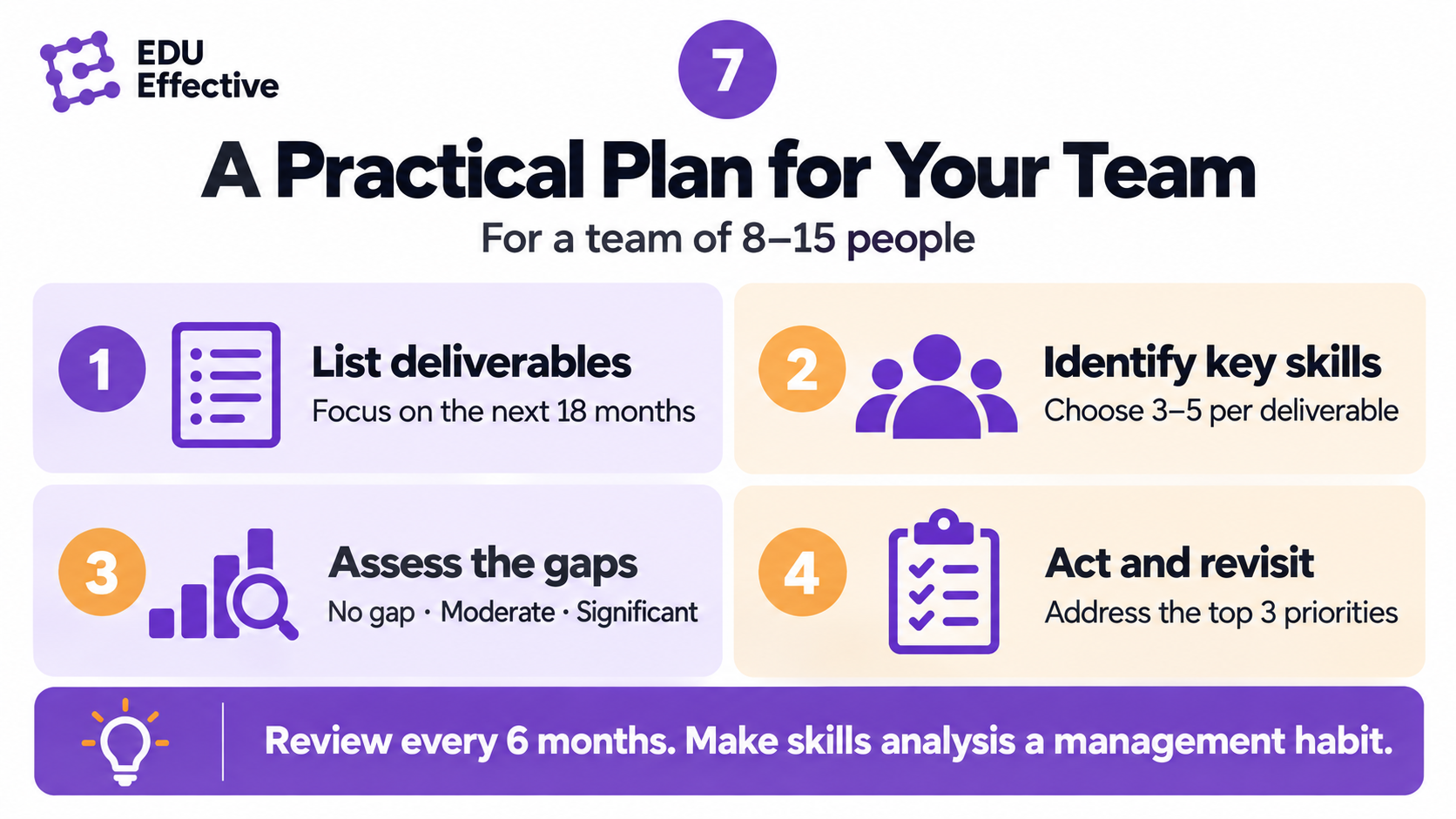
Start with a one-page summary of your team’s most important deliverables over the next 18 months. Be specific: not “support business growth” but “launch two new product lines in APAC, transition the team from quarterly to monthly financial reporting, and implement a new CRM.”
For each deliverable, list the three to five skills it most depends on. You will quickly see which skills appear repeatedly across multiple deliverables — those are your highest-priority items.
Run a structured conversation with each team member, not a performance review. Ask what parts of their current work they feel most confident in, where they feel they are developing, and what they are avoiding or delegating because they are uncertain. Combine this with your own observations from the last six months.
Score the gap: for each high-priority skill, estimate whether the person is at the level the work requires (no gap), approaching it (moderate gap), or clearly below it (significant gap).
You now have a prioritized list. The top three items — critical skills with the widest gaps — are your action items. Everything else is developmental context.
Review the analysis every six months, not annually. Skills requirements shift. People develop. What was a significant gap last year may no longer be one, and new requirements emerge faster than annual cycles can track.
The Organizational Stakes
76% of employers reported difficulty filling roles in 2025, down slightly from 80% the prior year, according to ManpowerGroup. The top reason: 30% of employers cannot find candidates with the required skills. This is a market condition that is not going to improve quickly. why most organizations get workforce transformation wrong — and what the data says about fixing it
The organizations that will navigate the skills shortage most effectively are those that manage their internal talent more intentionally — knowing what they have, developing what they need, and making decisions based on evidence rather than gut feel and job descriptions.
A skills gap analysis is not a one-time HR exercise. It is a management discipline. The teams that treat it as such are consistently better positioned when opportunities emerge and more resilient when conditions change.
Build the Talent Insight That Prevents the Gap
Managers who can read workforce capability, design development paths, and connect both to strategy are the ones organizations keep when conditions tighten. The Effective MBA develops that foundation.
About EDU Effective Business School
The Effective MBA: Executive Management & Leadership develops the judgment behind everyday management decisions. Runs on 15 minutes a day, completes in 10 months or less and is ASIC accredited.
Sources
- ManpowerGroup — 2026 Talent Shortage Report: https://www.manpowergroup.com/en/insights/2026-global-talent-shortage
- McKinsey & Company — HR Monitor (via UNLEASH summary): https://www.unleash.ai/strategy-and-leadership/3-things-hr-needs-to-know-from-mckinseys-hr-monitor-2025/
- Korn Ferry — Global Talent Crunch: 85 million worker shortage by 2030: https://www.kornferry.com/insights/this-week-in-leadership/talent-crunch-future-of-work
- World Economic Forum — Future of Jobs Report: https://www.weforum.org/publications/the-future-of-jobs-report-2025/
- ManpowerGroup — Talent Shortage Survey (76% employers report difficulty filling roles): https://www.manpowergroup.com/en/insights/2026-global-talent-shortage