

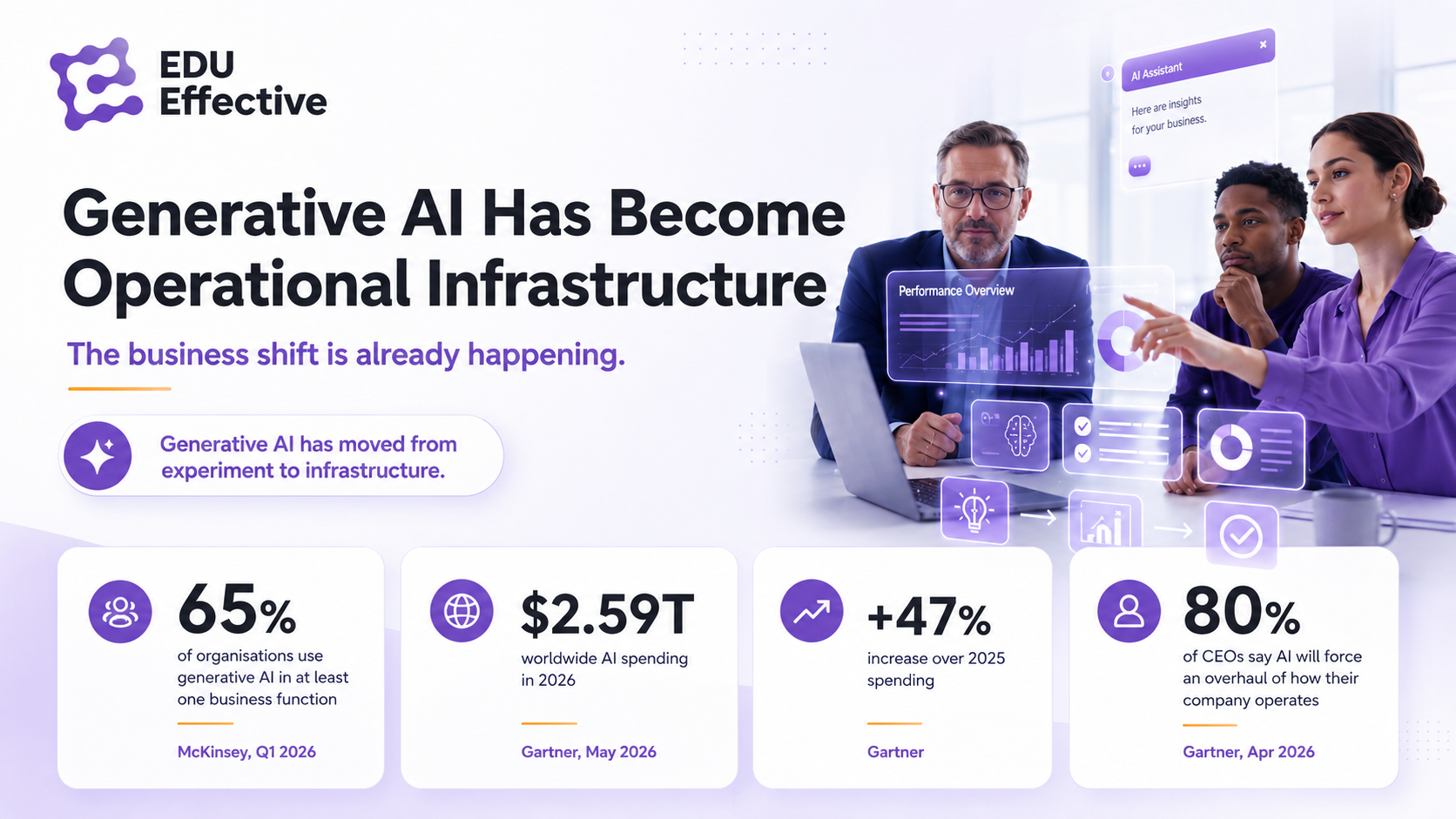
65% of organisations now use generative AI in at least one business function — double the rate from ten months earlier, according to McKinsey's Q1 2026 State of AI survey. Worldwide AI spending is forecast to total $2.59 trillion in 2026 — a 47% increase over 2025 — according to Gartner's May 2026 spending forecast. Enterprise spending on generative AI models and AI agents is expected to more than double in 2026 alone. And 80% of CEOs say AI will force an overhaul of how their company operates, according to Gartner's April 2026 research.
These numbers establish one thing clearly: generative AI has moved from experiment to operational infrastructure at a pace without precedent in enterprise technology adoption. The question for most business professionals in 2026 is no longer whether AI is relevant to their work — it is whether they understand it well enough to use it intelligently and to contribute meaningfully to decisions about how their organisation deploys it.
This guide is not a technical primer on how large language models work. It is a practical explanation of what generative AI is, what it can and cannot do, and what it means specifically for professionals who need to work alongside it.
What generative AI actually is — a plain-language explanation
Artificial intelligence is a broad term for computer systems that perform tasks that previously required human intelligence. It encompasses everything from the spam filter in your email to the recommendation engine on Netflix to the navigation system in your car. Most AI that businesses have used for the past decade — pattern recognition, anomaly detection, predictive analytics, classification systems — operates on structured data and produces specific, narrow outputs: this transaction is fraudulent; this customer is likely to churn; this product will be out of stock in three weeks.
Generative AI is a different category. Generative AI systems produce new content — text, images, audio, video, code, and synthetic data — by learning patterns from vast amounts of existing content and generating novel outputs that follow those patterns. The defining characteristic is generation: rather than classifying or predicting, generative AI creates.
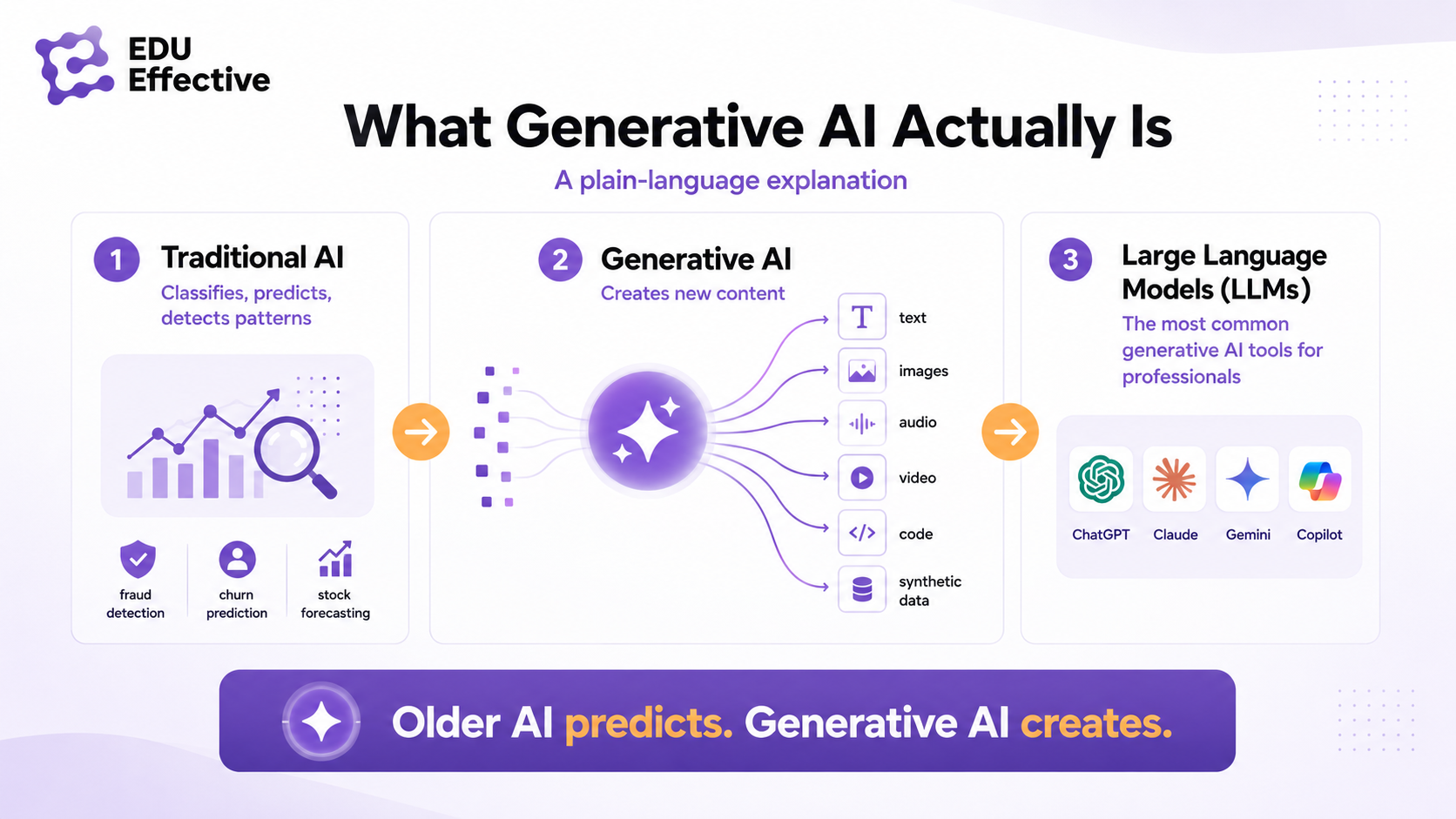
Large language models (LLMs) are the most widely used form of generative AI in professional settings. They are trained on enormous datasets of text — effectively a significant portion of the written language available on the internet, in books, and in professional documents — and learn to predict what text should follow a given input. The output is fluent, contextually appropriate prose that can answer questions, write documents, analyse arguments, generate code, translate languages, and engage in complex reasoning chains. ChatGPT, Claude, Gemini, and Microsoft Copilot are all interfaces to large language models.
The leap from older AI to generative AI is a leap from narrow capability to general capability. Previous AI systems were built to do one thing. Large language models can do many things — which is both their power and the source of the most common misunderstandings about what they are and what they can be trusted to do.
What generative AI can do — and where it is genuinely reliable
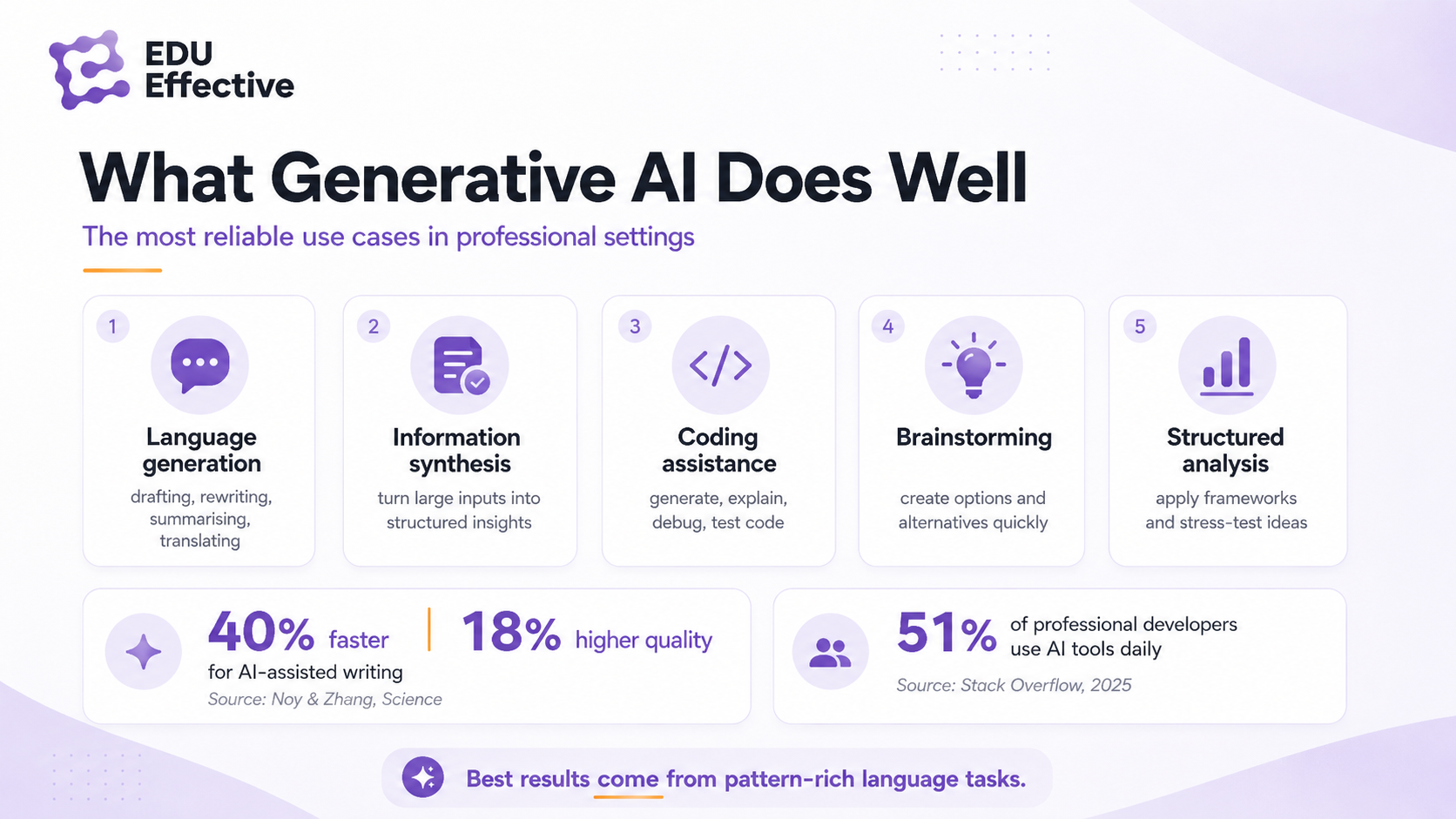
Understanding what generative AI does well is the starting point for using it effectively. The most consistent, most reliable capabilities of current LLMs in professional settings are:
Language generation and transformation. Writing first drafts, rewriting existing content in different styles or for different audiences, summarising long documents, translating between languages, converting notes into structured prose, and adapting content for different formats and channels. These are the tasks for which generative AI produces the most consistently useful outputs — because they are primarily about language patterns, which is what LLMs were trained on. Research consistently shows that AI-assisted professional writing tasks are completed 40% faster at 18% higher quality, according to the Noy and Zhang study published in Science.
Information synthesis and structuring. Taking a large body of information — a long document, a set of research papers, a collection of meeting notes — and synthesising it into a structured summary, identifying key themes, extracting specific information, or organising it according to a specified framework. LLMs are particularly effective at tasks that require reading a lot of material and producing a coherent synthesis, provided the information is in the input.
Coding assistance. Generating code, explaining what existing code does, debugging errors, converting code between programming languages, and writing tests. 51% of professional developers use AI tools daily, according to Stack Overflow's 2025 Developer Survey. Coding is one of the highest-value generative AI applications in professional settings because code is highly structured language — which LLMs handle more reliably than unstructured natural language.
Brainstorming and option generation. Generating multiple options, alternative approaches, counter-arguments, or creative variations on a brief. Generative AI is effective at producing volume — a large number of options quickly — which is useful in the early generative phases of problem-solving before human judgement narrows the field.
Structured reasoning and analysis. Breaking complex problems into components, applying established frameworks to new situations, identifying logical implications, and stress-testing arguments. This capability is genuine but requires careful prompt engineering and critical evaluation of outputs — because LLMs can produce confident-sounding reasoning that is subtly or significantly flawed.
What generative AI cannot do — the limits that every professional needs to understand
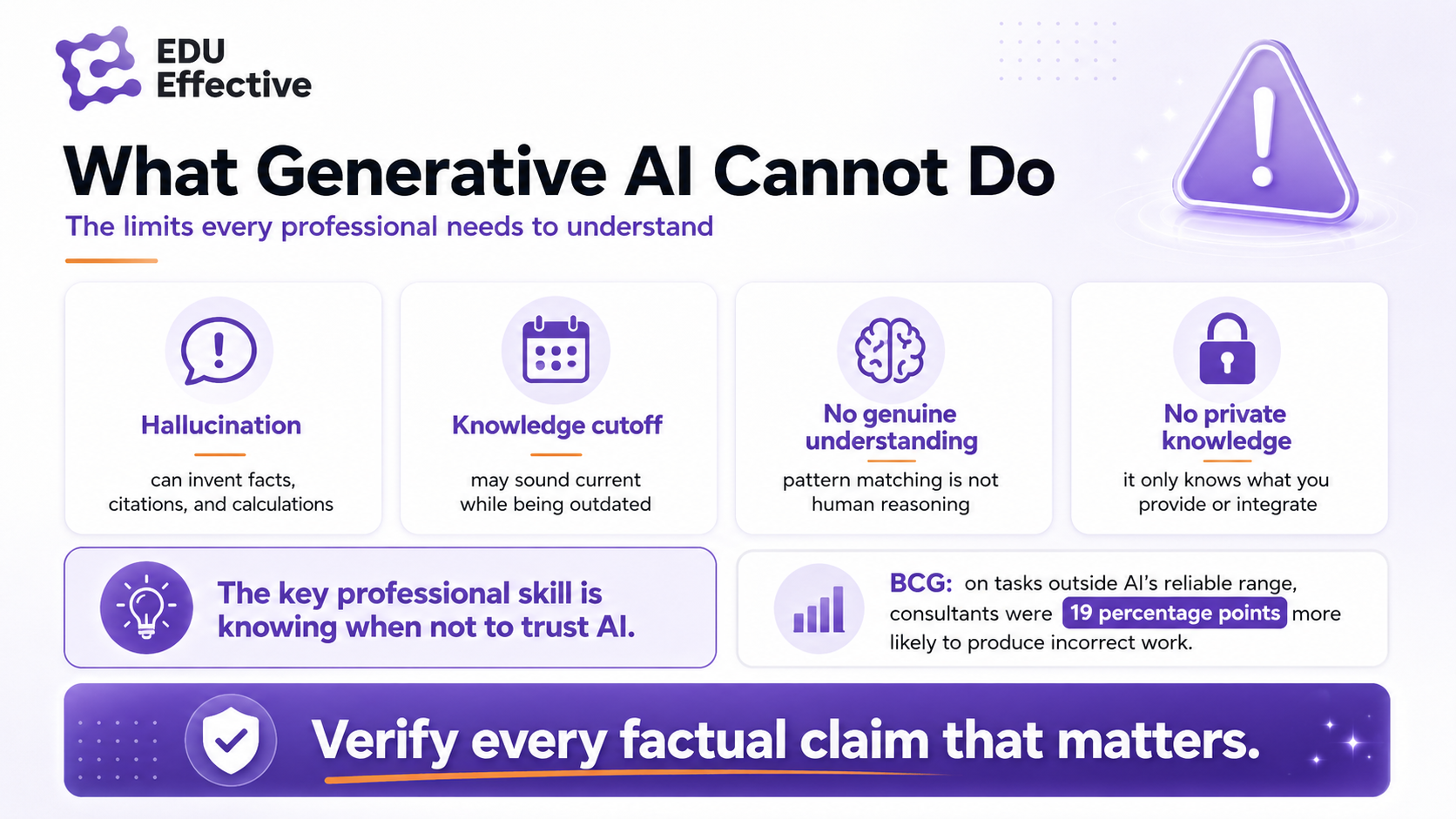
The most important professional skill related to generative AI is not knowing how to use it — it is knowing when not to trust it. The failure modes of current LLMs are specific, predictable, and consequential.
Hallucination. LLMs generate plausible-sounding text even when they do not have accurate information. They will invent citations that do not exist, state false facts with apparent confidence, and produce incorrect calculations formatted as correct ones. The term for this is hallucination — and it is not a bug that will be fixed in the next model release; it is an intrinsic feature of how language models work. An LLM that does not know the answer to a question is not designed to say so clearly — it is designed to produce a plausible continuation of the text, which may or may not correspond to reality.
The practical implication: any factual claim produced by a generative AI system that matters needs to be independently verified. This is not a marginal precaution — it is a fundamental requirement for professional use. BCG's research found that consultants using AI on tasks outside its reliable capability range were 19 percentage points more likely to produce incorrect work, without knowing it.
No real-world knowledge cutoff awareness. LLMs are trained on data up to a specific date, and their knowledge stops there — but they will not always clearly communicate this. A question about events after the training cutoff may produce an answer that sounds informed but is based on extrapolation from older information. For current market data, recent regulatory changes, or rapidly evolving competitive situations, AI outputs should be treated as potentially outdated.
No genuine reasoning or understanding. LLMs are pattern-matching systems that have learned what text should follow text. They produce outputs that look like reasoning, but they are not reasoning in the way humans do — they are generating plausible continuations. Complex multi-step logical reasoning, mathematical calculation, and tasks requiring genuine causal understanding are less reliable than tasks primarily involving language pattern matching.
No access to private or proprietary information unless it has been explicitly provided in the prompt or through an integration. A generative AI system does not know about your specific client, your internal processes, or your organisation's strategy unless you tell it. This is both a limitation and a privacy protection: what you do not put into the prompt is not processed by the system.
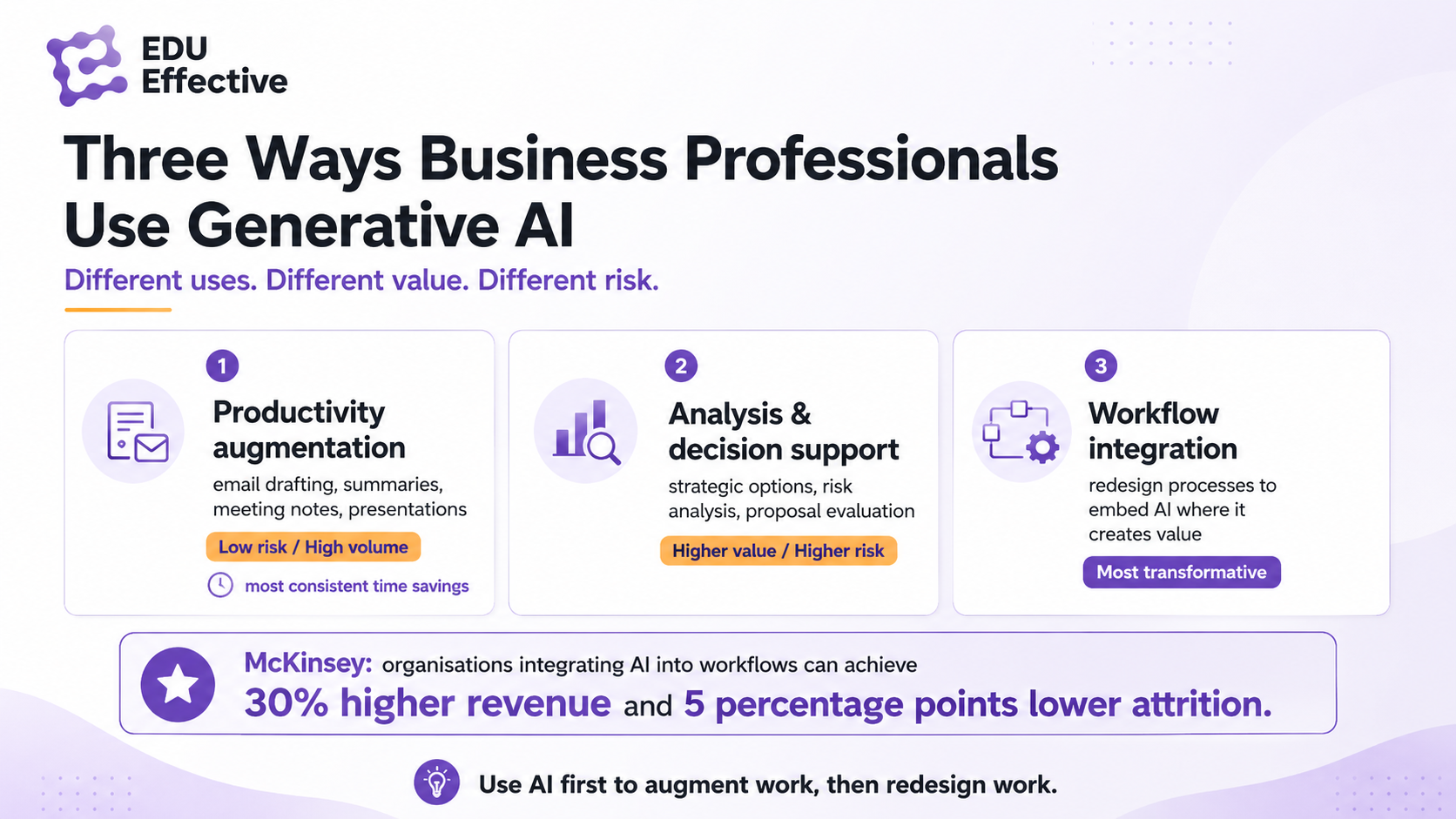
The three categories of generative AI use for business professionals
For most business professionals, generative AI use falls into three categories that differ in their risk profile, their value, and the skills they require.
Productivity augmentation is the lowest-risk, highest-volume category. Writing assistance, document summarisation, meeting note processing, email drafting, presentation structuring, and research synthesis. These applications use AI to do more of the same work faster — the professional provides the judgement, the context, and the review; the AI provides the drafting speed. This is where most professionals currently capture value and where the 40% time savings documented in research are most consistently realised.
Analysis and decision support is a higher-value, higher-risk category. Using AI to synthesise competitive intelligence, generate strategic options, analyse risks, model scenarios, or evaluate proposals. This category requires more sophisticated prompting and more rigorous output evaluation — because the higher the stakes of the decision the analysis supports, the more consequential a hallucination or reasoning error becomes.
Workflow integration is the most transformative category — redesigning how work actually flows through an organisation to embed AI at the points where it produces the most value, rather than bolting it onto existing workflows after the fact. This is where McKinsey's research shows that 30% higher revenue and 5 percentage points lower attrition are achievable — but it is also where most organisations are still in early-stage experimentation.
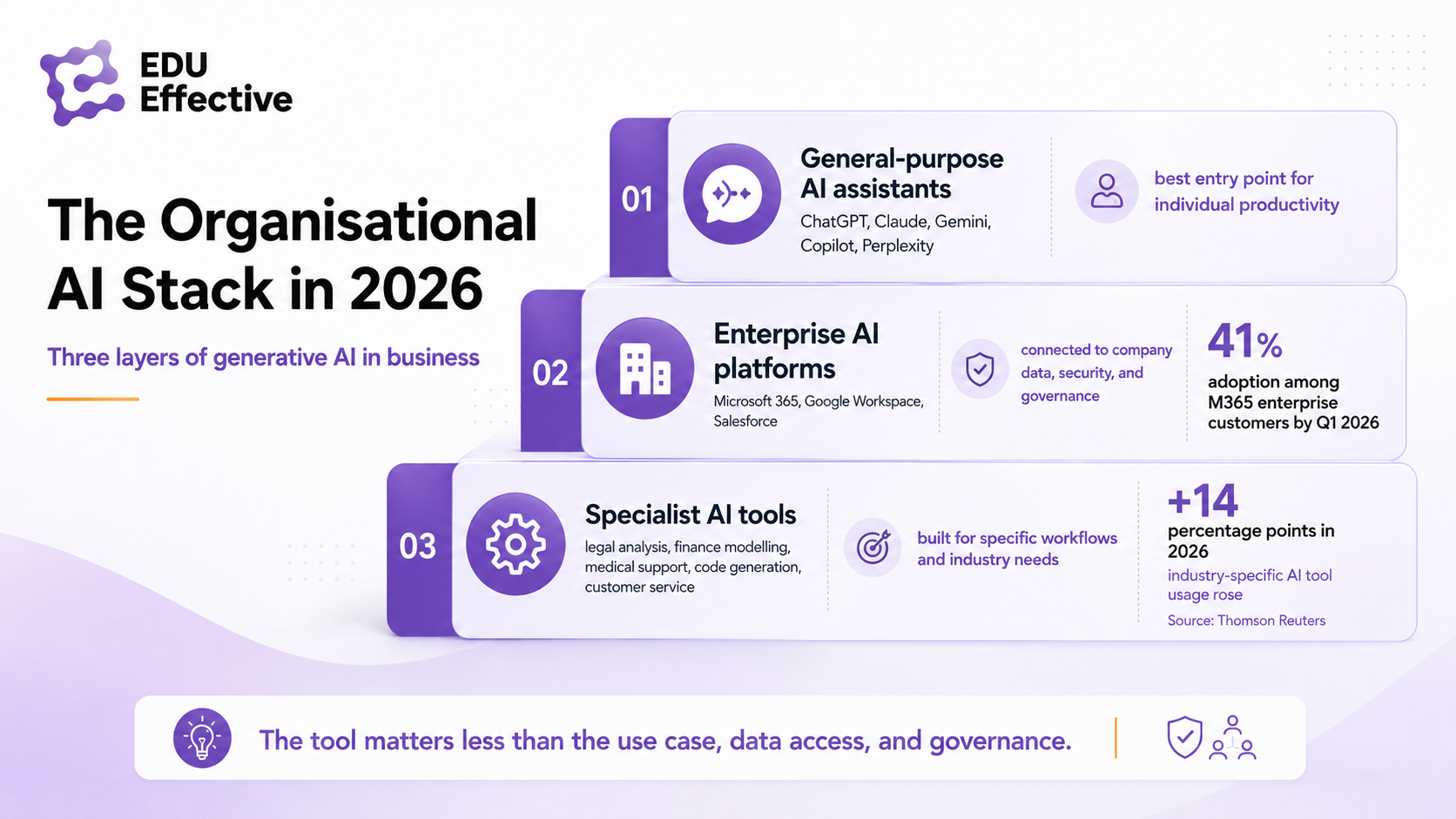
How generative AI is structured in organisations — the tools and their roles
The generative AI landscape in professional settings in 2026 has three layers.
General-purpose AI assistants — ChatGPT, Claude, Gemini, Microsoft Copilot, and Perplexity — are available to any professional with a subscription. They are the most accessible entry point, the most versatile, and the most appropriate for individual productivity augmentation tasks. Most professionals who are using generative AI are using these tools.
Enterprise AI platforms — integrated into Microsoft 365, Google Workspace, Salesforce, and other enterprise systems — operate within the organisation's data and security architecture. They can access the organisation's internal documents, emails, and data in ways that general-purpose consumer tools cannot, and their outputs are subject to the organisation's governance and compliance requirements. Microsoft Copilot for enterprise reached 41% adoption among M365 enterprise customers by Q1 2026.
Specialist AI tools are built for specific professional functions — legal document analysis, financial modelling assistance, medical diagnostic support, code generation, and customer service automation. These tools are trained on domain-specific data and optimised for the accuracy requirements of their specific professional context. Usage of industry-specific AI tools rose 14 percentage points in 2026, according to Thomson Reuters.
The AI capability that organisations are building in 2026: agentic AI
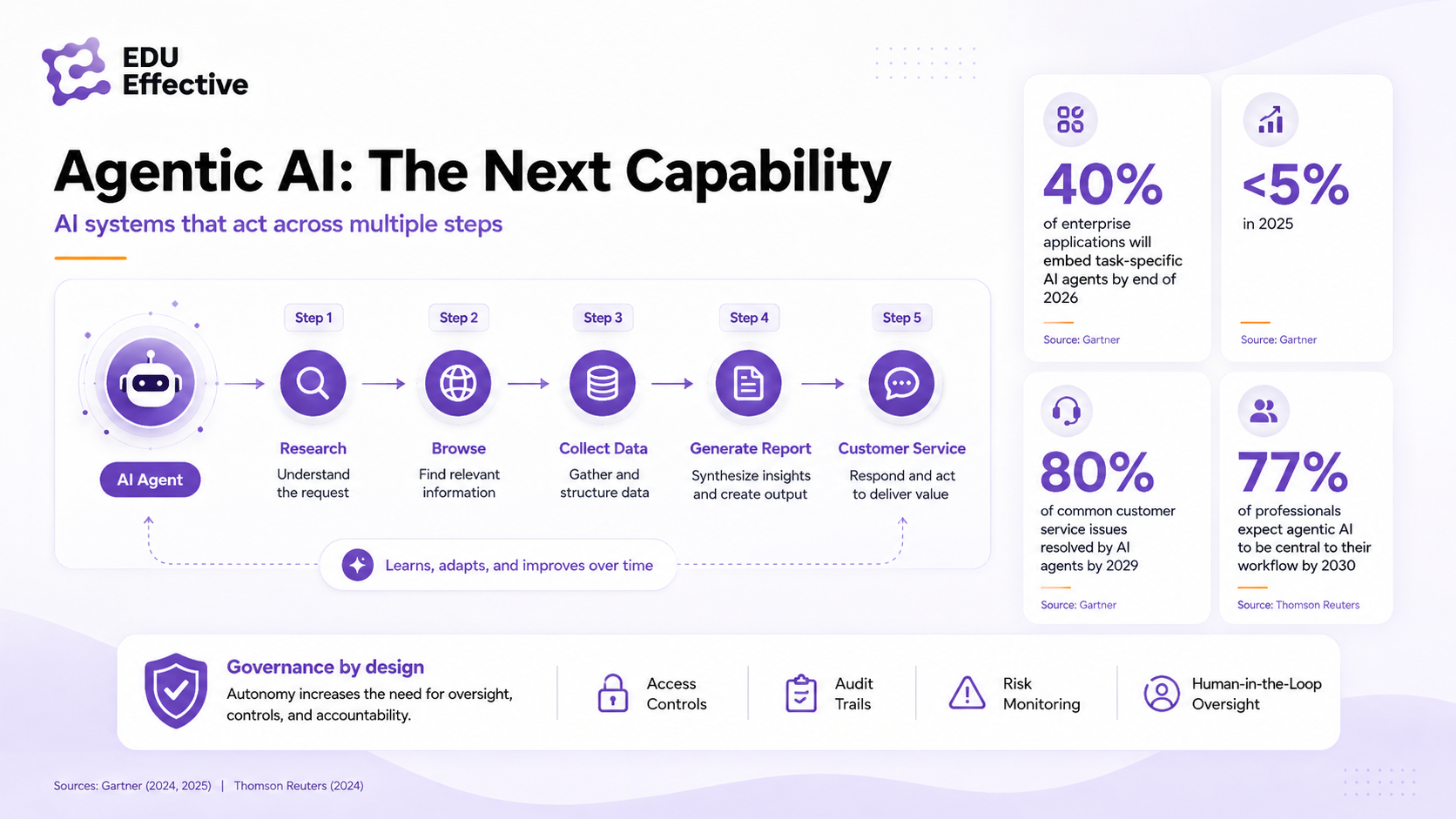
The frontier of generative AI in organisations has moved beyond single-turn conversations with AI assistants to agentic AI — AI systems that can take multi-step actions autonomously, using tools, browsing the web, executing code, and completing tasks that require sequences of decisions rather than a single response.
40% of enterprise applications will embed task-specific AI agents by end of 2026, up from less than 5% in 2025, according to Gartner. AI agents are already automating research, data collection, report generation, and customer service workflows that previously required sustained human attention. By 2029, Gartner forecasts that AI agents will resolve 80% of common customer service issues without human intervention.
For business professionals, understanding agentic AI — what it can do, what governance it requires, and how to manage its outputs — is moving from specialist knowledge to management literacy. The 77% of professionals who expect agentic AI to be central to their workflow by 2030, according to Thomson Reuters, are building that expectation into their professional development decisions now.
What this means for your professional development
The 65% of organisations using generative AI in at least one business function in 2026 are operating in an environment where AI fluency is no longer a specialist skill — it is a baseline professional expectation. PwC's 2026 Global AI Jobs Barometer found that roles requiring AI skills command a 62% wage premium over comparable roles without them.
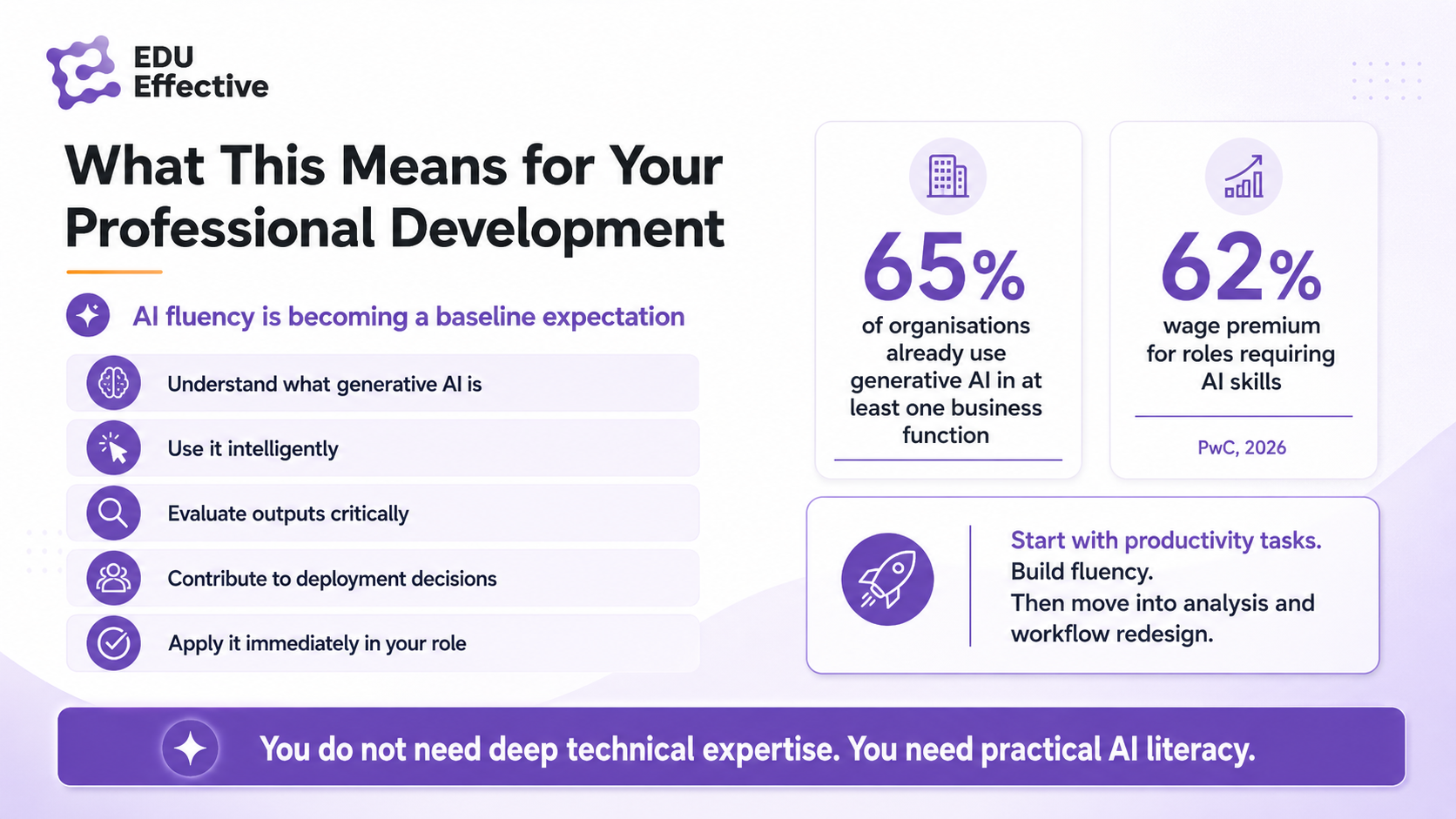
Understanding what generative AI is — clearly enough to use it intelligently, evaluate its outputs critically, and contribute to decisions about how your organisation deploys it — is the foundation of that fluency. The technical depth required to work effectively alongside generative AI in most business roles is not deep. It is a specific set of conceptual understandings and practical capabilities that can be built deliberately and applied immediately.
At EDU Effective, the Effective MBA: Applied Artificial Intelligence and the Effective MBA: Mastery in AI develop practical AI fluency for business professionals — from generative AI fundamentals and prompt engineering to AI implementation, governance, and agentic AI strategy. No coding required. Explore our programs →
Related articles
Prompt Engineering for Managers: How to Write Better AI Prompts
AI Tools for Professionals: What Actually Works and How to Choose
How to Implement AI in Business: A Manager's Guide
EDU Effective Business School — professional development for your long-term success.
All five best-selling Effective MBA programs are built on the same educational model — designed for working adults who need learning that fits real professional life:
Effective MBA: Executive Management & Leadership
Effective MBA: Applied Artificial Intelligence
Effective MBA: Coaching, Leadership & Mentoring
Effective MBA: Online Marketing
Every programme runs on 15 minutes a day, completes in 10 months or less, is ASIC accredited, and starts from €990.
These are professional programmes, not academic ones — built for working adults to apply what they learn directly in their own business, not to collect a scholarly credential.
Join more than 9,000 students in over 120 countries who are investing in their professional development and career success. Read the experiences of our graduates here.
Apply now — from €990 · Talk to a Study Advisor
Study with NO risk: 14-day money-back guarantee, no questions asked.
Sources
McKinsey & Company — The State of AI Q1 2026: 65% of Organisations Use Generative AI (double the rate from 10 months earlier)
https://www.mckinsey.com/capabilities/quantumblack/our-insights/the-state-of-ai
Gartner — Worldwide AI Spending Forecast May 2026: $2.59 Trillion, 47% Increase Over 2025
https://www.gartner.com/en/newsroom/press-releases/2026-05-gartner-worldwide-ai-spending
Gartner — 80% of CEOs Say AI Will Force Operational Overhaul (April 2026); 40% of Enterprise Apps to Include AI Agents by End 2026
https://www.gartner.com/en/newsroom
Thomson Reuters — 2026 AI in Professional Services Report: Industry-Specific AI Tools Up 14 Percentage Points; 77% Expect Agentic AI Central to Workflows by 2030
https://www.thomsonreuters.com/en/reports/2026-ai-in-professional-services-report
PwC — 2026 Global AI Jobs Barometer: 62% Wage Premium for AI Skills
https://www.pwc.com/gx/en/news-room/press-releases/2026/pwc-2026-ai-jobs-barometer.html
Noy & Zhang — Experimental Evidence on the Productivity Effects of Generative AI (Science)
https://www.science.org/doi/10.1126/science.adh2586
Dell'Acqua et al. / BCG & Harvard Business School — Navigating the Jagged Technological Frontier (Organization Science, 2026; DOI: 10.1287/orsc.2025.21838)
https://papers.ssrn.com/sol3/papers.cfm?abstract_id=4573321
Stack Overflow — Developer Survey: 51% of Developers Use AI Tools Daily
https://survey.stackoverflow.co/2025/
World Economic Forum — Future of Jobs Report
https://www.weforum.org/publications/the-future-of-jobs-report-2025/