

GenAI use nearly doubled to 40% of organisations in 2026, up from 22% in 2025, and more than 80% of current users engage with it weekly, according to Thomson Reuters' 2026 AI in Professional Services Report, which surveyed more than 1,500 professionals across industries. The era of AI as a novelty or a pilot project has passed. For most professional organisations, AI tools are now operational infrastructure — used daily across writing, analysis, research, communication, and decision support.
And yet: the gap between how most professionals use AI and how the highest performers use it is enormous — and it is not a gap in tool access. Everyone can open ChatGPT, Claude, Copilot, or Gemini. The gap is in prompt quality: the precision, structure, and specificity with which users direct AI systems to produce outputs that are genuinely useful rather than generically plausible.
BCG's research on AI tool adoption found that the same AI tools, applied to the same tasks, produced dramatically different results depending on how they were directed. Professionals using structured, high-quality prompts completed tasks 12.2% more often, 25.1% faster, and at 40% higher quality than those using unstructured approaches — on the same tools, in the same task environment. Prompt quality is not a marginal differentiator. It is the primary variable determining whether AI tools produce genuine value or sophisticated-sounding noise.
What prompt engineering is — and what it is not
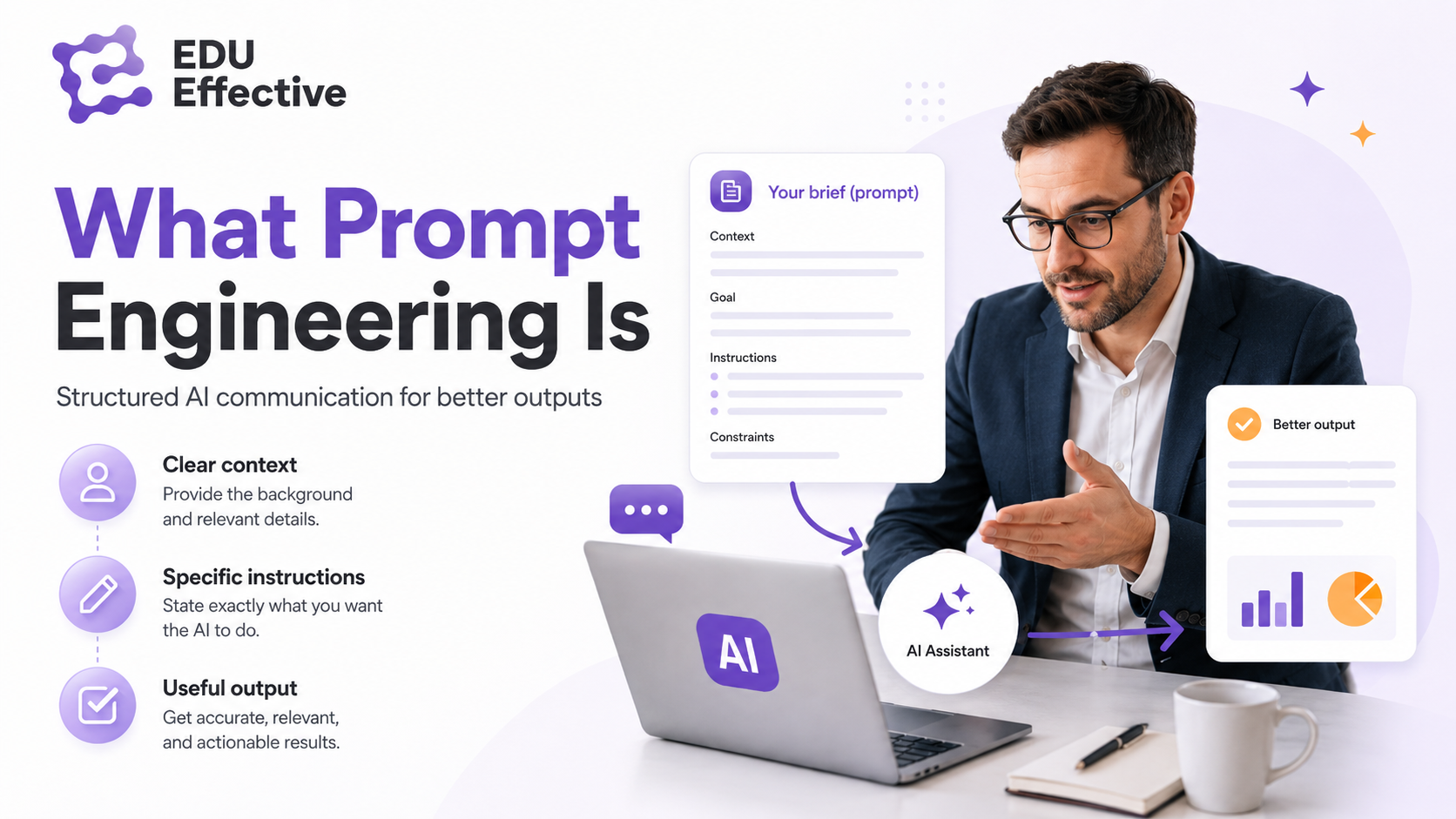
Prompt engineering is the practice of designing instructions for AI systems in ways that consistently produce useful, accurate, and appropriately formatted outputs. The word "engineering" implies more technical complexity than the practice actually requires for most business applications. A better description for most managers and professionals is structured AI communication: the discipline of telling an AI system precisely what you want, with sufficient context and specificity that it can produce it.
Prompt engineering is not programming. It does not require knowledge of Python, machine learning, or how large language models work at a technical level. It requires understanding what information an AI system needs to produce a good output — and providing that information clearly and completely.
The analogy that most consistently helps professionals understand prompt engineering is briefing a highly capable but context-free contractor. A contractor who can do almost anything, but who knows nothing about your organisation, your audience, your standards, or your specific objective, will produce generic work unless you brief them specifically. An AI system is the same: its output quality is directly proportional to the quality of the brief you provide.
Why most AI prompts underperform — the four failure modes
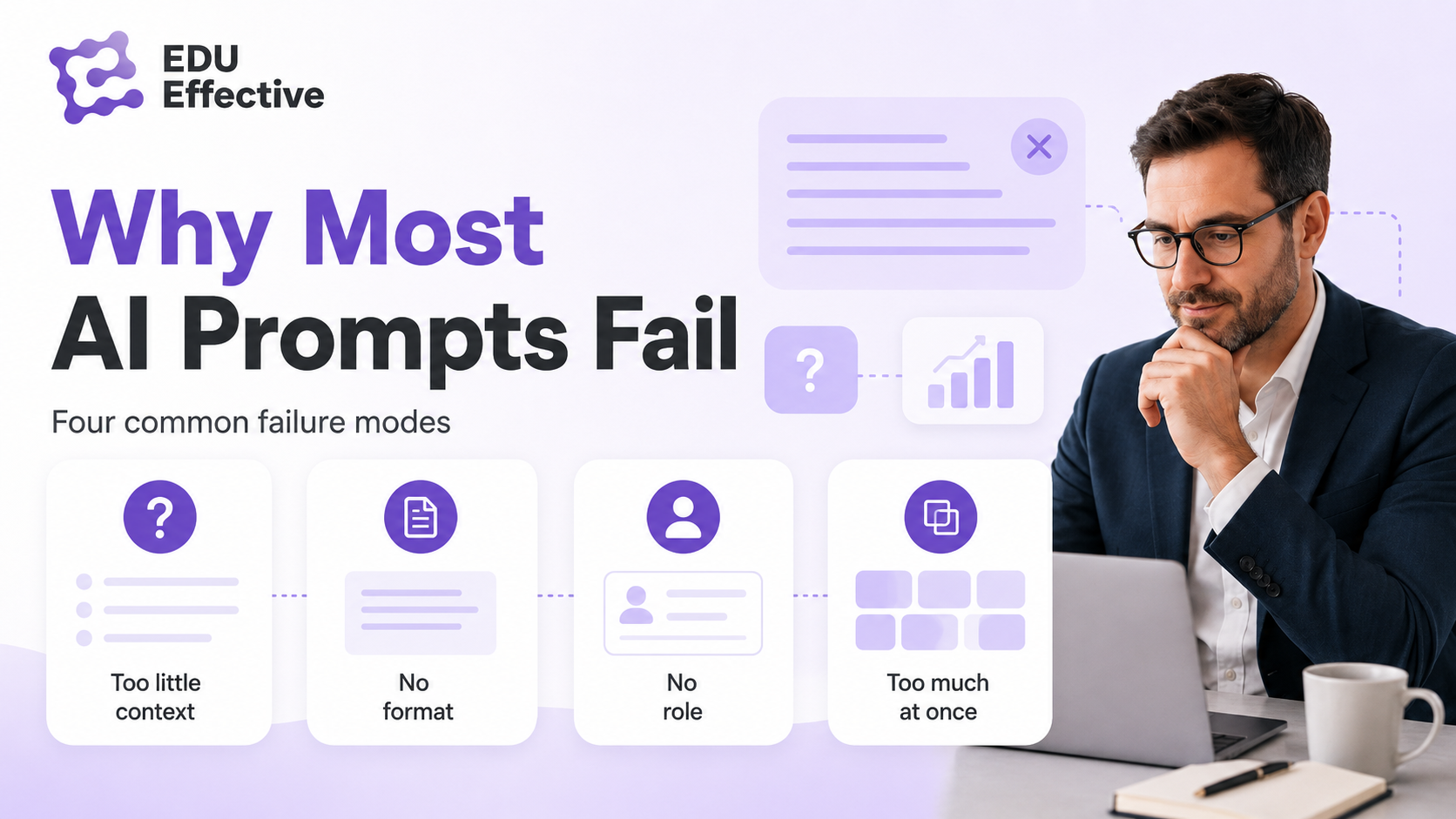
Most AI prompts used by professionals in practice fail for one of four consistent reasons.
Insufficient context. The most common prompt failure is asking an AI to produce something without telling it who it is for, what it is for, or what constraints apply. "Write an email to a client about our project delay" gives the AI no information about the client's relationship with the organisation, the nature of the delay, the tone the relationship requires, or what outcome the email needs to achieve. The AI will produce a plausible email — but not necessarily the right one. "Write an email to a longstanding enterprise client who has been patient about previous delays. The tone should be professional but warm. We need to tell them the software launch is delayed by three weeks due to third-party API integration issues, reassure them about the revised timeline, and offer a call to discuss concerns" will produce a significantly better output.
No specified format or length. An AI system that is asked to "explain our competitive positioning" will produce a response of whatever length and format it calculates as appropriate — which may be a 2,000-word essay when you needed three bullet points, or a bullet list when you needed a structured paragraph suitable for a board presentation. Specifying format, length, and structure — "in three bullet points of no more than 30 words each," "as a structured 200-word paragraph suitable for a board report," "in a table with columns for Advantage, Evidence, and Implication" — consistently produces more immediately usable outputs.
No defined role or perspective. AI systems produce different outputs depending on the perspective from which they are instructed to respond. "What are the risks in this contract?" will produce a general risk overview. "You are an experienced commercial lawyer reviewing this contract on behalf of a technology company entering a new market. Identify the three highest-risk clauses and explain why each is problematic from our perspective" will produce a more targeted, more useful analysis. Specifying a role, expertise level, and perspective is one of the highest-leverage elements of an effective prompt.
Asking for everything at once. Complex tasks broken into a single prompt produce lower quality outputs than the same tasks broken into a structured sequence. Asking an AI to "write a comprehensive competitive analysis of our three main competitors including market share, product strengths and weaknesses, pricing strategy, and strategic direction" produces a less useful output than a structured sequence: first generating the framework, then populating each section separately, then synthesising. Prompt chaining — using the output of one prompt as the input for the next — consistently produces better results for complex analytical tasks than single-prompt approaches.
The CRAFT framework: a practical structure for every business prompt
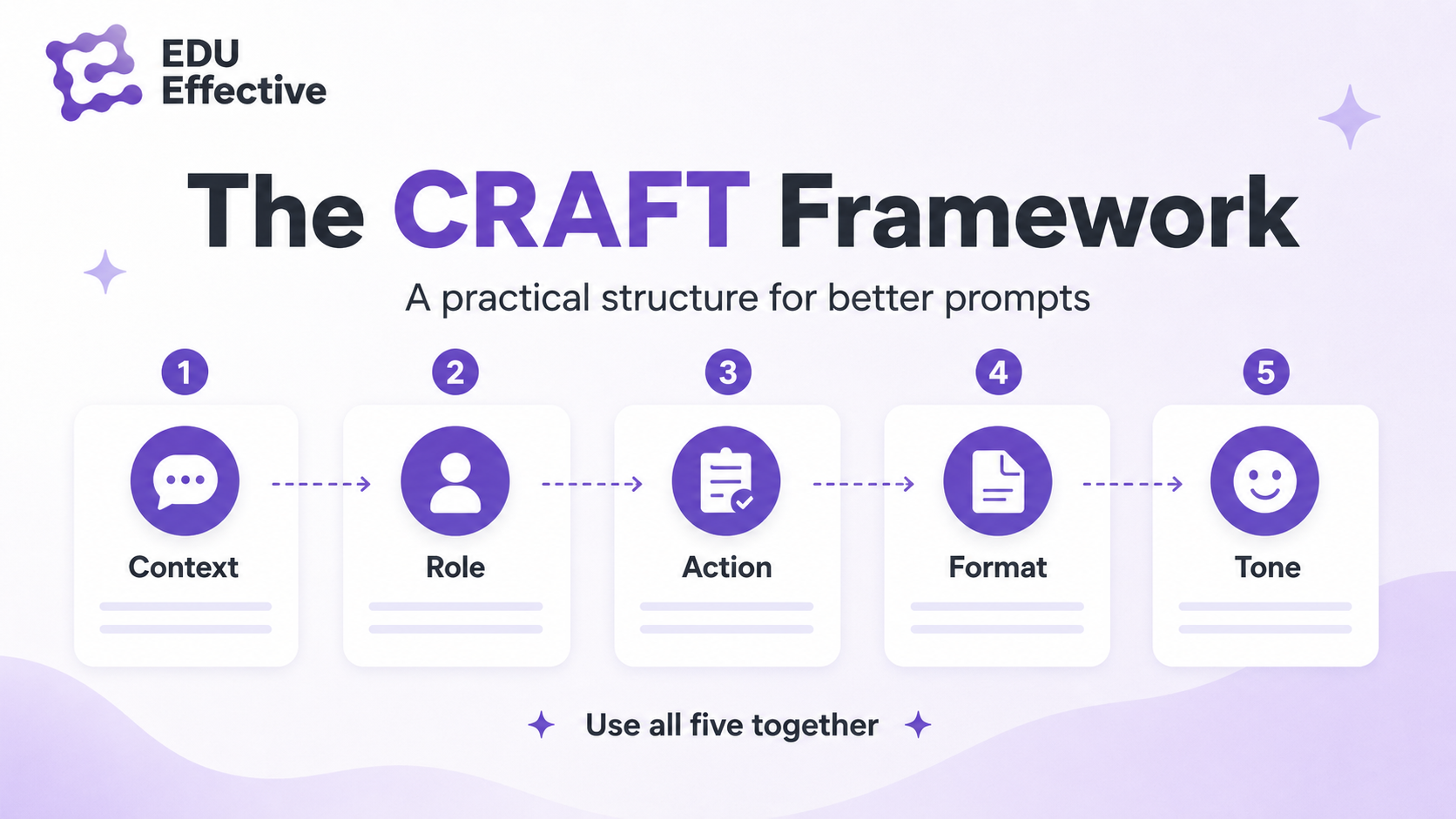
Several frameworks exist for structuring effective AI prompts. The most practical for business professionals who are not building AI systems but using them for daily work is the CRAFT framework — Context, Role, Action, Format, Tone.
Context provides the background information the AI needs to produce a relevant output. What is the situation? What has happened? What does the AI need to know about the organisation, the audience, the history, or the constraints? Context is the element most frequently omitted from prompts that underperform.
Example: "We are a B2B software company that has just lost a major client to a competitor. The client cited implementation complexity as their primary reason for leaving."
Role tells the AI what expertise or perspective to adopt. This is not a personality game — it is a signal about what domain knowledge and reasoning approach the AI should apply to the task.
Example: "You are an experienced customer success director with fifteen years in enterprise software."
Action specifies precisely what the AI should do. Not "help me with," not "think about," not "discuss" — a specific task with a specific deliverable.
Example: "Write a structured win-loss analysis that identifies the three most likely root causes of this churn, suggests what we could have done differently at each stage of the client lifecycle, and recommends three specific changes to our onboarding process."
Format specifies how the output should be structured. Length, format, level of detail, and any structural requirements.
Example: "Structure the output as three sections: Root Causes, What We Could Have Done Differently, and Recommendations. Each section should be 150–200 words in clear, professional prose."
Tone specifies the register, voice, and style appropriate for the intended audience and use case.
Example: "The tone should be analytical and direct — this is an internal document for senior leadership, not a client-facing communication."
A complete CRAFT prompt combining all five elements will consistently produce better outputs than any single element alone — and the gap between a complete CRAFT prompt and an ad-hoc question is typically measured in the time required to edit the output down to something usable.
Prompt techniques that every manager should know
Beyond the basic structure of effective prompts, several specific techniques consistently produce better outputs across different task types.
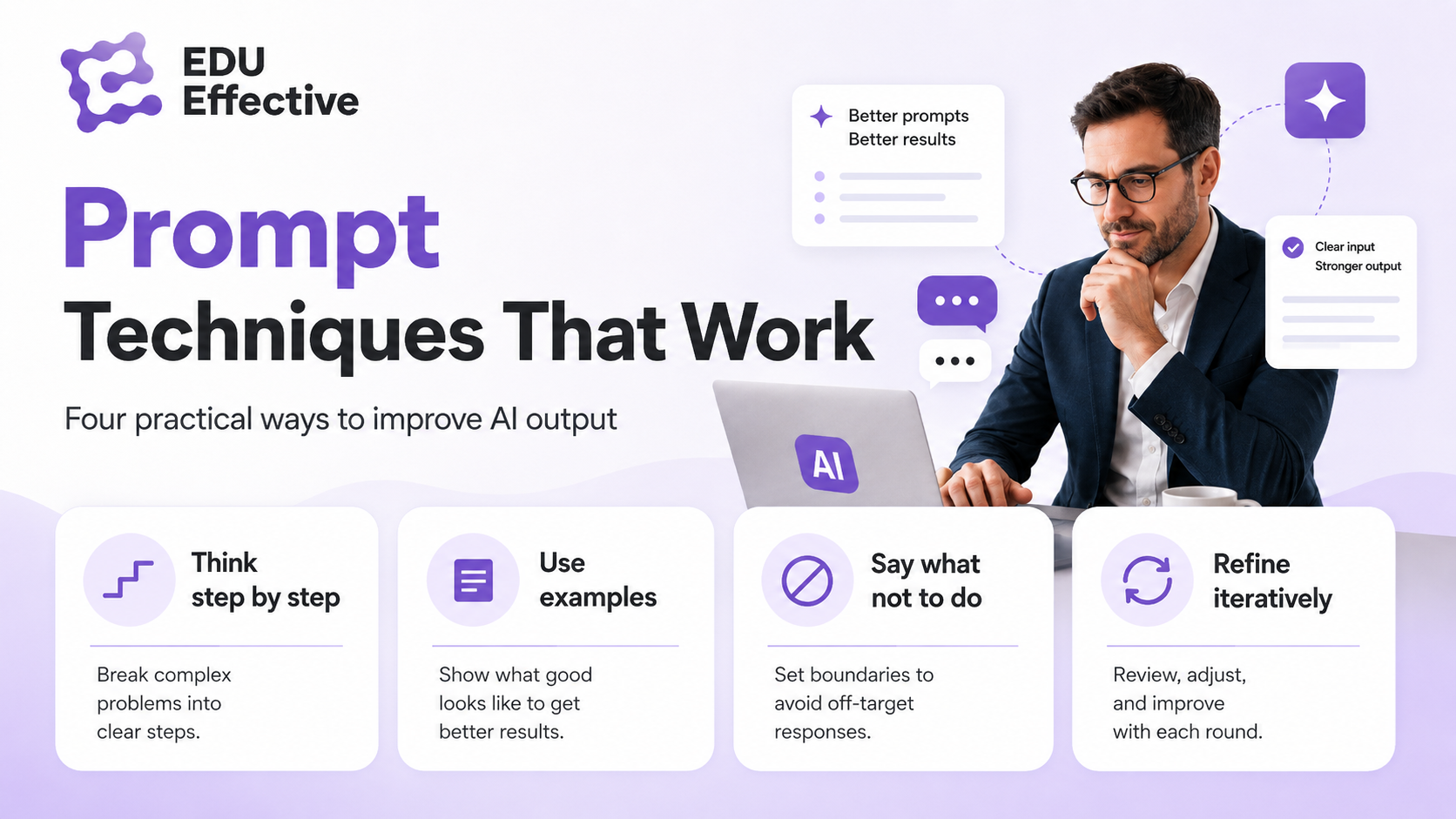
Chain-of-thought prompting. Asking an AI to show its reasoning rather than just its conclusion produces significantly more accurate outputs on complex analytical tasks. "Think through this step by step before giving me your conclusion" or "Walk me through your reasoning before reaching a recommendation" triggers a different — and more reliable — reasoning process than a direct question. This is particularly valuable for financial analysis, strategic assessment, and any task where the path to the conclusion matters as much as the conclusion itself.
Few-shot prompting. Providing two or three examples of the kind of output you want — before asking the AI to produce the actual output — is one of the most reliable ways to specify format, tone, and style precisely. "Here are three examples of the kind of meeting summary we produce internally: [examples]. Please produce a summary of the following meeting transcript in the same style and format." Example-driven prompting works better than description-driven specification for outputs where the format is complex or where the tone is distinctive.
Negative specification. Telling the AI what not to do is as important as telling it what to do — particularly for tone and format. "Do not use bullet points," "do not hedge your recommendations," "do not include an introductory paragraph explaining what you are about to do," "do not use management jargon" all directly improve output quality by removing the default patterns that AI systems revert to without specific instruction.
Iterative refinement. The first output of any significant prompt is rarely the final output. The most effective prompt engineering approach treats the first output as a draft to be refined through follow-up prompts: "The tone in paragraph two is too formal for this audience — rewrite it in a more conversational style," "The recommendations in point three are too vague to act on — add specific actions with owners and timescales," "This is good but too long — cut it to 300 words while keeping the key points." Iterative refinement produces substantially better final outputs than attempting to specify every requirement in a single initial prompt.
Business applications: where prompt engineering produces the most consistent value
Prompt engineering skills apply across every business function, but certain applications produce the most immediately measurable value for managers and professionals.
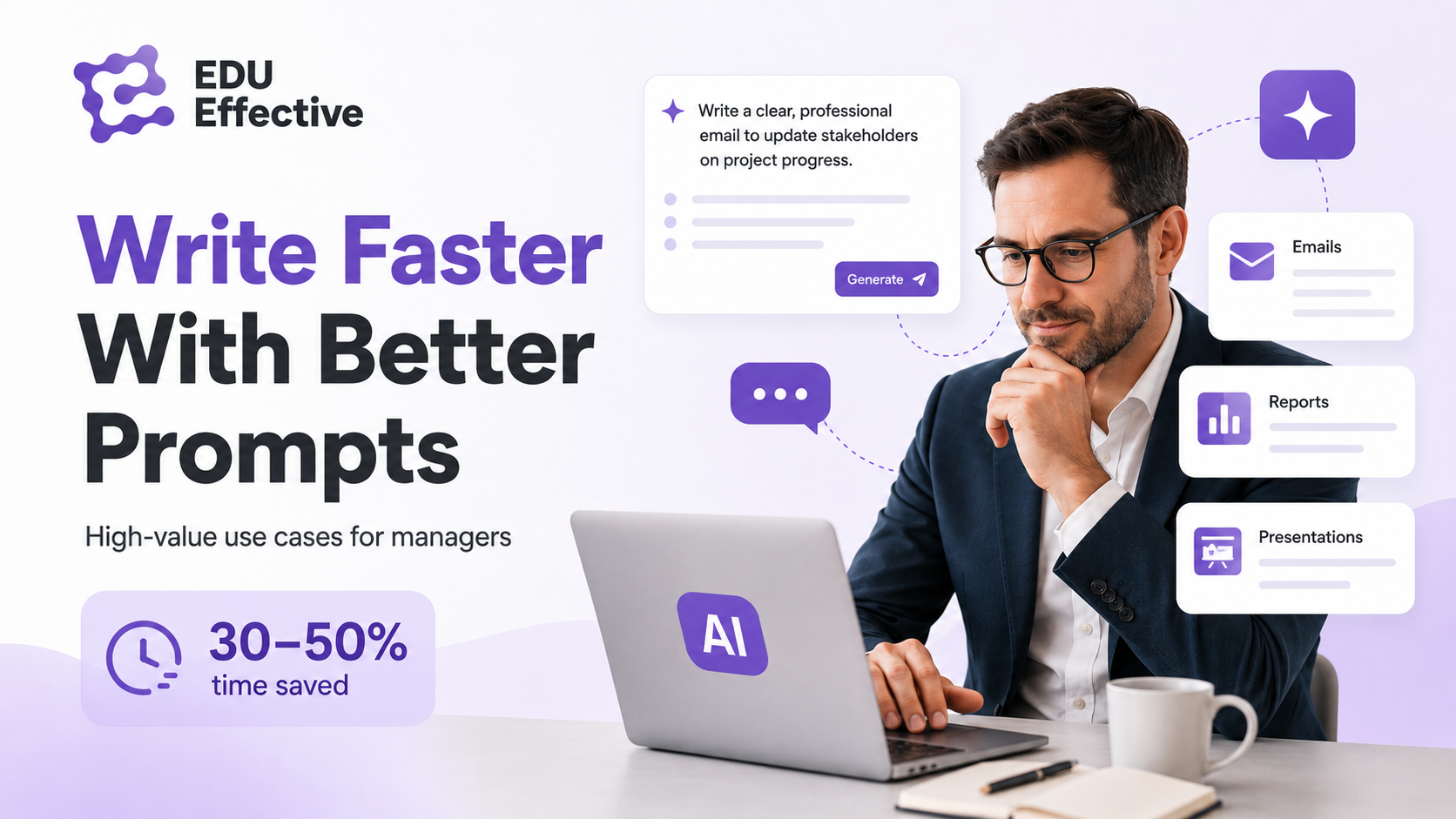
Writing and communication. The highest-volume, most time-consuming writing tasks in most professional roles — emails, reports, proposals, presentations, summaries — are the fastest-return applications of AI prompting. A manager who has developed a set of refined prompt templates for their most common writing tasks can reduce the time spent on these tasks by 30–50%, according to multiple research streams including the Science study by Noy and Zhang (2023), which found that AI-assisted professional writing tasks were completed 40% faster at 18% higher quality.
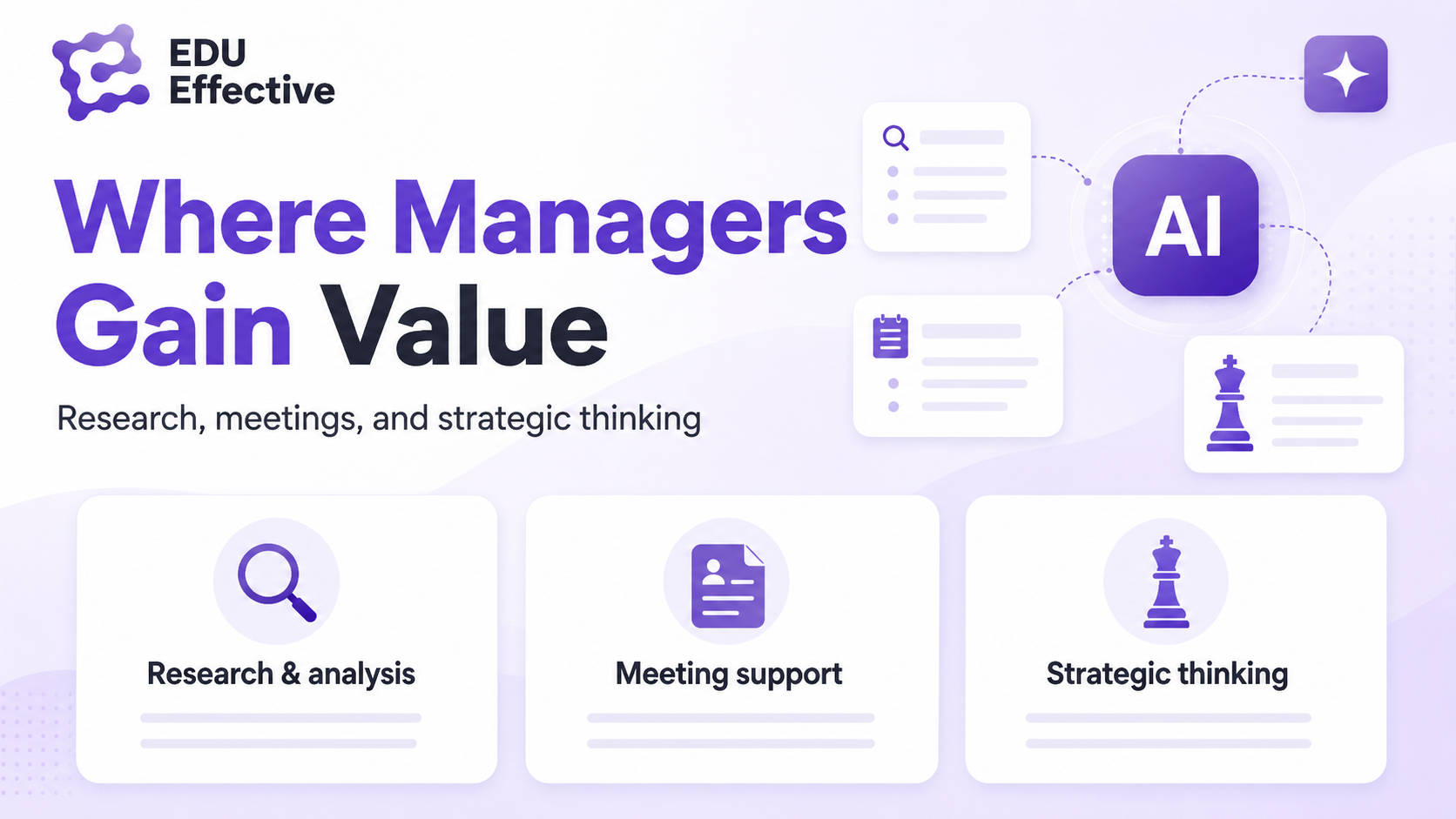
Research and analysis. Asking AI systems to synthesise information, identify patterns, generate hypotheses, and structure analytical frameworks is one of the highest-value applications for managers who need to produce insights from large amounts of information. The critical skill here is prompt engineering for critical evaluation: not accepting AI-generated analysis at face value, but using structured prompts to stress-test it — "What are the three strongest counterarguments to this analysis?" "What evidence would change this conclusion?" "What have I not considered?"
Meeting preparation and follow-up. Prompting AI to generate meeting agendas from a brief description, produce structured summaries from transcripts, extract action items from meeting notes, and draft follow-up communications represents some of the most accessible early value from AI tools for managers. The time savings are immediate and the quality bar is well within AI capability.
Strategic thinking support. Using AI as a structured thinking partner — to generate options you have not considered, challenge assumptions in your reasoning, stress-test strategic plans, or synthesise information from multiple sources — requires the most sophisticated prompting skills but produces some of the highest-value outputs. Prompt engineering for strategic thinking is not about outsourcing judgement to AI; it is about using AI to expand the information and perspective base from which human judgement operates.
The critical skill that prompt engineering requires: evaluation
The BCG research finding that consultants using AI on tasks outside its reliable capability range were 19 percentage points more likely to produce incorrect work — without realising it — is the most important data point in the literature on AI tool use for professionals.
AI systems produce confident, fluent, well-formatted outputs regardless of their accuracy. An AI-generated analysis that is factually wrong looks identical to one that is factually correct. This means that the critical evaluation of AI outputs — checking for factual accuracy, logical coherence, inappropriate generalisations, and the missing context that changes the conclusion — is not optional for professional use. It is the management skill that determines whether AI-assisted work is better than non-AI work or merely faster at producing errors.
Prompt engineering and output evaluation are two sides of the same practice. A well-structured prompt reduces the probability of poor AI output. Systematic evaluation catches the poor outputs that well-structured prompts do not prevent. Both are required for professional-quality AI-assisted work.
Building a prompt library for your team
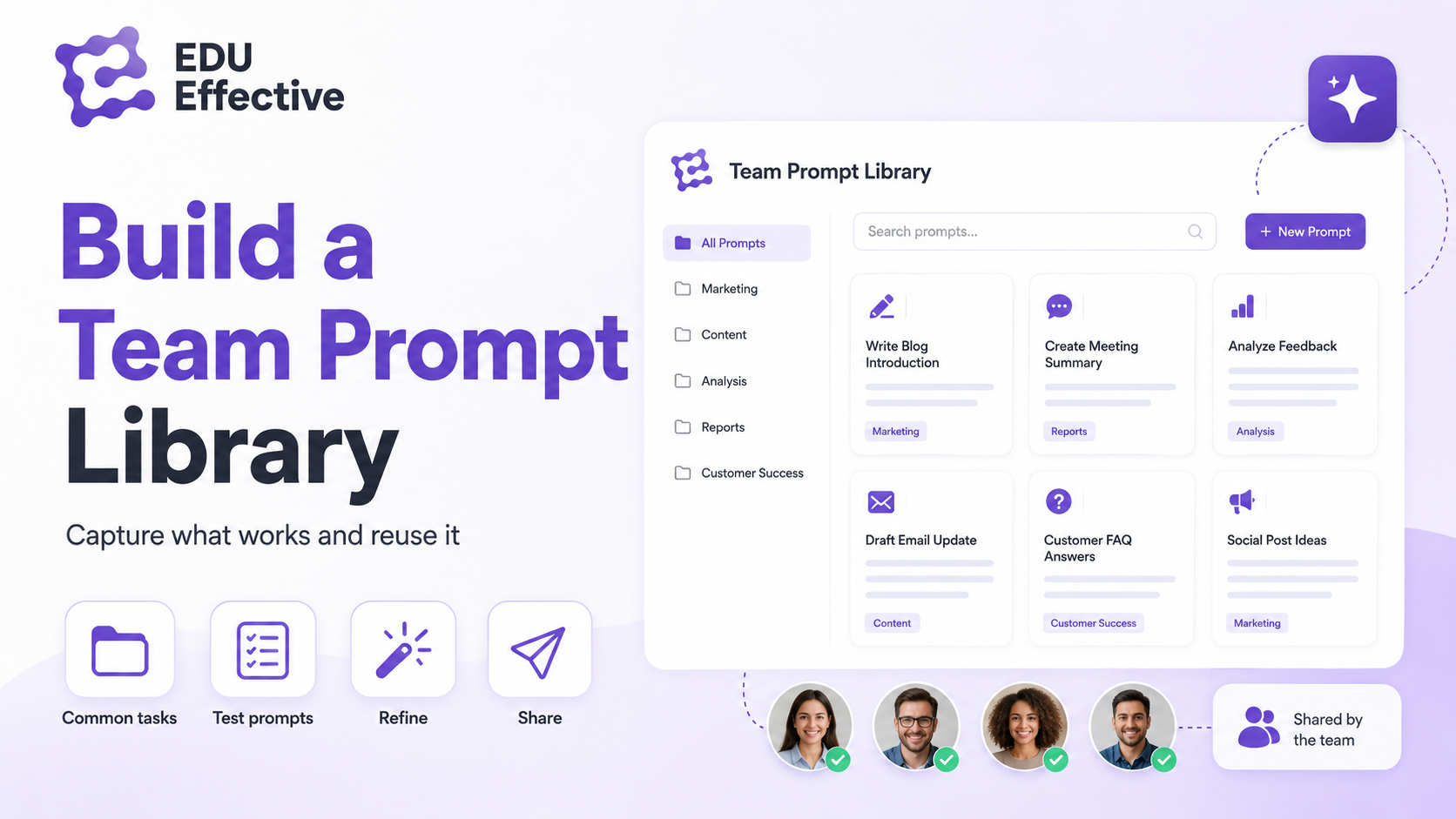
One of the highest-leverage investments in AI productivity for a manager is building a shared prompt library — a documented collection of refined, tested prompts for the team's most common tasks.
A prompt library solves the consistency problem that individual prompting practice creates: different team members using different prompts for the same tasks produce outputs of different quality and different format, requiring additional editing and standardisation. A shared library of tested prompts — with context slots that team members fill in for specific tasks — produces more consistent outputs, reduces individual experimentation time, and accumulates the team's collective learning about what works and what does not.
The process for building a useful prompt library is simple: identify the ten most time-consuming, most frequently repeated writing and analysis tasks your team does; develop a refined CRAFT prompt for each one; test and iterate each prompt over several real uses; document the refined version with instructions for filling in the context-specific slots; and share it as the team's standard approach. The library compounds: each new refined prompt added to it reduces future time on that task for everyone.
At EDU Effective, the Effective MBA: Applied Artificial Intelligence develops prompt engineering alongside the full range of applied AI capabilities for business professionals — including AI strategy, workflow integration, output evaluation, and AI governance. No coding required. Explore the programme →
Related articles:
- AI Tools for Professionals: What Actually Works and How to Choose
- How to Implement AI in Business: A Manager's Guide
- An MBA in AI: Why Artificial Intelligence Has Become a Business Skill
EDU Effective Business School — professional development for your long-term success.
All five Effective MBA programs are built on the same educational model — designed for working adults who need learning that fits real professional life:
- Effective MBA: Executive Management & Leadership
- Effective MBA: Applied Artificial Intelligence
- Effective MBA: Coaching, Leadership & Mentoring
- Effective MBA: Mastery in AI
- Effective MBA: Online Marketing
Every programme runs on 15 minutes a day, completes in 10 months or less, is ASIC accredited, and starts from €990.
These are professional programmes, not academic ones — built for working adults to apply what they learn directly in their own business, not to collect a scholarly credential.
Join more than 9,000 students in over 120 countries who are investing in their professional development and career success. Read the experiences of our graduates here.
Apply now — from €990 · Talk to a Study Advisor
Study with NO risk: 14-day money-back guarantee, no questions asked.
Sources
- Thomson Reuters — 2026 AI in Professional Services Report (1,500+ professionals, 27 countries, published February 2026) https://www.thomsonreuters.com/en/reports/2026-ai-in-professional-services-report
- Dell'Acqua et al. / BCG & Harvard Business School — Navigating the Jagged Technological Frontier: Field Experimental Evidence of the Effects of AI on Knowledge Worker Productivity and Quality (Organization Science, 2026; DOI: 10.1287/orsc.2025.21838) https://papers.ssrn.com/sol3/papers.cfm?abstract_id=4573321
- Noy & Zhang — Experimental Evidence on the Productivity Effects of Generative AI (Science) https://www.science.org/doi/10.1126/science.adh2586
- McKinsey & Company — The State of AI: How Organisations Are Rewiring to Capture Value https://www.mckinsey.com/capabilities/quantumblack/our-insights/the-state-of-ai
- PwC — 2026 Global AI Jobs Barometer (1B+ job ads, 27 countries, published June 2026) https://www.pwc.com/gx/en/news-room/press-releases/2026/pwc-2026-ai-jobs-barometer.html
- World Economic Forum — Future of Jobs Report: Prompt Engineering as Top Emerging Skill https://www.weforum.org/publications/the-future-of-jobs-report-2025/
- Microsoft — Work Trend Index 2025/2026: AI Use and Productivity https://news.microsoft.com/annual-work-trend-index-2026/