

In April 2026, the agency Digital Applied published a roundup of more than 100 statistics on AI agent productivity. The headline figures are tempting: a median of 6.4 hours saved per knowledge worker every week, a median payback period of 6.7 months, and long-form article drafts produced 156 times cheaper than by a human writer.
We tried to trace those numbers back to the original research. For several of them, we could not. Reports such as the "Bain Agentic AI Benchmark 2026", the "Gartner Agentic AI Pulse 2026" and the "BCG GenAI Productivity Index 2026", which the tables cite, did not turn up anywhere except in that article and in pages that copy it. This says nothing about the authors' intentions. It does mean we would not build a budget on those figures.
So we went the other way. This article uses only data you can check at the source: Gartner, BCG, a National Bureau of Economic Research working paper and the research organisation METR. There are fewer numbers. Each one will hold up when your CFO asks where it came from.
How many organisations actually use AI agents
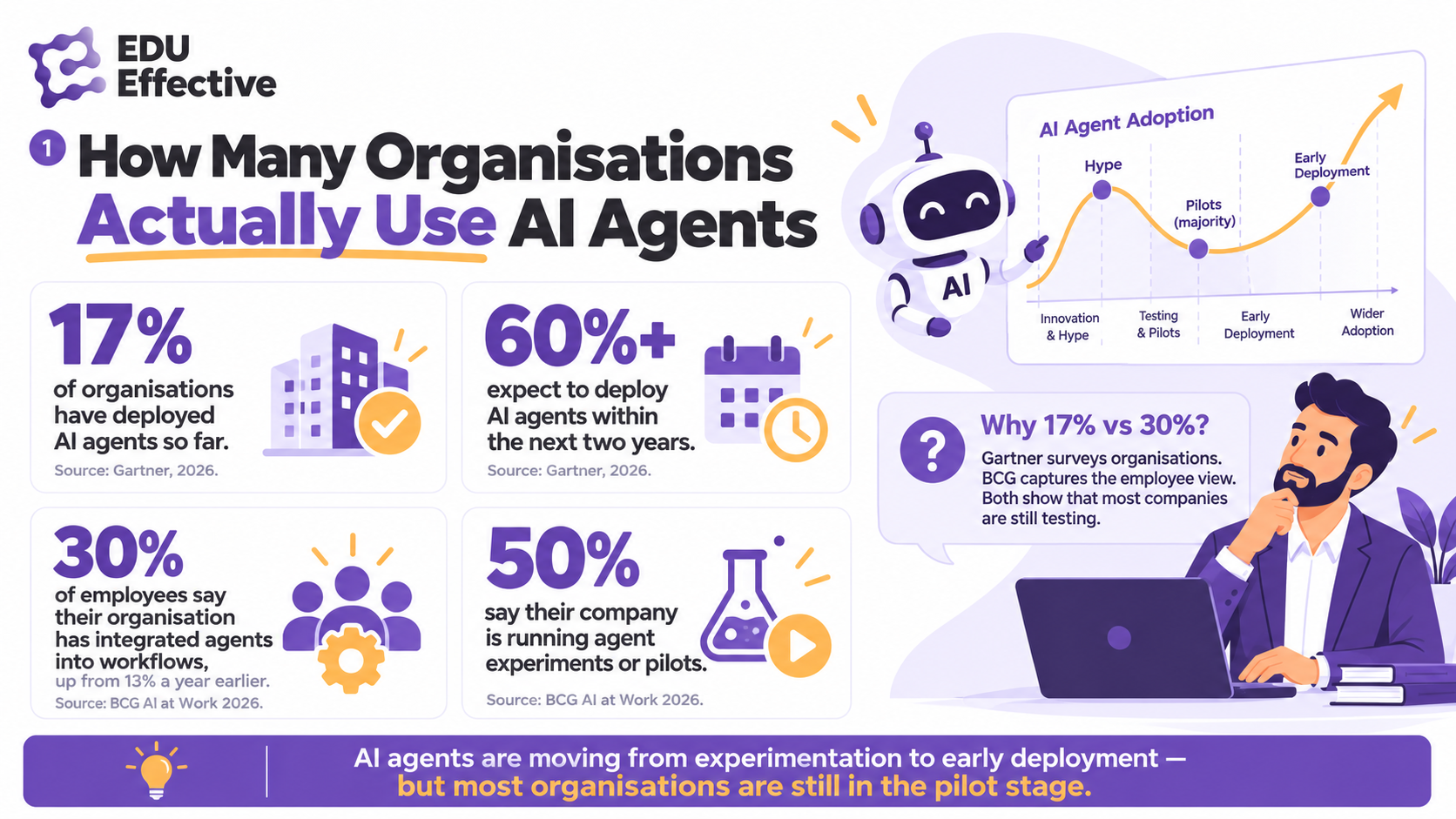
Gartner's first Hype Cycle for Agentic AI, published in 2026, reports that only 17% of organisations have deployed AI agents so far. More than 60% expect to do so within the next two years. Gartner places agentic AI at the Peak of Inflated Expectations, the point from which the curve usually drops before a technology settles. According to its analysts, most deployments remain narrowly scoped, and fully autonomous agents are not ready for the majority of enterprise use cases.
BCG's AI at Work 2026 survey of nearly 12,000 people in more than a dozen markets looks at the same shift from the employee side. 30% of respondents say their organisation has integrated agents into its workflows, up from 13% a year earlier. Another 50% say their company is running agent experiments or pilots.
The gap between 17% and 30% comes from the question being asked. Gartner asks organisations; BCG asks employees how they see their employer. Both numbers point the same way: most companies are still testing.
How much time AI really saves
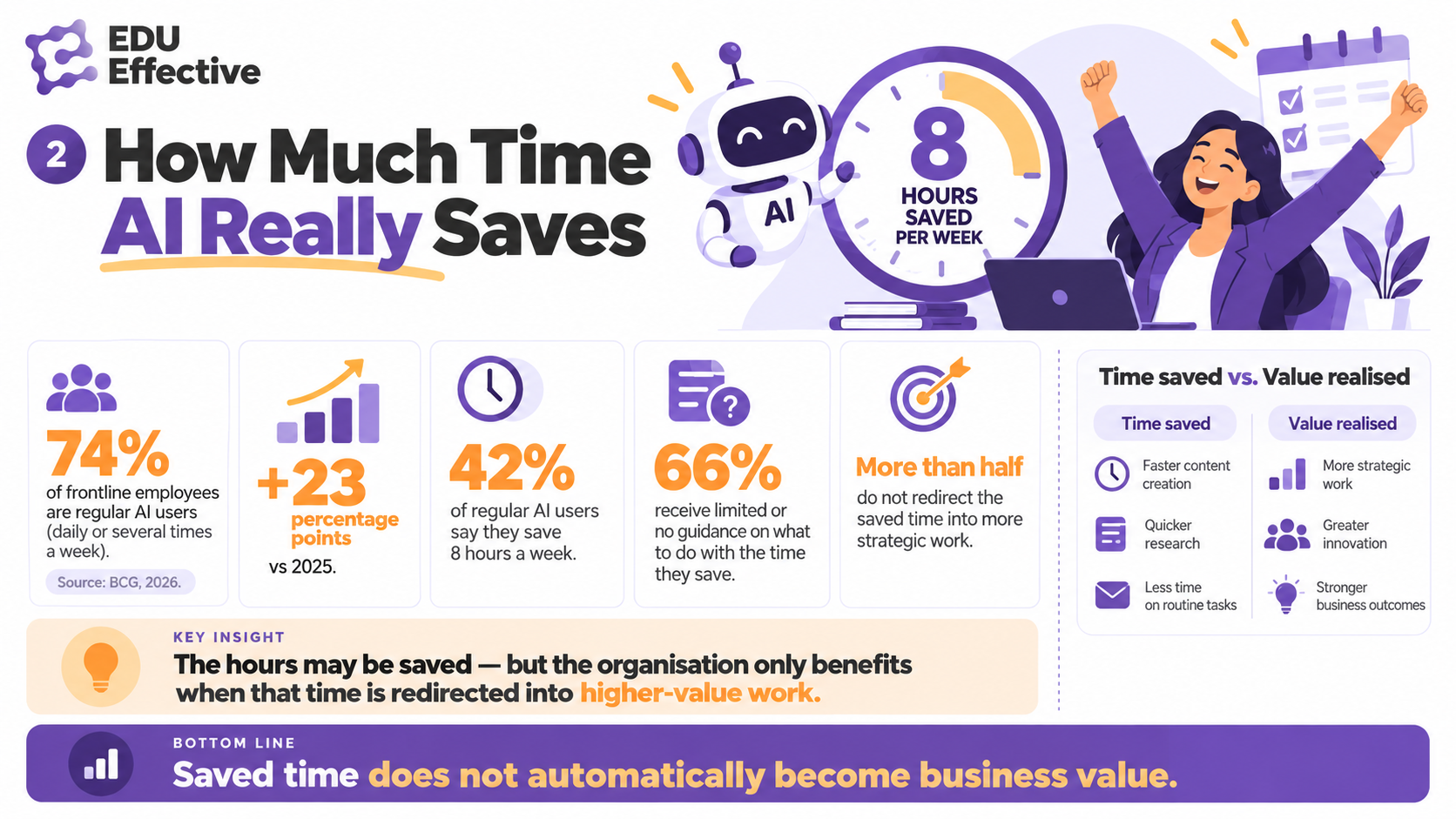
The strongest data on time savings still covers AI in general rather than agents specifically. According to BCG, 74% of frontline employees now describe themselves as regular AI users, using it daily or several times a week. That is 23 percentage points more than in 2025. Among those regular users, 42% say they save eight hours a week, the equivalent of a full working day.
The next finding is less comfortable. Two thirds of employees (66%) receive limited or no guidance on what to do with the time they save, and more than half do not redirect it into more strategic work. The hours are saved. The organisation never sees them.
Why feeling faster is not the same as being faster
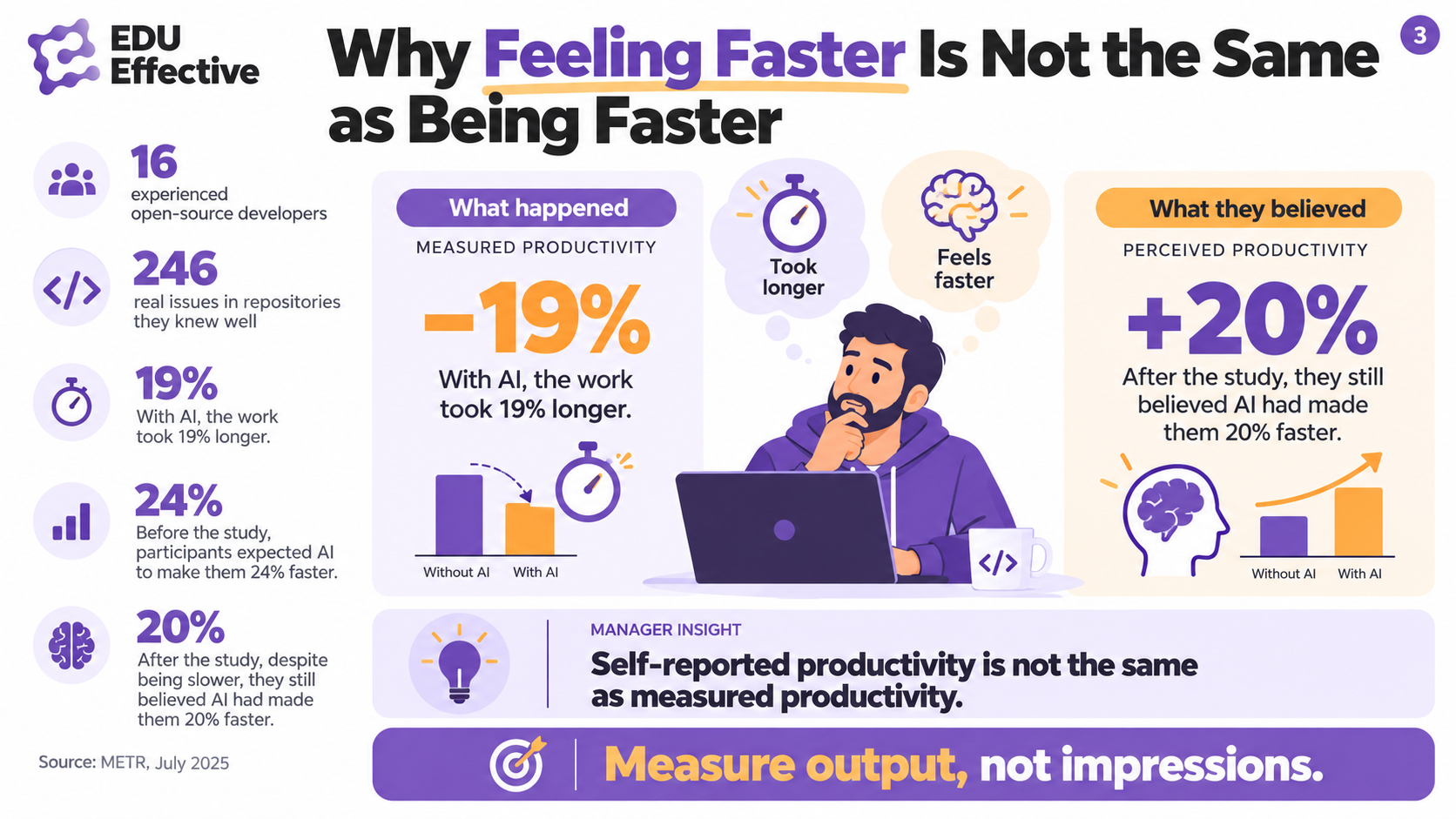
The most widely cited warning came from METR in July 2025. Sixteen experienced open-source developers worked on 246 real issues in repositories they knew well, some with AI tools and some without. With AI, the work took them 19% longer.
What the developers believed is even more revealing. Before the study they expected AI to speed them up by 24%. After it, having been measurably slower, they still believed AI had made them 20% faster.
The study covers early-2025 tools and highly experienced people working on code they know by heart. It does not show that AI slows everyone down. It shows something more useful for managers: when you ask people whether AI helps them, their answer is not a measurement. And most published figures on "hours saved" come from exactly that kind of survey.
The biggest gains go to newer employees
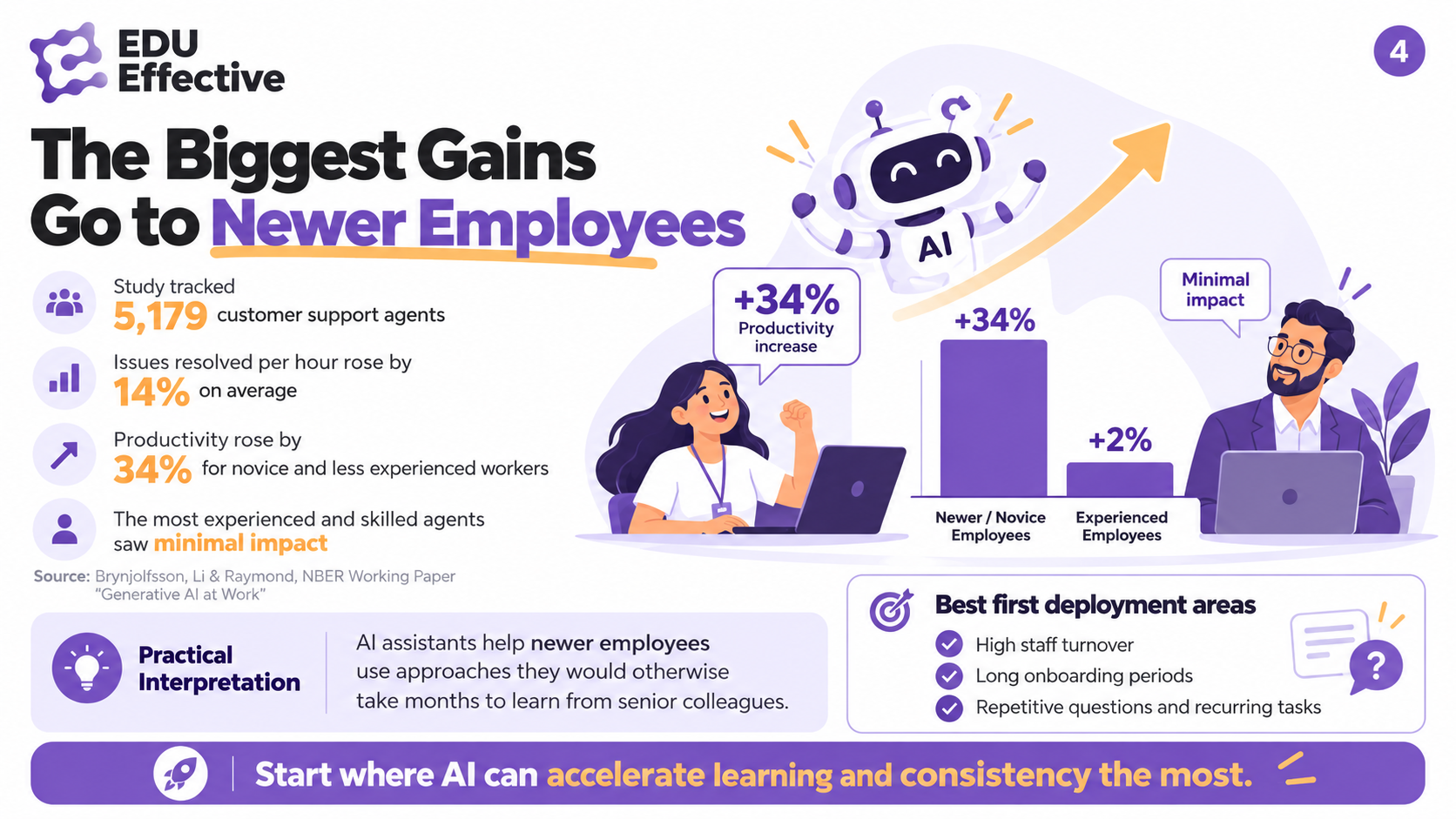
One of the most rigorous field studies so far comes from Erik Brynjolfsson, Danielle Li and Lindsey Raymond (NBER working paper "Generative AI at Work"). They followed 5,179 customer support agents who were given an AI assistant. Issues resolved per hour rose by 14% on average and by 34% for novice and less experienced workers. The most experienced and skilled agents saw minimal impact.
In practice, the assistant passed on to new hires the approaches they would otherwise have spent months picking up from senior colleagues. The practical conclusion for organisations is clear: a first deployment makes the most sense where staff turnover is high, onboarding takes long, or the same questions keep coming back.
Why 40% of agentic AI projects will be cancelled
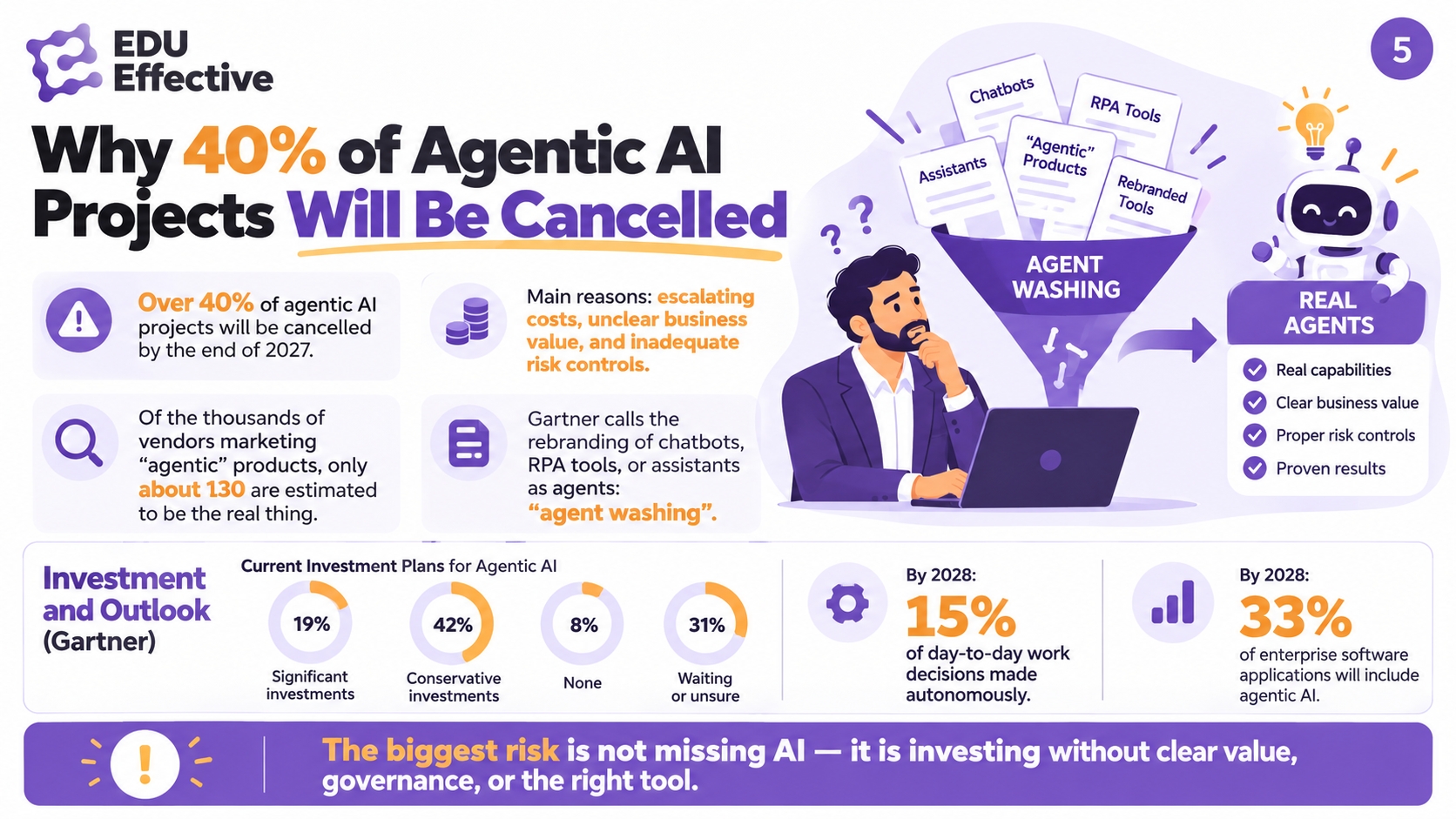
In June 2025, Gartner predicted that over 40% of agentic AI projects will be cancelled by the end of 2027. It names escalating costs, unclear business value and inadequate risk controls as the reasons.
The same release contains a number worth remembering. Of the thousands of vendors now marketing "agentic" products, Gartner estimates only about 130 are the real thing. The rest, it says, have rebranded existing chatbots, RPA tools or assistants. Gartner calls this agent washing.
A Gartner poll of 3,412 webinar attendees in January 2025 found that 19% of organisations had made significant investments in agentic AI, 42% conservative ones, 8% none, and 31% were waiting or unsure. The long-term outlook is still ambitious. By 2028, Gartner expects 15% of day-to-day work decisions to be made autonomously through agentic AI and 33% of enterprise software applications to include it.
What the data means for a manager considering AI agents
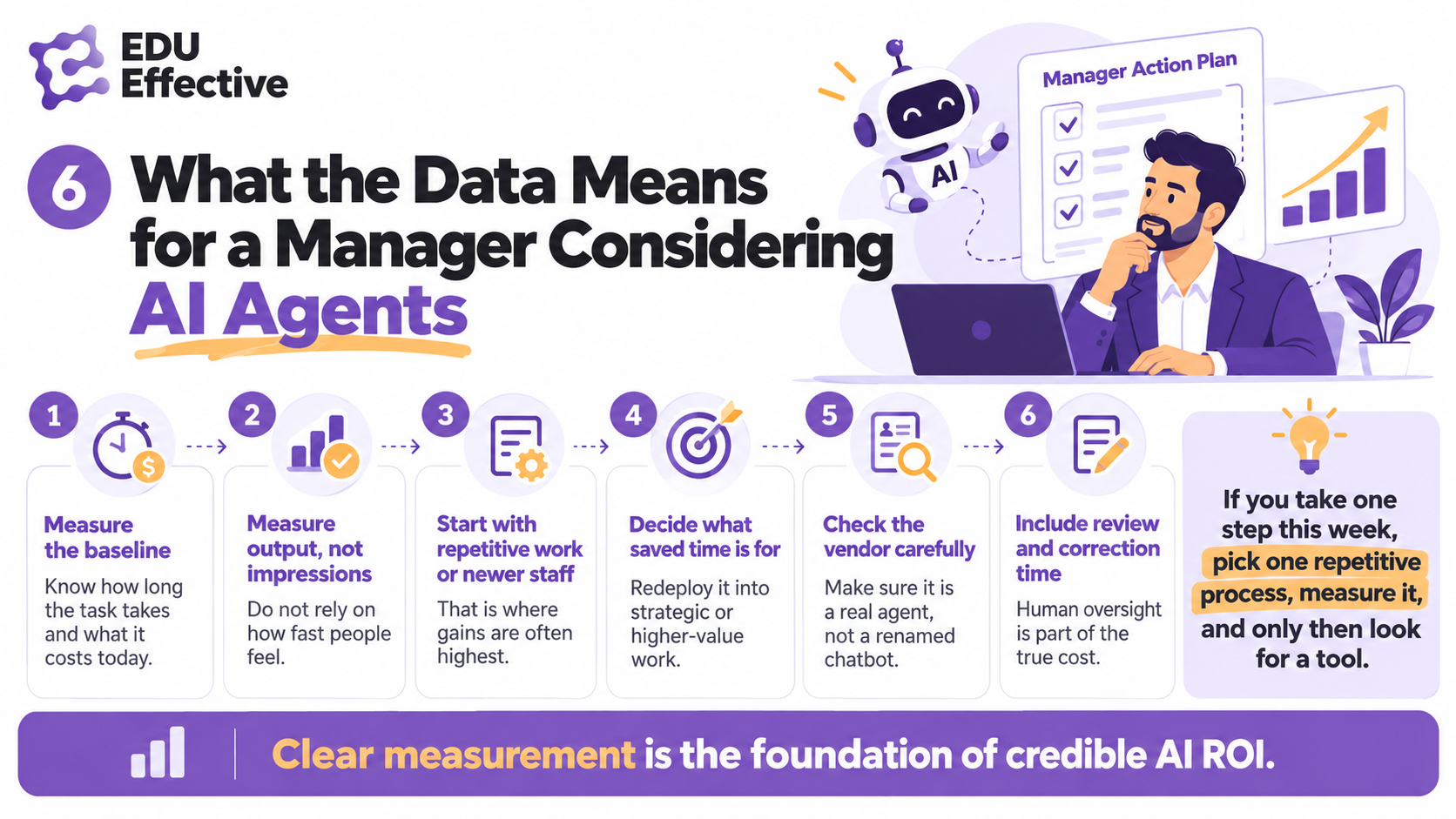
The verified research does not give you one magic ROI figure. It does give a fairly clear guide to setting up a deployment that will not end up among the cancelled 40%:
Before you launch an agent, measure how long the chosen task takes and what it costs today. Without a baseline, there is nothing to compare against.
Measure output, not impressions. The METR study shows how easily people misjudge their own speed by tens of percentage points.
Start with processes run by newer staff or flooded with repetitive questions. That is where NBER measured the largest gains.
Decide in advance what the saved time will be used for. Otherwise it disappears, as it does for two thirds of BCG's respondents.
Check that your vendor is selling an agent that carries out steps on its own, not a renamed chatbot.
Include in your costs the time people will spend checking and correcting what the agent produces.
If you take one step this week, pick a single repetitive process, measure it, and only then start looking for a tool. Unclear business value is one of the three reasons Gartner gives for cancelled projects, and you cannot show value you never measured. That includes knowing how to manage an AI agent as a process you set up, check and correct, instead of asking it one-off questions — and having a step-by-step guide to implementing AI in business, from choosing the first process to measuring results. It also helps to understand what changed when AI stopped advising and started carrying out work on its own.
At EDU Effective, the Effective MBA: Applied Artificial Intelligence teaches managers how to choose, deploy and evaluate AI tools and agents in their own work, alongside the full range of applied AI capabilities for business professionals, including AI strategy, workflow integration, output evaluation and AI governance. No coding required. Explore the programme →
Related articles
How to Manage an AI Agent, Not Just Ask It One-Off Questions
AI Stopped Advising, It Started Working for You: The Quiet Handover
How to Implement AI in Business: A Manager's Guide
EDU Effective Business School — professional development for your long-term success.
All five best-selling Effective MBA programs are built on the same educational model — designed for working adults who need learning that fits real professional life:
Effective MBA: Executive Management & Leadership
Effective MBA: Applied Artificial Intelligence
Effective MBA: Coaching, Leadership & Mentoring
Effective MBA: Online Marketing
Every programme runs on 15 minutes a day, completes in 10 months or less, is ASIC accredited, and starts from €990.
These are professional programmes, not academic ones — built for working adults to apply what they learn directly in their own business, not to collect a scholarly credential.
Join more than 9,000 students in over 120 countries who are investing in their professional development and career success. Read the experiences of our graduates here.
Apply now — from €990 · Talk to a Study Advisor
Study with NO risk: 14-day money-back guarantee, no questions asked.
Sources
Gartner — Gartner Predicts Over 40% of Agentic AI Projects Will Be Canceled by End of 2027 (press release, 25 June 2025)
https://www.gartner.com/en/newsroom/press-releases/2025-06-25-gartner-predicts-over-40-percent-of-agentic-ai-projects-will-be-canceled-by-end-of-2027
Gartner — 2026 Hype Cycle for Agentic AI
https://www.gartner.com/en/articles/hype-cycle-for-agentic-ai
BCG — AI at Work 2026: Why Strategy Matters More Than Tools (nearly 12,000 respondents, fourth annual edition)
https://www.bcg.com/publications/2026/ai-at-work-why-strategy-matters-more-than-tools
Brynjolfsson, Li & Raymond — Generative AI at Work (NBER Working Paper 31161, 5,179 customer support agents)
https://www.nber.org/papers/w31161
METR — Measuring the Impact of Early-2025 AI on Experienced Open-Source Developer Productivity (10 July 2025)
https://metr.org/blog/2025-07-10-early-2025-ai-experienced-os-dev-study/
Digital Applied — AI Agent Productivity Statistics 2026 (20 April 2026)
https://www.digitalapplied.com/blog/ai-agent-productivity-statistics-2026-roi-data-points