
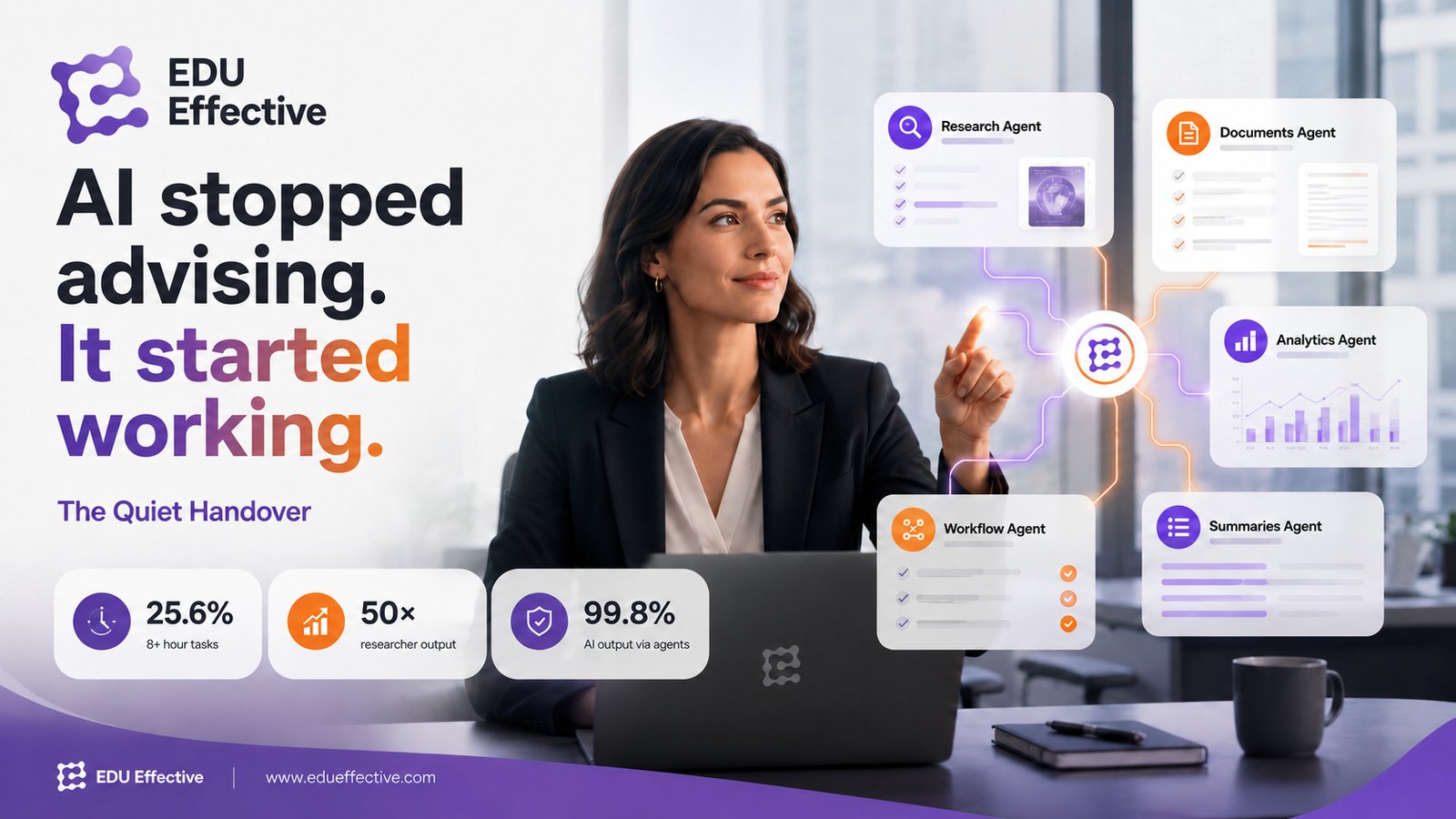

Most workplace shifts announce themselves. Email, spreadsheets, video calls — each arrived with noise, resistance, debate. The shift happening inside organizations right now is different. It's moving quietly, department by department, and the people in the middle often can't quite name what changed.
Here's what changed: the machine stopped waiting to be asked.
A research team spanning OpenAI, Columbia Business School, Wharton, and Duke spent the first half of 2026 watching what hundreds of thousands of people actually do with Codex, OpenAI's agentic work platform. Not surveys. Not interviews. Observed behavior, at scale.
What they found is harder to dismiss than another round of AI hype.
Perhaps the starkest number: inside OpenAI itself, Codex now represents 99.8% of all AI-generated output by employees. The conversational chatbot — the thing most people still picture when they think about using AI at work — has essentially left the building.
Two Modes, One Fundamental Difference
There's a distinction the research keeps returning to: consultation versus delegated production.
- Consultation is what most people do today. You bring a problem to AI, it helps you think through it, you do the work. The human stays in the driver's seat throughout.
- Delegated production is something else. You define an outcome, set the parameters, and the agent executes — pulling data, drafting documents, running searches, generating outputs — while you check in, redirect, and decide what comes next.
The legal and HR teams at OpenAI didn't gradually migrate to this model. They went from near-zero Codex usage to 75% adoption in a single month.
More than 10% of active Codex users now manage three or more agents simultaneously every week. None of them are programmers by trade. They're analysts, lawyers, researchers, and managers — people whose job description is quietly shifting from doing to directing.
Why Domain Knowledge Becomes More Valuable, Not Less
There's a reasonable fear that agentic AI flattens expertise — that if a tool can do the work, knowing the work matters less. The data points the other way.
- The researcher who understands methodology catches the agent when its outputs don't hold up.
- The lawyer who knows the case gives instructions precise enough to get useful drafts back.
- The manager who understands the business doesn't need to audit every agent output — they know which ones to question.
Expertise doesn't become redundant in an agentic workflow. It becomes the quality filter.
26.6% of Codex users are already acting on this — building "skills," their own codified, reusable workflow instructions that turn recurring processes into something an agent can execute reliably. It's a new form of institutional knowledge.
Five Ways to Close the Gap This Summer
Work slows down in summer. Fewer meetings, a quieter inbox, some actual room to think. That's worth using deliberately rather than letting it pass.
- 1. Build something real, not theoretical. Pick a problem you actually have and solve it with an AI agent. The constraint is that it has to produce something — a working output, not just a conversation. That finish line matters more than the complexity of the project.
- 2. Let AI clean up what you've been ignoring. Your file system, your notes, your folders. Tools like Cowork or Claude Code can move through it faster than you'd expect — categorizing, renaming, restructuring. Clear that backlog now.
- 3. Give AI a whole task, not just a question. Most people haven't made the jump from consultation to delegation. Try it deliberately: hand an agent something with multiple steps and a real output — a draft, a summary, a prepared set of materials. That division of labor is the skill worth building.
- 4. Write instructions for your own recurring work. What do you do regularly that follows a pattern? Report prep, standard email responses, briefing updates? Write down what the process looks like, step by step. That document becomes an agent instruction.
- 5. Define what you want by September. Not loosely — specifically. What processes should be running? What should you be able to hand off? Set that target now, then use AI to help map the path. Fifteen minutes a day adds up. But only when you know what you're building toward.
Where to Go Next
Understanding this shift and being ready for it are two different things. Reading about agentic AI won't close the gap. Putting it to work in your actual professional context will — especially if you have the domain knowledge to use it well.
The Effective MBA programs at EDU Effective are built on exactly that combination. Ten modules, structured into 30 daily fifteen-minute blocks. Fully online, no fixed schedule.
Two specializations focused on AI:
Professional development works like daily practice. One session a week, skipped whenever something comes up, produces nothing. The people getting ahead right now are doing a small amount consistently, with a clear direction.
Questions before committing? Everything's in the FAQ, or reach out directly at edueffective.com.