
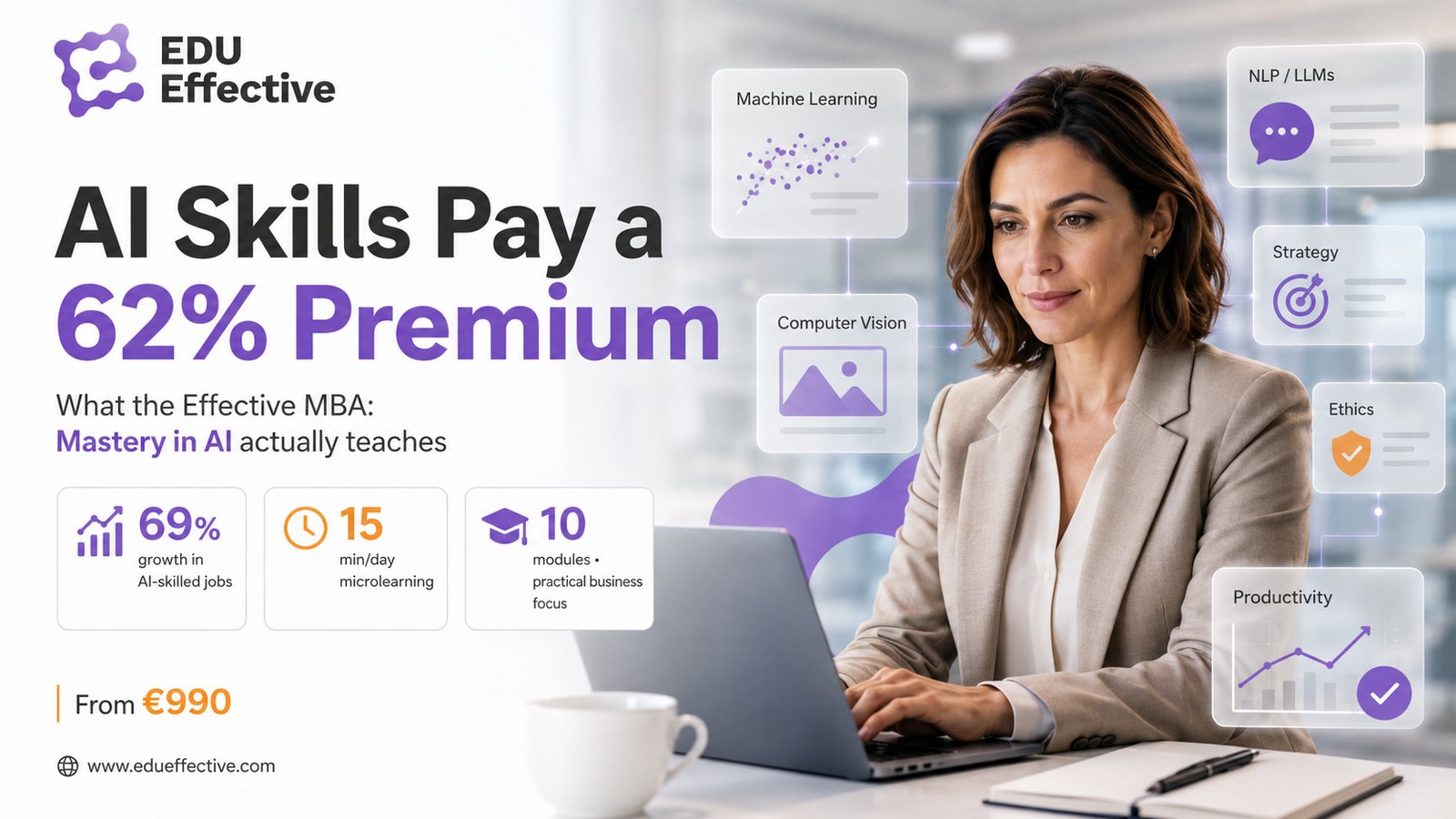

PwC's 2026 Global AI Jobs Barometer, published this June, put a number on something that used to be a guess: workers with AI skills now earn a 62% wage premium over those without — up from 57% a year earlier. Jobs requiring AI skills are growing 69%, against 9% for the job market overall. That's not a projection. It's what over a billion job postings across 27 countries say is happening right now.
None of that requires becoming a programmer. It requires understanding what these systems actually do, well enough to make decisions about them — which is the specific gap the Effective MBA: Mastery in AI is built to close.
The Job Market Isn't Waiting for a Consensus on AI
The World Economic Forum's Future of Jobs Report 2025 projects 170 million new roles by 2030 against 92 million displaced — a net gain of 78 million jobs, with AI and big data among the fastest-growing skill categories. 63% of employers already name the skills gap their biggest obstacle to using the technology at all. Forbes puts the global AI market at $407 billion by 2027, and McKinsey's data shows productivity gains from generative AI are consistently larger for companies that adopt early. The pattern across all three sources is the same: the advantage goes to people and companies acting now, not the ones still deciding whether AI is worth taking seriously.
What "Mastery in AI" Actually Teaches
This isn't a computer science degree. The program is built around a managerial lens on AI, not a technical one — the goal is understanding machine learning, neural networks and generative AI well enough to make real business decisions about them, not to write the underlying code. Ten modules cover the ground:
- 1. Introduction to AI and everyday business applications
- 2. Fundamentals of machine learning
- 3. Data strategy and analytical thinking
- 4. Neural networks and deep learning
- 5. Natural language processing (NLP) and large language models
- 6. Computer vision and visual AI
- 7. Generative AI and prompt engineering
- 8. AI strategy and executive leadership
- 9. Ethics, responsibility, and AI governance
- 10. Productivity tools and AI for personal efficiency
Content draws on people who've worked inside Google, Microsoft, Apple, Meta, AWS, Intel and Oracle, alongside academic input from Stanford, Harvard Kennedy School and London Business School.
Who It's Actually Built For
- Tech-adjacent professionals — product managers, analysts and team leads who need to confidently evaluate AI-driven initiatives, not just hear about them in meetings.
- Industry leaders and executives — senior professionals building AI implementation roadmaps and developing AI-literate teams.
- Data and analytics professionals — specialists moving from reporting into data strategy, predictive modelling and generative AI for analysis.
- Applied AI graduates and career changers — anyone who's covered the basics and wants to go deeper into deep learning, LLMs, computer vision and AI governance.
15 Minutes, Real Tools
The format is the same microlearning model behind every Effective MBA: 10 to 15 minutes a day, no fixed schedule, studied from a phone on a commute as easily as a laptop at a desk. The program includes 75+ hours of required video, 40+ hours of optional material, and 50+ recommended e-books and audiobooks. Graduates build and evaluate machine learning models using Python, write and refine prompts for tools like ChatGPT and Copilot, and walk away with an actual AI implementation roadmap for their own organization rather than a set of slides.
Not the Same Program as Applied AI
EDU Effective also runs an Effective MBA: Applied AI program, and the two aren't interchangeable. Mastery in AI is built for people who already have the basics down — including Applied AI graduates — and want to go further into deep learning, LLMs, computer vision, prompt engineering and AI governance at a more strategic level. Students can take both, with a discount on the second program. Full comparison is in the price page.
What You Actually Walk Away With
The credential carries international ASIC accreditation, and it's a professional degree, not an academic one — built for people who need the material to change how they work, not to cite in a thesis. Engineers respect it because it covers real technical ground: transformer architectures, feature engineering, model evaluation. Executives rely on graduates because they can translate that into an implementation roadmap and a business case. That combination — credible on both sides of the table — is the actual point of the program.
Worth Getting Ahead Of
AI adoption isn't a debate anymore, based on what the wage data and job postings actually show. The only open question is whether to build the literacy on your own schedule, or wait until it's a job requirement instead of a choice.
Enroll Now — From €990 Talk to an Advisor
14-day money-back guarantee, no questions asked.