
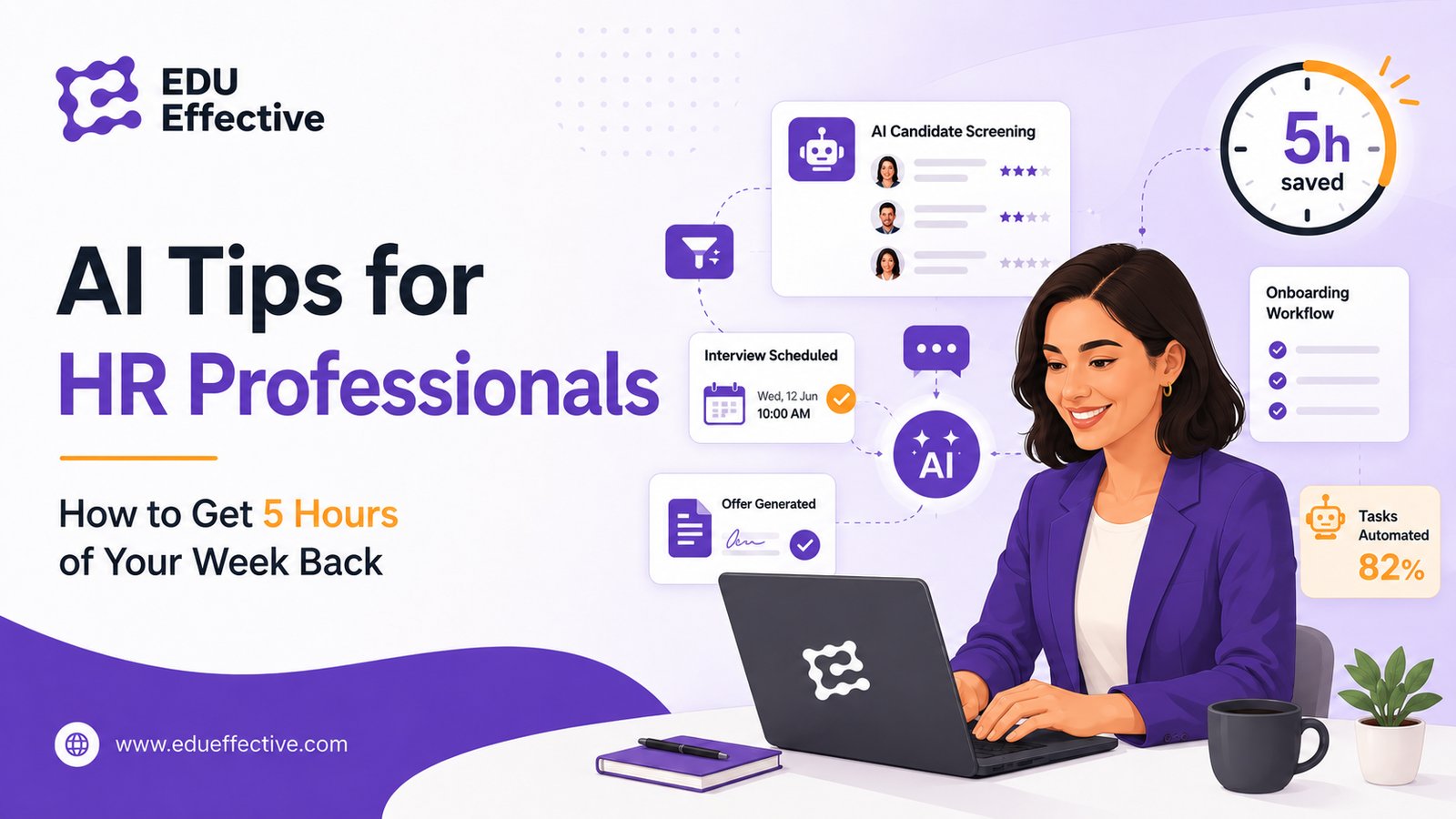

Five hours. That's roughly what a mid-sized HR team loses every week to tasks nobody actually wants to do: rewriting the same job ad for the third time, scrolling through CVs at 11pm, chasing candidates for interview slots. None of it requires a human brain. All of it eats a human week.
Artificial intelligence won't fix your culture and it won't replace a good recruiter's judgment. But it will take the repetitive part off your desk, and that's exactly where the five hours hide.
Recruitment Is Where the Time Actually Goes
Most HR pain lives in one place: recruitment. Writing ads, sorting CVs, first-round messages, scheduling calls. Companies have noticed. 66% use AI for writing job specifications, and 44% use it for resume screening.
Here's what that looks like on a Tuesday afternoon. You need a Sales Representative. Instead of burning two hours polishing "dynamic team" and "friendly environment" for the fifth time this quarter, you hand the AI a short brief. It drafts the ad, adjusts tone for seniority, pulls out the skills that actually matter for the role. You're not writing anymore. You're editing — and you know exactly who you're writing for.
The Tools Actually Worth Your Attention
The market is crowded, so here's the shortlist that keeps coming up.
Paradox (Olivia) handles screening, interview scheduling, and candidate chat over SMS — a conversational layer that removes most of the back-and-forth. HireVue scores AI-driven video interviews; some users report up to 60% time savings on first-round screening alone. Eightfold AI looks past the CV entirely and maps actual skills, which is how it surfaces internal candidates traditional screening tends to miss. From 2025, Workday users get Paradox built directly into the platform, so the hire-to-onboard data doesn't have to jump between systems.
Training People to Work With the Tools You Just Bought
Buying the software is the easy part. According to SHRM, 67% of HR professionals say their organizations haven't prepared employees to actually work with AI. The tool sits there. Nobody uses it right.
The fix isn't a company-wide webinar everyone half-watches. It's training built around role, experience, and the specific skill gap someone actually has. Once you have real data on skills and performance, you stop guessing. Development budgets start following business goals instead of whatever line item survived last year's cuts.
Where AI Still Needs a Human in the Room
AI doesn't do empathy, context, or accountability. It can't. Starred found that out of every 1,000 candidates, 825 get rejected and another 100 drop out along the way. Roughly 17% of rejected candidates go public with a negative review. Move fast without a human checking the process, and you're not saving time — you're spending your employer brand instead.
Regulation backs this up. Under Annex III of the EU AI Act, recruitment and candidate-evaluation systems are classified "high-risk." Full compliance lands in August 2026. Candidates have to know AI is involved. HR has to be able to show the model isn't quietly biased.
Starting Without the Chaos
You don't need a six-figure budget to start. You need one process and some honesty about where it hurts.
- Pick one repetitive process — job ads, CV pre-selection, onboarding FAQs. Something with an obvious, visible bottleneck.
- Measure it as it works today. How long does it take? Where does it stall? What repeats every single time? Skip this step and you'll never know if AI actually helped or just moved the mess around.
- Set guardrails before you set anything else. What can the tool decide alone? What stays human? Who signs off? This is the line between a smart shortcut and a compliance headache.
- Find the person who actually understands the tool. The best AI still fails with vague prompts and no one on the team who knows how to steer it.
- Treat this as a mindset shift, not a software purchase. The goal isn't a faster form-filling department. It's HR that connects people, data, and business outcomes in one place.
Where EDU Effective Fits In
AI in HR isn't its own separate subject — it sits at the intersection of leadership, data, and change management. That's the intersection our programs are built for, including our Effective MBA: Coaching, Leadership & Mentoring and Effective MBA: Applied Artificial Intelligence — not just tool tutorials, but the judgment to know when to use them and when not to.