
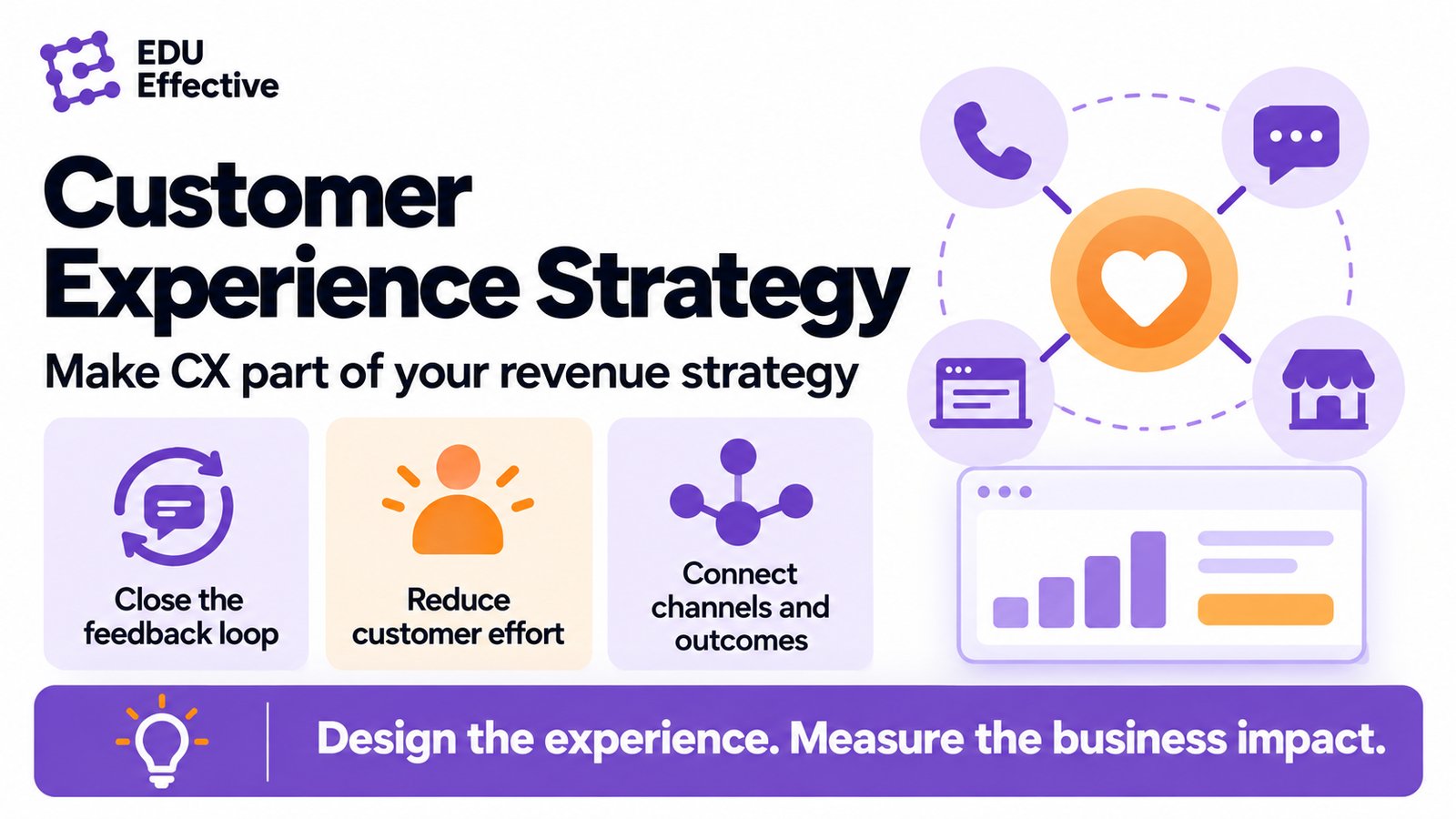

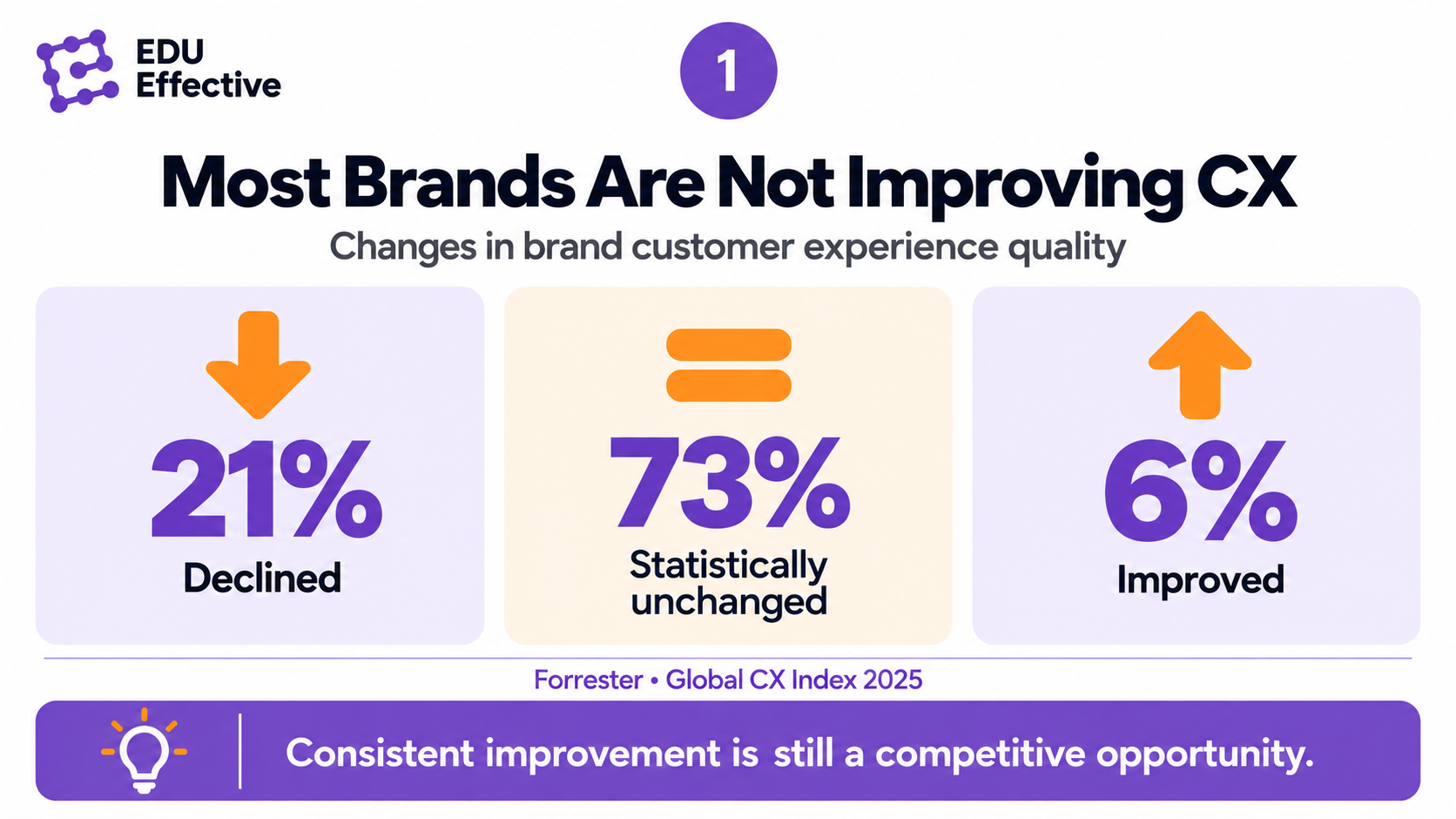
In 2025, Forrester's Global CX Index surveyed more than 275,000 customers rating 469 brands across 12 industries in 13 countries. The headline finding: 21% of brands declined in customer experience quality, 73% were unchanged, and only 6% improved. In the United States, 25% of brands declined, the second consecutive year of falling scores.
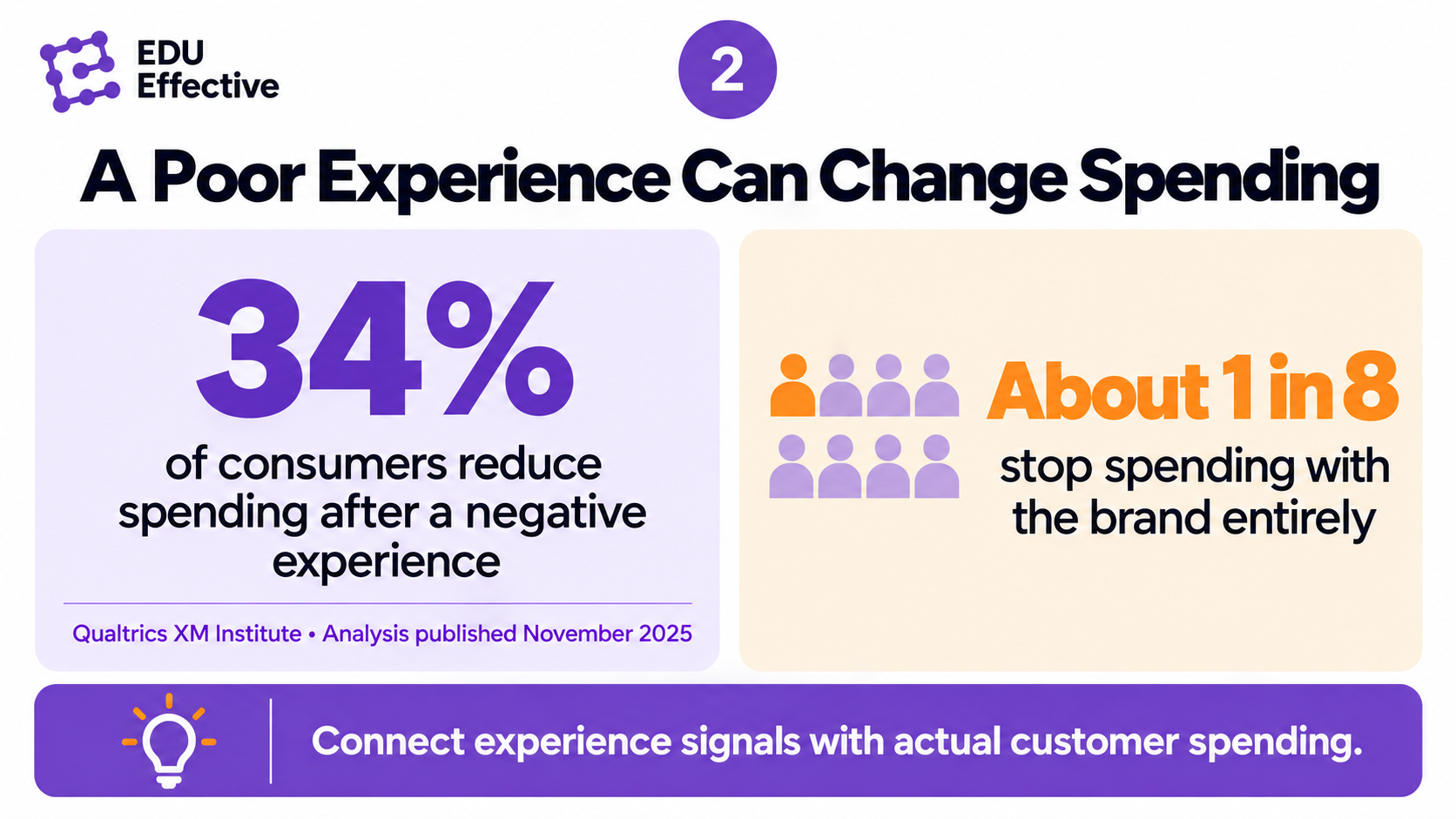
This is happening at the same time that Qualtrics' 2025 Consumer Trends Report (nearly 24,000 consumers across 23 countries) found that 34% of consumers reduce spending after a negative experience, and approximately one in eight stop spending with that brand entirely. Consumers are experiencing fewer truly terrible interactions than before, and they are less forgiving when those interactions do occur.
The combination is structurally significant. Most organizations are not improving their customer experience. The customers they serve are raising their expectations and cutting spending faster when those expectations are not met. This is not a CX team problem. It is a revenue problem, and the data makes the causal chain clear.
What customer-obsessed organizations actually achieve
Forrester's 2024 US CX Index data puts the business case in specific terms: firms Forrester classifies as customer-obsessed report 41% faster revenue growth, 49% faster profit growth, and 51% better customer retention than peers. These are not small performance differentials. They represent companies in the same markets, selling comparable products, with structurally different returns based primarily on how systematically they invest in customer experience.
The catch is in the denominator. Only approximately 3% of companies qualify as customer-obsessed under Forrester's definition. The gap between knowing that CX drives growth and building the organizational systems, measurement discipline, and cross-functional coordination that makes it true is where most companies stop.
The ten brands that held elite CX status (top 5% in their country) in the Forrester 2025 Index are instructive: Chewy, USAA, Zappos, Navy Federal Credit Union, H-E-B, and their peers are not competing on price. They are competing on the experience of being a customer, and they have been doing it consistently enough to hold elite status year over year. Consistency is the operative word. A single excellent interaction does not build loyalty. Consistency across every touchpoint, over time, does.
The churn math most companies are not running
Qualtrics' finding that 34% of consumers reduce spending after a negative experience is the number most organizations should be running against their own customer data, and most are not.
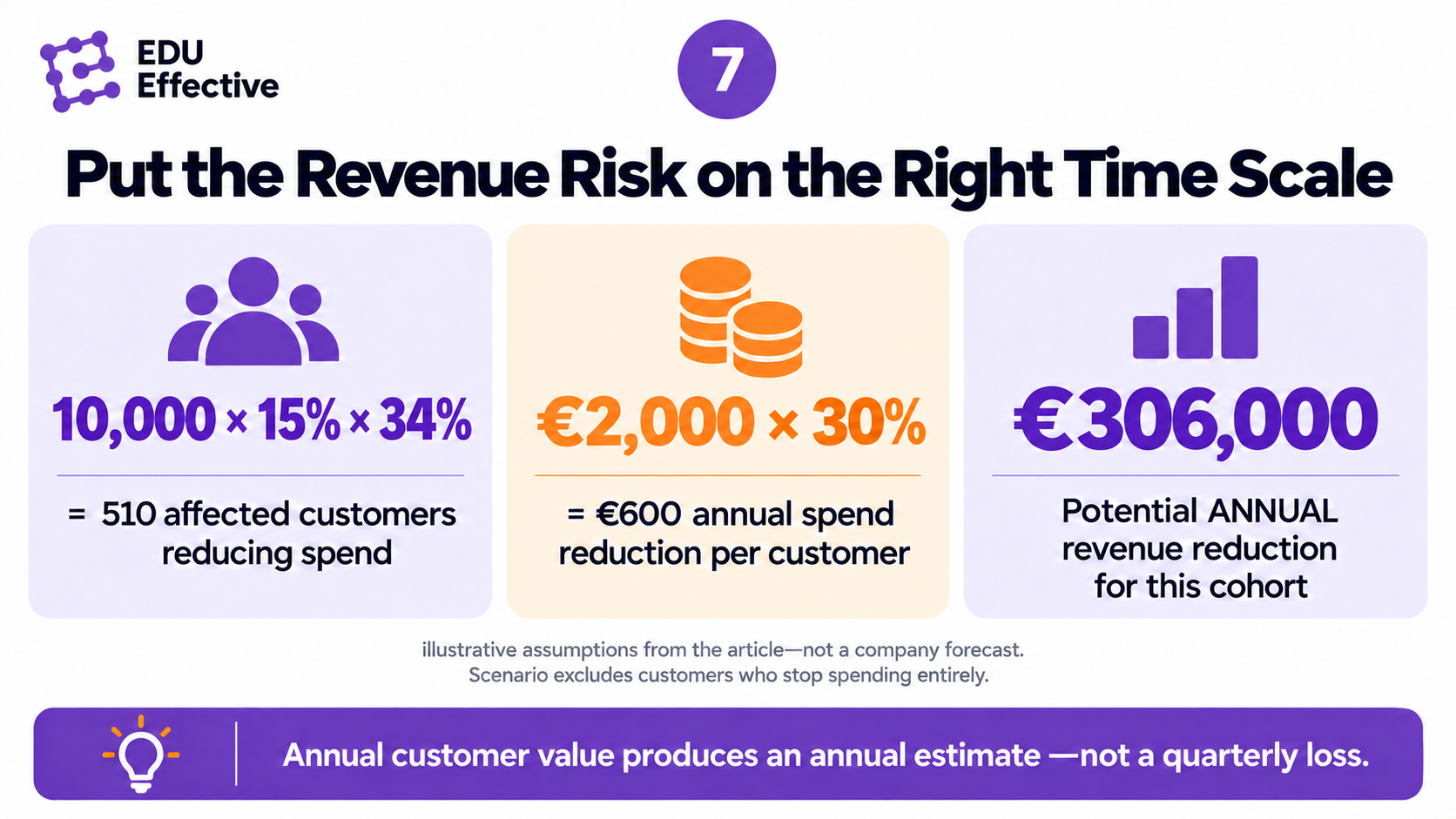
Consider what it means in practice. A company with 10,000 active customers, experiencing a 15% rate of significant service failures in a given quarter, has approximately 500 customers reducing spend. If average annual customer value is €2,000, and those customers reduce spending by 30%, that is €306,000 in revenue reduction per year from service failures alone, before accounting for the one-in-eight who leave entirely.
This is the calculation that moves CX investment from "cost center supporting retention" to "revenue lever with a measurable return." Most organizations do not run it because their CX metrics (NPS, CSAT scores, support ticket resolution times) do not connect directly to revenue data. Closing that gap, linking customer experience signals to purchasing behavior at the account level, is where the business case for CX investment becomes undeniable.
Forrester analyst Pete Jacques put the directional case plainly: "Even a minor improvement to a brand's customer experience quality can reduce churn and increase share of wallet." The arithmetic is rarely ambiguous when organizations actually run it.
Where loyalty is actually built, and where most programs fail
Medallia and Ipsos surveyed more than 800 CX practitioners for their 2025 loyalty research. 86% said loyalty will matter more as a business metric in the coming years. 87% said loyalty investments deliver a return. 97% said loyalty drives overall business success.
The more interesting finding is structural: 88% of practitioners identify product quality as a driver of loyalty, and 85% identify experience, both ahead of price (70%). This ranking contradicts how most businesses allocate competitive attention. Price wars are visible and immediately measurable. Experience improvements take longer to show up in retention data and require cross-functional coordination rather than a single pricing decision.
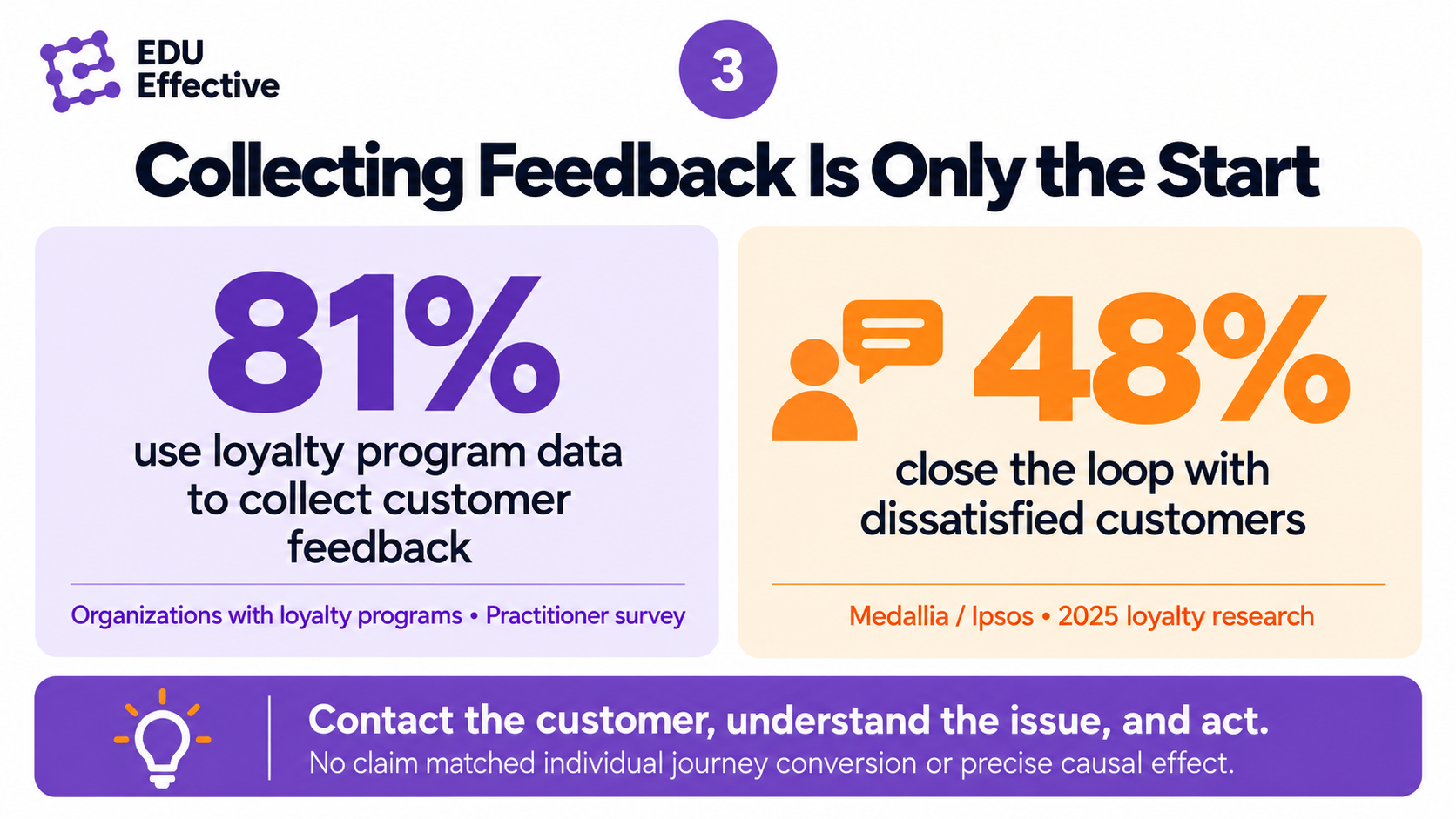
The gap between intention and execution shows up in the Medallia data clearly. 81% of organizations with loyalty programs use those programs to collect customer feedback. Only 48% actually close the loop with dissatisfied customers, contacting them, understanding what went wrong, and attempting to recover the relationship. That 33-point gap between hearing about a problem and doing something about it is where loyalty programs fail operationally. Data collection without action is not a loyalty strategy. It is market research with no downstream consequence.
The digital experience gap in B2B
Customer experience is not only a B2C challenge. McKinsey's B2B Pulse 2024 found that 54% of B2B buyers say they would switch suppliers if the connected experience is not seamless. B2B buyers now use an average of 10 interaction channels per purchase, with 42% using 11 or more.
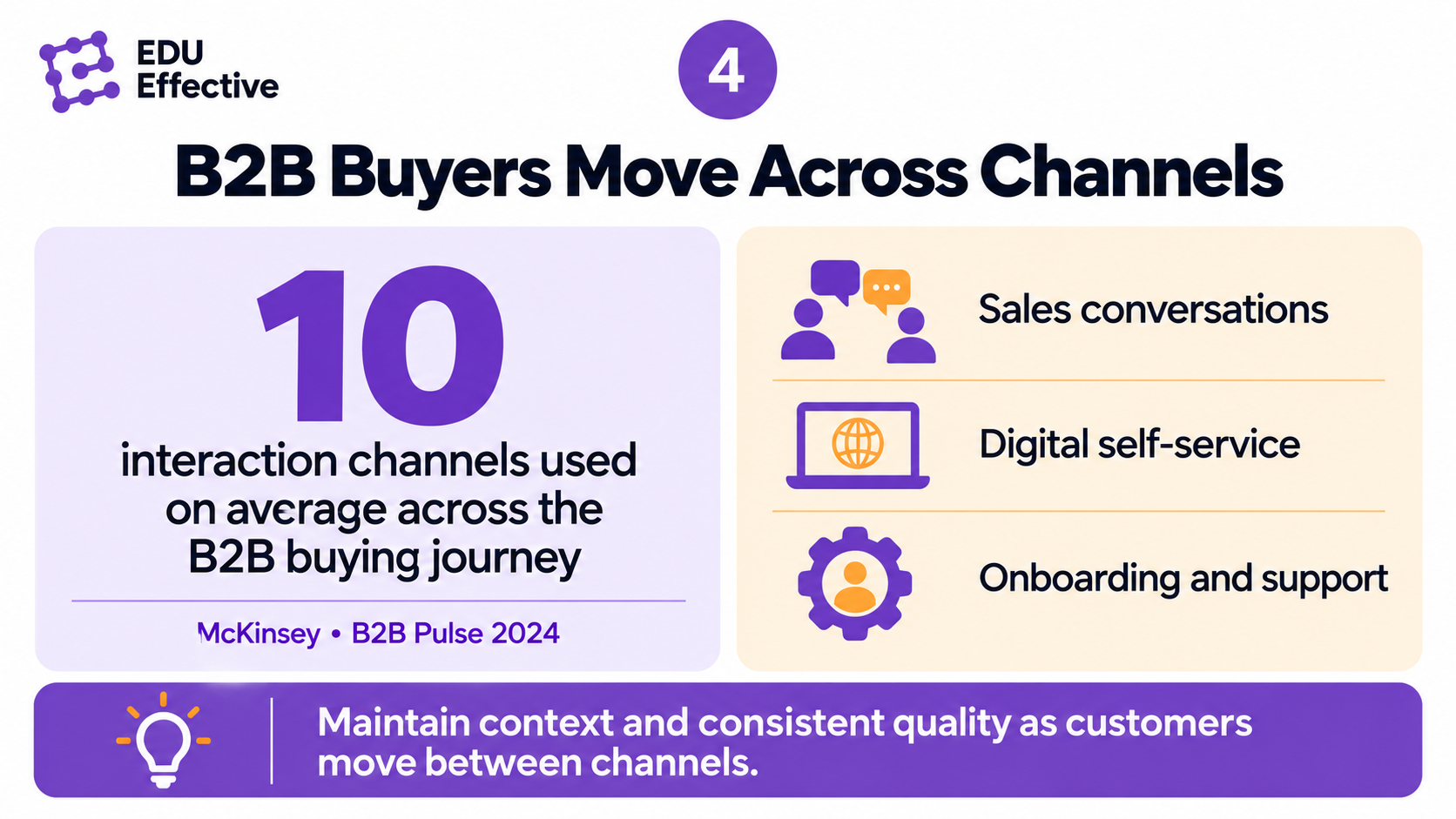
The implication is that B2B customer experience has become as complex as consumer experience, with the added pressure that B2B relationships involve larger transaction values, longer sales cycles, and higher switching costs. When a B2B buyer says they would switch for a better connected experience, the number represents real revenue at risk, not casual browsing behavior.
Qualtrics' data found that customers are 2.7 times more likely to return to a brand that gave them strong digital support. In B2B contexts, digital support includes every interaction from onboarding documentation to self-service account management to the quality of technical support channels. Companies that treat these as secondary to the sales relationship are building churn risk into their customer base systematically. This is also where content that genuinely helps buyers decide does measurable commercial work.
The three CX investments with the clearest return
Not all CX improvements generate equal returns. The research points consistently to three areas where investment has the most direct impact on retention and revenue.
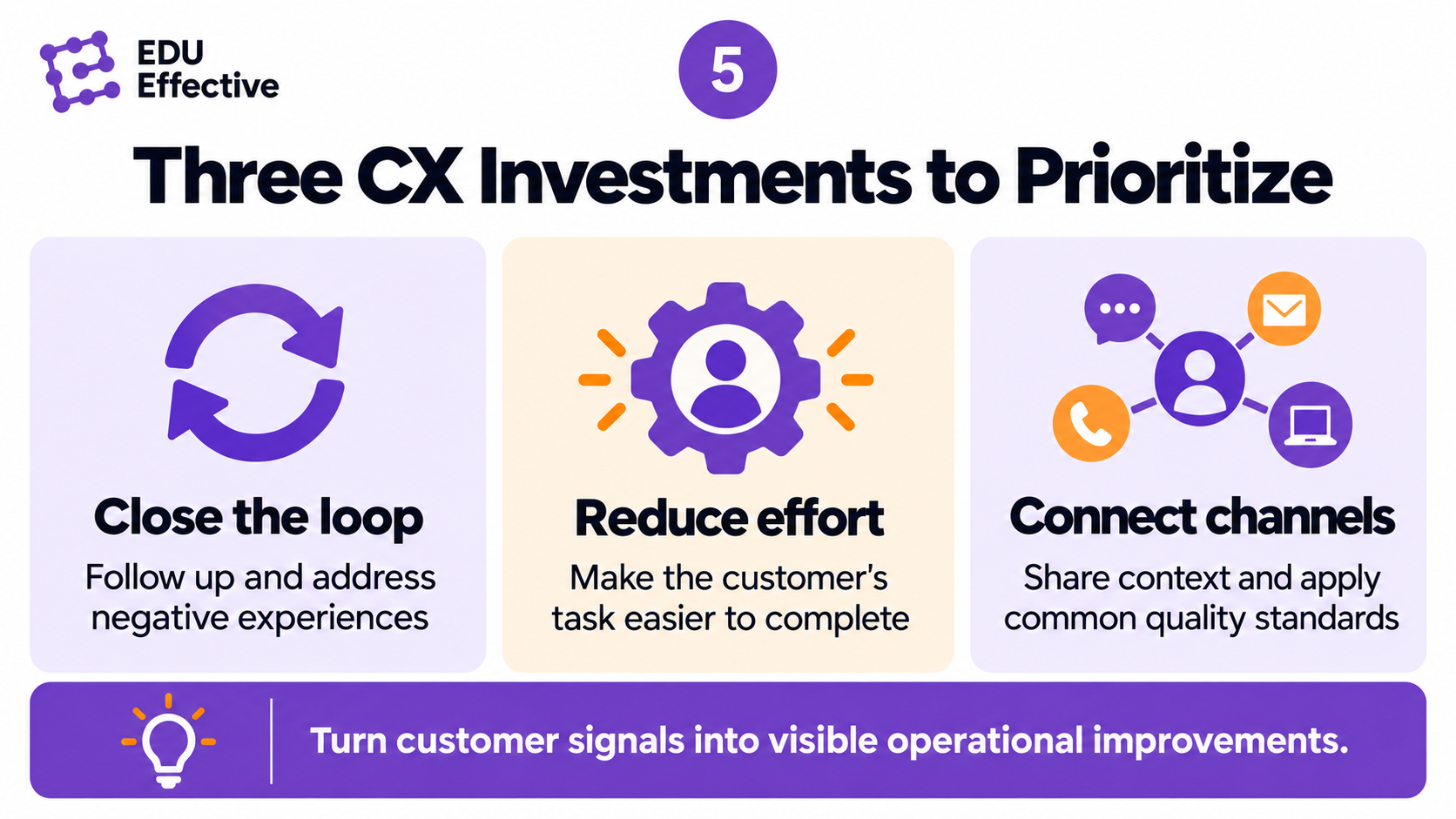
Closing the feedback loop. The Medallia finding that only 48% of organizations act on negative feedback from loyalty programs is a recoverable problem with a clear action. Companies that systematically contact dissatisfied customers after a negative experience, not to offer a discount, but to understand what happened and address it, recover a meaningful percentage of relationships that would otherwise churn. The contact itself signals that the organization takes the experience seriously, which is frequently enough to change the customer's assessment.
Reducing effort, not just improving satisfaction. The research consensus on what drives customer loyalty has shifted over the past decade away from "delight" (exceeding expectations) toward "reducing effort" (making it easy to do business). Customers who can resolve issues quickly, without escalation, through their preferred channel, on the first contact, are disproportionately loyal. The single most predictive question in many CX measurement frameworks is not "were you satisfied" but "how easy was it to accomplish what you needed."
Consistency across channels. The Forrester elite brands are distinguished not by one exceptional channel but by consistency across all of them. A brand that delivers excellent in-store experience but poor digital support creates cognitive dissonance that erodes trust. McKinsey's B2B data, 10 interaction channels per purchase, makes this consistency requirement structural. An organization cannot deliver a strong customer experience if each channel is managed independently with no common quality standard or customer data sharing between them.
Why most CX strategies stall at measurement
Organizations that fail to improve customer experience over time typically share a diagnostic pattern: strong measurement of experience metrics (NPS, CSAT, CES), weak connection between those metrics and operational decisions, and no accountability for experience quality outside the CX team.
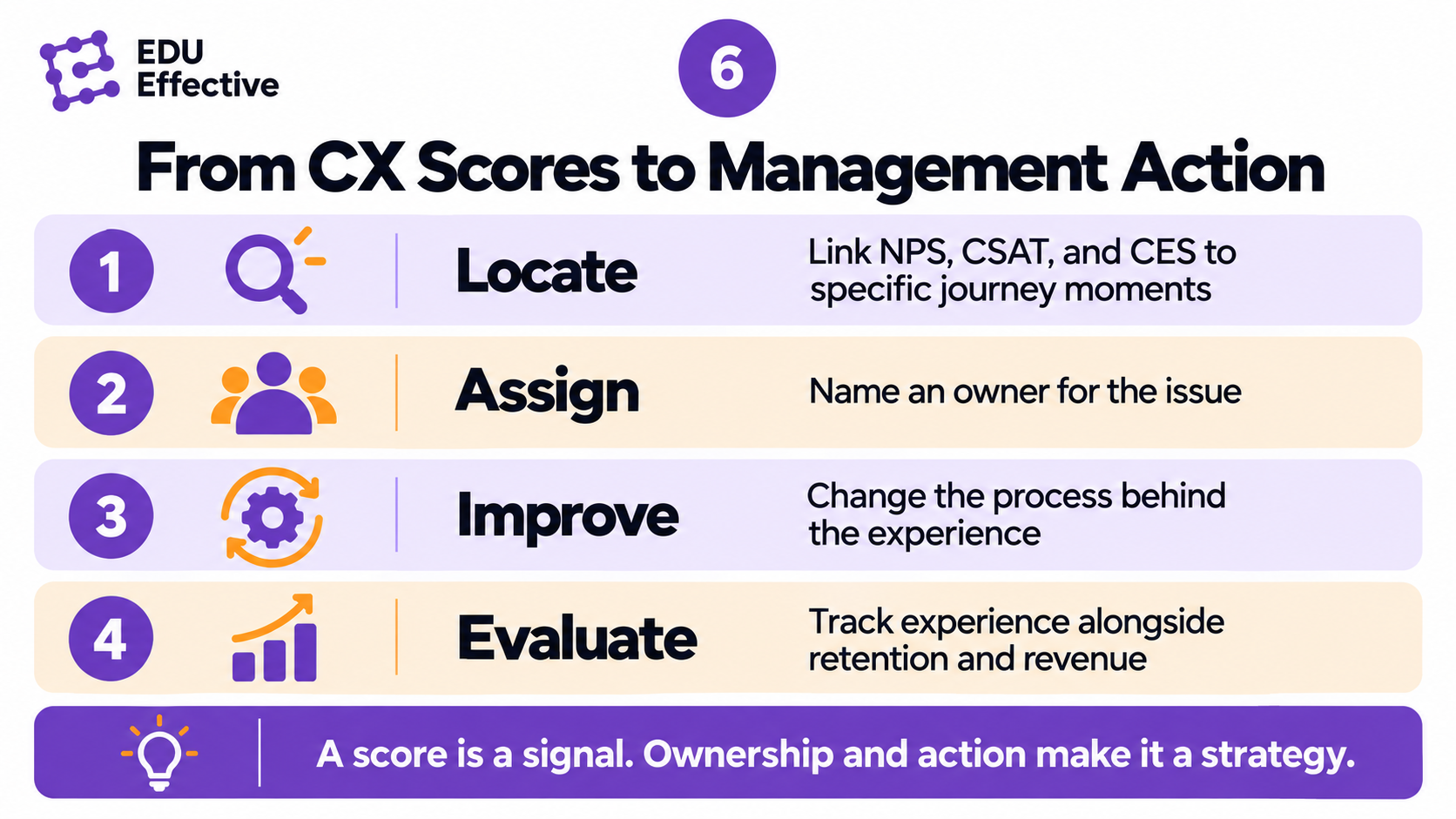
NPS is a useful signal. It is not a management system. An organization that tracks its NPS quarterly and uses it to report to the board has measurement. An organization that connects NPS data to specific journey moments, assigns ownership for improving those moments, and tracks changes in NPS against changes in revenue retention has a CX strategy with operational teeth.
The Forrester finding that only 3% of companies qualify as customer-obsessed is partly a measurement problem. Most organizations cannot identify which specific customer interactions are driving the loyalty and churn outcomes in their retention data. Without that granularity, CX improvement becomes a broad aspiration rather than a sequence of addressable problems. The same discipline of making quality visible externally applies to building recognized expertise people actually trust.
The business case in 2026
The Forrester 2025 CX Index found that most brands declined or were stationary while the minority improved. Those that did improve were not doing fundamentally different things. They were doing the same things more consistently, at higher quality, across more channels, with tighter feedback loops between what customers experienced and what the organization changed as a result.
The revenue math supports the investment. Forrester's customer-obsessed firms grow revenue 41% faster and retain customers 51% more effectively. Qualtrics documents that 34% of consumers reduce spending after a negative experience. Medallia finds that experience quality outranks price as a driver of loyalty for the majority of CX practitioners who study it.
Customer experience is not a department responsible for resolving complaints. It is a business design choice, about who owns the customer relationship, what quality standards are non-negotiable, and how the organization learns from what customers actually do rather than what they say they intend to do. The companies treating it that way are growing faster than the ones that are not.
About EDU Effective Business School
EDU Effective Business School exists for professionals who want measurable progress inside their own organization. Runs on 15 minutes a day, completes in 10 months or less and is ASIC accredited.
Explore the Effective MBA programs · What students say · Apply
Sources
- Forrester Global Customer Experience Index (275,000+ customers, 469 brands, 13 countries) https://agilebrandguide.com/forresters-2025-global-customer-experience-index-rankings-21-of-brands-declined-6-improved-and-73-remained-unchanged/
- Forrester US CX Index https://www.forrester.com/
- Qualtrics Consumer Trends Report (24,000 consumers, 23 countries) https://www.qualtrics.com/
- Medallia / Ipsos CX Loyalty Research 2025 (800+ CX practitioners) https://www.medallia.com/?p=10157
- McKinsey B2B Pulse https://www.mckinsey.com/