
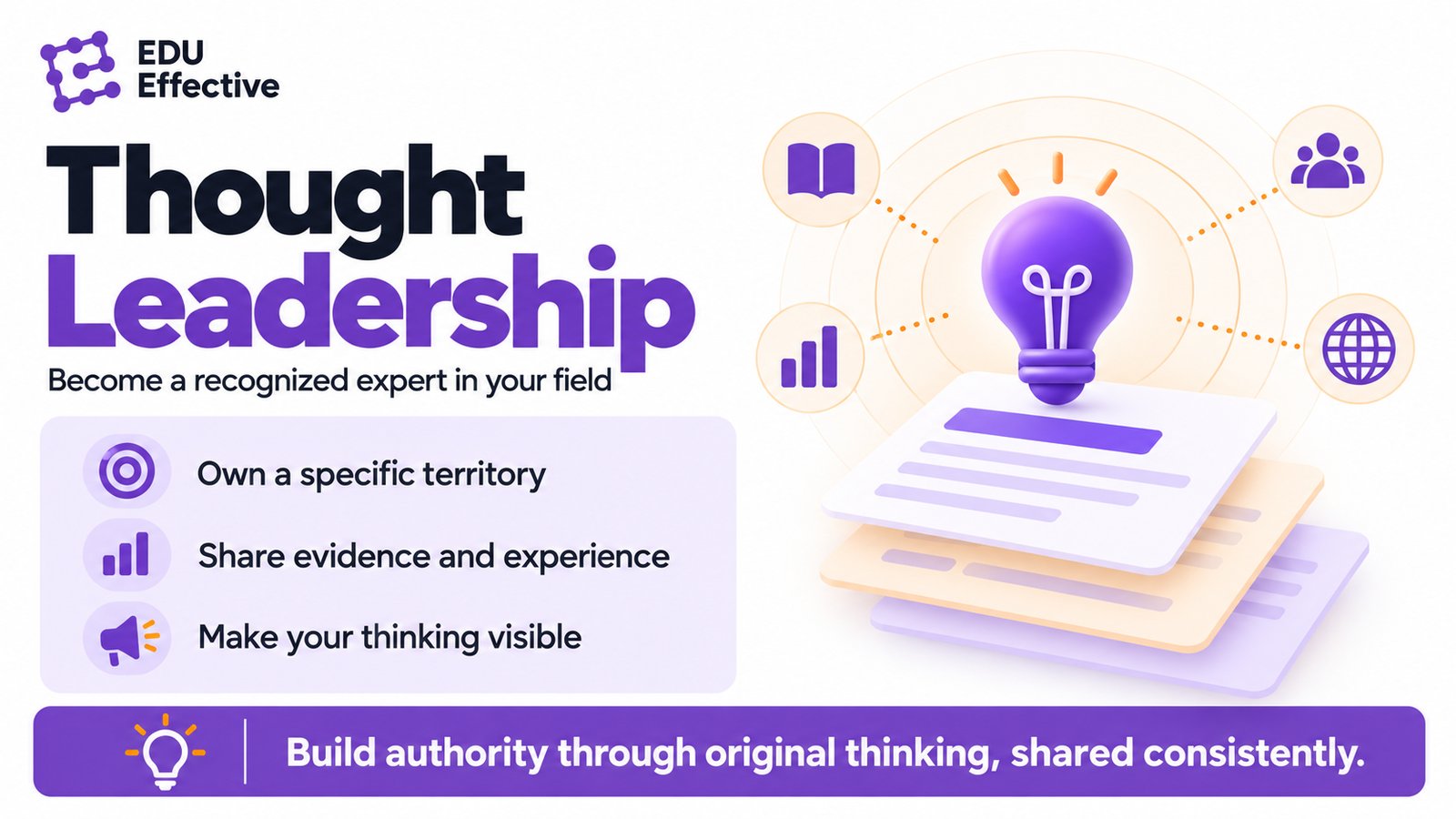

The phrase thought leadership has been used so loosely for so long that most people roll their eyes when they hear it. Posts that begin with “I’ve learned something important…” and end with a question nobody asked. Whitepapers that repackage industry consensus as original insight. Conference talks that are really 45-minute sales pitches.
The result of all that noise is that genuine thought leadership — content that actually changes how decision-makers think, earns trust before there is a deal on the table, and builds the kind of authority that shortens sales cycles — is rarer than it appears and more valuable than most people realize.
The data from 2025 and 2026 is precise about this. The gap between organizations doing thought leadership well and those merely producing content is not a matter of degree. It is a structural difference in outcomes.
What the Research Actually Shows
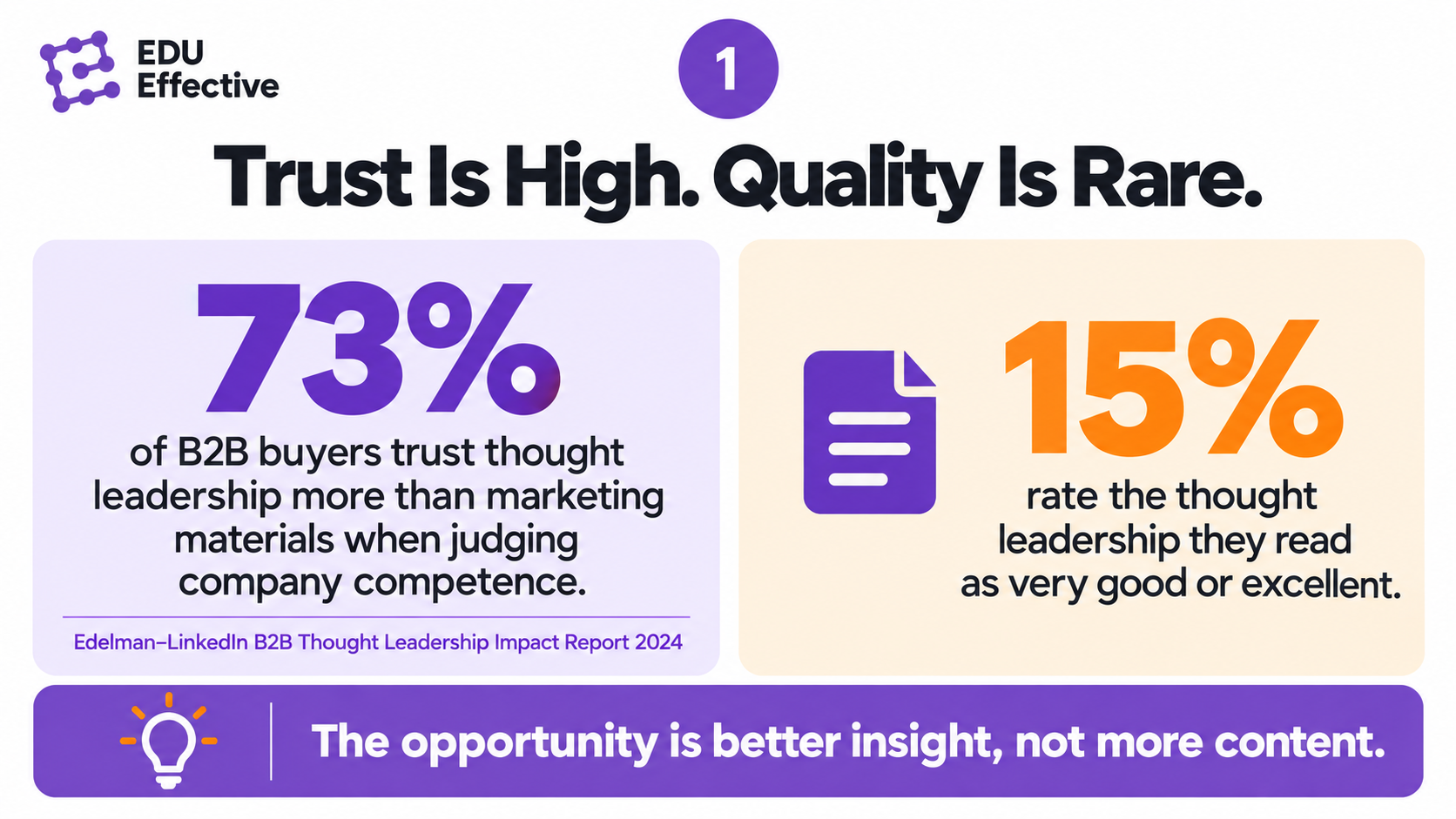
Edelman and LinkedIn’s B2B Thought Leadership Impact research — covering thousands of executives across multiple survey cycles — found that more than 75% of decision-makers say a piece of thought leadership led them to research a product or vendor they were not previously considering. 73% say thought leadership is a more trustworthy basis for judging a company’s competence than its marketing materials. And 70% of C-suite leaders say they have at least occasionally questioned an existing supplier because of thought leadership they encountered. Of those, 25% ended or significantly reduced the relationship.
Read that last figure carefully. A competitor’s thought leadership is not just winning new business. It is actively destabilizing existing relationships.
The same research found that only 15% of decision-makers rate the quality of thought leadership they encounter as very good or excellent. The market is flooded with content. Almost none of it is good enough to change how a senior executive thinks. That gap — between the volume of content produced and the quality threshold that actually influences decisions — is where the opportunity is.
Ascend2 and TopRank Marketing’s State of B2B Thought Leadership 2026 report — surveying 797 senior B2B marketing leaders in the U.S. and U.K. — found that 97% say thought leadership is critical to full-funnel success and 93% of marketers using original research-based content say it is effective at driving engagement and leads. The same report found that 44% more brands producing highly effective research-based content say their marketing significantly drives revenue.
Why Most People Are Invisible to the Buyers Who Matter
Here is the structural problem that thought leadership solves — and why most individual experts and organizations remain invisible despite producing significant content.
Bain and the LinkedIn B2B Institute research (covering over 500 buyers) found that 81% of buyers report the vendor they eventually purchased from was known to every member of the buying group on day one of the process. Bain research published in Harvard Business Review puts the figure even more starkly: buyers select from a pre-existing shortlist roughly 90% of the time.
This means the decision about who gets considered is made before the sales process begins. By the time a decision-maker is ready to buy, their shortlist is largely formed. The vendors on that list earned their place through brand recognition, prior exposure, and perceived expertise — not through outreach at the moment of purchase intent.
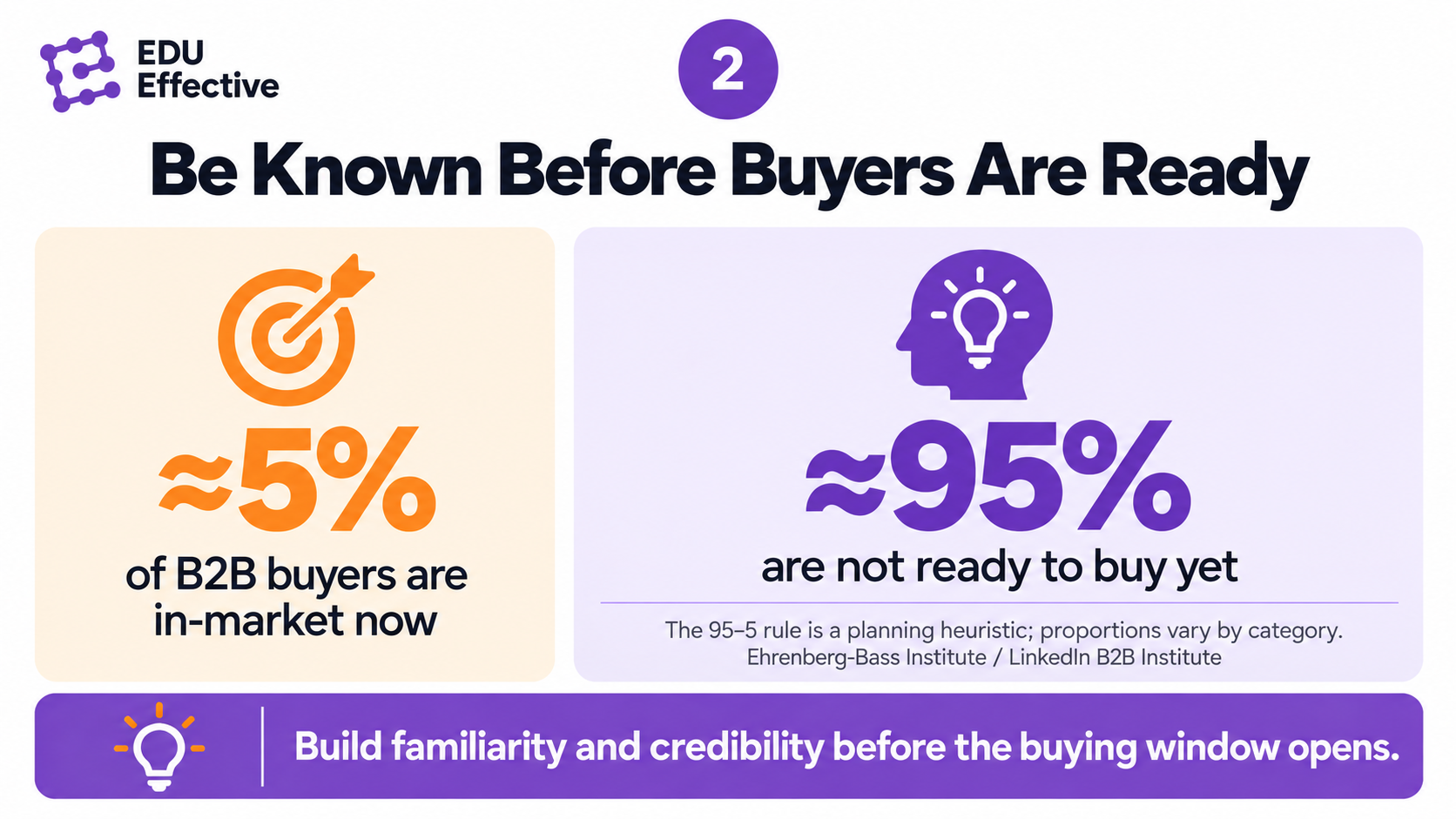
About 5% of business buyers are in market at any given time, per research from the Ehrenberg-Bass Institute. The other 95% are not ready to buy — but they are consuming content, forming impressions, and building the shortlists they will use when they are ready. Thought leadership is how you get onto those lists before the 5% window opens. Cold outreach when someone is ready to buy is competing with every other vendor who also timed their approach to the same signal.
The Anatomy of Thought Leadership That Actually Works
Not all content qualifies as thought leadership. The distinction matters.
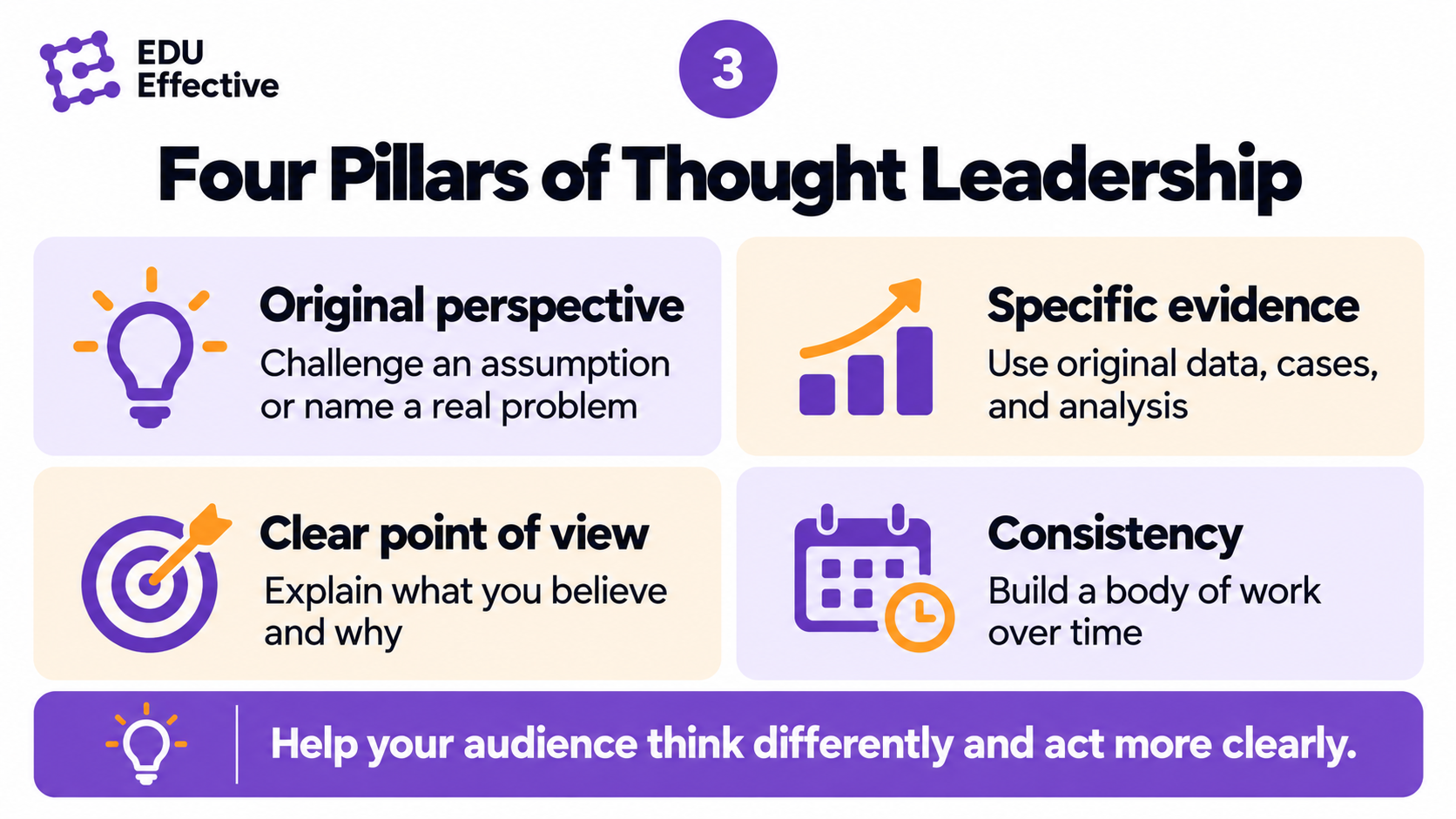
Original perspective on a specific problem. The strongest thought leadership takes a position on something that is actually contested or unclear. It does not summarize industry trends. It tells the reader something they did not know, challenges an assumption they held, or names a problem they recognized but had not articulated. A piece that could have been written by any competent person in your field is not thought leadership. It is content.
Specific evidence. The Edelman-LinkedIn research found that decision-makers rate thought leadership quality most highly when it is grounded in data, case studies, or analysis they cannot get elsewhere. Original research is the highest-value format: 35% of B2B buyers say original research is significantly more valuable than AI-generated content for building trust, per the Ascend2/TopRank 2026 report. A survey of your own customers, an analysis of proprietary data, a structured study of a problem in your specific domain — these produce assets that cannot be replicated by any competitor who simply hires a good writer.
A named point of view. The most effective thought leaders are specific about what they believe and why. Equivocation — “on the one hand, on the other hand” — signals a lack of genuine expertise. A professional who has spent years working on a problem knows what works and what does not. The content that earns trust is the content where that knowledge is visible.
Consistency over time. A single exceptional piece of content does not make a thought leader. The Ascend2/TopRank research found that brands publishing original research annually or quarterly become default authorities in their category. The mechanism is cumulative: each piece of content adds to a body of evidence that the person or organization has sustained attention on a specific problem. Decision-makers who encounter that body of work over months or years develop a level of familiarity and trust that a single piece cannot create.
The Formats That Produce the Best Results in 2026
The Ascend2/TopRank State of B2B Thought Leadership 2026 found that the top-performing formats are video, live and virtual events, and interactive experiences — with 48% of senior marketers citing each as most impactful. CMI’s 2025 B2B research found that video is rated the best-performing format by 58% of marketers, followed by case studies and customer stories (53%) and research reports, whitepapers, and ebooks (45%).
For individual professionals building personal thought leadership — rather than organizational brand thought leadership — the picture is more focused. LinkedIn remains the dominant distribution channel for B2B thought leadership, cited by 54% of senior marketers in the Ascend2 survey. The platform’s organic reach for individuals publishing original content continues to significantly exceed that of company pages. What actually works for professional brands across social channels in 2027.
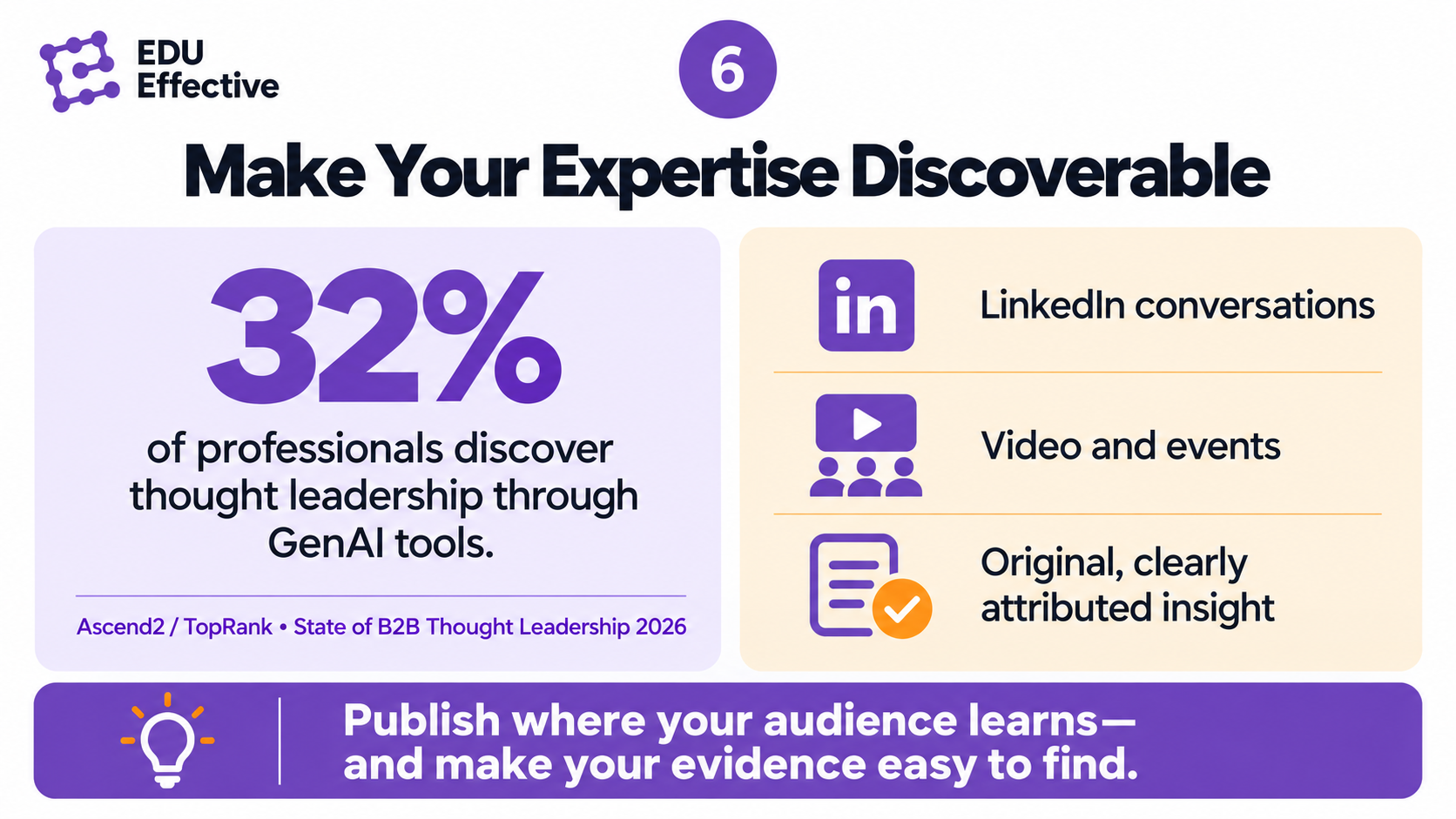
A notable shift: 32% of buyers now use generative AI tools to discover thought leadership, per the Ascend2/TopRank research — yet most content producers do not yet optimize for AI search discovery. This is the GEO (Generative Engine Optimization) gap: content that earns citations in AI-generated answers requires specific attributes — original data, clear authorship, named expertise, and definitive positions — that are also the attributes of high-quality thought leadership generally. The two disciplines are converging. What the data actually shows about content marketing in 2027.
How to Build Thought Leadership as an Individual Professional
The organizational picture above applies to how companies build authority. The individual professional’s personal brand question is different, and more actionable for a manager or executive reading this.
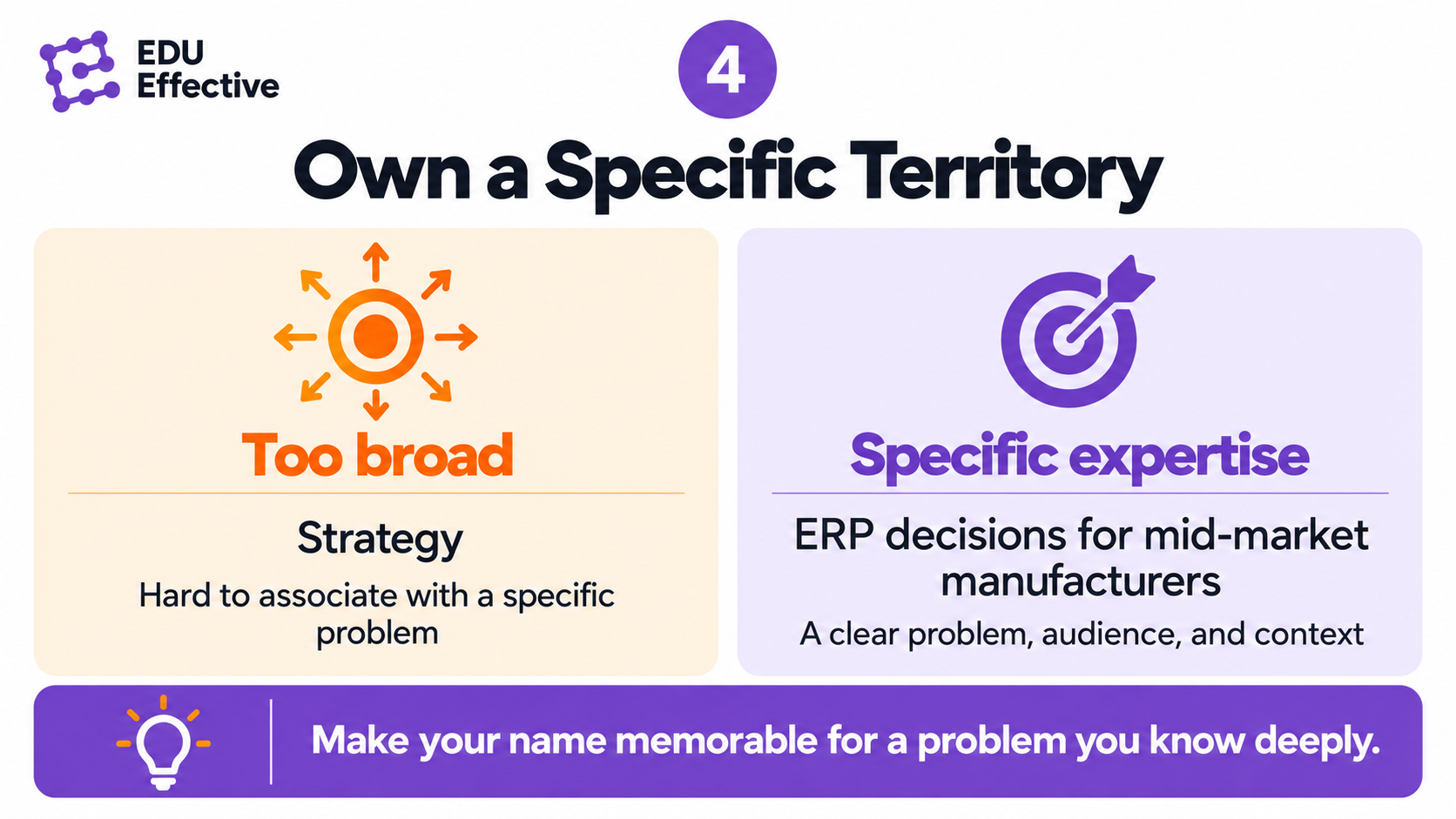
Pick a specific territory. The most effective individual thought leaders are not expert in everything. They are deeply credible on a specific intersection of problems, industries, and approaches. “Strategy” is not a territory. “How mid-market manufacturers evaluate and implement ERP systems” is a territory. The narrower and more specific the territory, the faster authority accumulates — because the audience who cares about that specific problem will find and remember you, while a broad audience will forget a generalist almost immediately.
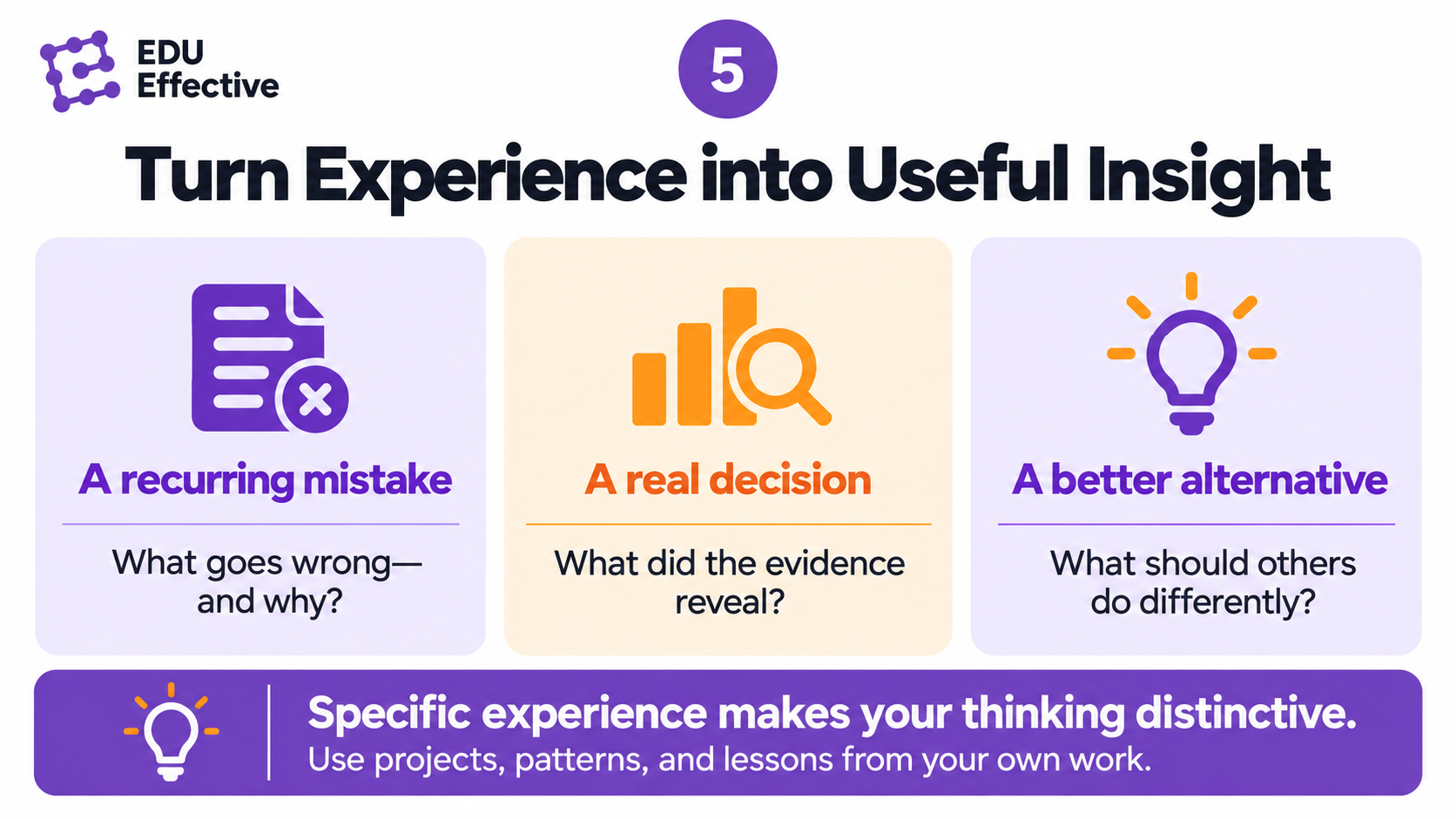
Publish consistently on what you actually know. The barrier most professionals cite is time. But the most credible thought leadership is not long — it is specific. A 600-word piece that names a mistake you see made repeatedly in your domain, explains why it happens, and describes what the alternative looks like is more valuable than a 2,500-word overview of industry trends. Write from experience, not from research into what everyone already knows.
Use your work as material. Projects you have delivered, decisions you have seen go wrong, patterns you have noticed across multiple client engagements or organizational contexts — this is material that no AI tool can generate and no competitor can replicate. The specificity of real experience is the currency of genuine thought leadership.
Engage in conversations, not just publications. The Edelman-LinkedIn research found that thought leadership operates most powerfully through the network effect: when a piece resonates with one decision-maker, it reaches their peers. Responding to comments, engaging with others’ content, and participating in professional conversations — on LinkedIn, in industry publications, at events — builds the relational infrastructure that turns a publication into a reputation.
More than 40% of B2B deals stall due to internal misalignment within buying groups, per the Edelman-LinkedIn 2025 report. The practical implication: thought leadership that helps a champion inside a target organization build the internal case — by providing language, frameworks, and data that can be shared upward — has a direct impact on deal velocity. The best thought leadership is not aimed at the final decision-maker. It is aimed at the person who has to convince the decision-maker.
What Separates Recognized Experts from Competent Professionals
Every field has hundreds of competent professionals. Recognized experts are different in one specific way: they have made their thinking visible, consistently, over a long enough period that a specific audience associates their name with a specific problem.
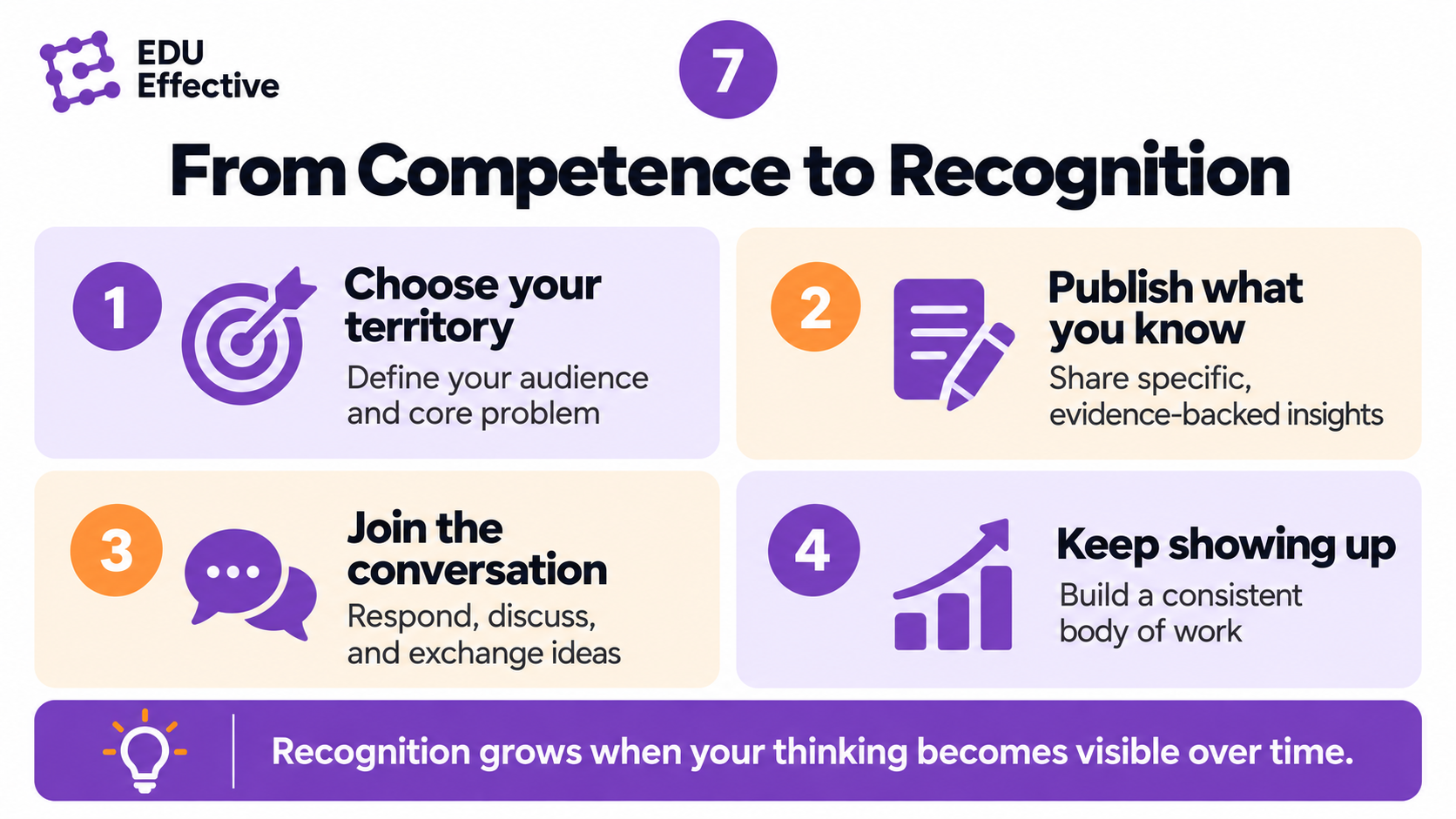
Competence is a prerequisite. It is not the output. The output is visibility of thinking — in writing, in speaking, in research, in the positions you take publicly on questions your audience cares about.
Only 15% of decision-makers rate the thought leadership they consume as excellent. That means 85% of the content in your market is failing to clear the quality bar that actually influences decisions. The market is not too crowded for good thought leadership. It is too crowded for mediocre content. Those are different problems with different solutions.
Build the Expertise That Gets Recognized
Recognized expertise is built on substance first and visibility second. Managers and executives who can turn their operational experience into structured, evidence-backed insight are the ones whose names travel beyond their own organizations. The Effective MBA develops that foundation.
About EDU Effective Business School
The Effective MBA: Executive Management & Leadership is built around the decisions managers actually face every week. Runs on 15 minutes a day, completes in 10 months or less and is ASIC accredited.
Sources
- Edelman and LinkedIn — B2B Thought Leadership Impact Report: https://www.edelman.com/sites/g/files/aatuss191/files/2024-02/_2024%20Edelman-LinkedIn%20B2B%20Thought%20Leadership%20Impact%20Report%20Final.pdf
- Ascend2 and TopRank Marketing — The State of B2B Thought Leadership 2026 (797 senior B2B marketing leaders, U.S. and U.K.): https://www.toprankmarketing.com/guide/b2b-thought-leadership-report-2026/
- Content Marketing Institute (CMI) — B2B Content Marketing Research: https://contentmarketinginstitute.com/b2b-research/b2b-content-marketing-trends-research
- Bain & Company / LinkedIn B2B Institute — B2B buying behavior research (500+ buyers, shortlist formation): https://www.bain.com/insights/raising-the-odds-on-a-deal-how-likelihood-to-buy-rewires-b2b-growth/
- Considered Content — B2B Thought Leadership Effectiveness 2026 (secondary compilation): https://www.consideredcontent.com/b2b-thought-leadership-effectiveness-what-the-data-says-in-2026/