


Most managers inherit a team rather than build one from scratch. They get a group of people with different strengths, different motivations, and different ideas about what "good work" actually looks like — and then they're expected to make it all click. What separates the teams that deliver from the teams that merely function?
High-performing teams don't happen by accident. They're built through deliberate decisions about structure, trust, communication, and how a manager shows up every single day. The research on this is clearer than most people realize — and more consistent across sources than you'd expect.
Why Most Teams Underperform
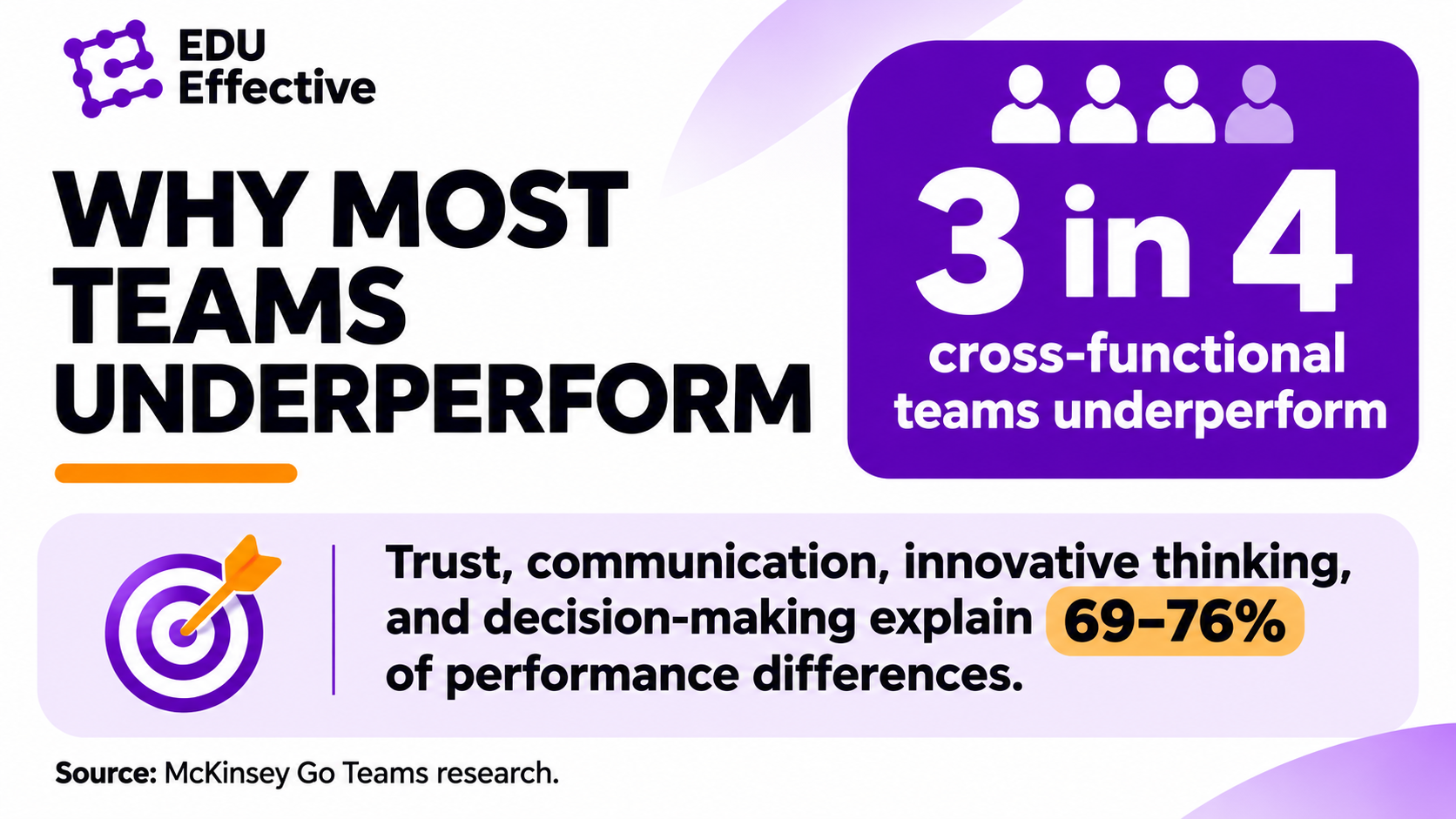
Start with an uncomfortable number. McKinsey's Go Teams research reviewed 14 annual literature reviews and more than 140 published studies, then tracked 905 team members across 110 teams in 42 countries over two years. Finding: three in four cross-functional teams underperform on their key metrics.
That's not a talent problem. The same research found that just four drivers — trust, communication, innovative thinking, and decision-making — explain 69 to 76 percent of the difference between low- and high-performing teams on efficiency, results, and innovation. Teams that ranked above average on trust were 3.3 times more efficient and 5.1 times more likely to deliver results. Above-average decision-making quality made teams 2.8 times more innovative.
And yet — teams routinely misjudge what matters. When asked to rank the drivers, teams placed innovative thinking and decision-making near the bottom, despite their outsized impact. People know trust matters. They dramatically underestimate how much how decisions get made shapes everything else.
The Manager Is the Leverage Point
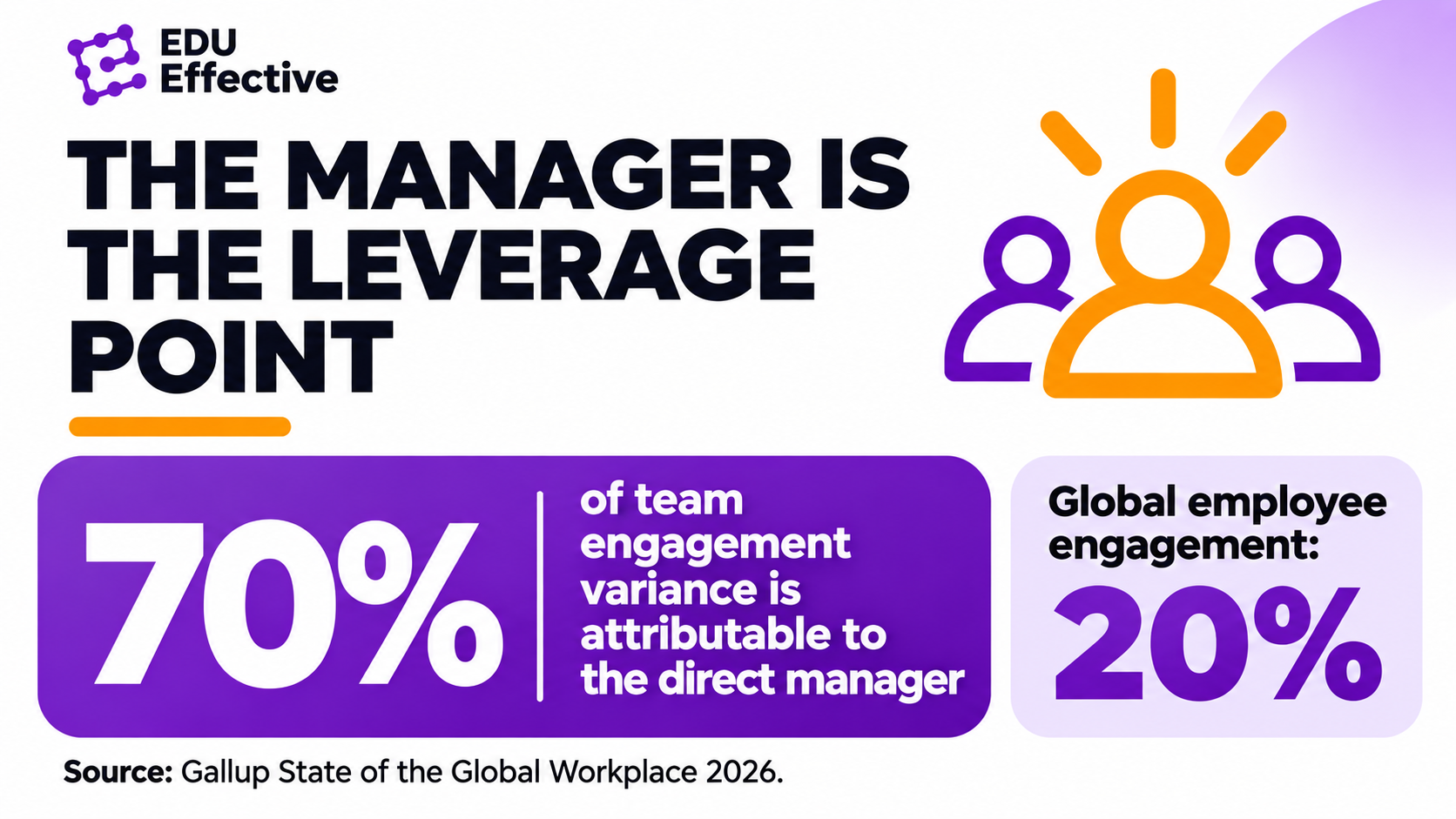
Gallup's State of the Global Workplace 2026 (141,444 respondents, 140+ countries) measured employee engagement across 2025. Global engagement fell to 20% — the lowest since 2020, down from 23% at the 2022–2023 peak. That 3-point decline represents roughly 63 million workers moving out of the engaged category. The economic cost: an estimated $10 trillion in lost productivity, equivalent to 9% of global GDP.
The primary driver of that decline was manager engagement, which collapsed from 31% in 2022 to 22% in 2025 — a nine-point fall in three years. The gap between manager and individual contributor engagement, which once stood at 11 points, has narrowed to just 3 points. Managers are now nearly as disengaged as the people they manage.
Gallup's core finding hasn't changed: approximately 70% of team engagement variance is attributable to the direct manager. That makes the manager the highest-leverage intervention available. When managers are disengaging, their teams follow. This is also why leadership coaching that develops questioning and listening behaviors is one of the few interventions that moves team trust directly.
McKinsey's State of Organizations 2026 (10,018 senior managers, 15 countries, 16 industries, data collected June–September 2025) adds a structural dimension: fewer than 25% of organizations achieve sustainable performance impact, even when they set it as a goal. Organizations that rapidly reallocate resources and talent have a 2.2x higher chance of outperforming competitors on total shareholder return than those that move slowly. The constraint isn't strategy — it's execution speed at the team level.
The Five Conditions Google Found
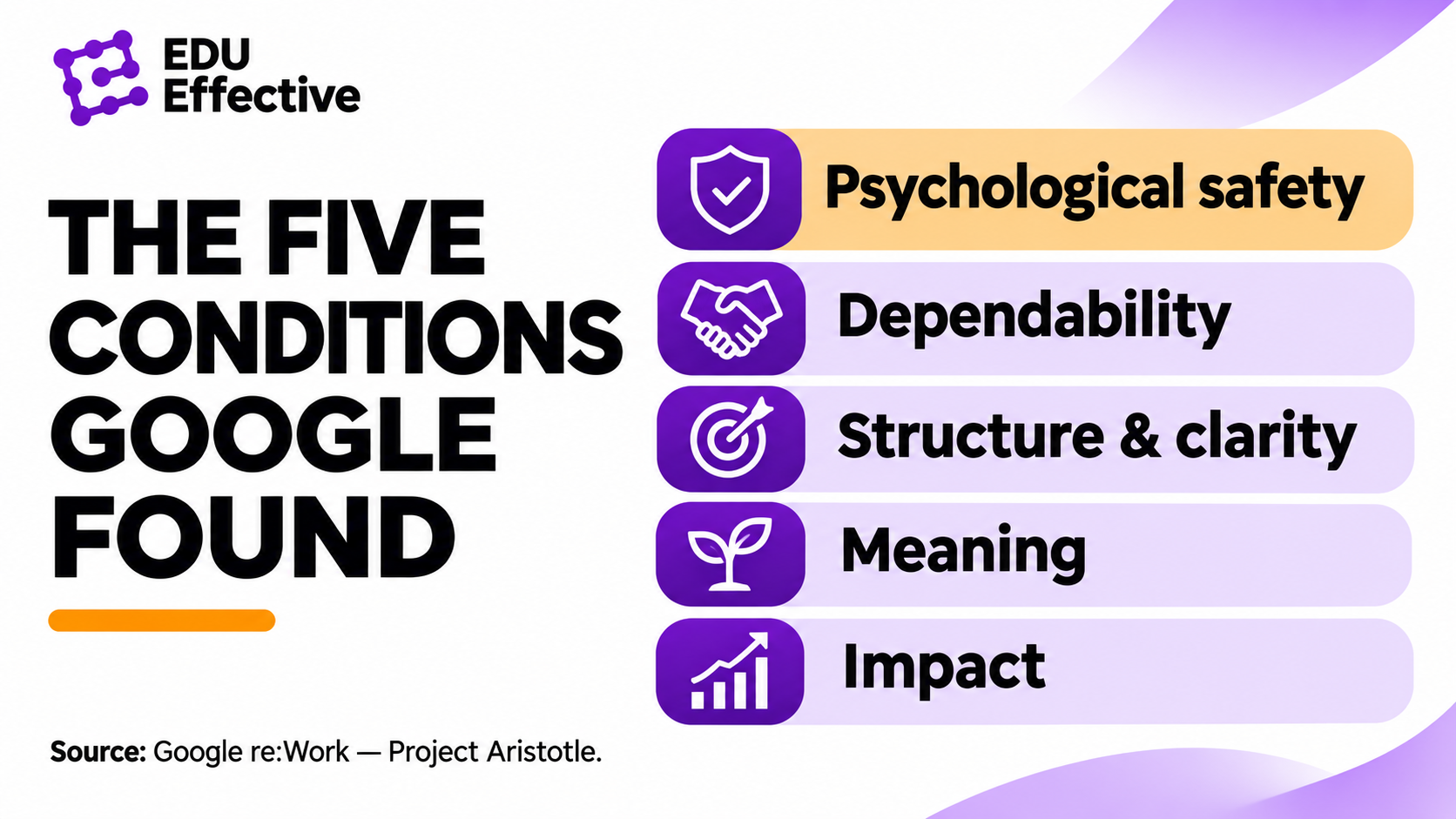
In 2012, Google launched Project Aristotle — a two-year internal study of 180+ teams and 250+ variables. They expected talent density or team composition to predict performance. The answer was more fundamental.
Five conditions distinguished high-performing teams from average ones. Psychological safety ranked first — team members feel safe to take risks, voice opinions, and admit mistakes without fear. Dependability ranked second — people follow through on commitments. Structure and clarity, meaning, and impact completed the five.
Psychological safety sits at the foundation not because it's the nicest condition, but because it's the enabling condition. Without it, the other four are compromised. People don't surface bad news, don't flag blockers early, don't propose unconventional solutions. The team performs to the floor of what's politically safe rather than the ceiling of what's actually possible.
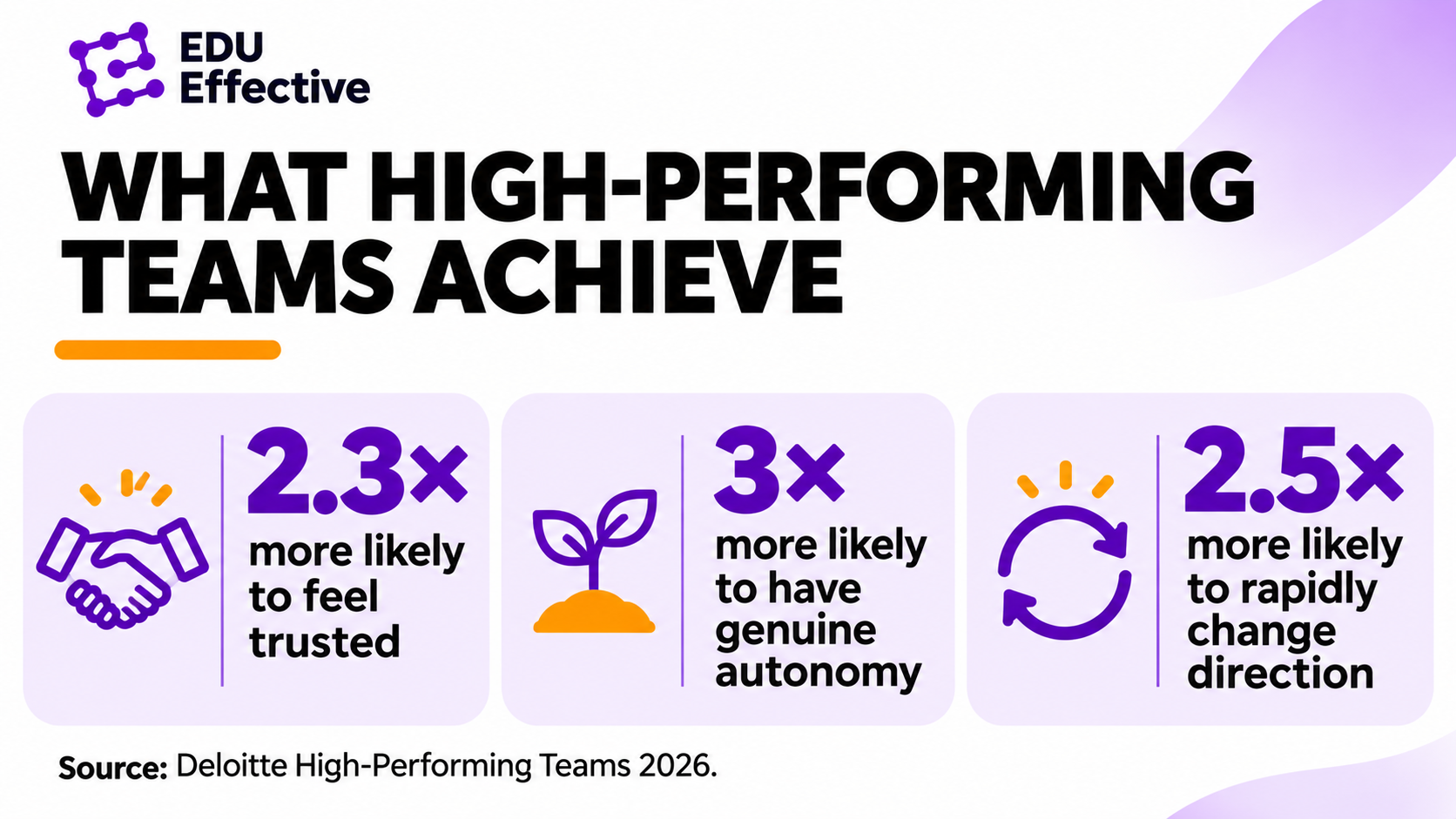
Deloitte's 2026 High-Performing Teams research (1,394 respondents, data collected June–July 2025, published January 2026) quantifies the gap concretely. Members of high-performing teams are 2.3 times more likely to feel trusted by their team leader, 2.3 times more likely to feel respected and recognized by colleagues, and 3 times more likely to have genuine autonomy. The team's ability to rapidly change direction and support each other through change is 2.5 times more likely in high-performing teams.
On learning culture — which directly feeds psychological safety — 40% of high-performing team members report an apprenticeship culture of mutual learning, compared to 15% of others. And yet only 50% of high-performing team members say their team learns from mistakes without excessive blame. The gap is real even among the best.
What High-Performing Teams Actually Do Differently
They define success at the team level, not just the individual level. Most performance management systems are built around individual metrics. High-performing teams add a layer: what does this team need to deliver collectively? McKinsey's State of Organizations 2026 found that only 39% of organizations plan strategic workforce management even annually, and just 14% use flexible planning. Without collective goal clarity, individuals optimize locally and suboptimize together.
They have fewer, clearer goals. The McKinsey Go Teams data shows that only 46% of teams actually agree on their outcome and task interdependence — the two most basic things that define what kind of team they are. OKRs, when used well, solve exactly this problem by forcing public commitment to three to five priorities that everyone can name.
They communicate with a bias toward over-sharing. High-performing teams treat information as a team asset, not an individual one. Status updates, blockers, context on decisions — these travel freely, not only through formal channels and not only upward. The mechanism varies, but the norm is consistent: if it's relevant to the team's work, share it.
They have structured decision-making. McKinsey's data shows decision quality is the most underrated driver of team performance. High-performing teams make it clear who decides what, by when, and with whose input. They distinguish between reversible decisions — which should be made quickly, often by whoever's closest to the problem — and irreversible ones, which warrant more deliberation.
They give and receive feedback regularly, not just at review time. Deloitte's 2026 research found that 67% of respondents expect the importance of human skills to grow over the next two years, yet only 42% strongly agree that their organization places equal emphasis on technical and human skills. Teams that depend on annual performance reviews to surface issues are already operating with a significant lag. High-performing teams normalize real-time feedback — peer-to-peer, not only manager-to-direct-report.
They use AI differently. The Deloitte 2026 data is striking here: high-performing teams use AI tools at a rate of 78% versus 54% for others. And they rate the quality of AI-supported work significantly higher — efficiency (93% vs. 77%), problem-solving (88% vs. 71%), collaboration (79% vs. 57%). AI adoption is not uniform across teams; it correlates directly with team effectiveness.
The Manager's Practical Toolkit
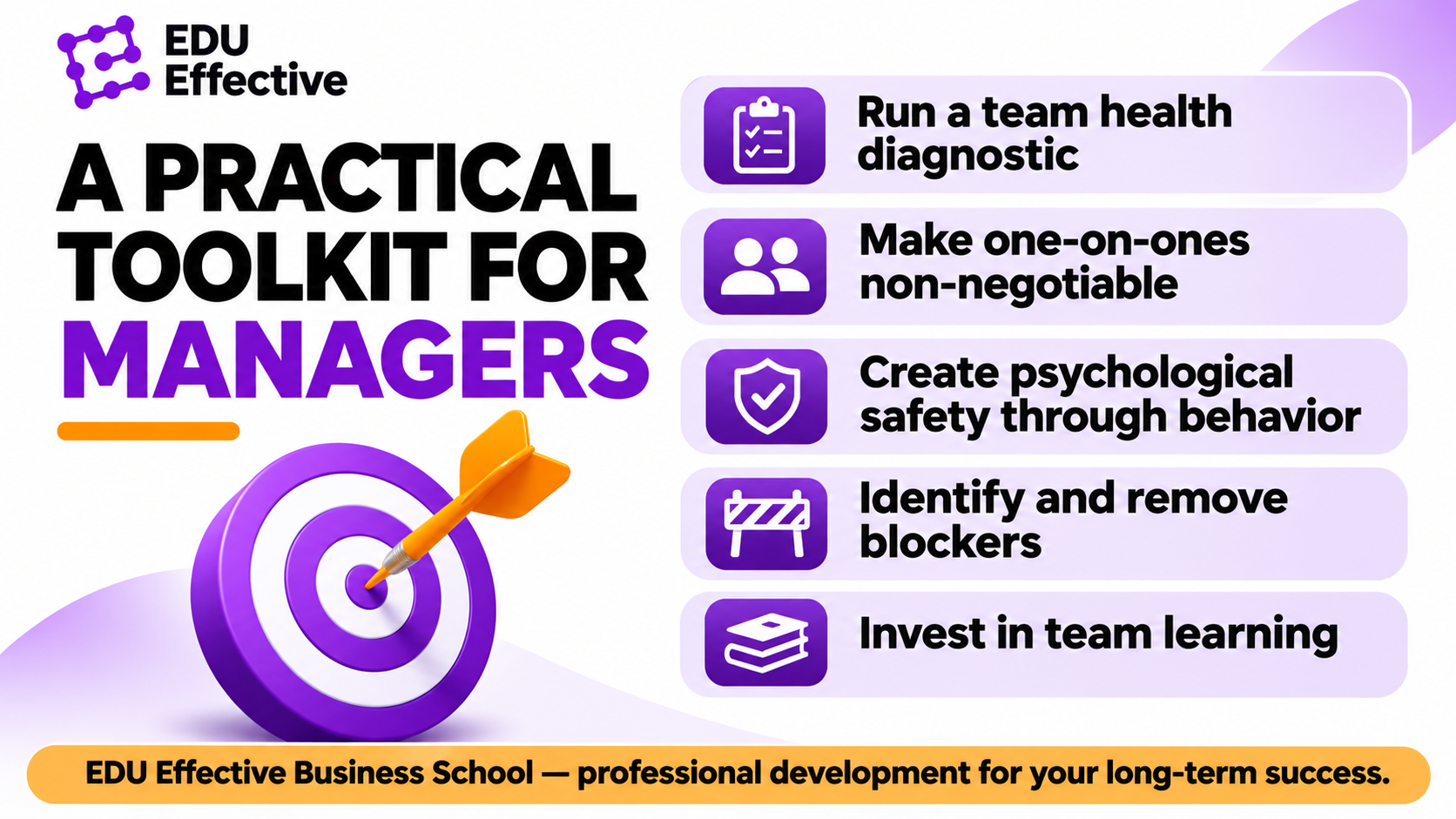
Run a team health diagnostic. Before optimizing anything, understand where you actually are. Ask your team directly: where do we trust each other least? Where does communication break down? What decisions feel unclear? Anonymous input will get you more honest answers than a meeting. McKinsey's framework identifies 17 specific behaviors — teams don't need to excel at all of them, but knowing which four or five are weakest gives you a starting point.
Make one-on-ones non-negotiable. Regular one-on-one meetings between a manager and each direct report are the primary vehicle for individual development, early problem detection, and relationship maintenance. The cadence matters less than the consistency — weekly, biweekly, or monthly all work, as long as it actually happens.
Create psychological safety through behavior, not declaration. Saying "we have an open-door policy" is not the same as reacting calmly when someone brings bad news. Psychological safety is built in small moments: how a manager responds to the first mistake, whether they ask questions before assigning blame, whether they model vulnerability by admitting what they don't know. Deloitte's 2026 data shows that only 50% of high-performing team members say their team genuinely learns from mistakes without excessive blame-seeking. If that's the number at the top, the gap in average teams is wider still.
Identify and remove blockers actively. High-performing teams don't wait for people to escalate. The manager scans proactively: who is stuck, who is working around a problem, where is the team losing time to friction that could be eliminated. McKinsey's State of Organizations 2026 found that 72% of leaders say their organizations are not fully prepared for upcoming changes — even among optimists, only a third feel prepared. That unpreparedness compounds when managers don't remove blockers early.
Invest in team learning, not just individual training. Individual professional development raises individual capability. But high-performing teams also learn together — retrospectives, post-mortems, shared exposure to new methods. Deloitte's 2026 research found that 68% of high-performing team respondents make time to help each other grow and learn. Teams that reflect together on what worked and what didn't get better faster than teams that treat each project as a discrete event.
The Compounding Effect of Team Health
There's a compounding dynamic to team performance that's hard to fully appreciate until you've seen it. McKinsey's State of Organizations 2026 found that organizations which rapidly reallocate talent have a 2.2x advantage in total shareholder return. Gallup's 2026 data shows that manager engagement at 22% — nine points below its 2022 peak — is driving an estimated $10 trillion in annual productivity loss globally. These are downstream outcomes of daily decisions about how teams are led.
The teams that consistently outperform aren't built on talent alone. They're built on clarity about what the team is trying to do, trust in the people doing it, and a manager who treats the quality of the team environment as seriously as any output metric.
That's the work. It's not glamorous. It compounds. The same team-level conditions are also what make an innovation culture possible in the first place.
About EDU Effective Business School
The Effective MBA: Executive Management & Leadership develops the judgment behind everyday management decisions. Runs on 15 minutes a day, completes in 10 months or less and is ASIC accredited.
Sources
- Gallup — State of the Global Workplace 2026 (141,444 respondents, 140+ countries) https://www.gallup.com/workplace/697904/state-of-the-global-workplace.aspx
- McKinsey — The State of Organizations 2026 (10,018 senior managers, 15 countries, 16 industries) https://www.mckinsey.com/~/media/mckinsey/business%20functions/people%20and%20organizational%20performance/our%20insights/the%20state%20of%20organizations/2026/the-state-of-organizations-2026.pdf
- Deloitte — High-Performing Teams 2026 (1,394 respondents, published January 2026) https://www.deloitte.com/us/en/about/press-room/high-performing-teams.html
- McKinsey — Go Teams: When Teams Get Healthier, the Whole Organization Benefits https://www.mckinsey.com/capabilities/people-and-organization/our-insights/go-teams-when-teams-get-healthier-the-whole-organization-benefits
- Google re:Work — Understanding Team Effectiveness (Project Aristotle) https://rework.withgoogle.com/intl/en/guides/understand-team-effectiveness