
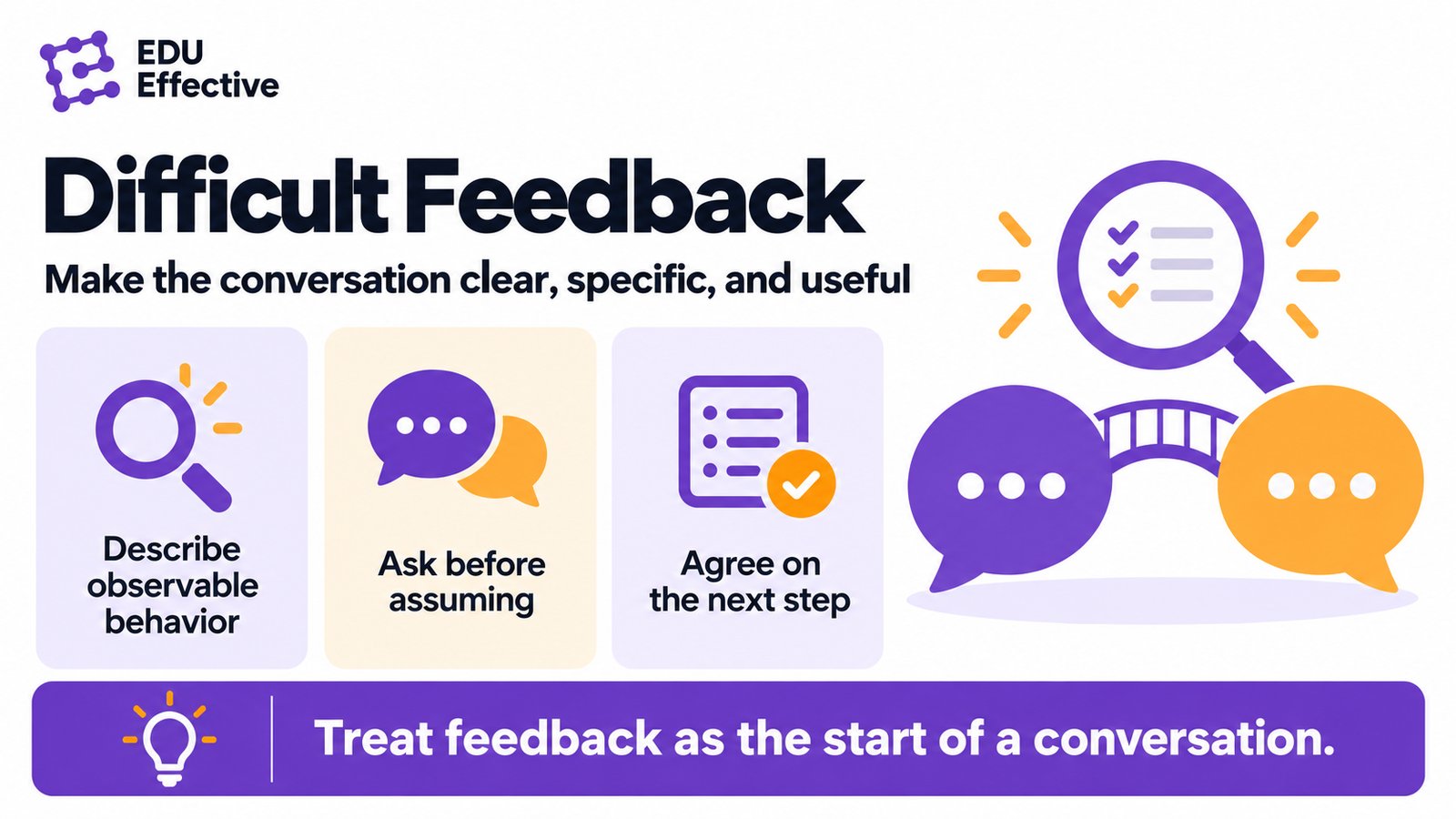

Most managers know they should give more direct feedback. Most do not. The gap between knowing and doing is one of the most consistent findings across workplace research, and its cost is measurable.
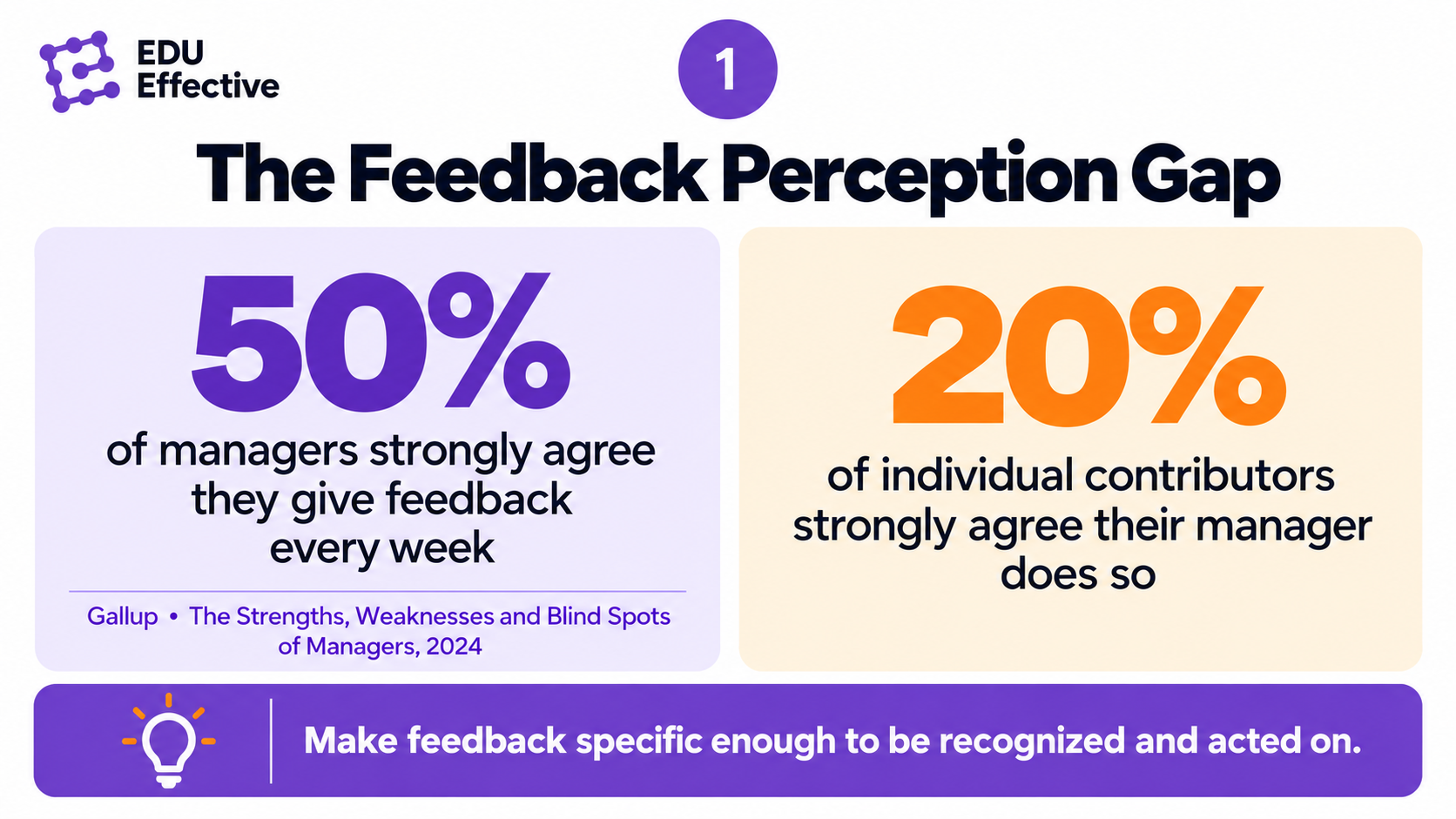
Gallup's study of 2,729 managers and 12,710 individual contributors found that about 50% of managers say they give feedback weekly. Only 20% of employees say they receive it. That 30-point perception gap is not about managers lying. It is about what qualifies as feedback. A vague "good job" in passing registers differently to the giver than to the receiver. Substantive, specific, behaviorally grounded feedback, the kind that actually changes how someone works, is far rarer than managers believe they are delivering.
The research on difficult feedback specifically is even starker. A survey cited by Harvard Business School Working Knowledge (drawing on international data) found that 72% of respondents rated managers providing critical feedback as important for career development. Only 5% believed managers actually provide it. That is not a small gap. That is a near-complete failure to deliver something people explicitly say they need.
This article covers what the research shows about why managers avoid difficult conversations, what distinguishes feedback that improves performance from feedback that damages relationships, and what the practical mechanics of a well-structured difficult conversation look like.
Why the avoidance happens, and why it persists
Research by Francesca Gino and colleagues, summarized by Harvard Business School Working Knowledge, identified a consistent psychological pattern in feedback avoidance: givers systematically overestimate the cost to themselves and underestimate the value to the receiver.
In controlled experiments, people predicted that giving difficult feedback would be more painful and more damaging to the relationship than it turned out to be. After the conversation, they reported it went better than they expected. The receivers, meanwhile, valued the input more than the givers had anticipated. The fear was real; the predicted outcome was not.
What makes this finding important is that the gap grew with the stakes. In higher-consequence situations, where the feedback really mattered, the overestimation of cost was larger. Managers avoid the most important conversations most reliably. The thing they most need to say is the thing they are most likely not to say.
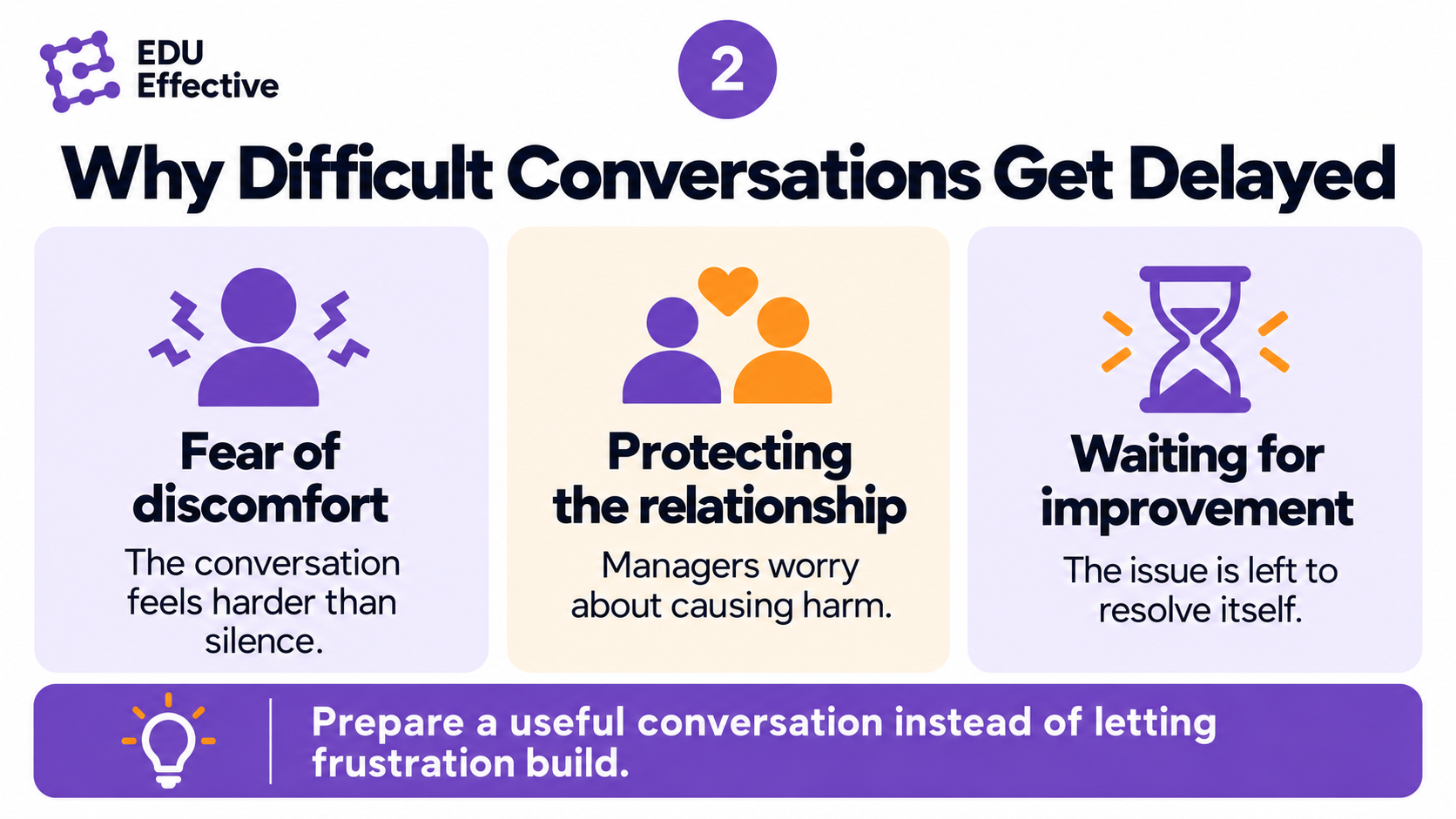
A separate Harris Poll for Interact (2,058 U.S. adults including 616 managers) found that 37% of managers said they were uncomfortable giving direct feedback or criticism, and 69% identified at least one aspect of communication with employees that made them uncomfortable. These are self-reported figures, which means they likely understate the actual avoidance rate. People tend to underreport behaviors they recognize as professionally suboptimal.
The practical consequence is that most organizations have a substantial backlog of undelivered feedback sitting in managers' heads. Performance problems persist longer than they should. Promotable employees do not know what is holding them back. People leave having never understood why the relationship with their manager deteriorated.
What people actually want, which is not what managers assume
The instinct behind feedback avoidance is often protective: managers believe they are sparing people from discomfort. The data does not support this reasoning.
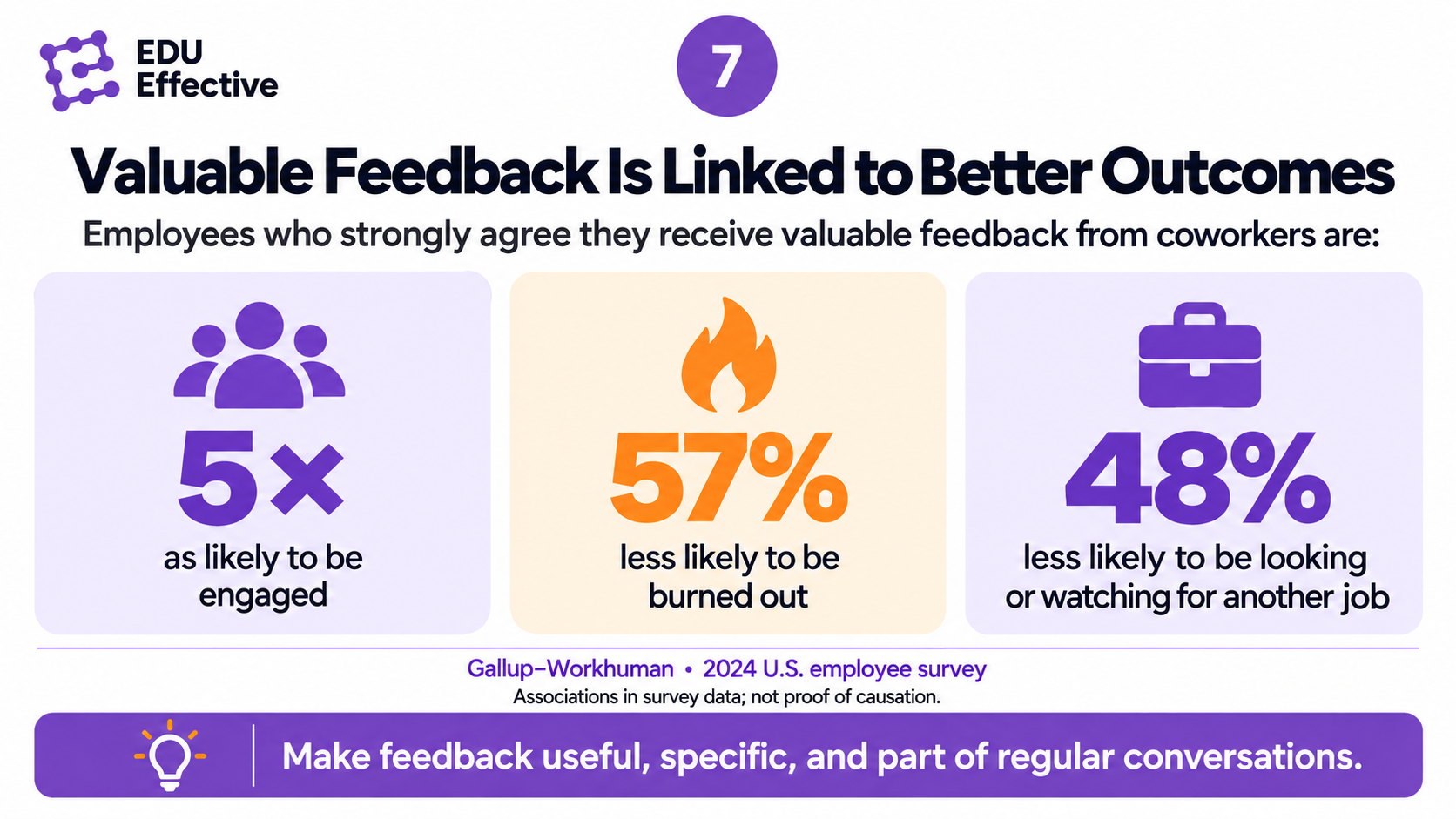
Zenger Folkman's assessment of 899 people found that 57% preferred corrective feedback over praise. 92% agreed that negative feedback, delivered appropriately, improves performance. A Gallup-Workhuman survey of 4,439 U.S. employees found that employees who strongly agree they receive valuable feedback are five times as likely to be engaged, 57% less likely to report burnout, and 48% less likely to be actively looking for another job.
The pattern in the research is consistent: people want to know where they stand, including when the answer is uncomfortable. What they do not want is vague, non-specific, or sandwiched feedback that communicates discomfort without clarity. The problem is not that managers give too much difficult feedback. It is that they give too little of the right kind.
Gallup's State of the Global Workforce report found that only 21% of employees are engaged globally, and that managers drive approximately 70% of team engagement. Fewer than 44% of managers have received training in how to develop people. Among those who have, active disengagement in their teams drops by half. The feedback gap is not just an interpersonal issue. It is an organizational performance issue with a direct line to engagement and retention outcomes. If you are building that capability across a team, it is worth thinking about how mentoring and sponsorship differ and which of the two your people actually need.
The structure of feedback that actually works
The research on feedback effectiveness points to several consistent structural features that separate conversations that change behavior from conversations that generate defensiveness or confusion.
Specificity is the non-negotiable
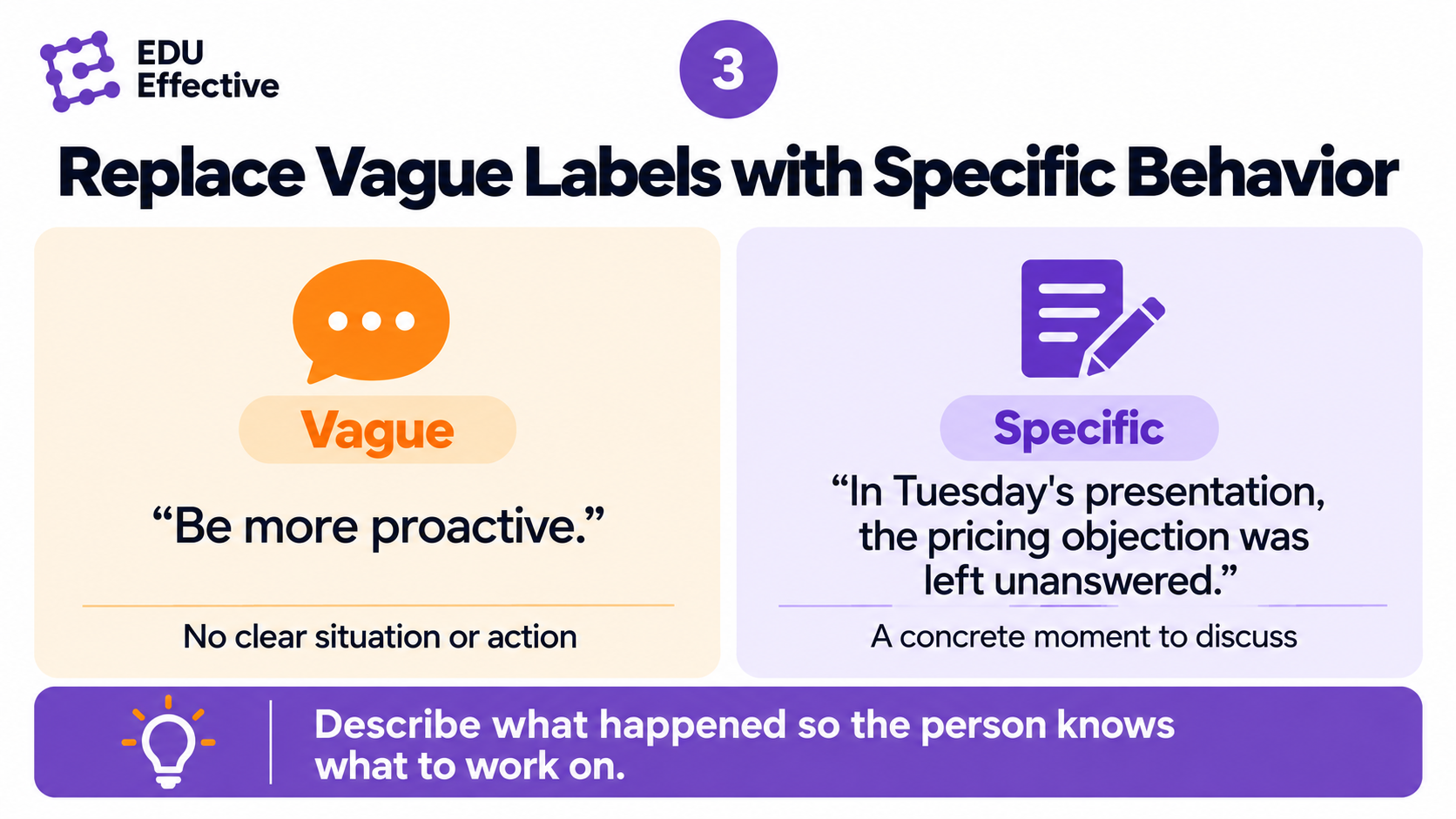
Vague feedback, such as "you need to be more proactive" or "your communication style sometimes creates issues", fails not because it is wrong but because it gives the receiver no actionable information. Specific feedback describes observable behavior in a specific context: "In the client presentation Tuesday, when the client raised the pricing objection, you moved past it without addressing it directly. I want to talk about how to handle that differently."
The receiver can act on the second version. The first version generates only anxiety and speculation about what the manager actually means.
Separate observation from interpretation
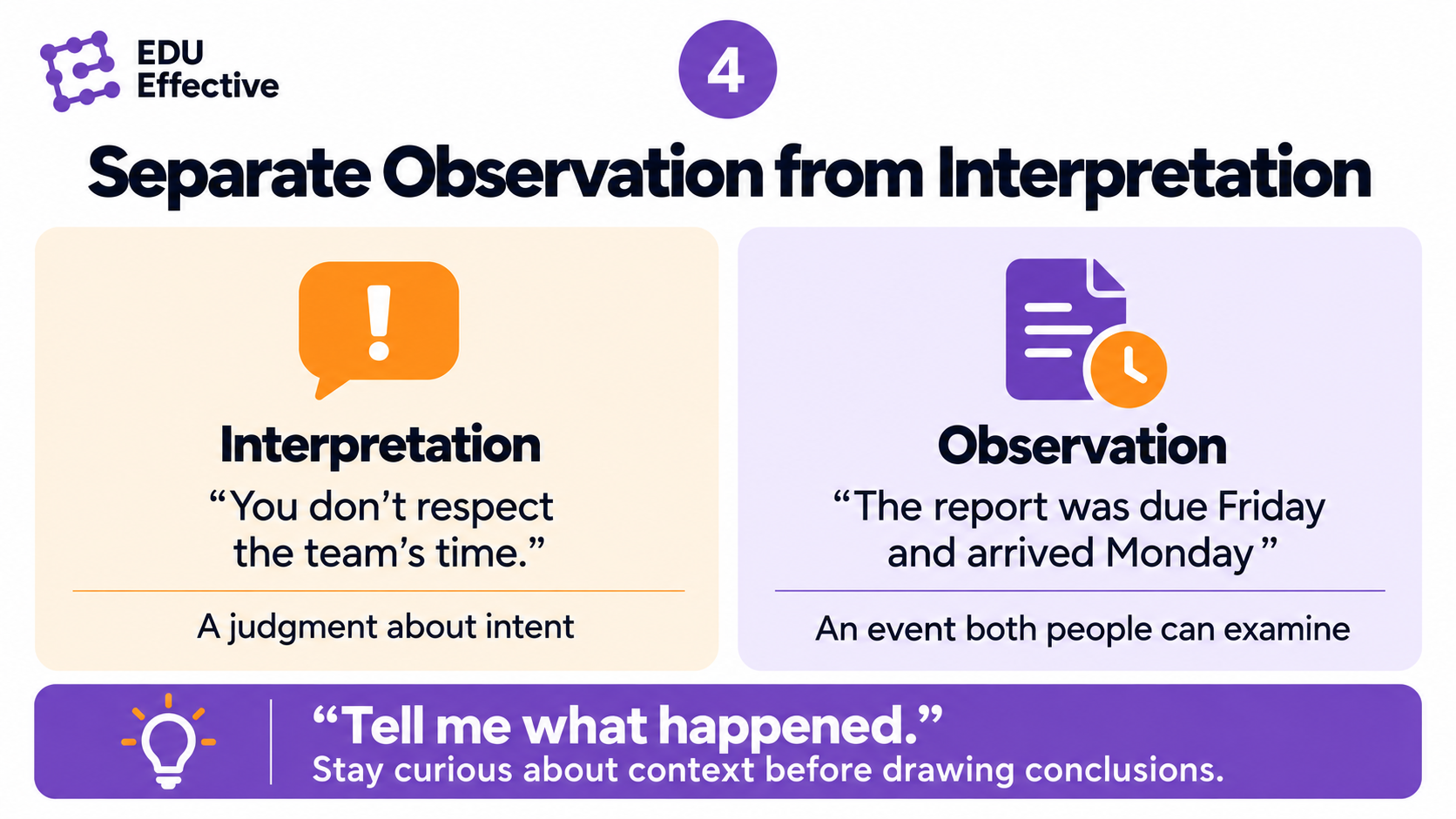
One of the most reliable ways for difficult feedback to go wrong is conflating what happened with what it means. "You missed the deadline and that shows you don't respect the team's time" packages an observation with an attribution that may or may not be accurate, and which the receiver will spend the conversation defending against rather than thinking about the underlying behavior.
Effective difficult feedback separates the two: "The report was due Friday and arrived Monday. Tell me what happened." The conversation stays on the actual situation rather than escalating into a character assessment.
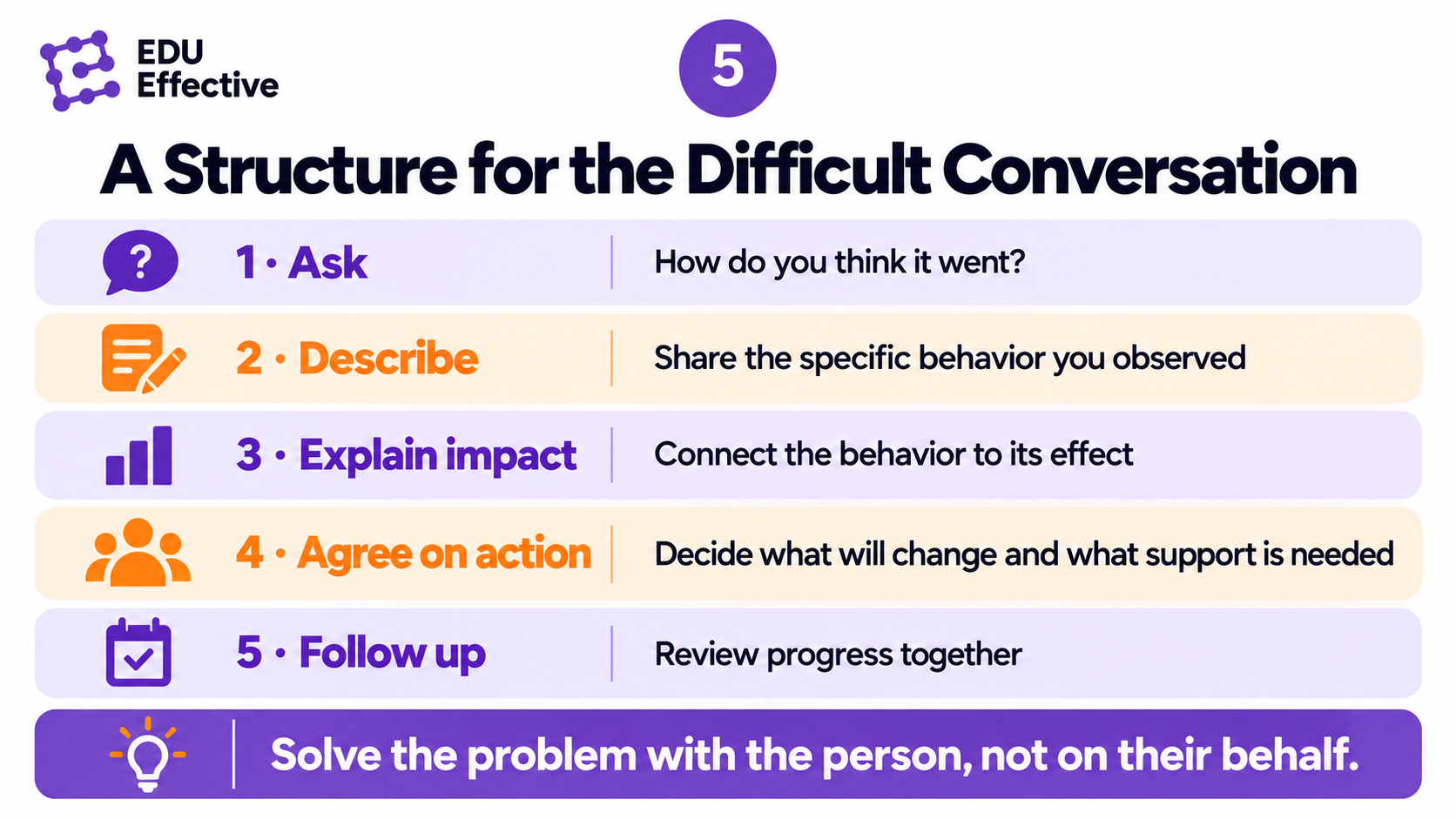
Put together, these features form a repeatable sequence. A five-step guide keeps the conversation structured without making it mechanical: state the observation, describe the impact, ask for their view, agree on what changes, and close with a follow-up date.
Timing: sooner, not later
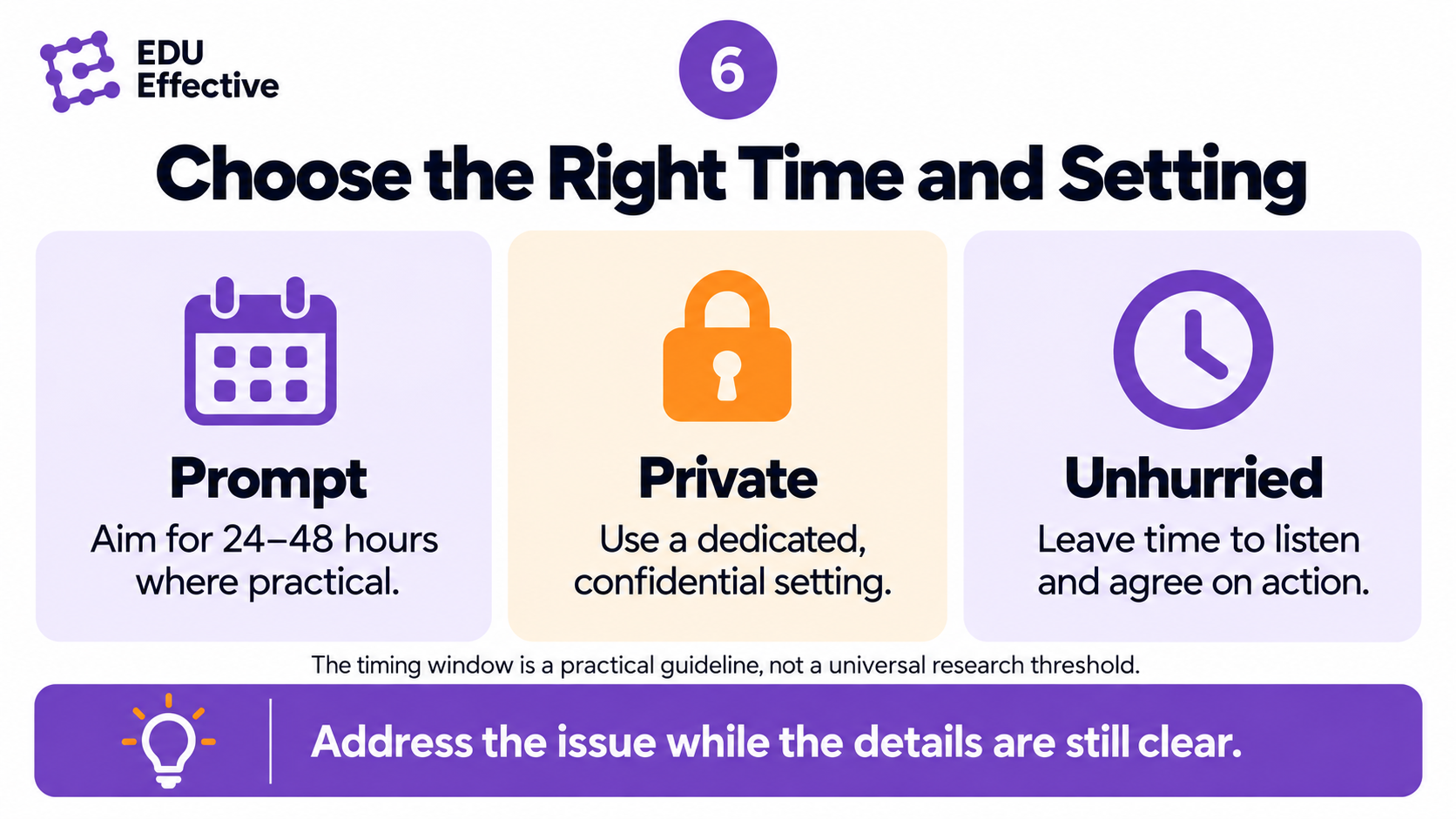
The research consistently shows that delayed feedback loses most of its effectiveness. The further from the event, the more defensive the receiver becomes, the less clearly both parties remember the specifics, and the more the delay itself communicates that the manager has been sitting on a grievance rather than addressing a problem professionally.
The practical standard is: address behavior within 24 to 48 hours of observing it, in a private setting, with enough time allocated to have an actual conversation rather than a quick comment. Feedback delivered in a corridor, in an email chain, or at the end of a performance review cycle is almost never as effective as feedback delivered promptly and in a dedicated conversation.
Ask before telling
The most underused technique in difficult feedback conversations is asking the receiver for their own assessment before offering yours. "How did you think that presentation went?" or "What's your read on why the project timeline slipped?" accomplishes several things simultaneously: it gives the manager information about the receiver's self-awareness, it shifts the conversation from accusation to dialogue, and it often surfaces context the manager did not have.
When the receiver's self-assessment is accurate, the manager's job becomes reinforcing rather than delivering news. When it differs significantly from the manager's assessment, that gap itself is important information about how the person sees their own performance.
The conversations most managers avoid longest
Some feedback categories generate more avoidance than others. Three stand out consistently in research on managerial behavior:
- Performance below expectations in high-potential employees. Managers tend to delay difficult feedback with employees they value, assuming the relationship is strong enough to absorb it or that the problem will self-correct. The delay typically makes both the performance issue and the eventual conversation worse.
- Behavioral or interpersonal feedback. Telling someone their technical work is insufficient is uncomfortable. Telling someone their communication style, their attitude in meetings, or their impact on team dynamics is creating problems is substantially harder. These conversations get delayed the longest and cause the most damage when they finally happen, partly because by the time they are delivered, the manager has accumulated months of frustration that makes it hard to stay specific and constructive.
- Feedback to senior or long-tenured colleagues. Organizational hierarchy creates a strong pull toward silence. Giving difficult feedback to someone who has been in the organization longer, or who holds a more senior title, requires a specific kind of confidence that most managers have not been trained to develop.
What changes when feedback culture is built deliberately
Gallup found that employees who receive meaningful feedback in the past week are 80% more likely to be fully engaged. Employees who receive daily feedback are 3.6 times as likely as those with only annual reviews to strongly agree they are motivated to do outstanding work. Those with weekly feedback are 2.7 times as likely to be engaged as those reviewed annually.
The Gallup 2025 data on manager training is particularly specific: managers trained in coaching approaches see 20-28% performance improvements in their teams, and team engagement rises by up to 18%. These are not small-sample findings. They are drawn from Gallup's longitudinal workplace database covering tens of thousands of employees.
The implication for organizations is that feedback culture is a choice with a measurable return. Teams where feedback is specific, timely, and delivered without the avoidance patterns described above consistently outperform teams where feedback is rare, vague, or negative in atmosphere. Building that culture requires training managers in the mechanics of difficult conversations, not assuming they will develop the capability naturally.
The one thing most managers get wrong about difficult feedback
The framing that causes most difficult feedback to fail is treating it as a verdict rather than a conversation. Managers who approach these discussions as delivering a judgment, here is what you did wrong, here is what needs to change, generate defensiveness. Managers who approach them as collaborative problem-solving, here is what I observed, here is the impact, help me understand what happened and how we address it, generate engagement.
The distinction is not cosmetic. It changes the structure of the conversation, the role of the receiver in it, and the likelihood that anything actually changes as a result. Gallup's finding that only 14% of employees say performance reviews inspire them to improve is a verdict on how most feedback conversations are structured, not on whether difficult feedback can be effective.
The same principle applies to how you measure what follows. Feedback that is never connected to clear expectations and measurable outcomes fades within weeks, which is why it helps to be deliberate about whether OKRs or KPIs fit the outcome you are trying to change.
Feedback that improves performance is specific, timely, behaviorally grounded, and delivered as the beginning of a conversation rather than the end of one. It is not comfortable. It is not supposed to be. But it is not as costly as managers predict, and its absence is consistently more damaging than its delivery.
About EDU Effective Business School
The Effective MBA: Executive Management & Leadership develops the judgment behind everyday management decisions. Runs on 15 minutes a day, completes in 10 months or less and is ASIC accredited.
Sources
- Gallup, State of the Global Workforce 2026 https://www.gallup.com/workplace/349484/state-of-the-global-workplace.aspx
- Gallup-Workhuman, Employee Recognition & Feedback Survey (4,439 U.S. employees) https://www.gallup.com/analytics/472658/workplace-recognition-research.aspx
- Gallup, Manager Feedback Study (2,729 managers, 12,710 individual contributors) https://www.gallup.com/workplace/713033/managers-and-team-productivity.aspx
- Harvard Business School Working Knowledge, Abi-Esber et al., Journal of Personality and Social Psychology https://www.library.hbs.edu/working-knowledge/why-people-crave-feedback-and-why-were-afraid-to-give-it
- Zenger Folkman, Feedback Preference Assessment https://zengerfolkman.com/solutions/leadership-coaching/elevating-feedback/