

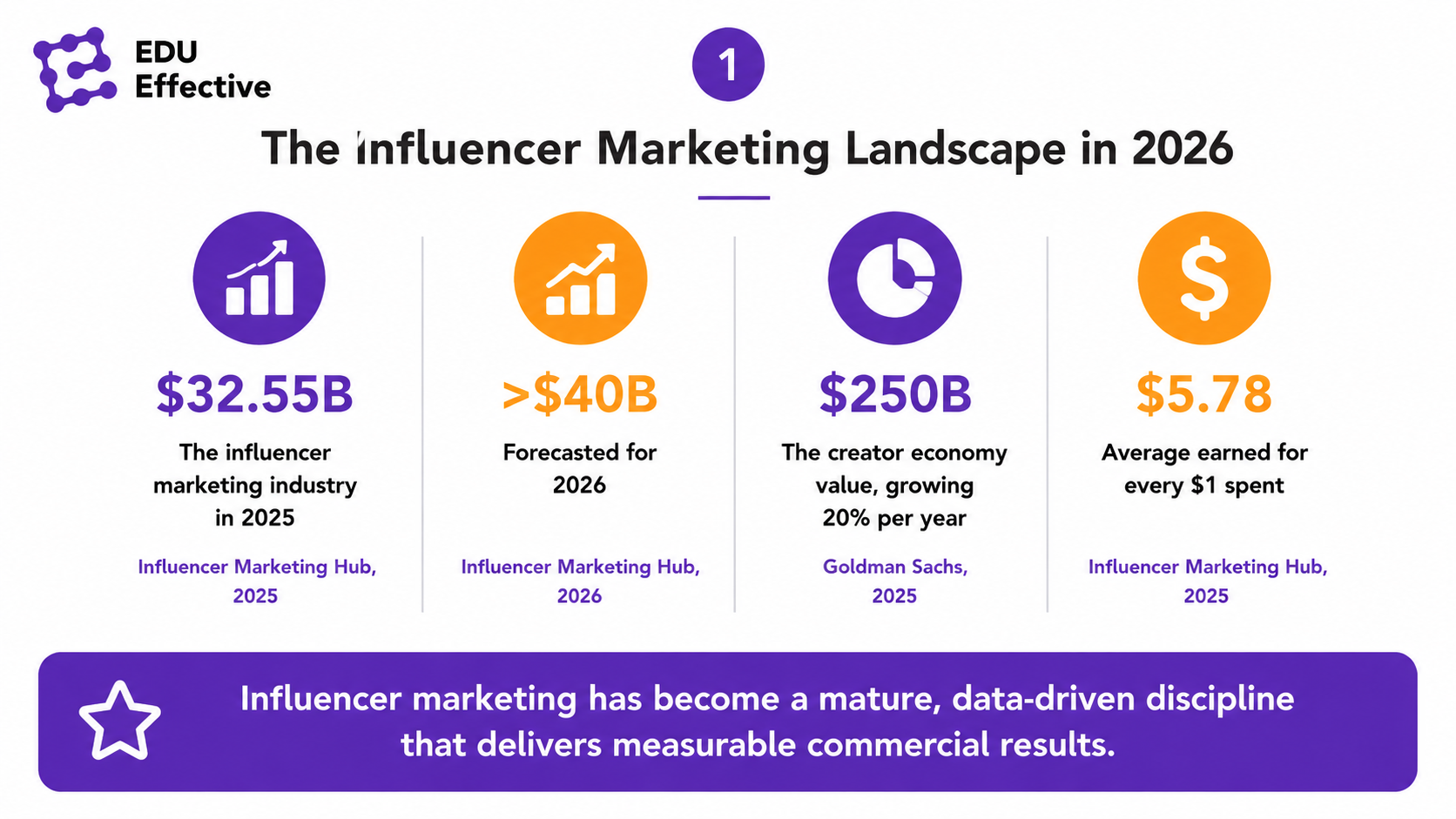
The influencer marketing industry reached $32.55 billion in 2025 and is forecast to exceed $40 billion in 2026, according to Influencer Marketing Hub's annual Benchmark Report — the industry's most widely cited primary research source, based on surveys of thousands of marketing professionals globally. The creator economy as a whole is valued at approximately $250 billion and growing at 20% per year, according to Goldman Sachs' Creator Economy Report. And brands investing in influencer marketing earn an average of $5.78 for every dollar spent, according to Influencer Marketing Hub data.
The growth is not happening in isolation. Influencer marketing has expanded from celebrity endorsements on Instagram into a mature, data-driven discipline operating across platforms, audience tiers, and formats — with sophisticated performance measurement, AI-powered creator selection, and a growing body of research on what actually works. Understanding the landscape clearly — what influencer marketing is, why it performs, and how to build a strategy that produces genuine commercial results — is increasingly a baseline competency for anyone working in digital marketing.
What influencer marketing is — and why it works
Influencer marketing is the practice of partnering with individuals who have built audiences on social media platforms — or through podcasts, newsletters, YouTube channels, and other content formats — to reach those audiences with brand messages, product recommendations, and promotional content.
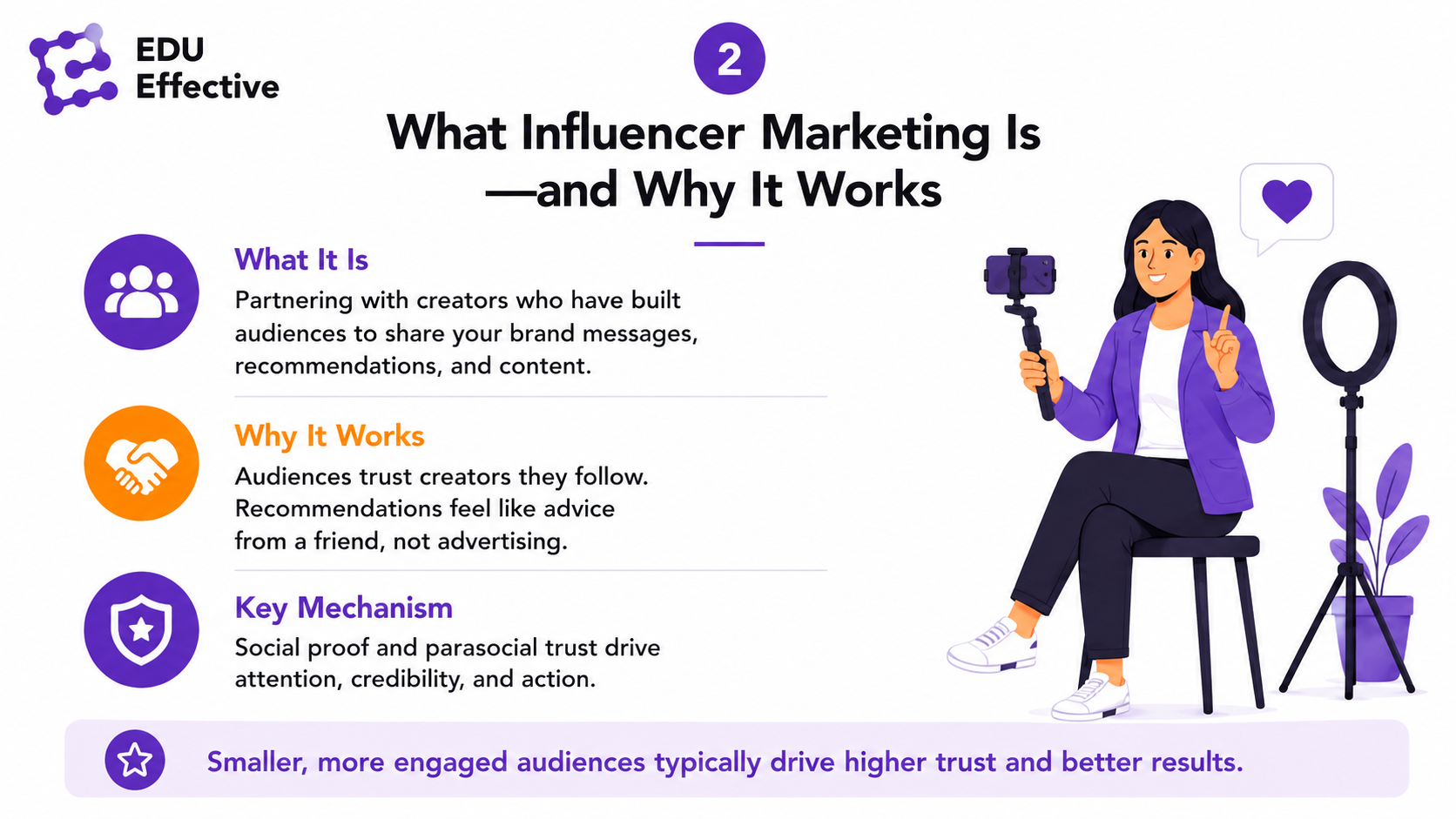
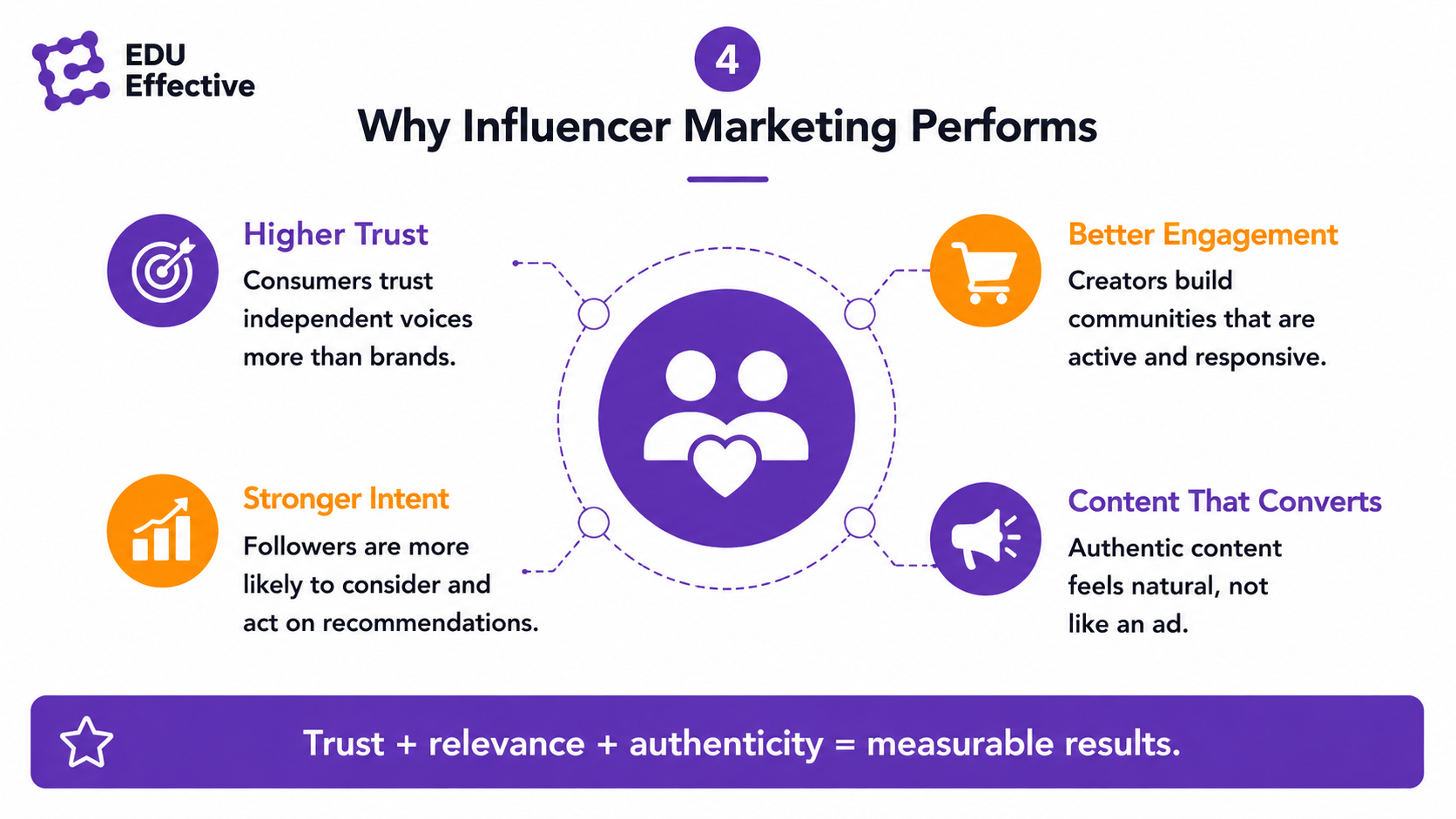
The commercial logic of influencer marketing rests on a specific psychological mechanism: social proof and parasocial trust. Audiences who follow a creator consistently over time develop a level of familiarity and trust with that person's opinions and recommendations that is qualitatively different from their relationship with advertising from a brand they do not know. When a trusted creator recommends a product, the recommendation carries the weight of a friend's opinion rather than the scepticism that brand advertising typically encounters.
Edelman's Trust Barometer consistently shows that consumers trust peer recommendations and independent voices significantly more than they trust advertising from brands. The influencer marketing channel operationalises this trust differential at scale — connecting brands with the audiences of creators whose recommendations those audiences are predisposed to act on.
This mechanism also explains why influencer marketing effectiveness varies so significantly by creator type and audience relationship. The audiences most likely to act on a creator's recommendation are those with the strongest parasocial connection — which is typically the smaller, more engaged audiences of nano and micro-influencers, not the large but less engaged audiences of mega-influencers and celebrities.
The influencer tier framework — who to work with and why
Influencer marketing strategy in 2026 is primarily organised around creator tiers defined by audience size, each with a distinct performance profile.
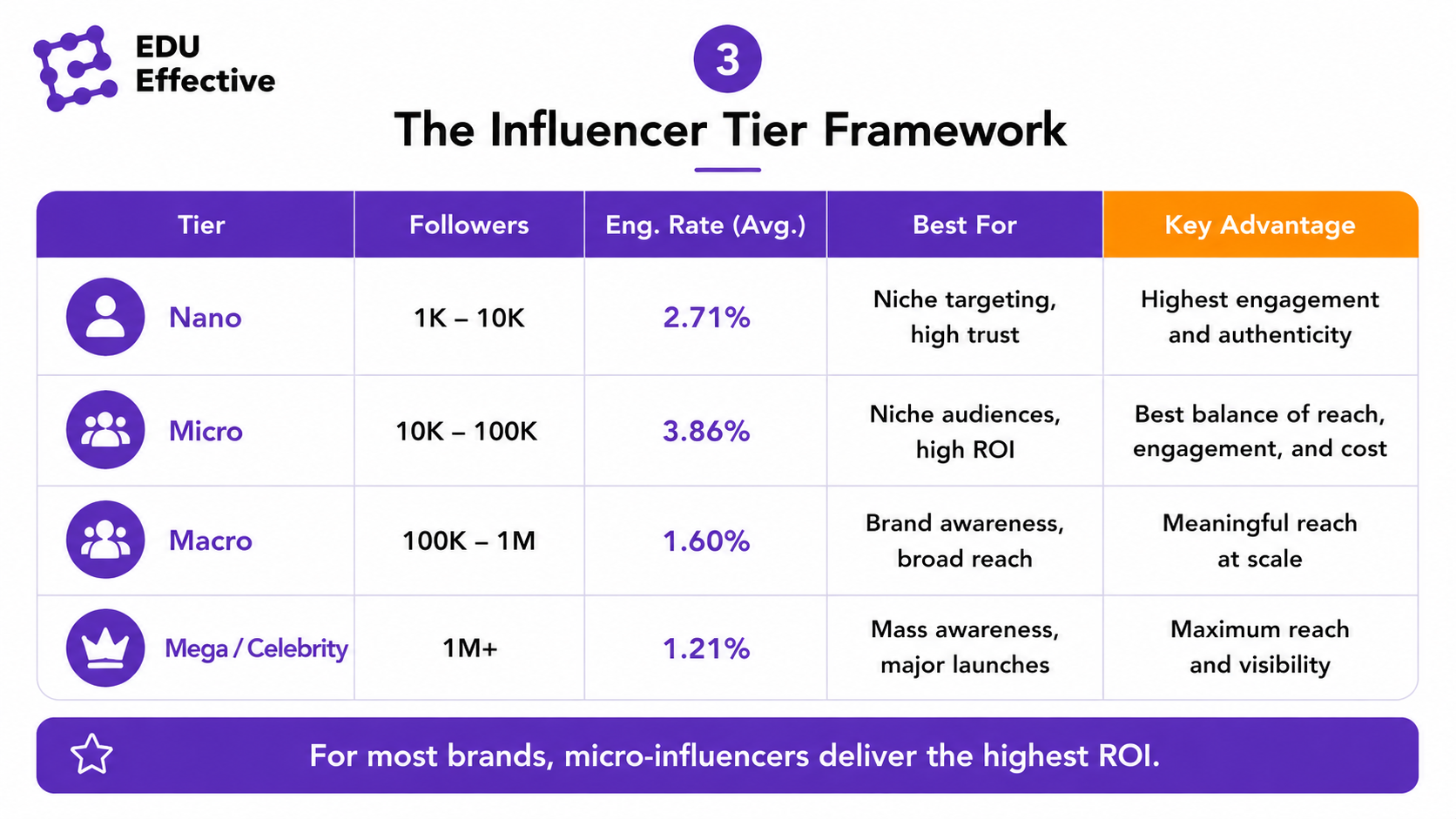
Nano-influencers (typically 1,000 to 10,000 followers) are the smallest tier and the highest-performing on engagement rate. Nano-influencers now represent 75.9% of Instagram's influencer base and achieve an average engagement rate of 2.71% — dramatically higher than the 1.21% average for mega-influencers with audiences of one million or more, according to Influencer Marketing Hub data. Their audiences are typically highly specific communities with whom the creator has genuine personal connection. The reach per post is low; the quality of that reach — in terms of audience trust and responsiveness to recommendations — is disproportionately high.
Micro-influencers (10,000 to 100,000 followers) combine meaningful reach with above-average engagement. They deliver 3.86% average engagement rates at cost per post that is typically 60% lower than macro-tier creators, according to current research benchmarks. For most brands — particularly those with defined niche audiences in health, fitness, food, finance, parenting, technology, and professional development — micro-influencers represent the highest ROI tier because their audience specificity matches their commercial objectives more precisely than broader-reach options.
Macro-influencers (100,000 to one million followers) reach larger audiences at higher cost. They are most appropriate for brand-awareness objectives in categories where broad reach matters more than niche specificity, and for launches that benefit from simultaneous exposure across a large audience.
Mega-influencers and celebrities (one million or more followers) provide maximum reach at maximum cost, with the lowest engagement rates of any tier. They are appropriate for campaigns where the primary objective is cultural visibility or association with a specific public figure's brand equity — not for campaigns where action, conversion, or niche audience targeting are the primary objectives.
The strategic implication is that most brands are better served by partnerships with multiple nano and micro-influencers than by single partnerships with mega-influencers at equivalent or higher budget. 40% of dedicated influencer marketing budgets are spent on micro-influencers, according to Influencer Marketing Hub's 2026 research, reflecting the accumulated learning that engagement quality, not audience size, predicts commercial performance most reliably.
Platforms: where influencer marketing performs in 2026
Platform selection is one of the most consequential decisions in influencer marketing strategy — because platform determines content format, audience demographic, engagement mechanics, and the cultural context in which recommendations land.
TikTok has the highest average engagement rate of any major influencer platform at 5.3%, according to current benchmarks — nearly three times Instagram's 1.9%. 56% of brands increased their TikTok influencer spending in 2026. TikTok's short-form video format rewards authenticity and entertainment over polished production, and its algorithm distributes content based on watch behaviour rather than follower count, giving creators the ability to reach beyond their existing audience. The platform's short-term ROI benchmark is 11.8%, according to Sprout Social research.
Instagram remains the platform preferred by 57% of brands for their primary influencer channel, according to Influencer Marketing Hub data. Its combination of short-form video (Reels), stories, posts, and live formats makes it versatile across campaign objectives. Instagram's shopping features allow direct conversion tracking from influencer content — an important capability as measurement expectations increase.
YouTube produces the longest-lasting influencer marketing impact of any platform: 62% of viewers recall brand mentions from YouTube influencer content after 30 days, according to research cited across multiple 2026 studies. Long-form video allows deeper product demonstration and more nuanced storytelling than short-form alternatives — which is why YouTube influencers consistently perform strongly for considered purchases in categories like technology, beauty, and finance. Sponsored YouTube videos from macro-influencers typically cost $5,000 to $25,000 per video, reflecting the platform's demonstrated brand-building value.
LinkedIn is the emerging influencer marketing platform for B2B contexts. 55% of B2B marketers already use influencer marketing, with another 29% planning to adopt it, according to Ipsos research. LinkedIn thought leaders and subject matter experts who have built professional audiences represent a significant and largely underdeveloped opportunity for B2B brands targeting professional decision-makers.
How to build an influencer marketing strategy that delivers
The most common failure in influencer marketing is not the absence of investment but the absence of strategy. Brands that treat influencer marketing as ad hoc sponsorships rather than as a systematic channel consistently underperform relative to those with defined creator selection criteria, clear campaign objectives, structured content briefing, and robust measurement frameworks.
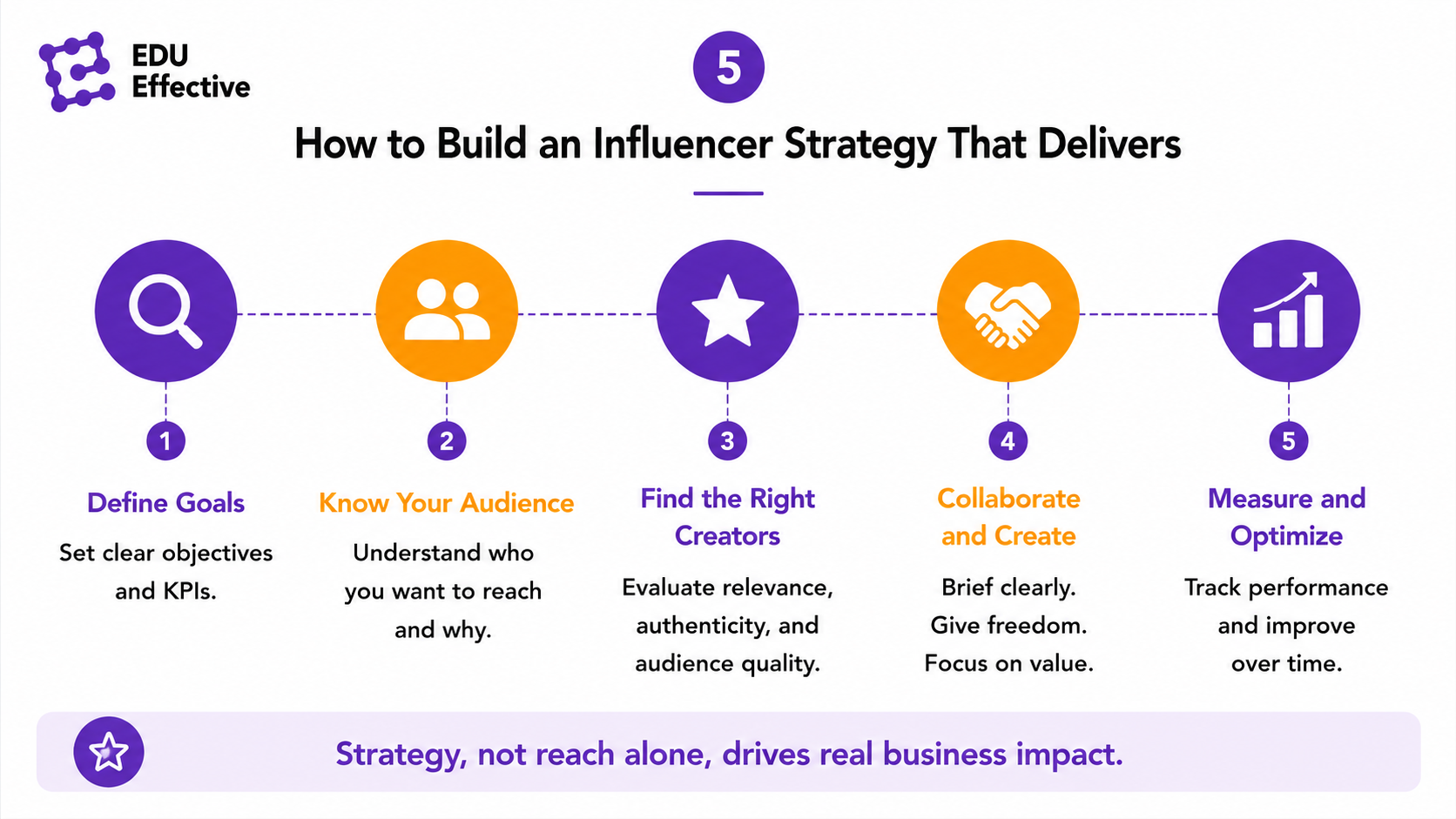
Define the objective before selecting the creator. Influencer marketing serves different objectives depending on where in the marketing funnel a brand is targeting: awareness at the top, consideration in the middle, conversion at the bottom. The campaign structure, creator tier, and performance metrics appropriate for a brand-awareness objective are different from those appropriate for a conversion objective. Campaigns that conflate these objectives — selecting creators for reach while measuring conversion performance, or selecting for conversion audiences while expecting awareness outcomes — consistently produce disappointing results.
Select creators based on audience fit, not follower count. The single most consistent finding in influencer marketing research is that audience relevance predicts performance more reliably than audience size. The right micro-influencer whose audience is precisely your target customer profile will outperform a macro-influencer with a larger but less relevant audience in almost every performance metric. Audience analysis — examining the demographic profile, geographic distribution, and interest structure of a potential creator's audience — is the most important pre-campaign activity in influencer selection.
Brief for authenticity, not brand control. The parasocial trust that makes influencer marketing effective is grounded in the audience's belief that the creator is being genuine. Heavily scripted, brand-controlled influencer content consistently underperforms authentic creator-led content because audiences recognise and discount scripted recommendations. The most effective influencer briefs communicate what the brand is and why a creator who genuinely finds value in it should want to share it — and then give the creator latitude to communicate that in their own voice and style. Gifted collaborations deliver 2.19% engagement rates — 12.9% higher than paid collaborations at 1.94% — reflecting the authenticity advantage of content that is not primarily transactional.
Use long-term partnerships rather than one-off posts. 58% of brands now opt for influencer collaborations of three months or more, according to Klear's 2026 research. Long-term ambassador relationships produce compounding benefits: audiences become familiar with the creator's association with the brand, the creator's genuine familiarity with the product improves content quality, and the consistency of the association builds credibility in ways that single posts cannot.
Measure what matters. The metrics that matter in influencer marketing depend on the campaign objective. For awareness campaigns: reach, impressions, brand search uplift, and share of voice. For consideration campaigns: engagement rate, click-through rate, content saves, and profile visits. For conversion campaigns: tracked link clicks, promo code redemptions, direct attributable sales, and cost per acquisition. A campaign measured on reach when the objective was conversion will appear to succeed while failing commercially; the measurement framework needs to match the objective.
Influencer marketing in 2026: the AI transformation
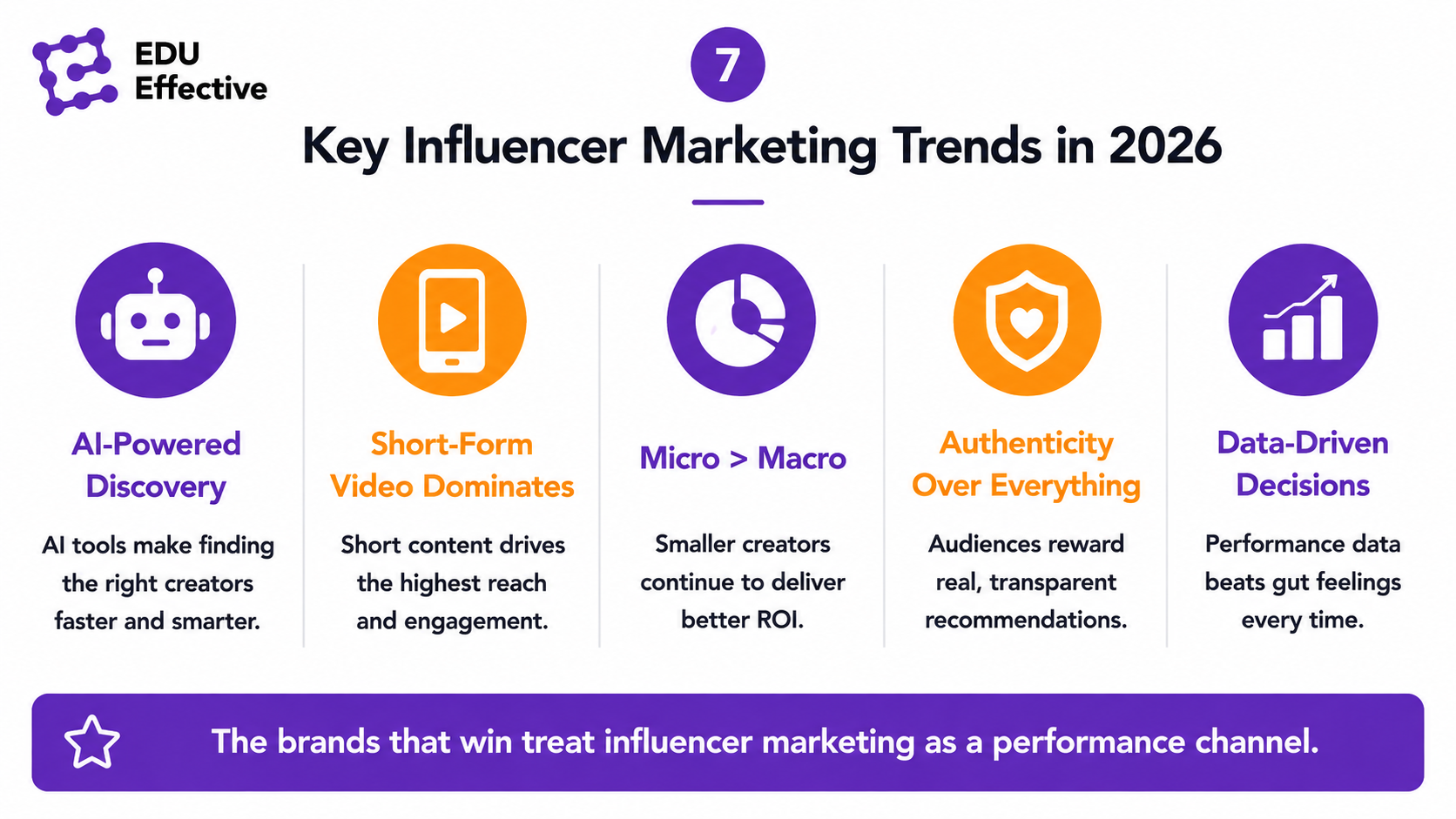
AI is reshaping influencer marketing at every stage of the campaign process. 66% of marketers report that AI integration has actively improved their influencer marketing campaign outcomes, according to Influencer Marketing Hub's 2026 research. 26.89% of marketers identify AI creator matching as their top strategic priority for 2026.
AI-powered creator discovery — using machine learning to analyse audience demographics, engagement patterns, brand safety signals, and predicted performance across thousands of potential creators — has dramatically reduced the time and subjectivity of influencer selection. What previously required weeks of manual research can now be completed in hours, with better data quality and more consistent application of selection criteria.
AI fraud detection has become essential as influencer fraud — fake followers, artificially inflated engagement, and audience manipulation — has become more sophisticated. AI systems that identify anomalous engagement patterns, suspicious follower growth trajectories, and inconsistencies between audience demographics and engagement behaviour are standard in professional influencer marketing platforms in 2026.
Predictive performance analytics — AI models that forecast which content will perform before it is published, based on historical performance data, platform algorithm signals, and audience behaviour patterns — allow brands to optimise content briefs and posting strategies before a campaign launches rather than adjusting after results are in.
Measurement: the ROI calculation that makes influencer marketing defensible
The most consistent challenge in influencer marketing is demonstrating ROI in ways that satisfy finance and leadership stakeholders who expect the accountability standards of performance marketing. The average $5.78 return per dollar is a useful benchmark, but the specific ROI of any campaign depends on measurement methodology, attribution approach, and the full range of value the campaign produced.
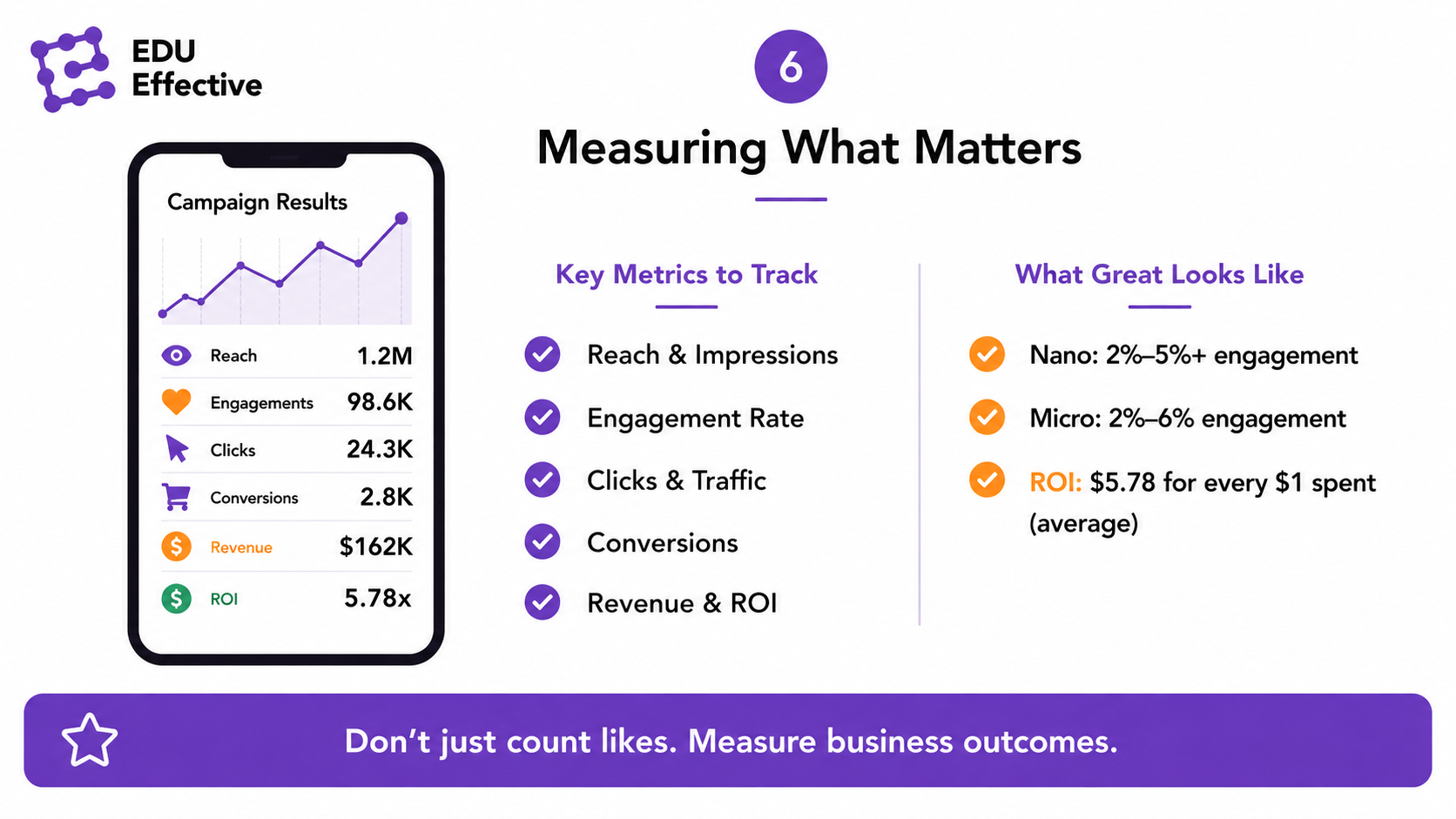
The most defensible ROI frameworks for influencer marketing combine direct conversion tracking (promo codes, tracked links, pixel-based attribution) with earned media value calculations (the cost equivalent of the organic reach and impressions generated) and brand equity metrics (survey-based measurement of awareness, consideration, and preference uplift in the target audience). No single metric captures the full value of influencer marketing, which operates simultaneously at multiple stages of the customer journey.
76% of marketers describe influencer marketing as "effective" or "very effective" for their goals, according to Influencer Marketing Hub's 2026 Benchmark Report. The 24% who do not typically cite measurement gaps rather than channel failure as the primary reason — suggesting that the channel's performance is widely validated and that the remaining adoption barrier is primarily analytical capability rather than commercial evidence.
At EDU Effective, the Effective MBA: Online Marketing covers influencer marketing alongside the full range of digital marketing disciplines — from SEO and content marketing to email marketing, social media strategy, and marketing analytics. Content draws on practitioners from leading digital and marketing organisations, delivered in 15 minutes a day. Explore the programme →
Related articles
Social Media Marketing Strategy in 2026: What Works and How to Build It
Content Marketing Strategy in 2026: What Works, What Has Changed
The Marketing Funnel Explained: How the Customer Journey Works
EDU Effective Business School — professional development for your long-term success.
All five Effective MBA programs are built on the same educational model — designed for working adults who need learning that fits real professional life:
Effective MBA: Executive Management & Leadership
Effective MBA: Applied Artificial Intelligence
Effective MBA: Coaching, Leadership & Mentoring
Effective MBA: Online Marketing
Every programme runs on 15 minutes a day, completes in 10 months or less, is ASIC accredited, and starts from €990.
These are professional programmes, not academic ones — built for working adults to apply what they learn directly in their own business, not to collect a scholarly credential.
Join more than 9,000 students in over 120 countries who are investing in their professional development and career success. Read the experiences of our graduates here.
Apply now — from €990 · Talk to a Study Advisor
Study with NO risk: 14-day money-back guarantee, no questions asked.
Sources
Influencer Marketing Hub — Influencer Marketing Benchmark Report 2026: $32.55B Market Size; $5.78 ROI per $1; 76% Marketers Say Effective; 66% Report AI Improving Outcomes; Nano-Influencer 75.9% of Instagram Base; 2.71% Engagement Rate
https://influencermarketinghub.com/influencer-marketing-benchmark-report/
Edelman — Trust Barometer 2025: Consumer Trust in Peer Recommendations vs. Brand Advertising
https://www.edelman.com/trust/trust-barometer
HubSpot — State of Marketing Report 2026: 85% of Marketers Describe Influencer Marketing as Effective
https://www.hubspot.com/state-of-marketing
Statista — Influencer Marketing Worldwide: Platform Growth, Budget Allocation, and Market Sizing Data 2026
https://www.statista.com/topics/2496/influence-marketing/
Sprout Social — TikTok Influencer Marketing ROI Benchmark: 11.8% Short-Term ROI
https://sproutsocial.com/insights/influencer-marketing/
Ipsos — B2B Influencer Marketing Adoption: 55% of B2B Marketers Already Use Influencer Marketing
https://www.ipsos.com/en/
Klear — Influencer Marketing Trends 2026: 58% of Brands Opt for 3+ Month Collaborations
https://klear.com/blog/influencer-marketing-statistics/