

79% of marketing leads never convert to sales, according to MarketingSherpa research — with lack of proper lead nurturing consistently identified as the primary cause. At the same time, B2B buyers in 2026 complete 70% to 80% of their purchase journey before ever making contact with a sales representative, according to Gartner and Forrester research — meaning that most of the decision has already been shaped by content, peer reviews, and self-directed research long before any salesperson enters the conversation.
These two numbers describe the same underlying reality from opposite directions: the quality and structure of the marketing funnel — the path a potential customer follows from first awareness to final purchase — determines whether the investment in marketing generates revenue or generates activity. Understanding how the funnel works, why it behaves differently in 2026 than it did five years ago, and how to design one that actually converts is one of the most practically valuable marketing capabilities available.
What the marketing funnel is — and where it comes from
The marketing funnel is a model that describes the progressive stages a potential customer moves through on the way to making a purchase. The metaphor of a funnel is deliberate: a large number of people enter at the top (awareness), a smaller number progress to the middle (consideration), and a still smaller number reach the bottom (decision and purchase). The funnel narrows at each stage as some proportion of potential customers exit — through disqualification, loss to competitors, or simply moving on.
The underlying framework traces back to E. St. Elmo Lewis's AIDA model, first articulated in 1898: Attention, Interest, Desire, Action. Lewis observed that effective advertising moves a potential customer through a sequence of psychological states — first making them aware of a product, then generating interest in it, then creating desire for it, and finally prompting action. The AIDA model has been extended, revised, and adapted continuously in the century since Lewis proposed it, but its fundamental structure — progressive stages of engagement leading toward a decision — remains the conceptual foundation of every modern customer journey model.
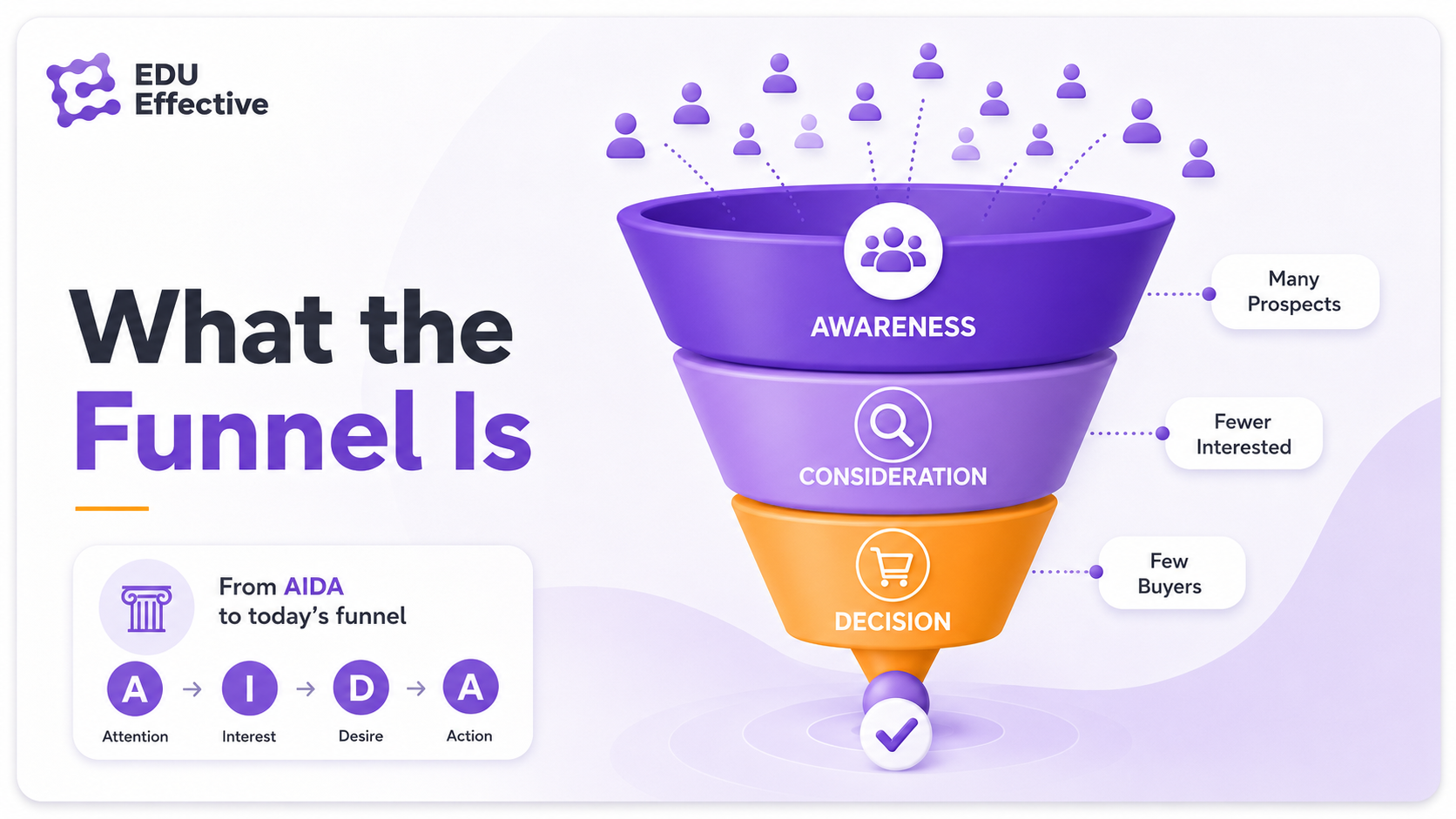
In 2026, the funnel is frequently described as inadequate for the complexity of modern buying behaviour — and it is. Customers do not move linearly from awareness to purchase; they research, reconsider, compare alternatives, abandon and return, and loop back through earlier stages multiple times before committing. But the funnel's value is not its literal accuracy as a description of individual customer behaviour. It is its utility as an organising framework for marketing strategy: it clarifies which content, channels, and messages serve which phase of the customer relationship, and prevents the common mistake of applying bottom-of-funnel sales pressure to customers who are still in the awareness phase.
The three stages of the marketing funnel — what happens at each
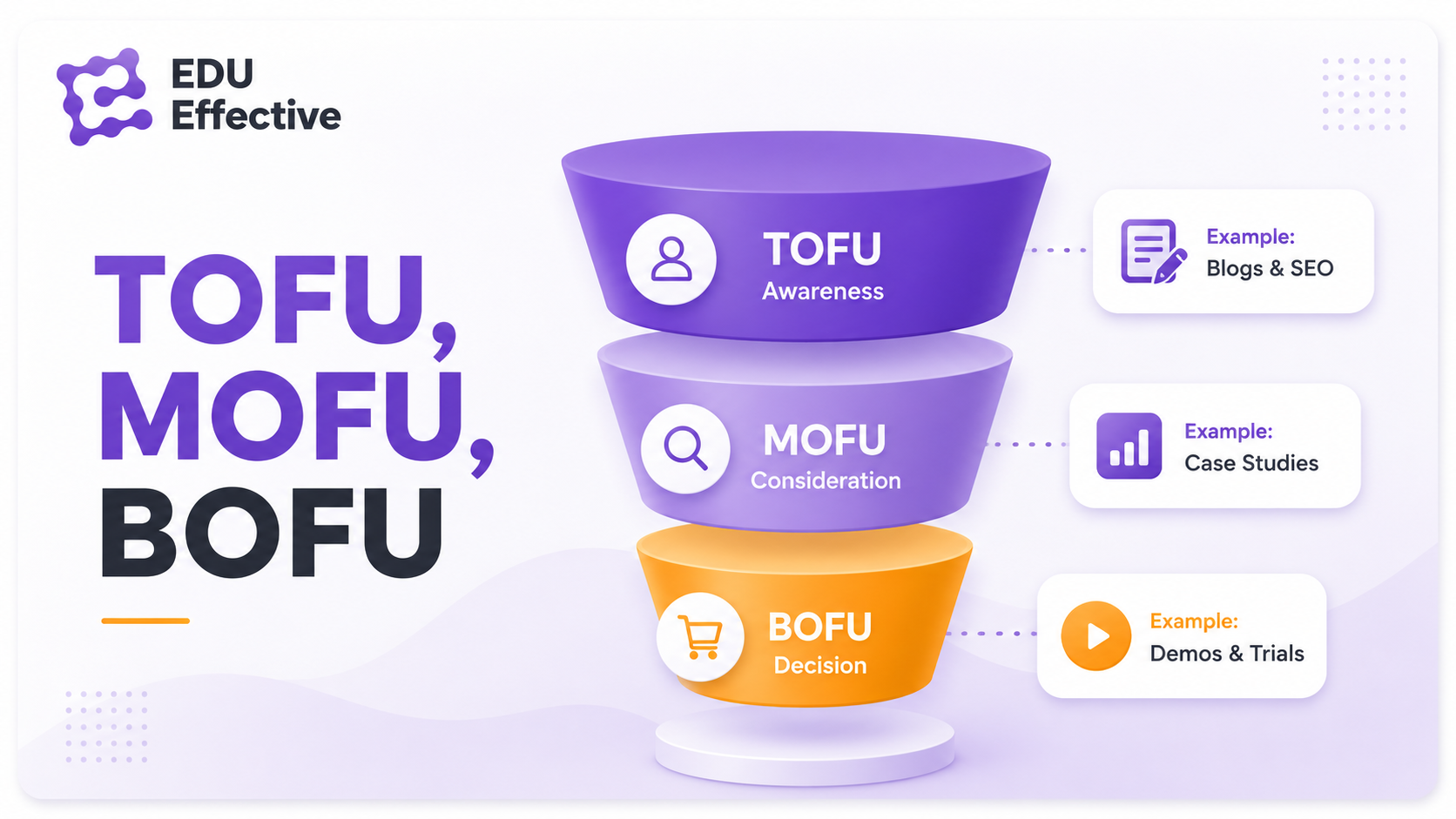
Top of funnel (TOFU): Awareness
The top of the funnel is where potential customers first encounter your brand, product, or content. They may not yet know they have a problem you can solve. They may know they have a problem but not know what solutions exist. They are in the early stages of exploration — looking for information, education, and perspective rather than for a sales pitch.
The marketing objective at this stage is visibility and relevance: being present where your target audience is searching, browsing, or consuming content, and providing something genuinely useful that earns their attention and creates a positive first association with your brand.
The content formats that perform best at TOFU are educational and informational: blog articles, videos, social media content, podcasts, infographics, and any format that delivers value without requiring a purchase commitment. SEO is particularly important at this stage — 68% of online experiences begin with a search engine, and the brands that appear in those early searches shape the consideration set before potential customers have even identified what they are looking for.
Middle of funnel (MOFU): Consideration
Middle of funnel is where potential customers have defined their problem and are actively evaluating solutions. They know what they need; they are not yet sure which provider, product, or approach best serves their specific situation. This is the stage where comparison happens — between your offering and competitors, between different approaches to solving the same problem, between doing something and doing nothing.
The marketing objective at this stage is education and differentiation: providing the specific information that helps potential customers understand why your approach is the right one for their situation, building the trust and credibility that makes a purchase feel safe, and maintaining engagement during the often-extended period between initial interest and final decision.
The content formats that perform best at MOFU are more detailed and more specific than TOFU content: case studies, webinars, comparison guides, white papers, product demonstrations, and email sequences that deliver relevant information progressively over time. Peer reviews and case studies are decisive for 68% of B2B buyers at the consideration stage, according to DemandGen Report research — reflecting the reality that evidence of results for people in similar situations is more persuasive than any marketing claim.
Bottom of funnel (BOFU): Decision
Bottom of funnel is where potential customers are ready to make a purchase decision. They have done their research, narrowed their options, and are evaluating the specific terms, risks, and commitments of choosing your offering over the alternatives. At this stage, the question is no longer "what should I buy?" but "should I buy from you, and on what terms?"
The marketing objective at BOFU is removing friction and building confidence: providing the specific information needed to make a final decision, reducing perceived risk through guarantees and transparent terms, and making the purchase process as simple as possible. Free trials, consultations, demos, money-back guarantees, and personalised proposals are the primary conversion tools at this stage.
The mistake most commonly made at BOFU is applying high-pressure sales tactics to customers who still have unresolved doubts. 86% of B2B purchases stall during the process, according to Forrester's State of Business Buying 2024 — and the primary cause is not competitive preference but unresolved uncertainty about whether the decision is the right one. The most effective BOFU marketing does not push harder; it addresses the specific concerns that are causing hesitation.
The AIDA model — and how it maps to the modern funnel
The AIDA model (Attention, Interest, Desire, Action) remains the most widely used framework for structuring individual marketing communications across all stages of the funnel. It provides a practical structure for any piece of content, campaign, or sales message by specifying the psychological progression that effective persuasion needs to follow.
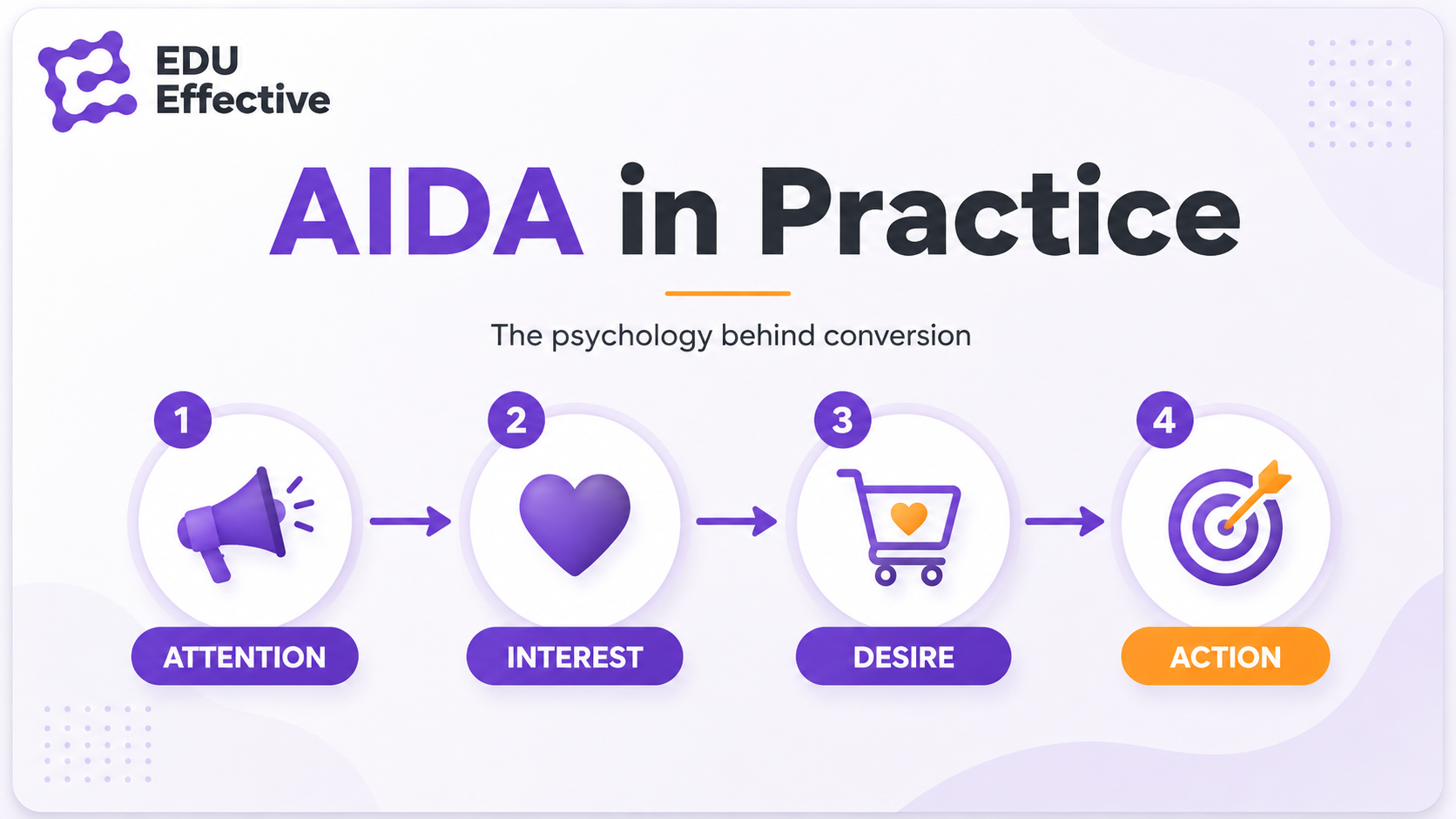
Attention is the first task of any marketing communication: earning enough of the recipient's attention to be processed at all. In an environment where the average person encounters thousands of marketing messages daily, attention is the scarcest resource in marketing. Subject lines, headlines, opening sentences, and the first three seconds of video content all serve the sole function of earning enough attention to deliver the rest of the message.
Interest converts initial attention into sustained engagement by demonstrating relevance to the recipient's specific situation. A headline that promises information relevant to a specific person's specific problem earns Interest from that person; the same headline may earn no Interest from someone who does not have that problem. Interest is the stage where personalisation and targeting pay their most significant dividends.
Desire moves from "this is relevant to me" to "I want this." It is built through specificity about benefits rather than features, through social proof that demonstrates results for people in similar situations, through emotional resonance that connects the offering to what the potential customer actually cares about, and through clarity about what changes for the better when the decision is made.
Action converts Desire into a decision. The most common failure at this stage is not insufficient desire but insufficient clarity about what to do next, or insufficient removal of the friction that stands between desire and action. A clear, low-commitment call to action — try it free, read a case study, talk to an advisor, get a quote — converts better than a high-commitment ask made before trust is established.
The customer journey in 2026 — why the funnel has become non-linear
The linear funnel model describes what marketing strategy aims to produce. The actual customer journey in 2026 is considerably messier — and the gap between the two is one of the most important things for marketers to understand.
McKinsey's Consumer Decision Journey research, first articulated in 2009 and continuously updated, describes the modern buying process not as a linear descent through the funnel but as a cyclical set of behaviours: initial consideration → active evaluation → moment of purchase → post-purchase experience → loyalty loop. Customers loop back through earlier stages repeatedly, reconsider options they had previously eliminated, and are influenced at every stage by the experiences of other customers and by content they encounter outside formal marketing channels.
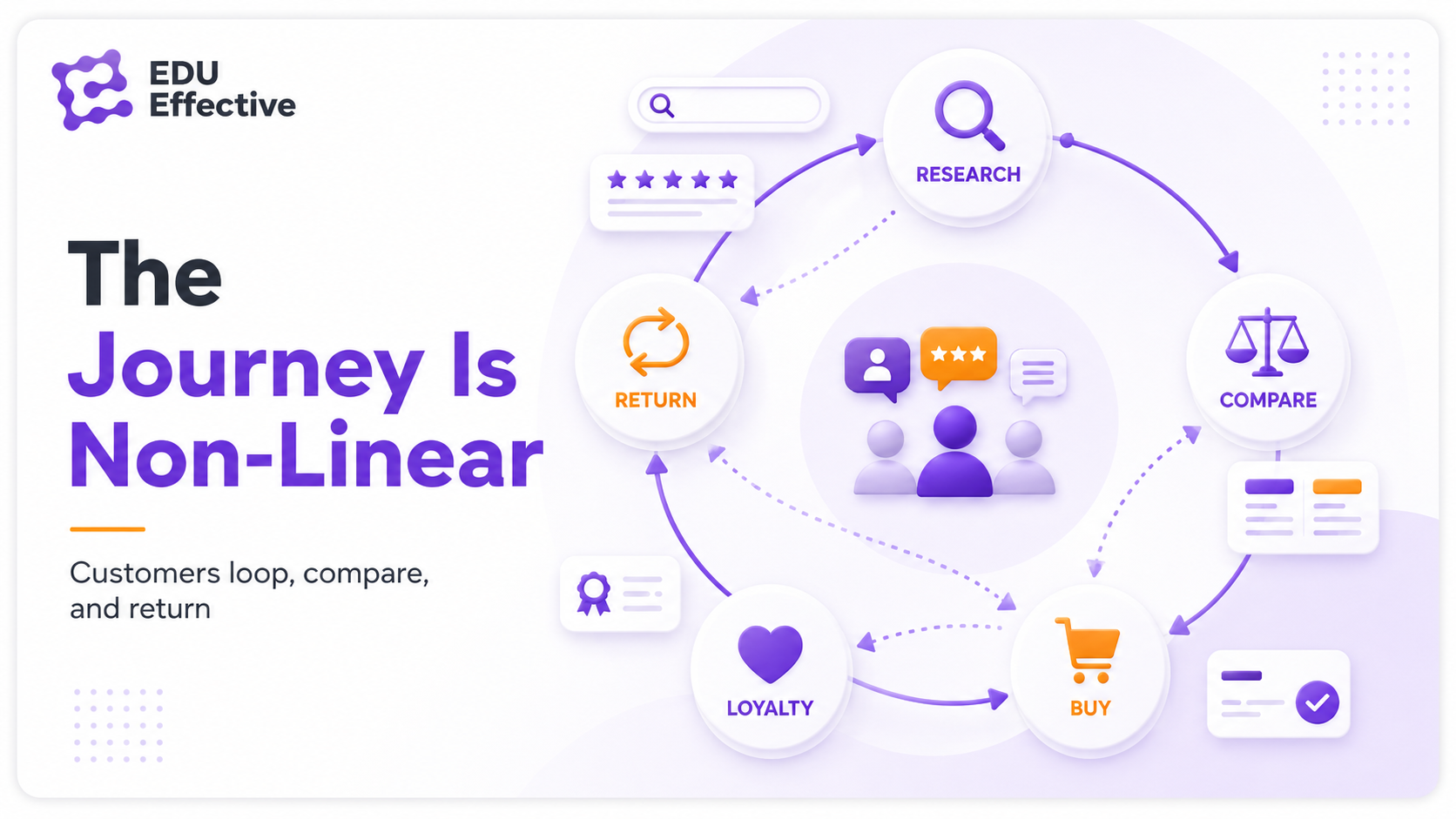
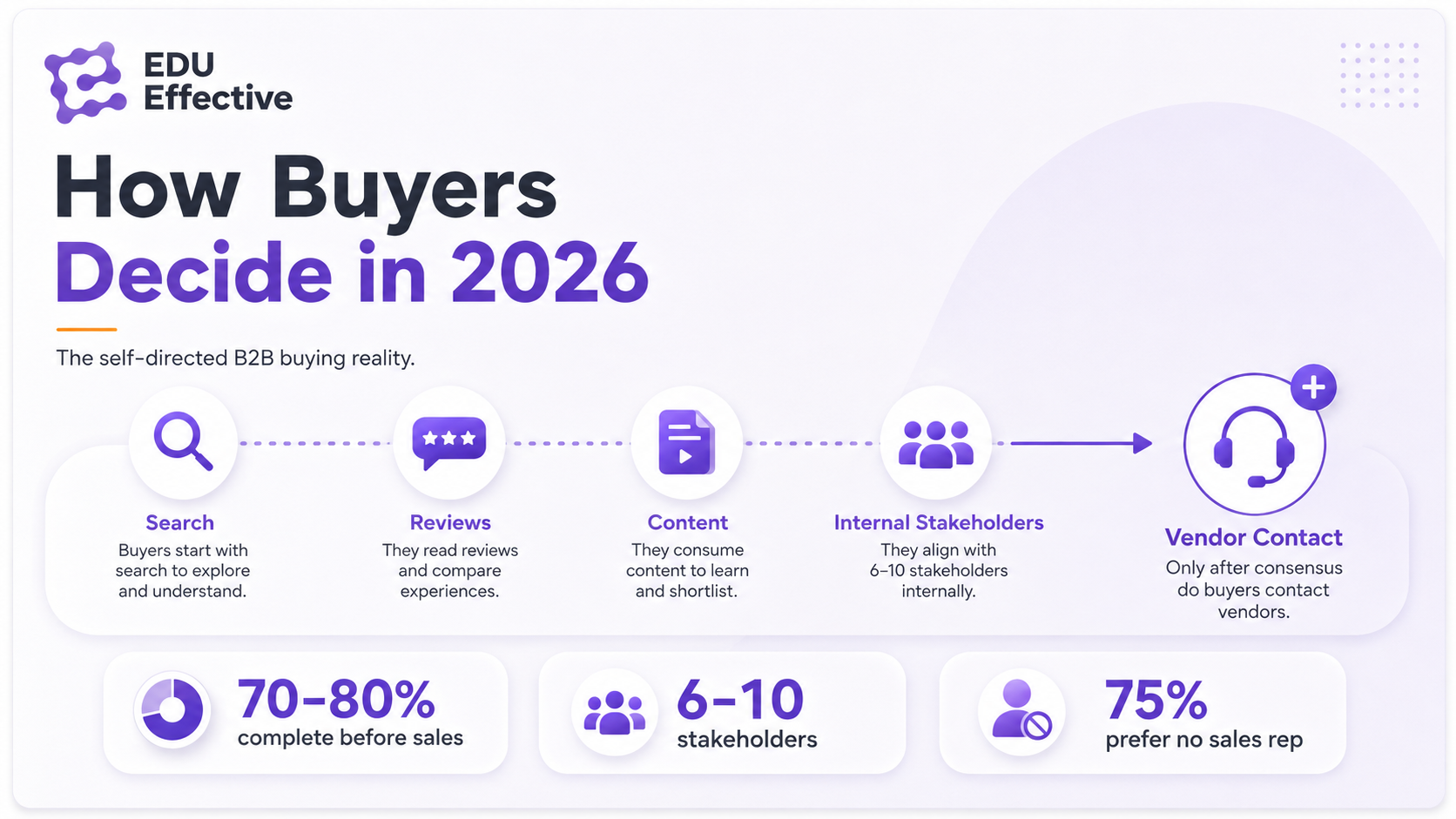
The B2B version of this complexity is particularly pronounced. B2B buying decisions in 2026 involve an average of 6 to 10 stakeholders, each arriving with independently gathered information, according to Gartner research. Buyers complete 70% to 80% of their purchase journey before vendor contact. Only 17% of total purchase time is spent meeting with potential vendors — the rest is spent in independent research, internal discussions, and evaluation of content that the vendor may never have seen or influenced. 75% of B2B buyers prefer a purchasing experience that does not involve a sales representative, according to McKinsey's 2024 B2B Pulse research.
The practical implication is that the content and signals in the early and middle stages of the funnel — the material potential customers find through search, peer review platforms, social media, and AI-generated summaries — carry more persuasive weight than most marketing budgets reflect. The organisation that shows up clearly and helpfully in the research phase of the customer journey — before customers have even made contact — is shaping the decision before the decision-making conversation begins.
Lead nurturing: how to convert funnel stages into revenue
The most consistent finding in marketing funnel research is the cost of neglecting lead nurturing — the structured programme of communications that maintains engagement with potential customers through the consideration phase until they are ready to purchase.
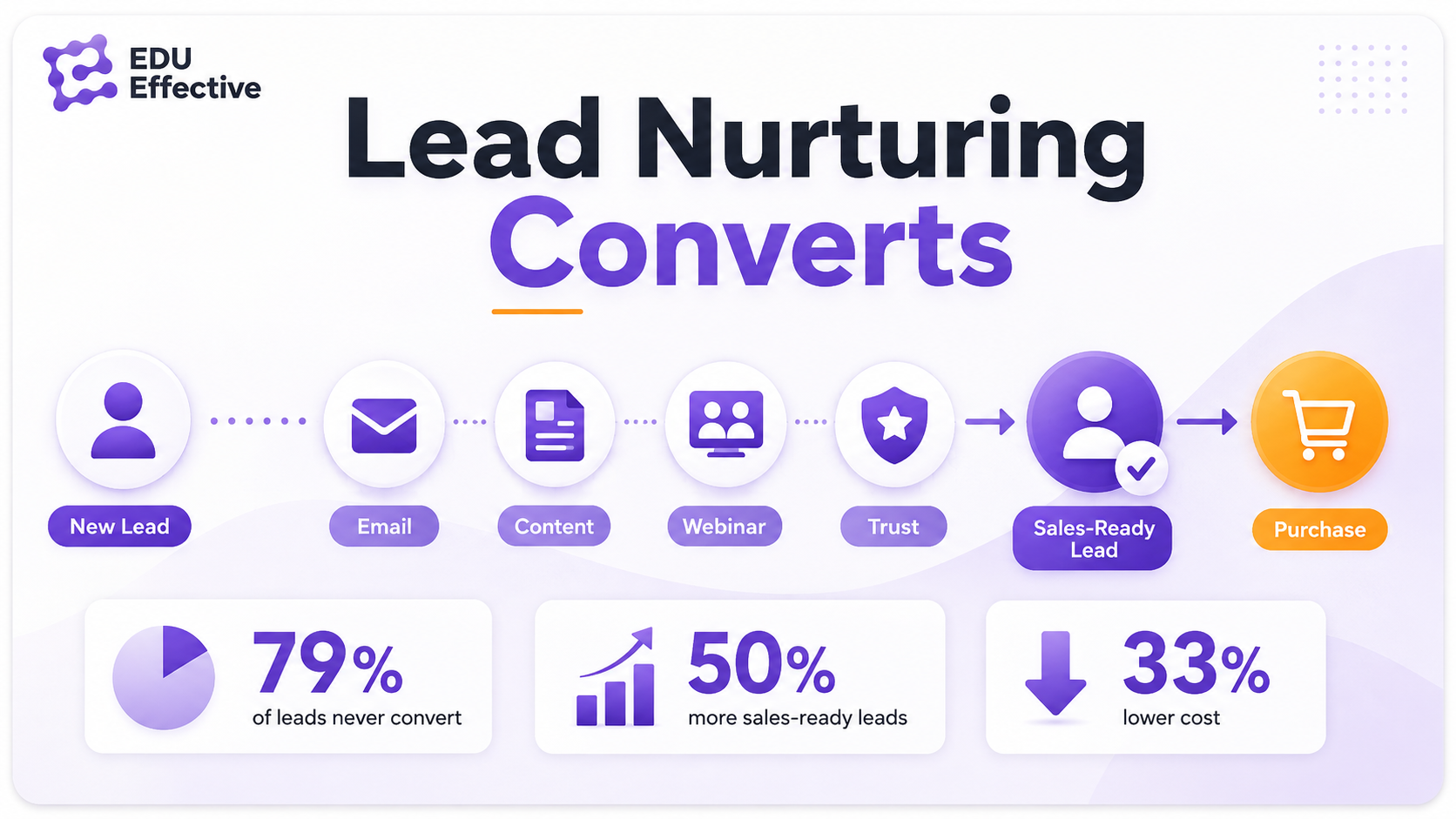
79% of marketing leads never convert to sales, according to MarketingSherpa research — but Forrester's complementary finding is equally instructive: companies that excel at lead nurturing generate 50% more sales-ready leads at 33% lower cost than those without mature nurture programmes. The difference between a potential customer who converts and one who exits the funnel at consideration stage is frequently not their fit or intent but the quality of the engagement they received between initial interest and final decision.
Effective lead nurturing is not the same as sending more emails. It is providing the specific information each funnel stage requires, at the time when potential customers are most receptive to receiving it, through the channels where they are most likely to engage with it. It requires understanding which content addresses which concerns at which stage of the customer journey — and delivering that content consistently enough to maintain awareness and build trust during the extended periods between initial interest and purchase readiness.
DemandGen Report's 2026 B2B Buyer Behaviour Survey found that personalised content increases engagement by 42% and conversions by 29% compared to generic content — confirming that the most effective lead nurturing is not broadcast but responsive to the specific situation and stage of each potential customer.
Measuring the funnel — the metrics that matter
A marketing funnel that cannot be measured cannot be improved. The metrics that matter are those that track progression through the funnel — not just the volume of activity at any one stage, but the conversion rates between stages that determine where the funnel is performing well and where it is leaking.
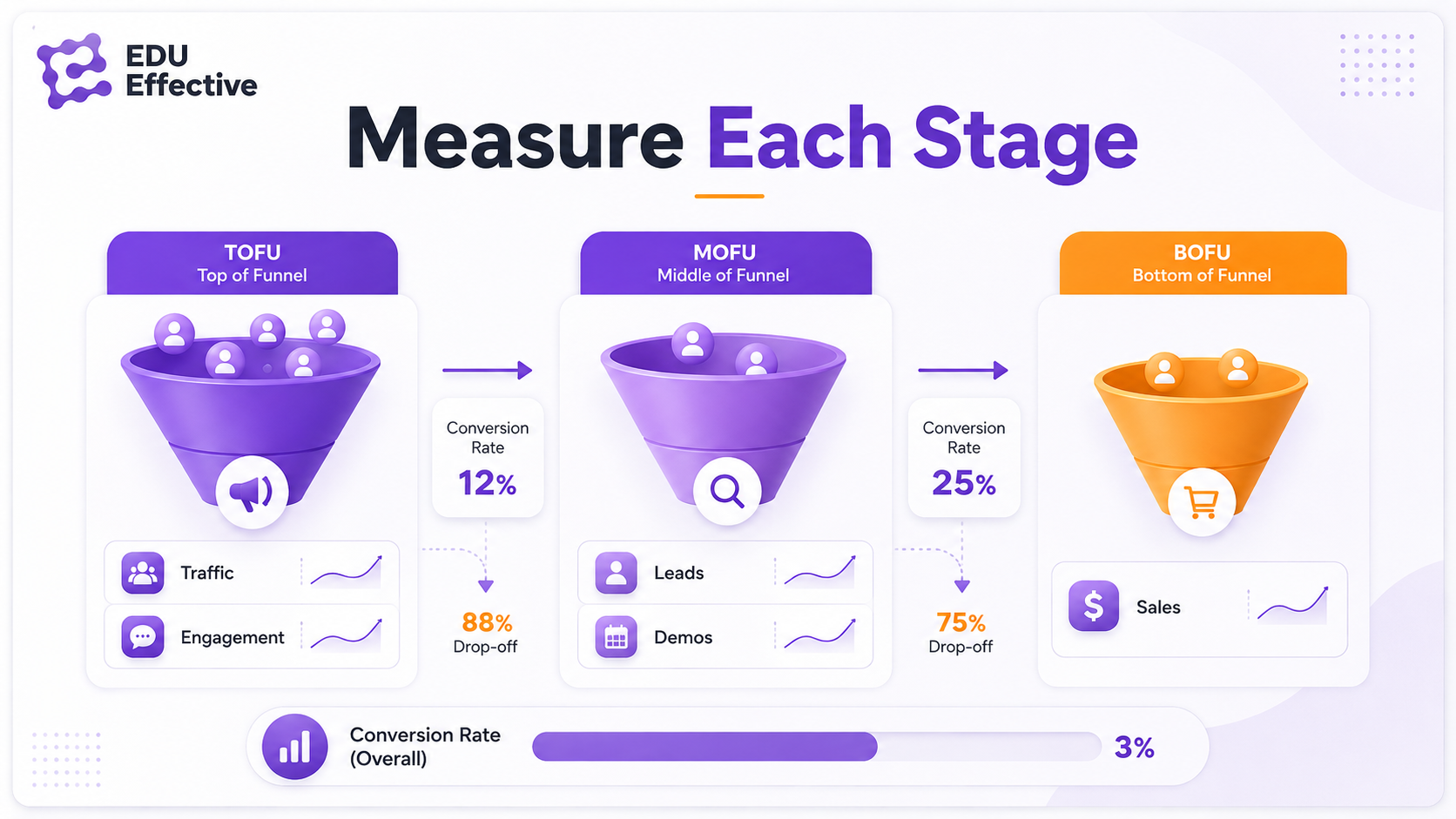
Top of funnel metrics include organic search traffic, social media reach and engagement, content consumption (page views, video plays, download rates), and new subscriber or follower growth. These metrics measure awareness — how effectively the organisation is reaching its target audience.
Middle of funnel metrics include email open and click rates, content download rates, webinar registrations and attendance, time on site, return visits, and lead quality scores. These metrics measure consideration — how effectively the organisation is maintaining engagement and building preference among people who have expressed initial interest.
Bottom of funnel metrics include demo requests, trial signups, sales conversations initiated, proposal requests, and ultimately conversion to sale. These metrics measure decision — how effectively the organisation is converting consideration into commitment.
The most useful funnel metric is stage conversion rate — the proportion of people at each stage who progress to the next. A high TOFU traffic volume with poor MOFU conversion indicates a problem with relevance or targeting: the awareness activity is reaching people who are not genuinely interested in the offering. High MOFU engagement with poor BOFU conversion indicates a problem with trust, risk perception, or the specific terms of the offer. Mapping where conversion rates drop most sharply identifies where funnel investment will produce the highest return.
The full-funnel marketing approach — why all stages matter simultaneously
One of the most consistent mistakes in marketing strategy is concentrating resources at one stage of the funnel to the neglect of others. Organisations under revenue pressure tend to concentrate on BOFU — the activities closest to immediate conversion — while underinvesting in TOFU awareness and MOFU nurturing. This produces short-term results at the cost of the pipeline that will generate revenue in three to six months, creating a boom-and-bust cycle in which today's urgency is addressed at the expense of tomorrow's opportunity.
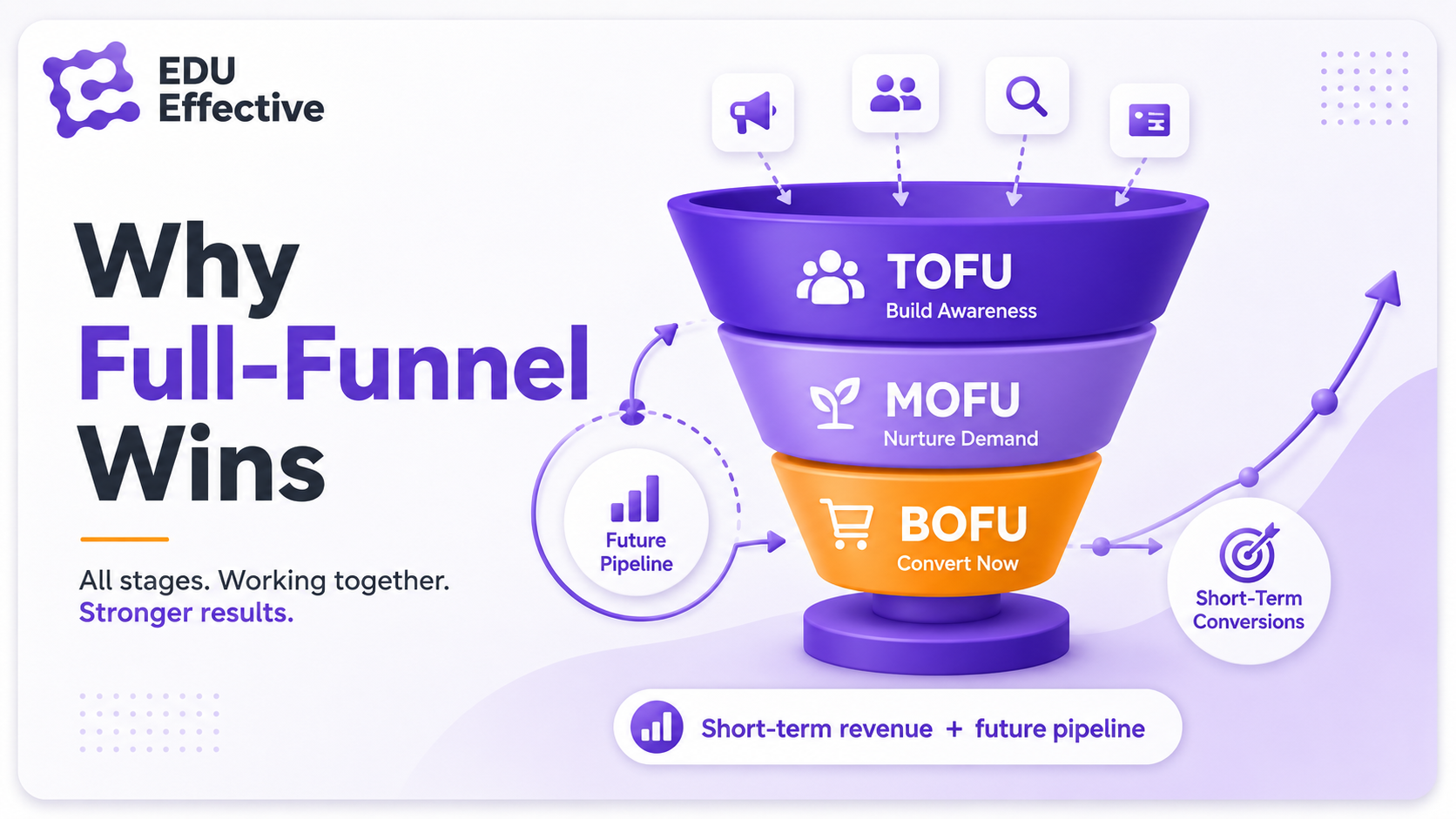
Full-funnel marketing distributes investment and attention across all three stages simultaneously — building awareness that creates tomorrow's prospects while nurturing today's consideration-stage leads while converting the most purchase-ready pipeline. It requires accepting that some of the most valuable marketing activity produces results on a timeline measured in months rather than weeks, and that the accumulated value of top-of-funnel investment compounds over time in ways that bottom-of-funnel-only strategies cannot replicate.
49% of marketers report that organic search — primarily a top-of-funnel channel — delivers the best return on investment of any marketing activity, according to HubSpot's State of Marketing 2026. The return is compounding and delayed. The investment is worth making consistently.
At EDU Effective, the Effective MBA: Online Marketing covers the marketing funnel and customer journey alongside the full range of digital marketing disciplines — from SEO and content marketing to email marketing, social media strategy, and marketing analytics. Content draws on practitioners from Google, HubSpot, McKinsey, and many more, delivered in 15 minutes a day, applicable to your current role from day one. Explore the programme →
Related articles
Online Marketing in 2026: Strategy, Channels, AI Tools and What Actually Drives Growth
Content Marketing Strategy in 2026: What Works, What Has Changed
SEO for Beginners: How Organic Search Works
EDU Effective Business School — professional development for your long-term success.
All five Effective MBA programs are built on the same educational model — designed for working adults who need learning that fits real professional life:
Effective MBA: Executive Management & Leadership
Effective MBA: Applied Artificial Intelligence
Effective MBA: Coaching, Leadership & Mentoring
Effective MBA: Online Marketing
Every programme runs on 15 minutes a day, completes in 10 months or less, is ASIC accredited, and starts from €990.
These are professional programmes, not academic ones — built for working adults to apply what they learn directly in their own business, not to collect a scholarly credential.
Join more than 9,000 students in over 120 countries who are investing in their professional development and career success. Read the experiences of our graduates here.
Apply now — from €990 · Talk to a Study Advisor
Study with NO risk: 14-day money-back guarantee, no questions asked.
Sources
MarketingSherpa — 79% of Marketing Leads Never Convert to Sales — Lack of Lead Nurturing as Primary Cause
https://marketingsherpa.com/article/case-study/lead-scoring-effort-increases-conversion
Forrester — Forrester’s 2026 Buyer Insights: GenAI Is Upending B2B Buying As Leaders Face Mounting Pressure To Justify Every Dollar Spent
https://www.forrester.com/press-newsroom/forrester-2026-the-state-of-business-buying/
Gartner — Gartner Sales Survey Finds 67% of B2B Buyers Prefer a Rep-Free Experience
https://www.gartner.com/en/newsroom/press-releases/2026-03-09-gartner-sales-survey-finds-67-percent-of-b2b-buyers-prefer-a-rep-free-experience
McKinsey & Company — Consumer Decision Journey: Cyclical Model (continuously updated); 75% of B2B Buyers Prefer Digital Purchasing Experience (2024 B2B Pulse)
https://www.mckinsey.com/capabilities/growth-marketing-and-sales/our-insights/the-consumer-decision-journey
HubSpot — State of Marketing Report 2026: 49% of Marketers Say Organic Search Delivers Best ROI; 68% of Online Experiences Begin with Search Engine
https://www.hubspot.com/state-of-marketing