
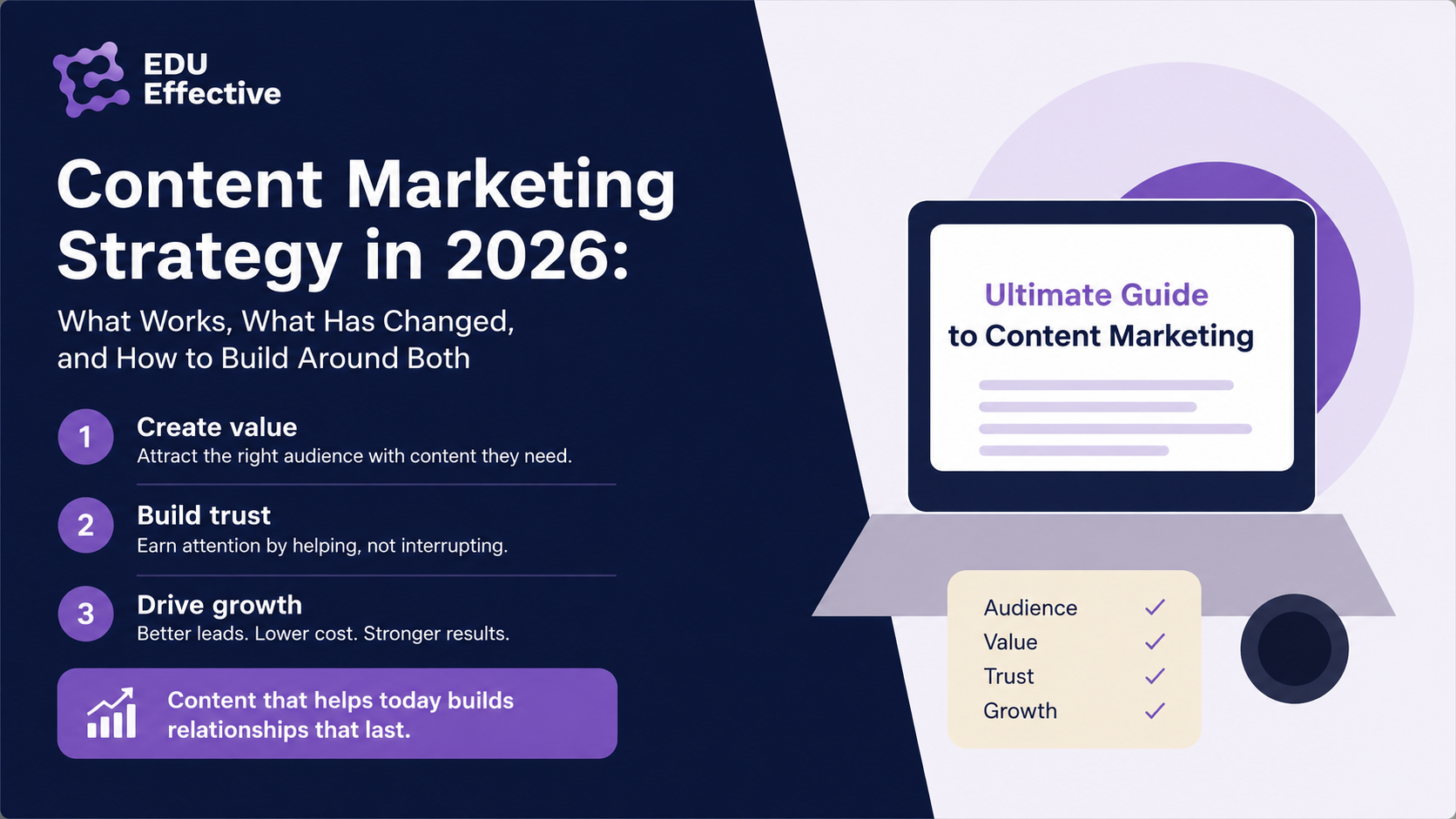

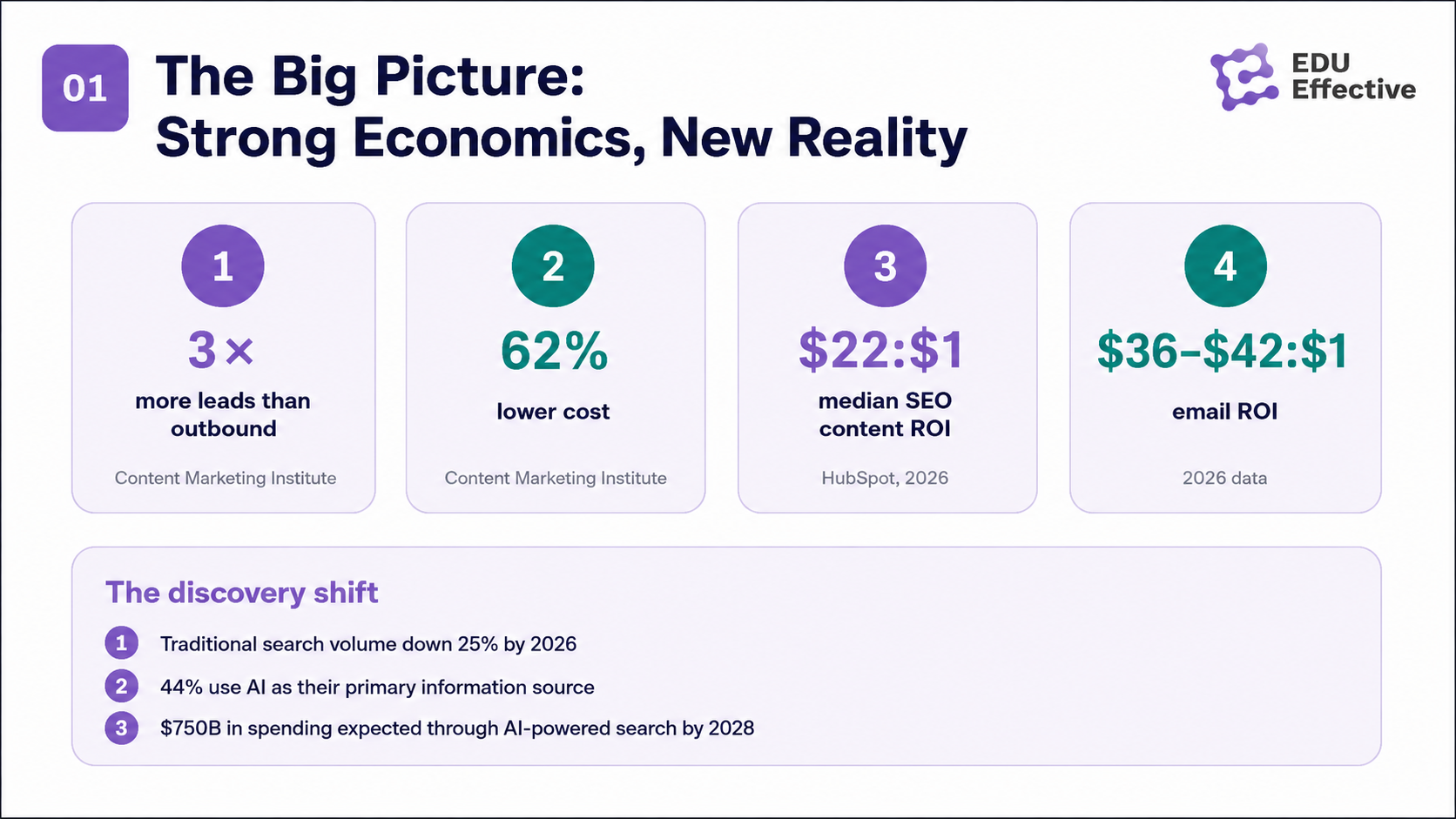
Content marketing generates three times more leads than traditional outbound marketing at 62% less cost. That finding from the Content Marketing Institute's research has been true — and frequently cited — for several years. In 2026, it remains true. And in 2026, content marketing is also navigating the most significant structural disruption in its history.
Gartner's prediction that traditional search engine volume would drop 25% by 2026 has materialised. Google AI Overviews now reduce click-through rates for top-ranking content by more than half. 44% of consumers call AI their primary source of information, surpassing traditional search at 31%, according to McKinsey's October 2025 research of 1,927 consumers. And McKinsey projects $750 billion in US consumer spending will flow through AI-powered search by 2028.
These two realities — content marketing's strong underlying economics and a fundamentally changed discovery environment — are co-existing. The organisations building the most effective content strategies in 2026 are those that have understood both rather than choosing between them. That matters commercially, because content marketing's economics are a central part of why marketing matters commercially — and how content marketing's 3x lead generation advantage at 62% less cost fits into the broader business case for sustained marketing investment.
What content marketing is — and why the definition has expanded
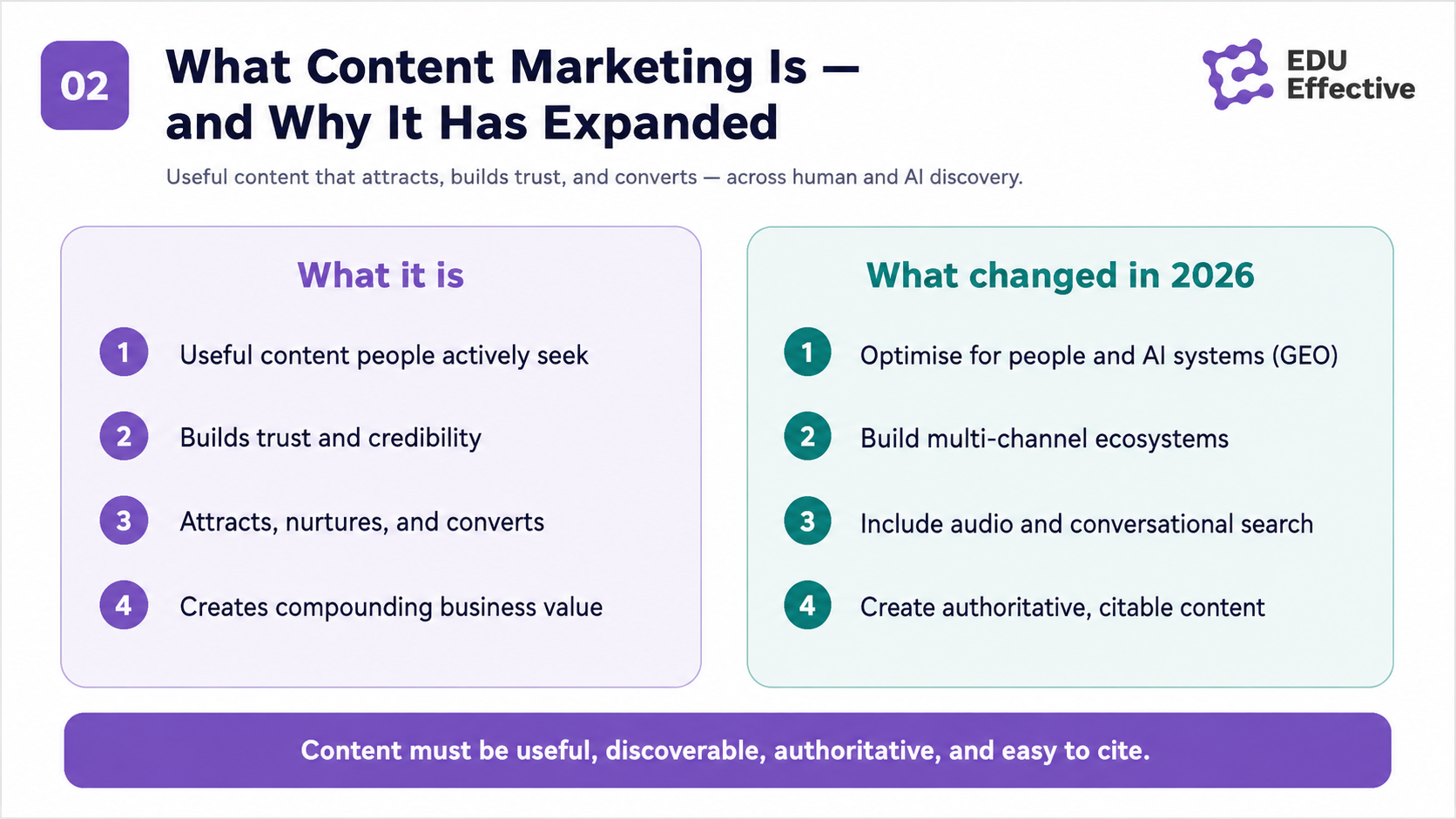
Content marketing is the creation and distribution of genuinely useful, relevant content — articles, guides, videos, podcasts, case studies, tools, and other formats — that attracts and retains a defined audience by providing value rather than interrupting them with advertising.
Its commercial logic is straightforward: people who encounter your business through content they actively sought out arrive with more context, more trust, and higher intent than people who were interrupted by an advertisement. That logic has not changed. What has changed is the surface area across which content now needs to operate, and the channels through which it reaches audiences.
In 2026, content marketing encompasses not just creating content for human readers but structuring it to be cited by AI systems — a new discipline called Generative Engine Optimisation (GEO). It also means building content ecosystems across owned channels (website, blog, email, podcast) alongside social platforms, video, and the increasingly significant audio search environment. The marketer who thinks of content marketing as "writing blog posts" is operating with a model that is several years behind current practice.
The business case: what the numbers actually show
The ROI data for content marketing in 2026 is among the strongest in the marketing mix, particularly for organic and long-form content.
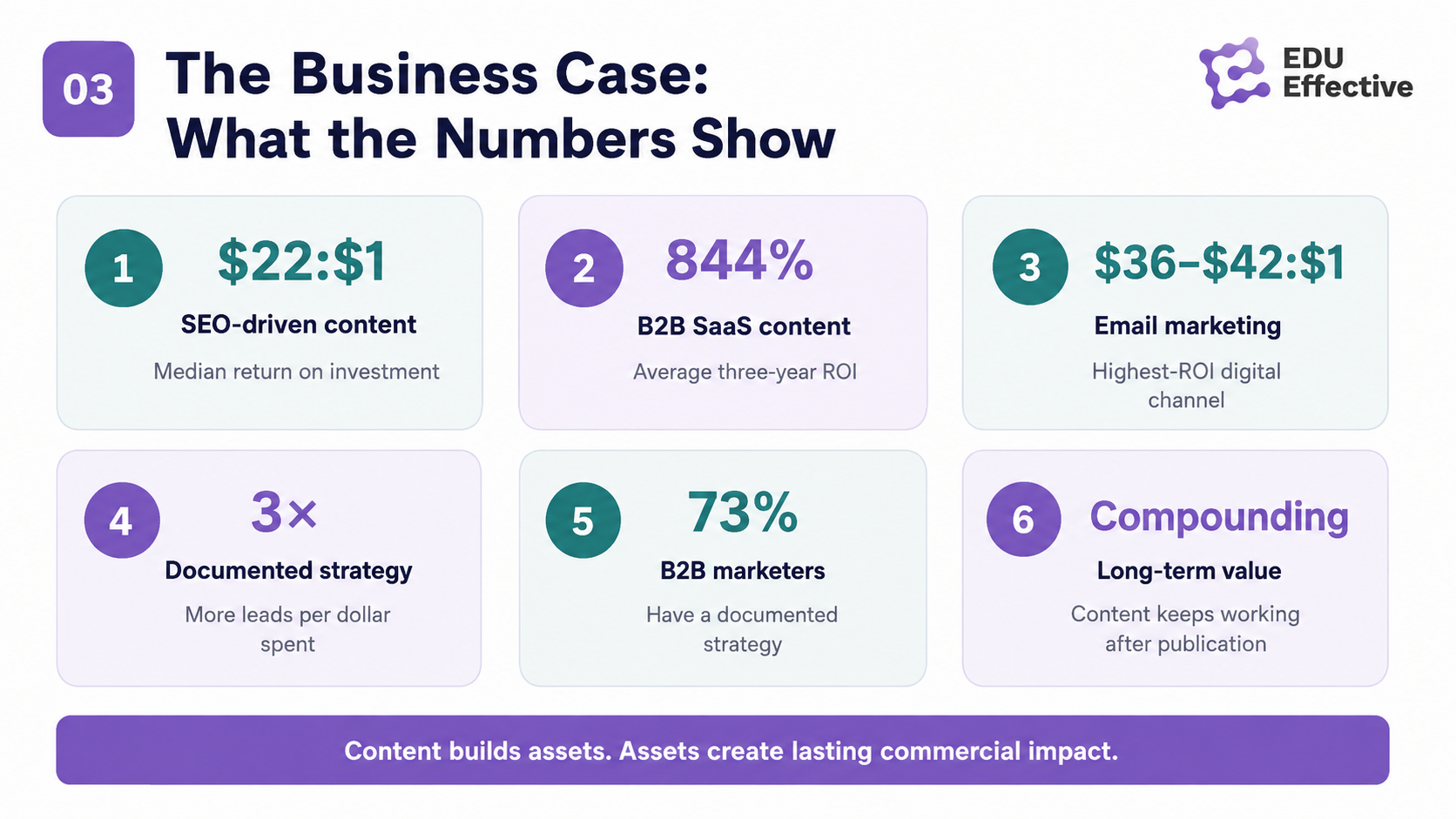
SEO-driven content delivers a median return of $22 for every $1 invested in B2B organisations, according to HubSpot's 2026 research. B2B SaaS programmes report three-year ROI averaging 844% for mature content programmes. Email marketing — the distribution channel most closely integrated with content strategy — delivers $36-$42 per dollar spent, the highest ROI of any digital marketing channel.
Organisations with a documented content marketing strategy generate three times more leads per dollar spent than those without one, according to CMI's 2026 B2B report — and only 73% of B2B marketers currently have a documented strategy, meaning a meaningful share are investing in content without the strategic framework that determines its effectiveness.
The fundamental economic advantage of content marketing over paid acquisition is asset accumulation: a well-produced article or video continues generating traffic and leads for years after publication, compounding returns over time. Paid advertising stops delivering the moment the budget stops. Content that builds topical authority in an area where your audience has genuine questions earns an ongoing presence in search results and, increasingly, in AI-generated answers.
The new discovery environment: GEO and the AI search shift
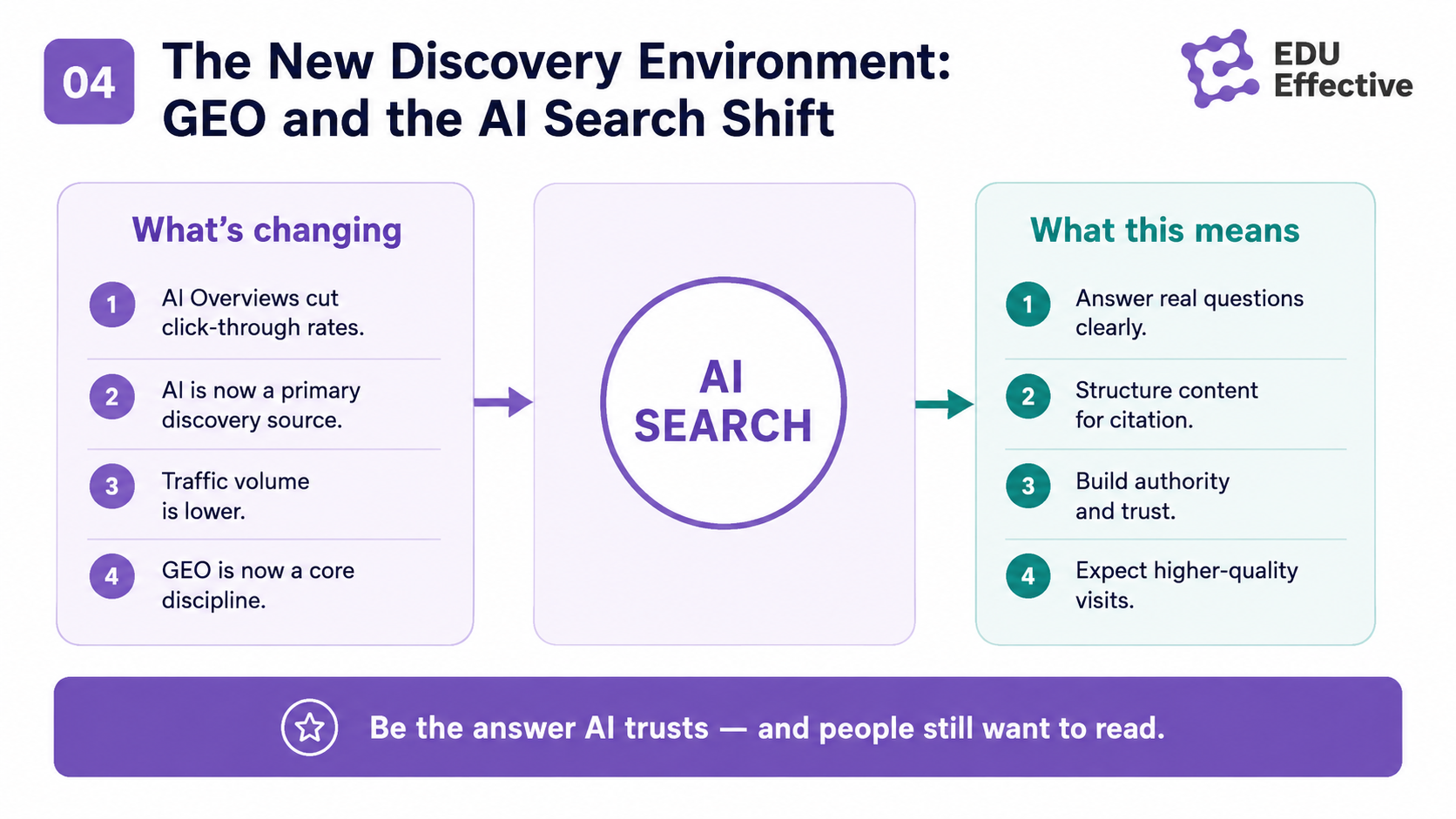
The most significant change to content marketing in 2026 is not a content format or a distribution channel — it is where audiences find content in the first place.
Gartner's prediction of a 25% decline in traditional search volume has been confirmed by mid-2026 data. Google AI Overviews now appear in a substantial share of searches and synthesise answers directly on the results page, reducing the number of users who click through to source websites. Where AI Overviews appear, click-through rates for even position-one organic results have dropped by more than 50% according to BrightEdge research cited across multiple 2026 studies.
The flip side of this shift is significant. Users who do arrive at websites from AI-generated answers — clicking through because an AI system cited your content as a source — spend up to three times longer on-page than visitors from traditional search, according to Forrester. They convert at higher rates because they arrive with more context and clearer intent. The traffic volume is lower; the quality is higher.
This creates the new central challenge in content strategy: building content that earns citations from AI systems — ChatGPT, Perplexity, Google AI Overviews, Gemini, Claude — not just rankings in traditional search results. Generative Engine Optimisation (GEO) is the emerging discipline that addresses this. By July 2026, it has moved from experimental to mainstream at the enterprise level, with dedicated conferences, agency specialisations, and a growing ecosystem of purpose-built measurement tools.
The principles of GEO align closely with what Google has always said it valued — but have now become non-negotiable for AI citation as well: clear, authoritative, well-structured content that directly answers specific questions, with verified factual claims, consistent brand entity signals across the web, and genuine topical expertise rather than keyword-optimised surface coverage. AI systems are pattern-matching for trustworthiness and authority at a level that keyword manipulation cannot game.
A practical content strategy framework for 2026
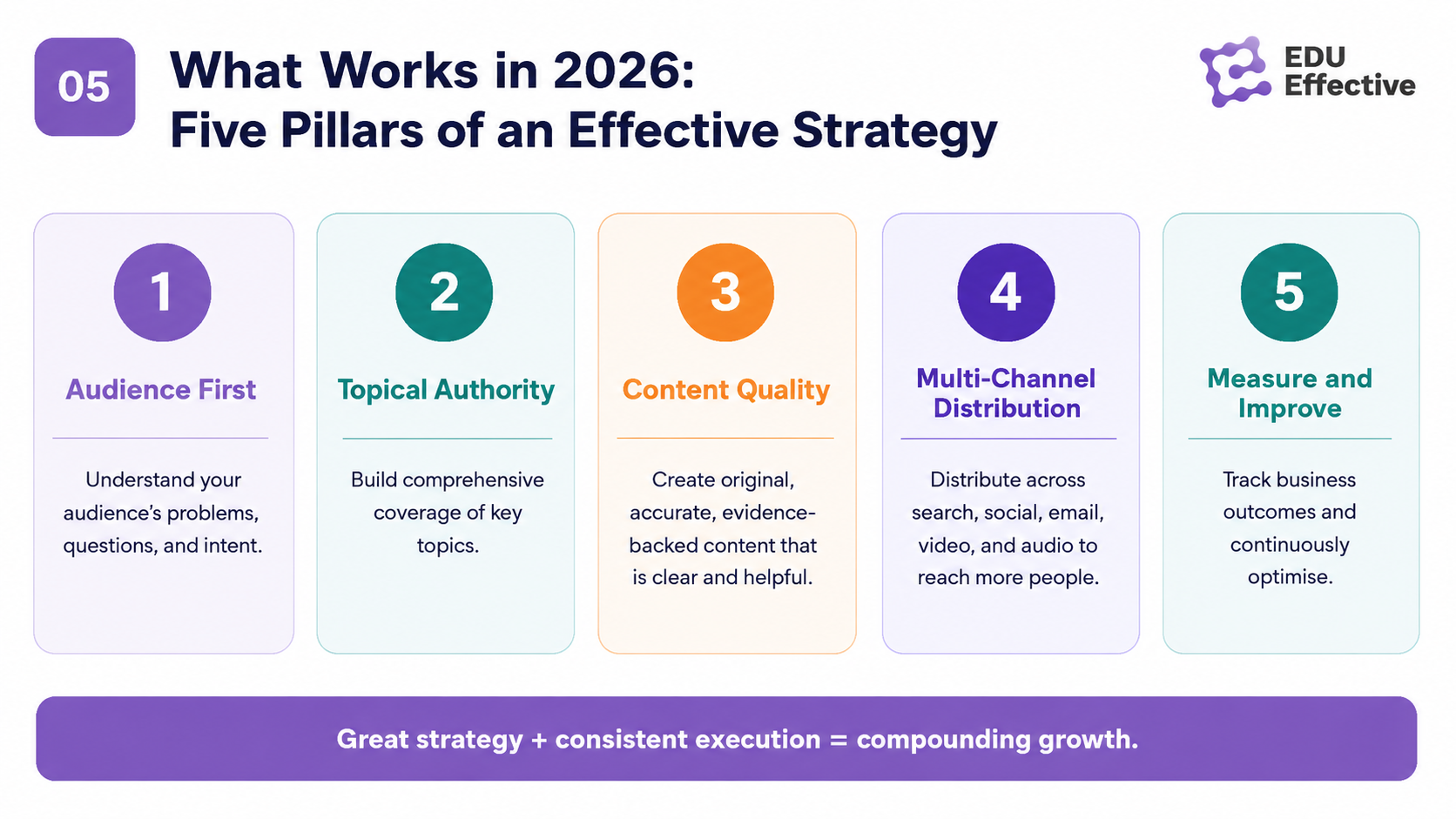
Effective content strategy in 2026 is built on five interconnected decisions.
1. Audience and intent clarity
Every content decision should start from a precise understanding of who you are creating content for and what they are trying to accomplish. Generic audience definitions produce generic content that neither ranks in search, earns AI citations, nor converts visitors into customers.
The 2026 version of audience understanding goes deeper than demographics. It includes the specific questions your audience asks at each stage of their decision-making process, the language they use when they ask those questions, the formats they prefer for different types of questions, and the channels through which they currently discover content in your category. B2B buyers now consume an average of three to seven pieces of content before contacting a sales team, according to DemandGen Report 2026 data — which means content strategy must address not just initial awareness but the full research sequence that precedes a purchase decision.
2. Topical authority over keyword coverage
The transition from keyword-based to topic-based content strategy has been underway for several years but has accelerated significantly in 2026. Both traditional search algorithms and AI systems reward content that demonstrates genuine, deep expertise in a defined subject area — not content that covers many topics at surface level.
Building topical authority means producing comprehensive, high-quality content around a specific domain rather than chasing individual keyword opportunities. A company that publishes thirty substantive articles on leadership development over twelve months builds stronger authority signals than one that publishes one hundred thin articles across thirty different topics. The authority accumulates in the topical cluster rather than in individual articles — and both search engines and AI systems recognise and reward that accumulated authority.
Pillar content — comprehensive guides on core topics — combined with supporting articles that address specific questions within those topics is the structural approach most content strategists are deploying in 2026. The pillar article earns authority; the supporting articles capture long-tail intent; together they signal topical expertise to both search algorithms and AI systems.
3. Format matching to purpose
Different content formats serve different purposes in the customer journey, and deploying the right format for the right purpose is one of the highest-leverage decisions in content strategy.
Short-form video is rated the highest-ROI content format by 58% of marketers, according to CMI's 2026 data. 93% of video marketers say video provided a good ROI in 2026, the highest figure Wyzowl has ever recorded in their annual survey. For brand awareness, product demonstration, and social distribution, video is the dominant format.
Long-form written content — comprehensive guides, in-depth articles, research reports — builds topical authority, earns backlinks, and is the format most likely to be cited by AI systems. It converts at higher rates from organic search because it serves audiences in the research and decision-making phases of their journey.
Case studies and social proof remain the second-highest-performing format in B2B content at 53% effectiveness rating among marketers surveyed by CMI — because B2B buyers require evidence, not just information, before making significant purchasing decisions.
Email newsletters convert at higher rates than almost any other content distribution mechanism — because subscribers have explicitly opted in and arrive with established trust rather than as anonymous visitors.
4. Distribution strategy: owned, earned, and AI-native channels
Creating content without a distribution strategy is one of the most common and most costly content marketing failures. Content that is not discovered by the right people at the right time does not produce commercial outcomes regardless of its quality.
In 2026, effective distribution operates across three categories. Owned channels — website, email list, podcast, owned social accounts — provide direct audience relationships that are not subject to algorithm changes or platform policy shifts. Building owned audiences is a long-term strategic investment that compounds in value; the email list you build today earns you distribution independence that no platform can revoke.
Earned distribution — backlinks from authoritative sites, PR mentions, social shares, community engagement — amplifies content reach beyond your owned audience and is a primary signal of authority for both search algorithms and AI systems.
AI-native distribution — being cited in AI-generated answers — is the new category that 2026 content strategy must address deliberately. This is earned through the quality, structure, and authority of content rather than through any direct relationship with AI platforms. Content that is clear, factually specific, well-cited, and genuinely authoritative on its topic earns citations; content that is generic, superficial, or primarily optimised for keyword density does not. And content strategy never operates in isolation — it is worth understanding how content marketing fits into a comprehensive online marketing strategy — including the paid, social, and AI-native channels through which content reaches audiences beyond organic search, as well as the seven innovative marketing strategies reshaping business growth in 2026 — and how content strategy underpins several of the highest-performing approaches, from community-first marketing to GEO.
5. Measurement: from vanity metrics to business outcomes
The measurement gap in content marketing remains wide: 73% of B2B and 70% of B2C marketers now have documented content strategies, but only 19% of teams using AI for content are tracking AI-specific KPIs, according to current research. More broadly, content marketing is frequently measured on metrics — page views, social shares, time on page — that are loosely correlated with business outcomes rather than directly connected to them.
The metrics that actually matter are those that connect content activity to commercial results: leads generated and converted, sales cycle length for content-influenced prospects versus those without content engagement, customer acquisition cost by content channel, and customer lifetime value for customers who engaged with content before purchase. AI-era metrics that should now be part of every content dashboard include AI citation rate (how often your content appears as a source in AI-generated answers for target queries), brand mention frequency in AI responses, and conversion rates from AI-referred traffic versus traditional search traffic.
The role of AI in content creation: what it enables and where it falls short
94% of marketers plan to use AI for content creation in 2026, according to CMI's B2B survey. The adoption is effectively universal. The strategic question is not whether to use AI in content creation but how to use it in ways that produce genuinely differentiated content rather than efficiently produced mediocrity.
AI tools are most valuable in content creation for research acceleration (gathering sources, summarising background material, identifying related questions), structural drafting (producing outlines, first drafts, and content variations quickly), distribution optimisation (reformatting content for different channels and audiences), performance analysis (identifying which content is performing and why), and personalisation at scale (adapting content for different audience segments without producing each version manually).
AI tools are least reliable for producing the elements that create genuine differentiation: original insights based on unique experience or data, distinctive voice and perspective, deep subject matter expertise, and the judgment required to select which information is genuinely useful versus which is superficially plausible. McKinsey's personalisation research found that personalised content generates 40% more revenue than generic equivalents — and that level of personalisation requires human understanding of the audience, not just AI processing of demographic data. It is worth a closer look at what applied artificial intelligence means for content creation specifically — where AI accelerates content production reliably and where human judgment remains the irreplaceable differentiator, and at how AI implementation principles — particularly the 10-20-70 people/process/technology split — apply directly to building AI-augmented content workflows that produce differentiated outputs rather than efficiently produced mediocrity.
The content that earns AI citations, builds genuine audience trust, and converts at high rates in 2026 has the same characteristics it has always had: it is specific, authoritative, genuinely useful, and clearly written. AI can help produce it faster. It cannot substitute for the expertise and judgment that makes it worth producing.
At EDU Effective, the Effective MBA: Online Marketing develops comprehensive content marketing strategy alongside the full range of digital marketing capabilities — from audience strategy and SEO to email marketing, analytics, and AI tools. Explore the programme →
At EDU Effective, we build programs for professionals who want to work smarter — not just harder. Explore our programs →
EDU Effective Business School = professional development for your long-term success.
All best-selling Effective MBA programs are built for working adults: 15 minutes a day, 10 months or less, ASIC accredited, from €990.
- Effective MBA: Executive Management & Leadership
- Effective MBA: Applied Artificial Intelligence
- Effective MBA: Coaching, Leadership & Mentoring
- Effective MBA: Mastery in AI
- Effective MBA: Online Marketing
These are professional programmes, not academic ones — built for working adults to apply what they learn directly in their own business, not to collect a scholarly credential.
Join more than 9,000 students in over 120 countries who are investing in their professional development and career success.
Read the feedback and experiences of our students and the stories of our graduates here.
Apply now — from €990 · Talk to a Study Advisor
Study with NO risk: 14-day money-back guarantee, no questions asked.
Sources
- Content Marketing Institute — 9 Takeaways and Insights From the 2026 B2B Content and Marketing Trends Report https://contentmarketinginstitute.com/b2b-research/b2b-content-marketing-trends-research
- McKinsey & Company — Unlocking the next frontier of personalized marketing https://www.mckinsey.com/capabilities/growth-marketing-and-sales/our-insights/unlocking-the-next-frontier-of-personalized-marketing
- McKinsey & Company — New front door to the internet: Winning in the age of AI search https://www.mckinsey.com/capabilities/growth-marketing-and-sales/our-insights/new-front-door-to-the-internet-winning-in-the-age-of-ai-search
- Gartner — The Future of Marketing: 5 Trends and Predictions for 2026 https://www.gartner.com/en/articles/future-of-marketing
- Gartner — Gartner 2026 CMO Spend Survey Finds CMOs Allocate 15.3% of Marketing Budgets to AI, But Only 30% Are Ready to Scale AI Capabilities https://www.gartner.com/en/newsroom/press-releases/2026-05-11-gartner-2026-cmo-spend-survey-finds-cmos-allocate-15-point-3-percent-of-marketing-budgets-to-ai-but-only-30-percent-are-ready-to-scale-ai-capabilities
- Forrester — Forrester’s B2B Marketing Predictions for 2026 https://www.demandgenreport.com/industry-news/news-brief/forresters-b2b-marketing-predictions-for-2026/50729/
- HubSpot — State of Marketing Report 2026 https://www.hubspot.com/state-of-marketing
- Salesforce — State of Marketing Report 10th Edition 2026 https://www.salesforce.com/resources/research-reports/state-of-marketing/
- Wyzowl — Video Marketing Statistics Report 2026 https://www.wyzowl.com/video-marketing-statistics/
- DemandGen Report — The 2026 Database Strategies & Contact Acquisition Benchmark Survey https://www.demandgenreport.com/resources/the-2026-database-strategies-contact-acquisition-benchmark-survey/51434/