

The phrase "innovative marketing" is used so frequently that it has almost lost meaning. Every brand claims to be innovative. Most are not. Real marketing innovation is not about using a new platform or running a campaign with a creative twist — it is about applying fundamentally different approaches to how you find customers, communicate value, and build relationships at scale.
In 2026, the gap between genuinely innovative marketing and surface-level novelty is wider than ever — and the data shows it clearly. Brands deploying AI-driven personalisation are seeing campaign response rates 40% higher than those using conventional segmentation. Companies that have built genuine audience communities are outperforming those spending equivalent budgets on paid acquisition. Marketers who have reorganised their operations around agentic AI systems are producing more content, at higher quality, with smaller teams.
This is what innovative marketing actually looks like right now — not as aspiration, but as documented practice. For a foundational overview of the digital channels these innovations are reshaping, see our guide on what GEO is and how it fits alongside other digital marketing types.
What makes marketing genuinely innovative — versus merely new
Before examining specific strategies, it is worth being precise about what distinguishes genuine innovation from tactical novelty.
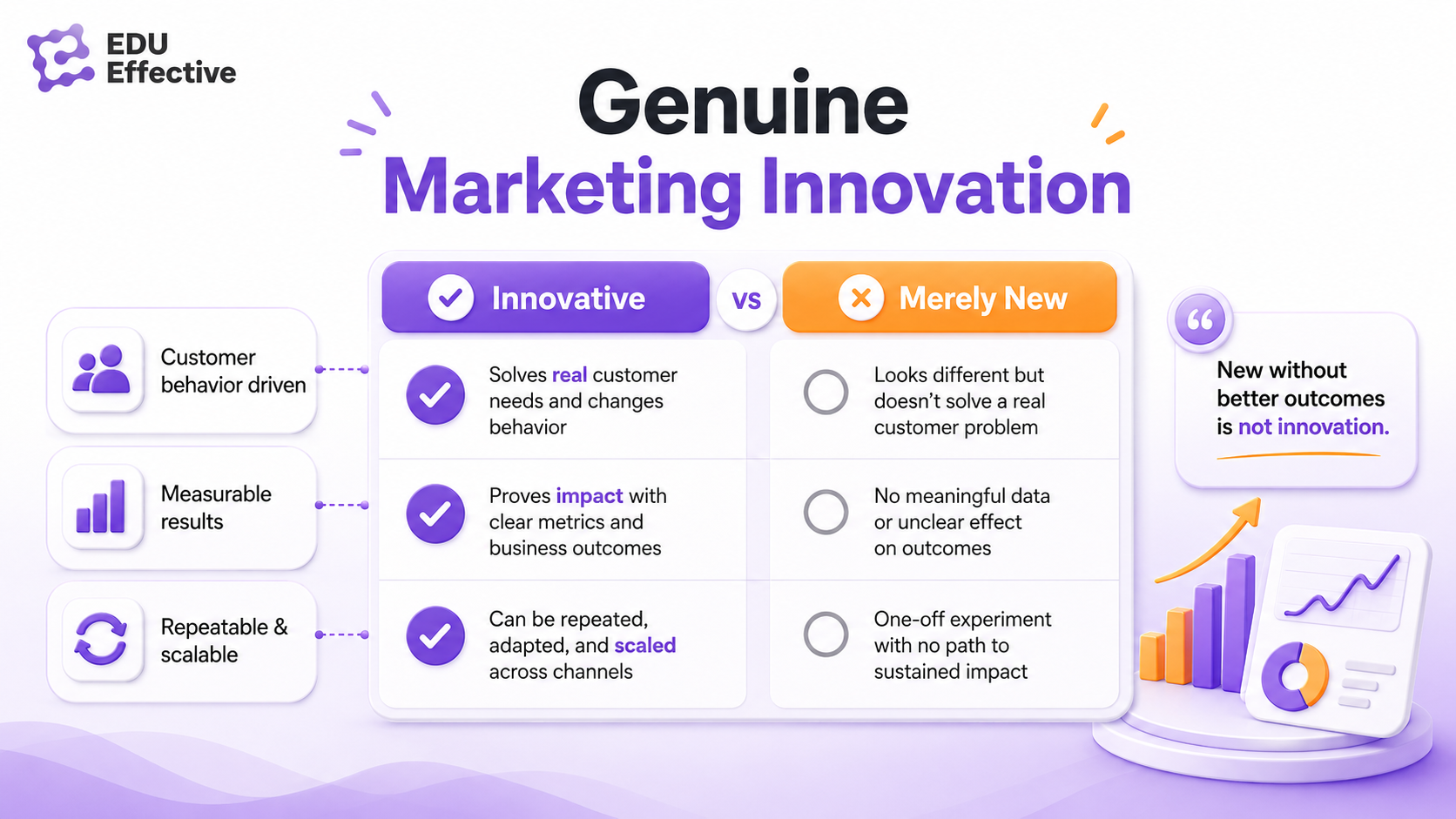
Marketing innovation means applying a new approach, technology, or model that delivers measurably better outcomes than previous methods — either by reaching customers more effectively, converting them at higher rates, retaining them longer, or doing all three at lower cost. The novelty is necessary but not sufficient: a tactic that is new but produces no better results than what it replaced is not innovation — it is experiment without outcome.
Three conditions characterise genuine marketing innovation in 2026. First, it must be grounded in changed customer behaviour, not just changed technology. Second, it must be measurable — innovation claims without attribution data are marketing for marketing's sake. Third, it must be repeatable and scalable, not dependent on a single creative moment.
With that frame in place, here are seven innovative marketing concepts that are producing verifiable results. For a broader look at how these channels are being disrupted by AI and changing search behaviour, we cover the statistics elsewhere.
1. Agentic AI marketing: from tools to autonomous systems
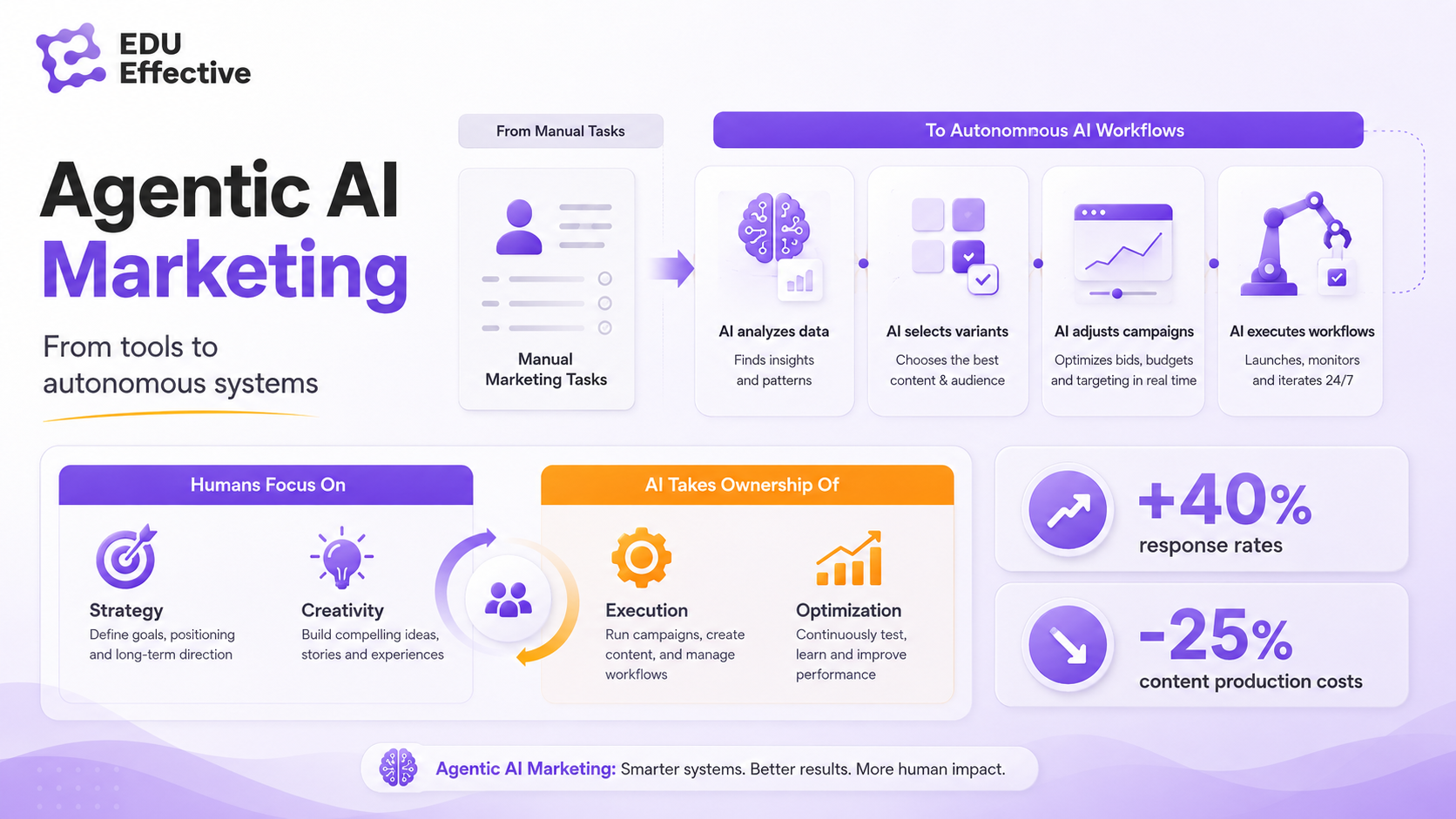
The most structurally significant innovation in marketing in 2026 is the shift from AI as a productivity tool to AI as an autonomous operational system. Agentic AI refers to systems that can independently analyse data, select content variants, adjust campaign parameters, and execute multi-step workflows without requiring human approval at each stage.
The practical implication: marketing teams that previously needed to manually review every email variant, every bid adjustment, and every audience segment update are now deploying systems that handle those decisions automatically — continuously, at a pace and granularity no human team can match. One documented deployment achieved a 40% lift in campaign response rates alongside a 25% reduction in content production costs by moving from manually managed segments to AI-orchestrated micro-segments.
This is not about replacing marketing teams. It is about redirecting human effort from execution tasks — which AI now handles reliably — to strategic and creative decisions that genuinely require human judgement. The organisations pulling ahead have made this distinction explicitly and structured their teams accordingly.
2. Hyper-personalisation at scale — beyond segmentation
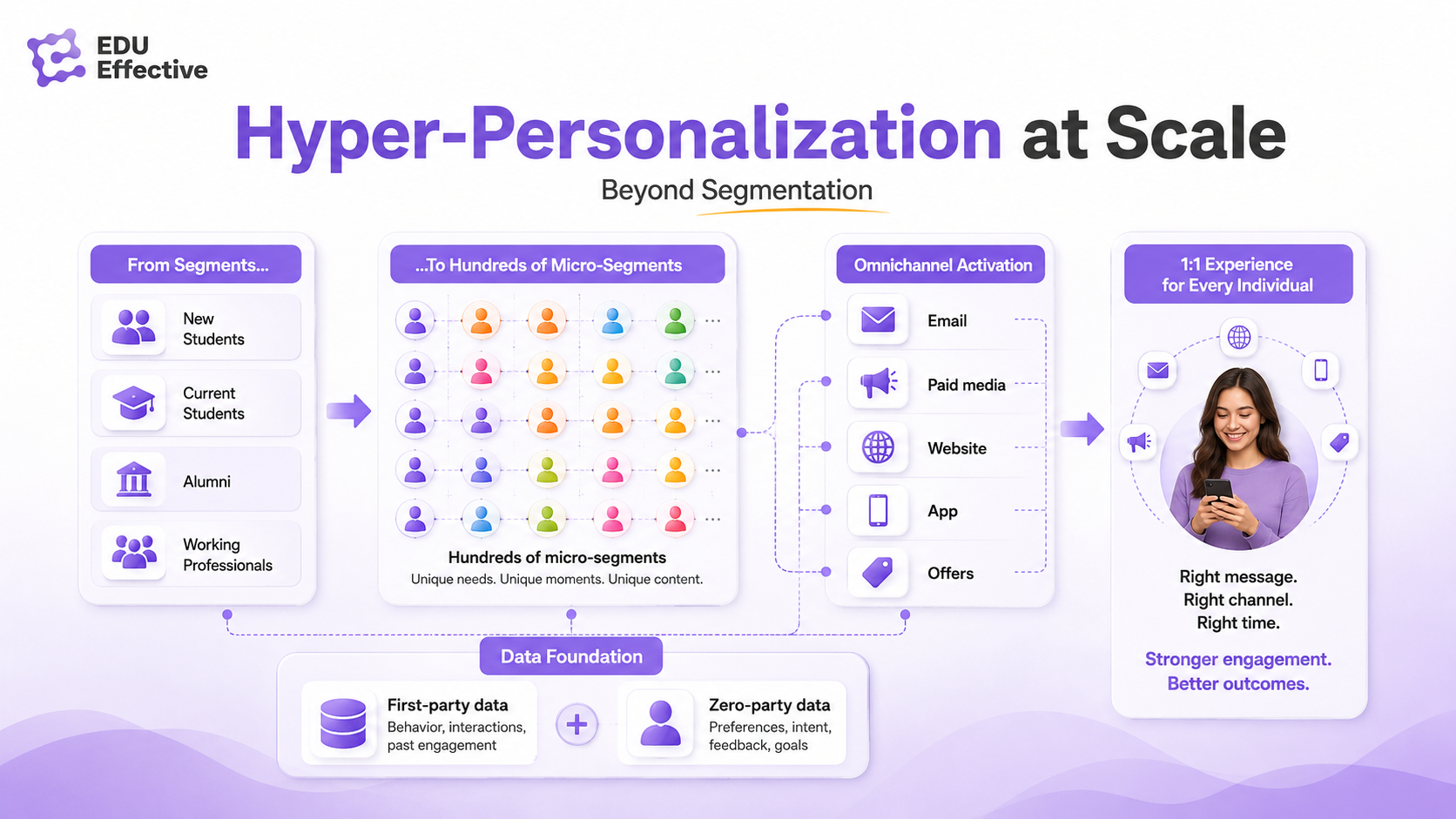
Personalisation is not new. What is new in 2026 is the scale and granularity at which it operates. Where conventional personalisation might divide an audience into five or ten behavioural segments, AI-driven hyper-personalisation now routinely operates across hundreds of micro-segments, delivering different content, offers, timing, and channel combinations to each.
More significantly, personalisation has escaped the boundaries of owned channels. For most of its history, personalised marketing was possible only in email, on websites, and in apps — channels a brand controls. In 2026, the convergence of adtech and martech means that the same personalisation intelligence powering email campaigns now powers paid media placements, dynamic website content, app experiences, and offer optimisation simultaneously. The customer receives a coherent, individually relevant experience across every touchpoint rather than a generic ad followed by a personalised email.
The data requirement is changing alongside the capability. As third-party cookies have been progressively deprecated and privacy regulation has tightened globally, the most innovative marketers have shifted to first-party data — collected from their own platforms — and zero-party data, willingly shared by customers through preference centres, quizzes, and explicit opt-ins. Brands that made this transition early have a structural advantage: richer, more accurate customer data that performs better and carries lower legal and reputational risk.
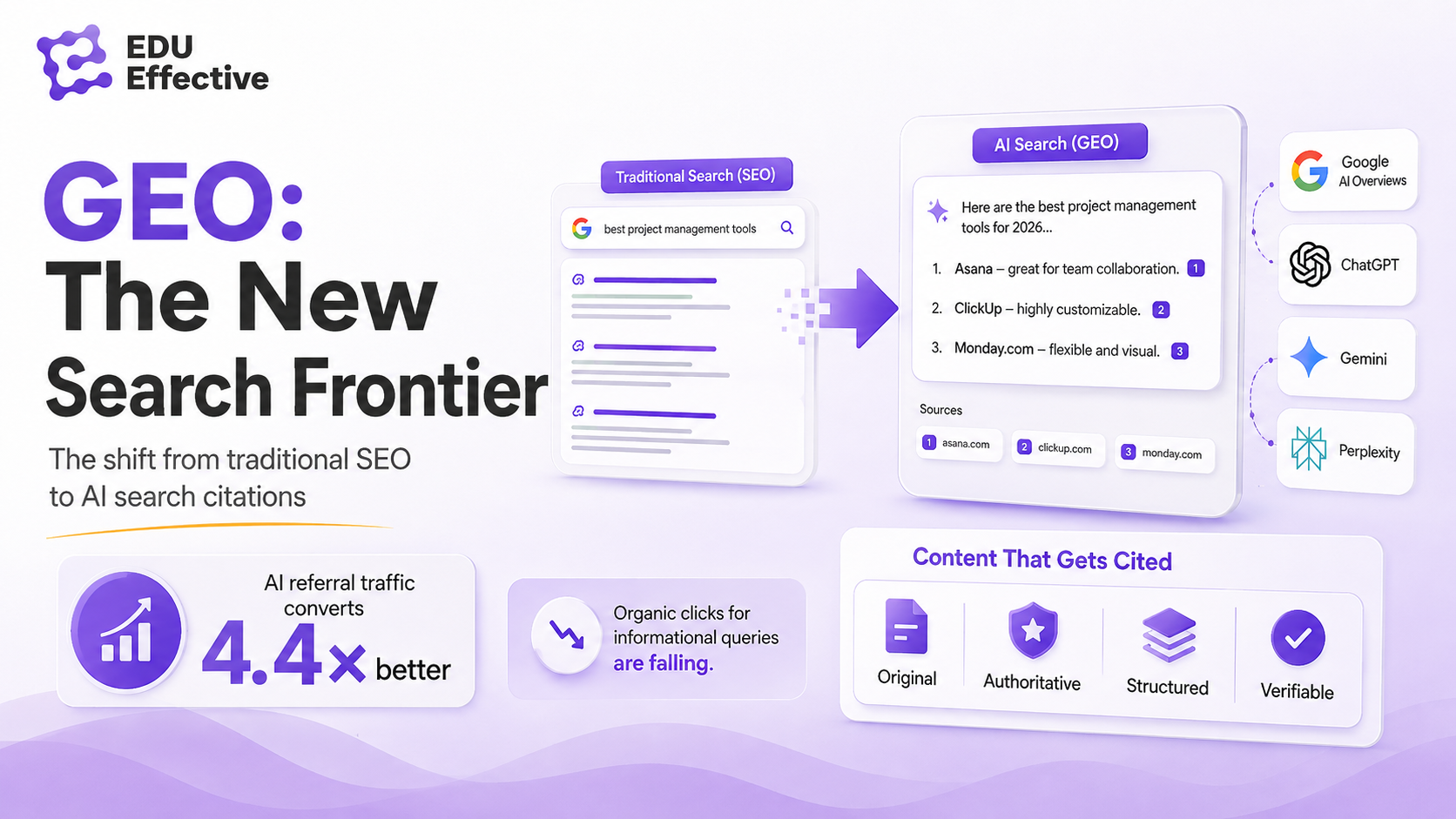
3. Generative Engine Optimisation (GEO) — the new search frontier
One of the most disruptive shifts in marketing innovation is playing out in search. Google AI Overviews are reducing organic click-through rates by 18–47% for informational queries in 2026, as AI-generated answers appear above traditional search results and satisfy user queries without requiring a click. For many content categories, the traffic model that underpinned content marketing for the past decade is being structurally undermined.
The innovative response is Generative Engine Optimisation (GEO) — the practice of structuring content to be cited by AI systems, not just to rank in traditional search results. When ChatGPT, Gemini, Perplexity, or Google's AI Overviews answer a user's question, they surface content from the web. Being cited in those AI-generated answers drives AI referral traffic that converts at approximately 4.4 times the rate of traditional organic traffic — because visitors arrive with greater context and higher intent.
GEO requires a different content strategy than traditional SEO. It favours original, authoritative content on specific topics, consistent brand entity signals across platforms, clear factual claims that AI systems can verify, and structured information that is easy for AI to parse and attribute. Brands investing in genuine topical authority are winning citations. Those producing undifferentiated content are losing visibility. To measure the impact, learn how to track AI referral traffic in GA4 as GEO strategies start producing results.
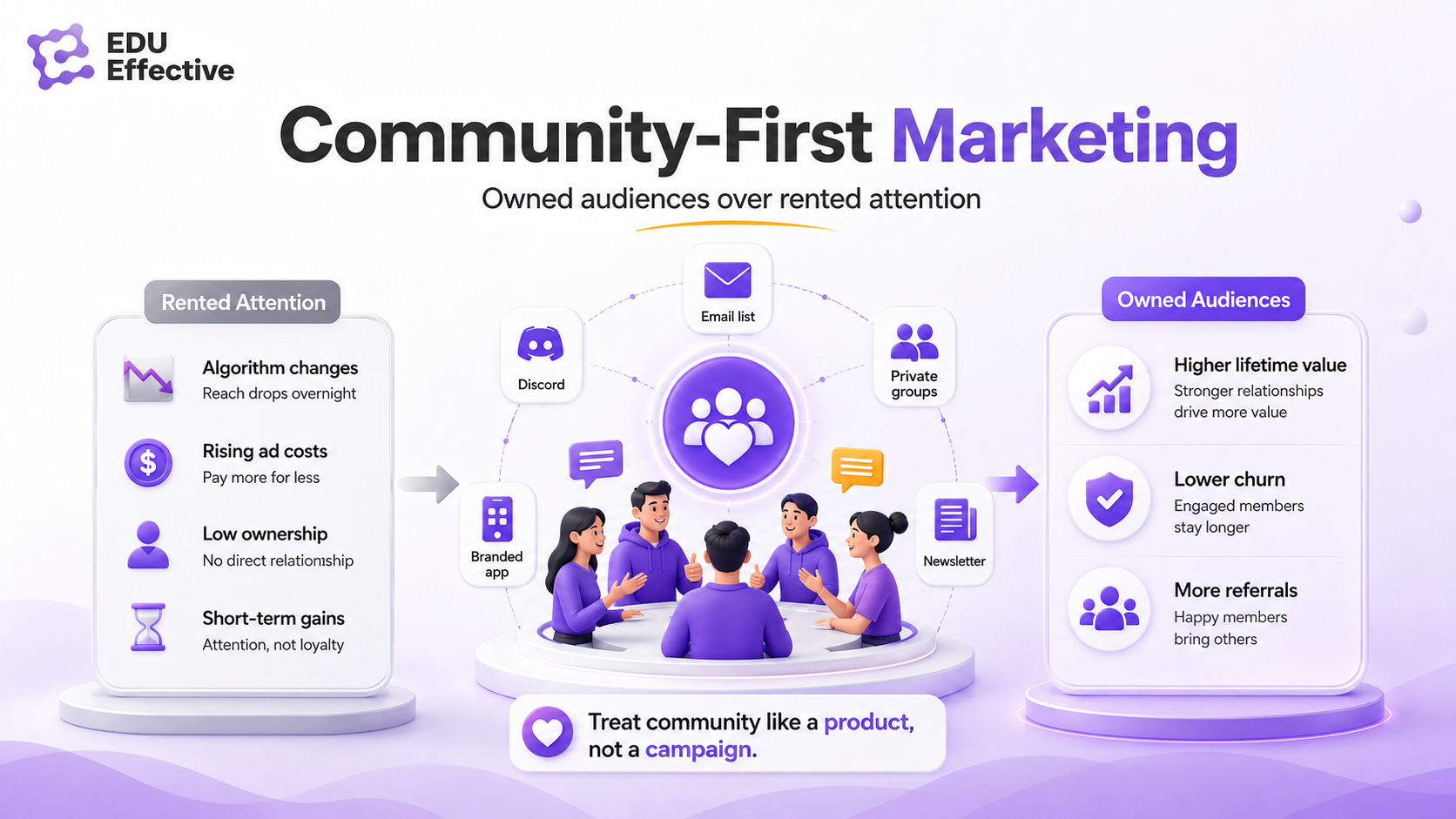
4. Community-first marketing — owned audiences over rented attention
One of the most durable innovative marketing concepts of the 2020s is also one of the oldest: building an audience you own rather than renting attention from platforms.
In 2026, this takes the form of community-first marketing — deliberately building communities of engaged customers and prospects on platforms where the brand controls the relationship: email lists, Discord servers, private groups, branded apps, and subscription newsletters. Rather than broadcasting messages to a passive audience, community-first brands foster genuine dialogue, co-creation, and peer-to-peer advocacy.
The commercial logic is compelling. Platform-mediated audiences are subject to algorithm changes, reach restrictions, and rising CPMs. An owned community is not. Customers who participate in a brand community demonstrate measurably higher lifetime value, lower churn rates, and higher referral rates than those who interact only through conventional channels.
The brands executing this most effectively in 2026 are those that treat community building as a product function rather than a marketing campaign — investing in sustained engagement, genuine response to community feedback, and the creation of content and experiences that have value independent of any sales objective. This is part of the marketing philosophy shift that underpins community-first and privacy-first strategies.
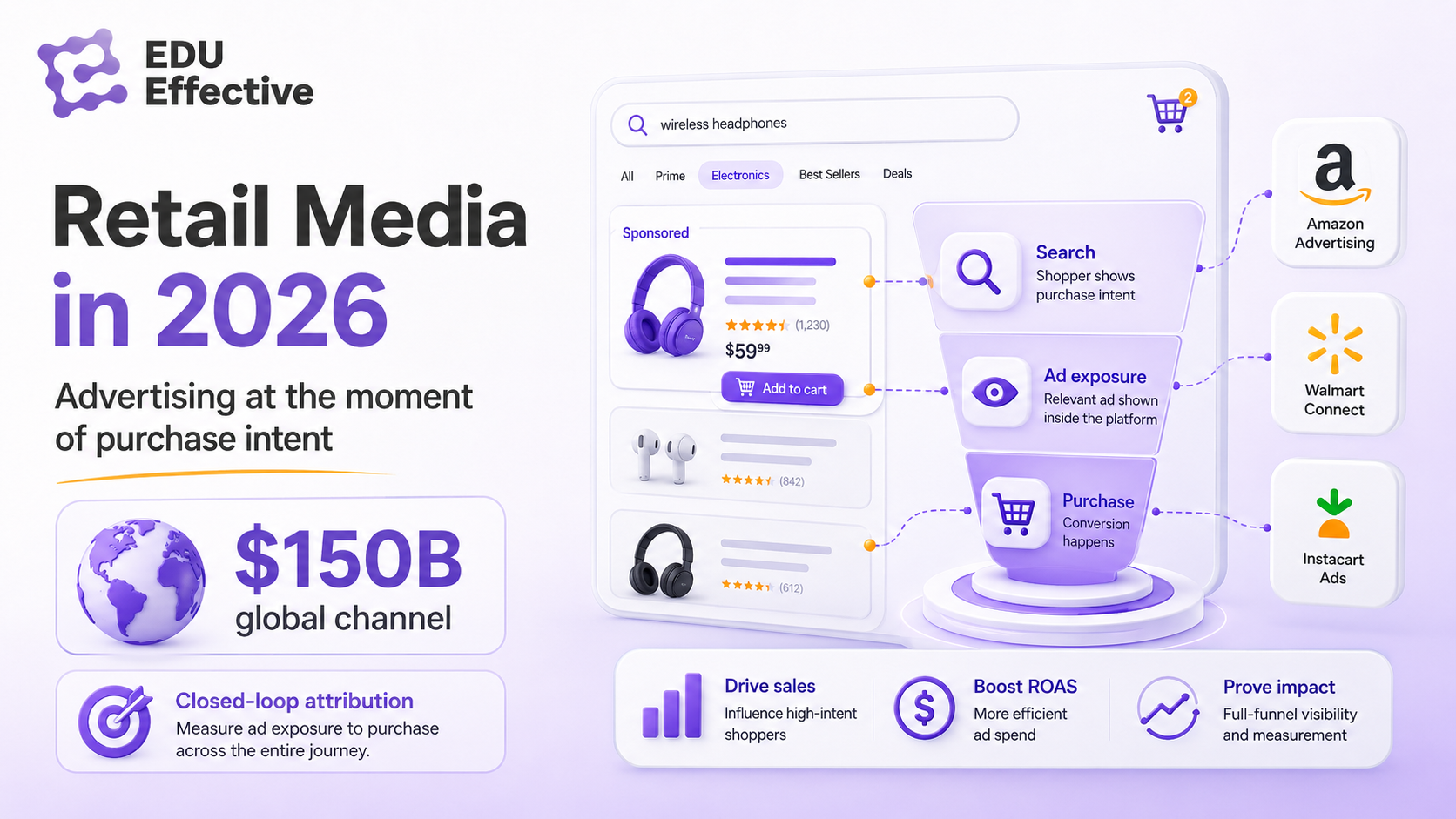
5. Retail media and zero-moment-of-truth advertising
Retail media — advertising within e-commerce platforms at the point of purchase intent — has grown from a niche tactical option to a $150 billion global channel in 2026, making it one of the most significant innovations in marketing distribution of the past five years.
The concept is straightforward: advertising that appears when a consumer is actively searching for products to buy, on the platform where they are about to make the purchase, reaches people at the highest-intent moment in the purchase journey. Amazon Advertising, Walmart Connect, Instacart Ads, and dozens of retailer-specific networks now offer this capability across sectors from grocery to electronics to fashion.
The data advantage compounds the channel benefit: retail media networks can connect advertising exposure to actual purchases, providing attribution clarity that has historically been unavailable to upper-funnel marketing. For brands with products sold through major retail channels, retail media allocation has become one of the most commercially efficient uses of marketing budget available.
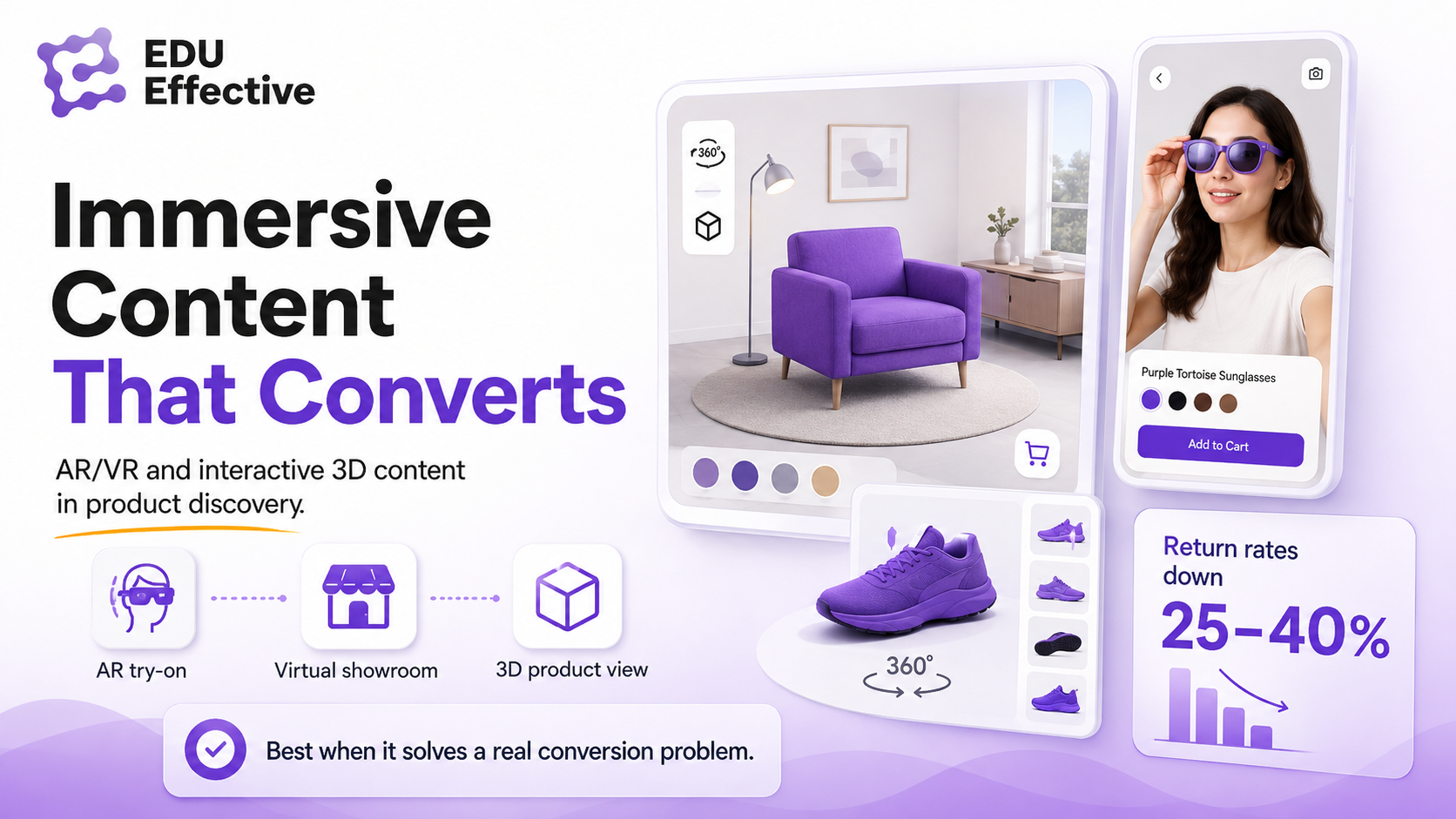
6. Immersive and interactive content — beyond passive consumption
AR and VR in marketing have been predicted as transformative for a decade. In 2026, the prediction has materialised in specific, commercially significant applications — not as a general revolution, but as a targeted tool that produces measurable results in contexts where product visualisation and experiential engagement are high-value.
AR product try-on has reduced return rates by 25–40% in fashion and beauty retail by allowing customers to visualise products on themselves before purchase. Immersive virtual showrooms for high-consideration categories — automotive, furniture, luxury goods — enable detailed product exploration that outperforms static images and video on conversion rate. Interactive 3D product visualisation has become a standard expectation for premium consumer electronics and home improvement categories.
The common thread across effective immersive marketing is that it addresses a specific information gap or emotional need in the purchase journey — it is not deployed as novelty, but as a solution to a concrete conversion problem.
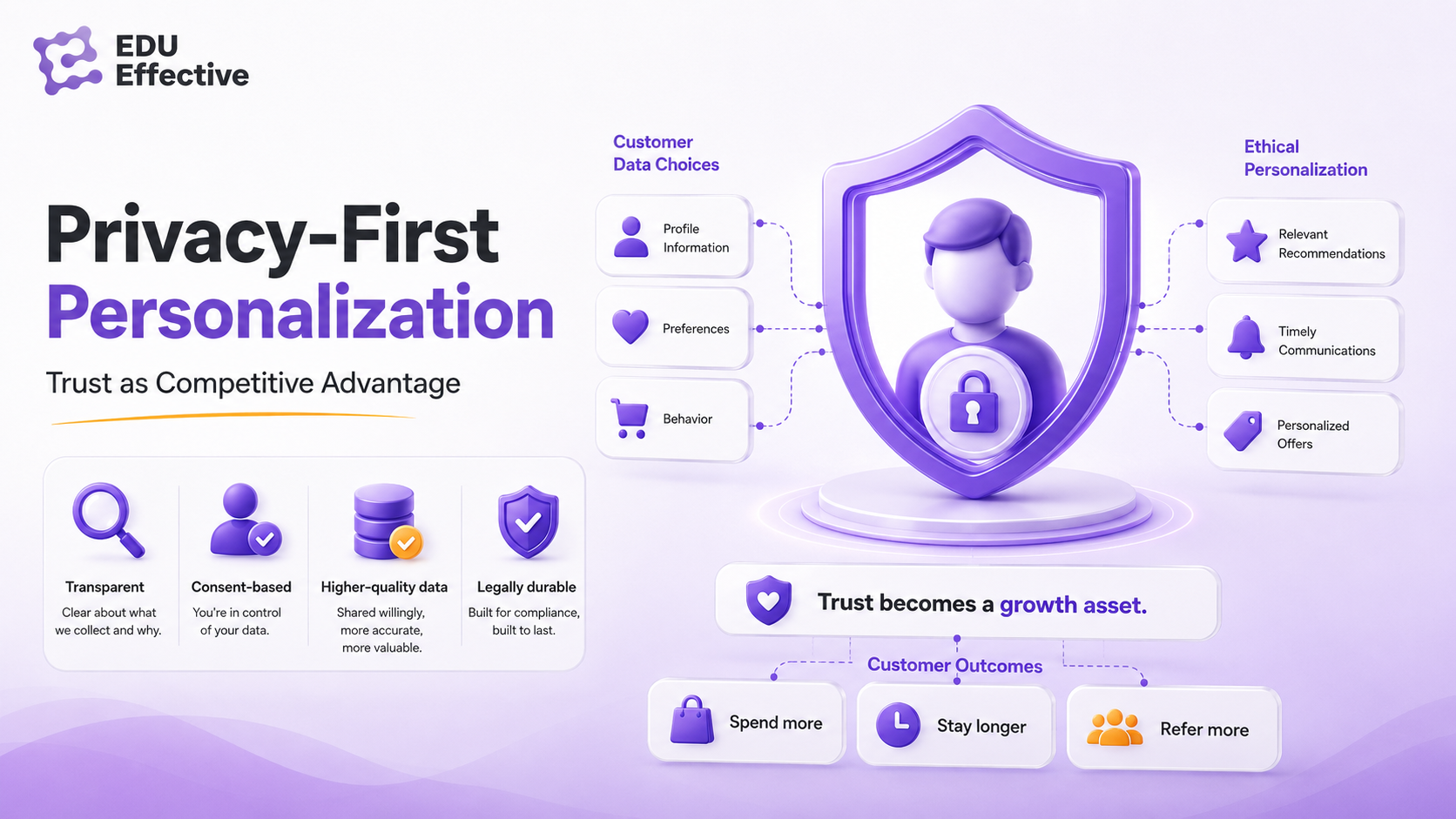
7. Privacy-first personalisation — trust as competitive advantage
The final innovative strategy on this list is one that the least innovative marketers dismiss as compliance overhead and the most innovative treat as genuine strategic opportunity.
Privacy-first marketing — building personalisation capabilities that are transparent, consent-based, and grounded in data customers willingly share — is producing measurable competitive advantages in 2026. As privacy regulation has tightened across the EU, US states, and major Asian markets, brands that built privacy-compliant data strategies early are now marketing more effectively, not less, because their data is higher quality, more accurate, and more legally durable than data assembled through third-party tracking.
The consumer dimension is equally significant. Research consistently shows that customers who trust a brand with their data spend more, stay longer, and refer more frequently than those who feel their data has been collected without genuine consent. The transparency that privacy-first marketing requires is not a concession — it is a mechanism for building the kind of relationship that creates commercial value over time.
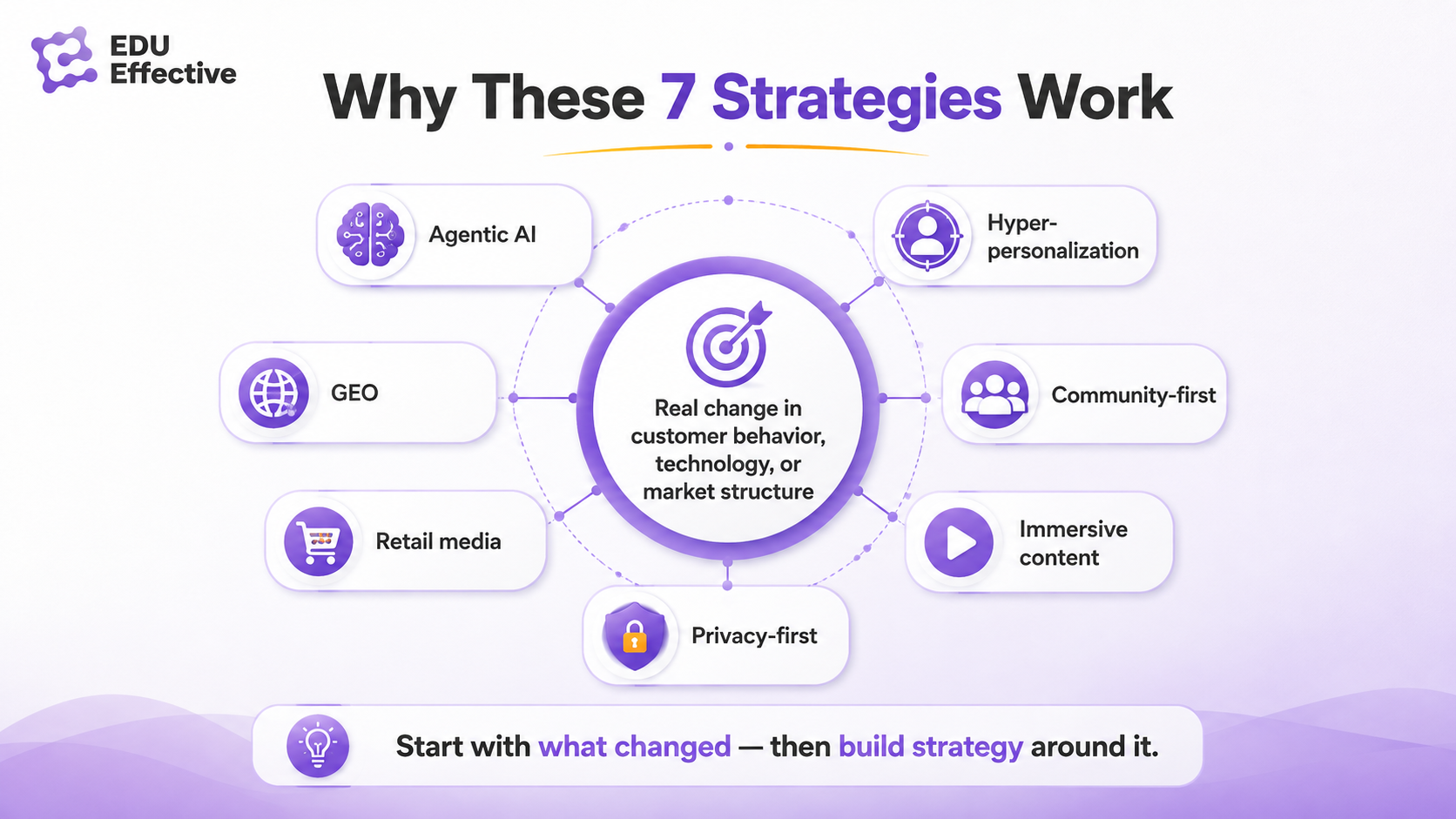
The common thread across all seven
The innovative marketing strategies that are producing the most durable results in 2026 share a structural characteristic: they are each responses to genuine changes in customer behaviour, technology capability, or market structure — not responses to competitive pressure or trend reports.
Agentic AI emerged because the volume and speed of optimisation decisions required exceeds what human teams can execute. GEO emerged because search behaviour has changed. Community-first marketing emerged because platform reach has become unreliable. Privacy-first strategies emerged because regulatory and consumer expectations changed simultaneously.
Marketing innovation that lasts starts with an honest assessment of what has actually changed in how customers find, evaluate, and choose products and services — and builds from there. Tactics that start with the technology and work backward to a customer benefit rarely sustain. For a framework view, see the core marketing functions being reshaped by each of these innovations.
At EDU Effective, our Effective MBA programs develop the strategic thinking and analytical capabilities needed to identify, evaluate, and implement genuinely innovative marketing approaches — not just follow them. Explore our Effective MBA: Online Marketing program →
EDU Effective Business School = professional development for your long-term success.
All best-selling Effective MBA programs are built for working adults: 15 minutes a day, 10 months or less, ASIC accredited, from €990.
These are professional programs, not academic ones — built for working adults to apply what they learn directly in their own business, not to collect a scholarly credential.
Join more than 9,000 students in over 120 countries around the world to further your personal development and career success.
Read the feedback and experiences of our students and the stories of our graduates here.
Apply now — from €990 · Talk to a Study Advisor
Study with NO risk: 14-day money-back guarantee, no questions asked.
Sources
- Aprimo — AI-Driven Marketing Strategies to Implement in 2026 https://www.aprimo.com/blog/ai-driven-marketing-strategies-to-implement-in-2026
- Improvado — 7 AI Marketing Trends for 2026: Strategy & Data Insights https://improvado.io/blog/ai-marketing-trends
- Zeta Global — Predictions 2026: How AI Will Redefine Marketing https://zetaglobal.com/resource-center/predictions-2026-ai-marketing/
- Robotic Marketer — How AI Is Powering Personalization at Scale in 2026 https://www.roboticmarketer.com/personalization-at-scale-ai-marketing-trends-for-2026/
- WSI World — Top Digital Marketing Trends for 2026 https://www.wsiworld.com/blog/top-digital-marketing-trends-for-2026-what-businesses-need-to-know
- Klaviyo — 8 Marketing Automation Trends for 2026: AI, Privacy & Personalization https://www.klaviyo.com/blog/marketing-automation-trends
- Ravetree — Top Digital Marketing Trends Agencies Must Embrace in 2026 https://www.ravetree.com/blog/top-digital-marketing-trends
- WordStream — The Biggest AI Marketing Trends for 2026 https://www.wordstream.com/blog/2026-ai-marketing-trends