

Artificial intelligence has been a topic of conversation in business for years. In 2026, it has become a topic of operational reality. The question that mattered in 2023 — "should we be paying attention to AI?" — has been replaced by one that is considerably more demanding: "how do we actually use it to get results?"
That shift from theoretical interest to practical application is what distinguishes applied artificial intelligence from AI in general. Applied AI is not about understanding how neural networks work or writing code to train models. It is about using AI tools, techniques, and systems to do real work better, faster, and more effectively — and doing so in a way that is structured, sustainable, and delivers measurable value.
For business professionals without a technical background, this is both the most important and the most underserved dimension of the AI conversation. Most of the content about AI is written by technologists for technologists. This article is written for the professional who wants to lead with AI, not just follow it. For context on how applied AI skills fit within the broader executive management responsibilities that senior leaders must develop in 2026, see our companion guide.
What applied AI actually means
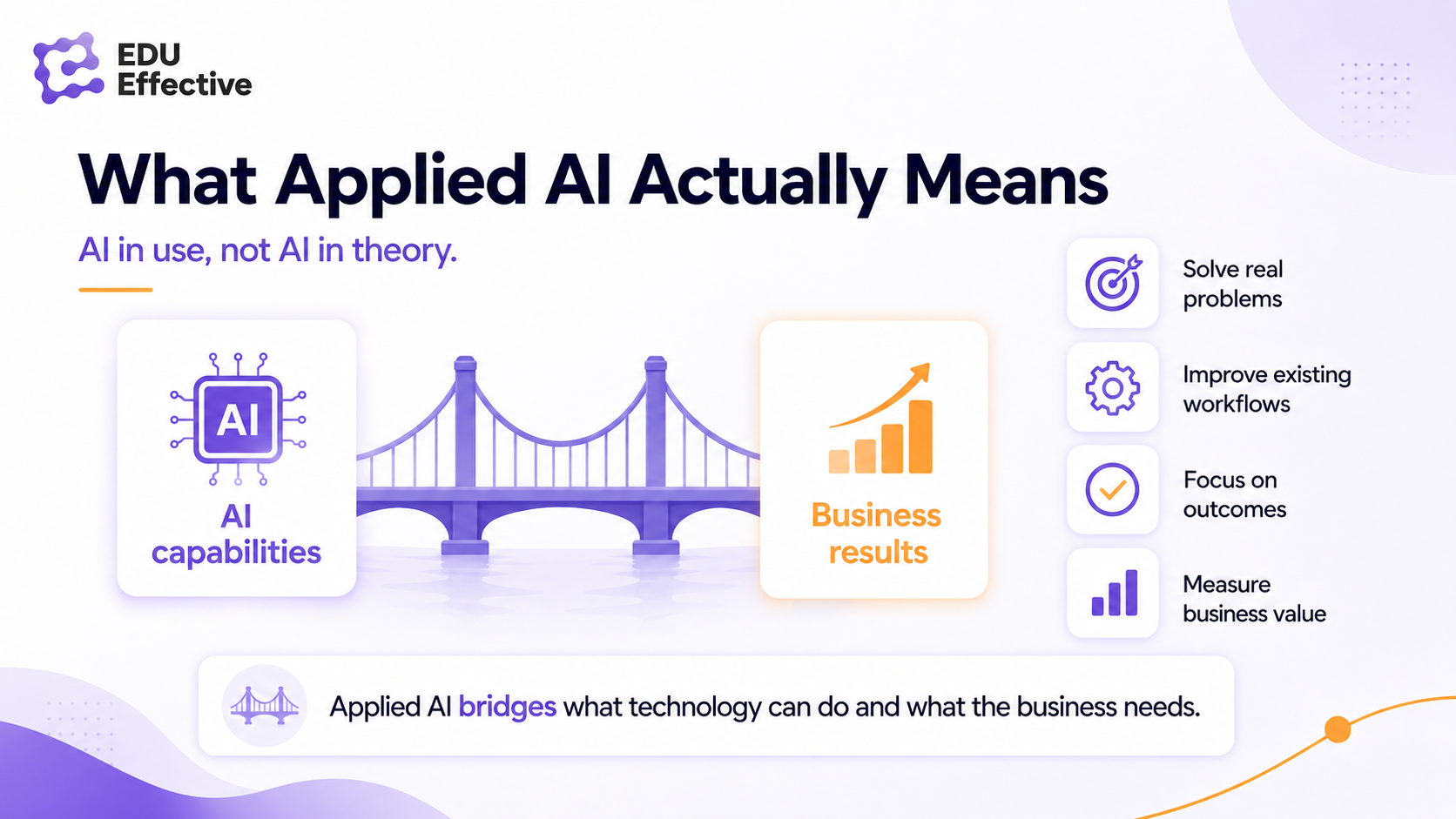
Applied artificial intelligence refers to the practical deployment of AI capabilities to address specific real-world problems. It is AI-in-use rather than AI-in-theory.
Where theoretical AI research focuses on advancing the underlying science — improving model architectures, developing new training techniques, pushing the boundaries of what AI systems can do in principle — applied AI focuses on what those capabilities can deliver in practice: saving time, improving decision quality, automating repetitive tasks, generating better content, analysing data faster, and personalising experiences at scale.
For business professionals, the distinction matters enormously. You do not need to understand how a large language model was trained to use one effectively. You do need to understand what it is good for, what it is unreliable for, how to direct it precisely, and how to integrate it into your existing workflows in a way that improves rather than complicates your work.
Applied AI is the bridge between what AI can do and what your organisation actually does with it.
The state of AI adoption in 2026: the data is unambiguous
The scale of AI adoption in professional contexts in 2026 is significant by any measure.
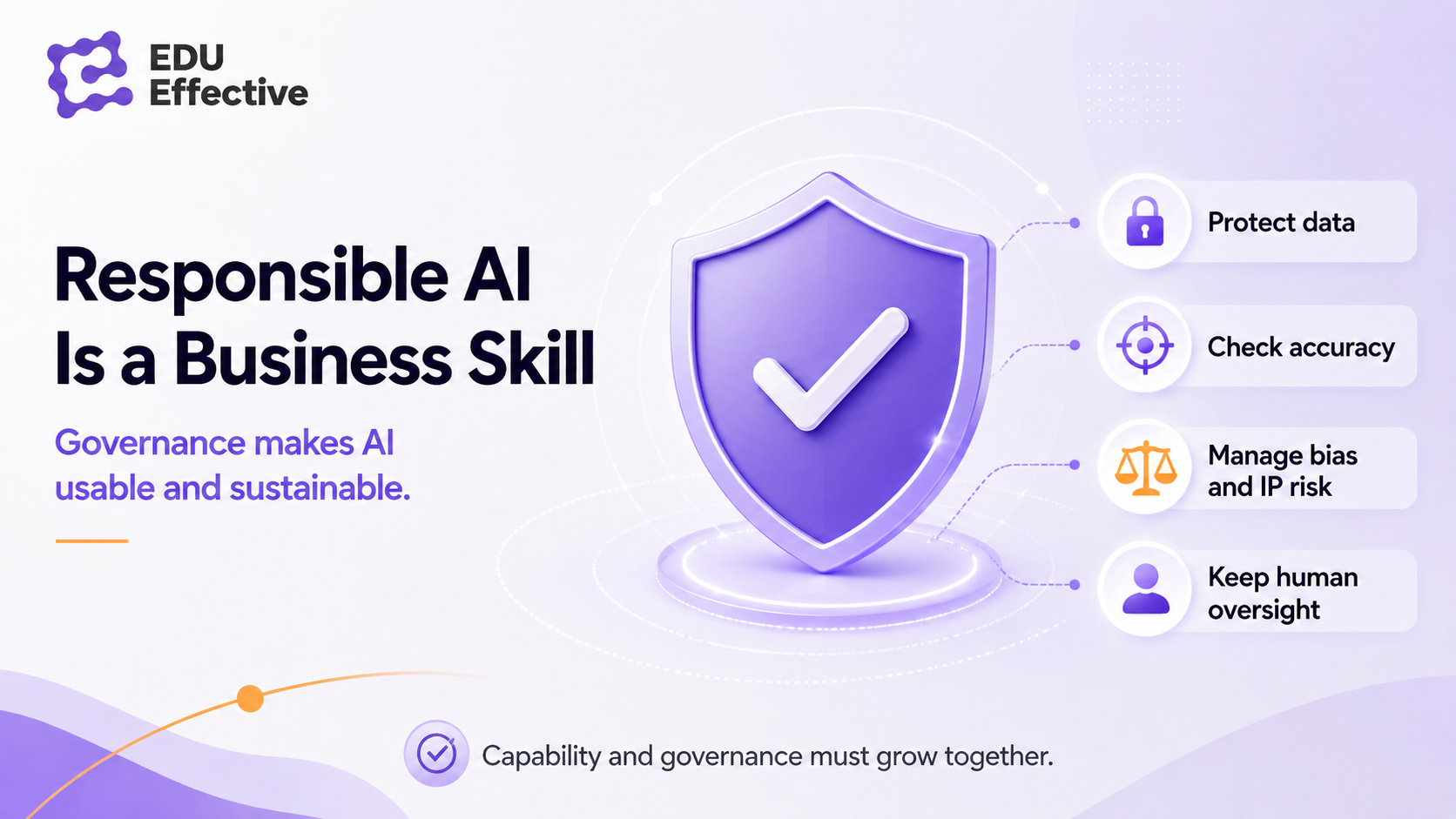
Generative AI use in organisations has nearly doubled in the past year, with 40% of professionals now reporting their organisations use it — up from 22% the previous year, according to Thomson Reuters' 2026 AI in Professional Services Report. More than 80% of current users engage with AI weekly, and more than 90% expect it to become a central part of their workflow within five years.
The generative AI market itself reached $103.58 billion in 2025 and is projected to grow to $161 billion in 2026. McKinsey's 2025 State of AI report found that 92% of companies plan to increase AI investment over the next three years. AI has moved from competitive advantage to baseline infrastructure — and the professionals who have not yet built practical AI fluency are increasingly operating at a structural disadvantage.
The productivity evidence is concrete. Federal Reserve research quantified generative AI's time savings at an average of 5.4% of work hours — equivalent to approximately 2.2 hours saved per week for a standard professional workload. Frequent AI users save considerably more: 27% of regular AI users report saving over 9 hours per week. Knowledge workers using production AI agents recover a median 6.4 hours per week, according to McKinsey's 2026 Global AI Survey and the Slack Workforce Index Q1 2026.
But here is the important counterpoint: 74% of generative AI pilots fail to move to scaled production, according to BCG, typically stalling due to data or governance issues. And only 18% of organisations track AI's return on investment systematically. The gap between organisations that are capturing AI's value and those that are not is widening — and it is primarily a human capability gap, not a technology gap.
Generative AI: the engine of applied AI for most professionals
Generative AI — AI systems that produce content, analysis, summaries, code, and other outputs from natural language prompts — is the category of AI that most professionals will engage with directly in their day-to-day work.
The most widely used generative AI tools in professional contexts in 2026 include ChatGPT, Microsoft Copilot (integrated across Microsoft 365), Google Gemini, Claude, and category-specific tools built on these foundations for marketing, legal, HR, finance, and other functions. Each has different strengths, different reliability profiles, and different integration points with the platforms professionals already use.
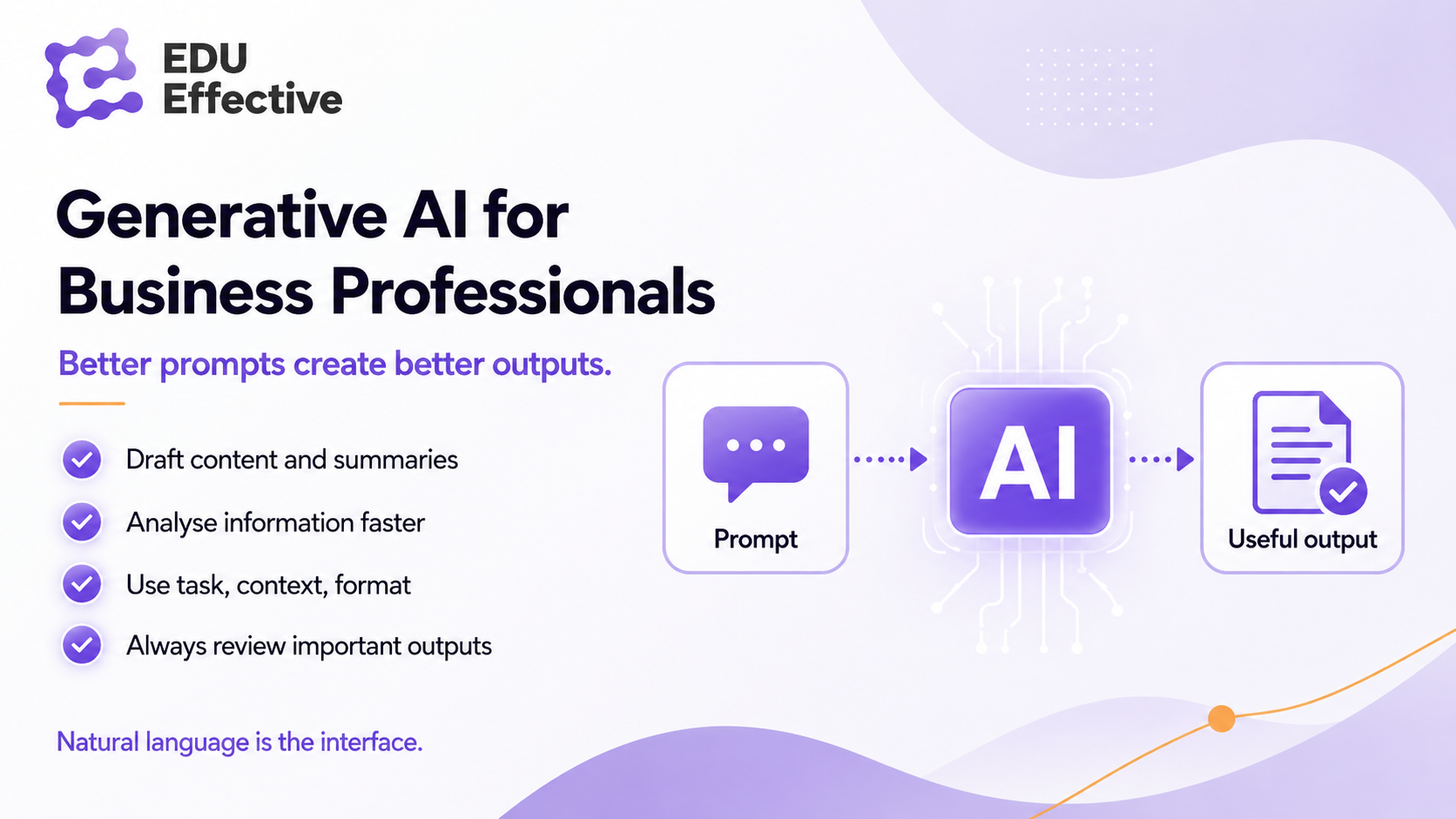
What these tools share is a common interface: natural language. You communicate with them by writing prompts — instructions, questions, context, constraints — and they generate responses. The quality of what you get out is directly determined by the quality of what you put in. This is why prompt engineering — the practice of writing effective AI instructions — has become one of the highest-value practical skills for business professionals.
A poorly written prompt produces generic, often useless output. A well-structured prompt that specifies the task, the context, the format, the constraints, and the intended audience produces output that is immediately useful and often excellent. The difference between these two outcomes is not the AI model — it is the professional using it.
AI agents: the next layer of applied AI
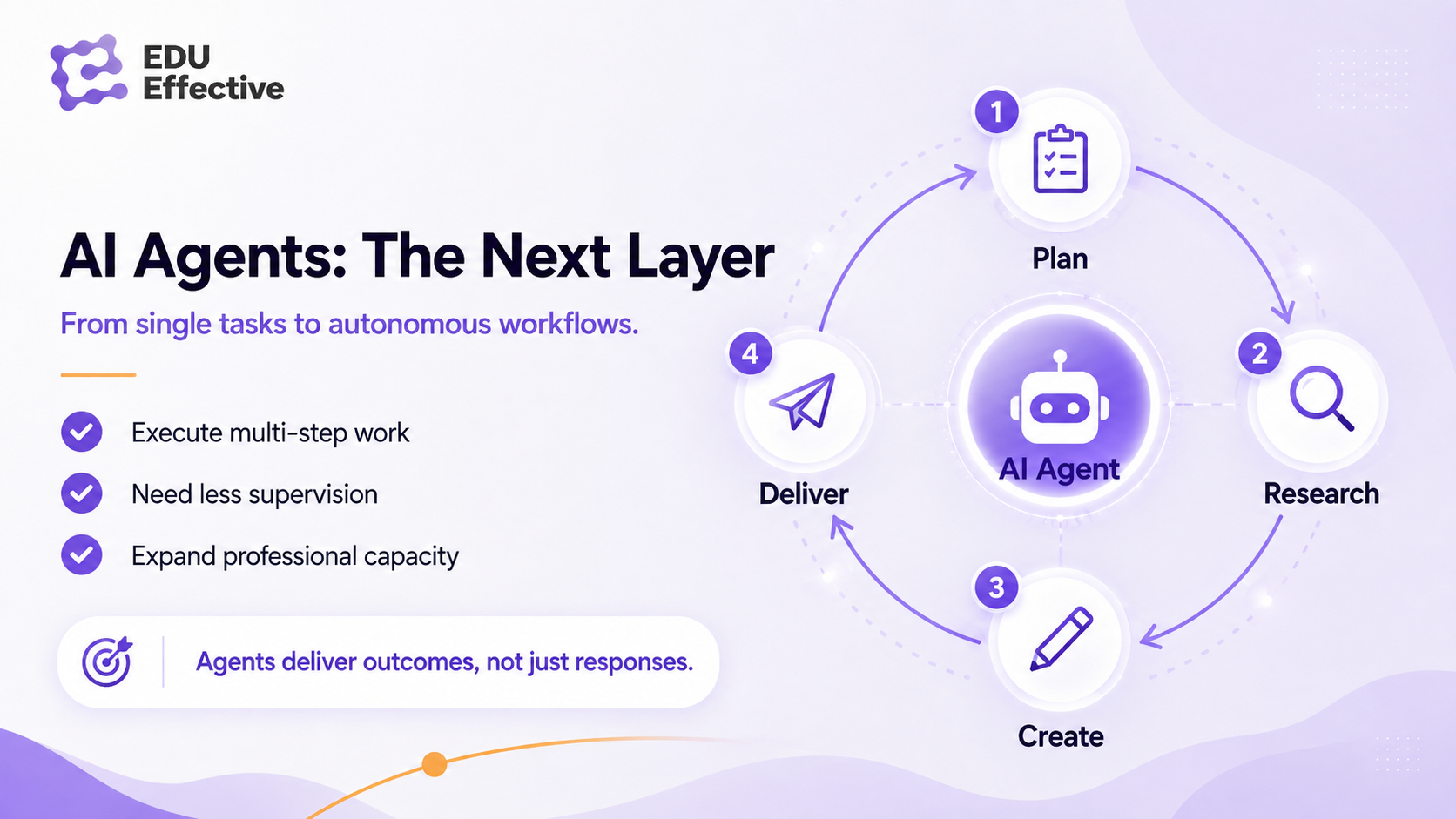
If generative AI handles individual tasks on request, AI agents handle sequences of tasks autonomously. An AI agent can be given a goal — "research the top five competitors in this market and produce a comparative summary with sources" — and execute the multiple steps required to achieve it without requiring human intervention at each stage.
According to Google Cloud's September 2025 survey of 3,466 senior leaders across 24 countries, 52% of enterprises are actively using AI agents, and 39% have already deployed more than ten. By end of 2026, Gartner projects that 40% of enterprise applications will include task-specific AI agents — up from less than 5% in early 2025.
The productivity implications are substantial. Companies using AI agents cited 66% productivity gains and 57% cost savings, according to PwC's 2026 AI Business Predictions. Payback periods are reaching positive ROI in 4 to 9 months depending on the use case, according to Bain's 2026 Agentic AI Benchmark — with customer service, marketing operations, and engineering being the categories showing fastest returns.
For business professionals, the practical opportunity of AI agents is the ability to delegate multi-step workflows — research, drafting, scheduling, data analysis, reporting — to systems that execute them reliably without human involvement at each step. No coding required. The most widely used agent frameworks in 2026 are accessible through the same interfaces as standard generative AI tools. For more on how agentic AI is being deployed specifically in marketing contexts — and what results it produces, see our dedicated guide.
Where applied AI delivers the most value by function
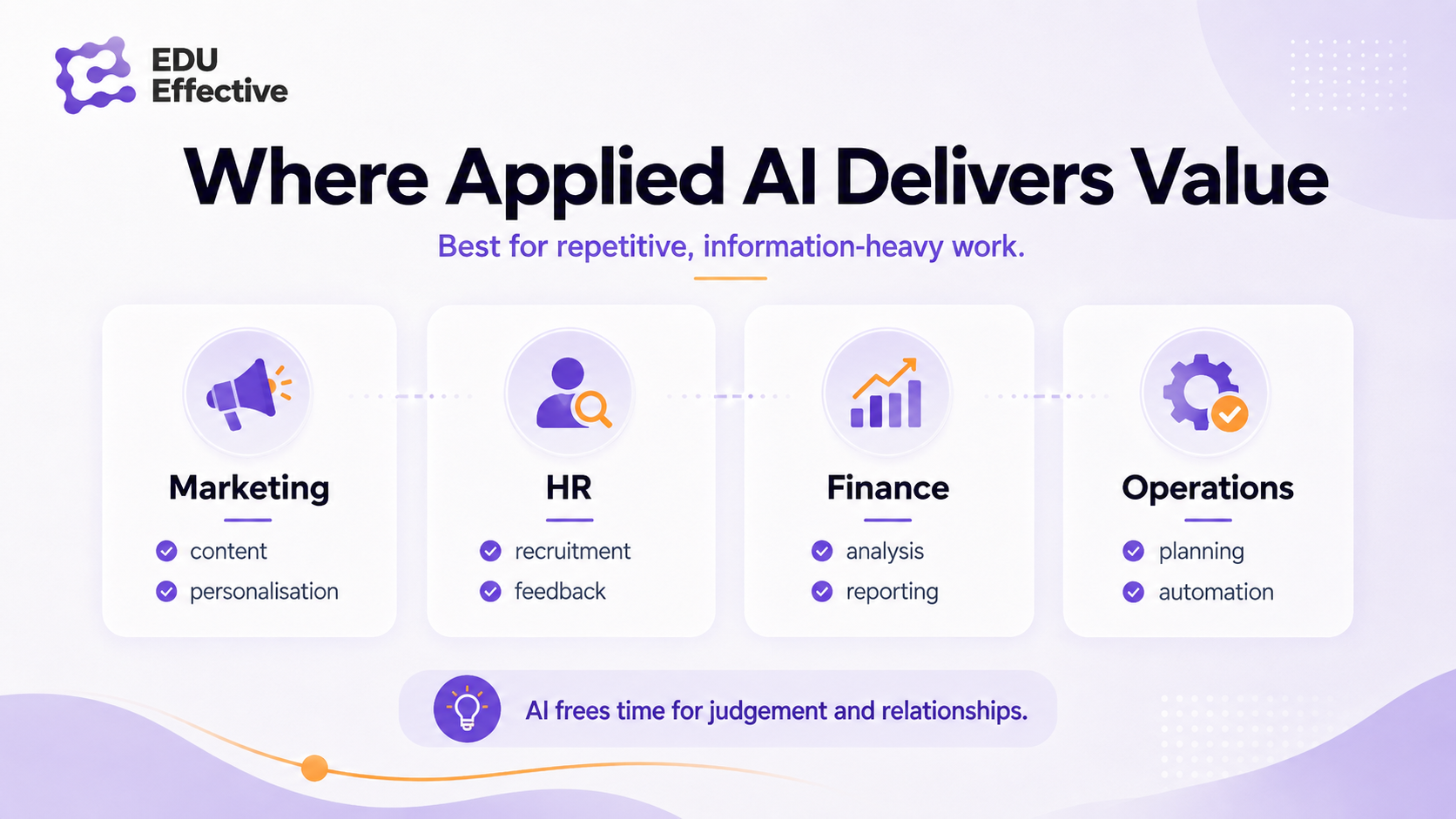
Applied AI is not uniformly valuable across all professional contexts. Its impact concentrates in specific types of work — and understanding where the value is highest helps professionals prioritise their learning and deployment.
Marketing and content. AI-generated or AI-assisted content now accounts for a substantial share of digital marketing output. AI tools accelerate research, drafting, A/B testing, personalisation, and performance analysis simultaneously. AI-driven campaigns are delivering 32% more conversions than traditional methods according to current McKinsey benchmarks. To go deeper, see how AI is reshaping each of the seven core marketing functions in detail.
Human resources and people management. AI tools support recruitment (CV screening, job description optimisation), performance management (structured feedback drafting, pattern identification in engagement data), learning and development (personalised content curation), and workforce planning (attrition prediction, skills gap analysis). AI-supported HR functions are delivering measurably faster hiring cycles and more consistent feedback processes.
Finance and analysis. AI tools now handle routine financial modelling, report generation, variance analysis, and regulatory compliance checking at speeds that reduce analyst workload dramatically. Financial services firms where 65% are actively using AI report both revenue gains and cost reductions at 89% of surveyed organisations, according to NVIDIA's 2026 State of AI in Financial Services report.
Project management and operations. AI supports project planning, risk identification, status reporting, meeting summarisation, and cross-team communication. Operations professionals using AI agents for workflow automation report significant reductions in administrative burden — freeing capacity for strategic and relationship-intensive work.
The pattern across all these functions is consistent: AI delivers the most reliable value on tasks that are repetitive, well-defined, information-intensive, and currently consuming disproportionate amounts of skilled professionals' time. It delivers the least reliable value on tasks requiring original strategic judgment, nuanced stakeholder relationship management, or ethical reasoning in context. To measure the impact of these activities, see how to track the AI-driven traffic your applied AI marketing strategies are generating.
Responsible AI: why governance is a practical professional skill, not a compliance exercise
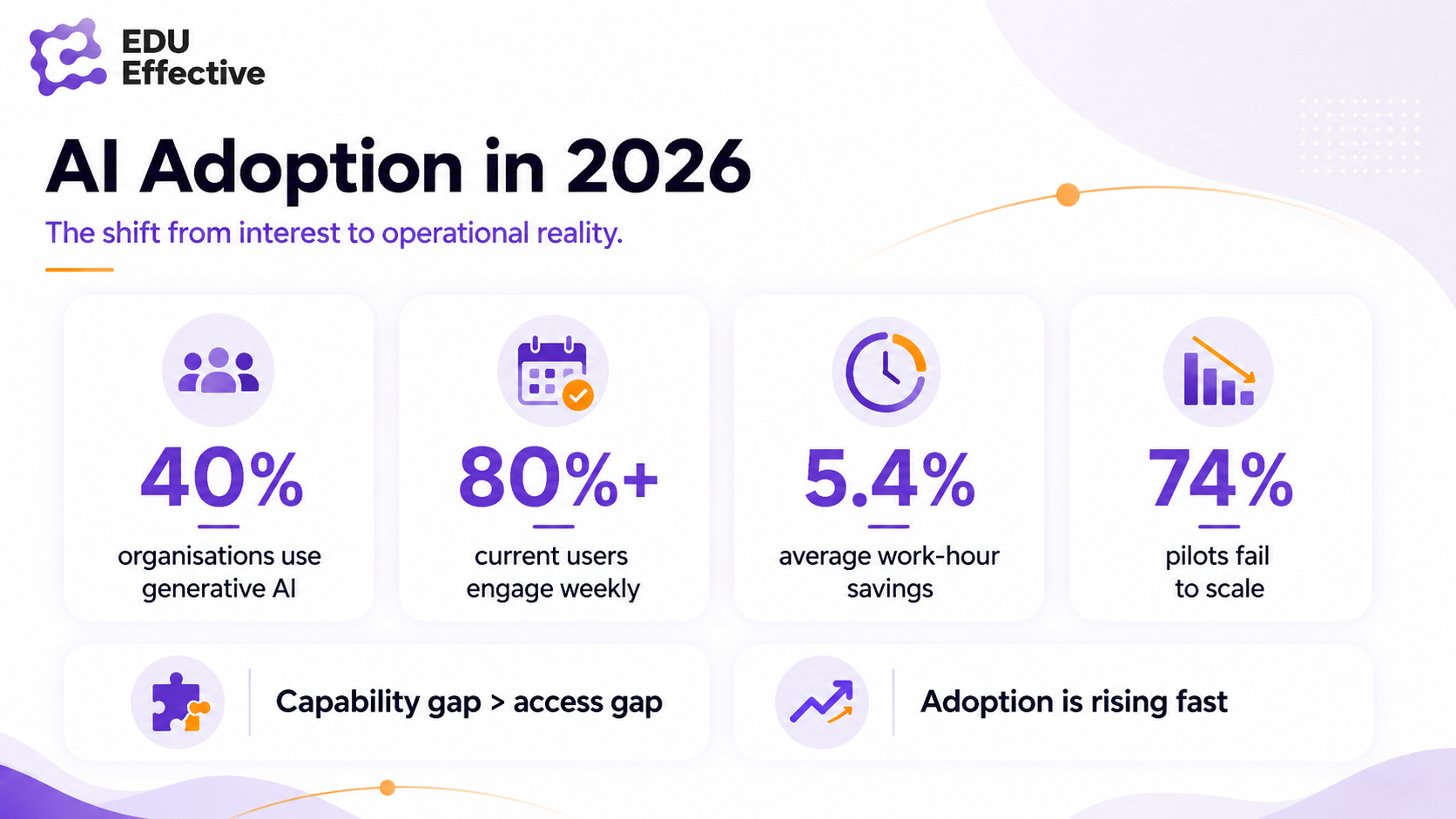
Applied AI without governance is a liability rather than an asset. Data protection, output accuracy, intellectual property exposure, algorithmic bias, and reputational risk are all live concerns that business professionals need to manage actively — not delegate entirely to legal or technology teams.
The EU AI Act, which has been entering its application phases since 2024, imposes specific obligations on organisations using AI in high-risk contexts including HR decisions, credit scoring, and customer-facing recommendation systems. These are not technical requirements — they are business requirements that require professionals at every level to understand what AI is doing in their organisation, how outputs are being used, and what oversight mechanisms are in place.
Only 18% of organisations currently track AI ROI systematically, according to Thomson Reuters. The same gap exists in governance: AI is being deployed faster than the frameworks to govern it are being built. The professionals who understand both the capability and the governance of AI — who can drive adoption and manage risk simultaneously — are the ones most valuable to any organisation navigating this transition.
The skill gap — and what it actually looks like
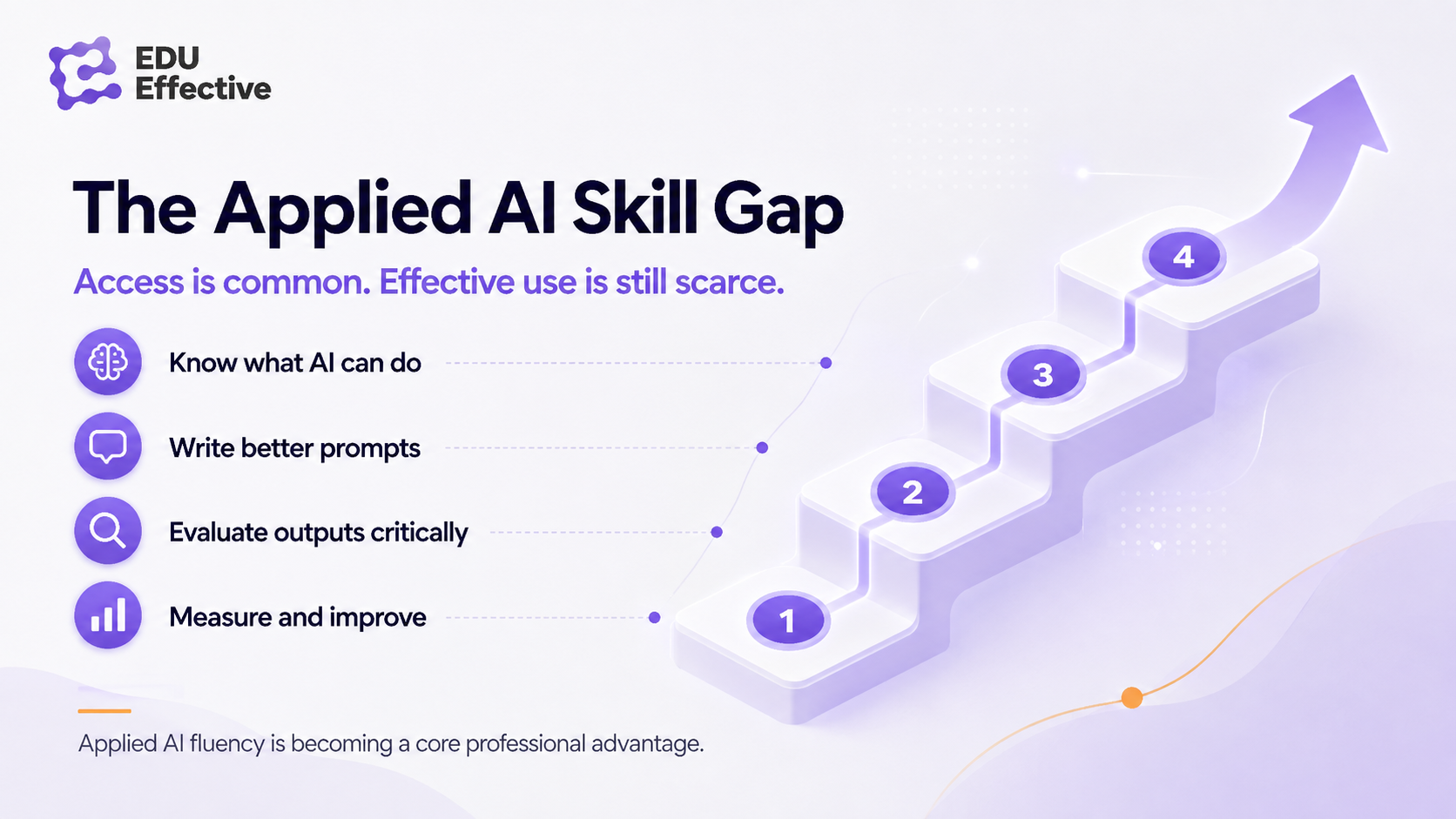
BCG's 2026 "AI at Work" survey found that 78% of managers and executives now use AI regularly, while adoption among frontline employees has stalled at 51%. The gap is not primarily technological — it is skill and confidence based. The employees and managers who use AI most effectively are those who understand what it can and cannot do, who have practised prompt writing enough to get reliable results, and who have thought through where in their workflows AI genuinely helps versus where it creates additional work.
Self-reported productivity improvements from AI adoption average 40% across sectors, according to AutoFaceless research. But that average conceals wide distribution: the professionals capturing the most value from AI are those who have invested in deliberately building their applied AI skills — not those who have simply been given access to AI tools and told to figure it out.
The practical implication is straightforward: access to AI tools is no longer scarce. The capability to use them well is.
Ready to build your applied AI skills professionally?
If this article has clarified that applied AI is a practical discipline — not a technical speciality — that every business professional needs to develop, the Effective MBA: Applied Artificial Intelligence at EDU Effective is built precisely for that purpose.
The programme covers all 10 dimensions of applied AI for business: AI productivity tools, generative AI in practice, AI with ChatGPT and Notion AI, AI-supported leadership, advanced AI prompting, AI agents in practice, AI in professional roles across marketing, HR, finance, and project management, implementing AI in organisations, responsible AI, and AI for business success. No coding required. See the full Effective MBA: Applied Artificial Intelligence programme, and for those who want to go deeper still, the Effective MBA: Mastery in AI builds beyond applied skills.
Content draws on insights from practitioners at Apple, Google, Microsoft, AWS, Meta, LinkedIn, Adobe, Salesforce, American Express, Visa, and many more — structured for immediate application in your own role, not as theoretical case studies.
EDU Effective Business School = professional development for your long-term success.
All five Effective MBA programs are built for working adults who need learning that fits real professional life:
Effective MBA: Executive Management & Leadership
Effective MBA: Applied Artificial Intelligence
Effective MBA: Coaching, Leadership & Mentoring
Effective MBA: Mastery in AI
Effective MBA: Online Marketing
Every programme runs on 15 minutes a day, completes in 10 months or less, is ASIC accredited, and starts from €990.
These are professional programmes, not academic ones — built for working adults to apply what they learn directly in their own business, not to collect a scholarly credential.
Join 9,000 students in over 120 countries who are investing in their professional development and career success. Read the experiences of our graduates here.
Apply now — from €990 · Talk to a Study Advisor
Study with NO risk: 14-day money-back guarantee, no questions asked.
Sources
- Thomson Reuters — 2026 AI in Professional Services Report https://www.thomsonreuters.com/en/reports/2026-ai-in-professional-services-report
- McKinsey & Company — The State of AI: How Organizations Are Rewiring to Capture Value (2025) https://www.mckinsey.com/capabilities/quantumblack/our-insights/the-state-of-ai
- PwC — 2026 AI Business Predictions: Agentic AI Survey https://www.pwc.com/us/en/tech-effect/ai-analytics/ai-predictions.html
- BCG — AI at Work 2026: Bridging the Gap Between Ambition and Adoption https://www.bcg.com/publications/2026/ai-at-work-why-strategy-matters-more-than-tools
- Google Cloud — ROI of AI Study 2025 (3,466 senior leaders, 24 countries) https://cloud.google.com/resources/content/roi-of-ai-2025
- Gartner — Gartner Predicts 40% of Enterprise Applications Will Include AI Agents by 2026 https://www.gartner.com/en/newsroom/press-releases/2025-08-26-gartner-predicts-40-percent-of-enterprise-apps-will-feature-task-specific-ai-agents-by-2026-up-from-less-than-5-percent-in-2025
- Accelirate — Agentic AI Statistics 2026: Global Enterprise Adoption and Market Insights https://www.accelirate.com/agentic-ai-statistics-2026/
- OneReach AI — Agentic AI Stats 2026: Adoption Rates, ROI & Market Trends https://onereach.ai/blog/agentic-ai-adoption-rates-roi-market-trends/
- Unico Connect — AI Statistics 2026: Adoption, ROI & Impact https://unicoconnect.com/blogs/ai-statistics-2026
- Wavelength Leadership — Leadership Trends 2026: 5 Critical Shifts https://www.wavelengthleadership.com/general/leadership-trends-2026-the-5-strategic-shifts-defining-the-future/
- Fortune Business Insights — Generative AI Market Size & Growth Report 2026–2034 https://www.fortunebusinessinsights.com/generative-ai-market-107837