

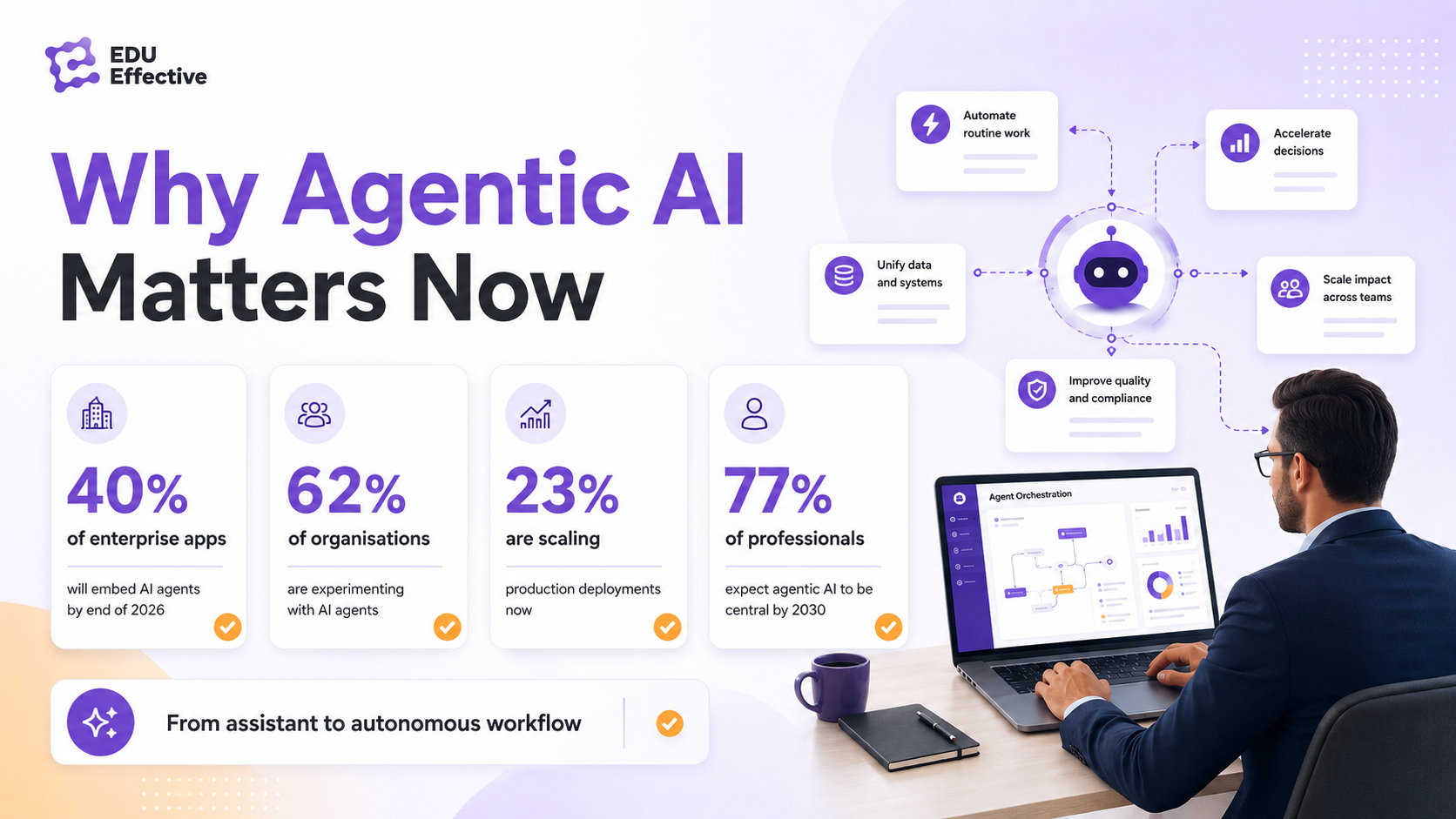
40% of enterprise applications will embed task-specific AI agents by the end of 2026 — up from less than 5% in 2025, according to Gartner. 62% of organisations are already experimenting with AI agents, and 23% are actively scaling them, according to McKinsey's 2026 Global AI Survey. And 77% of professionals expect agentic AI to be central to their workflow by 2030, according to Thomson Reuters' 2026 AI in Professional Services Report.
These numbers describe a shift that is qualitatively different from the generative AI adoption that has characterised the past three years. Generative AI assistants answer questions and produce content when prompted. Agentic AI systems pursue goals — planning sequences of actions, using tools, making decisions, and completing multi-step tasks with varying degrees of human involvement. The difference is not one of degree but of kind.
For business managers who do not need to build AI agents but will increasingly manage teams that work alongside them, approve their deployment, and govern their use, understanding what agentic AI is — specifically, what it does, where it creates value, and where it creates risk — has become a practical management requirement.
What AI agents actually are — a plain-language explanation
An AI agent is a software system that uses artificial intelligence to pursue a goal through a sequence of decisions and actions, rather than responding to a single prompt with a single output. The word "agent" reflects the system's capacity for agency: it perceives its environment, plans a course of action, executes that plan using available tools, evaluates the results, and adapts its approach based on feedback.
The distinction from conventional AI tools — including the generative AI assistants that most professionals now use daily — is meaningful. ChatGPT, Claude, and Gemini, used as conversational assistants, respond to a single input with a single output. They do not pursue goals across time. An AI agent built on the same underlying language model might be given a goal — "research three potential acquisition targets in the European renewable energy sector, compile a briefing document for each, and schedule preliminary calls with their CFOs" — and proceed to complete each step of that sequence, using web search, document creation, email, and calendar tools, without requiring human input at each decision point.
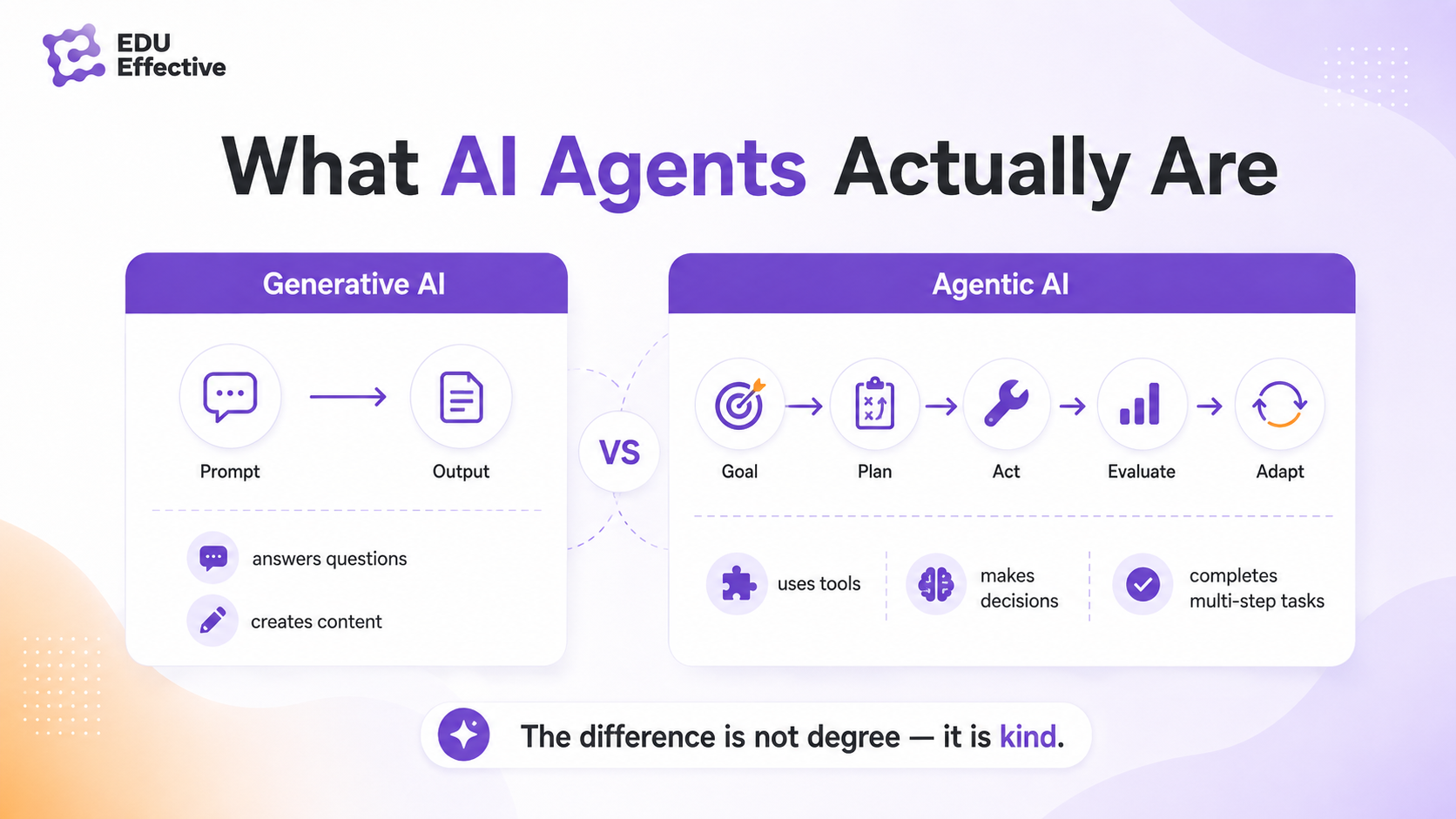
This capacity for multi-step autonomous action is what distinguishes agentic AI from generative AI as a category. It is also what creates the governance challenges and risk profile that make AI agents a management concern rather than just a technology concern.
How AI agents work — the four components
Understanding what makes an AI agent function requires familiarity with four components that work together in most agentic AI systems deployed in enterprise settings.
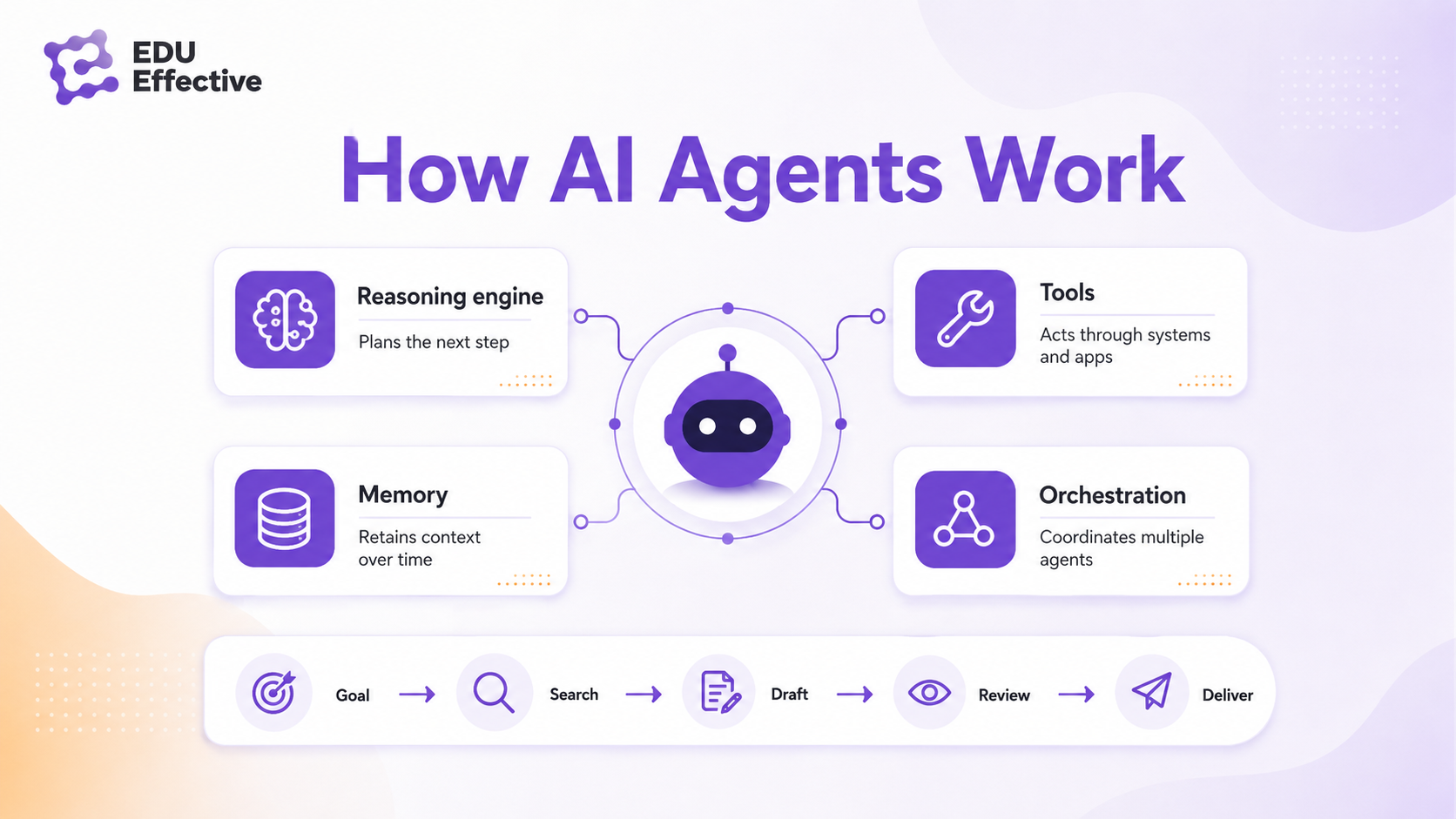
The reasoning engine is typically a large language model — the same technology that powers conversational AI assistants. The LLM provides the planning capability: given a goal and information about the current state, it determines what action to take next. The quality of the reasoning engine determines how effectively the agent can decompose complex goals into tractable steps, handle unexpected situations, and recover when an action produces an unintended result.
Tools are the mechanisms through which an AI agent acts on the world. A reasoning engine without tools can plan but not execute. Tools extend the agent's capabilities to include web search, code execution, database queries, email and calendar access, API calls to external systems, document creation and modification, and form completion. The set of tools available to an agent determines what it can actually accomplish — and what it can inadvertently affect.
Memory allows an AI agent to maintain context across the multiple steps of a task and across multiple interactions over time. Short-term memory holds the context of the current task; long-term memory allows the agent to retain information about past interactions, preferences, and results. Without adequate memory architecture, an agent effectively starts fresh at each step — significantly limiting its ability to pursue complex, multi-step goals coherently.
Orchestration coordinates how multiple agents work together. The most capable agentic AI deployments in 2026 do not rely on a single agent but on multi-agent systems — networks of specialised agents that collaborate on different aspects of a complex task, with an orchestrating agent coordinating the overall workflow. A customer service multi-agent system might include specialised agents for query classification, knowledge retrieval, response drafting, escalation decision, and satisfaction follow-up — each doing what it does best, with coordination provided by the orchestrator.
What agentic AI is being used for in business in 2026
The AI agent applications that have demonstrated the most consistent production-scale value in 2026 share a specific profile: they involve high-volume, repetitive, rule-bounded tasks with clear success criteria and short feedback loops. This is not the entire potential of agentic AI — but it is where production deployment is currently most concentrated and most reliable.
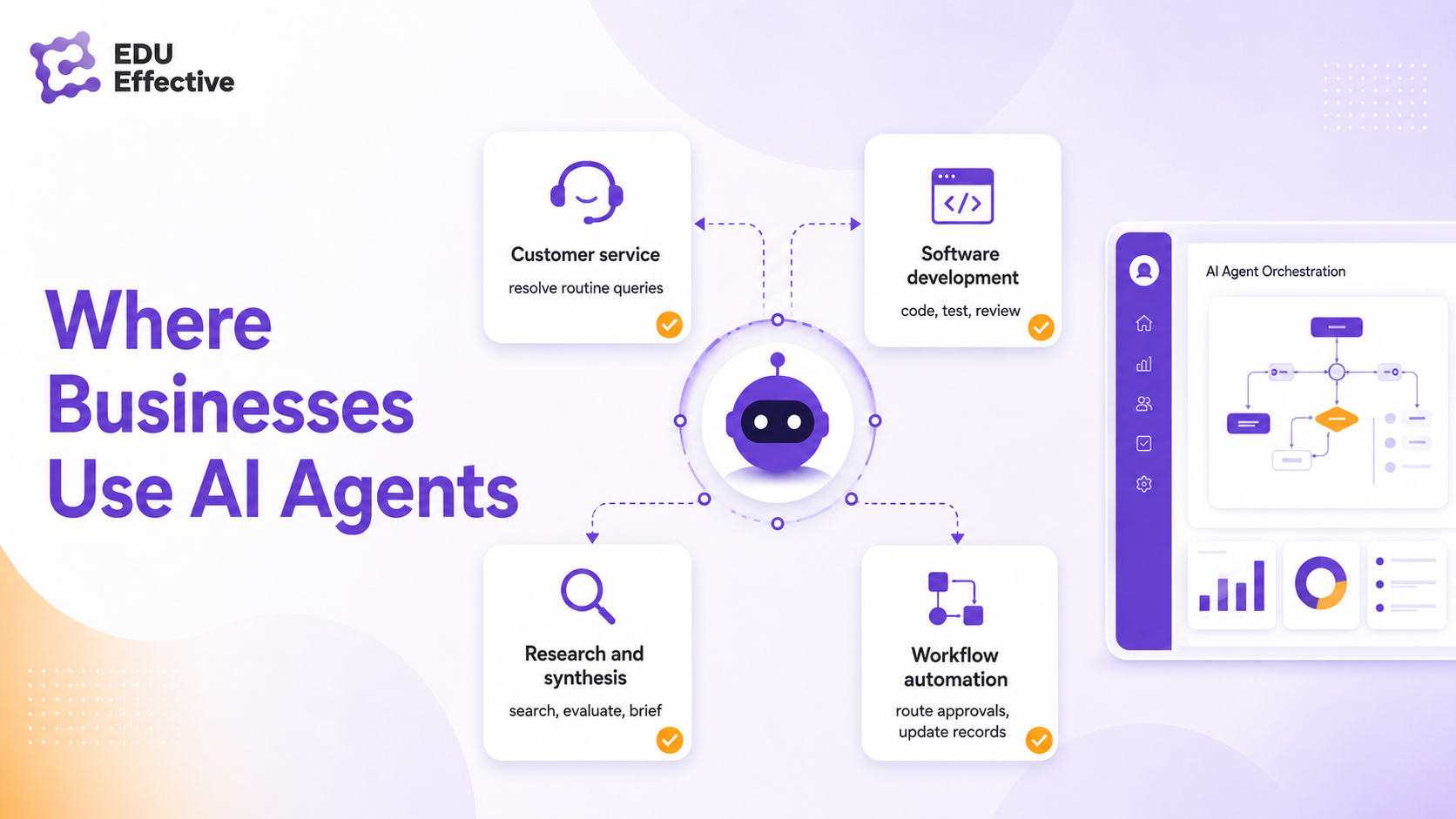
Customer service and support is the leading AI agent deployment in enterprises in 2026. AI agents in customer service resolve routine enquiries autonomously, escalate complex or sensitive cases to human agents, draft responses for human review in hybrid workflows, and maintain conversation context across multiple interactions. Gartner forecasts that AI agents will resolve 80% of common customer service issues without human intervention by 2029. Current deployments in production show meaningful ticket resolution rates that free human agents for the complex, relationship-sensitive interactions where human judgement is genuinely necessary.
Software development is the second most mature deployment area. AI coding agents generate code, write tests, review pull requests, identify bugs, and refactor existing codebases with varying degrees of human oversight. 51% of professional developers use AI tools daily, according to Stack Overflow's 2025 Developer Survey, and the shift from AI-assisted to AI-agentic development workflows is accelerating in 2026.
Research and information synthesis is the category most immediately relevant to knowledge workers and managers. Research agents that autonomously search multiple sources, evaluate credibility, synthesise findings, and produce structured briefings — completing in minutes what would previously have taken hours of human research time — are producing measurable time savings across professional services, financial analysis, and strategic planning functions. McKinsey found that knowledge workers using AI agents in production environments recover a median of 6.4 hours per week.
Operations and workflow automation encompasses the integration of AI agents into business processes that previously required human coordination across multiple systems. AI agents that autonomously process invoices, route approvals, update records across connected systems, and generate compliance documentation are being deployed in finance, legal, and operations functions where the volume of routine transactions makes manual processing increasingly unsustainable.
The governance challenge: why agentic AI requires different management than generative AI
The management challenge of agentic AI is qualitatively different from the management challenge of generative AI assistants — and it is this difference that most organisations are underestimating.
When a professional uses ChatGPT or Claude to draft a document, the worst-case failure mode is a poorly drafted document that needs editing. The human reviews the output before anything consequential happens. The AI has no access to external systems and takes no action in the world. The risk is bounded.
When an AI agent has access to email, calendar, database, and API tools and is pursuing a goal autonomously, the failure modes are different in kind. An agent that misunderstands a goal can take a sequence of actions — sending emails, modifying records, initiating processes — that are difficult or impossible to reverse. Gartner forecasts that more than 40% of agentic AI projects will be cancelled by 2027 due to escalating costs, unclear ROI, and inadequate risk controls. The cancellation rate is not primarily a technology failure — it is a governance failure.
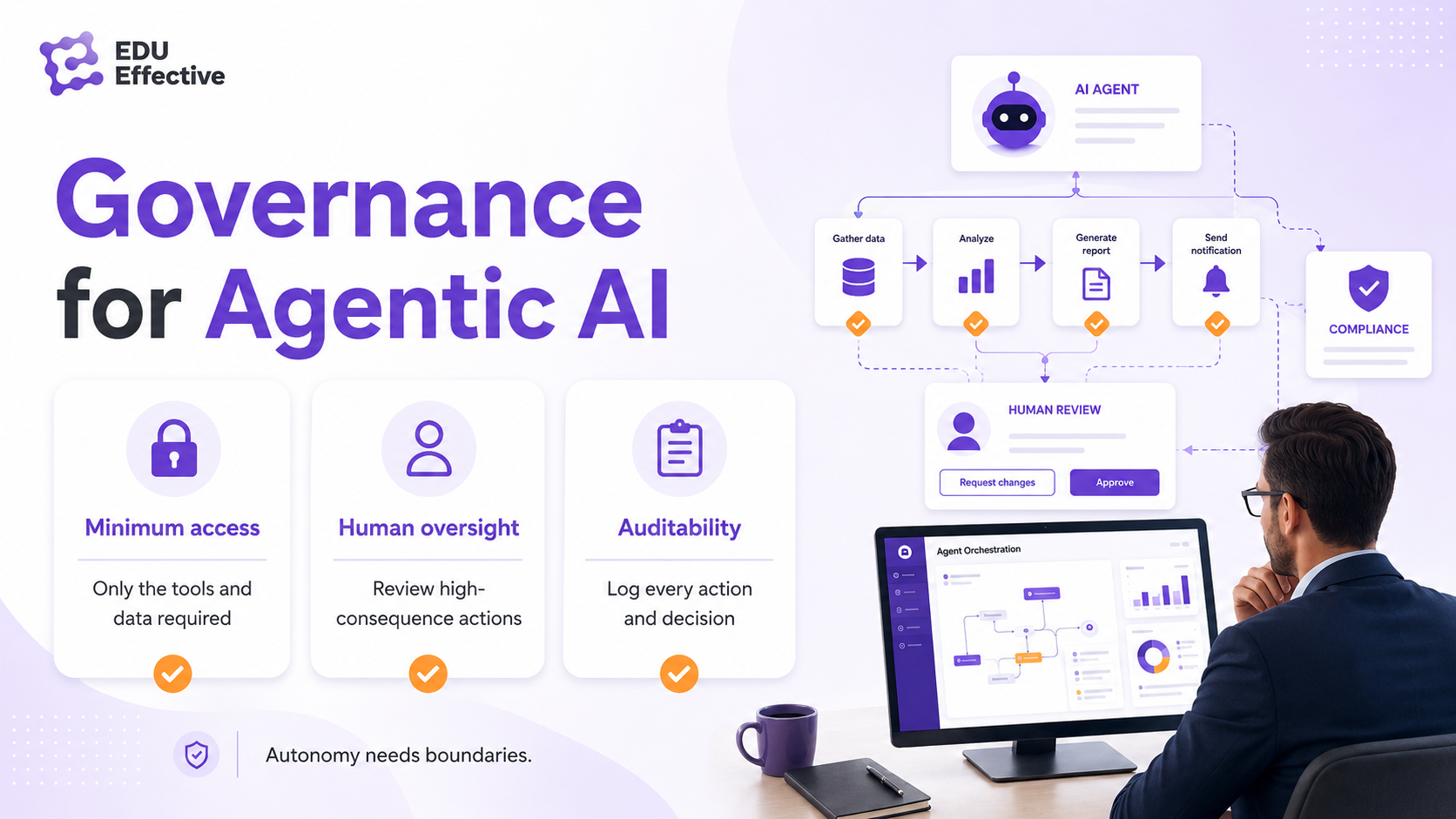
Three governance principles are consistently identified across research as the most critical for responsible agentic AI deployment.
Minimum necessary access. An AI agent should have access to only the tools and data it specifically needs to perform its designated function — not a broad set of capabilities that might be convenient. An agent that only needs to search the web and create documents should not have email access. An agent that manages customer service queries should not have access to financial systems. The principle of least privilege, standard in cybersecurity, applies directly to AI agent governance.
Human oversight at consequential decision points. The most robust agentic AI deployments in production define explicitly which decisions the agent can make autonomously and which require human review before execution. Sending a standard query response: autonomous. Issuing a refund above a threshold: human review. Updating a customer record: autonomous. Deleting a customer record: human approval. Building this decision boundary explicitly into the agent's design is not a limitation on its capability — it is the governance architecture that makes deployment responsible and scalable.
Auditability. Every action taken by an AI agent should be logged and reviewable. When an agent takes an unexpected action, or when its output needs to be checked, or when a regulatory body asks what decisions were made and by whom, the audit trail is the evidence that governance was in place. Organisations deploying agents without comprehensive action logging are building systems that cannot be governed effectively.
The skills managers need for the agentic AI era
The shift from AI-assisted to AI-agentic workflows changes what business managers need to understand and do. The skills required are not technical — they are managerial, strategic, and governance-oriented.
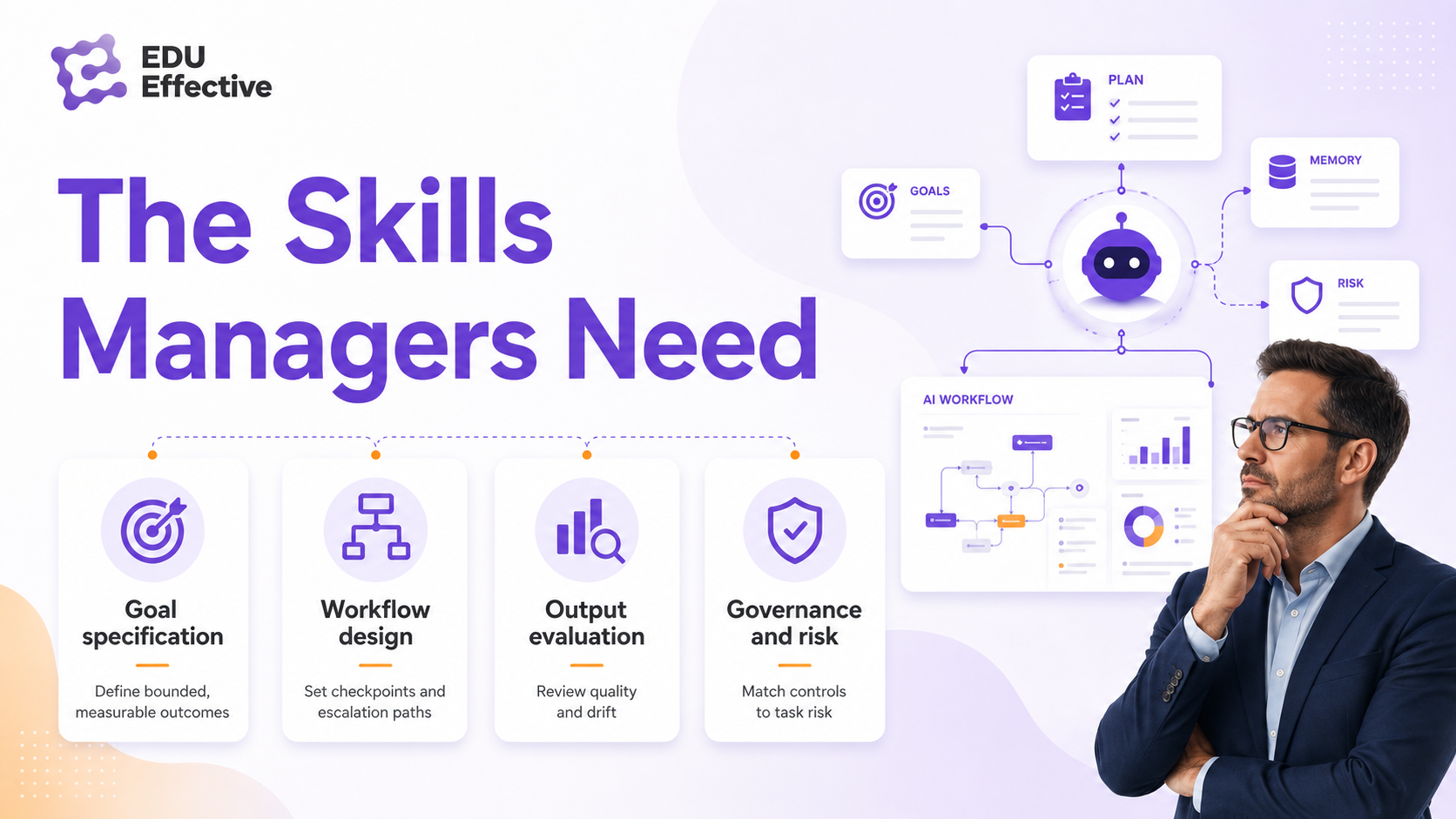
Goal specification. The quality of an AI agent's output is primarily determined by how precisely its goal is defined. Vague goals produce unpredictable agent behaviour; specific, bounded goals with clear success criteria produce reliable, auditable results. The skill of writing effective agent goals — specifying what the agent should achieve, what constraints it should not violate, and how its success will be evaluated — is a managerial skill that extends directly from the prompt engineering capability that effective AI use already requires.
Workflow design. Integrating AI agents into organisational workflows is a process design challenge before it is a technology challenge. Which tasks should be handled autonomously? At which points should the agent pause for human review? How should escalation thresholds be set? What happens when the agent encounters a situation outside its defined parameters? These questions are answered by managers and operations designers, not by technologists.
Output evaluation. The same critical evaluation skills required for generative AI outputs apply to agentic AI results — but with higher stakes, because agents act as well as generate. A manager whose team relies on AI agents for research, customer communication, or operational processes needs to maintain the judgement to evaluate whether the agents are performing as intended, identify when outputs are drifting from acceptable quality, and intervene effectively when governance gaps emerge.
Governance and risk management. As AI agents proliferate across organisations, the manager's responsibility extends to understanding the risk profile of the agents their team uses: what access they have, what actions they can take, how their outputs are reviewed, and whether the governance architecture is proportionate to the risk of the tasks they perform.
Where agentic AI is heading — the 2026 to 2030 trajectory
The adoption trajectory for agentic AI in business is steep, with the gap between current deployment and projected scale over the next three years larger than for any previous enterprise technology category.
74% of enterprises expect to use agentic AI at least moderately within two years, according to Deloitte's 2026 research of 3,235 leaders — up from 23% currently scaling it. McKinsey estimates that AI agents will automate 30% of knowledge work tasks by 2030. Gartner's best-case scenario projects agentic AI representing 30% of enterprise application software revenue by 2035 — a $450 billion market.
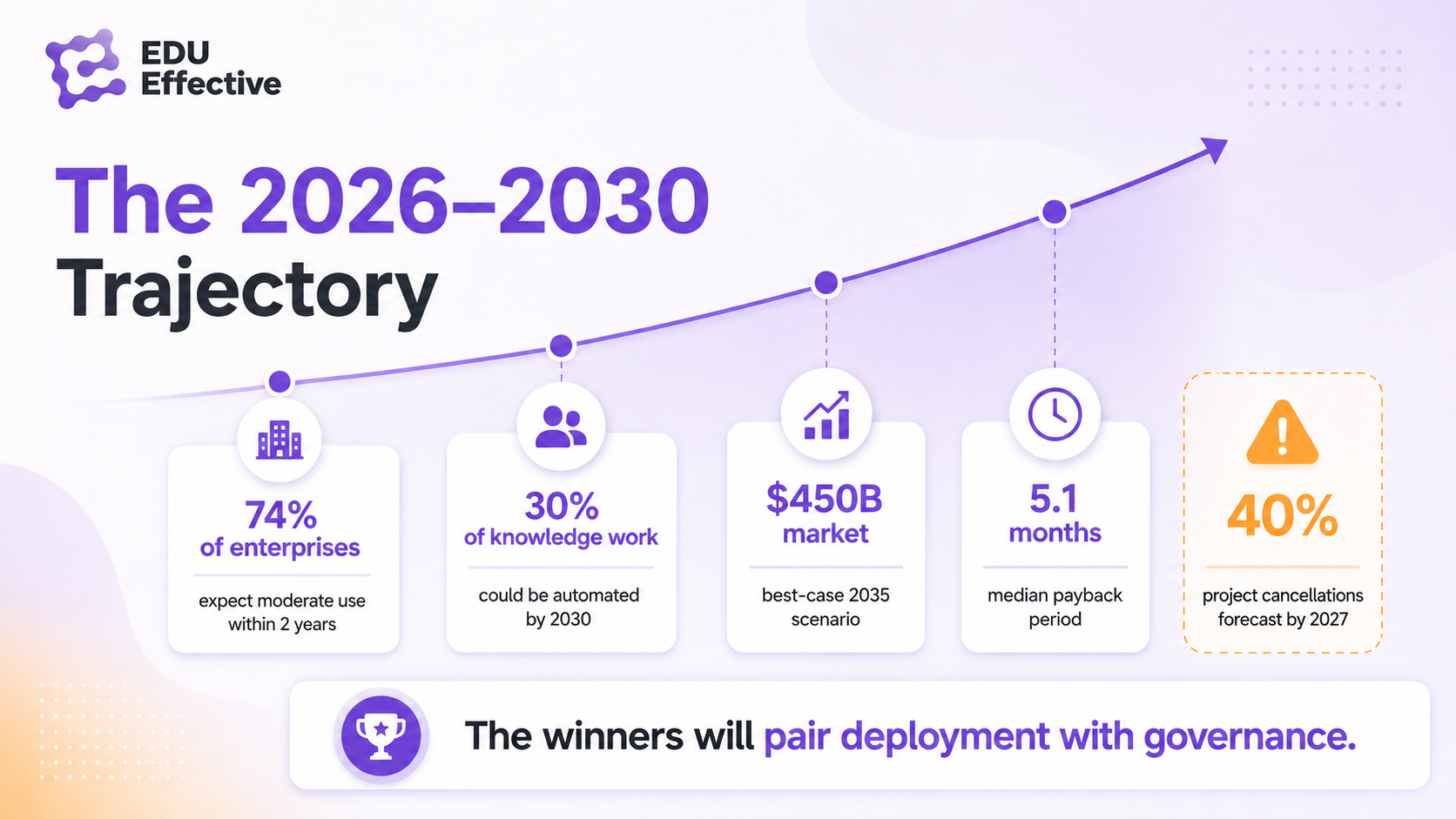
The median payback period for AI agent deployments in production is currently 5.1 months across verified implementations, according to BCG and Forrester 2026 data. The return profile is compelling — but only for deployments where governance is in place, the use case is well-matched to current agent capability, and the integration into existing workflows is managed deliberately rather than rushed.
The 40% cancellation rate that Gartner forecasts for agentic AI projects by 2027 will not be evenly distributed. The organisations that invest in governance capability alongside deployment capability — that build the management understanding of what AI agents can and cannot do, establish clear oversight frameworks, and develop the skills to specify, evaluate, and govern agent behaviour — will disproportionately be in the 60% whose projects deliver the returns that justify the investment. That starts with understanding how agentic AI fits into the broader AI implementation framework — and why the foundation-building phases that determine whether AI generates value at all are the same prerequisites that determine whether agentic AI projects deliver or join the 40% that are cancelled.
At EDU Effective, the Effective MBA: Mastery in AI develops deep agentic AI understanding alongside the strategic, governance, and implementation capabilities that allow managers to lead AI agent deployment effectively — not just understand it theoretically. Explore the programme →
Related articles
What Is Generative AI: A Guide for Business Professionals
How to Implement AI in Business: A Manager's Guide
Prompt Engineering for Managers: How to Write Better AI Prompts
EDU Effective Business School — professional development for your long-term success.
All five best-selling Effective MBA programs are built on the same educational model — designed for working adults who need learning that fits real professional life:
Effective MBA: Executive Management & Leadership
Effective MBA: Applied Artificial Intelligence
Effective MBA: Coaching, Leadership & Mentoring
Effective MBA: Online Marketing
Every programme runs on 15 minutes a day, completes in 10 months or less, is ASIC accredited, and starts from €990.
These are professional programmes, not academic ones — built for working adults to apply what they learn directly in their own business, not to collect a scholarly credential.
Join more than 9,000 students in over 120 countries who are investing in their professional development and career success. Read the experiences of our graduates here.
Apply now — from €990 · Talk to a Study Advisor
Study with NO risk: 14-day money-back guarantee, no questions asked.
Sources
Gartner — Gartner Predicts 40% of Enterprise Apps Will Feature Task-Specific AI Agents by 2026, Up from Less Than 5% in 2025 (press release, August 26, 2025); Agentic AI to Drive 30% of Enterprise App Revenue by 2035 ($450B+); Over 40% of Agentic AI Projects to Be Cancelled by 2027
https://www.gartner.com/en/newsroom/press-releases/2025-08-26-gartner-predicts-40-percent-of-enterprise-apps-will-feature-task-specific-ai-agents-by-2026-up-from-less-than-5-percent-in-2025
McKinsey & Company — Global AI Survey 2026: 62% Experimenting with AI Agents, 23% Scaling; 6.4 Hours/Week Saved in Production; 30% Knowledge Work Automated by 2030
https://www.mckinsey.com/capabilities/quantumblack/our-insights/the-state-of-ai
PwC — 28th Annual Global CEO Survey 2026: 79% Adopting AI Agents, 66% Report Measurable Value
https://www.pwc.com/gx/en/news-room/press-releases/2026/pwc-2026-global-ceo-survey.html
Deloitte — State of Generative AI in the Enterprise 2026 (3,235 global leaders): 74% Expect Moderate Agentic AI Use Within Two Years
https://www2.deloitte.com/us/en/insights/focus/cognitive-technologies/state-of-ai-and-intelligent-automation-in-business-survey.html
BCG — The Formula for Agentic AI Value
https://www.bcg.com/publications/2026/the-formula-for-agentic-ai-value
Thomson Reuters — 2026 AI in Professional Services Report: 77% Expect Agentic AI Central to Workflows by 2030
https://www.thomsonreuters.com/en/reports/2026-ai-in-professional-services-report
Grand View Research — Agentic AI Market Size: $7.6 Billion in 2025, $10.9 Billion in 2026
https://www.grandviewresearch.com/industry-analysis/ai-agents-market-report