

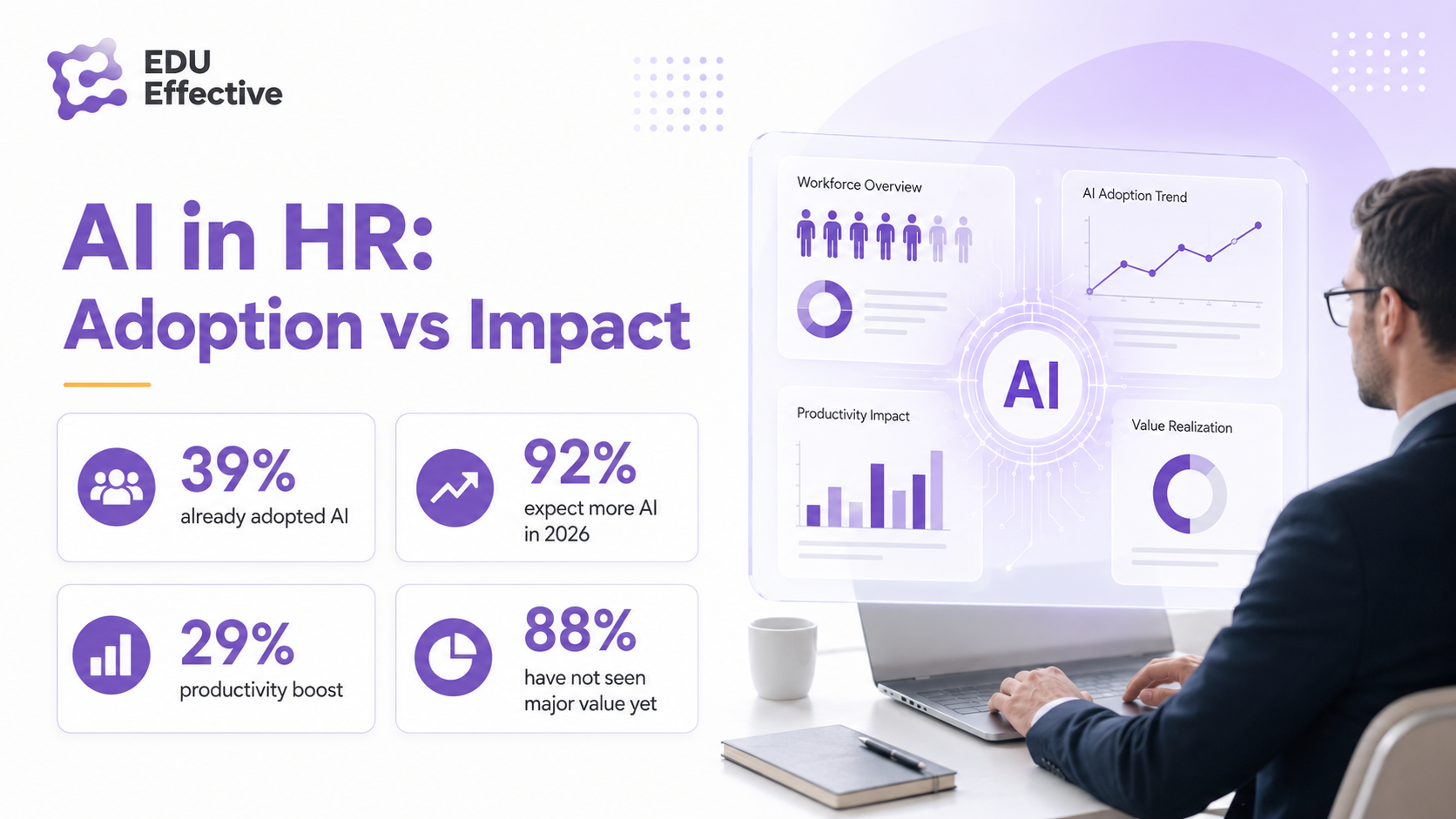
39% of HR functions have already adopted AI, with another 7% planning to launch it this year, according to SHRM's State of AI in HR 2026 report — a survey of 1,722 HR professionals conducted in December 2025. 92% of CHROs anticipate greater AI integration in workforce operations in 2026. And Gartner predicts that organisations adopting an AI-infused HR operating model will see a 29% productivity boost — moving HR beyond administrative duties and into genuinely strategic people management.
The picture is not uniformly positive. 88% of HR leaders say their teams have not yet seen significant business value from AI tools, according to Gartner's October 2025 survey of 114 HR leaders. And Deloitte's 2026 Global Human Capital Trends research delivers a specific warning: organisations taking a purely technology-focused approach to AI in HR are 1.6 times more likely to fail to realise expected returns compared to those that take a human-centred approach.
The pattern that emerges across the research is consistent: AI adoption in HR is broad and accelerating, the value gap between adoption and impact is real and wide, and the organisations closing that gap are those that understand which HR tasks AI genuinely improves and which ones it cannot replace.
Why AI in HR is different from AI in other business functions
Human resources operates at the intersection of legal obligation, organisational performance, and individual human experience. The decisions it influences — who gets hired, how performance is assessed, who is promoted, how conflicts are resolved, who is selected for development opportunities — are among the highest-stakes decisions an organisation makes.
This creates a specific challenge that does not exist to the same degree in other AI applications. An AI system that makes a biased recommendation in a demand-forecasting model costs money. An AI system that makes a biased recommendation in a hiring or promotion decision can violate anti-discrimination law, damage the careers of the people affected, and expose the organisation to significant legal and reputational risk.
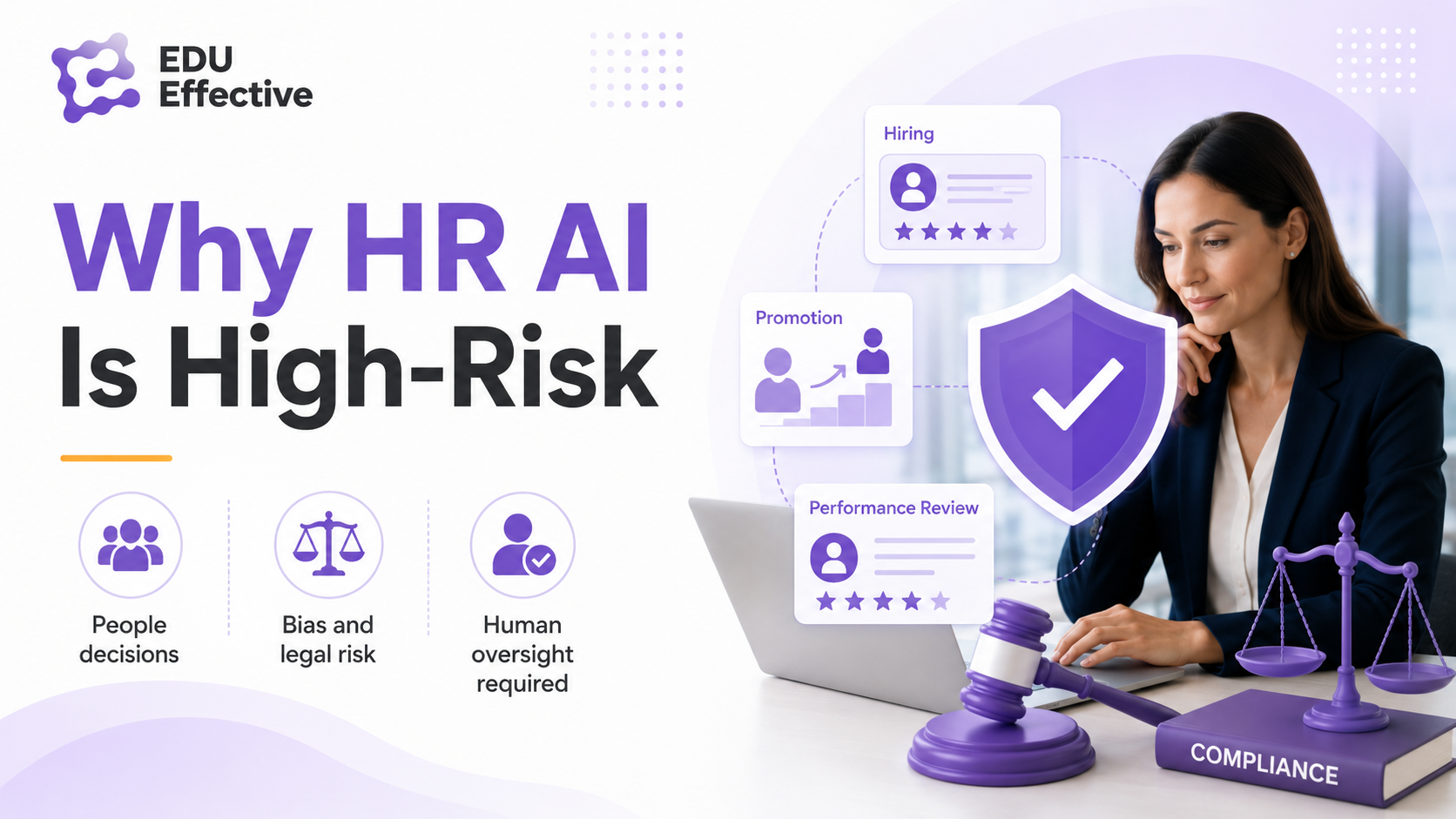
The EU AI Act classifies AI systems used for employment decisions and worker management as high-risk applications — requiring conformity assessments, human oversight mechanisms, and transparency to affected individuals before deployment. The UK's Information Commissioner's Office issued 296 recommendations and 42 advisory notes to audited AI HR tool providers following its 2024 audit programme. These regulatory dimensions do not make AI in HR inadvisable — they make governance of AI in HR a management and legal requirement, not an optional consideration.
57% of CHROs specifically expect reducing bias in AI hiring tools to become a more prevalent workplace concern in 2026, according to SHRM. Understanding the governance requirements of HR AI is increasingly a baseline competency for any manager involved in people decisions.
Where AI is currently used in HR — and what it actually does
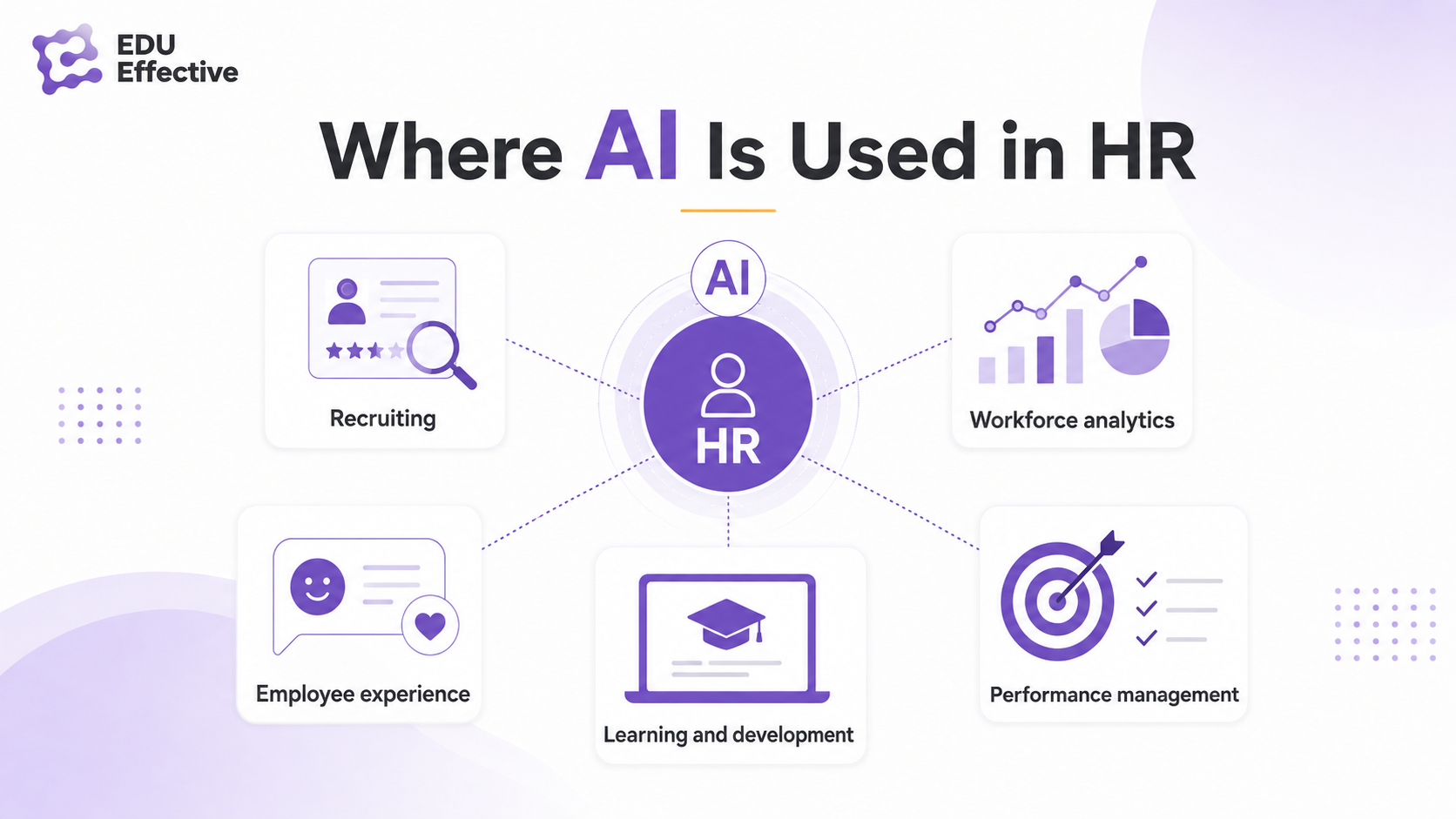
Recruiting and talent acquisition is the single largest AI application in HR, used by 27% of organisations specifically for this function, making it the leading HR AI use case ahead of general HR technology, learning and development, and employee experience, according to SHRM's 2026 data.
Within recruiting, the most common applications are AI-assisted job description writing (used by 66% of AI-adopting organisations), AI resume screening (44%), and candidate sourcing and outreach automation. AI resume screening reduces time-to-screen by up to 75% in documented implementations — a significant efficiency gain in high-volume hiring. Talent acquisition professionals using generative AI report a 20% workload reduction, according to LinkedIn research.
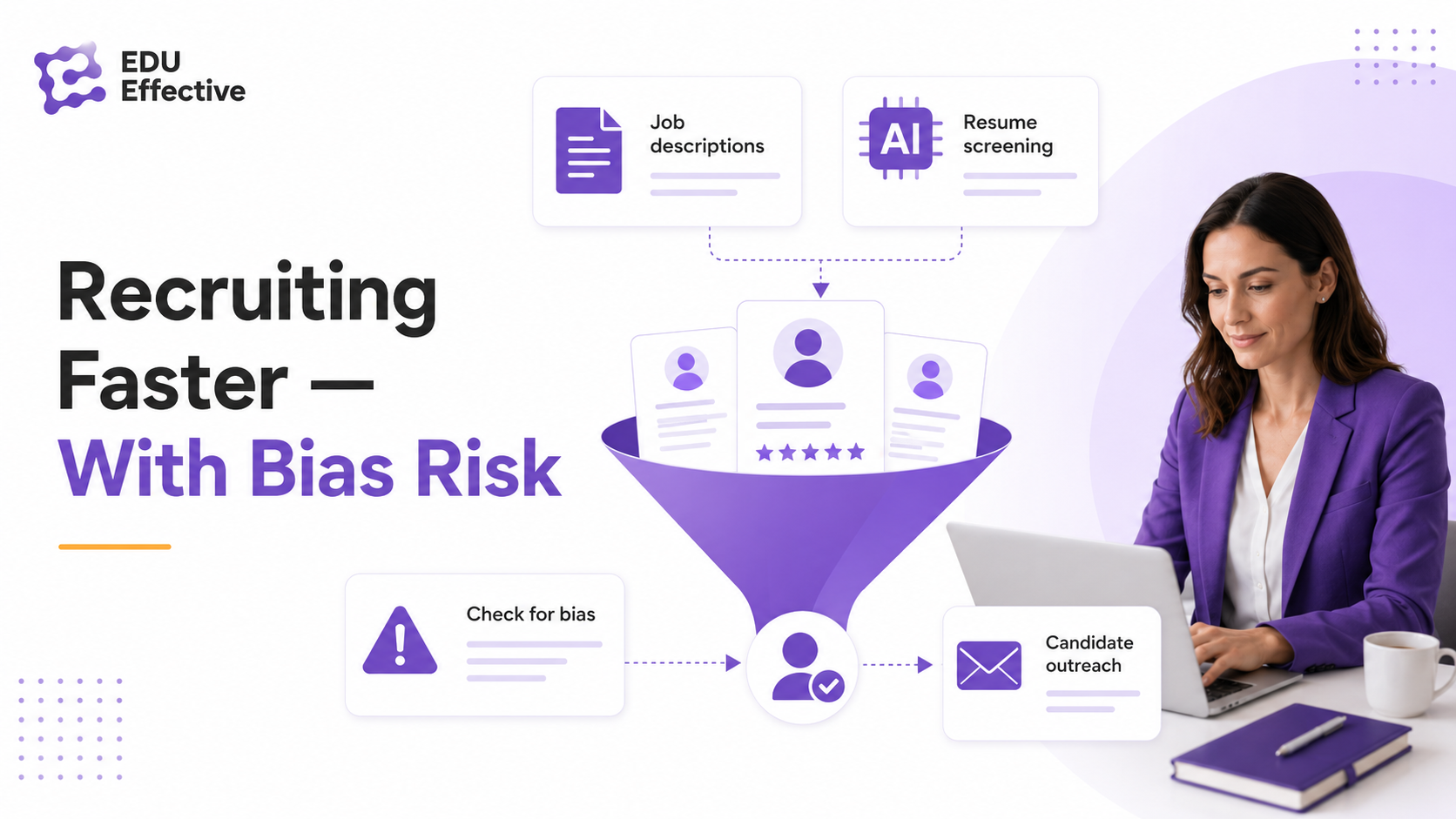
The caveat that every HR and hiring manager needs to understand: AI resume screening systems filter on patterns in historical hiring data. If historical hiring data reflects biased selection decisions — favouring candidates from particular universities, demographic backgrounds, or career trajectories — the AI will replicate and scale those biases rather than correcting them. Amazon famously discontinued an internal AI recruiting tool in 2018 after discovering it systematically downgraded CVs from women. The technology has improved since, but the underlying principle has not changed: AI learns from training data, and biased training data produces biased AI.
Workforce planning and analytics is the second fastest-growing AI application in HR. AI systems that analyse workforce data — turnover patterns, skill gaps, performance trends, absenteeism signals — can identify risks months before they become crises. Gartner research documents that AI tools can predict labour shortages up to six months in advance. AI-powered predictive analytics have helped organisations reduce turnover rates by 15% through earlier identification of retention risks and intervention opportunities, according to McKinsey.
Employee experience and engagement applications include AI-powered internal communications, personalised learning recommendations, benefits optimisation, and employee query handling through AI assistants. IBM replaced approximately 200 HR roles with AI agents, automating 94% of routine tasks — including benefits enquiries, policy questions, and administrative reporting — through their AskHR system. The HR professionals freed from these tasks were redeployed to higher-value strategic and relationship functions.
Learning and development applications include AI-powered skills assessments, personalised learning path recommendations, and content curation. 17% of organisations use AI in learning and development, according to SHRM — the third most common HR AI application. AI systems that match individual employees' skill profiles to available learning content and recommend the most relevant development paths are significantly more effective than generic training catalogues that employees must navigate independently.
Performance management applications are growing but remain less mature than recruiting and workforce planning tools. AI applications in performance management include real-time performance data aggregation, early identification of underperformance signals, and AI-assisted review drafting. The governance requirements here are particularly demanding: any AI system that influences compensation or promotion decisions must be explainable, auditable, and demonstrably free of discriminatory patterns.
The agentic AI shift in HR: from assistance to autonomous action
The frontier of AI in HR in 2026 has moved beyond tools that assist HR professionals to systems that act autonomously. Agentic AI in HR — systems that source candidates, draft outreach emails, schedule interviews, and process routine employee queries without human intervention at each step — is the fastest-growing category in HR technology.
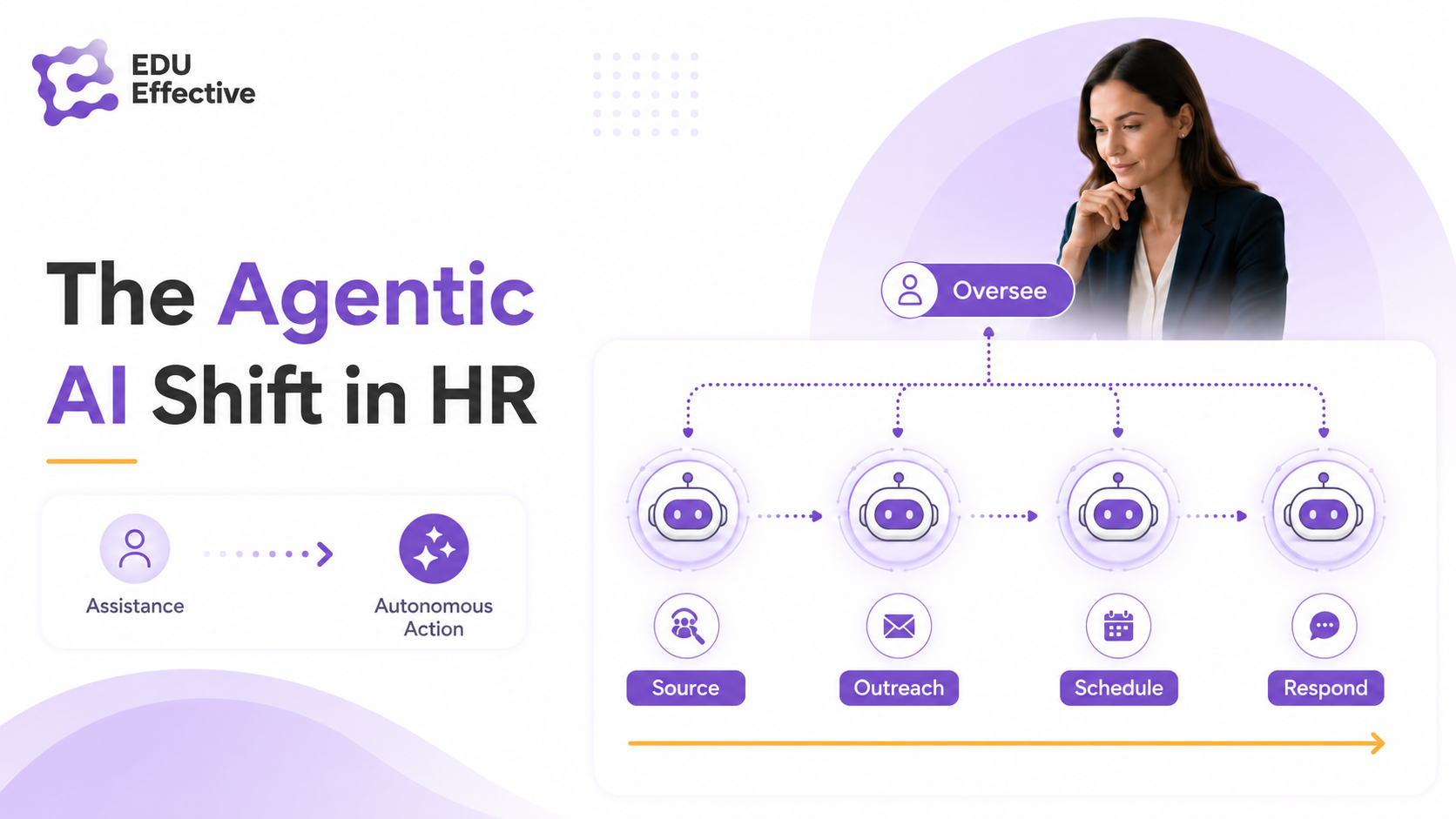
82% of HR leaders plan to deploy agentic AI within their functions, according to Gartner's CHRO Priorities research for 2026. The transition from AI-assisted to AI-driven HR workflows represents a qualitative shift in what HR professionals do day to day: less administration, more judgement; less process, more relationship; less information-processing, more strategic decision-making.
The governance challenge scales with capability. Agentic AI systems that act autonomously in HR contexts — making candidate screening decisions, processing employee requests, managing scheduling and communications — require the same human oversight requirements as any high-risk AI application under the EU AI Act, but with greater complexity because the actions are more consequential and the decision points more numerous. Gartner also predicts that more than 40% of agentic AI projects will be cancelled by 2027 due to escalating costs, unclear business value, or inadequate risk controls — a sobering counterbalance to the adoption enthusiasm.
What HR AI cannot replace: the human capability premium
The pattern across HR AI applications is consistent with the broader pattern of AI in knowledge work: AI handles the routine, the high-volume, and the data-intensive; humans handle the nuanced, the consequential, and the relational.
The HR functions that AI handles most reliably are those characterised by high volume, clear criteria, and structured data: resume screening, scheduling, policy query handling, benefits administration, and training content matching. The HR functions that AI does not handle reliably are those requiring contextual human judgement: assessing cultural fit in a way that does not replicate existing biases, navigating a complex employee relations situation, coaching a manager through a difficult performance conversation, building the trust that enables honest upward feedback, and making the judgement call about whether an employee's declining performance reflects a capability issue or a personal crisis that deserves a different kind of response.
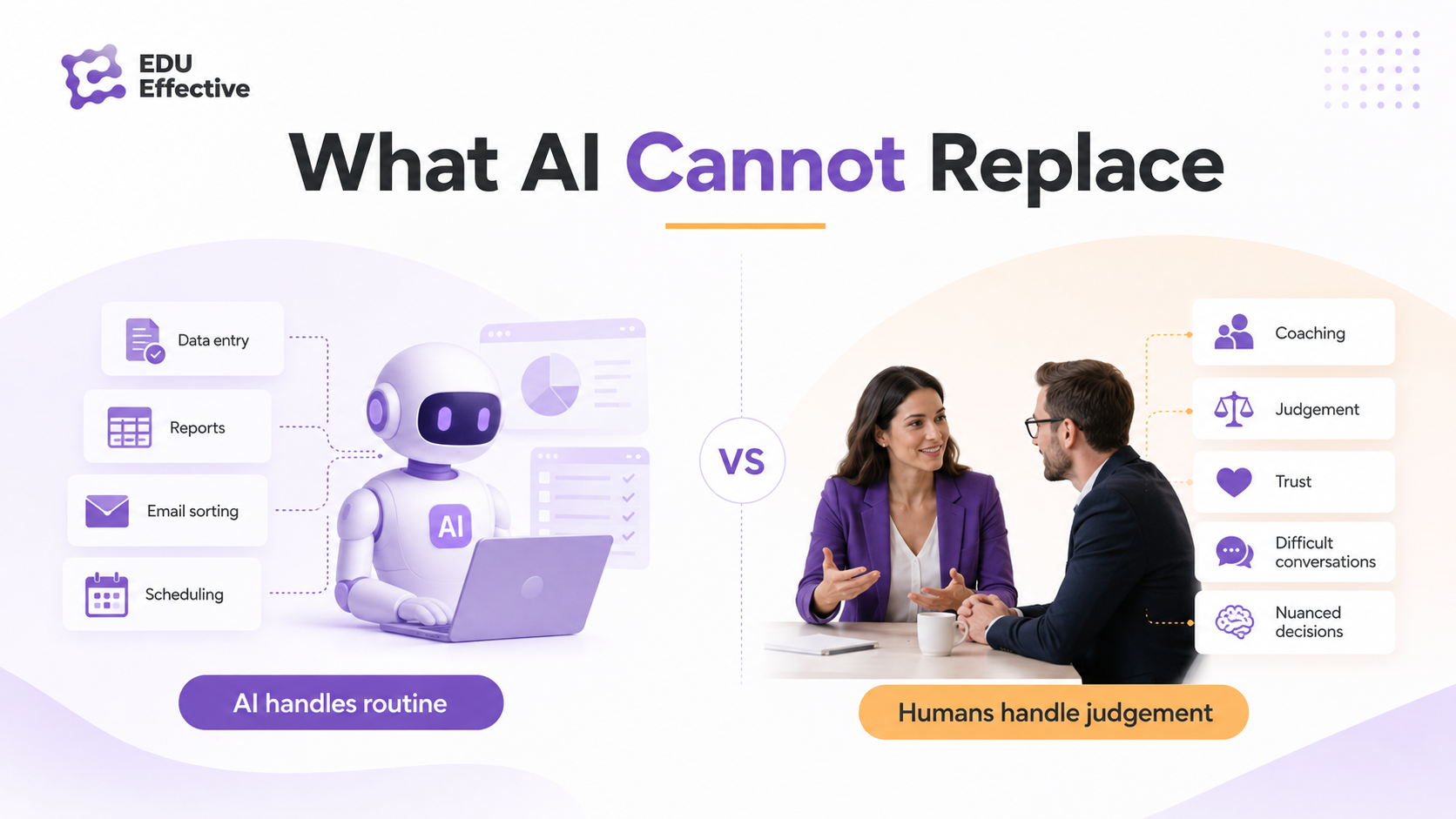
The implication for HR professionals and managers is not that AI is threatening their roles — it is that AI is shifting what their roles need to focus on. The 29% productivity boost Gartner identifies comes from HR professionals spending less time on administration and more time on the human relationship work that genuinely moves the needle on engagement, retention, and performance.
The governance and ethics framework that AI in HR requires
Every organisation using AI in HR in 2026 needs three things that many currently lack.
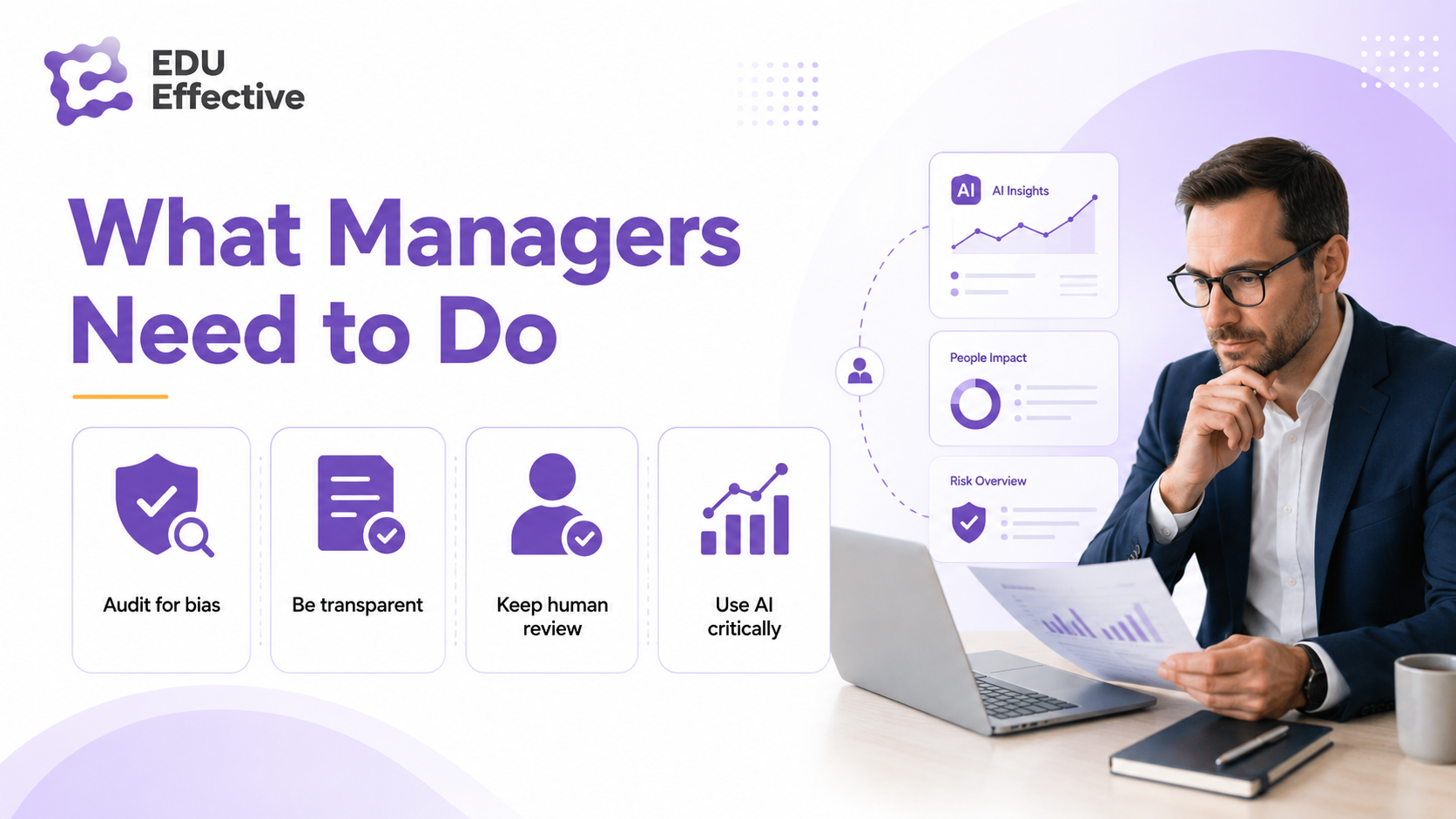
A bias auditing process. Any AI system influencing hiring, promotion, or performance decisions should be regularly audited for disparate impact across protected characteristics. This is not a one-time exercise at implementation — biases can emerge or intensify as the system learns from new data. 30% of AI HR deployments have surfaced bias issues according to IBM research. Organisations that audit proactively find and fix these issues before they become legal problems; those that do not discover them through complaints or litigation.
Transparency to affected individuals. The EU AI Act requires that individuals affected by high-risk AI decisions have the right to meaningful information about the AI system used, its logic, and its impact on their case. Beyond legal compliance, transparency produces measurably better outcomes: bias-audited AI tools have 50% higher employee trust scores than un-audited alternatives, according to Deloitte research.
Human oversight at consequential decision points. AI recommendations in HR contexts — particularly in hiring, performance, and promotion decisions — should be inputs to human judgement, not substitutes for it. The manager or HR professional who reviews and takes responsibility for the decision is not a formality; they are the legal and ethical accountability point for the outcome. Treating AI HR recommendations as authoritative without human review violates both the EU AI Act requirements and the basic principle that consequential decisions about people should be made by people.
What this means for managers who are not in HR
AI in HR is not only relevant to HR professionals. Any manager involved in hiring decisions, performance management, development planning, or team management will increasingly encounter AI-generated inputs to these processes — candidate screening outputs, engagement analytics, performance trend data, skills gap analyses.
The management competency this requires is not technical. It is the ability to use AI-generated HR data intelligently — to understand what the AI is measuring and what it is missing, to identify where its outputs should inform decisions and where they should be questioned, and to maintain the human judgement and relationship quality that AI cannot replicate. This is the same AI fluency that produces value in every other business function: not coding, but critical engagement with AI outputs.
The 92% of CHROs anticipating greater AI integration in workforce operations are building organisations where every manager will need this competency. The time to build it is not when the AI HR system arrives — it is now.
At EDU Effective, the Effective MBA: Applied Artificial Intelligence develops the AI fluency, governance understanding, and implementation skills that allow managers and HR professionals to use AI intelligently in people management contexts — including HR AI applications, bias governance, and agentic AI strategy. Explore the programme →
Related articles
What Is Generative AI: A Guide for Business Professionals
How to Implement AI in Business: A Manager's Guide
Performance Management in 2026: How to Actually Develop Your Team's Performance
EDU Effective Business School — professional development for your long-term success.
All five best-selling Effective MBA programs are built on the same educational model — designed for working adults who need learning that fits real professional life:
Effective MBA: Executive Management & Leadership
Effective MBA: Applied Artificial Intelligence
Effective MBA: Coaching, Leadership & Mentoring
Effective MBA: Online Marketing
Every programme runs on 15 minutes a day, completes in 10 months or less, is ASIC accredited, and starts from €990.
These are professional programmes, not academic ones — built for working adults to apply what they learn directly in their own business, not to collect a scholarly credential.
Join more than 9,000 students in over 120 countries who are investing in their professional development and career success. Read the experiences of our graduates here.
Apply now — from €990 · Talk to a Study Advisor
Study with NO risk: 14-day money-back guarantee, no questions asked.
Sources
SHRM — State of AI in HR 2026 Report (1,722 HR professionals)
https://www.shrm.org/topics-tools/research/state-of-ai-hr-2026/full-report
SHRM — 2026 CHRO Priorities and Perspectives Report (129 CHROs, January 2026)
https://www.shrm.org/about/press-room/what-will-work-look-like-in-2026--new-shrm-research-reveals-how-
Gartner — AI-Infused HR Operating Model: 29% Productivity Boost; 82% of HR Leaders Plan Agentic AI; 88% Haven't Seen Significant Value (October 2025, n=114 HR leaders)
https://www.gartner.com/en/human-resources/trends/top-priorities-for-hr-leaders
McKinsey & Company — State of Organizations 2026: 80% Deployed AI, Only 20% Rebuilt Workflows
https://www.mckinsey.com/capabilities/people-and-organization/our-insights/the-state-of-organizations
Deloitte — 2026 Global Human Capital Trends: Human-Centred AI Approach 1.6x More Likely to Deliver ROI
https://www2.deloitte.com/us/en/insights/focus/human-capital-trends.html
LinkedIn — Talent 2026: Generative AI in Talent Acquisition — 20% Workload Reduction
https://www.linkedin.com/pulse/generative-ai-recruitment-trends-employers-must-ttetc/
EU AI Act — High-Risk AI Systems: Employment and Worker Management Classification (Official Journal of the EU)
https://eur-lex.europa.eu/legal-content/EN/TXT/?uri=CELEX:32024R1689
World Economic Forum — Future of Jobs Report
https://www.weforum.org/publications/the-future-of-jobs-report-2025/