

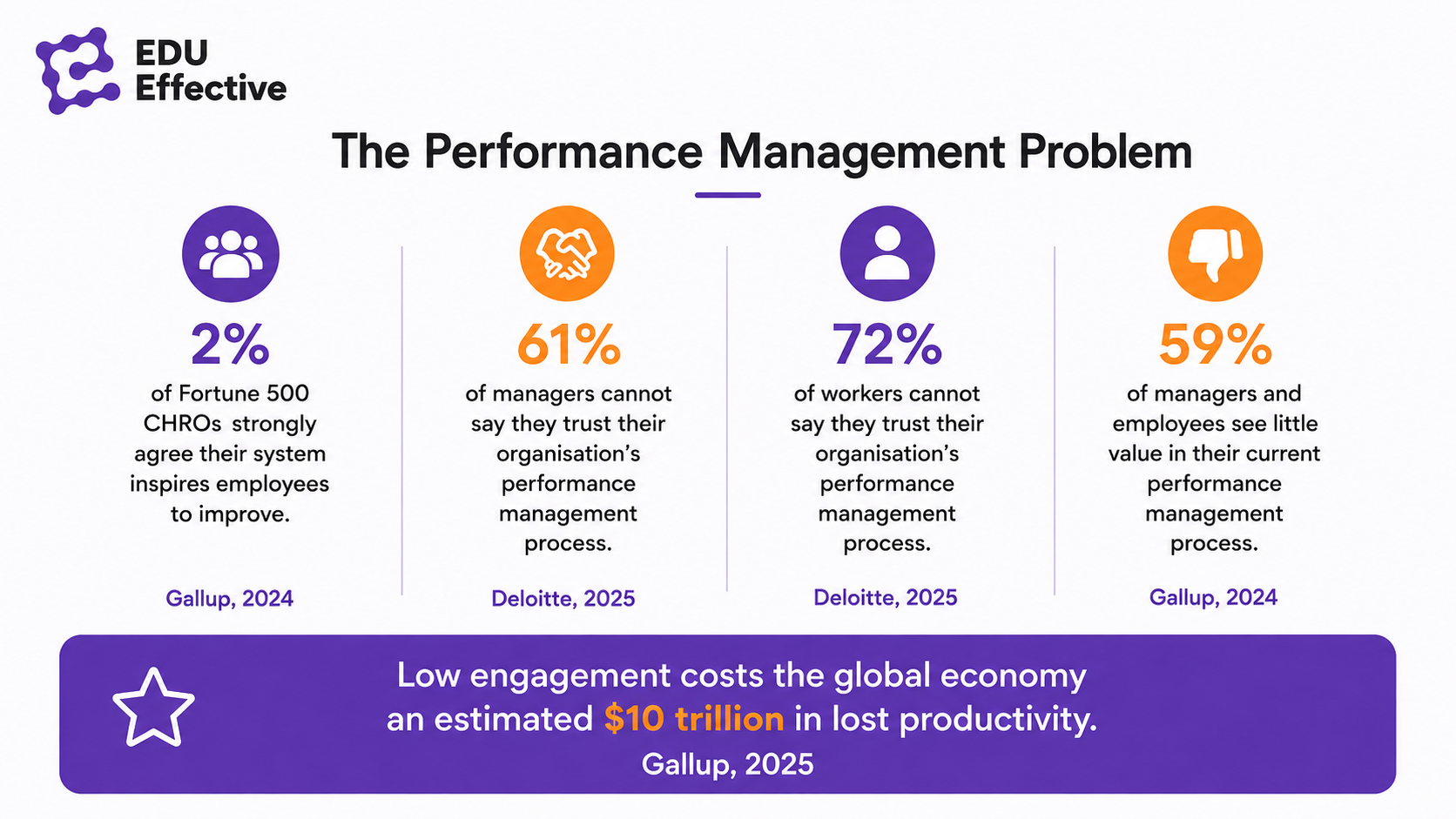
Only 2% of Fortune 500 CHROs strongly agree that their organisation's performance management system inspires employees to improve, according to Gallup research published in May 2024. 61% of managers and 72% of workers cannot say they trust their organisation's performance management process, according to Deloitte's 2025 Global Human Capital Trends survey. And 59% of both managers and employees see little value in their current performance management process — according to Gallup's analysis of failed performance management systems.
These numbers describe a system that most of the people inside it believe is not working. And yet the same research shows that performance management done well is one of the most commercially significant management investments available. Companies focused on their people's performance are 4.2 times more likely to outperform their peers, achieving 30% higher revenue growth and five percentage points lower attrition rates, according to McKinsey's research on performance management effectiveness.
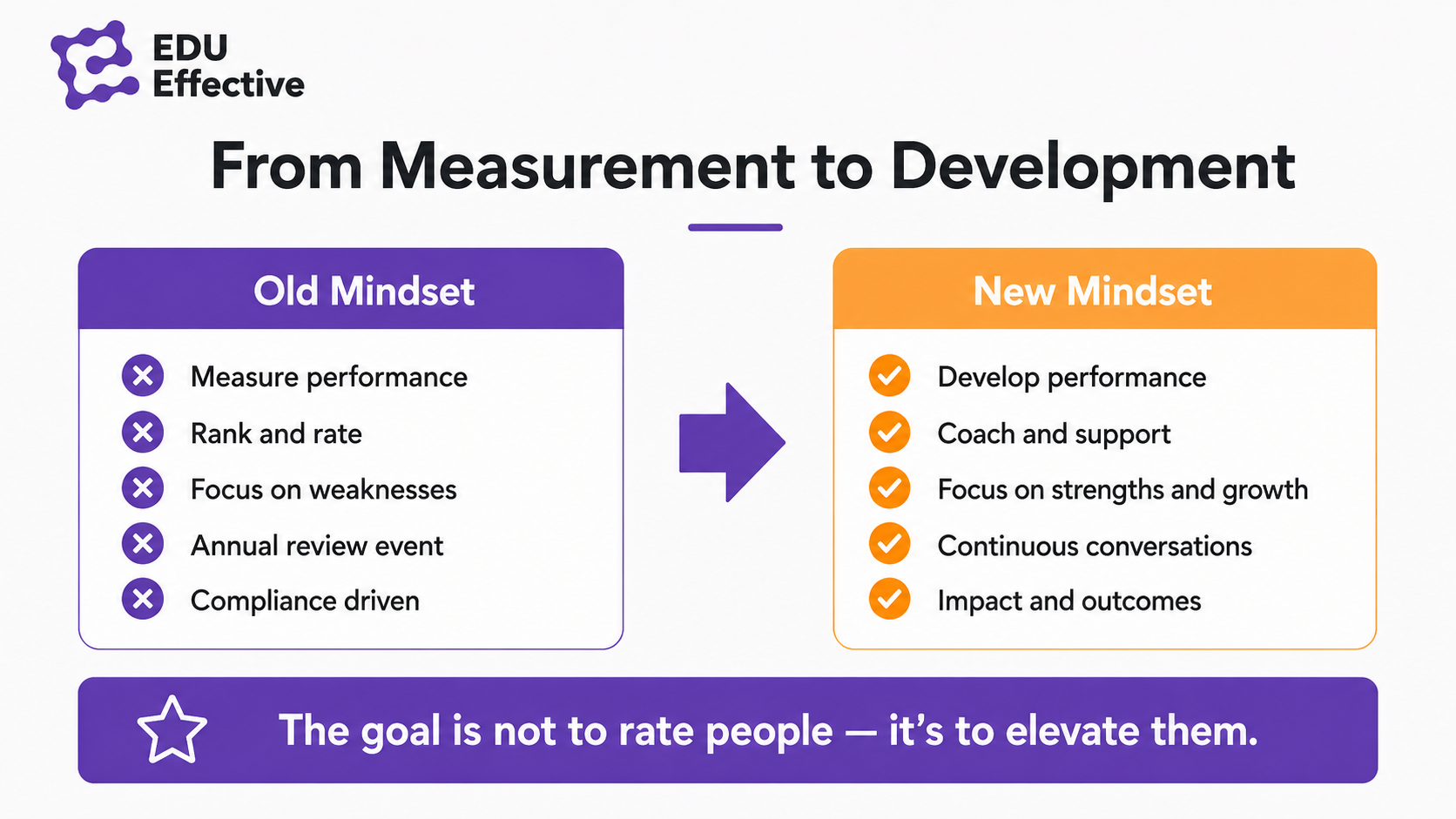
The gap between what performance management produces when done well and what it typically produces in practice is the result of a structural misalignment: most performance management systems are designed to evaluate rather than to develop, to document rather than to improve, and to satisfy administrative requirements rather than to produce better performance. Understanding that misalignment — and how to correct it — is the starting point for performance management that actually works.
Why traditional performance reviews fail — and what the data shows
The annual performance review is the most widely used performance management tool and the one with the weakest evidence base for improving actual performance. Its limitations are structural, not cosmetic.
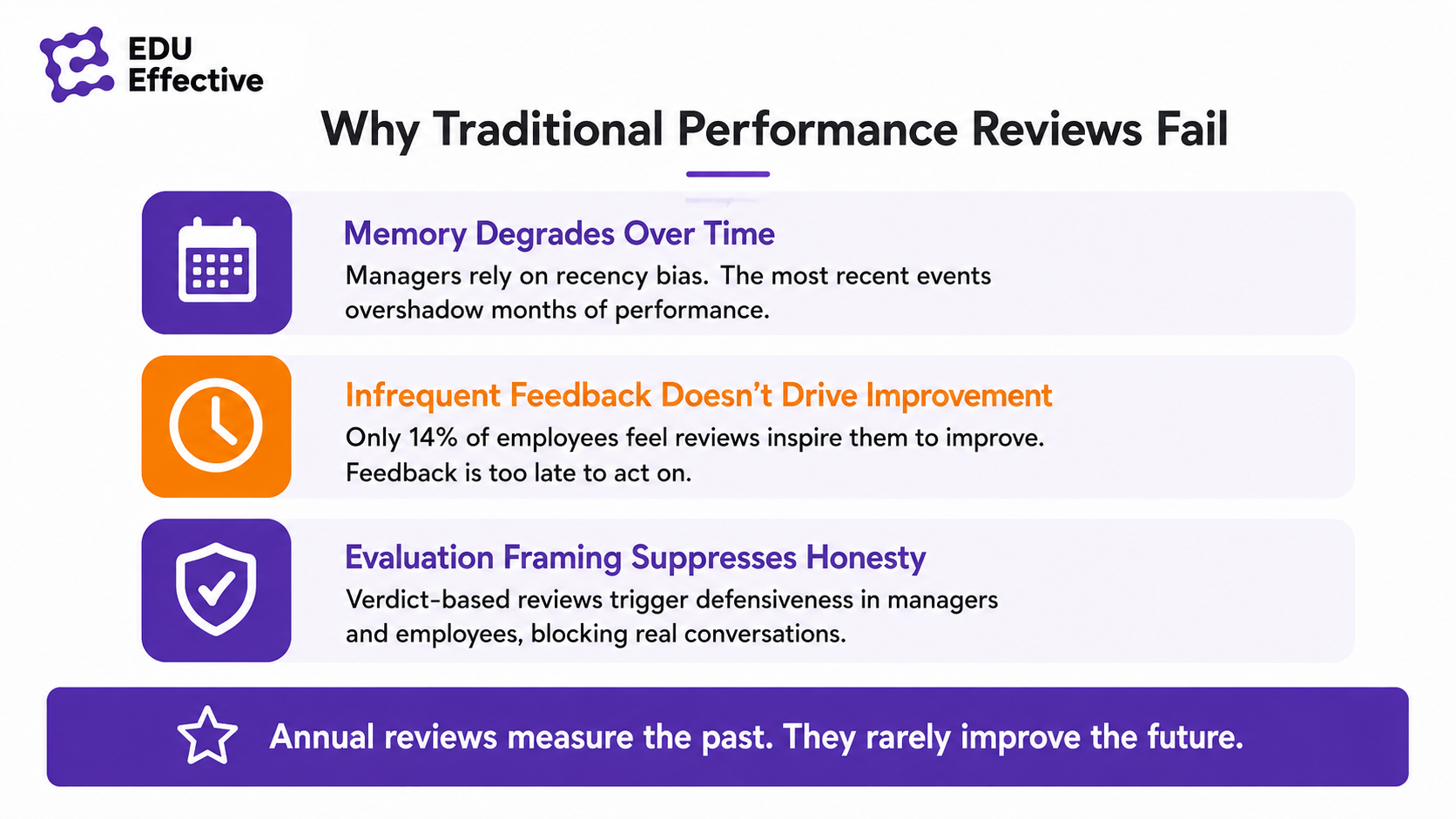
Memory degrades over time. A manager assessing twelve months of a team member's performance in a single annual conversation is working from recollections that are systematically biased toward recent events — the recency bias that causes the most recent three months of performance to dominate the assessment of a full year. The team member's best work from nine months ago is underweighted. Their worst week last month is overweighted. The resulting evaluation is not an accurate reflection of the year's performance — it is a reflection of what the manager can remember, shaped by the cognitive shortcuts that govern human recollection under conditions of information overload.
Frequency matters for both learning and motivation. Only 14% of employees strongly agree that their performance reviews actually inspire them to improve, according to Gallup. The reason is timing: by the time feedback is delivered in an annual review, the specific situations it references are too distant for the recipient to engage with productively, too historical to change, and too far removed from the behaviours they need to modify going forward. Feedback that cannot be acted on immediately has limited developmental value — and feedback delivered once a year cannot be acted on immediately.
The evaluation framing suppresses honest conversation. Performance reviews structured as evaluations — where the manager judges the employee and communicates a verdict — activate defensive responses that are antithetical to the openness that learning and development require. Employees who know they are being assessed protect themselves: they emphasise positives, minimise negatives, and avoid raising concerns that might damage their evaluation. Managers who know they are delivering verdicts soften their assessments to avoid difficult conversations. The result is a conversation where neither party says what they are actually thinking — which is precisely the opposite of the honest, developmental conversation that performance management is supposed to produce.
The shift to continuous performance management
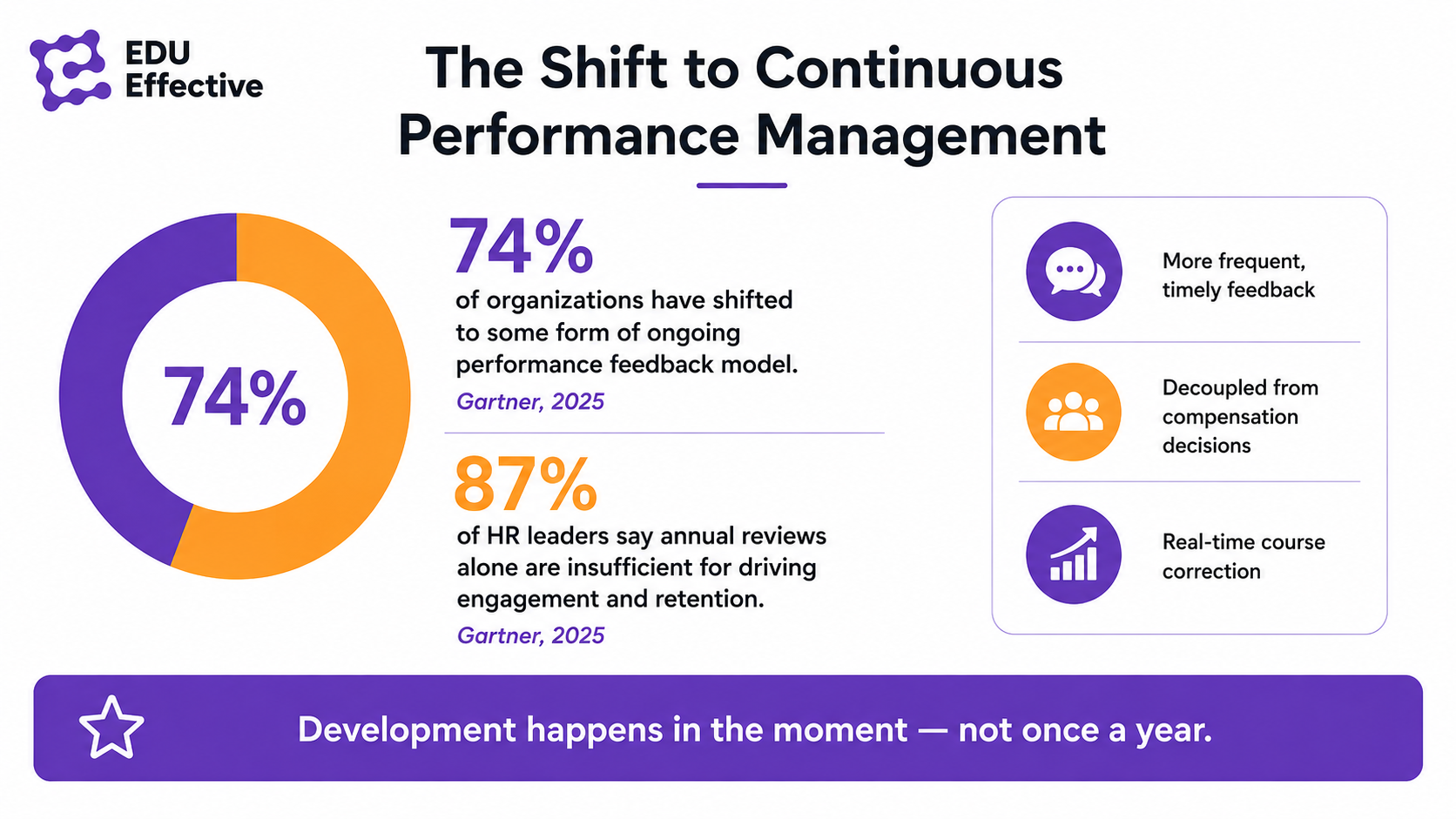
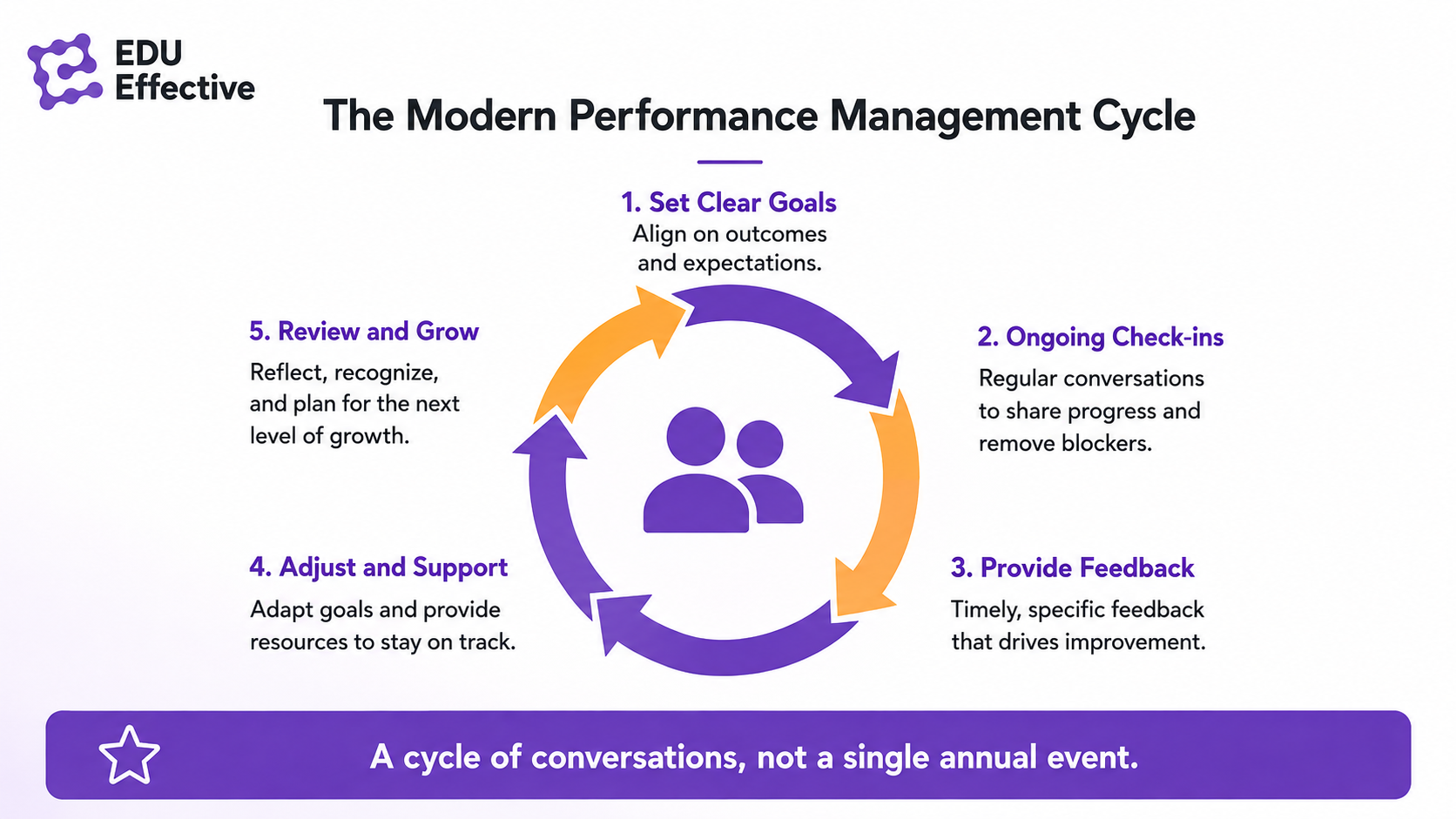
74% of organisations have shifted to some form of ongoing performance feedback model, and 87% of HR leaders report that annual reviews alone are insufficient for driving engagement and retention, according to Gartner's Performance Management Trends 2025 research. The direction of change is consistent: away from annual evaluation cycles and toward continuous performance management — regular, ongoing conversations about performance, development, and alignment that happen throughout the year rather than once at the end of it.
74% of organisations have already moved to some form of continuous performance feedback model, according to Gartner 2025 — a shift that reflects growing recognition that annual review cycles are structurally misaligned with the pace at which performance problems emerge and need to be addressed.
The shift matters for two reasons beyond the frequency of feedback itself. First, continuous performance management decouples performance conversations from compensation decisions — which allows both parties to engage more honestly with development questions without the shadow of a pay outcome distorting the conversation. When a performance conversation might affect someone's salary, it activates exactly the defensive dynamics that undermine genuine development. When the conversation is explicitly developmental and compensation is handled separately and less frequently, honesty becomes structurally easier.
Second, continuous performance management allows course correction in real time rather than after twelve months of accumulated drift. A team member whose performance is declining in February can be supported in March — not discovered to have declined at the following December's review. The gap between a performance problem emerging and being addressed is the primary driver of the compounding underperformance that makes performance management conversations difficult — and continuous performance management closes that gap structurally.
Goal setting: the foundation of effective performance management
Performance management without clear goals is evaluation without criteria. The most common source of perceived unfairness in performance reviews is not assessor bias — it is the absence of the explicit, agreed objectives against which performance could have been clearly measured throughout the year.
McKinsey's research on performance management fairness found that among employees who believed their companies linked goals to business priorities, 46% considered their performance management system effective — compared to only 16% of those whose companies did not. Goal clarity is the single most powerful predictor of perceived performance management fairness and effectiveness — more than compensation differentiation, more than manager quality, more than review frequency.
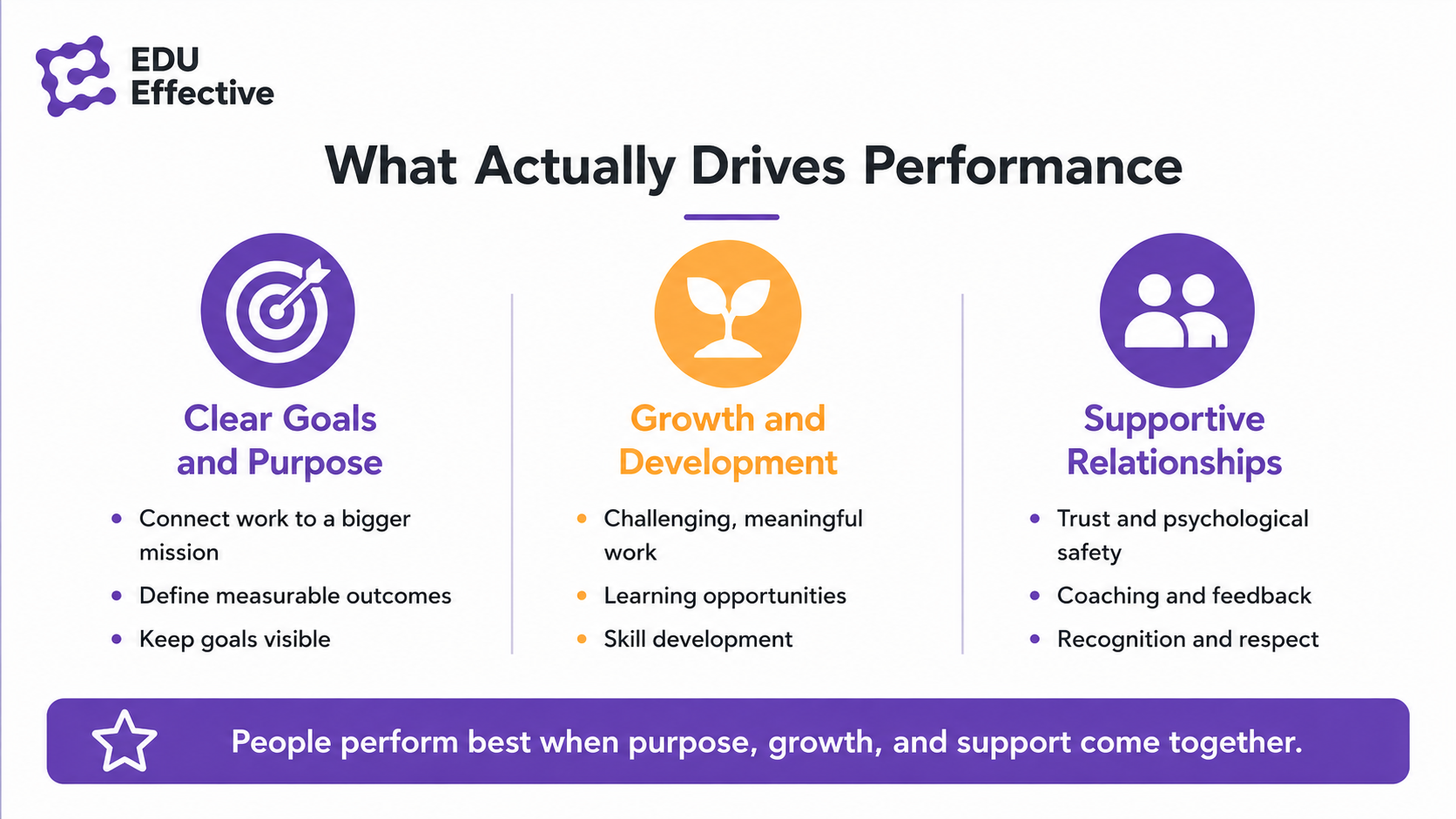
The two most widely used goal-setting frameworks in professional contexts are SMART goals and OKRs.
SMART goals — Specific, Measurable, Achievable, Relevant, and Time-bound — provide a structure for setting objectives that are precise enough to be evaluated, realistic enough to be achievable, and connected enough to business priorities to be meaningful. The SMART framework is most useful for operational goals with clear, measurable outputs: sales targets, project deliverables, quality metrics, timeline commitments.
OKRs (Objectives and Key Results) operate at a higher level of ambition. The Objective defines a qualitative direction — what you are trying to achieve and why it matters. The Key Results define the specific, measurable outcomes that would demonstrate the Objective has been achieved. OKRs are designed to be stretching rather than comfortable — Google's original OKR guidance suggests that consistently achieving 100% of an OKR indicates the goal was set too low. They work best for strategic, directional goals where the definition of success is complex and where the path to achievement requires creativity rather than execution of a known plan.
Both frameworks share a critical principle: goals should be co-created between manager and team member rather than handed down from above. Research consistently shows that employees who participate in setting their own goals demonstrate higher commitment to achieving them — the sense of ownership that goal participation creates is itself a motivational factor.
Development conversations: the heart of modern performance management
The most significant shift in performance management thinking over the past decade is the move from evaluation to development as the primary purpose of performance conversations. The traditional performance asks "how did you do?" The development conversation asks "how are you growing, and what do you need to grow further?"
McKinsey's research on performance management found that 74% of respondents who felt their managers provided effective feedback and coaching reported that their companies had effective performance management systems. No other single factor — not compensation, not goal clarity, not review frequency — predicted perceived performance management effectiveness more reliably than manager coaching quality.
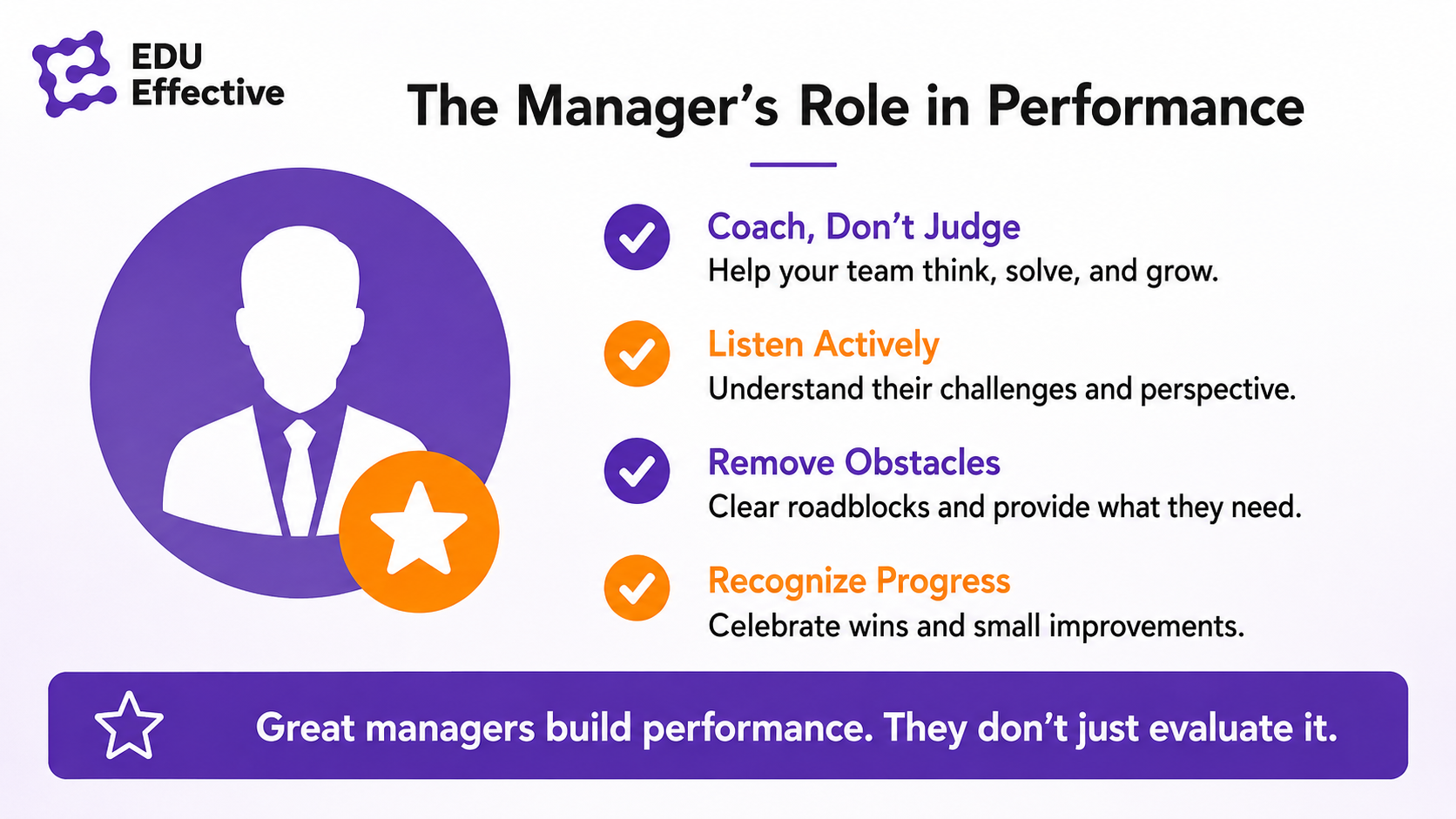
This finding has a direct practical implication: the quality of the manager as a coach and developer is the primary determinant of performance management effectiveness at the team level. HR systems, rating scales, and annual review formats are secondary to whether the manager has regular, honest, forward-looking conversations with each team member about what they are doing well, what they need to develop, and what support they need to get there.
Development conversations differ from evaluation conversations in their orientation. Evaluation conversations are backward-looking — they assess what happened. Development conversations are forward-looking — they explore what the team member is working on building, what obstacles they are encountering, and what the manager can do to help. They draw on the same information — performance over the past period — but use it as material for planning ahead rather than as the basis for a verdict.
The SBI framework (Situation-Behaviour-Impact), covered in depth in our guide to giving feedback effectively, provides a practical structure for both the developmental feedback and the recognition that should be part of every ongoing performance conversation. Specific, timely, impact-focused feedback builds capability; generic, delayed, outcome-focused assessment does not.
Calibration and fairness: ensuring consistent standards across a team
One of the most consistent complaints about performance management across research studies is perceived unfairness — the belief that evaluation standards are applied inconsistently, that personal relationships influence ratings, and that the criteria for what constitutes good performance are not clearly understood or consistently applied.
Just 20% of employees say their company's performance review process is "fair and transparent", according to Gallup. Gartner research shows that 82% of employees say it is important for their organisation to see them as a person rather than just an employee — but only 45% feel their organisation actually does. The perception of fairness is not just a morale issue — it is a trust and engagement issue with direct commercial consequences.
Three practices most reliably improve perceived fairness in performance management. First, making criteria explicit at the beginning of the performance period rather than applying them retrospectively at the review. Employees who know from the start what constitutes excellent, satisfactory, and unsatisfactory performance can orient their effort accordingly — and have a basis for understanding their evaluation that does not depend on trusting the manager's subjective judgement.
Second, using multiple sources of evidence rather than relying exclusively on the manager's observation. 360-degree feedback — structured input from peers, direct reports, and other stakeholders who interact with the team member — produces a richer and less biased picture of performance than unilateral manager assessment. It also creates accountability for performance dimensions that manager observation alone cannot reliably capture: collaboration quality, cross-functional impact, and the informal leadership that does not appear in formal deliverables.
Third, separating performance evaluation from development planning. When the same conversation serves both purposes, the evaluation tends to dominate — and the development planning is either squeezed into the remaining time or coloured by the emotional dynamics of the evaluation itself. Adobe's decision to eliminate annual reviews in favour of continuous check-ins tied directly to goals produced measurable improvements in both manager clarity and employee agility — demonstrating that the separation is practically achievable in complex organisations.
Performance management and AI in 2026
75% of organisations plan to integrate AI-based technology into their performance management processes, according to Gartner research. AI in performance management is most valuable in three specific applications: pattern recognition across large datasets of performance and engagement signals that individual managers cannot track; reduction of recency and other cognitive biases in evaluation by providing objective data alongside subjective manager assessment; and real-time coaching support for managers that helps them have more effective development conversations.
The limitation worth understanding is that AI performance management tools are most reliable for structured, quantifiable aspects of performance and least reliable for the relational, contextual, and developmental dimensions that matter most in knowledge work. An AI system can tell a manager that a team member's output volume has declined over the past six weeks. It cannot tell the manager why — whether this reflects a personal difficulty, a process bottleneck, a capability gap, or a loss of engagement — and cannot replace the human conversation required to find out.
The managers who use AI most effectively in performance management are those who use it to surface signals and reduce administrative burden — freeing their attention for the development conversations that only a human can have effectively.
Building a performance management system that actually works
The performance management system that produces the outcomes described in McKinsey's research — 4.2x outperformance, 30% higher revenue growth — is not complicated to describe, even if it is difficult to sustain under operational pressure.
It starts with clear, co-created goals aligned to business priorities, established at the beginning of each performance period and revisited regularly rather than set once and reviewed annually. It continues with frequent, specific, timely feedback — both developmental and recognitional — delivered in regular one-to-one conversations that are explicitly protected from being cancelled when time is short. It includes honest development planning — conversations about what the team member is building, what they need, and what the manager can provide — separated from the evaluation conversation and treated as a primary management priority rather than an administrative requirement.
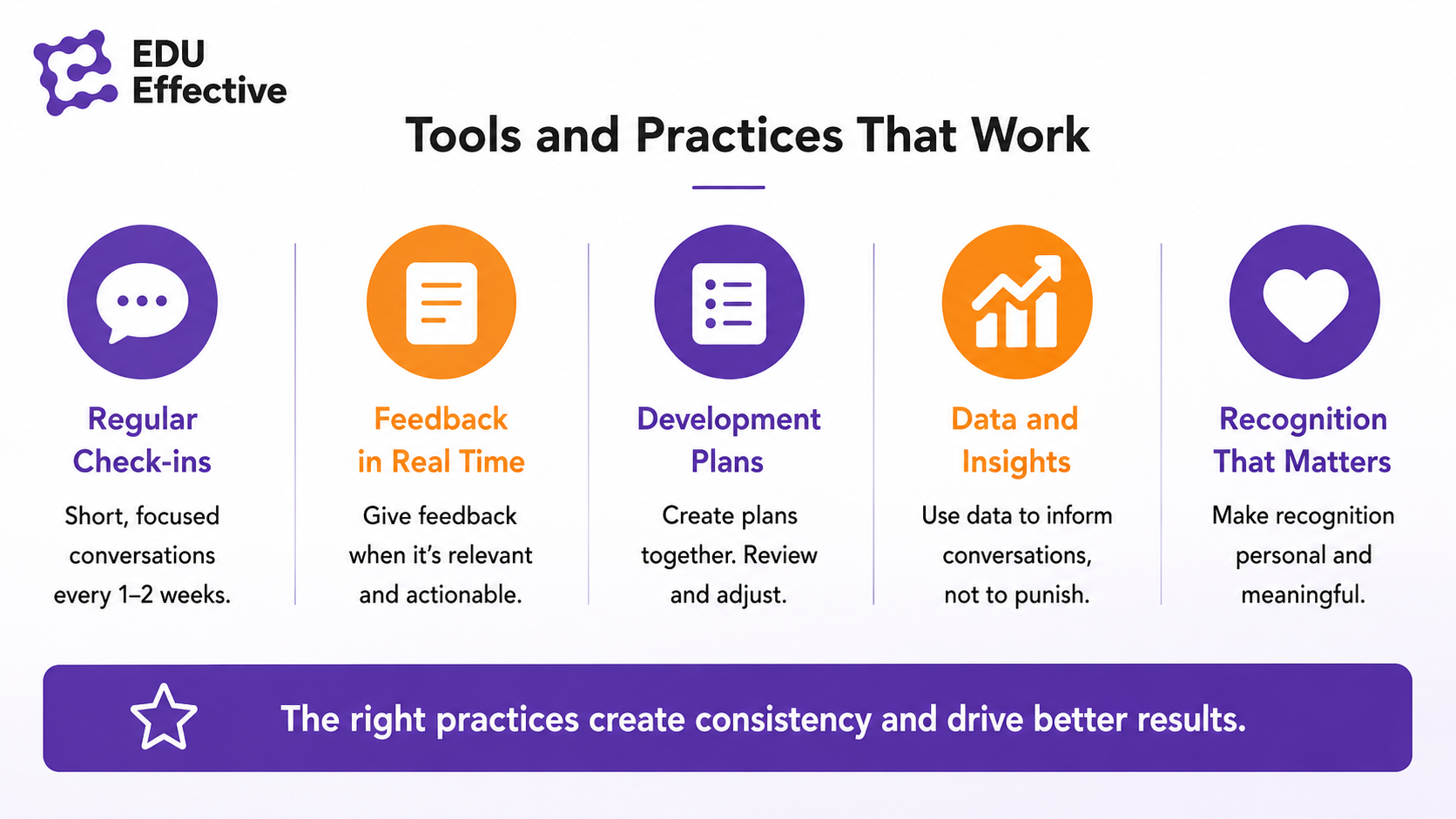
It requires calibrated, criteria-based evaluation that applies consistent standards, uses multiple sources of evidence, and is experienced by the team member as fair even when the feedback is difficult. And it closes with clear recognition of good performance — specific, timely, and connected to impact — that communicates what the manager values and what should be repeated.
None of this is new. All of it requires the management capability that most managers have not been explicitly trained to develop.
At EDU Effective, the Effective MBA: Executive Management & Leadership develops performance management, coaching, feedback, and goal-setting capabilities as integrated management skills — building the practical ability to have the conversations that drive team development, not just the administrative competence to complete the required forms. Explore the programme →
Related articles:
- How to Give Feedback at Work: A Practical Manager's Guide
- How to Coach Employees: A Practical Guide for Managers
- How to Motivate Employees: What the Research Actually Says
At EDU Effective, we build programs for professionals who want to work smarter — not just harder. Explore our programs →
EDU Effective Business School = professional development for your long-term success.
All best-selling Effective MBA programs are built for working adults: 15 minutes a day, 10 months or less, ASIC accredited, from €990.
- Effective MBA: Executive Management & Leadership
- Effective MBA: Applied Artificial Intelligence
- Effective MBA: Coaching, Leadership & Mentoring
- Effective MBA: Mastery in AI
- Effective MBA: Online Marketing
These are professional programmes, not academic ones — built for working adults to apply what they learn directly in their own business, not to collect a scholarly credential.
Join more than 9,000 students in over 120 countries who are investing in their professional development and career success.
Read the experiences of our graduates here.
Apply now — from €990 · Talk to a Study Advisor
Study with NO risk: 14-day money-back guarantee, no questions asked.
Sources
- Gallup — 2% of CHROs Think Their Performance Management System Works (135 Fortune 500 CHROs, Q2 2023; 18,665 US employees, Q3 2023; published May 2024) https://www.gallup.com/workplace/644717/chros-think-performance-management-system-works.aspx
- Gallup — Failed Performance Management: The Fix (59% see little value) https://www.gallup.com/workplace/236396/failed-performance-management-fix.aspx
- Gallup — How Effective Feedback Fuels Performance (14% inspired by reviews) https://www.gallup.com/workplace/357764/fast-feedback-fuels-performance.aspx
- Gallup — State of the Global Workplace 2026 (published May 2026) https://www.gallup.com/workplace/349484/state-of-the-global-workplace.aspx
- McKinsey & Company — In the Spotlight: Performance Management That Puts People First (4.2x outperformance, 30% revenue growth) https://www.mckinsey.com/capabilities/people-and-organizational-performance/our-insights/performance-management-that-puts-people-first
- McKinsey & Company — Harnessing the Power of Performance Management (74% coaching quality finding) https://www.mckinsey.com/capabilities/people-and-organizational-performance/our-insights/harnessing-the-power-of-performance-management
- Gartner — Performance Management Trends 2025: 74% Shifted to Ongoing Feedback, 87% Say Annual Reviews Insufficient https://www.gartner.com/en/human-resources/insights/performance-management
- Gartner — Future of Performance Management: 82% Want to Be Seen as People, Not Resources https://www.gartner.com/en/articles/6-predictions-for-the-future-of-performance-management
- Deloitte — Global Human Capital Trends 2025: Employee Performance Management Optimization (61% managers, 72% workers don't trust PM system) https://www.deloitte.com/us/en/insights/topics/talent/human-capital-trends/2025/employee-performance-management-optimization-effective-strategy.html
- SHRM — The Evolving Landscape of Performance Management https://www.shrm.org/labs/resources/the-evolving-landscape-of-performance-management