

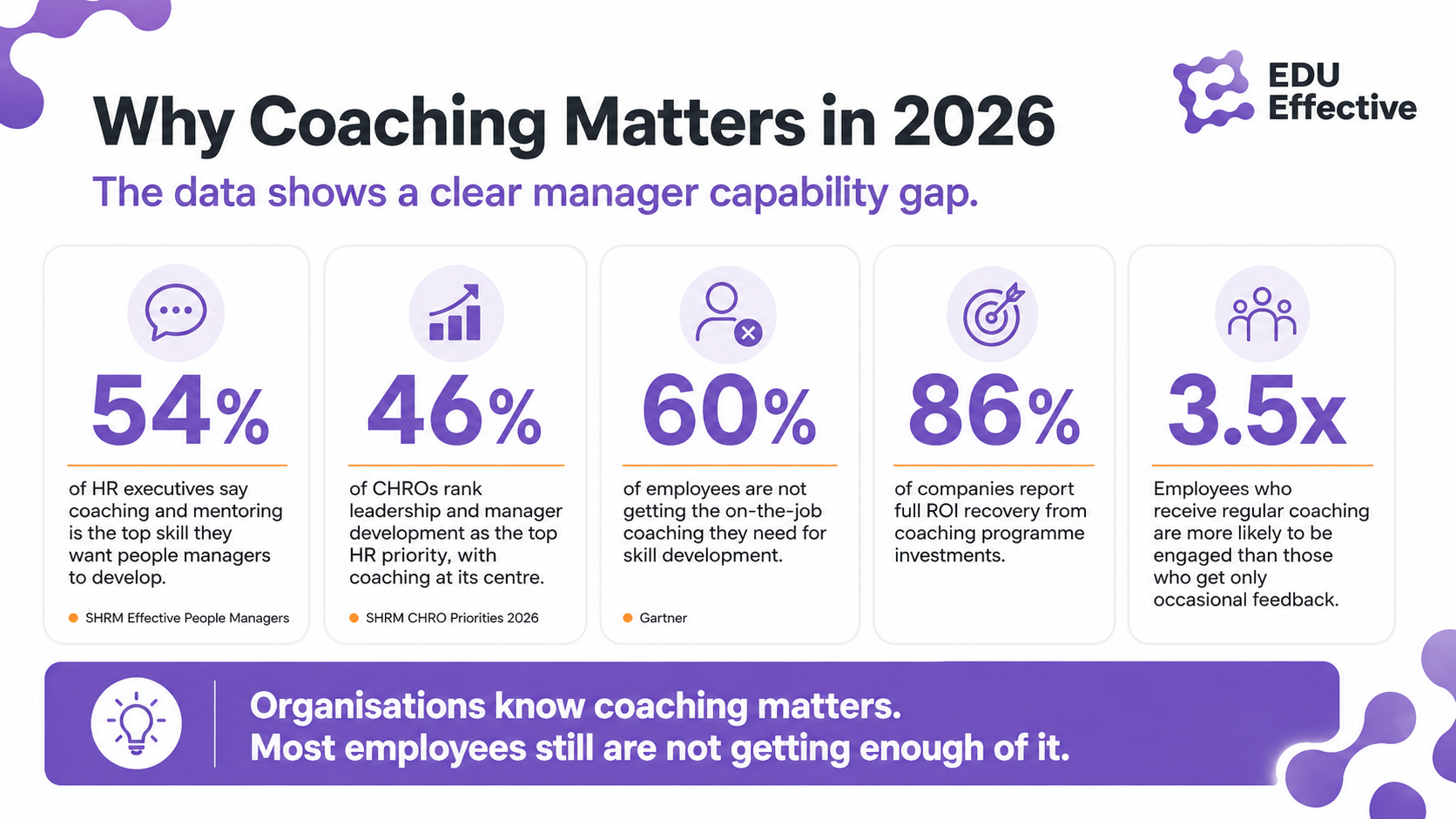
54% of HR executives listed coaching and mentoring as the top skill they want people managers to develop, according to SHRM's Effective People Managers report. Leadership and manager development — with coaching at its centre — is the top priority for 46% of CHROs surveyed in SHRM's 2026 CHRO Priorities and Perspectives report. And Gartner's research found that 60% of employees are not getting the on-the-job coaching they need for skill development.
These three numbers describe the same gap from different angles. Organisations know coaching matters. Leaders responsible for talent say it is their highest priority. And the majority of employees are not receiving it.
Understanding why that gap exists — and what it takes to close it — starts with being precise about what coaching actually is. Because the most common reason managers do not coach their teams effectively is not indifference or lack of time. It is that they have never been clearly shown what coaching looks like in practice, or how it differs from the other things managers do.
What coaching is — and what it is not
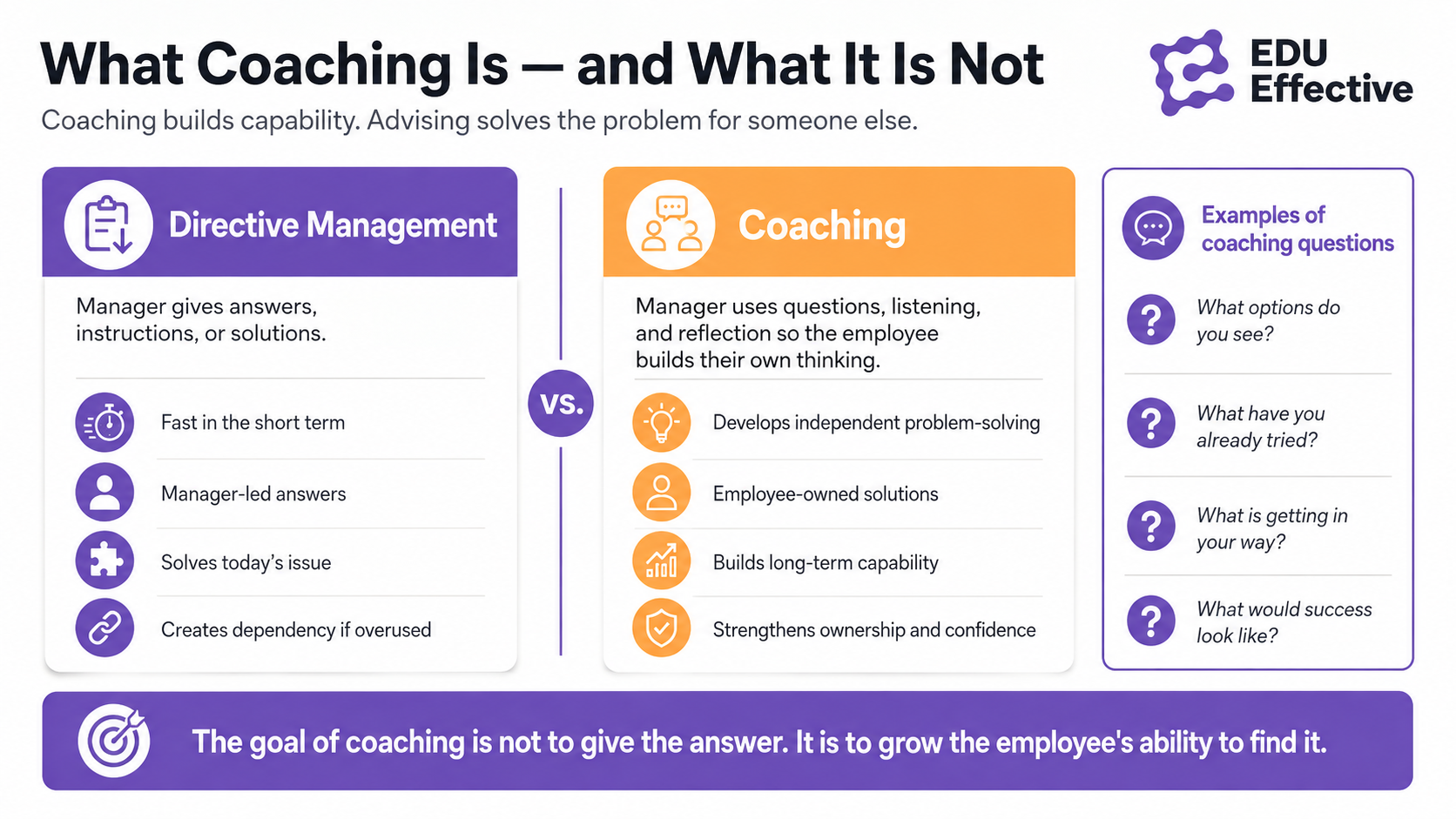
Coaching is a structured conversation in which a manager uses questions, reflection, and active listening to help an employee develop their own thinking, solve their own problems, and build their own capability. The critical word is "own" — coaching is not about the manager providing answers. It is about the manager creating the conditions in which the employee develops the capacity to find answers themselves.
This distinction matters practically because it determines what kind of conversation a manager has with an employee who brings a problem. The instinctive response for most managers — particularly those who have been promoted on the basis of their own expertise — is to provide the solution. "Here is what I would do." "In this situation you should..." "The answer is..." This feels efficient, and in the short term it often is. The problem is solved, the meeting ends, and both parties move on.
The coaching response is different. "What do you think the options are?" "What have you already tried?" "What is stopping you from taking that approach?" "What would you do if you had complete freedom to act?" These questions are less efficient in the short term. Over time, they produce something the directive response cannot: an employee who can solve this type of problem independently, without requiring management input each time.
This is the commercial logic behind manager coaching. Organisations where managers coach consistently produce employees who grow faster, perform better, and stay longer. 86% of companies report full ROI recovery from investing in coaching programmes. Gallup's 2026 data shows that organisations with strong coaching cultures see 20-28% boosts in manager performance. And employees who receive regular coaching from their managers are 3.5 times more likely to be engaged than those who receive only occasional feedback.
The GROW model: the most widely used coaching framework
The GROW model — developed in the UK in the late 1980s by Sir John Whitmore, Graham Alexander, and Alan Fine — remains the most widely used framework for structuring coaching conversations in professional settings. Its endurance reflects its simplicity and its adaptability: the same four-step structure works for a ten-minute informal conversation after a meeting and a formal development session scheduled in advance.
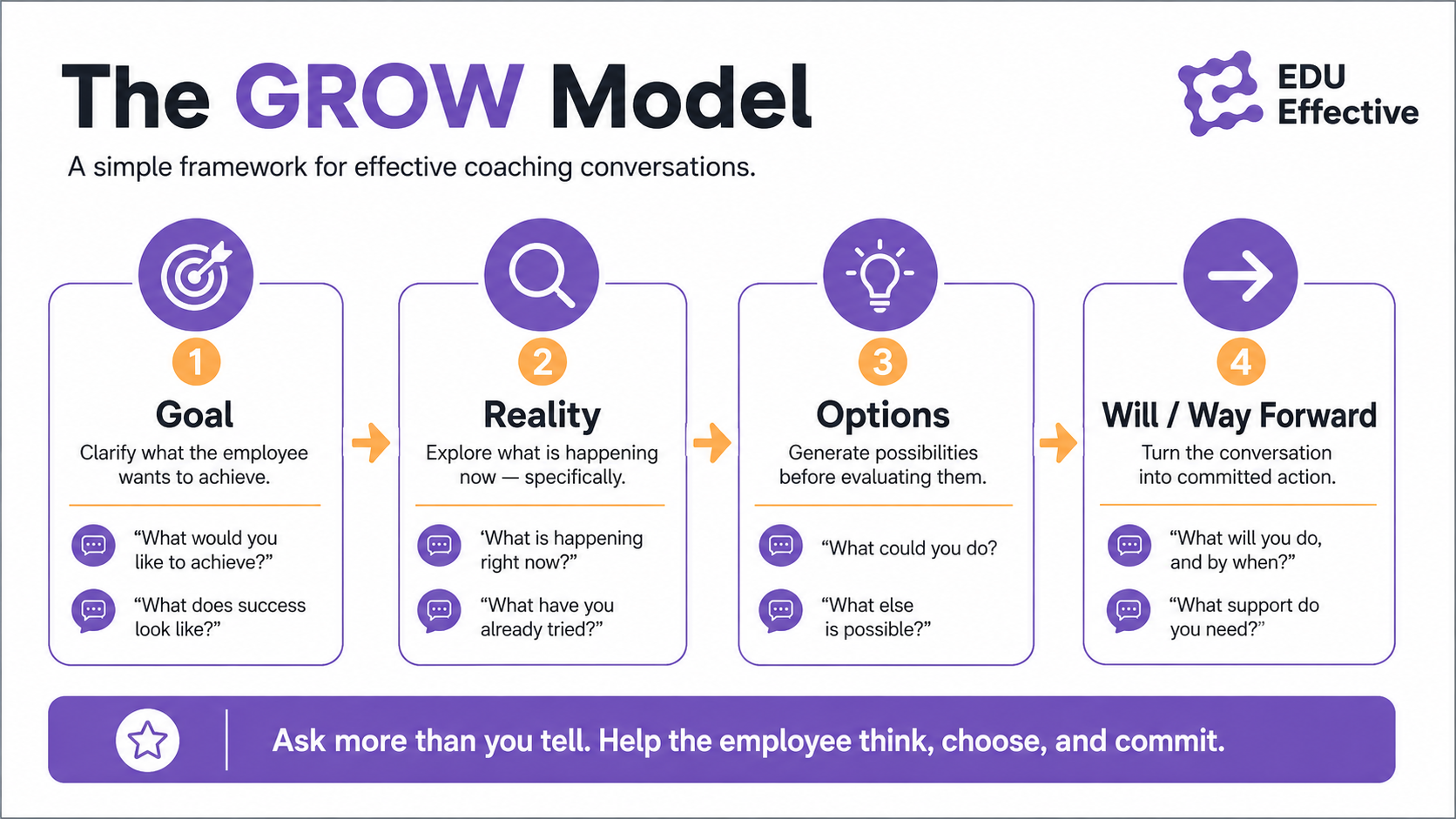
GROW stands for Goal, Reality, Options, and Will — or Way Forward. Each phase has a specific purpose, and each is conducted primarily through questions rather than statements.
Goal establishes what the employee is trying to achieve. Not the presenting problem — "my presentation to the board went badly" — but the underlying development objective: "I want to be able to deliver high-stakes presentations with confidence and clarity." The goal should be specific enough to be measurable and meaningful enough to be motivating. The manager's role in this phase is to help the employee articulate a goal that is genuinely theirs, not a goal the manager would set for them.
Useful Goal questions: "What would you like to achieve from this conversation?" "What does success look like to you?" "How will you know when you've reached where you want to be?"
Reality explores the current situation honestly and specifically. What is actually happening? What has the employee already tried? What is working, and what is not? What are the constraints? This phase is where managers most often fail coaching conversations — by accepting a vague description of the situation and moving too quickly to solutions. Precision about the current reality is what makes the subsequent exploration of options genuinely useful. Vague reality leads to generic options; specific reality leads to targeted options.
Useful Reality questions: "What is happening right now — specifically?" "What have you already tried?" "What is getting in your way?" "How much of this is within your control?"
Options generates possibilities for action without evaluating them. The goal of this phase is quantity and creativity — as many options as possible, including some that might seem impractical — before narrowing to what is genuinely actionable. The manager's instinct to evaluate and filter options immediately is counterproductive here. An option dismissed too quickly may have contained a useful element, and premature evaluation narrows the employee's thinking rather than expanding it.
Useful Options questions: "What could you do?" "What else?" "What would you do if there were no constraints?" "What would someone you admire do in this situation?" "What have you not yet tried?"
Will — or Way Forward — converts the conversation into committed action. The employee identifies specifically what they will do, by when, and how they will know they have done it. The commitment should be the employee's own — not a task assigned by the manager — because self-generated commitments are significantly more likely to be acted on than externally assigned ones.
Useful Will questions: "Which of these options will you pursue?" "What specifically will you do, and by when?" "What might get in the way?" "How will you handle that if it happens?" "What support do you need?"
The coaching conversation in practice: what it actually sounds like
The theory of coaching is straightforward. The practice is harder, because it requires the manager to resist the habitual response of providing answers and replace it with the discipline of asking questions.
The most common failure in coaching conversations is the pseudo-question — a question that is structurally interrogative but is actually a disguised statement of the manager's preferred answer. "Don't you think you should...?" "Have you considered...?" "Wouldn't it be better to...?" These questions do not create the employee's own thinking — they invite the employee to adopt the manager's thinking while feeling like they reached it independently.
Genuine coaching questions are open, non-leading, and focused on the employee's own thinking rather than on eliciting a particular response. They tend to begin with "what," "how," or "which" rather than "why" — because "why" questions, particularly in the context of performance, often produce defensiveness rather than reflection.
The physical and attentional dimensions of coaching also matter. Coaching conversations produce the best outcomes when the manager is genuinely present — not checking messages, not preparing their next statement while the employee is speaking, not looking at the clock. The quality of listening directly affects the quality of the questions the manager can ask: a manager who has genuinely heard what the employee said will ask a better follow-on question than one who was composing their response while the employee spoke. why emotional intelligence is the foundational capability that makes coaching conversations work — and how the self-regulation and empathy skills underlying EQ determine whether a manager can genuinely hold space for an employee's thinking, or fills it with their own answers the moment discomfort appears
Coaching does not require a formal setting or a scheduled session. Some of the most effective coaching conversations are five minutes long and happen immediately after an observed situation — a presentation, a difficult client interaction, a team meeting — while the specifics are still fresh. "I noticed you seemed to lose the room when the numbers came up — what do you think happened there?" is a coaching question that can be asked in a corridor and can produce more development than a formal review conversation a month later. how coaching conversations and feedback conversations work as complementary tools in the same manager's repertoire — the SBI model structures what you observed and what it produced; the GROW model structures what the employee will do differently and why
When to coach and when to do something else
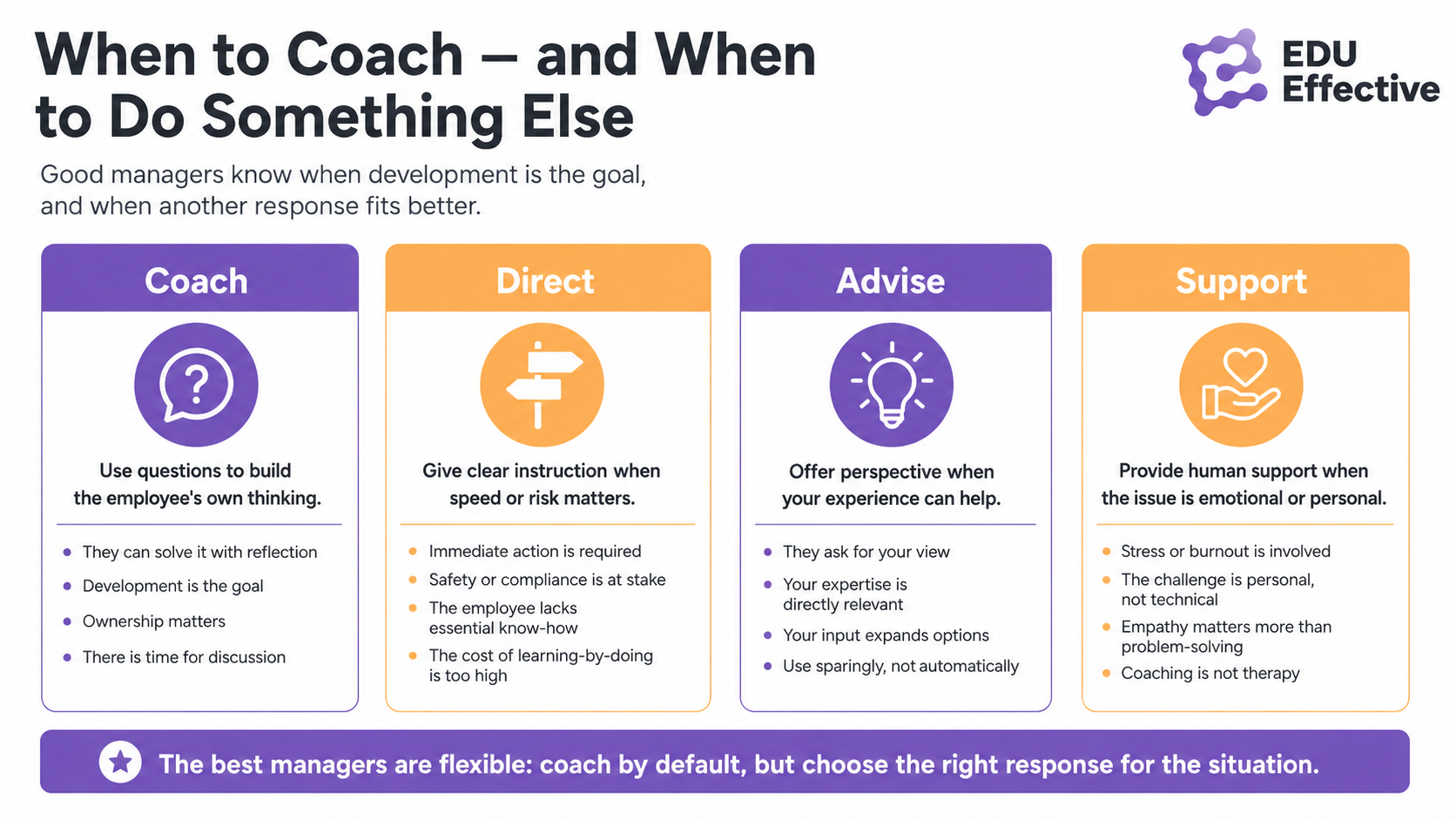
Coaching is not the right approach to every management conversation — and recognising when to coach versus when to direct, advise, or support is as important as knowing how to coach.
Coach when the employee has the capability to solve the problem themselves, with the right questions and reflection. When the goal is development rather than immediate task completion. When the employee needs to build ownership of a solution rather than simply implement one. When there is time for a proper conversation.
Direct when the situation requires immediate action, when safety or legal compliance is at stake, when the employee genuinely lacks the knowledge or capability to find a solution, or when the cost of the learning process is too high relative to the value of the outcome.
Advise when the employee explicitly requests your perspective, when your specific experience is directly relevant to the situation, or when the coaching conversation has reached the options phase and your input would genuinely expand rather than narrow the employee's thinking. Managers often feel compelled to offer advice; the more effective discipline is to offer it sparingly, after the employee's own thinking has been fully explored.
Support when the employee is facing a difficulty that is primarily emotional or personal rather than technical or strategic. Coaching is not therapy, and a manager coaching an employee through grief, significant stress, or mental health challenges is operating outside the appropriate boundaries of a management relationship.
Building coaching into the management rhythm
The most effective coaching does not happen as a periodic formal event. It happens as an integrated part of regular management practice — woven into one-to-one meetings, embedded in post-project reviews, and present in the brief conversations that happen around actual work. how to adapt coaching conversations to hybrid and remote environments — and why one-to-one meetings in distributed teams need to carry the full weight of the coaching relationship that ambient office interaction previously supplemented
The practical infrastructure that makes this possible is simple: regular, structured one-to-one meetings with each direct report, a consistent habit of asking coaching questions rather than providing immediate answers, and explicit tracking of the development goals each team member is working toward.
Only 21% of employees strongly agree they received meaningful feedback from their manager in the previous week, according to Gallup's 2025 data. DDI's Global Leadership Forecast 2025 — the largest leadership study of its kind, covering 10,796 leaders across 50 countries — found that employees with managers who are effective coaches are nine times more likely to trust their manager. Trust in immediate managers has nonetheless plummeted to just 29%, down from 46% in 2022, signalling how far most organisations still are from closing the coaching gap. High-potential talent is 3.7 times more likely to leave if their manager does not regularly provide development opportunities — making coaching capability one of the highest-leverage retention investments available to any organisation.
Gallup's research found that employees who have strong, frequent coaching conversations with their managers show significantly higher engagement and are substantially more likely to stay with their organisations. The manager who provides that coaching — and does so consistently rather than occasionally — is operating in a small minority, and that minority produces measurably better team outcomes. how consistent manager coaching directly accelerates professional development — and why employees whose managers coach regularly show measurably faster skill development and are substantially more likely to stay than those receiving only task direction
SHRM's 2026 CHRO Priorities and Perspectives report identifies leadership and manager development — with coaching capability at its centre — as the highest HR priority for the second consecutive year. The organisations closing the gap between that stated priority and actual practice are those investing in developing coaching as a concrete management skill, not treating it as a personality trait some managers happen to have. how coaching capability fits into the broader executive management and leadership skill set — and why SHRM identifies it as the single highest-priority management development area for the second consecutive year in 2026
At EDU Effective, both the Effective MBA: Coaching, Leadership & Mentoring and the Effective MBA: Executive Management & Leadership develop coaching skills as core management competencies — building the practical capability to have coaching conversations that change behaviour, not just the conceptual understanding of why coaching matters. Explore our programs →
EDU Effective Business School — professional development for your long-term success.
All five Effective MBA programs are built on the same educational model — designed for working adults who need learning that fits real professional life:
- Effective MBA: Executive Management & Leadership
- Effective MBA: Applied Artificial Intelligence
- Effective MBA: Coaching, Leadership & Mentoring
- Effective MBA: Mastery in AI
- Effective MBA: Online Marketing
Every programme runs on 15 minutes a day, completes in 10 months or less, is ASIC accredited, and starts from €990.
These are professional programmes, not academic ones — built for working adults to apply what they learn directly in their own business, not to collect a scholarly credential.
Join more than 9,000 students in over 120 countries who are investing in their professional development and career success. Read the experiences of our graduates here.
Apply now — from €990 · Talk to a Study Advisor
Study with NO risk: 14-day money-back guarantee, no questions asked.
Sources
- SHRM — 2026 CHRO Priorities and Perspectives Report (129 CHROs, surveyed Oct-Nov 2025) https://www.shrm.org/about/press-room/what-will-work-look-like-in-2026--new-shrm-research-reveals-how-
- SHRM — Effective People Managers Report: Coaching as Top Skill Priority https://www.shrm.org/topics-tools/tools/toolkits/build-business-driven-coaching-culture-strategies-tips-tools
- Gallup — State of the Global Workplace 2026 https://www.gallup.com/workplace/349484/state-of-the-global-workplace.aspx
- Gallup — Manager Development Strategy 2026 https://www.gallup.com/workplace/702065/manager-development.aspx
- Gallup / Workhuman — The Human-Centered Workplace: Feedback and Recognition Research https://www.workhuman.com/resources/reports-guides/the-human-centric-workplace-gallup-report/
- Gartner — The Manager Coaching Gap: 60% of Employees Not Getting Development https://www.gartner.com/en/newsroom/press-releases/2024-10-28-gartner-hr-research-finds-organizations-are-in-the-midst-of-a-reset-most-are-not-prepared
- DDI — Global Leadership Forecast (10,796 leaders, 50 countries) https://www.ddiworld.com/research/global-leadership-forecast-2025