

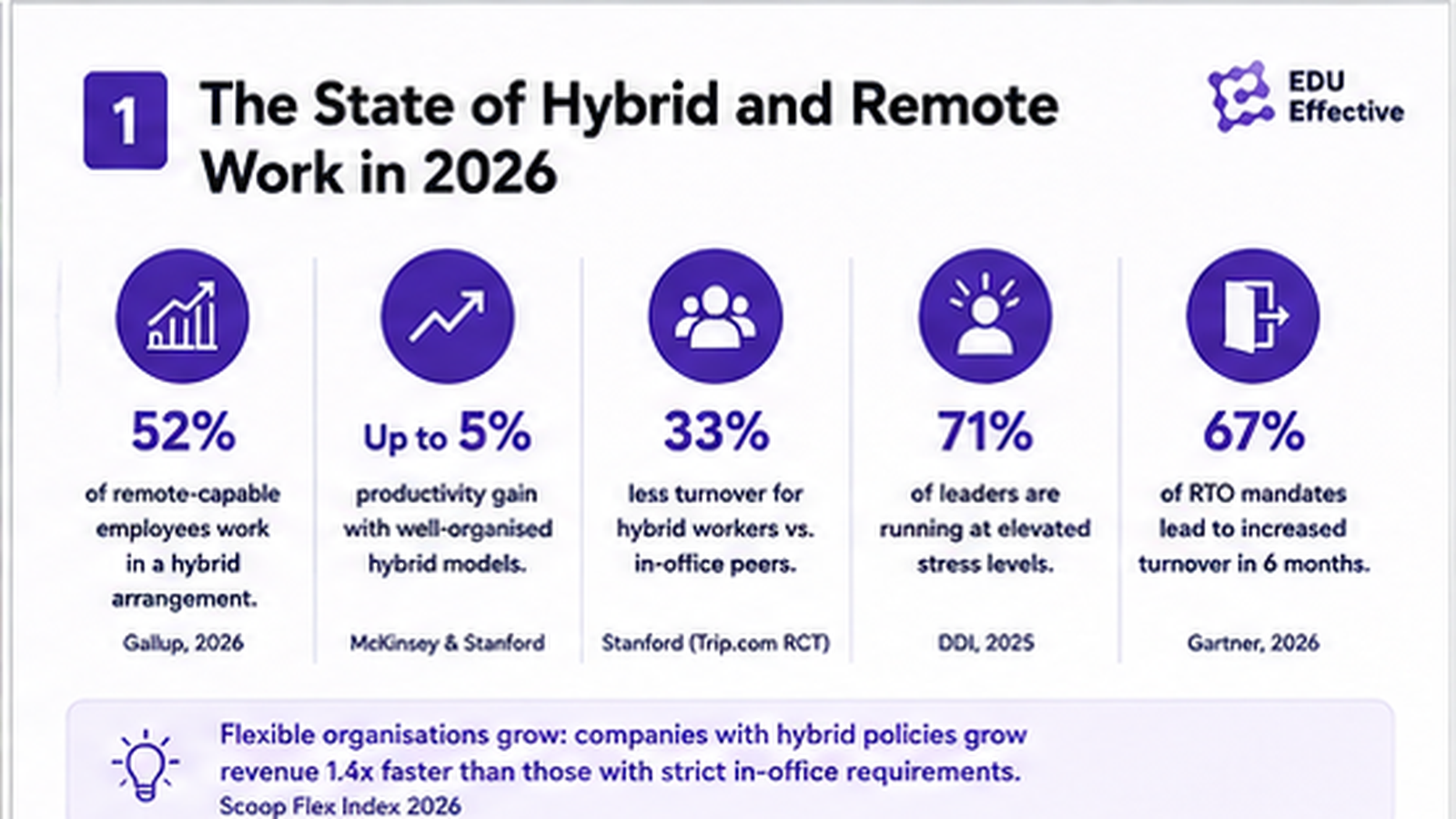
Remote and hybrid work is no longer an emergency response or a temporary accommodation. It is the permanent operating model for a significant share of the global workforce. Gallup's 2026 data shows that 52% of remote-capable employees now work in a hybrid arrangement — and that figure has stabilised rather than declined, despite the wave of return-to-office mandates that many large organisations have attempted in the past two years.
The management challenge this creates is real and specific. The techniques that made managers effective in shared physical spaces — proximity-based oversight, informal visibility into team dynamics, spontaneous connection in corridors and meeting rooms — do not transfer cleanly to distributed environments. Research consistently shows that the gap between what managers need to do differently in hybrid and remote settings and what they have actually been trained to do is wide. That gap shows up in team performance, engagement, and retention.
The good news is that the gap is not structural — it is a skill gap, and skills can be developed.
The state of hybrid and remote work in 2026
Several findings from current research are worth internalising before examining how to manage distributed teams effectively.
Hybrid is outperforming expectations on productivity. Well-organised hybrid arrangements deliver up to a 5% productivity gain over both fully remote and fully in-office models, according to McKinsey and Stanford research, accounting for reduced commute time and more focused work. The randomised controlled trial most often cited in this literature — a six-month study of 1,612 employees at Trip.com led by Stanford's Nicholas Bloom — found that hybrid workers quit 33% less often than their in-office peers, while performance review scores and promotion rates were statistically identical. The productivity-loss argument that underpins many return-to-office mandates does not survive contact with RCT-grade evidence.
Managers are struggling more than their teams. Gallup's 2026 State of the Global Workplace data shows 78% of managers report their remote teams are meeting or exceeding expectations. Yet DDI's Global Leadership Forecast 2025 found that 71% of leaders are running at elevated stress levels — and remote and hybrid management adds a specific layer: the emotional labour of maintaining connection, culture, and accountability across screens, without the informal social infrastructure of shared office environments.
Return-to-office mandates are not solving the underlying problem. Gartner's HR research found that 67% of return-to-office mandates result in increased voluntary turnover within six months. Companies with flexible hybrid policies grow revenue 1.4x faster than those with strict in-office requirements, according to the Scoop Flex Index 2026. The organisations performing best are not those that have mandated a particular location — they are those that have invested in the management capabilities required to lead distributed teams well.
Proximity bias is real and measurable. Employees who are physically visible to senior leaders are more likely to be promoted, recognised, and developed — regardless of their actual performance relative to remote peers. This creates both a fairness problem and a performance problem: it means that promotion decisions and development investments are being made on the basis of presence rather than contribution, which systematically underutilises the remote portion of the workforce.
The core shift: from presence management to outcomes management
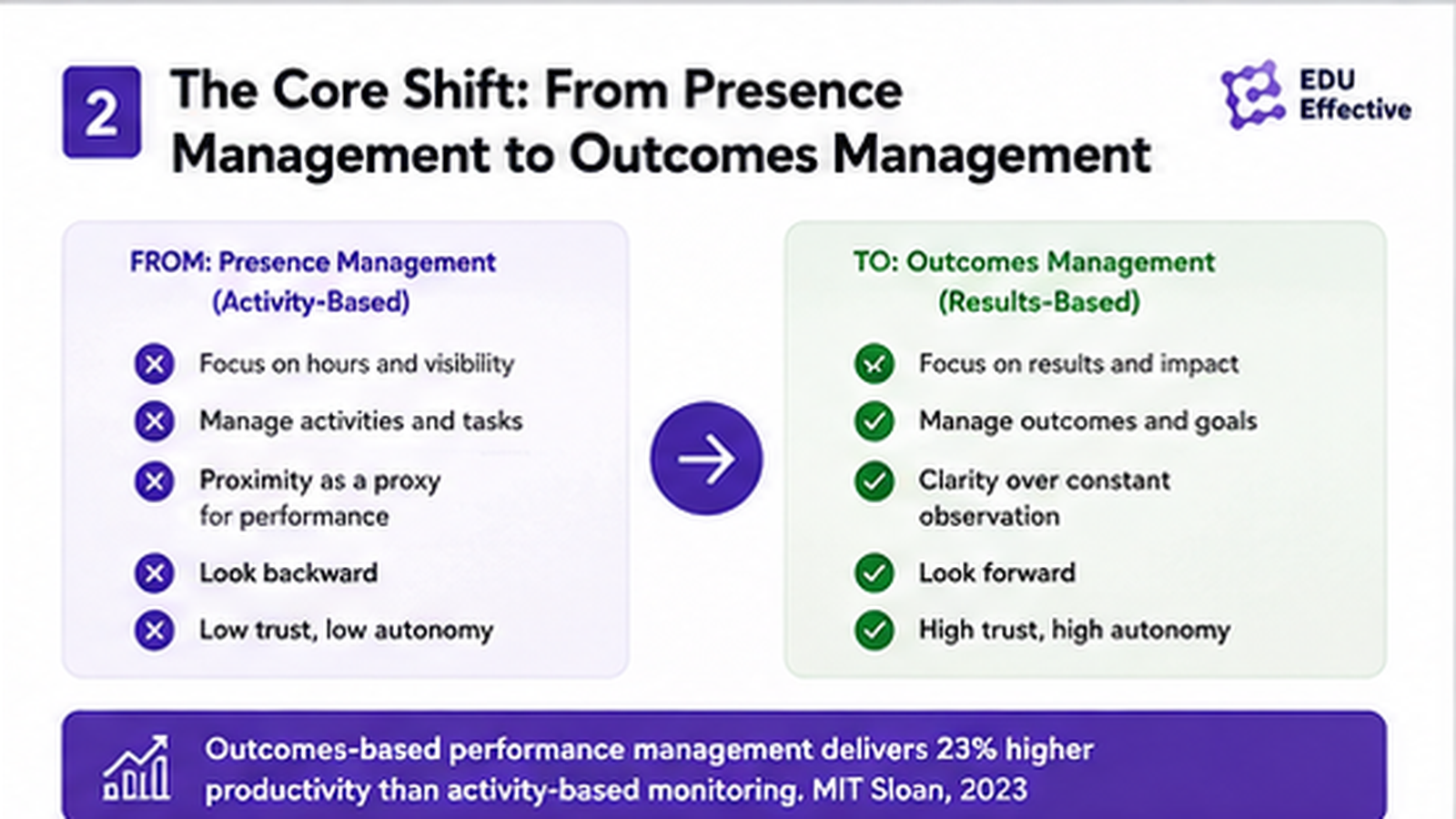
The single most important conceptual shift for managers of hybrid and remote teams is moving from presence-based to outcomes-based management.
In a shared office, presence and effort are proxies for performance — visible, easily observed, and intuitive. A manager can see who is at their desk, who stays late, who engages actively in meetings. These observations feel like performance data, even though research consistently shows they are weak predictors of actual output quality.
In a distributed environment, these proxies are unavailable — and this is what drives the "productivity paranoia" that Microsoft's Work Trend Index first documented in 2022: 85% of business leaders struggling to feel confident their remote teams are productive, while 87% of those employees reported being productive. The gap is a measurement problem, not a performance problem.
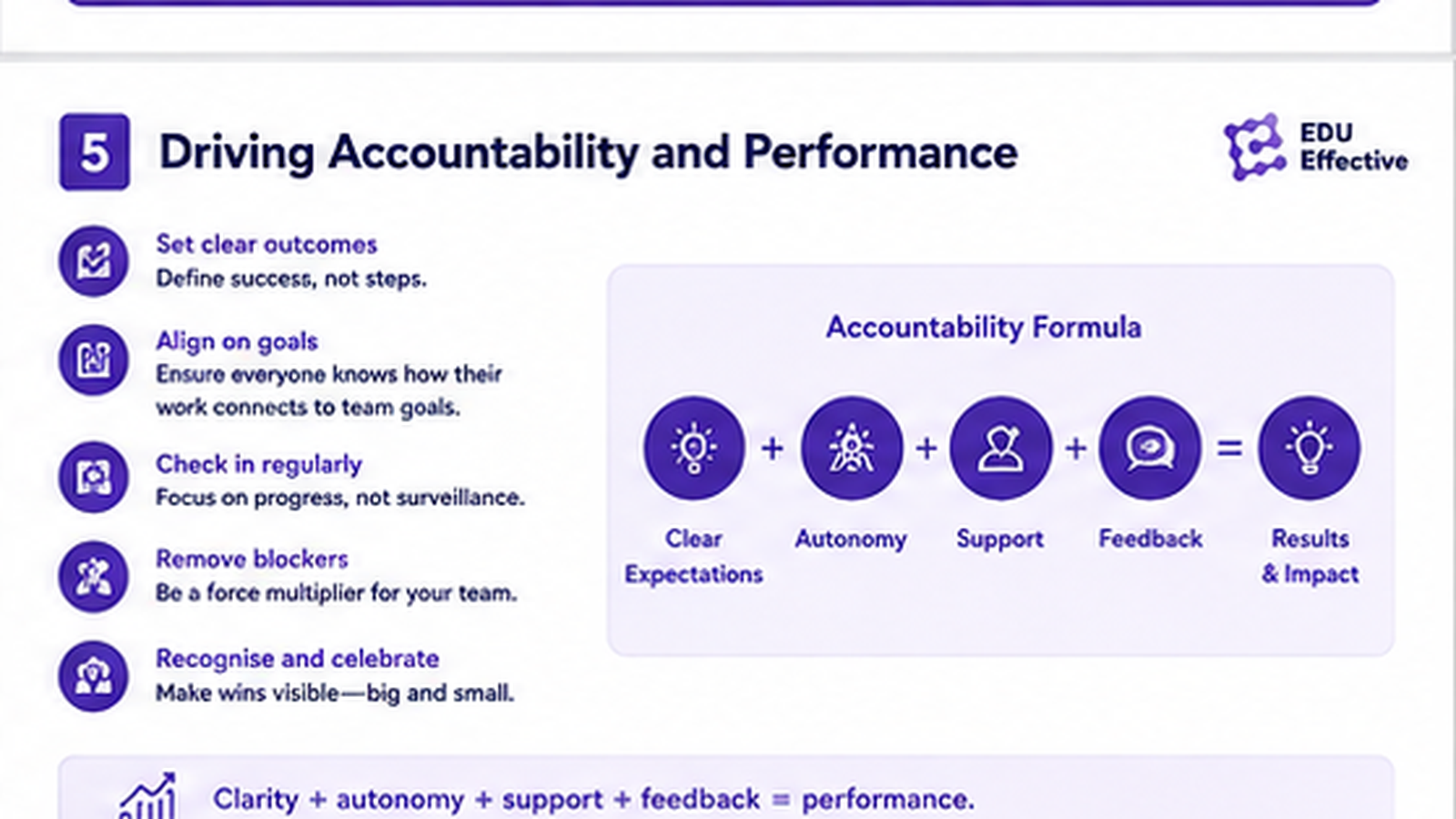
Outcomes-based management replaces presence proxies with direct measurement of what actually matters: deliverables completed, quality of work produced, objectives achieved, collaboration quality, and customer or stakeholder outcomes. It requires managers to be explicit about expectations — what does successful performance on this role look like in a given week, month, or quarter? — rather than relying on the ambient signals of shared physical space to communicate expectations implicitly.
MIT Sloan Management Review research on remote work effectiveness found that outcomes-based performance management produces 23% higher productivity than activity-based monitoring. The mechanism is not mysterious: clarity about what matters, combined with autonomy about how to achieve it, is one of the most consistent drivers of performance and engagement in knowledge work.
Building trust across distance
Trust is the operational currency of distributed teams. In shared offices, trust accumulates through repeated small interactions — the brief conversation before a meeting, the visible willingness to help, the consistent follow-through on minor commitments. These interactions happen naturally and continuously in physical environments. In distributed environments, they do not.
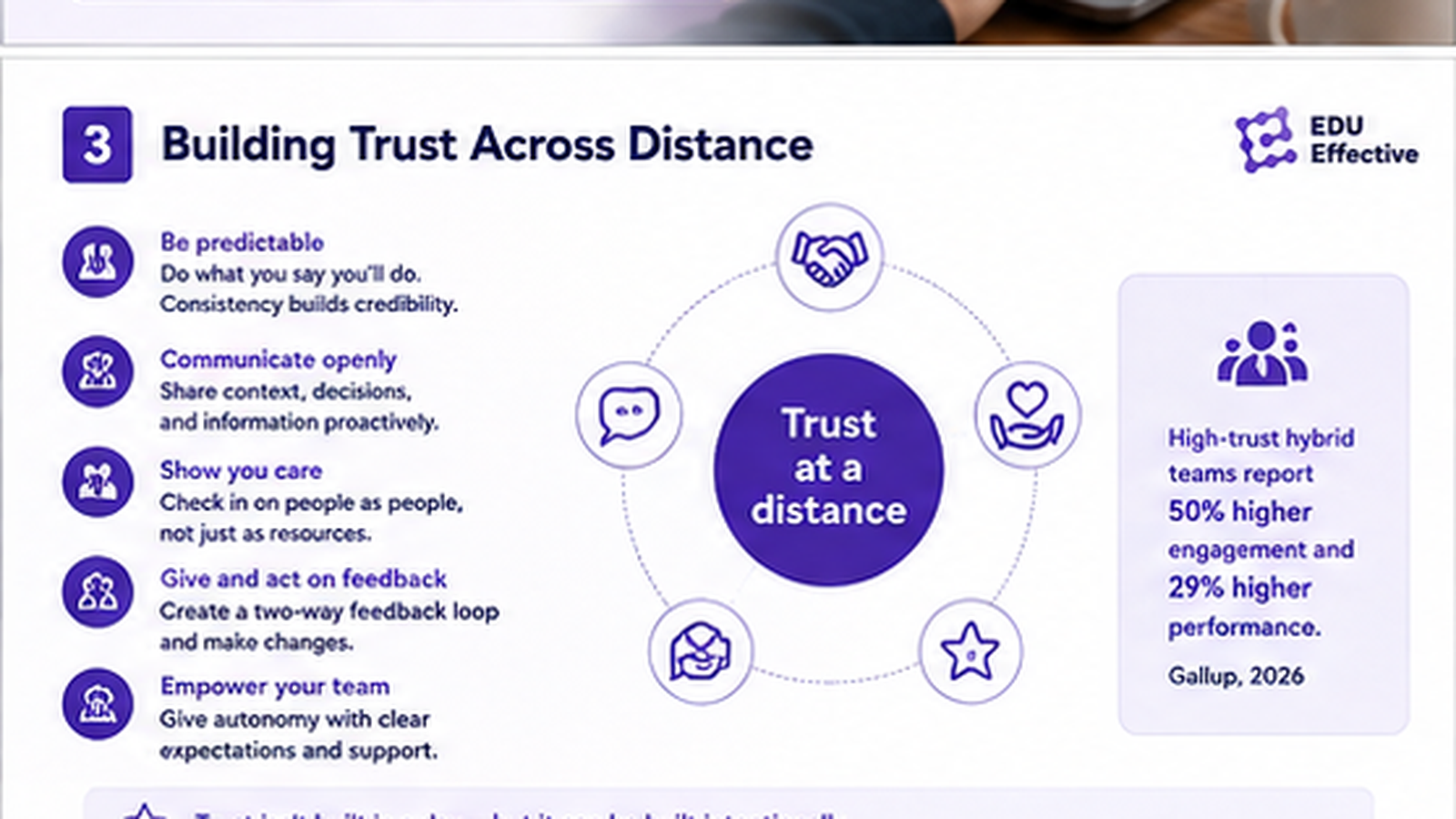
Gallup's research on hybrid and remote team management is explicit: trust is foundational to psychological safety in distributed teams, and psychological safety is foundational to performance. McKinsey found that 89% of respondents believe psychological safety is important in the workplace — but only 26% of leaders are perceived to actively create it in their teams. The gap between understanding and practice is wide — and emotional intelligence is the foundational capability for building trust and psychological safety in distributed teams — the research connection is direct.
Three specific management behaviours build trust in distributed environments more reliably than others.
Consistent follow-through on small commitments. In remote environments, small broken commitments — a promised reply that doesn't arrive, a scheduled one-to-one that gets cancelled without rescheduling, feedback that was mentioned but never given — have an outsized negative effect on trust, because they are not compensated for by the ambient positive signals of physical presence. Managers who are unusually reliable about small commitments build trust faster in distributed environments than in collocated ones.
Transparency about decisions and reasoning. Remote team members who cannot see how decisions are made, why priorities have shifted, or what information leadership has that they do not, fill the information vacuum with assumptions that are often more negative than the reality. Consistent, proactive communication about decisions, context, and reasoning — even when the message is uncertain or uncomfortable — maintains the psychological safety that distributed teams require.
Individual attention to each team member's experience. In shared offices, a manager notices who seems stressed, who is struggling, who is disengaged — through direct observation. Distributed environments require this awareness to be built through deliberate regular contact. One-to-one meetings that include genuine check-ins on wellbeing, workload, and experience — not just task updates — are the primary mechanism through which managers stay connected to their team members as individuals rather than as output producers.
Communication in distributed teams: the async-first principle
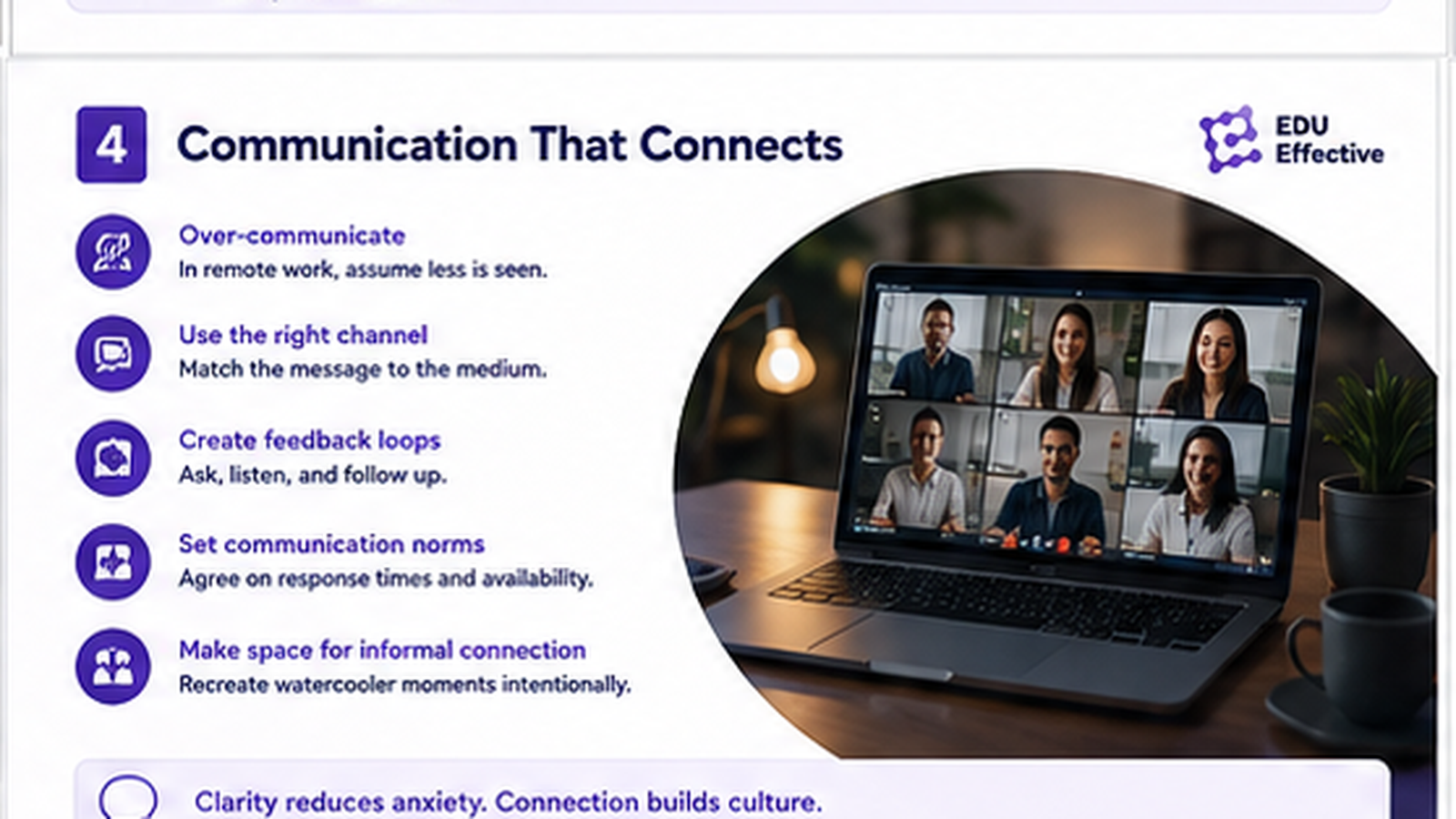
One of the most common management failures in hybrid and remote environments is attempting to run a distributed team on the same communication rhythms as a collocated one — defaulting to synchronous meetings for decisions that could be made asynchronously, and underinvesting in written communication infrastructure.
The data on meeting culture in distributed teams is instructive. Research from Slack's Future Forum — a consortium backed by Slack in partnership with BCG that ran from 2020 to 2023 and surveyed 10,000+ desk workers quarterly — found that asynchronous-first communication reduces meeting time by 29% and increases deep work time by 18%. Teams that establish clear norms about when to use synchronous versus asynchronous communication — specifying which decisions require a meeting, which warrant a message, and which can be handled through shared documents — consistently outperform those that treat every interaction as synchronous by default.
The async-first principle does not mean eliminating synchronous interaction. It means being deliberate about when synchronous interaction is worth the coordination cost it imposes on a distributed team. Decisions that benefit from real-time dialogue, relationship-building interactions, and situations requiring emotional calibration — these warrant synchronous time. Routine updates, documentation, information sharing, and decisions where deliberation time improves quality — these are better handled asynchronously.
Written communication quality becomes much more important in distributed environments, because it carries more of the total communication load. Managers who write clearly, specifically, and with appropriate context in written channels are significantly more effective in remote environments than those who rely on verbal communication in meetings and leave written channels vague or underused. And when written communication fails, the consequences compound — conflict resolution in hybrid teams requires a different approach, and the communication channel itself is often the primary source of escalation.
Proximity bias: the hidden management failure in hybrid teams
Proximity bias — the tendency to favour employees who are physically visible over those who are remote — is one of the most significant and least acknowledged risks in hybrid management. It shows up in promotion decisions, development opportunities, assignment of high-visibility work, and informal recognition.
The mechanism is not malicious. It is cognitive: physically present employees are more salient to managers, their contributions are more easily noticed, and their working style is more easily read. Remote employees are more easily overlooked, even by managers who are explicitly trying to be fair.
The practical consequences are significant. If promotion decisions systematically favour office-based employees regardless of actual performance, the organisation is effectively penalising the flexible working arrangements it has offered — which damages trust, increases turnover, and signals that the stated commitment to flexible work is not matched by actual management behaviour.
Addressing proximity bias requires specific structural interventions rather than general intentions to be fair. Documenting contributions explicitly across both remote and in-office team members — maintaining a shared record of achievements that is not filtered through visibility — provides a more reliable basis for promotion and development decisions than managerial recall. Establishing clear, objective criteria for performance evaluation that are role-relevant rather than presence-dependent removes the mechanism through which proximity bias operates. And actively ensuring that high-visibility assignments are distributed based on capability and development need rather than physical proximity creates the evidence base for equitable advancement.
One-to-ones as the management infrastructure of distributed teams
If there is a single management practice that produces the most consistent positive outcomes in hybrid and remote environments, it is the regular, well-structured one-to-one meeting between manager and each direct report.
One-to-ones in distributed environments serve functions that are handled by ambient interaction in collocated ones: maintaining personal connection, surfacing concerns before they become problems, providing developmental feedback, checking on wellbeing, and ensuring each team member feels seen and invested in rather than simply monitored.
Research on psychological safety in hybrid teams — including a controlled trial involving more than 7,000 people across 1,000 teams — found that instituting structured one-to-one meetings focused on genuine connection produced measurable improvements in engagement, retention, and reported wellbeing. Weekly or biweekly cadence is the most widely recommended frequency. The agenda should balance task review with genuine personal connection — not perfunctory welfare checks, but real conversation about the individual's experience, challenges, and development. Coaching and mentoring skills transform one-to-one meetings from task updates into the genuine developmental relationships that distributed teams rely on in place of ambient office contact.
One-to-ones that are consistently cancelled or converted into task update calls lose their function quickly. A manager who cancels one-to-ones when time is short is communicating, accurately, that the team members are lower priorities than other demands — and in distributed environments where physical proximity cannot compensate, that signal is received clearly.
Managing hybrid teams: the specific asymmetry challenge
Fully remote teams face management challenges. Hybrid teams face a different and in some ways harder one: the asymmetry between team members who are in the office and those who are remote, particularly in meetings and informal communication.
When some team members are in a meeting room together and others join via video, the in-room group has structural advantages: easier to read non-verbal cues, more natural conversational flow, greater visibility to decision-makers. Remote participants are systematically disadvantaged — they see a conference room on a screen rather than individual participants, they struggle to interrupt or contribute in the natural pauses of in-room conversation, and their contributions carry less social weight.
The most effective hybrid meeting management treats all participants as if they were remote: individual video windows for everyone, a clear agenda shared in advance, explicit facilitation that creates equal airtime, and written follow-up that captures decisions and actions. The in-room experience is made slightly worse so the remote experience can be made significantly better — a trade-off that most hybrid teams, once it is explained, find acceptable.
The forty per cent of office interactions that now involve remote participants, documented by hybrid work research, makes this not a niche concern but a central feature of how most professional meetings now operate.
What the most effective hybrid and remote managers do differently
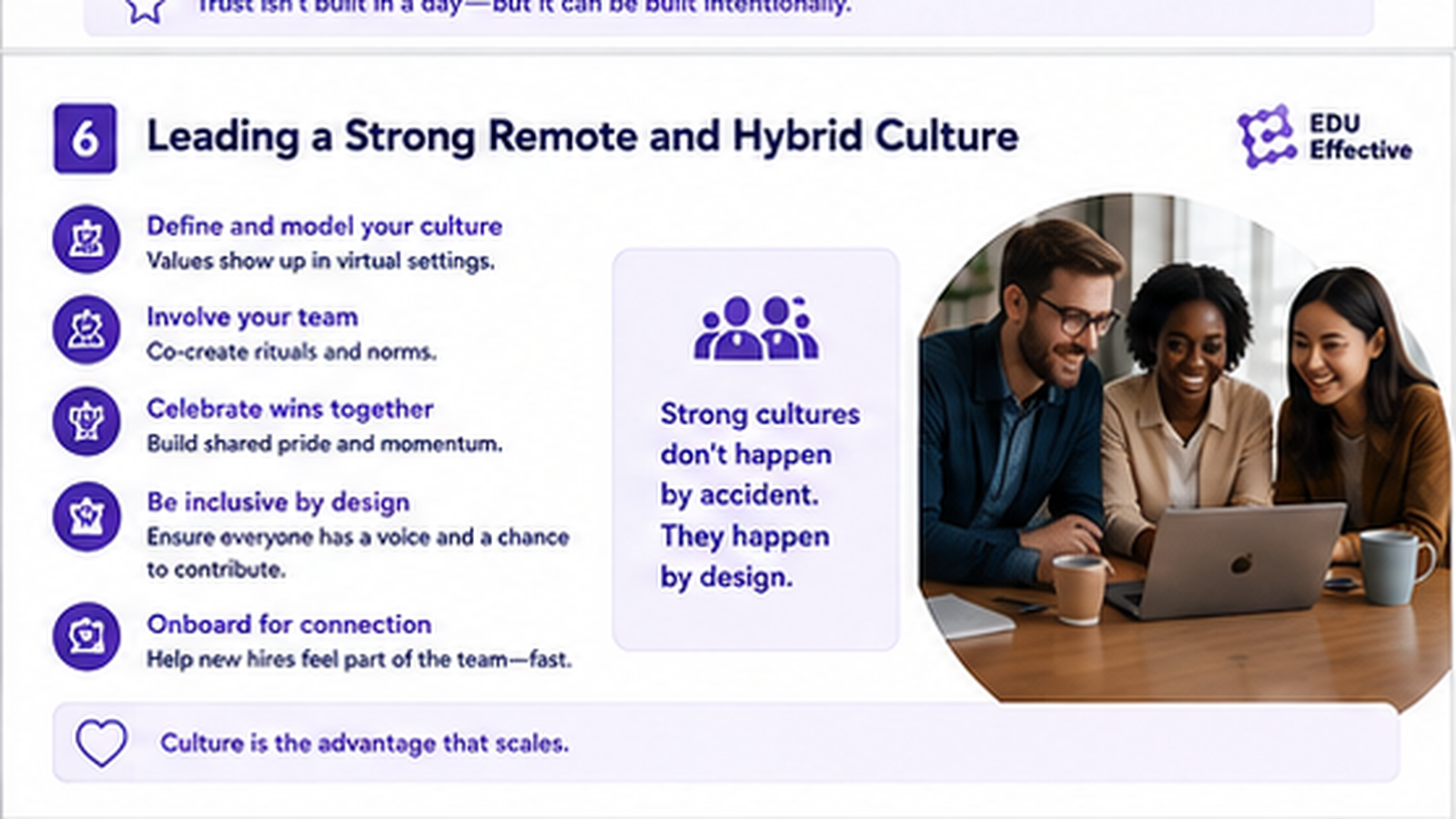
Research consistently identifies a cluster of behaviours that distinguish managers who lead distributed teams effectively from those who struggle.
They are explicit rather than implicit — about expectations, decisions, priorities, and reasoning. They do not assume that information communicated in a meeting was understood and retained by all; they follow up in writing. They do not assume that team members know how their performance is being assessed; they make evaluation criteria concrete and visible.
They invest in relationships, not just work. They use one-to-one time for genuine connection, not just task management. They create opportunities for informal interaction — virtual coffee meetings, non-work channels, shared social rituals — that build the personal familiarity that makes professional relationships more resilient.
They measure what matters, not what is visible. They define success in terms of outcomes and evaluate performance against those criteria, rather than using attendance, responsiveness, or meeting participation as proxies for contribution. Your default leadership style shapes the way you manage hybrid teams — and research identifies which approaches work best when presence-based oversight is unavailable.
And they manage proximity bias actively — tracking contributions across the team systematically, distributing high-visibility work equitably, and making promotion decisions on documented evidence rather than managerial recall.
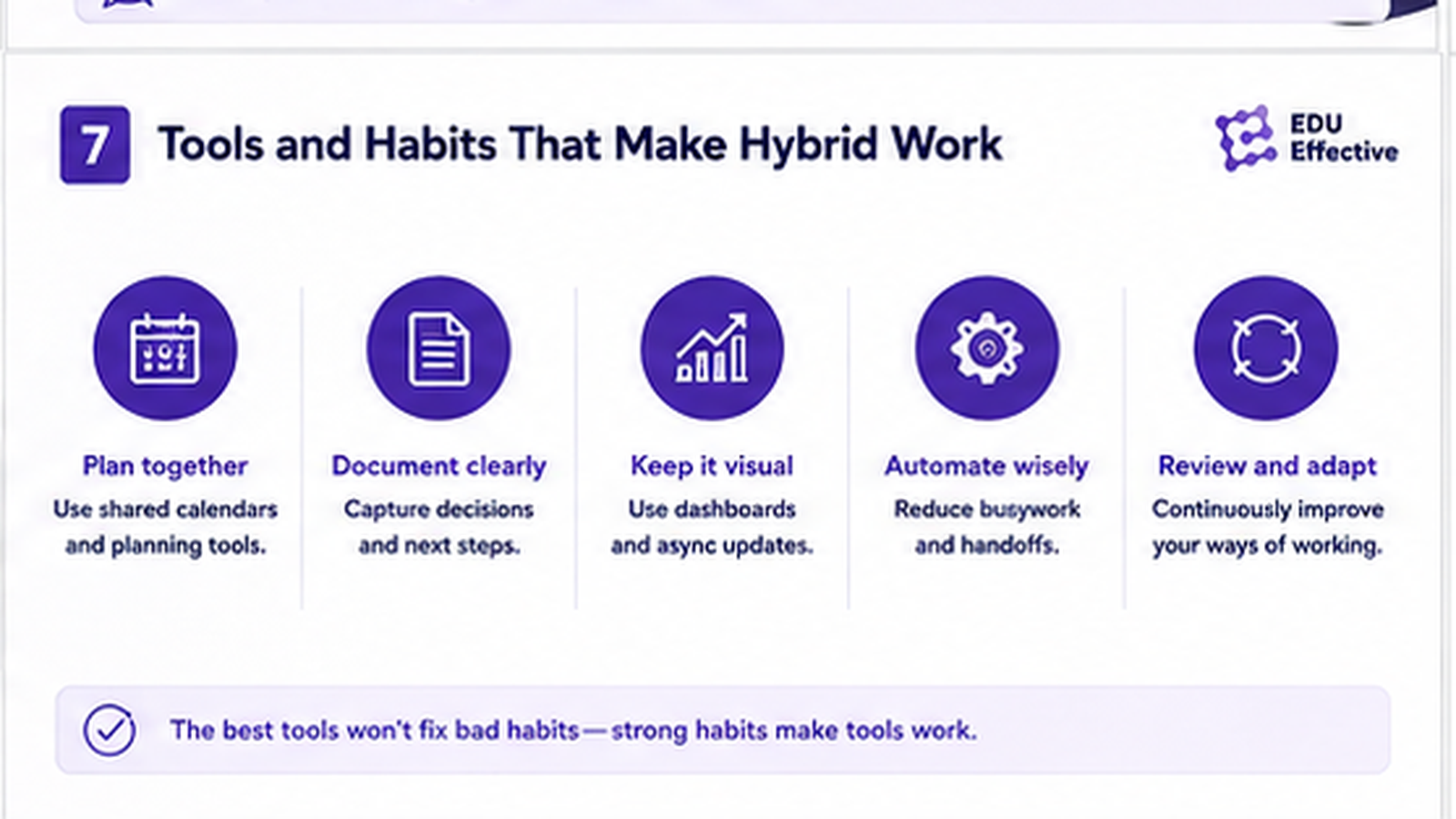
At EDU Effective, the Effective MBA: Executive Management & Leadership covers remote team management as a dedicated module — developing the specific capabilities that managing distributed teams in 2026 requires. Here is how managing distributed teams fits into the broader executive management and leadership skill set that 2026 requires — and why WEF and BCG data consistently identify it among the competencies with the fastest-growing demand.
For managers who want to build these capabilities alongside a full-time role, microlearning is particularly well-suited to working adults in hybrid and remote roles — structured professional development built around 15 minutes a day.
At EDU Effective, we build programs for professionals who want to work smarter — not just harder. Explore our programs →
EDU Effective Business School = professional development for your long-term success.
All best-selling Effective MBA programs are built for working adults: 15 minutes a day, 10 months or less, ASIC accredited, from €990.
- Effective MBA: Executive Management & Leadership
- Effective MBA: Applied Artificial Intelligence
- Effective MBA: Coaching, Leadership & Mentoring
- Effective MBA: Mastery in AI
- Effective MBA: Online Marketing
These are professional programs, not academic ones — built for working adults to apply what they learn directly in their own business, not to collect a scholarly credential.
Join more than 9,000 students in over 120 countries who are investing in their professional development and career success.
Read the feedback and experiences of our students and the stories of our graduates here.
Apply now — from €990 · Talk to a Study Advisor
Study with NO risk: 14-day money-back guarantee, no questions asked.
Sources
- Gallup — A Strategic Guide for Managing Hybrid and Remote Teams https://www.gallup.com/workplace/316313/understanding-and-managing-remote-workers.aspx
- Gallup — State of the Global Workplace 2026 https://www.gallup.com/workplace/349484/state-of-the-global-workplace.aspx
- DDI — Global Leadership Forecast 2025 https://www.ddiworld.com/research/global-leadership-forecast
- McKinsey & Company — How Companies Can Make Remote Working a Success https://www.mckinsey.com/capabilities/people-and-organizational-performance/our-insights/reimagining-the-postpandemic-workforce
- Microsoft — Work Trend Index: Productivity Paranoia and Hybrid Work Data https://news.microsoft.com/annual-work-trend-index-2026/