
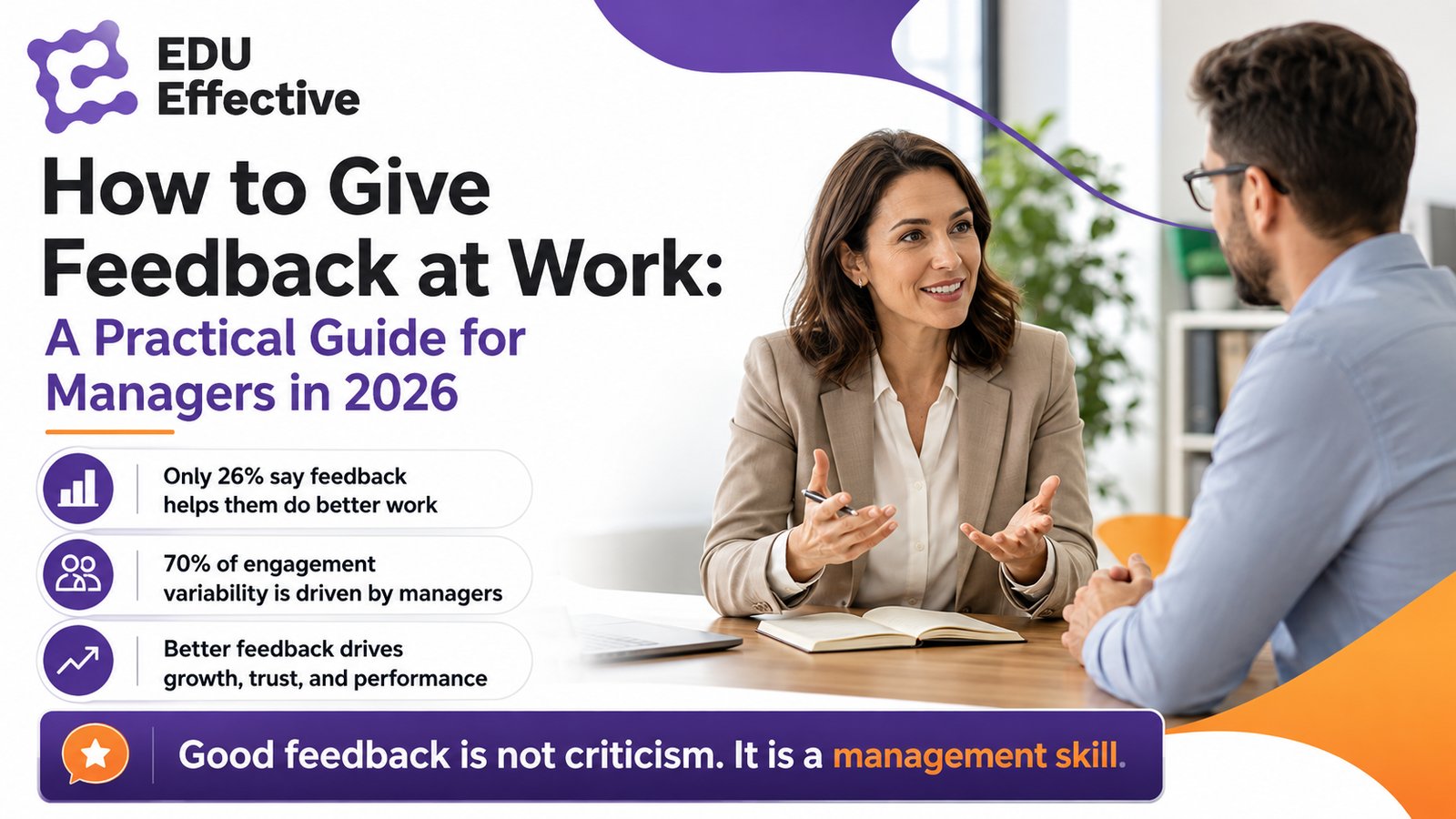

Only 26% of employees strongly agree that the feedback they receive helps them do better work, according to Gallup research. That means 74% of feedback conversations are not working — not because managers are not giving feedback, but because the feedback they give is not producing the behavioural change it is intended to produce.
The consequences compound quietly. When feedback does not land, managers conclude that giving it is not worth the discomfort. Problems that a good feedback conversation would have resolved in ten minutes persist for months. Performance issues that are addressed only when they become unavoidable are harder to correct than they would have been if addressed early. And talented employees who receive no meaningful feedback on how they are doing and where they could grow start looking for an organisation that will invest in them.
Gallup's 2026 State of the Global Workplace report found that 70% of team engagement variability is directly attributable to the manager. Quality feedback conversations are consistently ranked among the most critical drivers of that engagement. Getting feedback right — both giving it and receiving it — is one of the highest-leverage management skills available. how feedback capability fits into the broader framework of executive management and leadership effectiveness — and why Gallup's finding that managers account for 70% of team engagement variability makes feedback quality one of the highest-leverage competency investments available to any manager
Why most feedback fails — and the three patterns behind it
Before examining what works, it is worth being precise about the patterns that consistently produce feedback that does not land.
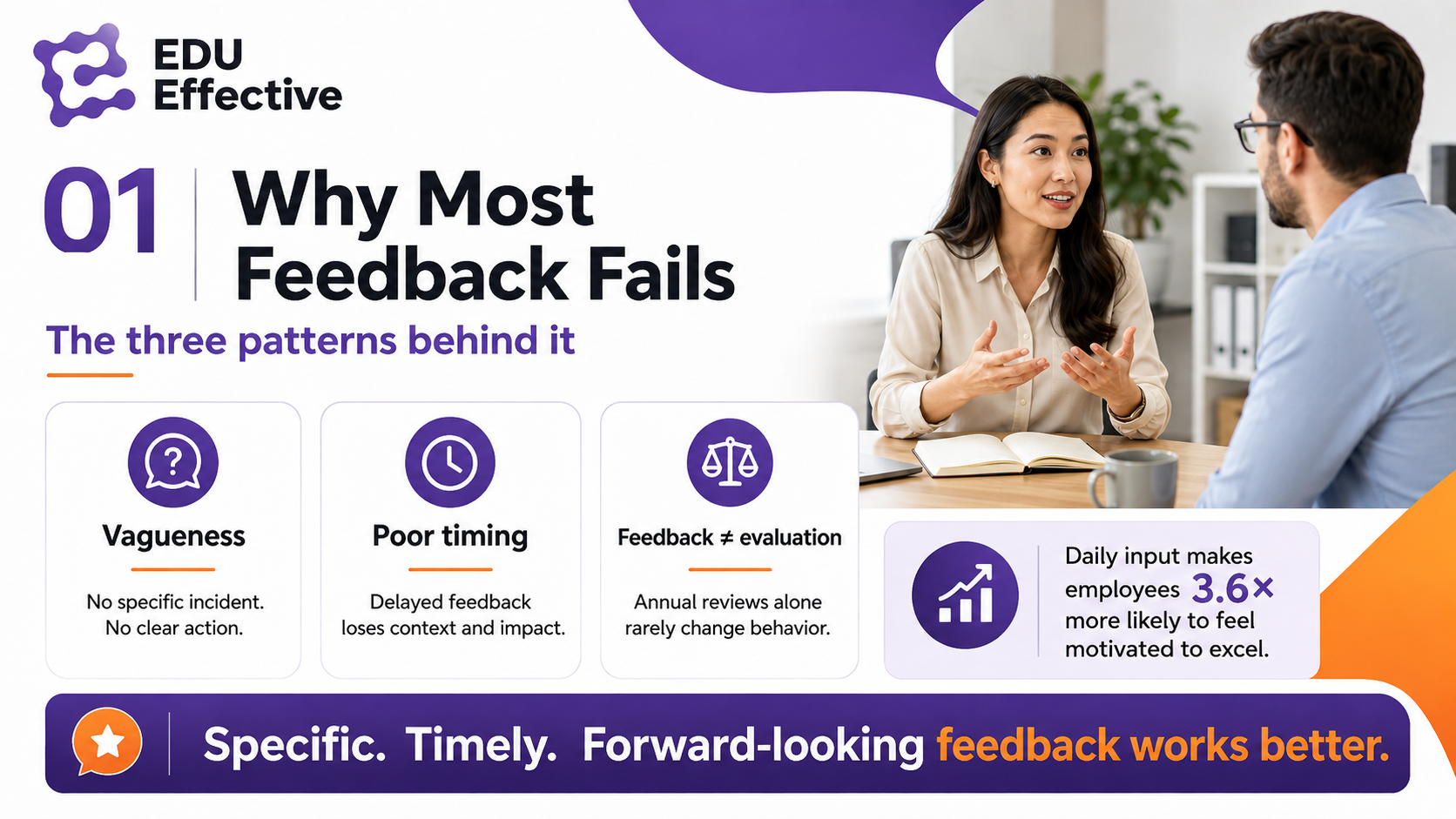
Vagueness. Feedback that describes patterns rather than specific incidents gives the recipient nothing concrete to act on. "You can be hard to work with sometimes" or "your presentations could be better" are observations that are impossible to verify, impossible to dispute constructively, and impossible to improve against because they name no specific behaviour. The recipient either accepts a general characterisation of themselves — which feels like an attack on identity — or rejects it as unfair — which produces defensiveness rather than reflection.
Poor timing. Feedback delivered weeks or months after the behaviour it references loses most of its utility. Memory degrades. Context changes. The gap between the action and the conversation makes it harder for the recipient to engage with the specific incident rather than defending a general position. Gallup data consistently shows that employees who receive daily input from their manager are 3.6 times more likely to feel motivated to excel compared to those who receive only annual reviews. The feedback that changes behaviour is timely feedback — delivered close enough to the incident that both parties can engage with its specifics. how timely, specific feedback prevents the unresolved performance issues that escalate into workplace conflict — and why the SBI structure that makes feedback land also provides the conversational foundation for resolving disputes before they require formal intervention
Conflating feedback with evaluation. Annual performance reviews are not feedback conversations. They are evaluative summaries of an extended period — useful for compensation decisions and formal documentation, but structurally unsuited to producing the behavioural change that requires timely, specific, forward-looking conversation. Many managers believe they are providing feedback because they conduct annual reviews. Research consistently shows that annual reviews alone produce meaningful improvement for only 26% of employees.
The SBI model: a structure that makes feedback land
The most widely validated framework for structuring feedback conversations in professional settings is the Situation-Behavior-Impact (SBI) model — a structured approach used across management development contexts worldwide and consistently validated in research on feedback effectiveness, including studies published by Gallup and referenced in Harvard Business Review.
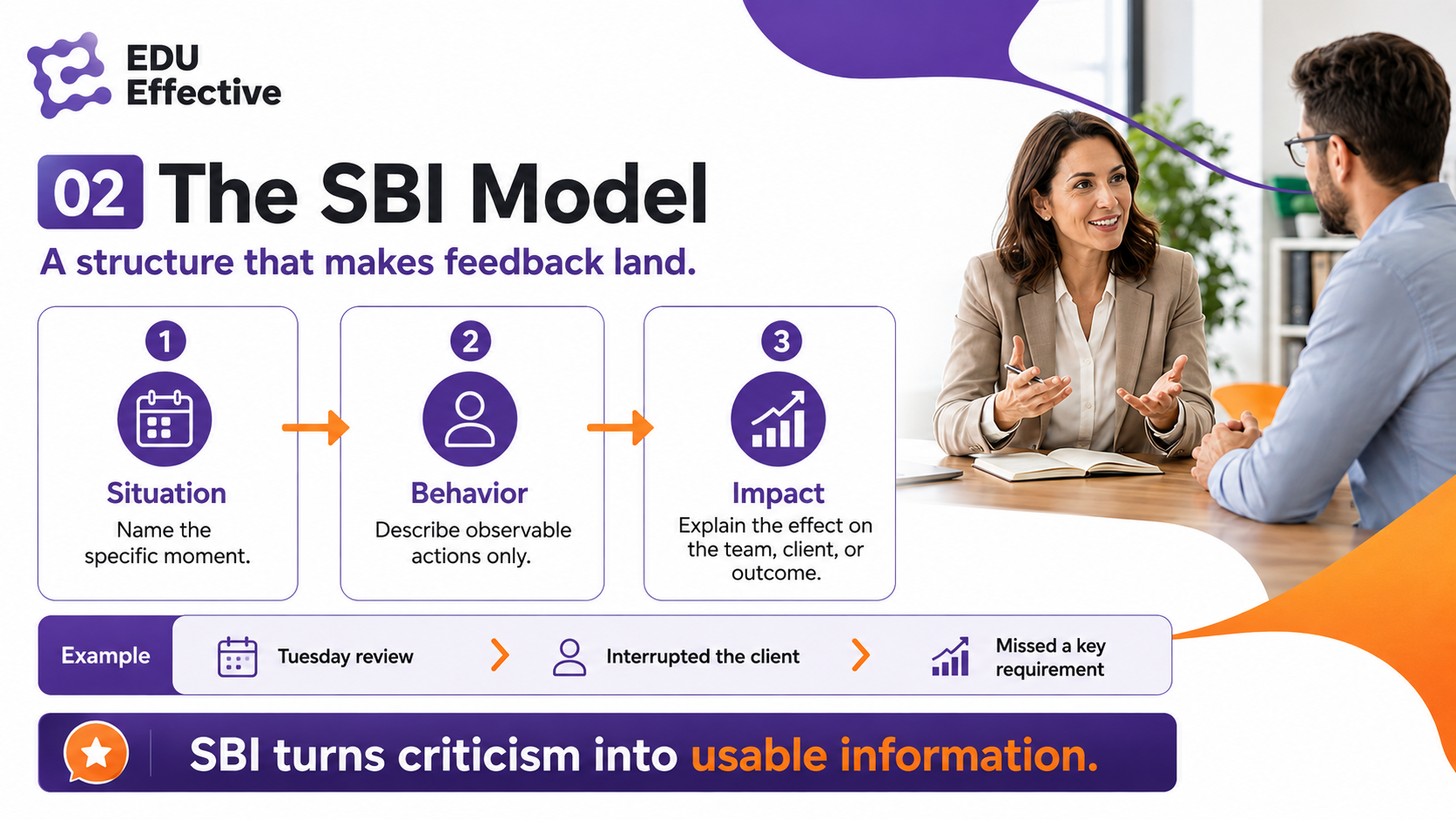
SBI works because it separates three things that most feedback conflates: what happened (Situation), what was observable (Behavior), and what it produced (Impact). Each element does a specific job.
Situation anchors the feedback to a specific, recent, verifiable moment. Not "lately" or "in general" — a named meeting, a specific deliverable, a particular interaction. "During Tuesday's project review" or "on the Henderson account call this morning." This specificity is not a formality. It is what makes the feedback checkable rather than contestable. The recipient can recall the specific moment, engage with what actually happened, and respond to something concrete rather than a characterisation.
Behavior describes what was observable — not what the manager inferred, assumed, or felt about it. What could be seen or heard, without interpretation. "You interrupted the client three times while they were explaining the problem" is a Behavior. "You were dismissive" is an interpretation. "You presented the Q3 numbers without the context slide we had discussed" is a Behavior. "You weren't prepared" is an interpretation. This distinction matters because interpretations are disputable on the grounds of intent, while observable behaviors are not.
Impact explains what the observable behavior produced — for the team, the client, the project, the outcome. "That interrupted the client's explanation and we missed a key requirement that we later had to redesign for" is an Impact. "The missing context slide meant the board asked questions in the Q&A that we'd already addressed in the slide — it cost us credibility in the room."
The Impact element is the most frequently omitted — and its absence is the most common reason feedback does not produce change. People change behaviour when they understand how it affects outcomes and relationships, not when they are told what they did wrong. The Impact is what makes the feedback meaningful rather than corrective. how feedback skills connect directly to coaching and mentoring capability — and why the same conversational structures that make feedback land are the foundation of the coaching relationships that research consistently identifies as the strongest driver of employee performance and retention
Giving positive feedback: the most underused management tool
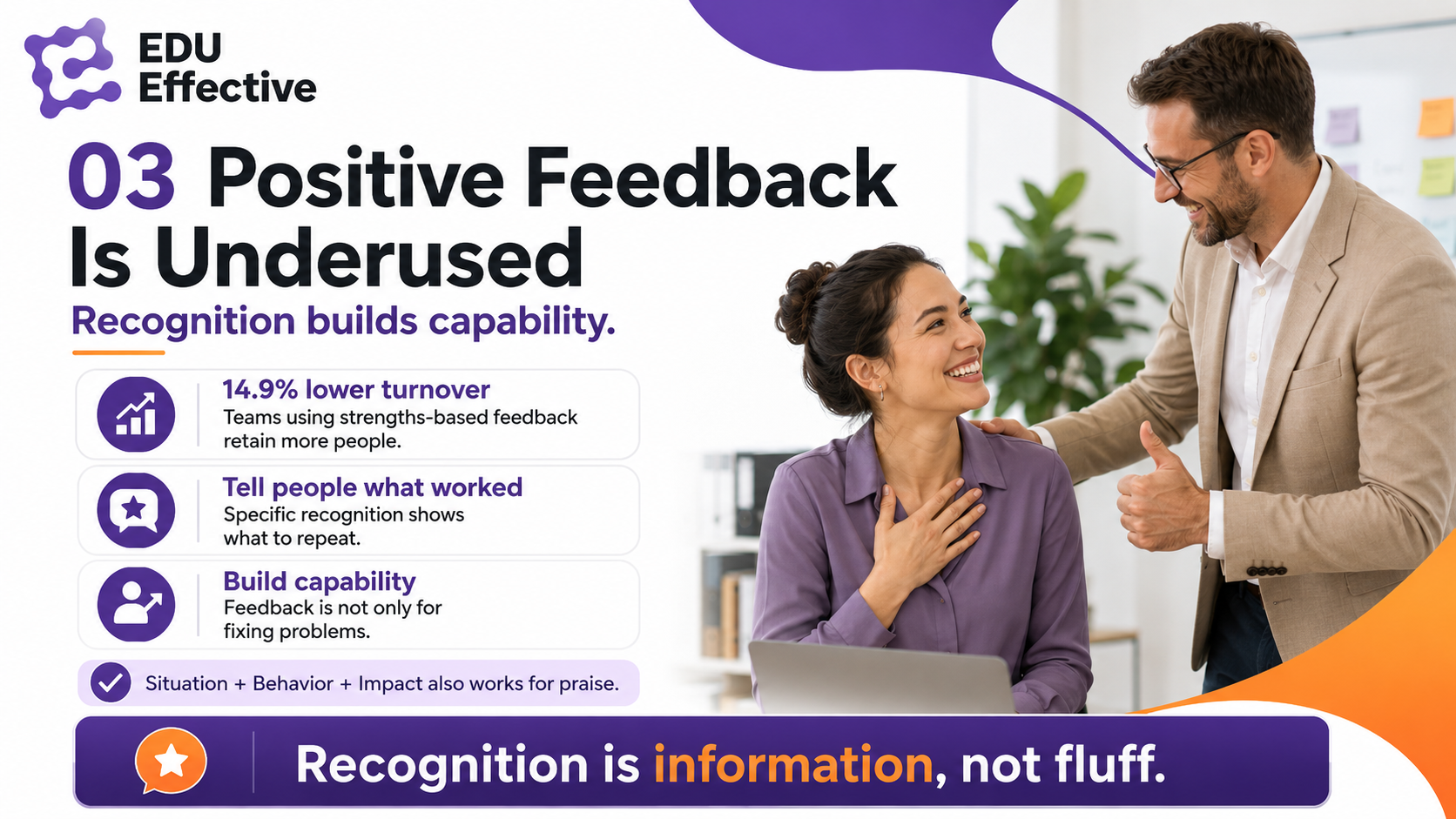
The SBI model applies equally to positive recognition as to corrective feedback — but most managers use structured feedback almost exclusively for correction. This is a significant missed opportunity.
Gallup's research on strengths-based feedback — where employees receive regular, specific recognition for what they do well — found turnover rates 14.9% lower among teams where this was practised consistently, in a study of 65,672 employees. Employees who receive strengths-based feedback are not just more likely to stay; they are more likely to apply those strengths deliberately rather than accidentally.
Positive SBI feedback looks like this: "In this morning's client kick-off [Situation], you proactively shared the project timeline and flagged the two constraints before the client asked about them [Behavior]. That set the tone for the whole meeting — the client left with a clear picture of what to expect, and we didn't spend the rest of the call managing expectations reactively [Impact]." This is not praise. It is information — specific, verifiable information about what the person did and why it worked. It tells the recipient exactly what to repeat.
The imbalance between corrective and positive feedback in most organisations is not because positive feedback is less important. It is because managers have been socialised to treat feedback as a mechanism for correcting problems, rather than as a mechanism for building capability. how your default leadership style shapes your feedback patterns — and why certain leadership approaches consistently produce higher engagement, lower turnover, and stronger team performance through the quality of feedback they generate
Psychological safety: the condition that determines whether feedback lands
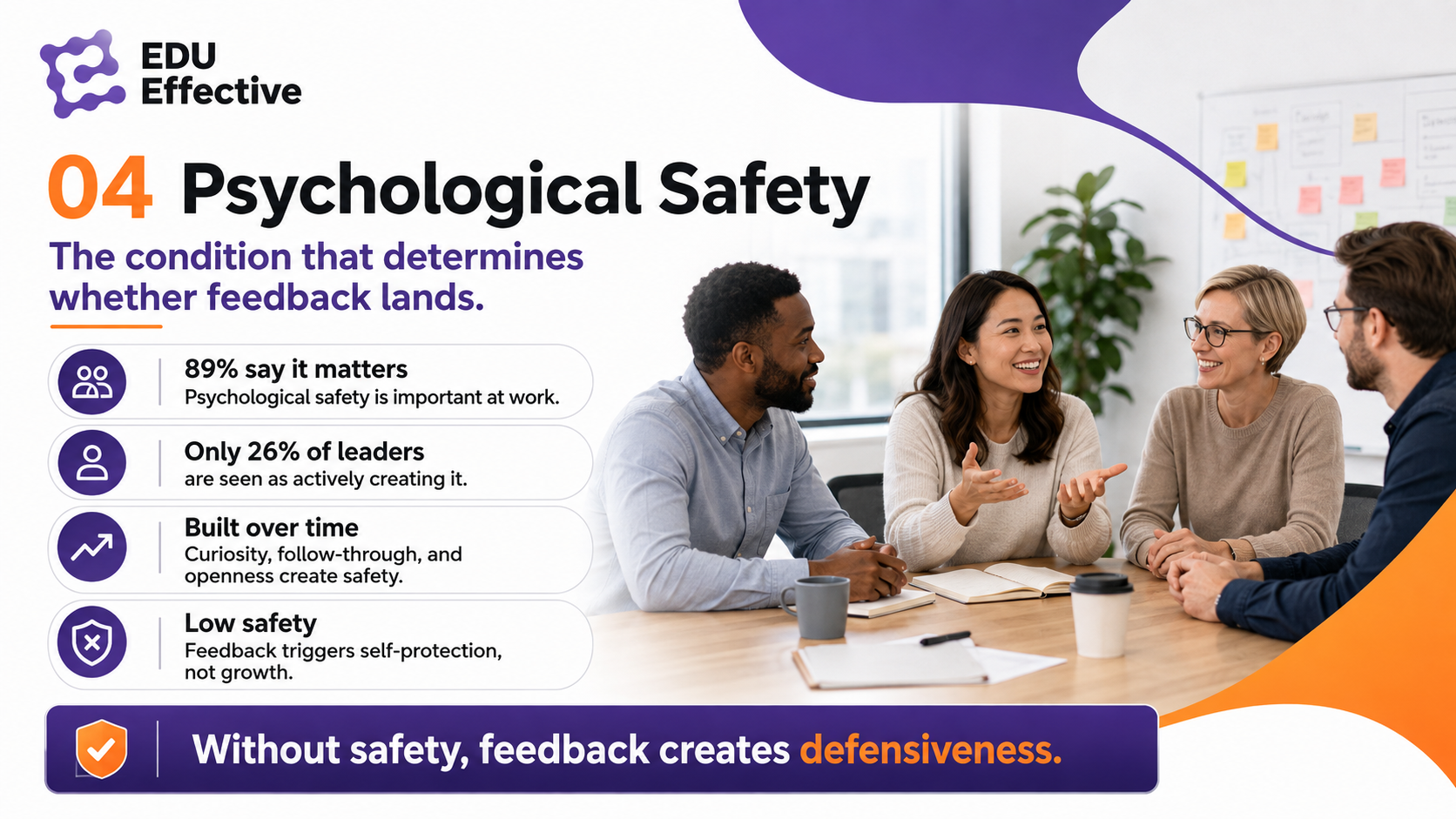
Feedback frameworks and timing are necessary but not sufficient. The condition that determines whether feedback produces growth or defensiveness is psychological safety — the degree to which the recipient believes that honest engagement with the feedback will be received constructively rather than used against them.
McKinsey's research found that 89% of respondents believe psychological safety is important in the workplace — but only 26% of leaders are perceived to actively create it in their teams. Teams with high psychological safety surface problems earlier, iterate faster, and respond better to developmental feedback. Teams without it suppress the honest conversation that feedback requires.
Psychological safety is built through consistent management behaviour over time — through follow-through on commitments, through responding to vulnerability with curiosity rather than judgment, through acknowledging one's own mistakes in a way that models the openness being asked of the team. A single feedback conversation cannot create psychological safety. But a single poorly handled feedback conversation can destroy it.
The practical implication for feedback: before delivering any significant corrective feedback, assess whether the relationship and environment support honest engagement. If the environment does not yet support it, the feedback may need to be preceded by deliberate investment in the relationship. Feedback that lands in an environment of low psychological safety produces self-protection, not growth. why emotional intelligence is the foundational capability that determines whether feedback conversations produce growth or defensiveness — and how self-regulation and empathy underpin both giving and receiving feedback in ways that no framework alone can substitute
How to receive feedback — the other half of the conversation
Most guidance on feedback focuses entirely on how to give it. Receiving feedback well is equally important — and equally underdeveloped in most managers and professionals.
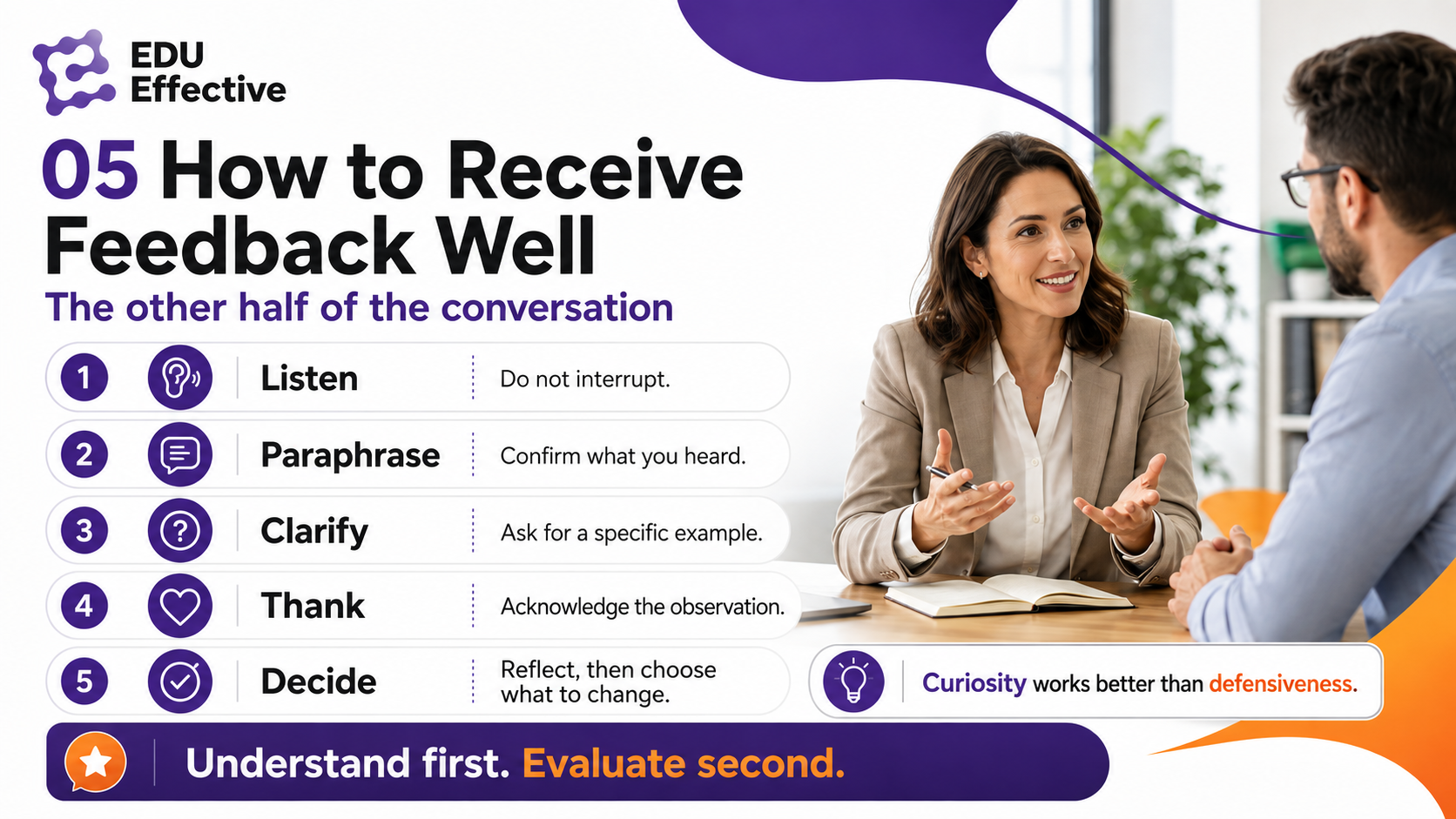
The most common failure in receiving feedback is the impulse to explain, defend, or correct the giver before fully understanding what they are saying. This impulse is understandable — feedback feels evaluative, and evaluation triggers the same defensive responses as threat. But the impulse consistently interferes with the thing that makes feedback valuable: understanding precisely what the other person observed and what impact they experienced.
The practical sequence for receiving feedback well is: listen without interrupting; confirm understanding by paraphrasing what you heard before responding; ask clarifying questions if the feedback is vague (asking for a specific example is the most useful clarifying question); and thank the person for the observation before deciding whether and how to act on it.
The decision about whether to agree with the feedback and change behaviour is separate from the conversation about receiving it. Many people conflate them — disputing feedback in real time as if the conversation itself is the moment to determine what is true. In practice, the most productive response to feedback is curiosity rather than judgment: what did the other person observe, and what can that tell me about how my actions are landing? how receiving structured, specific feedback accelerates professional development — and why organisations that invest in manager feedback capability see measurably better skill development outcomes than those relying on annual reviews alone
Feedback in hybrid and remote environments
The shift to distributed work has made feedback more important and more difficult simultaneously. The informal signals that provided ongoing performance information in shared offices — the brief conversation after a meeting, the visible response to a presentation, the ambient awareness of how colleagues are reacting — are absent in hybrid and remote environments.
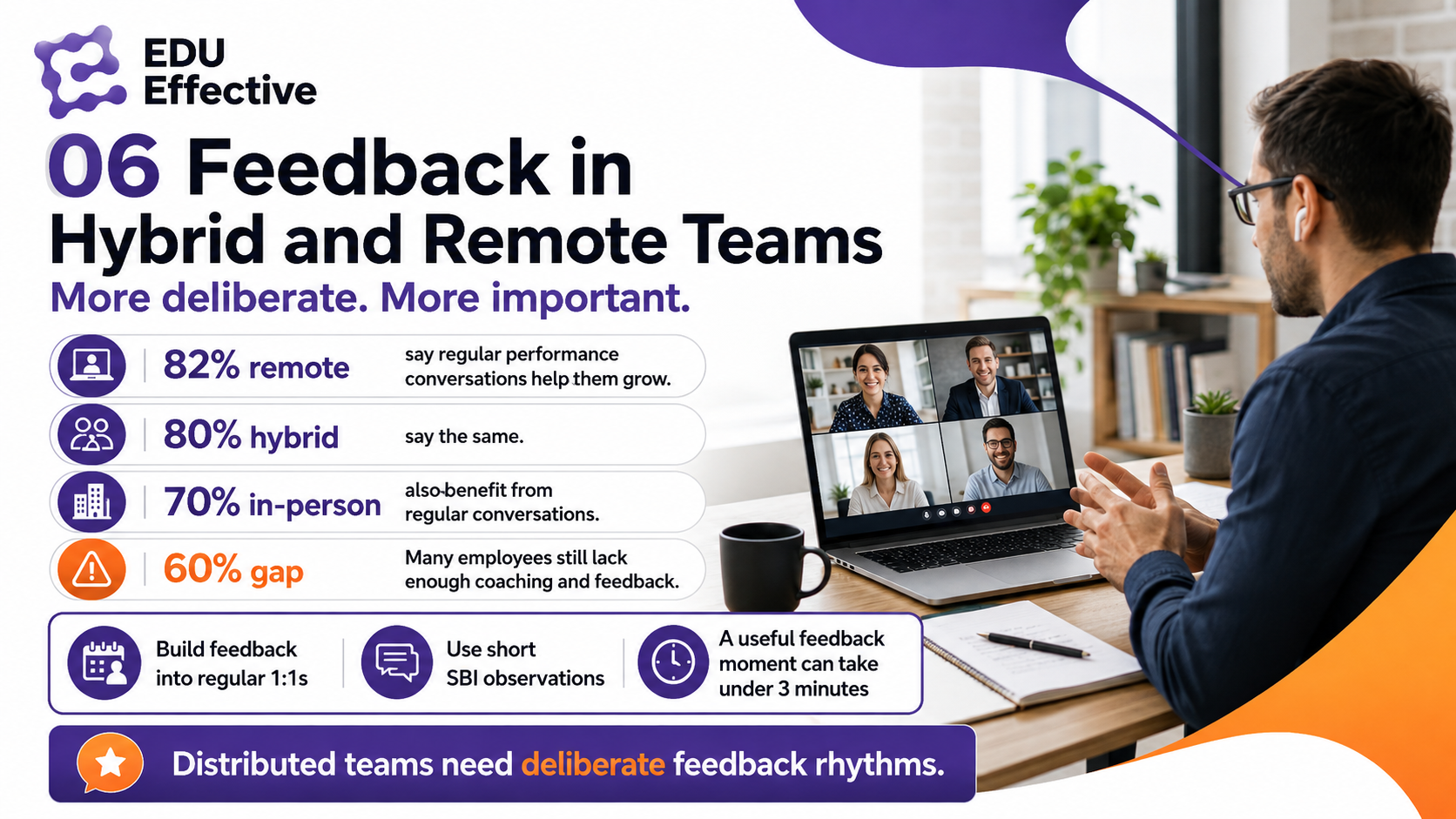
This means that feedback in distributed teams must be more deliberate. Gallup research shows that 82% of remote employees, 80% of hybrid employees, and 70% of in-person employees say that regular performance conversations help them understand how to grow — but the cadence required to produce that effect differs. Remote and hybrid employees consistently report lower frequency of meaningful feedback than office-based colleagues — not because managers intend to provide less, but because the informal mechanisms that supplemented formal conversations are unavailable.
The practical response is to build feedback into the regular rhythm of one-to-one meetings rather than treating it as a separate, occasional event. A brief SBI-structured observation delivered in a regular one-to-one takes less than three minutes. Done consistently, it produces the ongoing performance conversation that replaces the ambient feedback of shared physical presence. how the challenge of giving effective feedback in hybrid and remote teams connects to the broader infrastructure required to lead distributed teams well — and why one-to-one meetings are the primary feedback mechanism when ambient office interaction is unavailable
Gartner's research found that 60% of employees are not getting the on-the-job coaching and feedback they need for skill development. The gap is larger in distributed teams — which makes the deliberate practice of structured, timely, specific feedback a more significant management differentiator in 2026 than it was in fully collocated environments.
At EDU Effective, the Effective MBA: Executive Management & Leadership and the Effective MBA: Coaching, Leadership & Mentoring both develop feedback skills as core management competencies — alongside performance management, communication, and the other capabilities that determine how effectively a manager develops their team.
At EDU Effective, we build programs for professionals who want to work smarter — not just harder. Explore our programs →
EDU Effective Business School = professional development for your long-term success.
All best-selling Effective MBA programs are built for working adults: 15 minutes a day, 10 months or less, ASIC accredited, from €990.
- Effective MBA: Executive Management & Leadership
- Effective MBA: Applied Artificial Intelligence
- Effective MBA: Coaching, Leadership & Mentoring
- Effective MBA: Mastery in AI
- Effective MBA: Online Marketing
These are professional programs, not academic ones — built for working adults to apply what they learn directly in their own business, not to collect a scholarly credential.
Join more than 9,000 students in over 120 countries around the world to further your personal development and career success.
Read the feedback and experiences of our students and the stories of our graduates here.
Apply now — from €990 · Talk to a Study Advisor
Study with NO risk: 14-day money-back guarantee, no questions asked.
Sources
- Gallup — State of the Global Workplace 2026 https://www.gallup.com/workplace/349484/state-of-the-global-workplace.aspx
- Gallup — Manager Impact on Employee Engagement and Feedback https://www.gallup.com/workplace/236927/employee-engagement-drives-growth.aspx
- Gallup / Workhuman — The Human-Centered Workplace: Building Organizational Cultures That Thrive https://www.gallup.com/analytics/472658/workplace-recognition-research.aspx
- McKinsey & Company — Psychological Safety and Team Performance https://www.mckinsey.com/capabilities/people-and-organizational-performance/our-insights
- Gartner — Gartner HR Survey Finds 47% of Managers Say They Are Working Harder Than One Year Ago https://www.gartner.com/en/newsroom/press-releases/2026-04-29-gartner-hr-survey-finds-47-percent-of-managers-say-they-are-working-harder-than-1-year-ago
- DDI — Global Leadership Forecast https://www.ddiworld.com/research/global-leadership-forecast
- Harvard Business Review — The Feedback Fallacy (Marcus Buckingham & Ashley Goodall) https://hbr.org/2019/03/the-feedback-fallacy