

Marketing was one of the first business functions where AI stopped being a pilot project and became operational infrastructure. The shift happened fast, and it's not slowing down.
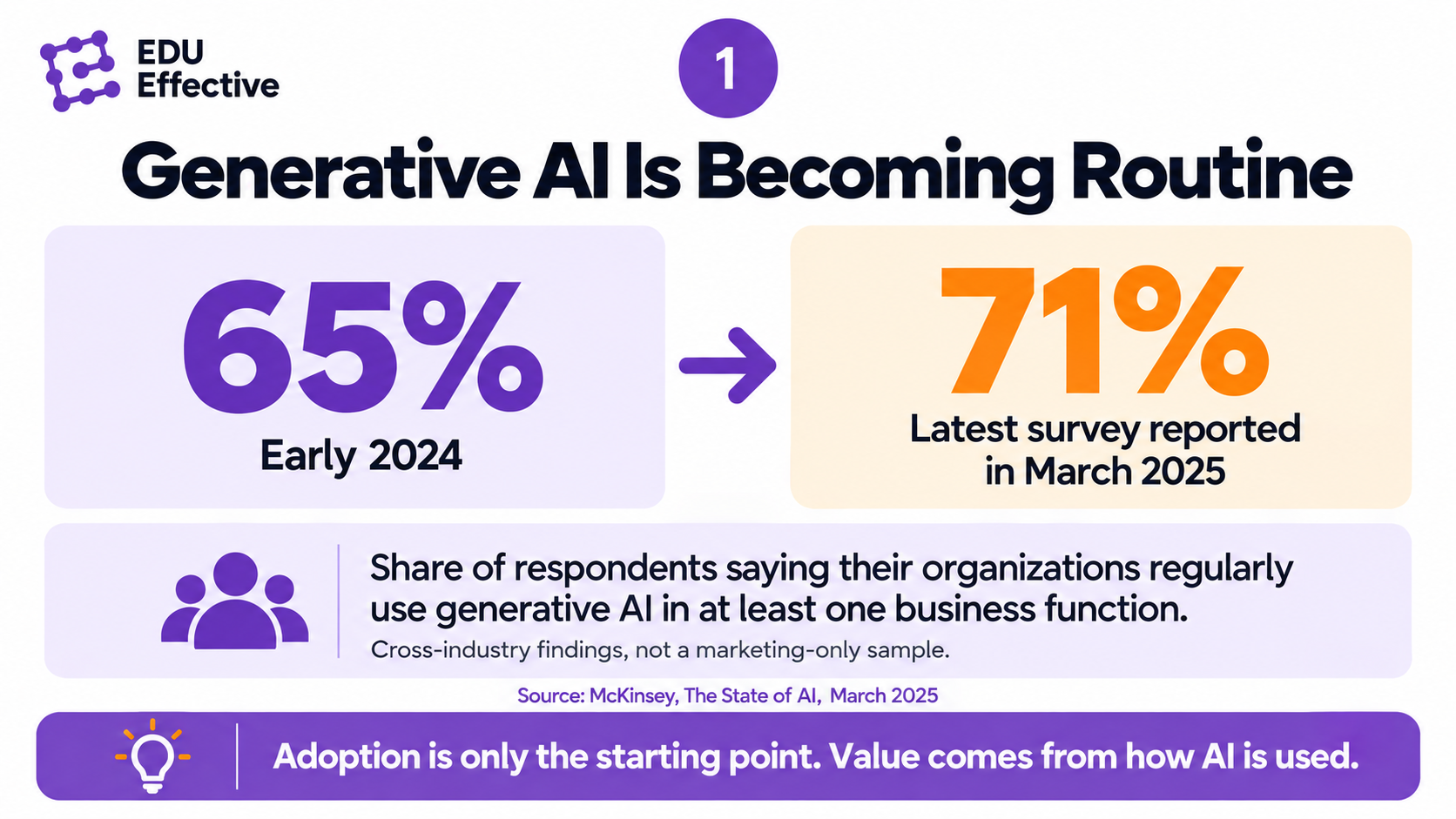
71% of leaders say their organizations regularly use generative AI in at least one function, up from 65% in 2024, according to McKinsey's State of AI report. 88% of organizations overall now use AI in at least one business function. The question for most marketing teams is no longer whether to use AI. It's how to use it in ways that actually grow the business rather than just generate more content faster.
This article covers the practical side: which use cases deliver real results, which tools matter, where the traps are, and what separates marketing teams that get measurable value from those that run AI experiments that go nowhere.
Where AI is actually being used in marketing
Gartner's survey found that among marketers who have adopted generative AI, 77% use it primarily for creative development: writing copy, generating images, producing variations for A/B tests. That's the most visible use case. It's also the least strategically interesting.
The higher-value applications are in areas where AI handles volume and pattern recognition better than humans can at scale:
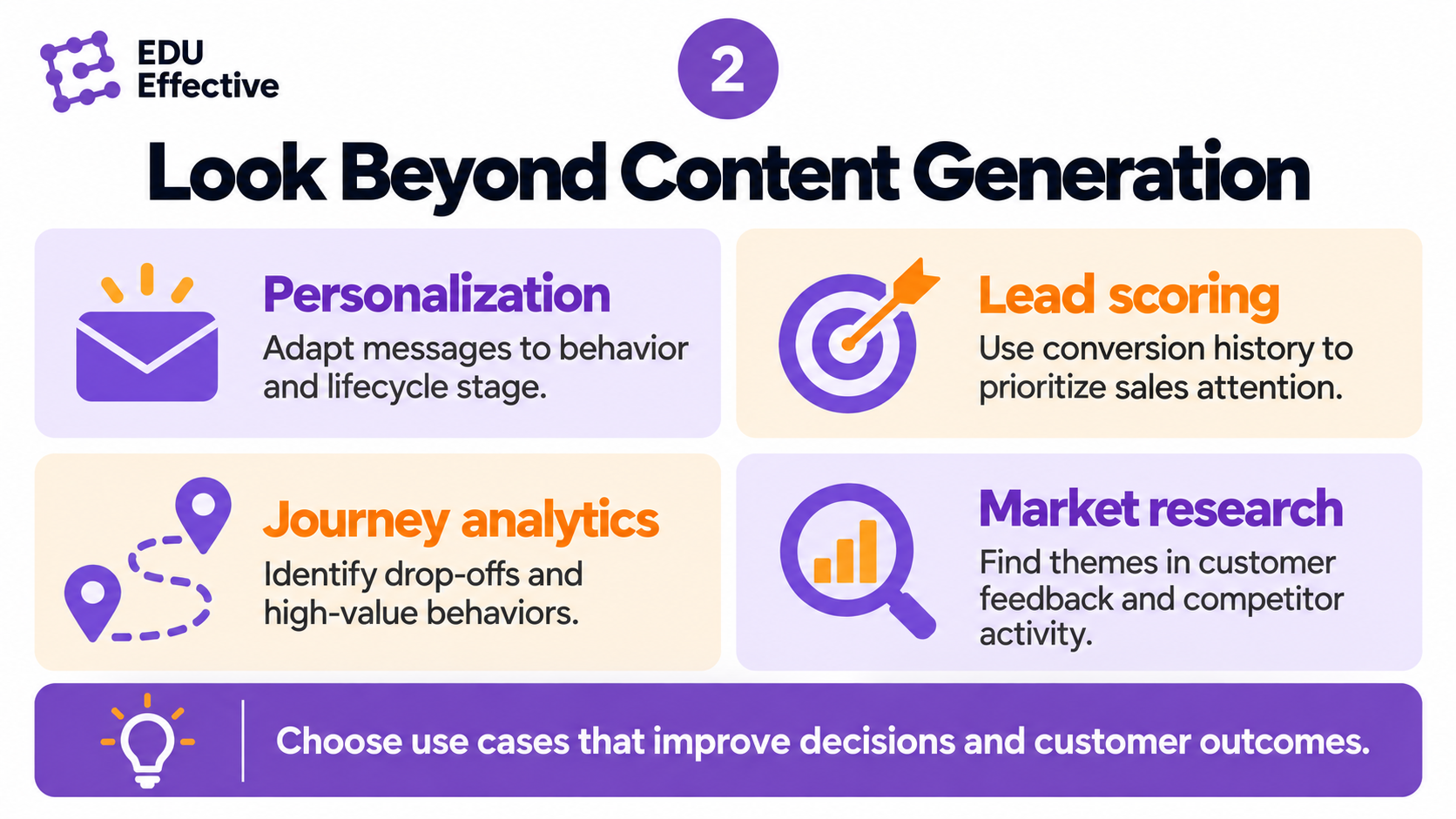
Content personalization at scale. Personalized content used to mean segmenting your email list into four buckets. AI makes true 1:1 personalization feasible: different messages for different behaviors, lifecycle stages, product histories, and engagement patterns, without a team of ten writers.
Predictive lead scoring. Machine learning models trained on historical conversion data score leads with more accuracy than rule-based systems. Sales teams that receive AI-scored leads spend less time on low-probability contacts. The result is the same pipeline with better conversion rates.
Campaign performance optimization. AI adjusts digital advertising bids, placements, and creative combinations in real time based on performance signals. Google's Performance Max and Meta's Advantage+ campaigns are both built on this logic. The marketer sets the goal; the AI runs thousands of micro-decisions to reach it.
Search behavior is changing. 31% of Gen Z consumers now most often use AI platforms or chatbots instead of traditional search engines, according to GWI. Forrester projects advertisers will cut display and traditional search budgets by 30% by 2026 as consumers shift to AI chat interfaces. This isn't a future trend. It's already affecting traffic and discovery patterns for businesses that depend on organic or paid search.
Customer journey analytics. AI identifies drop-off points, attribution patterns, and high-value customer behaviors that human analysts miss in large datasets. This moves marketing from reporting what happened to predicting what will happen next.
The ROI reality check
Not all AI marketing spend produces the same return. IBM's ROI of AI report found that 51% of decision-makers at companies using open-source AI tools report positive ROI, versus 41% at companies that don't. 83% of marketers using AI report a direct productivity increase, according to CoSchedule.
But Gartner found something important: fewer than 5% of marketing leaders who use generative AI only as a standalone tool report significant gains. The impact comes from integration, from AI embedded into workflows, connected to data, and combined with human judgment, not from using a chatbot in isolation.
47% of marketing leaders report significant benefits from generative AI specifically for campaign evaluation and reporting, per Gartner. That's the operational core: AI that helps teams understand what's working faster, so they can reallocate budget toward what's working rather than waiting for end-of-quarter reports.
The investment numbers reflect this shift. AI solutions now make up 28% of the average marketing tech budget, according to Statista. 71% of CMOs plan to invest at least $10 million annually in AI from 2025 to 2027 (BCG). And 59% of CMOs report insufficient budgets, which means AI adoption is partly driven by the need to do more with the same headcount (Gartner).
Practical AI use cases by marketing function
Content marketing
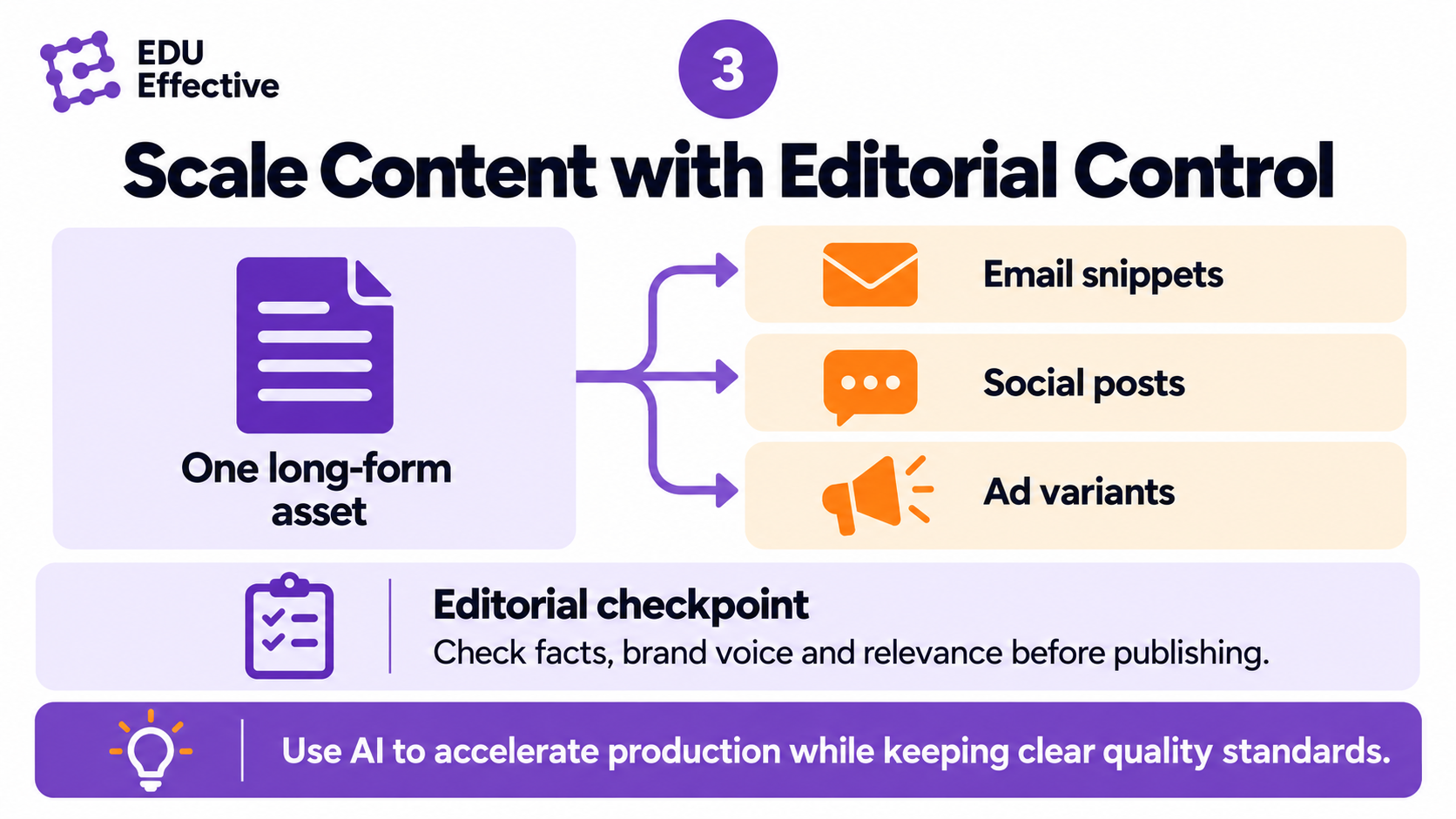
AI handles the volume problem in content. A single piece of long-form content can be repurposed into social posts, email snippets, ad copy variants, and metadata automatically. What used to take a week of coordinator time takes an afternoon.
More useful than speed: AI identifies which content topics correlate with pipeline movement by analyzing which pieces your converted customers engaged with. Most content teams produce based on intuition; AI-assisted teams can produce based on conversion signals. It is the same shift we described in what the content marketing data actually shows.
The limitation is quality control. AI-generated content at scale needs human editorial oversight. Content that sounds plausible but is factually wrong, or that reads like every other brand in your category, destroys trust faster than it builds traffic. Use AI to accelerate production, not to replace editorial judgment.
Email marketing and CRM
Email marketing is where AI delivers some of its clearest, most measurable results. Send-time optimization, subject line testing, behavioral triggers, and dynamic content personalization are all mature applications with real-world proof.
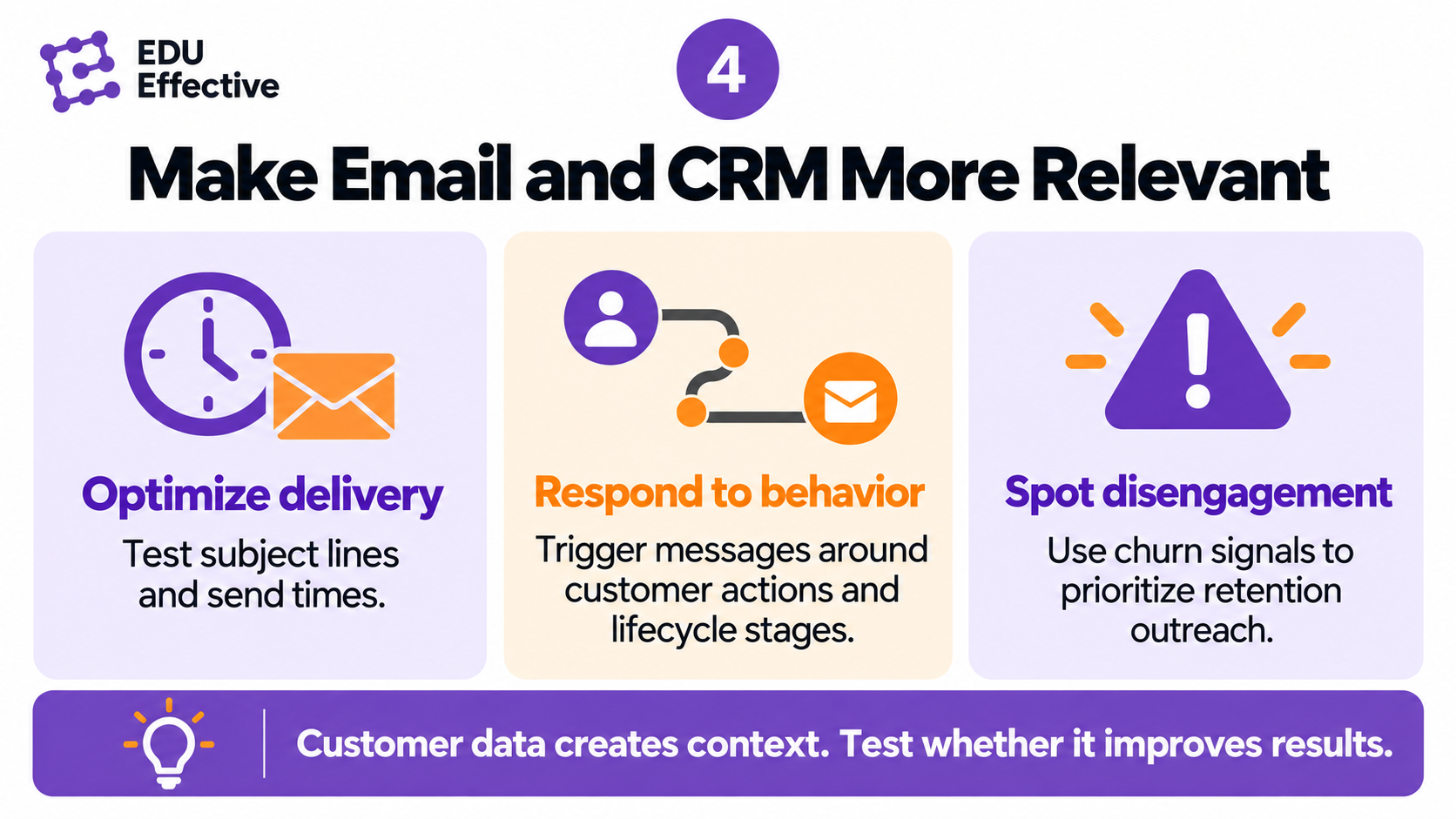
The more advanced use case is churn prediction: AI models flag customers showing disengagement signals before they actually churn, giving retention teams a window to intervene. For subscription businesses, catching five percent of churning customers early has direct revenue impact. Combined with well-built automation sequences, it becomes a retention system rather than a campaign.
Marketing automation platforms such as HubSpot, Salesforce Marketing Cloud, and Klaviyo have all embedded AI features directly into their core workflows. The advantage is that the data is already there; the AI operates on your actual customer behavior rather than generic models.
Paid media and performance marketing
Performance marketing is arguably the most mature AI application in marketing. Platforms like Google, Meta, and LinkedIn have been using machine learning to optimize ad delivery for years. The shift now is toward AI-driven creative optimization: testing hundreds of headline and visual combinations and identifying winners faster than any human testing cycle.
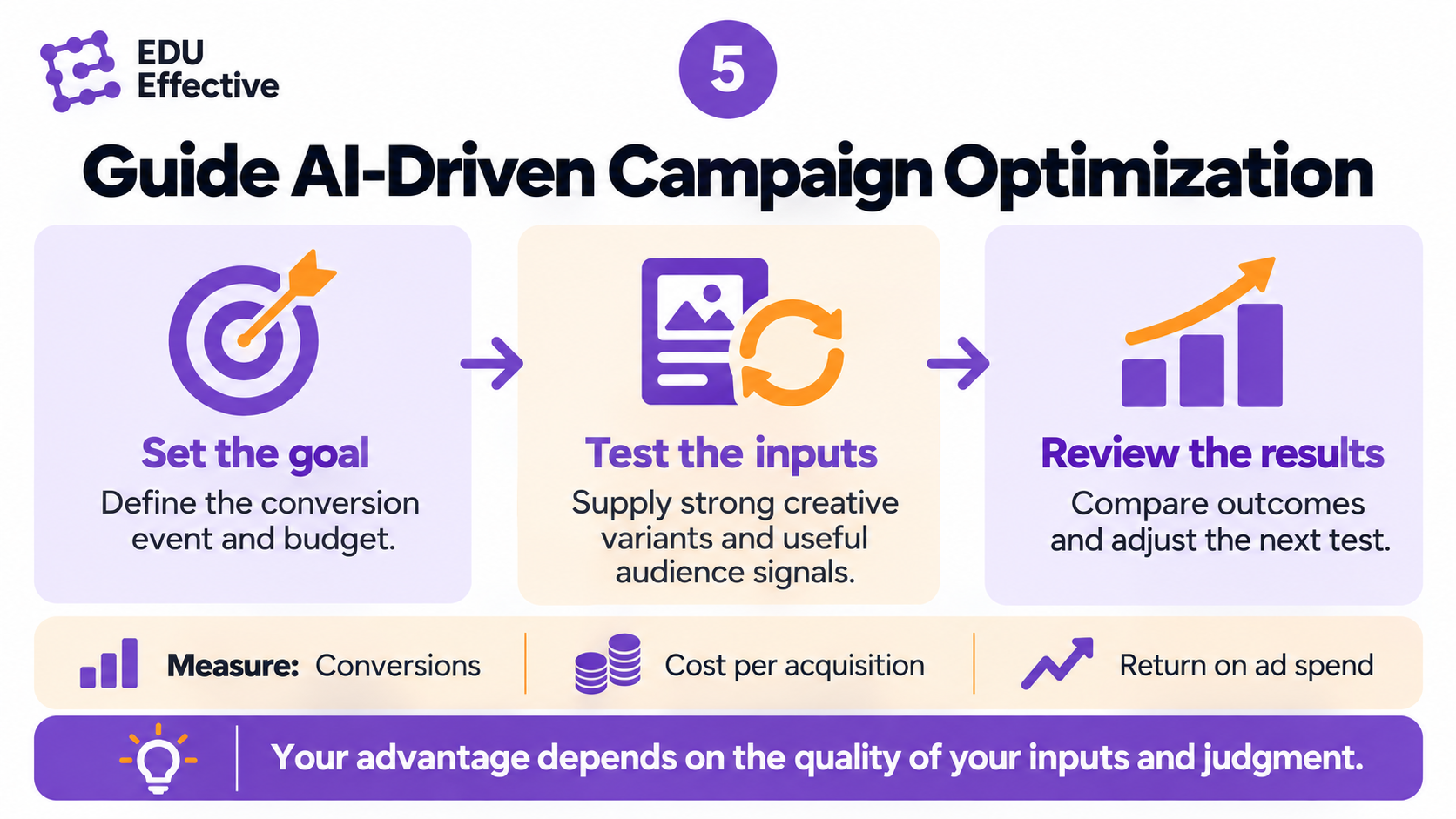
The business case: fewer wasted impressions, lower cost per acquisition, higher return on ad spend. Teams using AI optimization consistently outperform manual bidding on comparable budgets.
The risk: as more advertisers use the same platform AI, competitive advantage comes from the quality of your creative inputs and audience data, not from algorithmic access that everyone shares equally.
SEO and organic discovery
SEO strategy is being rewritten by AI search. Generative Engine Optimization (GEO), the practice of making content more likely to be cited or surfaced by AI search tools like ChatGPT, Perplexity, and Google AI Overviews, is becoming a parallel discipline to traditional keyword optimization.
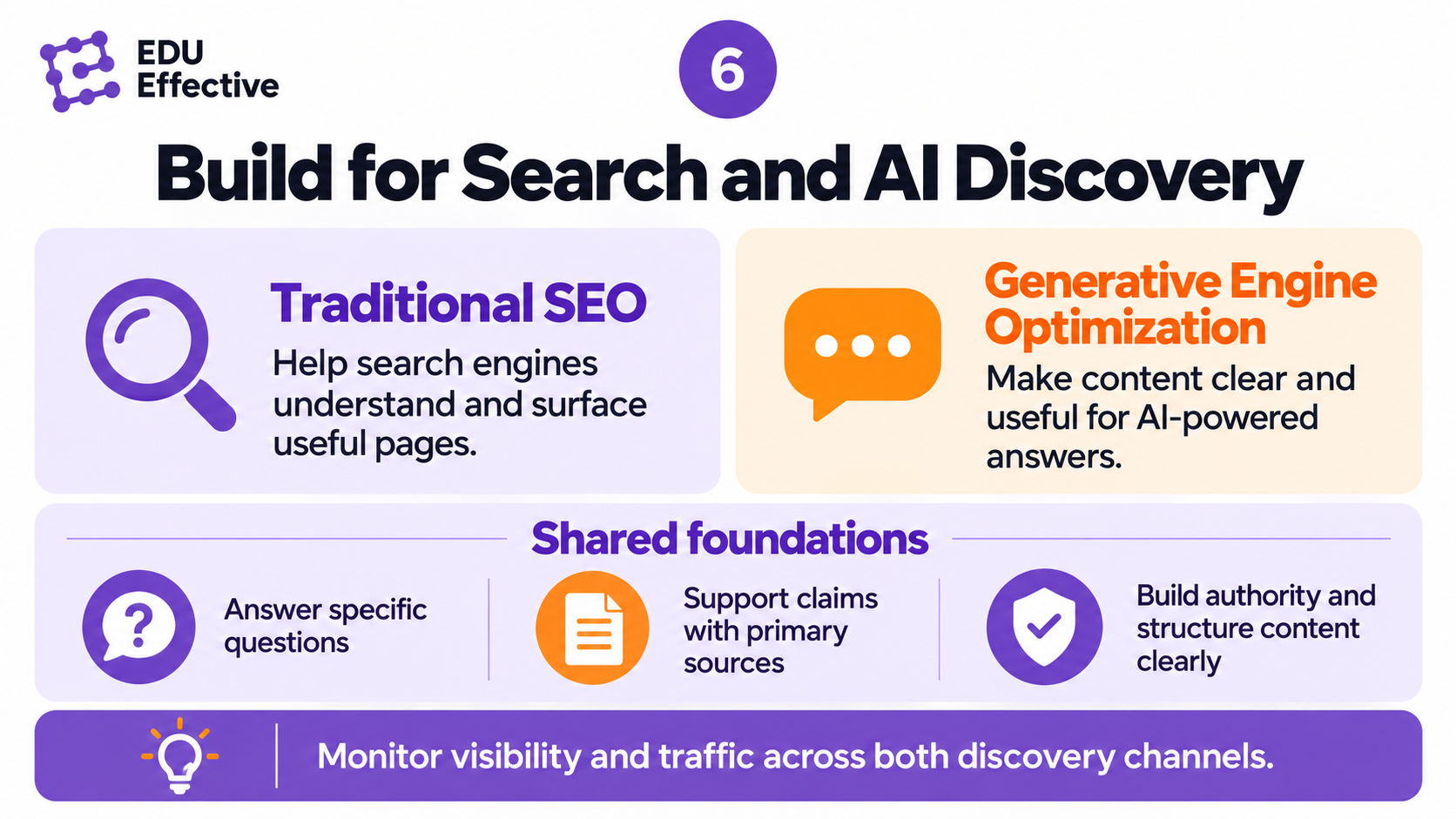
The principles overlap: authority, specificity, primary source citation, structured answers to clear questions. But the execution differs. AI search surfaces content that answers intent directly, not content that ranks by backlink volume. That changes the writing brief.
31% of Gen Z consumers already default to AI platforms over search engines. That number will grow. Businesses that build both traditional SEO and GEO into their content strategy now are ahead of those who will be forced to catch up in 2027.
Market research and competitive intelligence
AI has significantly lowered the time cost of competitive analysis. Tools like Perplexity, Crayon, and Semrush's AI features aggregate competitor content, pricing changes, and keyword movements in ways that previously required dedicated analyst time.
More practically: AI assists in qualitative research synthesis. Running AI analysis over 200 customer support tickets to find theme clusters, or over 50 sales call transcripts to identify objection patterns, are tasks that took weeks and now take hours. The output feeds directly into positioning work, messaging frameworks, and product marketing priorities.
Where AI marketing initiatives fail
45% of martech leaders say vendor-offered AI agents fail to meet their promised business performance, according to Gartner. The failure modes are predictable:
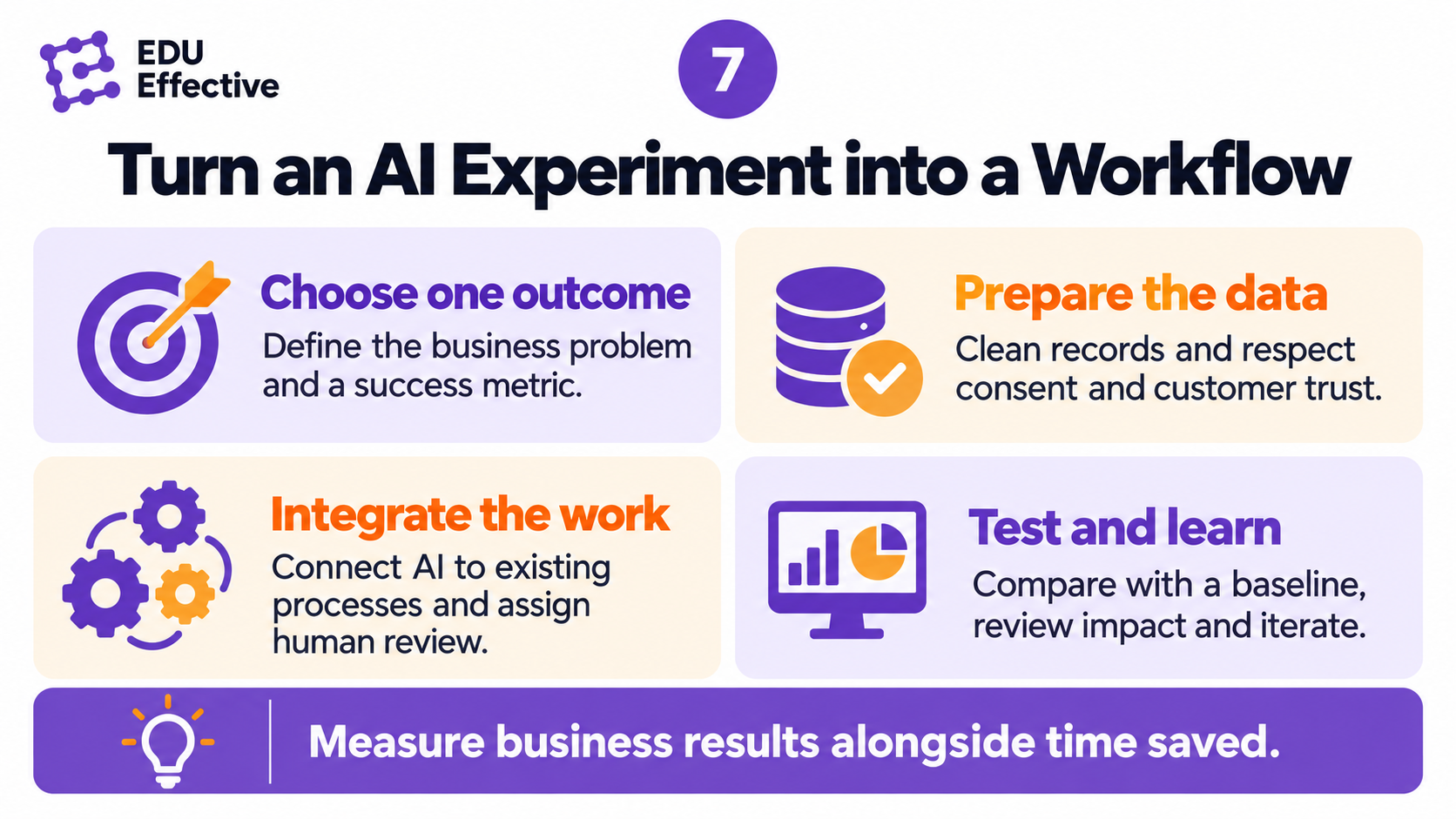
Data quality. AI is only as good as the data it trains on. If your CRM is full of duplicates, your email list has decayed, and your attribution model is broken, AI will optimize toward noise. Garbage in, garbage out applies more acutely to ML systems than to spreadsheets.
Integration gaps. AI tools that sit outside your core marketing stack generate outputs nobody uses. The value comes from AI embedded in the workflows where decisions are actually made, not from a separate platform that requires manual export.
Standalone tool logic. Gartner's finding that fewer than 5% of standalone AI users report significant gains is the clearest data point here. AI used for occasional content drafts doesn't move revenue. AI embedded in campaign planning, customer scoring, and performance reporting does.
Trust and consent. 53% of consumers distrust AI-powered search results, per Gartner. Brands that use AI in ways customers find opaque or manipulative, such as overly targeted ads, AI-generated content that isn't disclosed, or chatbots that pretend to be humans, face real reputational risk. Transparency about AI use is becoming a brand differentiator, not just a compliance requirement.
Building an AI-augmented marketing team
The organizational question isn't which AI tools to buy. It's how to structure a team that uses them effectively.
The roles that change most: content strategists who now set quality standards and editorial direction rather than producing volume; performance marketers who shift from manual optimization to AI oversight and creative strategy; marketing analysts who work with AI-generated insights rather than building reports from scratch.
The roles that don't change: brand strategy, customer insight, creative direction. These require judgment, empathy, and cultural fluency that AI assists but doesn't replace.
AI literacy, the ability to understand what AI tools can and can't do, to evaluate their outputs critically, and to integrate them into workflows effectively, is the skill gap most marketing teams are currently working through. McKinsey's State of AI report found that AI capability building is consistently cited as the top implementation barrier. Teams that invest in literacy now gain an advantage that compounds, which is why AI fluency beats AI expertise for most professionals.
The budget shift is real. AI solutions represent 28% of marketing tech budgets already. Teams that are still evaluating are falling behind teams that are already iterating.
The strategic view
AI doesn't change what marketing is for: building demand, winning customers, keeping them. It changes the speed, precision, and scale at which those goals can be pursued.
The AI marketing market is projected to reach $82.23 billion by 2030, growing at a 25% CAGR from 2025 to 2030, according to Grand View Research. That's not a niche capability. It's the direction the entire discipline is moving.
The businesses that treat AI as a cost-cutting tool, with fewer writers and cheaper content, will get incremental savings. The businesses that treat AI as a growth infrastructure, with better personalization, faster learning cycles, and smarter allocation, will grow.
The distinction isn't about budget. It's about whether marketing leadership understands what AI makes possible and builds the team capabilities to use it that way.
Key takeaways
AI in marketing delivers measurable results in content personalization, lead scoring, campaign optimization, email automation, and competitive intelligence. 83% of marketers using AI report direct productivity gains, but fewer than 5% who use it only as a standalone tool see significant business impact. The value comes from integration: AI embedded in workflows and connected to customer data. Consumer behavior is shifting fast, with 31% of Gen Z already defaulting to AI platforms over search engines. Marketing teams that build both traditional SEO and GEO strategies, maintain data quality, and develop AI literacy across the team are positioned to grow. Those that treat AI as a content shortcut are not.
About EDU Effective Business School
The Effective MBA: Applied Artificial Intelligence is built for managers who need to put AI to work in real operations, not in theory. Runs on 15 minutes a day, completes in 10 months or less and is ASIC accredited.
Sources
- McKinsey & Company, The State of AI https://www.mckinsey.com/capabilities/quantumblack/our-insights/the-state-of-ai
- Gartner, Survey: GenAI Adoption in Marketing Campaigns https://www.gartner.com/en/newsroom/press-releases/2025-02-18-gartner-survey-reveals-over-a-quarter-of-marketing-organizations-have-limited-or-no-adoption-of-genai-for-marketing-campaigns
- Gartner, CMO Spend Survey https://www.gartner.com/en/newsroom/press-releases/2025-05-12-gartner-2025-cmo-spend-survey-reveals-marketing-budgets-have-flatlined-at-seven-percent-of-overall-company-revenue
- Gartner, Consumers Distrust AI-Powered Search Results https://www.gartner.com/en/newsroom/press-releases/2025-09-03-gartner-survey-finds-53-percent-of-consumers-distrust-ai-powered-search-results0
- BCG, How CMOs Are Scaling Gen AI in Turbulent Times https://www.bcg.com/publications/2025/how-cmos-scaling-gen-ai-in-turbulent-times
- Forrester, Predictions 2026: B2C CX & Digital https://www.forrester.com/predictions/b2c-cx-digital-2026/
- Statista, Marketing Budget Share of AI Worldwide https://www.statista.com/