

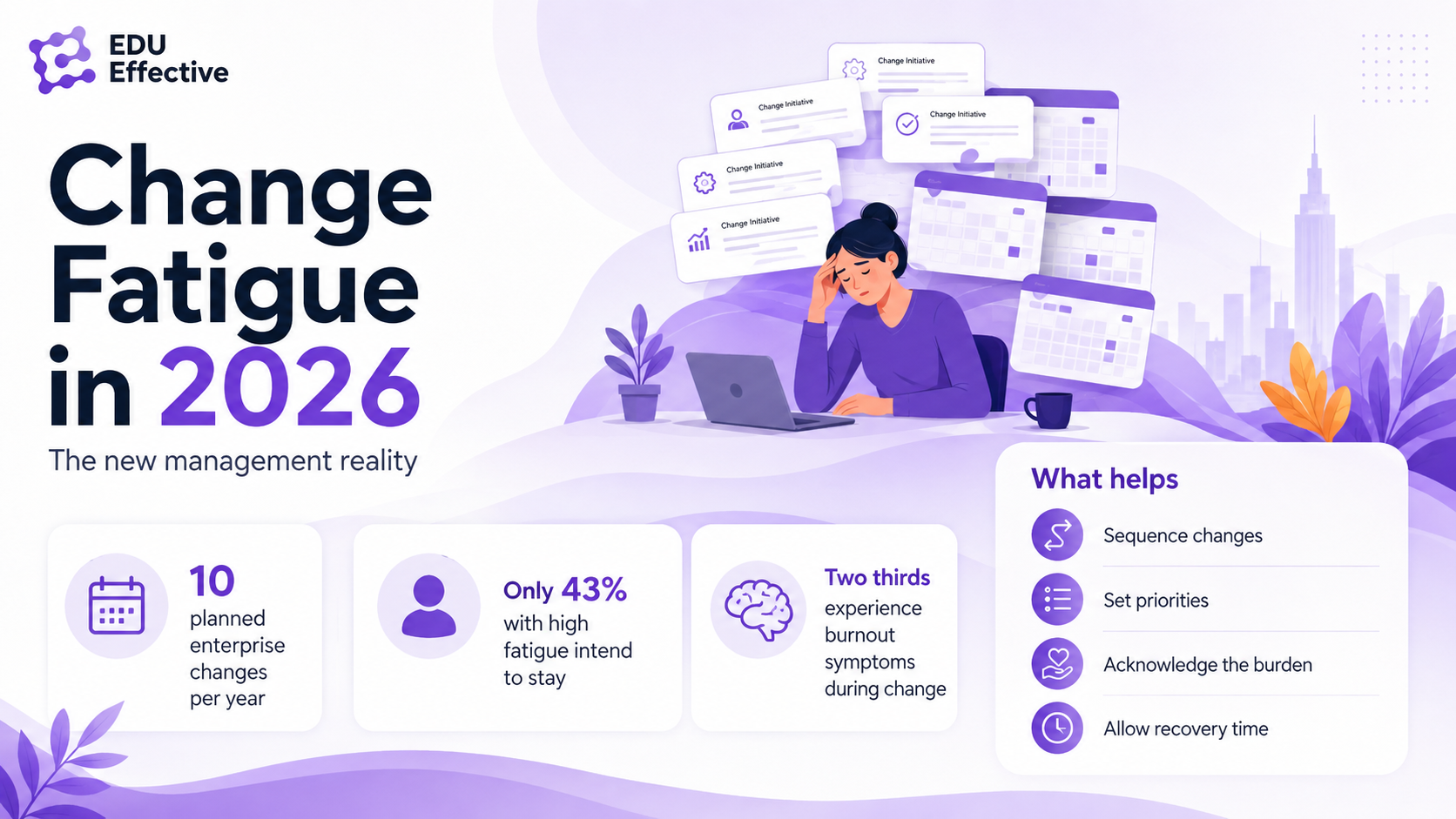
The average organisation now faces ten planned enterprise changes per year — including organisational restructuring, culture transformation, and technology initiatives — up from two in 2016, according to Deloitte's 2025 Global Human Capital Trends Report. That is a fivefold increase in the pace of organisational change in less than a decade.
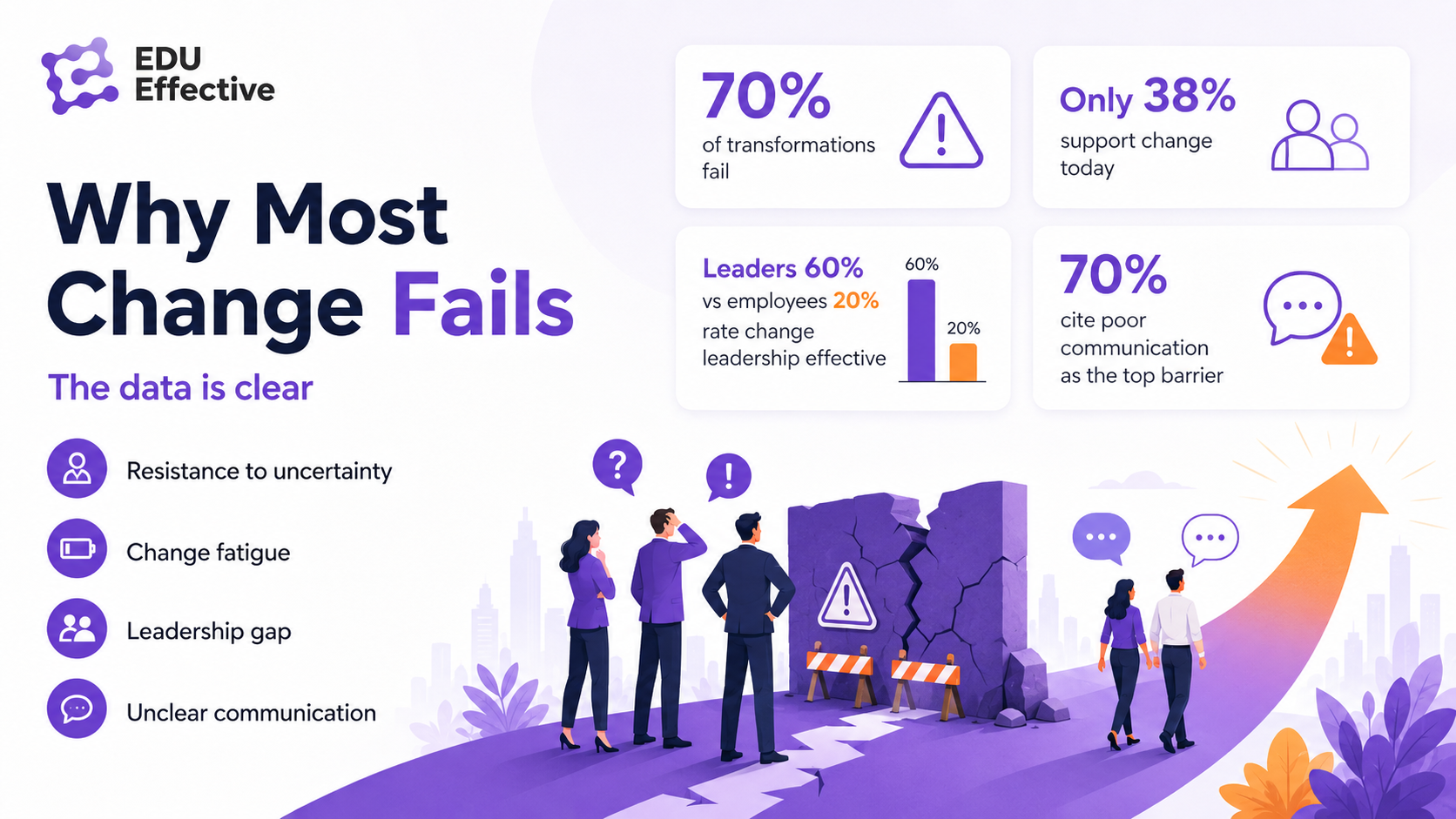
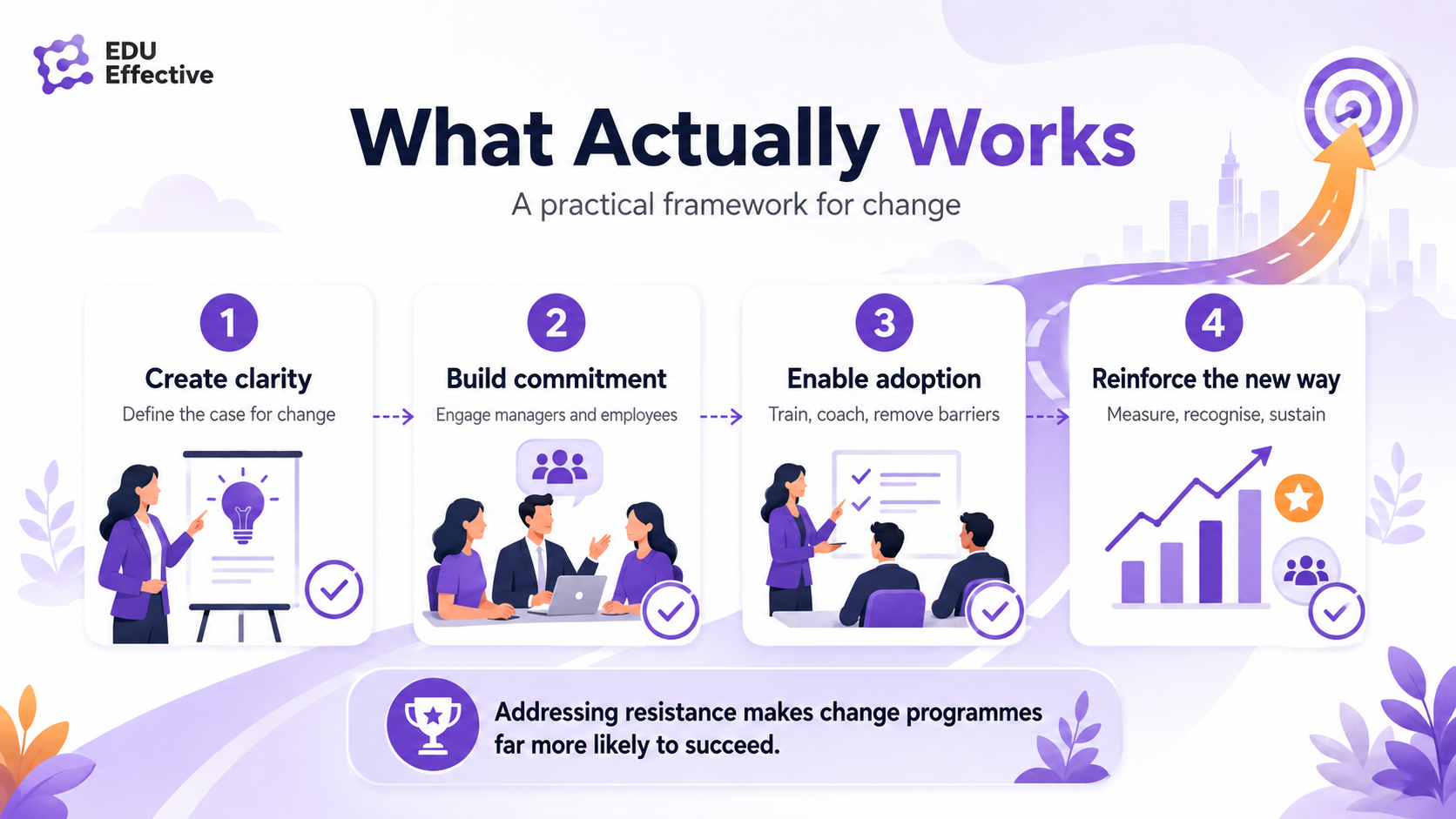
And the failure rate has barely moved. Approximately 70% of organisational transformation initiatives fail to achieve their intended goals — a figure that has circulated in change management literature since the 1990s, consistently cited across McKinsey, BCG, and Kotter research, and repeatedly confirmed in industry surveys even as its precise origin remains contested in academic literature. McKinsey's most recent transformational change survey found that organisations investing time to identify and address the underlying beliefs and assumptions behind resistance are four times more likely to rate their change programmes as successful. The implication is direct: most change management failures are not failures of strategy or technology — they are failures of the human dimension of change.
The World Economic Forum identifies adaptability and change management among the top skills required for professional success through 2030. Understanding why organisational change fails — and how to lead it more effectively — is one of the highest-value management capabilities available in 2026.
Why organisational change fails: the data is clear
Before examining what works in change management, it is worth being precise about what doesn't — because the failure patterns are consistent and predictable enough to function as a diagnostic checklist.
Employee resistance is the most consistently cited primary cause of change failure. McKinsey research identified resistance as a primary factor in the majority of failed change initiatives. But resistance is not a character flaw or a failure of individual employees. It is a predictable human response to uncertainty, loss of familiar ways of working, and the absence of compelling answers to the questions that matter most to the people being asked to change: why is this change necessary, what does it mean for me specifically, and do I have what I need to succeed in the new environment?
The resistance data has worsened significantly over the past decade. Only 38% of employees are willing to support organisational change today, down from 74% in 2016, according to Gartner Business Quarterly research. The acceleration of change velocity — ten enterprise changes per year against an expectation of two — has produced a workforce that is not merely resistant to individual changes but is experiencing cumulative change fatigue: the depletion of cognitive and emotional resources from continuous, overlapping change initiatives that arrive faster than people can adapt to them.
Change fatigue has measurable commercial consequences. Only 43% of employees with high change fatigue intend to stay with their organisation, compared to 74% of those with low fatigue levels, according to Gartner research. The change management approach that ignores this dynamic — that launches a new initiative without acknowledging the human cost of the previous ones — is building the resistance that will undermine its own adoption.
Leadership behaviour is the second most consistent cause of change failure. Gartner research found that 60% of leaders rate themselves as effective at managing change — but only 20% of employees agree. The gap between how leaders perceive their change management effectiveness and how the people experiencing the change perceive it is one of the widest perception gaps in management research. Leaders who believe they have communicated a change clearly, built sufficient urgency, and provided adequate support are frequently operating on fundamentally different information from the people they are leading through the transition.
Communication failure underlies both resistance and leadership failure. 70% of employees cite poor communication as the top barrier to change adoption. The most damaging communication failure in change management is not inadequate volume but inadequate specificity: communications that explain the strategic rationale for a change without answering the questions that employees are actually asking — what does this mean for my role, my team, my ways of working, my career? Employees who receive clear change-related communication are 1.9 times more likely to support organisational change, according to meta-analysis of communication and acceptance research.
The two levels of change: organisational and individual
The most practically useful insight in change management research is the distinction between organisational-level change and individual-level change — and the consistent finding that most change programmes focus almost exclusively on the first while neglecting the second.
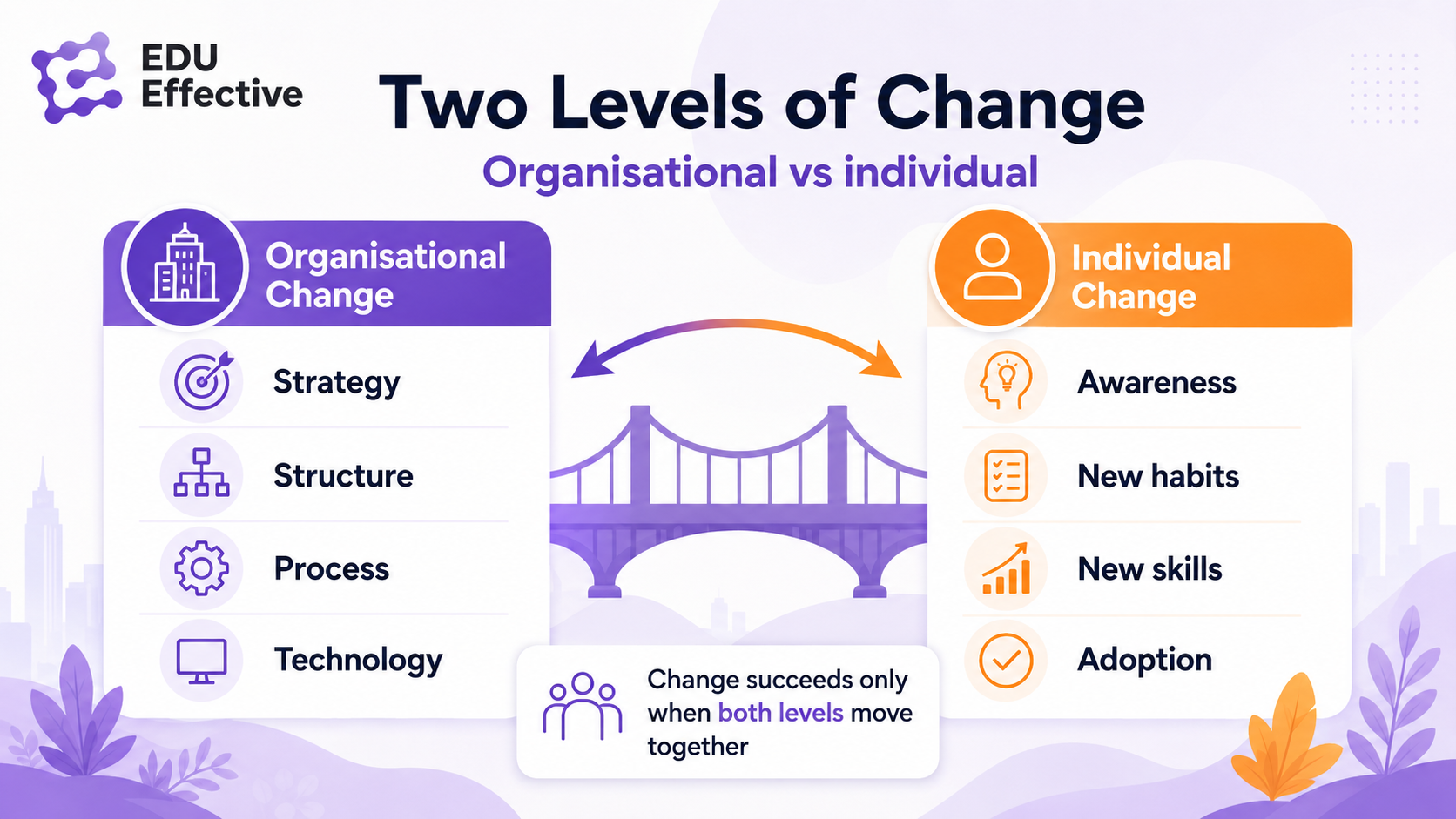
Organisational change addresses strategy, structure, process, and technology: what will be different, when, and how it will be implemented. This is the level at which most change programmes operate — the project plan, the milestone timeline, the systems configuration, the process redesign.
Individual change addresses the personal transition each affected person must make: the specific shift from their current behaviour, habit, tool, or working relationship to the new one the change requires. Organisational change can be mandated and planned. Individual change cannot — it has to be supported, enabled, and sustained one person at a time.
This distinction matters because organisational change can appear to be complete — systems configured, processes documented, training delivered, timelines met — while the individual transitions that determine whether the change actually produces the intended outcomes are still in progress, stalled, or failing silently. A technology implementation that finishes on time but whose intended users continue working around it rather than with it has produced organisational change without producing individual change — and will not produce the business outcomes that justified the investment.
The Kotter 8-Step Model: the most widely used framework for leading change
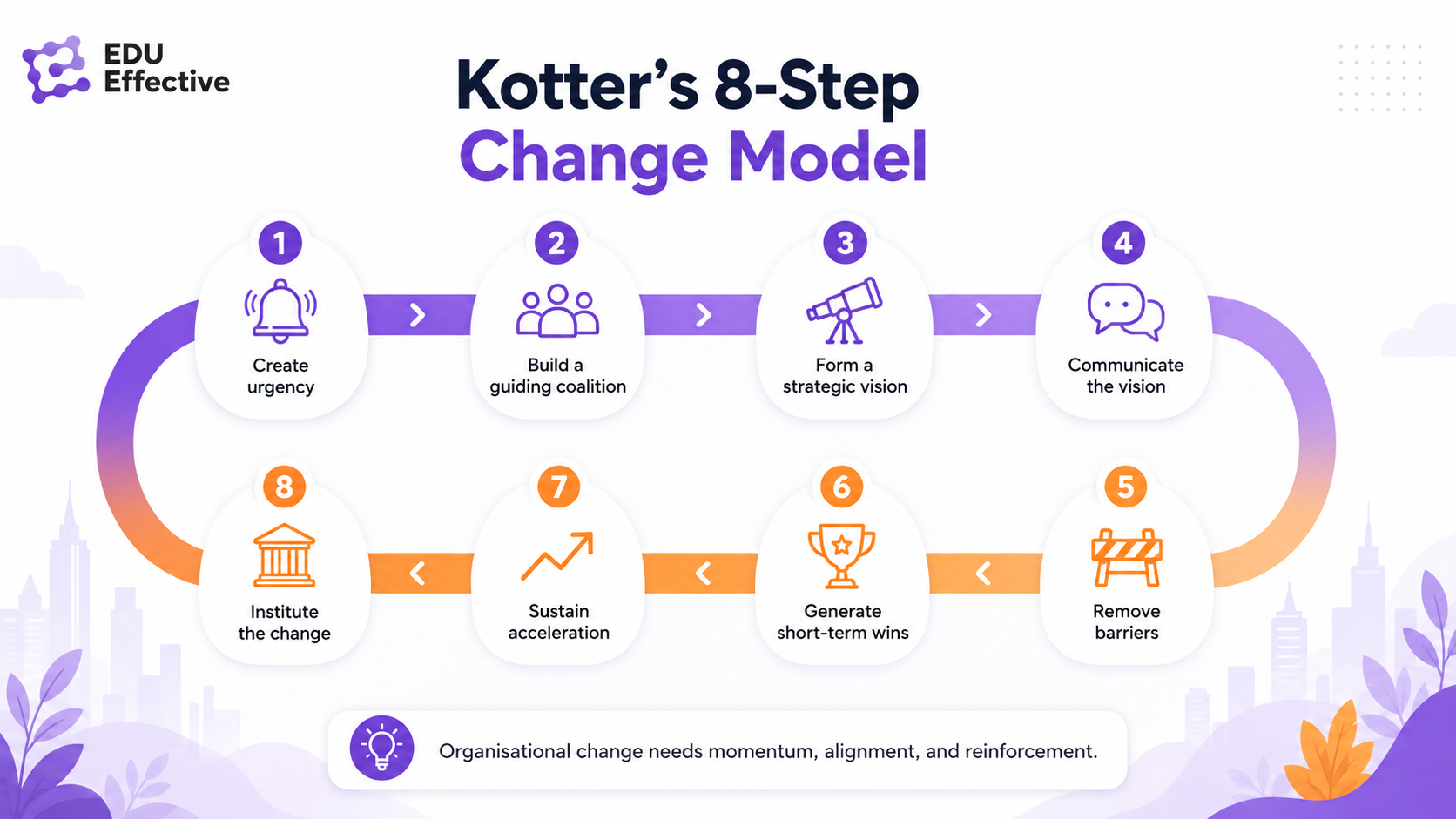
John Kotter's 8-Step Change Model, first published in 1996 and updated in his 2014 book Accelerate, remains the most widely used framework for leading organisational change at scale. It operates at the organisational level — providing a structured sequence for building the momentum, alignment, and sustainability that large-scale change requires.
Step 1: Create urgency. People change when they understand why the status quo is insufficient — why the current situation carries real risks or foregone opportunities that make change necessary. Urgency is not alarm; it is shared understanding of what is at stake. Without genuine urgency, a change initiative competes for attention with everything else that is happening, and it loses. With urgency, it becomes the priority.
Step 2: Build a guiding coalition. No leader can drive organisational change alone. The most effective change initiatives are supported by a cross-functional group of influential people — representing different functions, levels, and perspectives — who are genuinely committed to the change and actively champion it within their own spheres of influence. Coalition members are not simply informed of the change; they are engaged as co-owners.
Step 3: Form a strategic vision. The vision for change needs to be specific enough to be compelling and simple enough to be communicated clearly to every affected person. Vague visions — "we're becoming more agile" or "we're going digital" — do not provide the shared direction that guides individual decisions during a transition. Effective change visions describe what the organisation will look like when the change is complete in terms that are concrete and personally meaningful to the people being asked to change.
Step 4: Communicate the vision. Communication at this stage is not a single announcement — it is a sustained campaign that uses every available channel, repeats key messages consistently, and visibly involves senior leaders as living examples of the change rather than merely its advocates. Leaders who say "we're changing" but whose own behaviour has not visibly changed are undermining the change vision with every interaction.
Step 5: Remove barriers. The most common reason that people who are willing to change still fail to do so is that structural barriers make the new behaviour harder than the old one. Systems that don't work as expected, processes that haven't been redesigned for the new reality, managers who haven't been given the authority to make decisions the change requires — these are the barriers that change management must identify and remove proactively rather than retrospectively.
Step 6: Generate short-term wins. Change that promises results twelve or eighteen months from now competes with the short-term costs and disruptions it produces immediately. Visible, early wins — evidence that the change is producing the intended improvements — sustain momentum, build credibility with sceptics, and demonstrate to the broader organisation that the change vision is achievable. Planned short-term wins are not evidence of short-termism; they are the motivational infrastructure that makes long-term change sustainable.
Step 7: Sustain acceleration. The most common failure point in change management — the moment where most change initiatives stop producing results — is premature declaration of success. When the initial urgency subsides and the guiding coalition relaxes, the behaviours and norms that predate the change tend to reassert themselves. Sustaining change requires continuing to use the same tools — urgency, coalition, vision, communication — to build on early wins rather than treating them as destinations.
Step 8: Institute the change. Change becomes durable when it is embedded in the organisation's culture, systems, structures, and processes — not merely in individual behaviours that depend on ongoing management attention. The final step is making the new way of working the path of least resistance, the default, the norm — such that new employees learn it as "how things work here" rather than as the new initiative they are expected to adopt.
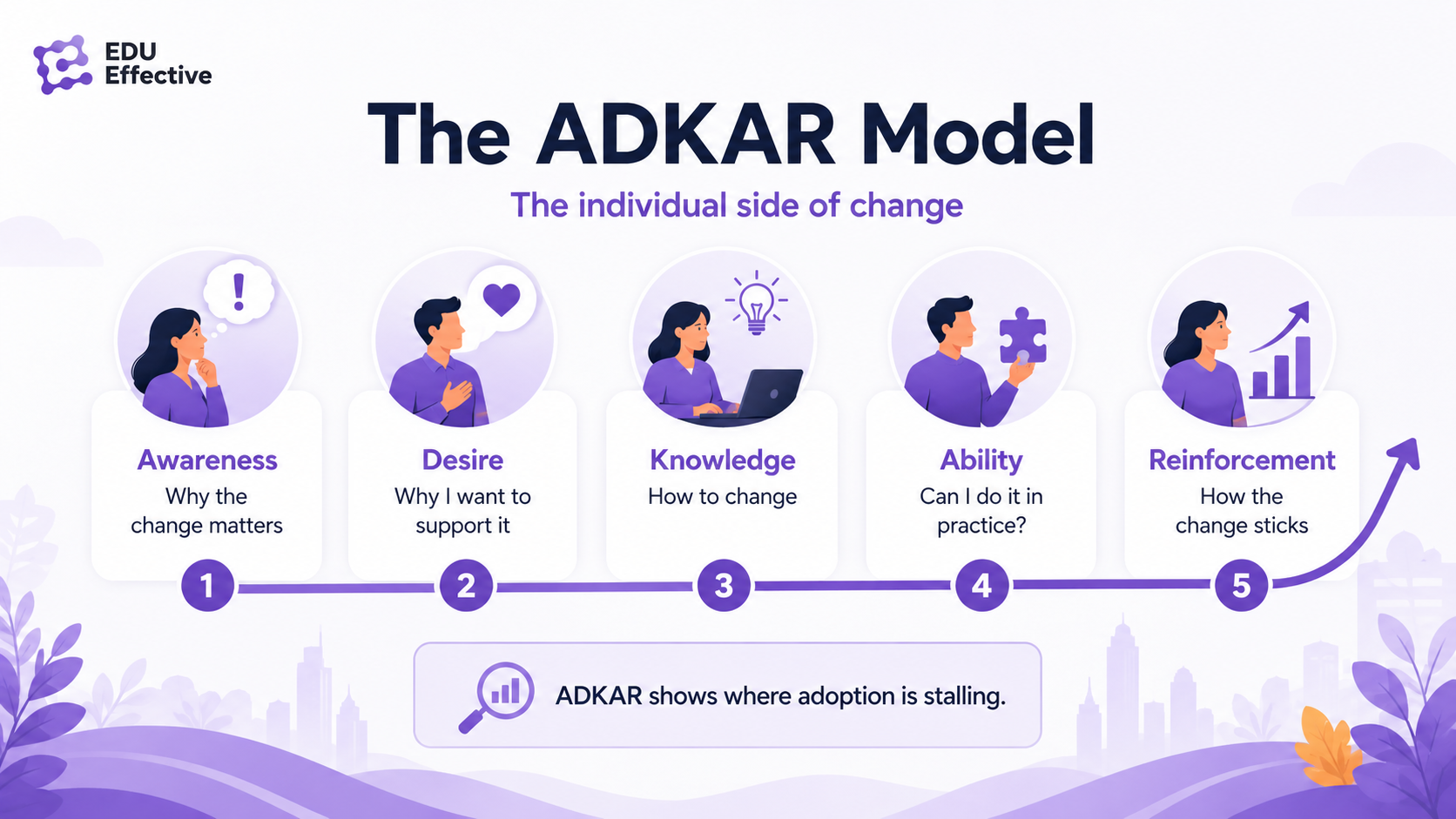
The ADKAR Model: the individual side of change
Where Kotter's model addresses the organisational level of change, the ADKAR Model — developed by Jeff Hiatt after studying change adoption patterns across more than 700 organisations — addresses the individual level. The two frameworks are complementary rather than competing, and the most effective change programmes use both.
ADKAR stands for Awareness, Desire, Knowledge, Ability, and Reinforcement — the five sequential conditions that each individual affected by a change must achieve to successfully adopt it.
Awareness is knowledge that the change is happening and understanding of why it is necessary. Without awareness, people cannot begin the transition. Many change communications assume awareness exists because announcements have been made — but awareness requires not just information but genuine understanding, which is a different and higher bar.
Desire is the personal motivation to support and participate in the change. Awareness of why the organisation needs the change does not automatically produce desire to make the transition personally. The question each individual is asking is not "is this change good for the organisation?" but "is this change something I want to be part of?" Desire is addressed by connecting the change to individual motivations — what it means for the individual's role, career, working relationships, and daily experience.
Knowledge is understanding of how to change — what specifically is different, what skills or behaviours the new environment requires, and what the transition process looks like. Knowledge gaps are primarily addressed through training, but training that is delivered before desire exists rarely produces lasting capability.
Ability is the demonstrated capacity to implement the change in practice. Knowledge of how to do something new and the ability to actually do it are not the same thing. Ability is built through practice, coaching, and the opportunity to try new approaches in conditions where errors are expected and supported rather than penalised.
Reinforcement is what sustains adoption after the initial transition — recognition of new behaviours, accountability for returning to old ones, and the reinforcing signals that tell individuals the change is permanent rather than temporary. Without reinforcement, many change adoptions decay: people revert to familiar behaviours because the new ones are not yet as automatic, and because no one is paying attention to whether the change has stuck.
The diagnostic power of ADKAR is that it pinpoints where individual adoption is stalling. If people are not adopting the change, the model identifies whether the gap is in awareness, desire, knowledge, ability, or reinforcement — each of which requires a different intervention. This precision is what makes it the most practically useful change management framework at the individual level.
The manager's role in change: why the middle layer determines outcomes
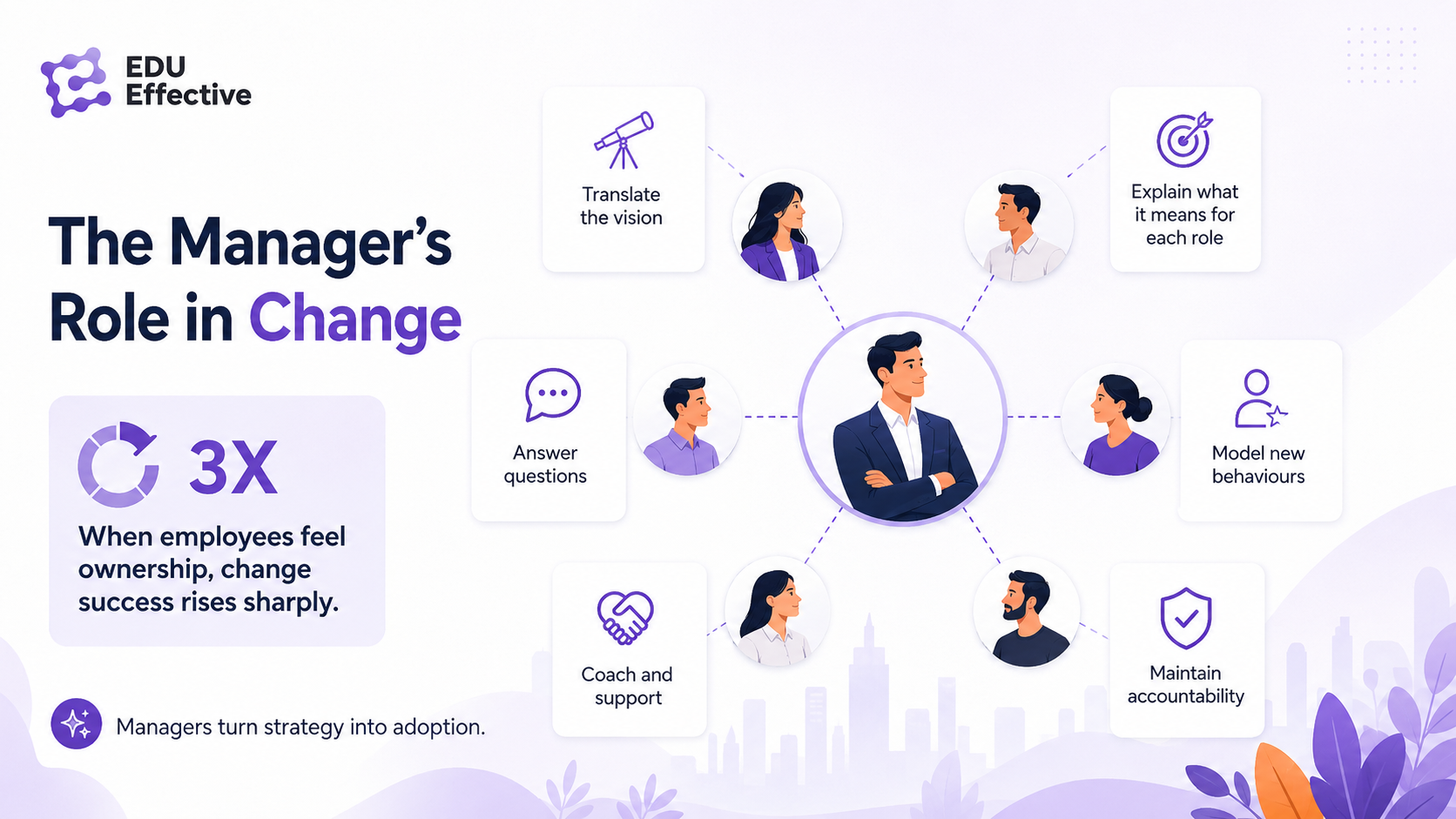
Research consistently identifies the manager layer — not senior leadership — as the primary determinant of change adoption outcomes at the team level. McKinsey's research on successful transformations found a 70% success rate for transformations in which frontline staff members feel genuine ownership and participation in shaping the change — compared to significantly lower success rates where change is planned by small groups at the top and implemented top-down. When employees are genuinely invested in change, the likelihood of success increases by 30%, according to McKinsey.
The manager is the person who translates the change vision into concrete actions for each team member: who explains what the change means specifically for each person's role, who addresses the questions that the formal change communications didn't answer, who models the new behaviours, who provides the support that enables the team to develop ability in the new approach, and who maintains accountability for adopting the new ways of working rather than reverting to the familiar ones.
Managers who have not been adequately prepared for this role — who have not been given clear answers to the questions their team members will ask, who do not understand the change well enough to explain it, and who have not been equipped with the coaching and communication skills that change management requires — become the primary obstacle to change adoption rather than its enabler. The investment in preparing managers for their role in change is one of the highest-return elements of any change management programme.
Change fatigue: the 2026 context
The ten enterprise changes per year figure from Deloitte is the structural context for all change management in 2026. Employees are not encountering individual changes in isolation — they are experiencing continuous, overlapping waves of organisational transformation, each of which makes demands on the cognitive and emotional resources that enable adaptation.
Effective change management in this context requires something that most change programmes do not explicitly address: the management of the change portfolio itself. This means being deliberate about the sequencing, pacing, and prioritisation of changes — not launching every initiative simultaneously, explicitly acknowledging the cumulative burden that change places on people, and investing in the recovery time that enables people to adapt to one change before the next one begins.
It also means being honest about the human cost of change. Two thirds of employees experience burnout symptoms during change initiatives. Managers who acknowledge this reality — who name the difficulty explicitly, who create space for people to express concerns without those concerns being dismissed as resistance, and who actively demonstrate that the change is worth the adaptation cost — manage change more effectively than those who expect enthusiasm as a default response to disruption.
At EDU Effective, the Effective MBA: Executive Management & Leadership develops change management alongside strategic thinking, leadership, and the full range of executive management capabilities — building the practical skills to lead organisational change effectively, not just the theoretical understanding of why it matters. Explore the programme →
Related articles:
- How to Build Company Culture: A Manager's Guide
- Strategic Thinking: What It Is and How to Develop It
- How to Lead a Team for the First Time
At EDU Effective, we build programs for professionals who want to work smarter — not just harder. Explore our programs →
EDU Effective Business School = professional development for your long-term success.
All best-selling Effective MBA programs are built for working adults: 15 minutes a day, 10 months or less, ASIC accredited, from €990.
- Effective MBA: Executive Management & Leadership
- Effective MBA: Applied Artificial Intelligence
- Effective MBA: Coaching, Leadership & Mentoring
- Effective MBA: Mastery in AI
- Effective MBA: Online Marketing
These are professional programs, not academic ones — built for working adults to apply what they learn directly in their own business, not to collect a scholarly credential.
Join more than 9,000 students in over 120 countries around the world to further your personal development and career success.
Read the feedback and experiences of our students and the stories of our graduates here.
Apply now — from €990 · Talk to a Study Advisor
Study with NO risk: 14-day money-back guarantee, no questions asked.
Sources
- McKinsey & Company — Transformational Change: Organisations 4x More Likely to Succeed When Addressing Underlying Beliefs https://www.mckinsey.com/capabilities/people-and-organization/our-insights/webinars-and-podcasts/change-at-scale
- McKinsey & Company — The Science Behind Successful Organizational Transformations (70% success rate with frontline ownership) https://www.mckinsey.com/capabilities/people-and-organizational-performance/our-insights/successful-transformations
- McKinsey & Company — The State of Organizations 2026 (10,000+ senior executives) https://www.mckinsey.com/capabilities/people-and-organizational-performance/our-insights/the-state-of-organizations
- Gartner — Change Fatigue and Retention: 43% vs 74% Intent to Stay https://www.gartner.com/en/newsroom/press-releases/2023-11-07-gartner-hr-leaders-survey-reveals-top-two-priorities-in-2024
- Deloitte — Global Human Capital Trends 2025: 10 Enterprise Changes Per Year (up from 2 in 2016) https://www2.deloitte.com/us/en/insights/focus/human-capital-trends.html
- World Economic Forum — Future of Jobs Report: Adaptability and Change Management as Top Skills https://www.weforum.org/publications/the-future-of-jobs-report-2025/
- Kotter, J.P. — Leading Change and Accelerate - The 8-Step Change Model https://www.kotterinc.com/methodology/8-steps/
- Hiatt, J. — ADKAR: A Model for Change in Business, Government and Our Community https://www.prosci.com/methodology/adkar