


Healthy organisations deliver three times the total shareholder returns of unhealthy ones, according to McKinsey's Organisational Health Index — a finding that has held consistently across industries, geographies, and business cycles in research covering tens of thousands of organisations over more than two decades. That is the commercial case for organisational culture in its most direct form: not a soft metric, not a feel-good initiative, but a three-to-one financial performance differential that operates independently of industry and market conditions.
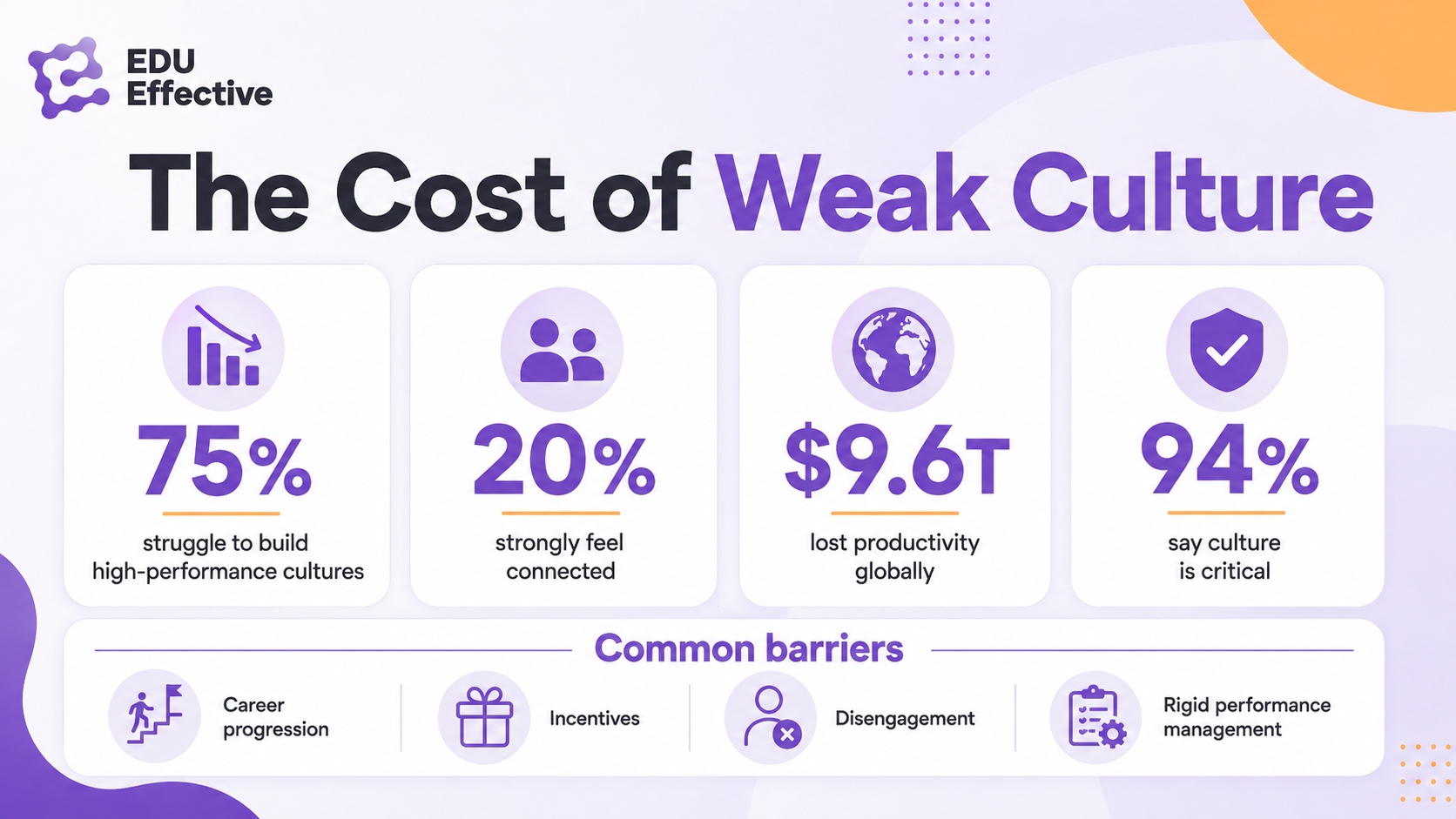
And yet 75% of organisations are struggling to build high-performance cultures, according to McKinsey's State of Organizations 2026 report — the largest global study of organisational health, based on responses from more than 10,000 senior executives across 15 countries and 16 industries. Only 20% of US employees strongly agree that they feel connected to their organisation's culture, according to Gallup's most recent Global Indicator data from May 2026. And 94% of executives and 88% of employees believe a distinct corporate culture is critical to business success, according to Deloitte's Core Beliefs and Culture research — a finding that has remained consistent across subsequent Deloitte Human Capital Trends surveys through 2025.
The gap between knowing that culture matters and knowing how to build it is one of the most persistent challenges in management. This guide is about closing that gap.
What organisational culture actually is — and what it is not
Organisational culture is the accumulated pattern of shared values, beliefs, behaviours, and practices that defines how work actually gets done in an organisation — not how leadership says it gets done, but how it actually happens in practice. It is the answer to the question: "How do things work here?"
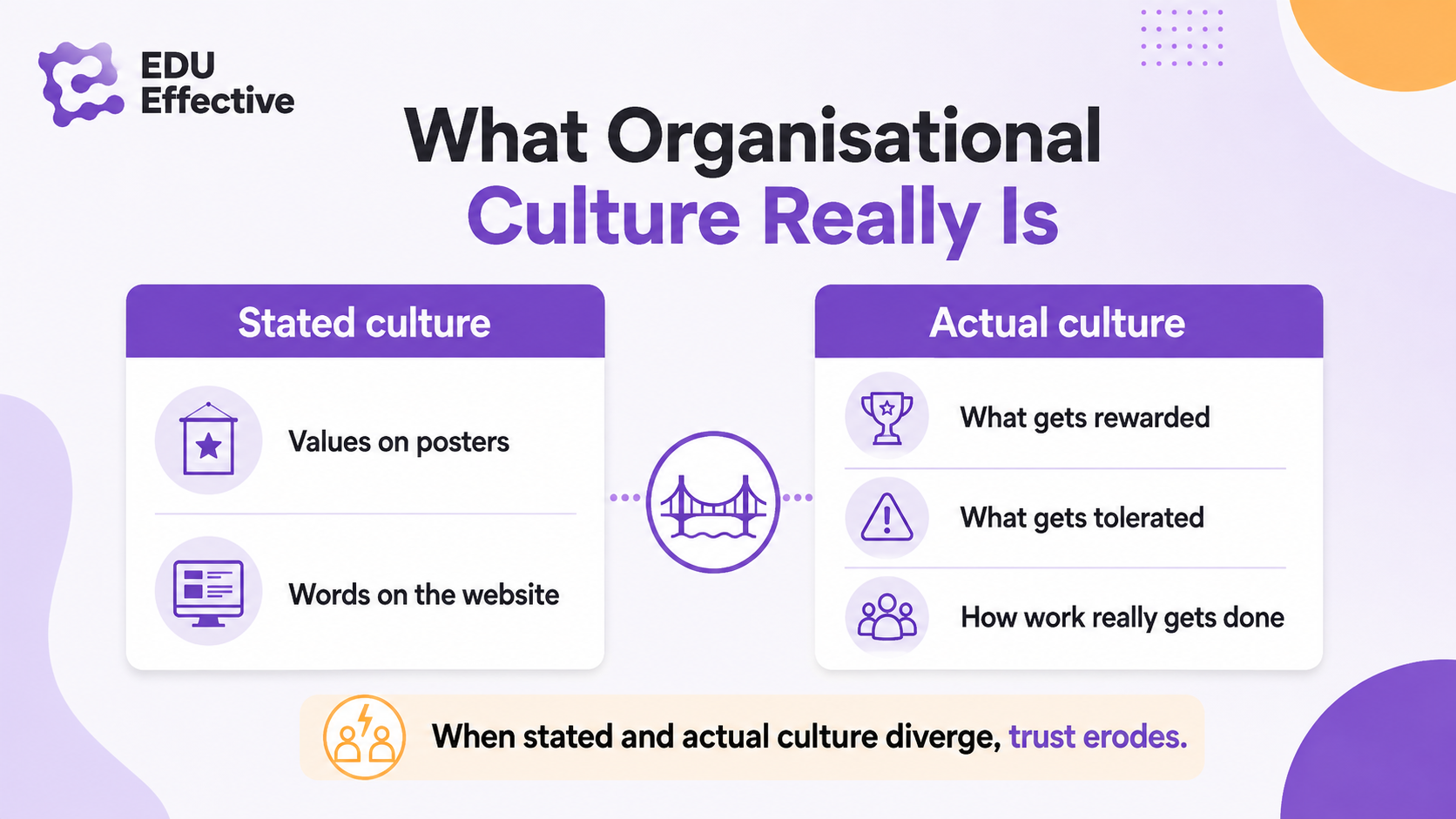
This distinction between stated and actual culture is the most important one for any manager to understand. Most organisations have articulated values — the words on the website and the posters in the office. They also have actual cultural norms — the behaviours that are genuinely rewarded, the things that are genuinely tolerated, and the patterns of action that new employees learn to adopt if they want to succeed. Where these two are aligned, culture is a genuine asset. Where they diverge, the actual norms consistently override the stated values, and the divergence itself erodes trust.
Culture is also not primarily a senior leadership initiative, a communications exercise, or an HR programme. It is built — or damaged — through the accumulated daily decisions of managers at every level: how they respond when things go wrong, what they recognise and reward, whose ideas they listen to, how they treat people who raise uncomfortable truths, and whether their own behaviour is consistent with the norms they ask others to follow. This is why Gallup's research consistently shows that 70% of the variance in team-level culture and engagement is attributable to the manager — not to the organisation's stated culture programmes, not to its values statements, but to the individual manager's daily behaviour.
The business case for culture: what the data shows
The McKinsey Organisational Health Index finding — healthy organisations generate three times the total shareholder returns — is the most widely cited and most rigorously evidenced financial case for organisational culture. It is based on McKinsey's longitudinal research tracking thousands of organisations across multiple business cycles, and its consistency across industries and time periods makes it more persuasive than any single-period correlation.
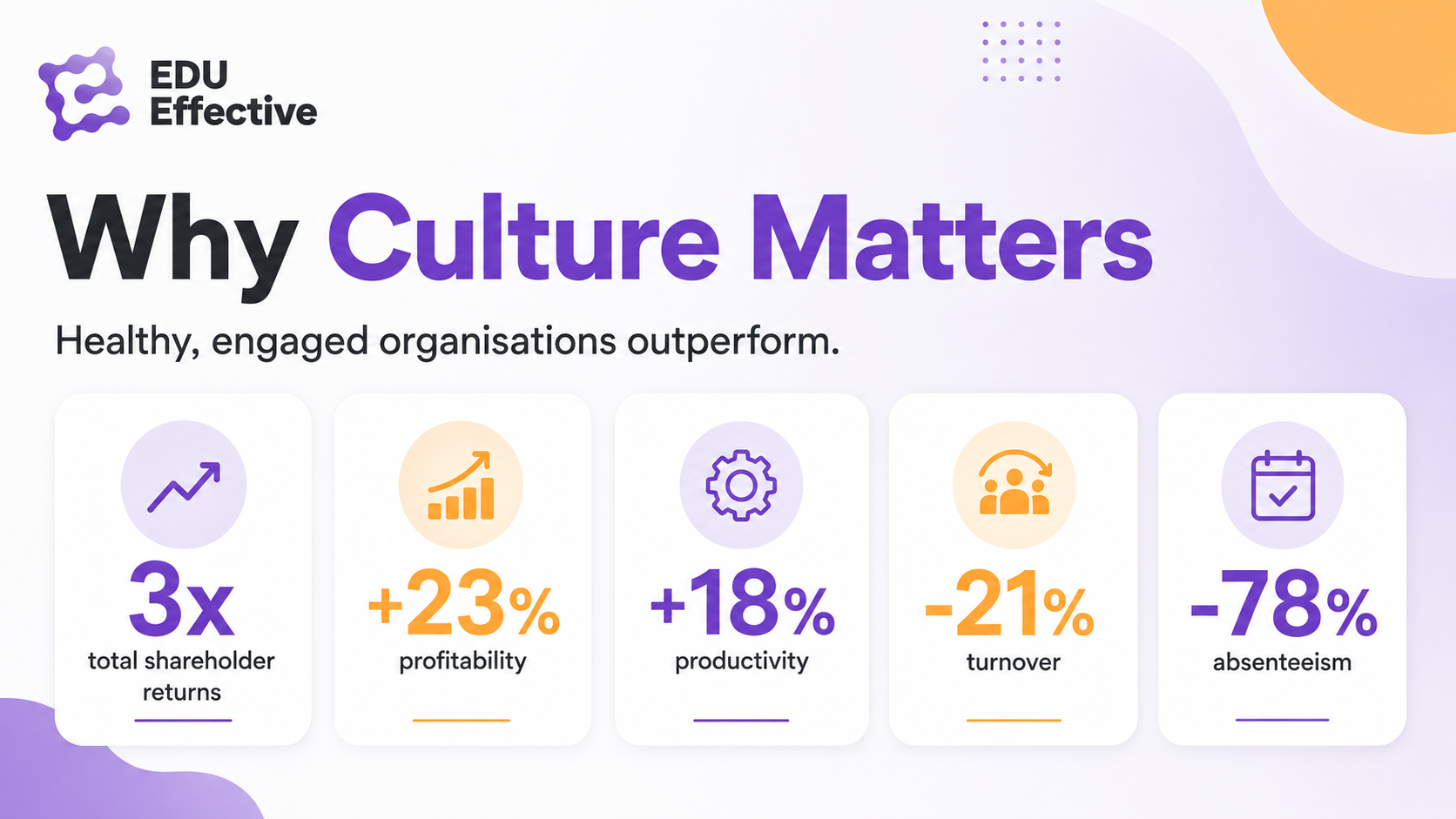
The mechanisms through which culture produces financial performance are well-understood. Engaged employees are 23% more profitable, show 18% higher productivity, 78% lower absenteeism, and 21% lower turnover, according to Gallup's meta-analysis across industries and geographies. The talent attraction effect is similarly significant: only 49% of employees trust their employers to create a workplace culture where everyone can thrive, according to Randstad's Workmonitor 2025 research across 34,000 workers in 35 markets — meaning that organisations that demonstrably build strong cultures operate in a talent market where the majority of the workforce is actively looking for something better.
The cost of poor culture is equally specific. Disengagement alone costs the global economy approximately $9.6 trillion annually in lost productivity, according to Gallup's 2026 State of the Global Workplace report. At the organisational level, McKinsey's State of Organizations 2026 identifies limited career progression (cited by 47% of the 10,000 executives surveyed), lack of targeted incentives (43%), disengaged employees (38%), and rigid performance management (38%) as the primary barriers to high-performance culture — all of which are management-addressable within the span of control of individual managers, not just organisational initiatives.
The components of culture that managers can actually influence
Organisational culture is shaped by many forces — founder history, industry norms, competitive environment, national culture, organisational structure. Not all of these are within a manager's control. What is within a manager's control is the micro-culture of their team — the behavioural norms, the interpersonal dynamics, the standards of performance, and the experience of working on that team day to day.
Understanding which specific behaviours shape culture allows managers to act deliberately rather than accidentally on the culture of their team.
What gets recognised and rewarded. The behaviours that are recognised and rewarded define what culture actually values — far more reliably than any values statement. A team that says it values collaboration but only recognises individual contribution is building a culture of competition regardless of what it intends. A manager who recognises specifically, promptly, and sincerely the behaviours they want to see more of — using the kind of SBI-structured recognition (Situation-Behaviour-Impact) covered in our guide to giving feedback effectively — is building a culture in which those behaviours become norms.
How the manager responds to failure. Nothing reveals cultural values more clearly than what happens when something goes wrong. A manager who responds to mistakes with curiosity — "what happened, what can we learn, what do we change?" — builds a culture of psychological safety in which problems are surfaced early and learning is continuous. A manager who responds to mistakes with blame builds a culture of self-protection in which problems are hidden until they become crises. This single behavioural pattern — the manager's response to failure — is the primary determinant of whether psychological safety exists in a team, and psychological safety is the single strongest predictor of team effectiveness across all the teams Google studied in Project Aristotle.
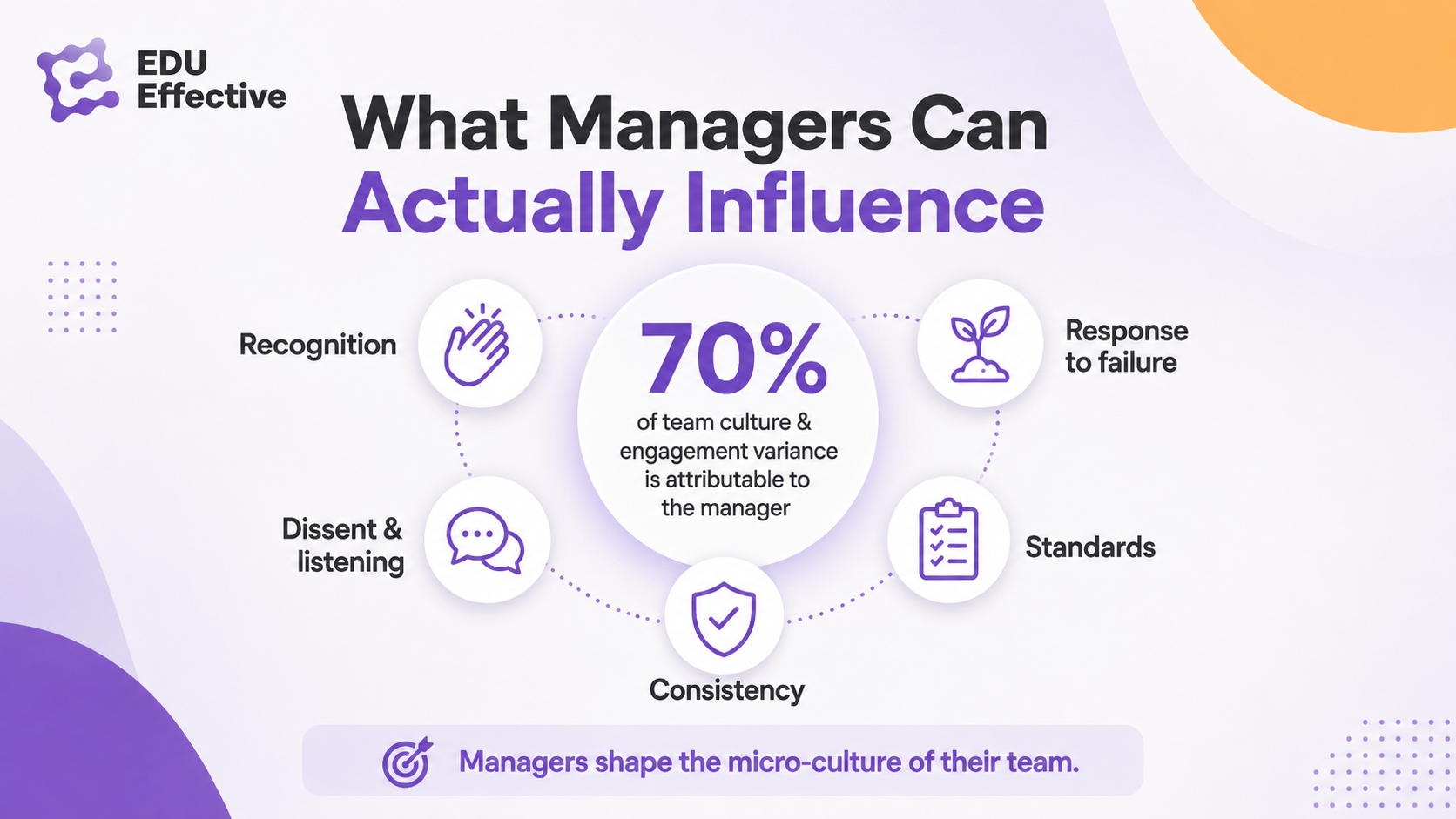
How the manager treats dissenting voices. In teams where the manager genuinely listens to perspectives that differ from their own, challenges their own thinking when presented with good counter-evidence, and creates space for disagreement without social penalty, psychological safety enables the honest communication that produces better decisions and earlier problem detection. In teams where the manager signals — verbally or through behaviour — that disagreement is unwelcome, the best ideas in the room go unspoken.
The standards the manager maintains. Culture is also defined by what a manager tolerates. A team that says it values quality but accepts consistently mediocre work without addressing it is building a culture of mediocrity. A manager who holds consistent, clear, fair standards — who addresses underperformance specifically and early, who distinguishes between effort and outcome, and who provides the support that enables standards to be met — builds a culture of accountability that team members generally prefer to one where poor performance has no consequences.
The consistency between what the manager says and what they do. No culture initiative survives a manager whose behaviour consistently contradicts the norms they espouse. A manager who talks about work-life balance while sending emails at 11pm on weekends, who advocates for psychological safety while punishing people who disagree with them, or who publicly champions team development while never investing time in one-to-ones is building a culture of cynicism — a workforce that has learned to discount stated values because they have learned that stated values do not predict actual behaviour.
Psychological safety: the foundation that everything else requires
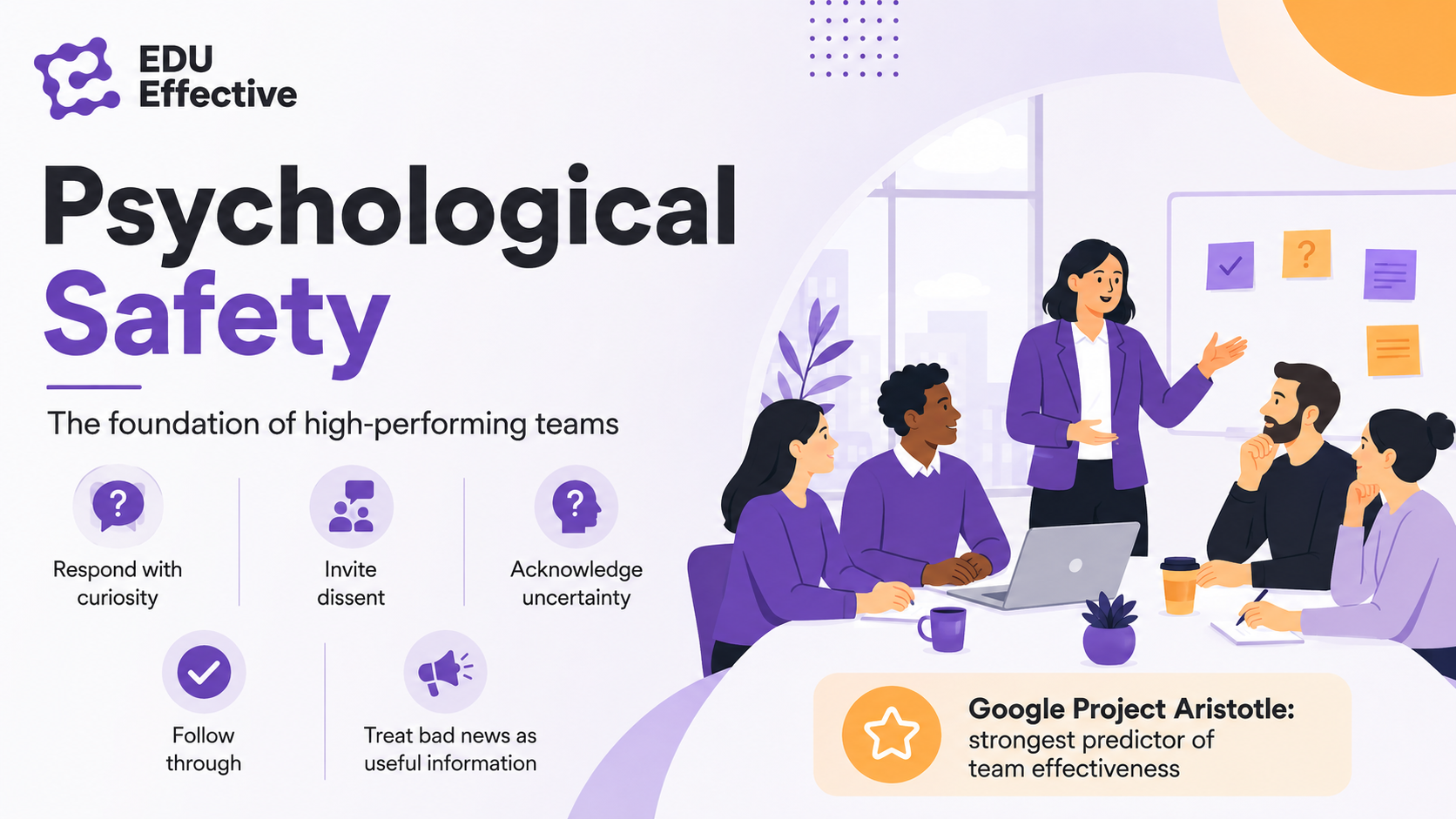
Psychological safety — the shared belief among team members that the team is safe for interpersonal risk-taking — is the cultural condition that most reliably predicts team performance. Google's Project Aristotle found it to be the single strongest predictor of team effectiveness, above talent composition, technical skill, and every other variable studied. Amy Edmondson's research, spanning more than two decades and multiple industries, consistently finds that teams with high psychological safety surface problems earlier, innovate more effectively, learn faster from mistakes, and perform better on complex tasks.
Psychological safety is not the same as comfort or harmony. It does not mean that everyone agrees, that standards are low, or that difficult feedback is avoided. Teams with high psychological safety are frequently characterised by vigorous disagreement — because people feel safe enough to actually say what they think. The absence of psychological safety is not absence of conflict; it is the presence of unspoken conflict, hidden problems, and the performance cost of a team that is never fully deploying its collective intelligence.
For a manager trying to build psychological safety in their team, the key behaviours are: responding to mistakes and bad news with curiosity rather than blame; acknowledging their own uncertainty and fallibility openly; explicitly inviting dissent in meetings rather than assuming silence means agreement; following through on commitments consistently; and treating early warning of problems as valuable information rather than evidence of incompetence.
Culture in hybrid and remote environments
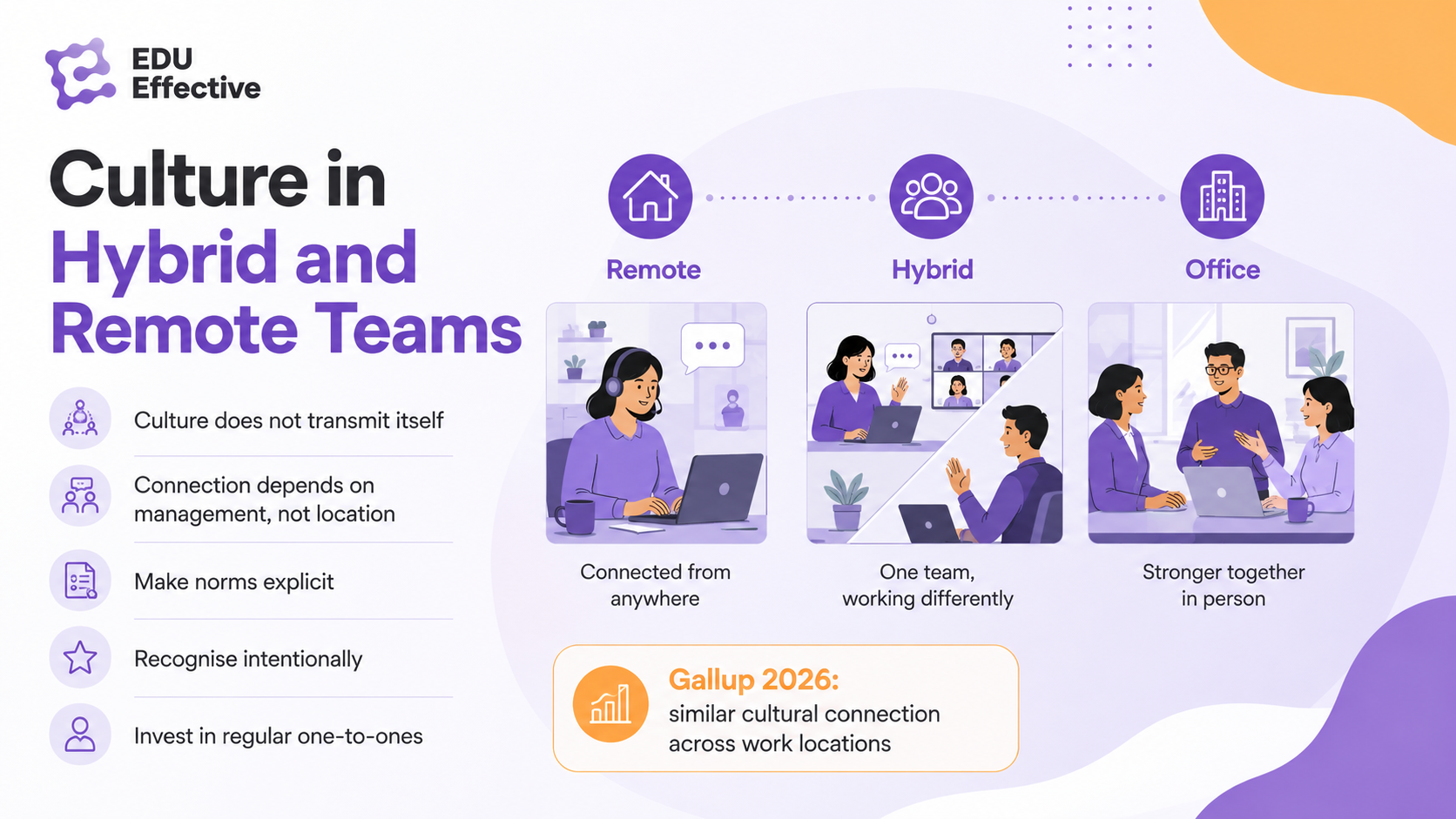
One of the most consistent findings in research on organisational culture post-2020 is that the assumptions about how culture is transmitted and maintained were based on physical co-location — the ambient social contact, informal relationship-building, and observational learning that happen naturally in shared physical spaces.
In distributed environments, none of these operate automatically. The social connection that builds the relationships underpinning psychological safety requires deliberate creation. The observational learning through which new employees absorb cultural norms requires explicit communication of those norms. The informal recognition that reinforces valued behaviours requires systematic replacement with deliberate, structured recognition.
Gallup's May 2026 data is instructive: there is virtually no difference in cultural connection across work locations — remote, hybrid, and in-office employees report similar levels of connection to organisational culture. This contradicts the assumption that physical presence is necessary for culture — and confirms that what matters is not where people work but how managers engage with them regardless of location.
The practical implication: managers who invest in deliberate culture-building behaviours — regular individual connection through one-to-ones, explicit communication of team norms and values, consistent recognition, and intentional community-building — maintain strong team cultures in distributed environments. Those who assume culture will transmit itself through proximity find that it does not — and that the engagement and retention costs of cultural disconnection are the same regardless of work location.
Building company culture deliberately: a practical framework
Culture-building is not a programme or a project. It is an ongoing management practice — the accumulation of deliberate daily choices about how to behave, what to recognise, what standards to maintain, and how to respond when things go well and when they do not.
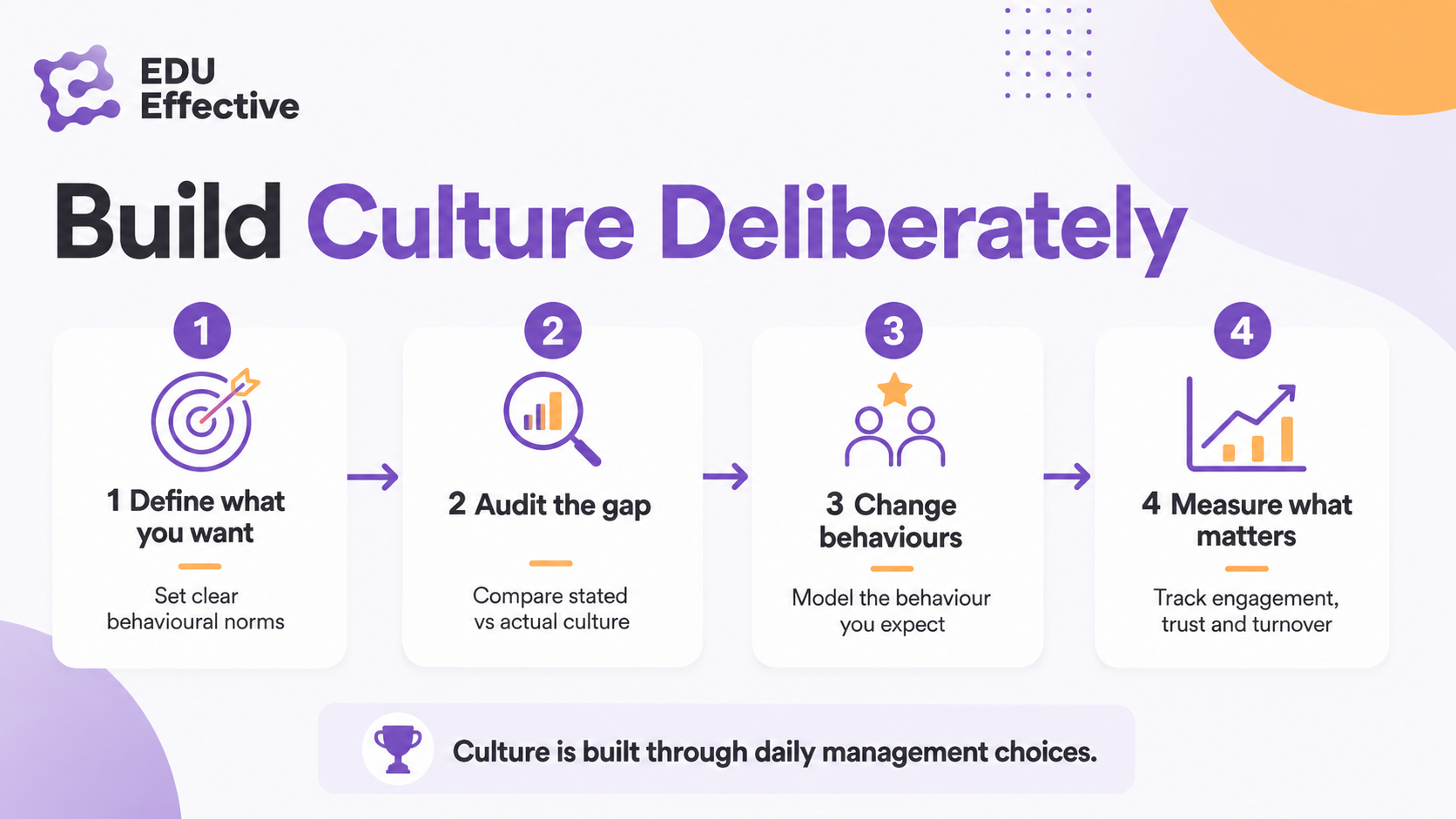
The practical framework for managers who want to build deliberately rather than accidentally has four components.
Define what you actually want. Not the corporate values statement, but the specific behavioural norms you want operating on your team. What does collaboration look like in practice on this team? What does accountability look like? What does quality mean specifically? The more concrete the definition, the more consistently it can be communicated, recognised, and maintained.
Audit the gap between stated and actual norms. The current culture of your team — not what you intend but what is actually happening — is visible in what gets recognised, what gets tolerated, whose voices are heard, how mistakes are handled. An honest audit of these behaviours reveals the gap between the culture you want and the one you have built through your accumulated daily choices.
Change behaviours, not programmes. Culture changes when behaviours change — consistently, over time, at every level of the team. The most effective lever is the manager's own behaviour, because it signals what the culture actually values more reliably than anything else. The manager who wants to build a culture of openness needs to model openness. The manager who wants a culture of accountability needs to hold themselves accountable visibly.
Measure what matters. The cultural metrics that predict performance — engagement scores, psychological safety ratings, team trust measures, voluntary turnover rates — provide feedback on whether culture-building efforts are producing the intended results. Managing culture without measurement is navigating without instruments.
At EDU Effective, the Effective MBA: Executive Management & Leadership and the Effective MBA: Coaching, Leadership & Mentoring both develop the leadership and management capabilities that shape team culture — from psychological safety and feedback to performance management and coaching. Not as abstract theory, but as practised behaviours applied directly to your team's reality. Explore our programs →
Related articles:
- How to Motivate Employees: What the Research Actually Says
- How to Give Feedback at Work: A Practical Manager's Guide
- Leadership Styles: What They Are and How to Develop Adaptive Leadership
At EDU Effective, we build programs for professionals who want to work smarter — not just harder. Explore our programs →
EDU Effective Business School = professional development for your long-term success.
All five Effective MBA programs are built on the same educational model — designed for working adults who need learning that fits real professional life:
- Effective MBA: Executive Management & Leadership
- Effective MBA: Applied Artificial Intelligence
- Effective MBA: Coaching, Leadership & Mentoring
- Effective MBA: Mastery in AI
- Effective MBA: Online Marketing
Every programme runs on 15 minutes a day, completes in 10 months or less, is ASIC accredited, and starts from €990.
These are professional programmes, not academic ones — built for working adults to apply what they learn directly in their own business, not to collect a scholarly credential.
Join more than 9,000 students in over 120 countries who are investing in their professional development and career success. Read the experiences of our graduates here.
Apply now — from €990 · Talk to a Study Advisor
Study with NO risk: 14-day money-back guarantee, no questions asked.
Sources
- McKinsey & Company — Organisational Health Is Still the Key to Long-Term Performance: 3x TSR (Organisational Health Index) https://www.mckinsey.com/capabilities/people-and-organizational-performance/our-insights/organizational-health-is-still-the-key-to-long-term-performance
- McKinsey & Company — The State of Organizations 2026: Three Tectonic Forces Reshaping Organizations (10,000+ senior executives, 15 countries, 16 industries) https://www.mckinsey.com/capabilities/people-and-organizational-performance/our-insights/the-state-of-organizations
- Gallup — Global Indicator: Organisational Culture (May 2026 — 20% of US employees connected to culture) https://www.gallup.com/471521/indicator-organizational-culture.aspx
- Gallup — State of the Global Workplace 2026 (published May 2026) https://www.gallup.com/workplace/349484/state-of-the-global-workplace.aspx
- Gallup — Meta-Analysis: Engaged Employees 23% More Profitable, 18% Higher Productivity https://www.gallup.com/workplace/236927/employee-engagement-drives-growth.aspx
- Deloitte — 2026 Global Human Capital Trends) https://www.deloitte.com/global/en/insights/topics/talent/human-capital-trends.html
- Randstad — Workmonitor 2025: Employee Trust in Workplace Culture (34,000 workers, 35 markets) https://www.randstad.com/workmonitor/
- Google re:Work — Project Aristotle: Five Keys to a Successful Google Team https://rework.withgoogle.com/intl/en/guides/understand-team-effectiveness