

Coaching Deep-Dive Series, Part 1 of 12
Every manager who has ever been asked to justify a coaching budget knows the moment. Finance wants a number. The investment feels right — the coachee is more focused, the team dynamic has shifted, conversations that used to go in circles are moving again. But a feeling is not a business case.
The good news is that coaching research has accumulated over three decades, and the numbers are there. The harder truth is that the numbers require context to use honestly — because what coaching delivers depends almost entirely on how it is deployed.
The headline numbers — and what they actually mean
The most cited figure in coaching ROI research comes from the ICF Global Coaching Client Study (International Coaching Federation, 2009): 86% of companies said they at least recouped their investment in coaching, with a median ROI of 700% — meaning seven dollars back for every one spent.
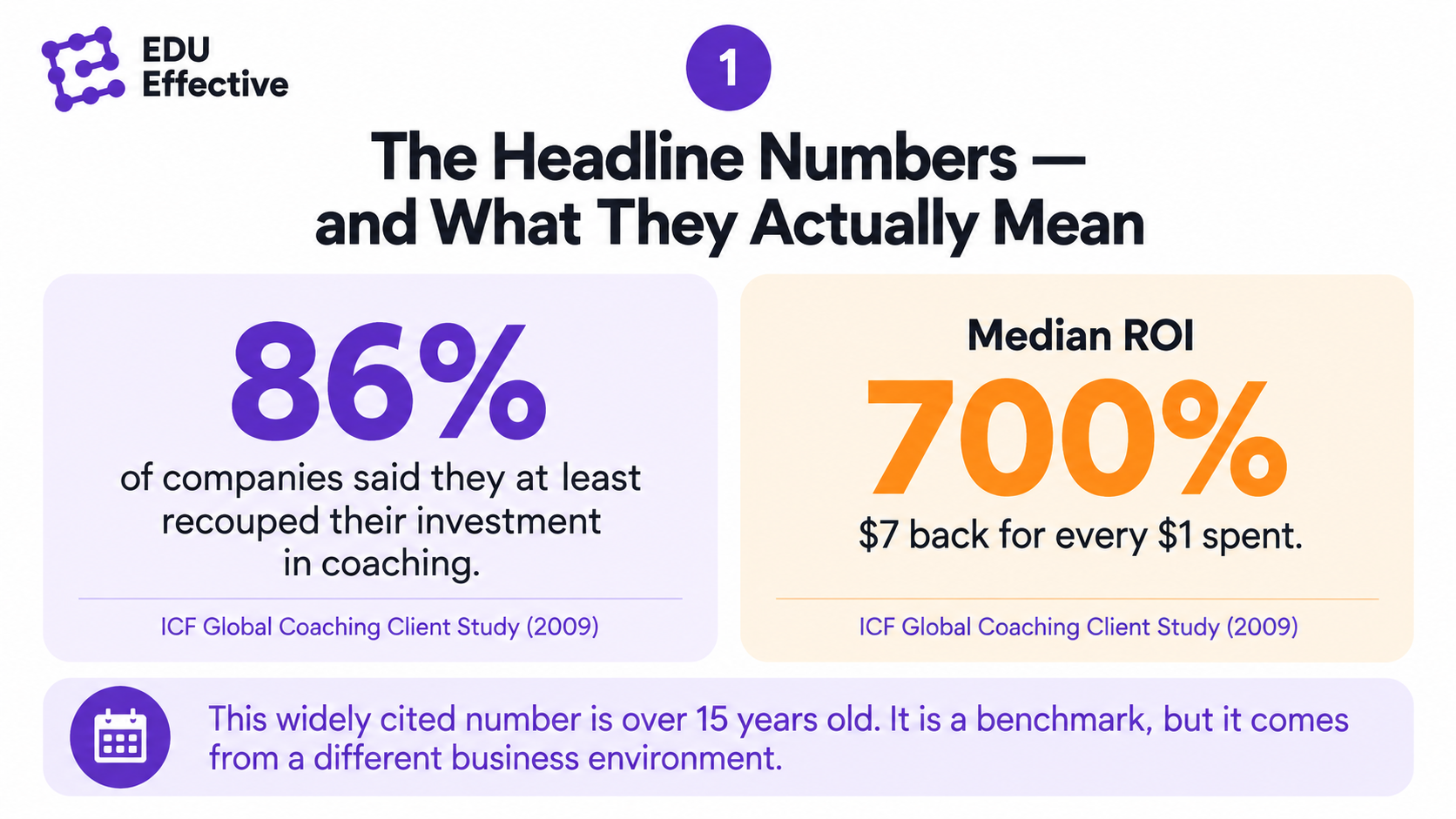
That number has traveled far. It appears in boardroom presentations, procurement justifications, and LinkedIn posts, usually without the year attached. It is over fifteen years old, and it covers a broad range of coaching engagements across industries and seniority levels. It is not wrong — but it is a benchmark from a different business environment, before remote work, before AI tools, and before coaching became the mainstream management development instrument it is today.
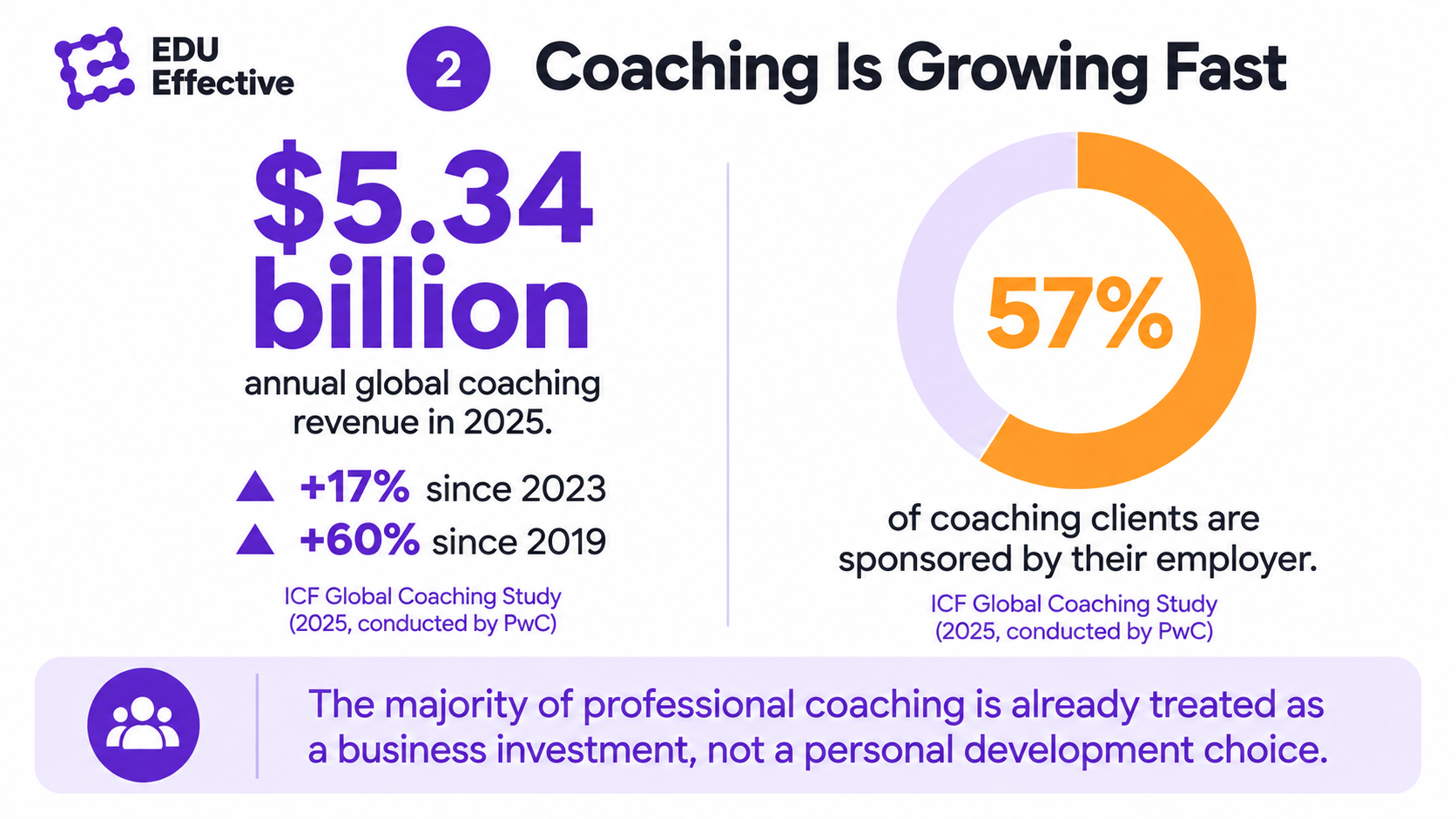
A more recent anchor comes from the 2025 ICF Global Coaching Study, the largest survey of the coaching profession ever conducted, commissioned by ICF and conducted by PwC. The study tracked 122,974 coach practitioners across 157 countries and found annual global coaching revenue of $5.34 billion USD — up 17% since 2023, and up 60% since 2019. More than 57% of coaching clients are now sponsored by their employer, meaning the majority of professional coaching is already treated as a business investment, not a personal development choice.
The question is whether that investment delivers.
What the research shows across specific outcomes
The 700% median ROI figure tells you the aggregate picture. What’s more useful for a manager making a decision is what coaching actually changes — and the research is specific enough to answer that.
The MetrixGlobal LLC executive briefing, a study of a single Fortune 500 company using the Phillips ROI Methodology, found 788% ROI when productivity gains and employee satisfaction improvements were quantified. This is a single-company case from the early 2000s, and it would be a mistake to treat it as universally applicable. What it demonstrates is the methodology: when you cost the baseline, measure the change, and attribute it carefully, the return is large enough to matter.
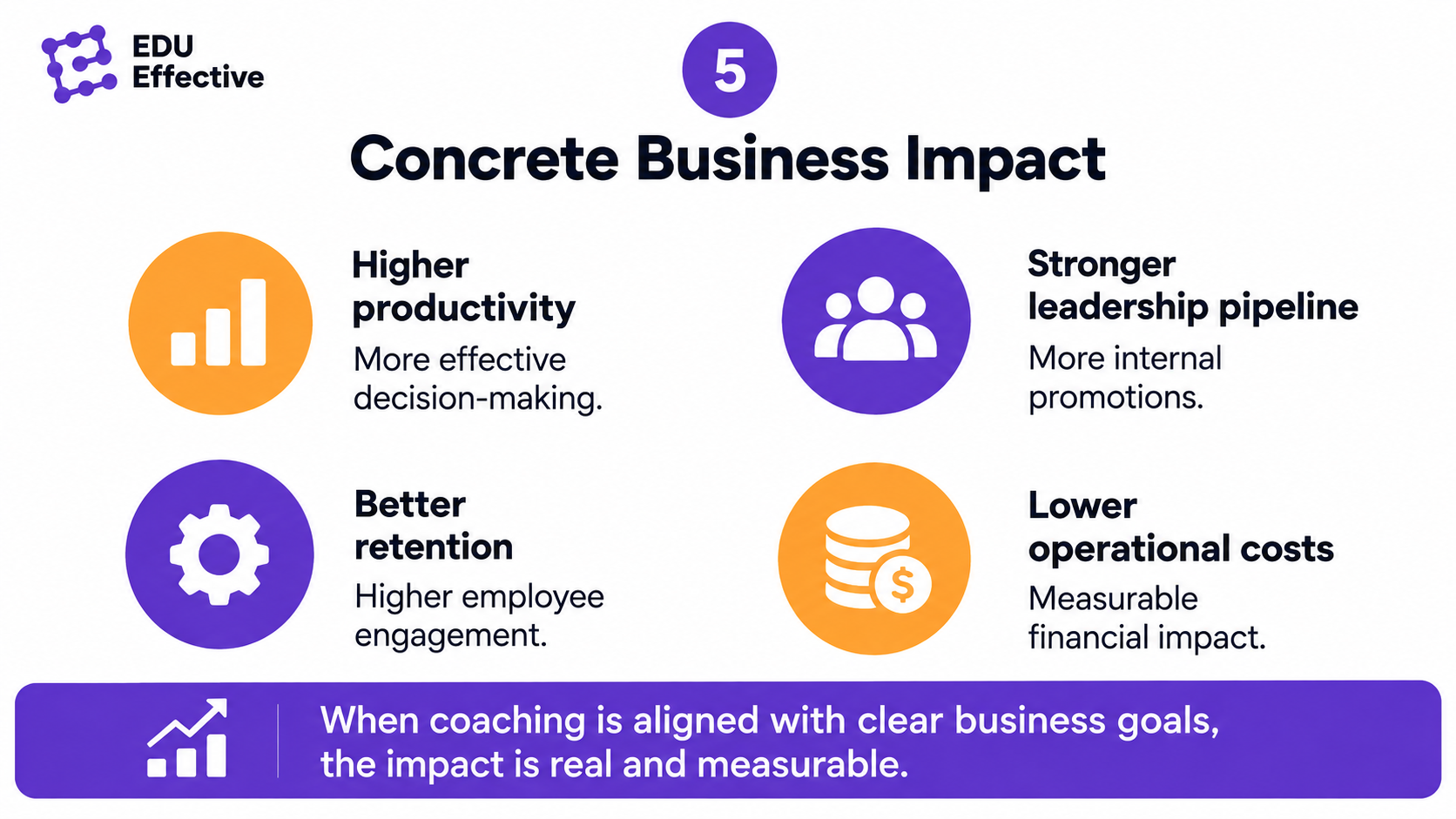
More recent and more granular evidence comes from real deployments. Saudi Electricity Company, which runs one of the most documented organizational coaching programs, reported the following from its leadership pipeline initiative: a 22% increase in internal promotions among coached leaders, 95% overall talent retention (98% for leaders specifically), and over 100 million SAR (approximately $26 million USD) in operational cost reductions attributable to the program. The program covered more than 800 employees annually across 11 structured coaching tracks.
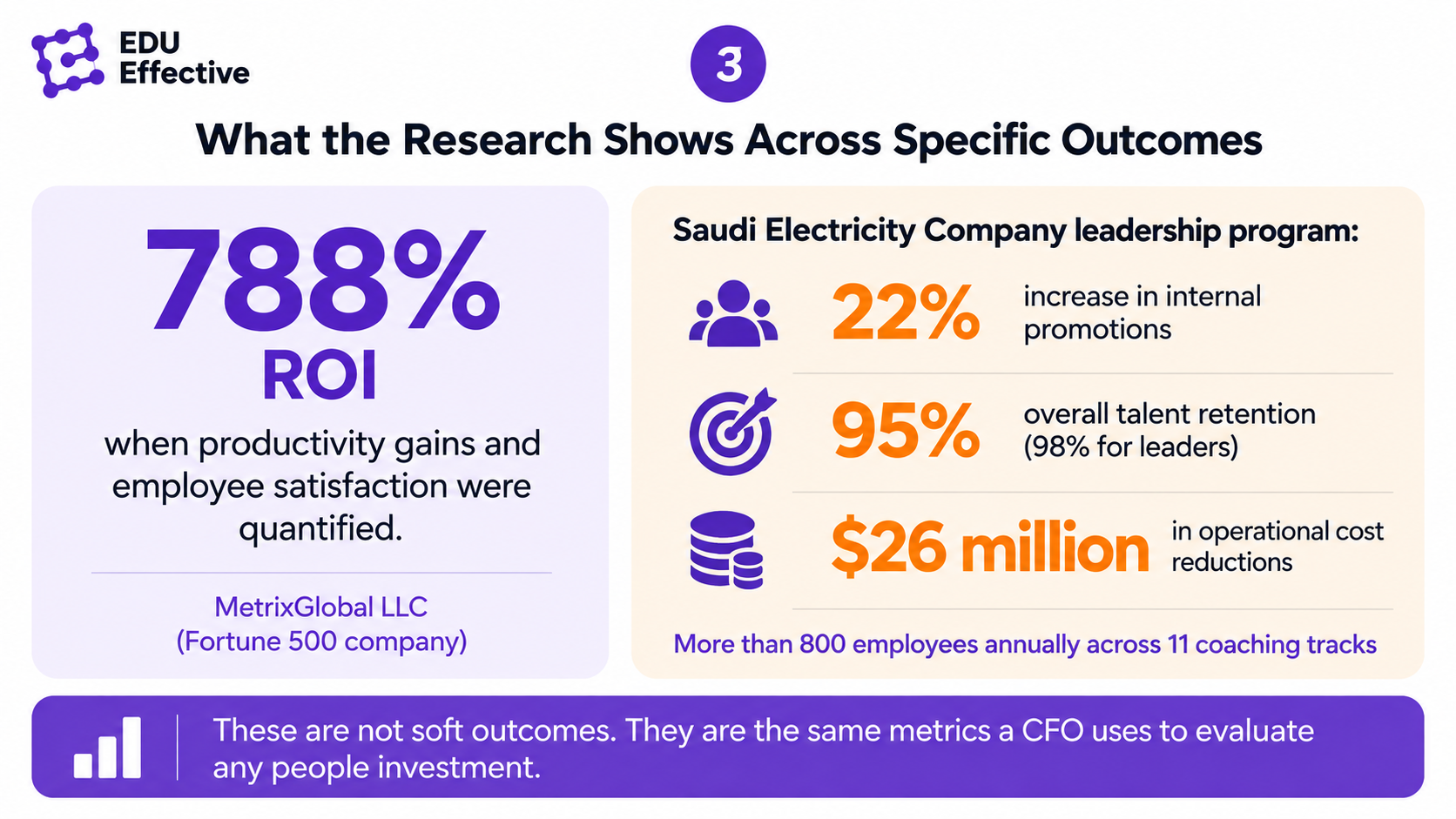
These are not soft outcomes. They are the same metrics a CFO uses to evaluate any people investment.
Where coaching ROI is strongest — and where it falls short
Not all coaching delivers the same return. The research consistently points to three variables that determine whether an engagement pays off.
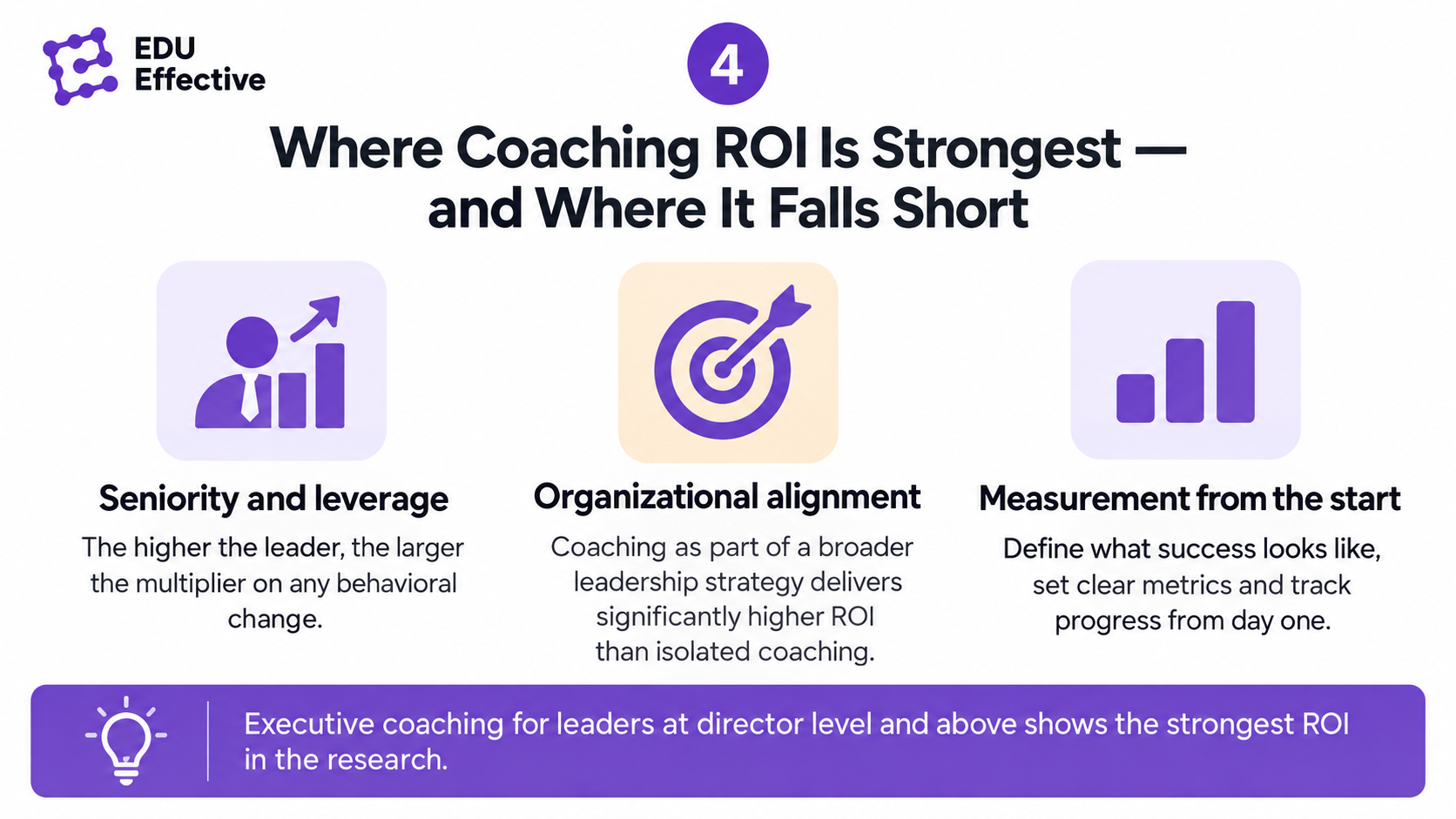
Seniority and leverage. The higher the leader, the larger the multiplier on any behavioral change. A mid-level manager who improves their delegation skills affects a team of five or ten. A VP who shifts how they make decisions, communicate priorities, or develop direct reports affects everyone below them. This is why executive coaching — specifically for leaders at director level and above — shows the strongest ROI in the literature. The return on improving a CEO’s self-awareness is structurally different from the return on improving a junior analyst’s confidence.
Organizational alignment. Coaching delivered as an isolated intervention — a coachee working with a coach independently of any organizational context — produces personal development. Coaching delivered as part of a broader leadership strategy — linked to succession planning, tied to specific business challenges, with a sponsor who maintains accountability — produces organizational change. The difference in outcomes is significant. The ICF data on employer-sponsored coaching reflects this: organizations that pay for coaching are more likely to structure it well.
Measurement from the start. Most coaching engagements fail to demonstrate ROI not because the coaching didn’t work, but because no one defined what “working” meant before it started. What behavior needs to change? By how much? What business outcome is it connected to? Organizations that answer these questions at the outset — before the first session, not after the last — can measure and attribute results. Those that don’t are left with testimonials, which are powerful and unconvincing in equal measure.
The costs that are never counted
Any honest ROI calculation for coaching also requires looking at the cost of not coaching.
Harvard Business Review research puts the all-in cost of a failed executive hire — including recruitment, onboarding, lost productivity, and team disruption — at between 1.5x and 5x the annual salary of the role. A significant share of executive transitions underperform against their original mandate — through missed targets, team disruption, or early departure. If coaching meaningfully reduces that risk — and the retention and promotion data from structured coaching programs suggests it does — the ROI calculation changes substantially.
There is also the talent retention angle. Gallup’s research consistently finds that the quality of management is the single largest predictor of employee engagement and retention. Coaching that develops better managers does not only improve the manager — it improves everyone that manager leads, and it reduces the attrition that costs organizations an estimated 50% to 200% of annual salary per departing employee (depending on seniority and role complexity).
These costs are real. They rarely appear in coaching ROI analyses because they require connecting data across HR, finance, and operations — which most organizations don’t do systematically. The absence of the data doesn’t mean the return isn’t there.
Why skepticism about coaching is still reasonable
The honest answer to “does coaching pay off?” is: it depends, and the evidence for strong ROI comes with important caveats.
The most cited studies are old. The 700% median and the 788% case study are from the early 2000s. Research methodology in coaching has improved since then, but large-scale, rigorously controlled studies with randomized assignment and independent measurement are still relatively rare. Much of the evidence is self-reported by coachees, self-published by coaching organizations, or derived from case studies that cannot be easily replicated.
Gartner has noted that organizations frequently over-invest in leadership development programs — including coaching — without clear linkage to business outcomes. Their research on leadership development effectiveness consistently finds that the organizations with the best results are those with the fewest, most focused interventions, not the broadest programs.
The implication is not that coaching doesn’t work. It is that coaching deployed without a business rationale, without measurement, and without organizational alignment is expensive professional development with uncertain returns. Coaching deployed with discipline — targeted at the right leaders, tied to specific outcomes, measured from the start — is among the highest-return people investments available.
What good deployment looks like
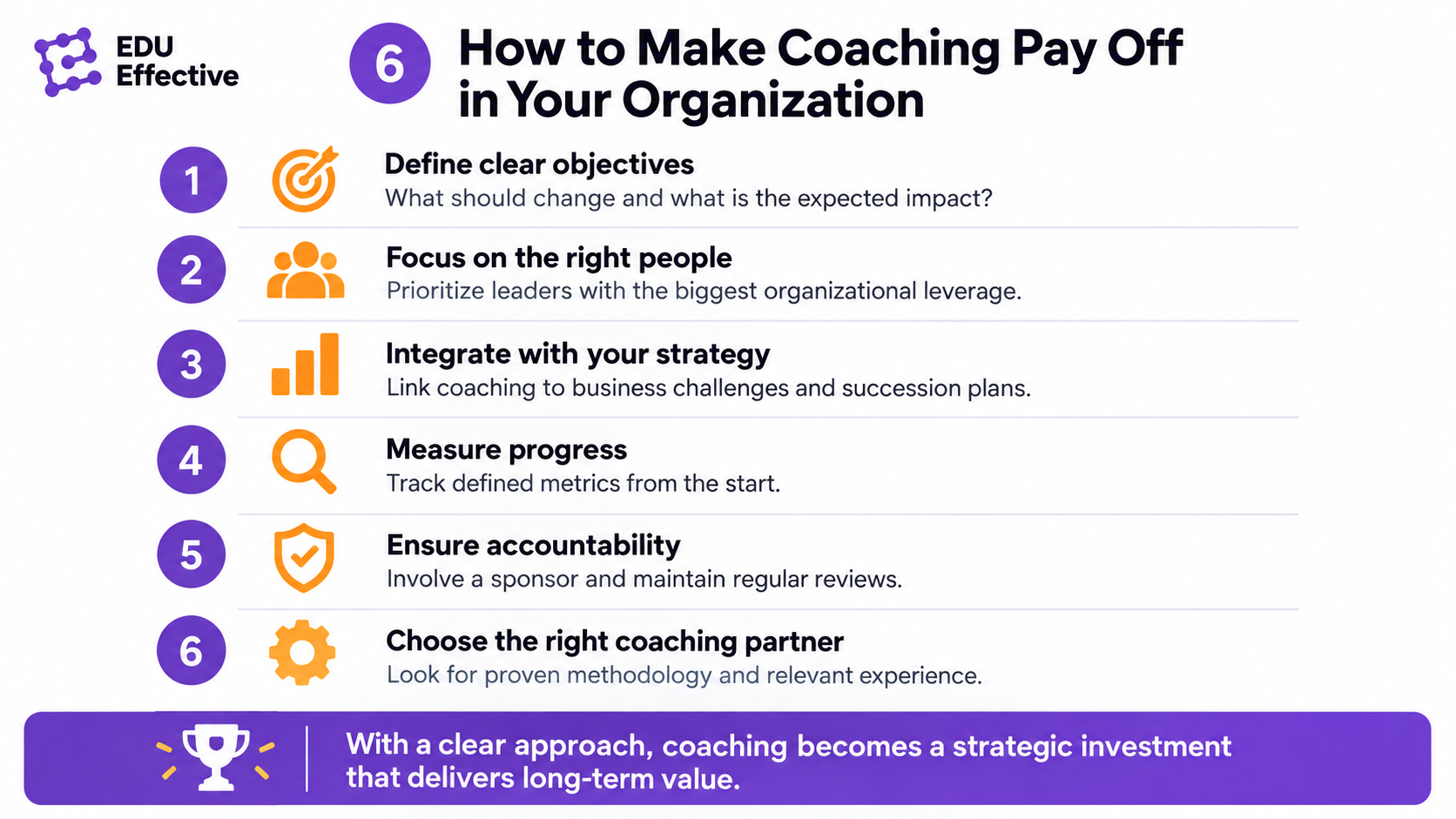
Three things separate organizations that get strong ROI from coaching from those that don’t.
They define the business problem first. The coach is not hired to “develop leadership.” The coach is hired because a specific leader needs to improve how they handle conflict with peers, or communicate strategic priorities, or build the team they’ll need for the next phase. The specificity of the brief drives the specificity of the result.
They involve the sponsor throughout. A sponsor — typically the coachee’s manager or CHRO — who provides context at the start, stays informed without breaching confidentiality, and creates accountability for applying what’s learned in the coaching room. The ICF calls this the “triangle” of coach, coachee, and sponsor. Organizations that operate this model report consistently better outcomes than those treating coaching as a one-to-one private arrangement.
They measure what matters, not what’s easy. Self-reported satisfaction scores from coachees are the least useful metric and the most commonly used. The more useful metrics — 360-degree behavioral assessments before and after, performance data from the relevant period, retention and promotion outcomes — require more effort to collect and clearer design up front. They are the difference between knowing coaching worked and being able to show it.
The bottom line
Coaching pays off when it is deployed as a business tool, not as a benefit. The median ROI of 700% from the ICF research, the 788% from the MetrixGlobal case study, and the operational cost reductions documented at organizations like Saudi Electricity Company are not flukes. They are the outcome of treating coaching as an investment — with a business rationale, a measurable objective, and accountability for results.
The organizations that get these returns are not exceptional. They are disciplined. They define what they need, select coaches accordingly, involve the right people, and measure what changes. That is within reach of any organization willing to approach coaching the same way it approaches any other serious business investment.
Develop the skills to lead — and to grow others
If you manage people, coaching is not just something you hire for others. It is a core part of how you lead. Understanding what leadership coaching is, how to apply coaching conversations in day-to-day management, and how to develop the people around you is increasingly what separates effective leaders from those who rely on authority alone.
The Effective MBA: Coaching, Leadership & Mentoring at EDU Effective is built for working professionals who want to lead with greater impact — combining evidence-based coaching methodology with the practical demands of managing real teams in real organizations.
Join and start building skills you can use from the first week.
About EDU Effective Business School
The Effective MBA: Coaching, Leadership & Mentoring is built around the conversations that shape team performance. Runs on 15 minutes a day, completes in 10 months or less and is ASIC accredited.
Sources
- ICF / PwC — 2025 ICF Global Coaching Study, conducted by PwC, February 2026 ($5.34B Global Coaching Revenue; 122,974 Practitioners; 57% Employer-Sponsored Clients) https://coachingfederation.org/blog/coaching-as-a-strategic-advantage-what-the-2025-global-coaching-study-reveals/
- ICF — Global Coaching Client Study, International Coaching Federation, 2009 (86% Recouped Investment; Median ROI 700%) https://coachingfederation.org/research/global-coaching-study
- MetrixGlobal LLC — Executive Briefing: Coaching Achieves ROI, Merrill C. Anderson (Single Fortune 500 Case Study, Phillips ROI Methodology, 788% ROI) https://stratoscoaching.com/executive-coaching-roi.html
- Gartner — Leadership Development Effectiveness Research (Focused, Outcome-Linked Interventions Outperform Broad Programs) https://www.gartner.com/en/human-resources/topics/leadership-development
- Gallup — State of the American Workplace (Management Quality as the Largest Predictor of Engagement and Retention) https://www.gallup.com/workplace/285674/improve-employee-engagement-workplace.aspx
- Saudi Electricity Company — Program Outcomes Cited in ICF 2025 Global Coaching Study Blog Post (22% More Internal Promotions; 95% Talent Retention; 100M SAR Cost Reductions) https://coachingfederation.org/blog/coaching-as-a-strategic-advantage-what-the-2025-global-coaching-study-reveals/