

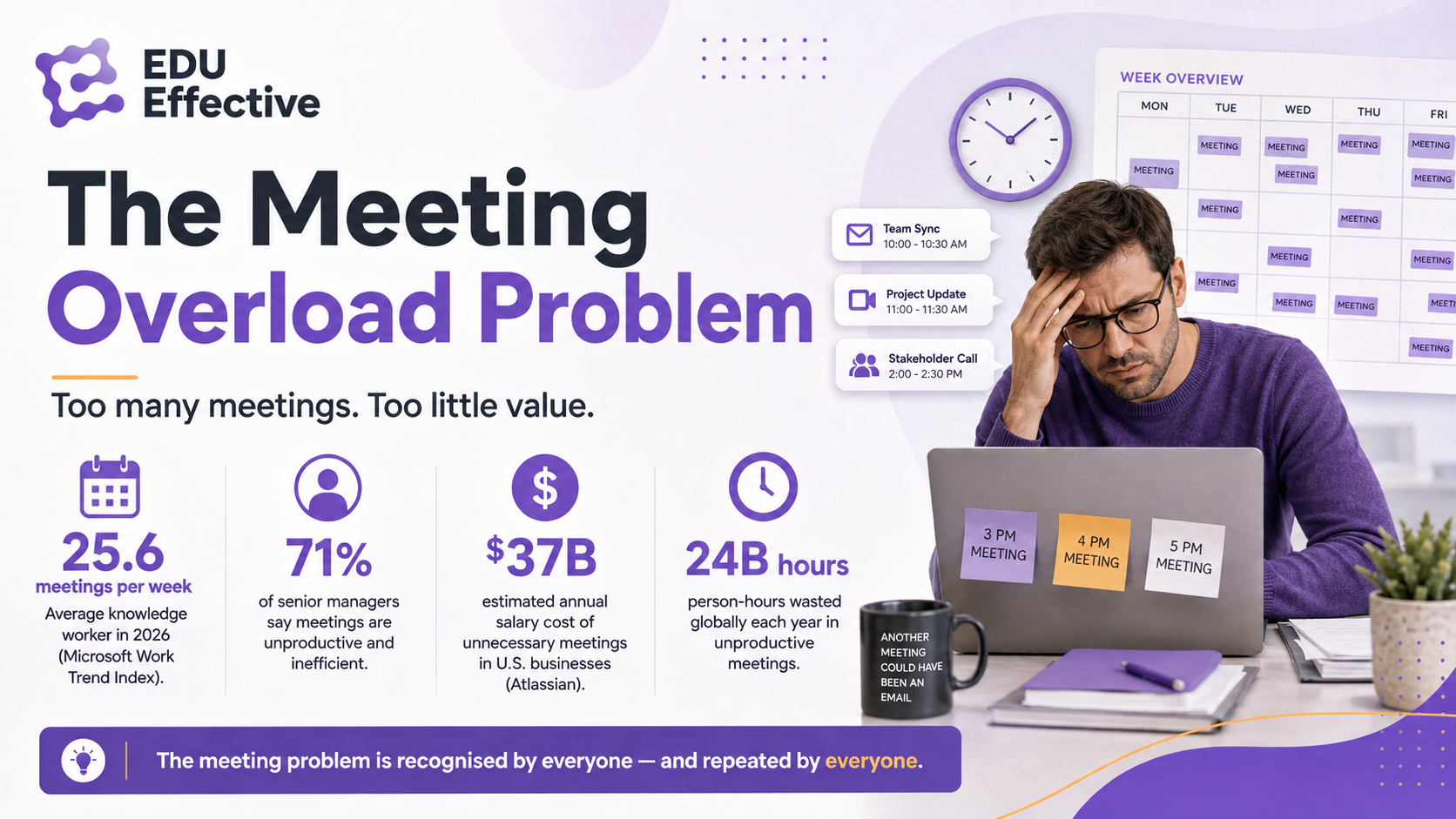
The average knowledge worker attends 25.6 meetings per week in 2026 — up 252% since 2020, according to Microsoft's Work Trend Index. That is more than five meetings per working day, before any actual work has been done. And 71% of senior managers say meetings are unproductive and inefficient, according to Harvard Business Review research — meaning the people who schedule the most meetings are also the ones most convinced that meetings are not working.
The financial cost of this dysfunction is specific and large. Atlassian's research estimates that unnecessary meetings cost US businesses $37 billion in salary costs annually, with 24 billion person-hours wasted each year globally in meetings that participants themselves recognise as unproductive. For a single organisation with 5,000 employees, the annual cost of ineffective meetings can exceed $100 million.
The paradox of modern meeting culture is that the problem is universally recognised and almost universally perpetuated. Everyone agrees that too many meetings are too long, too unfocused, and too poorly run. And the next meeting gets scheduled anyway. This guide is about breaking that cycle.
Why meetings fail — the consistent patterns
Before examining what makes a meeting effective, it is worth being precise about what makes most of them ineffective — because the failure patterns are consistent and predictable across organisations, industries, and cultures.
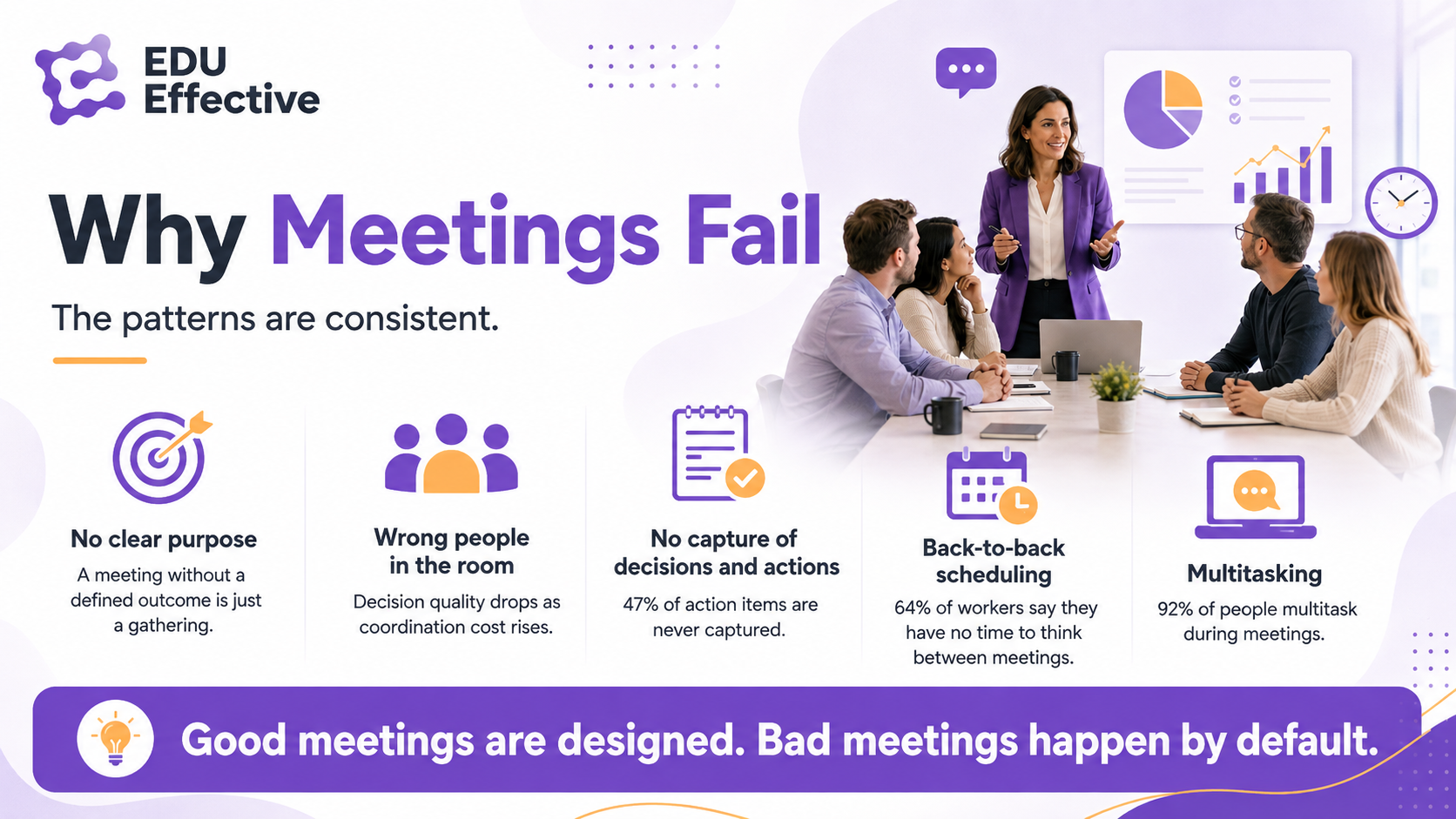
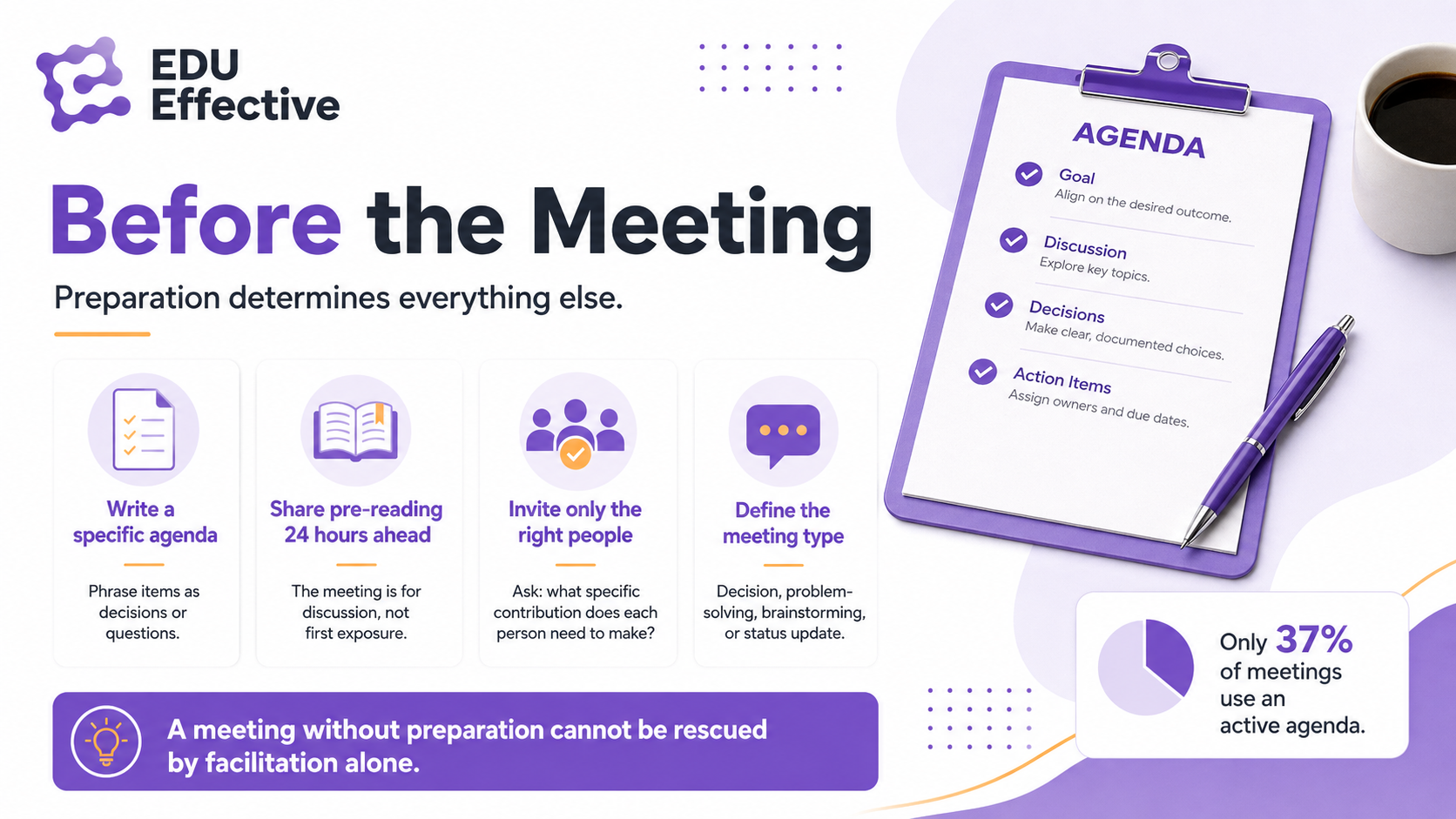
No clear purpose. The most fundamental question in meeting management — "what decision or outcome does this meeting need to produce?" — is not asked before most meetings are scheduled. A meeting without a defined outcome is not a meeting; it is a gathering. Gatherings consume time; they do not produce decisions. The research finding that only 37% of meetings use an active agenda reflects this gap: without a defined purpose, an agenda cannot be written, and without an agenda, a meeting has no mechanism for staying focused.
Wrong people in the room. Every additional person in a meeting adds coordination overhead, increases the time required to reach decisions, and reduces the probability that every attendee's presence was genuinely necessary. Jeff Bezos's two-pizza rule — if a meeting requires more than two pizzas to feed its attendees, it is too large — reflects a specific insight about group decision-making: decision quality does not scale linearly with group size, but coordination cost does. Optimal meeting group size for decision-making is consistently identified in research as fewer than eight people.
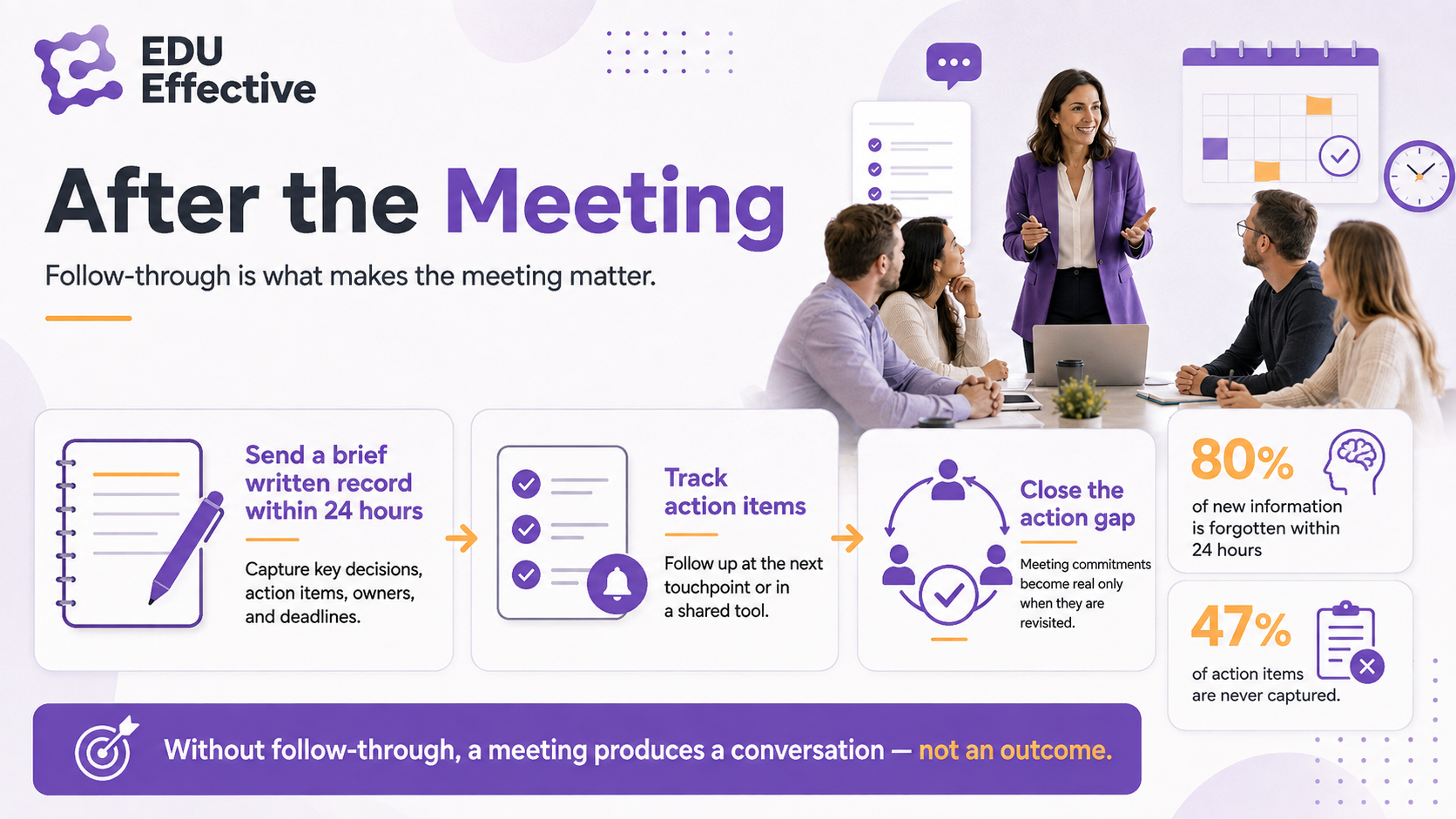
No capture of decisions and actions. 47% of action items discussed in meetings are never captured, according to current workplace research. The meeting that produces a good decision but no written record of that decision — who is responsible, by when, with what resources — produces no meaningful outcome. The decision exists only in the fading memories of the people who were present, and it will need to be made again.
Back-to-back scheduling. The median uninterrupted focus block for a knowledge worker in 2026 has narrowed to approximately 20 minutes before the next interruption. Back-to-back meetings eliminate any possibility of the cognitive transitions — the processing, reflecting, and preparing — that allow people to arrive at the next meeting ready to contribute rather than still mentally present in the last one. Microsoft's Work Trend Index found that 64% of workers feel they have no time to think between meetings — and that this feeling is the primary driver of the meeting fatigue that makes meetings less productive over the course of a working day.
Multitasking. 92% of people multitask during meetings, according to research cited across multiple workplace productivity studies. Multitasking during a meeting is not a failure of attention or professionalism — it is a rational response to a meeting whose content is not sufficiently relevant to the attendee's work to justify their full attention. The cause is the symptom: meetings that include people who do not need to be there produce people who multitask. Multitasking reduces the quality of both the meeting participation and the parallel work, producing two diminished outputs instead of one strong one.
The first question: does this need to be a meeting at all?
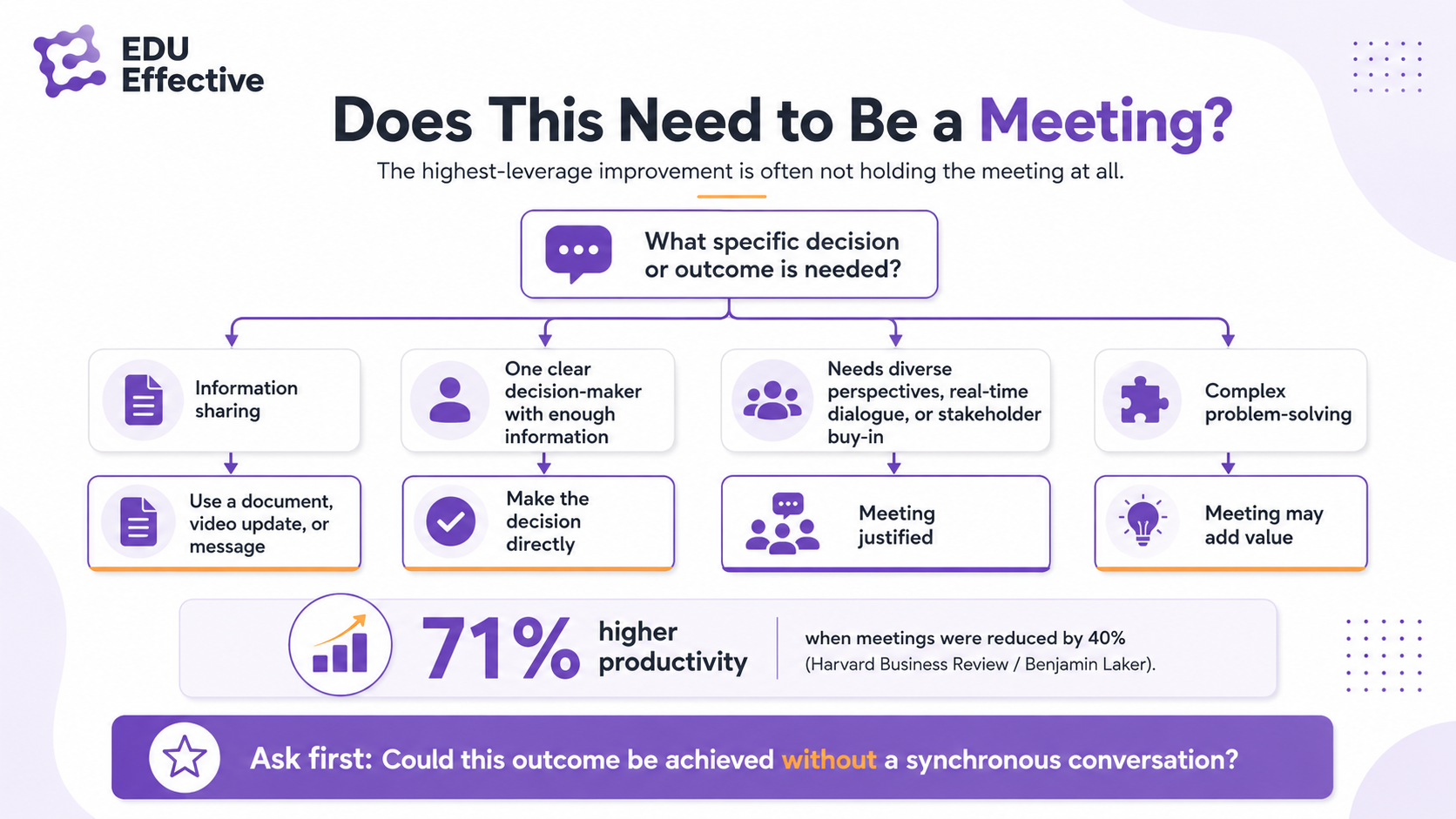
The single highest-leverage meeting management intervention available is not improving how meetings are run — it is not running meetings that should not happen at all. Research by Benjamin Laker, reported in Harvard Business Review, found that employee productivity was 71% higher when meetings were reduced by 40% — providing the most widely cited quantitative benchmark for the return on meeting reduction.
The practical test for whether a meeting is necessary is straightforward: what decision or outcome does this meeting need to produce, and is a synchronous conversation genuinely the most efficient way to produce it?
Information sharing rarely requires a meeting. A well-written document, a recorded video update, or an asynchronous message delivers information more efficiently — recipients can consume it when they are ready rather than at a scheduled time, can reread unclear sections, and do not need to synchronise their schedules. The instinct to "have a meeting to discuss this" before verifying that discussion is actually needed produces most of the unnecessary meeting volume that Microsoft's Work Trend Index tracks.
Decisions with clear decision-makers and sufficient information rarely require a meeting. A decision that one person can make with available information should be made by that person, not subjected to a group meeting whose primary effect is to diffuse accountability without improving decision quality.
Decisions that genuinely benefit from diverse perspectives, where the quality of the decision is improved by real-time dialogue, where buy-in from multiple stakeholders is required for implementation — these justify a meeting. So do complex problems where the dynamic of real-time exchange produces insights that sequential individual thinking does not.
The question to ask before scheduling any meeting: "What is the specific decision or outcome this meeting needs to produce, and could that outcome be achieved without a synchronous conversation?"
Before the meeting: the preparation that determines everything else
The quality of a meeting is determined primarily before it starts. A meeting that begins without a clear purpose, a prepared agenda, and the right people in the room cannot be rescued by good facilitation during the session.
Write a specific agenda with a defined outcome. An agenda that lists topics — "Q3 update," "Marketing strategy," "Team issues" — is not an agenda; it is a list of categories. An effective meeting agenda defines specific questions to be answered or decisions to be made: "Decide on the Q3 marketing budget allocation between search and social," "Agree on the criteria for evaluating the three vendor proposals," "Identify the top two obstacles to the September launch and assign owners." Each agenda item should be phrased as a question or a decision, so that the meeting has a clear test for whether the item has been resolved.
Share the agenda — and any necessary pre-reading — at least 24 hours before the meeting. A meeting at which attendees encounter complex information for the first time produces lower quality discussion than one at which attendees have had time to read, think, and form views in advance. The meeting should be for the discussion, not for the information transfer that enables it. Pre-reading that is genuinely required for the meeting to be productive should be explicitly identified as required, not optional.
Invite only the people who need to be there. For each invited attendee, there should be a clear answer to: "What specific contribution does this person need to make to this meeting's outcome?" If the honest answer is "they should be kept informed," they do not need to attend — they can receive the meeting notes. If the honest answer is "it would be polite to include them," they do not need to attend. Unnecessary attendees increase coordination overhead, dilute decision quality, and create the conditions for the multitasking that signals to every attendee that the meeting's content is not worth their full attention.
Define the meeting type. Different types of meetings have different purposes and require different facilitation approaches. A decision-making meeting needs clear decision criteria and a defined decision-maker. A problem-solving meeting needs a clearly defined problem and a structured exploration process. A status update meeting is almost always more efficiently replaced by a written update. A brainstorming meeting needs psychological safety and a clear constraint on evaluation during the generative phase. Knowing which type of meeting you are running before it starts determines what preparation is needed and how it should be facilitated.
During the meeting: facilitation that produces outcomes
Effective meeting facilitation is not a soft skill or a personality trait — it is a set of specific practices that can be learned and applied consistently.
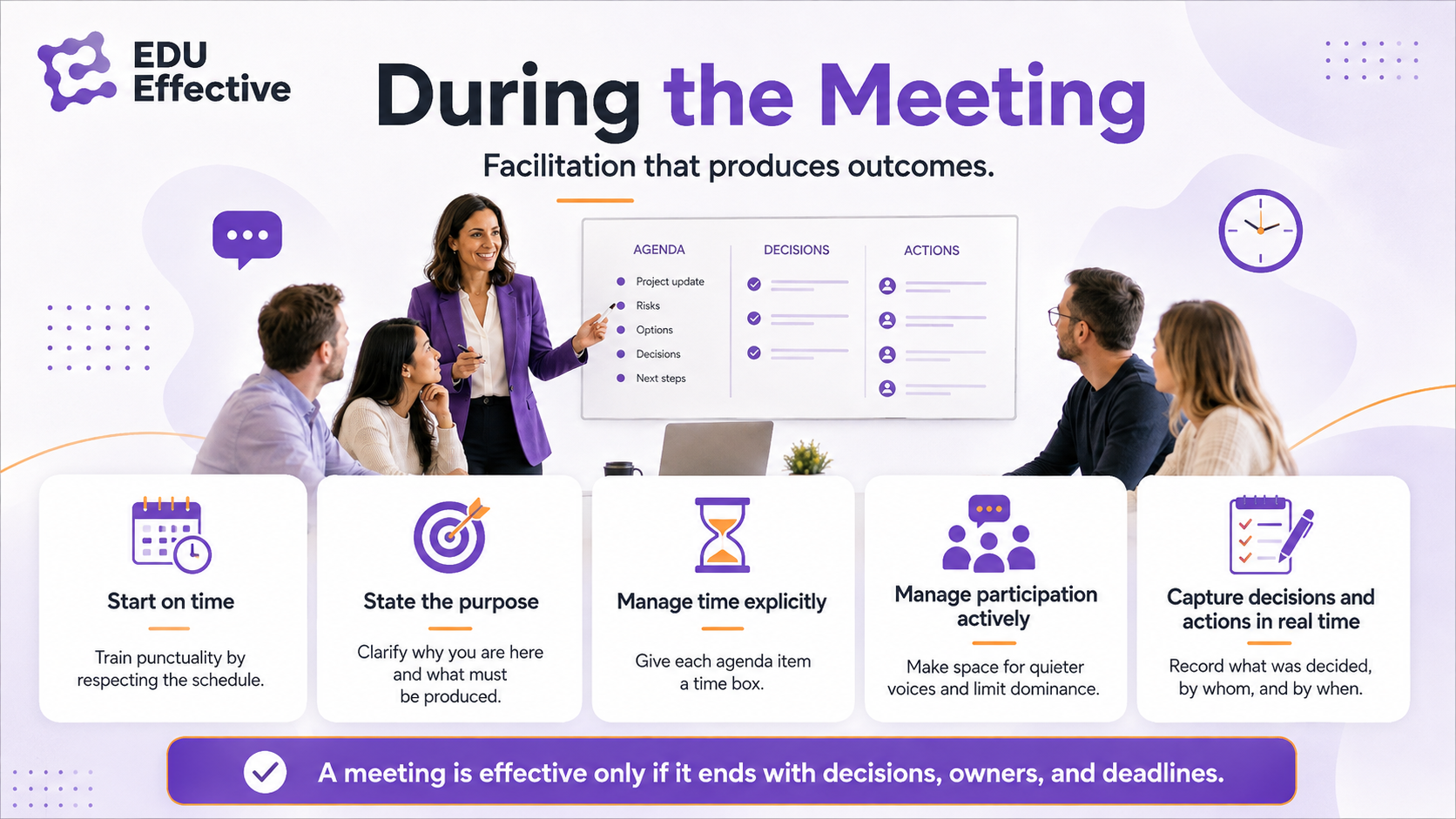
Start on time, every time. Starting late rewards lateness and penalises the people who arrived on time by making them wait. More significantly, it signals that the meeting organiser does not consider attendees' time sufficiently important to start when agreed. Starting precisely on time — even if not everyone is present — consistently trains attendees to arrive on time, because they know the meeting will start without them.
State the purpose and desired outcome at the start. The first 60 seconds of a meeting should answer: "Why are we here, what do we need to produce by the end of this session, and how will we work to get there?" This framing orients attendees, establishes a shared reference point for whether the meeting is making progress, and provides a mechanism for the facilitator to redirect the conversation when it drifts.
Manage time explicitly. Each agenda item should have an allocated time, and the facilitator should track time visibly and explicitly rather than allowing individual items to expand until the meeting runs long. Parkinson's Law — that work expands to fill the time available — applies directly to meetings: a 60-minute default slot produces 60-minute meetings regardless of agenda complexity. Time pressure, applied explicitly and transparently, focuses discussion more effectively than any facilitation technique.
Manage participation actively. The failure mode of most meetings is a conversation dominated by one or two voices while the rest of the room — physically or virtually — contributes minimally or disengages. The facilitator's job is to actively create space for the perspectives that are not naturally assertive — by specifically inviting quieter attendees to contribute, by directing questions to specific people rather than to the room, and by interrupting dominant voices when their contribution is preventing others from contributing.
Capture decisions and actions in real time. Every decision made in a meeting should be written down, in shared view, as it is made: what was decided, who is responsible, by when. Every action item should be recorded with a specific owner and a specific deadline before the meeting moves to the next topic. The facilitator who ends a meeting without reviewing the list of decisions and actions is leaving the most important output of the meeting in the unreliable custody of individual memories.
After the meeting: the follow-through that makes it matter
The meeting that ends without a clear record and follow-through process has produced a conversation, not an outcome. The actions that were agreed in the meeting exist only in the memories of the people who were present — which are already beginning to degrade at the rate of 80% of new information within 24 hours, according to Ebbinghaus forgetting curve research.
Send a brief written record within 24 hours. The meeting record does not need to be a verbatim transcript — it needs to capture the key decisions made, the action items assigned (with owners and deadlines), and any context that is necessary for someone who was not present to understand what was decided. A meeting record that takes more than ten minutes to read has been over-engineered; a meeting record that omits the action items is useless.
Follow up on action items at the next available touchpoint. The manager who assigns action items in a meeting and never references them again is training their team that meeting commitments are not real commitments. Tracking action items — at the next one-to-one, at the next team meeting, or through a shared project management tool — is the management behaviour that closes the 47% action item gap.
AI in meeting management: what it can and cannot do
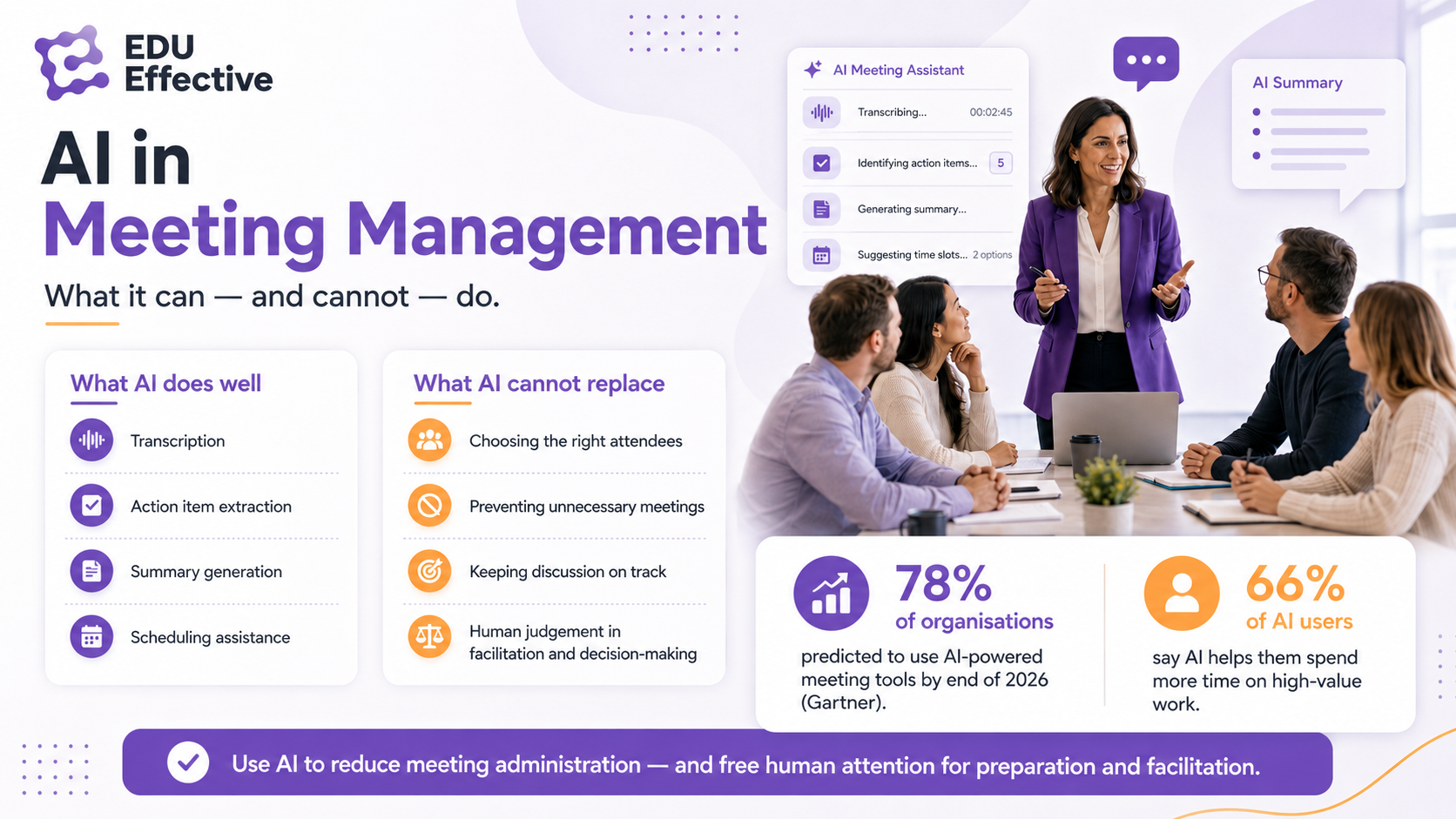
78% of organisations are predicted to use AI-powered meeting tools by the end of 2026, according to Gartner research. AI tools for meeting management — automated transcription, action item extraction, summary generation, and meeting scheduling assistance — address several of the most time-consuming aspects of meeting administration.
AI meeting tools are most valuable for reducing the administrative overhead of meetings: transcribing accurately, capturing action items reliably, and generating readable summaries that can substitute for manually written meeting notes. Microsoft's Work Trend Index found that 66% of AI users say AI helps them spend more time on high-value work — and meeting administration is one of the clearest examples of lower-value work that AI can handle effectively.
The limitation is equally specific: AI can capture what was said and extract the action items from a meeting. It cannot improve the quality of the discussion, ensure that the right people are in the room, prevent a meeting from drifting off agenda, or replace the human judgement that determines whether a meeting needed to happen at all. The managers who use AI most effectively in meeting management are those who use it to reduce the time spent on meeting administration — freeing their attention for the facilitation and preparation that actually determines whether meetings produce value.
At EDU Effective, the Effective MBA: Executive Management & Leadership develops meeting management, facilitation, time management, and the full range of management capabilities that allow managers to protect their teams' most valuable resource: focused working time. Explore the programme →
Related articles:
- Time Management for Managers: Why Most Approaches Fail and What Actually Works
- How to Delegate Effectively: A Practical Manager's Guide
- Decision-Making for Managers: How to Make Better Decisions Under Uncertainty
EDU Effective Business School — professional development for your long-term success.
All five Effective MBA programs are built on the same educational model — designed for working adults who need learning that fits real professional life:
- Effective MBA: Executive Management & Leadership
- Effective MBA: Applied Artificial Intelligence
- Effective MBA: Coaching, Leadership & Mentoring
- Effective MBA: Mastery in AI
- Effective MBA: Online Marketing
Every programme runs on 15 minutes a day, completes in 10 months or less, is ASIC accredited, and starts from €990.
These are professional programmes, not academic ones — built for working adults to apply what they learn directly in their own business, not to collect a scholarly credential.
Join more than 9,000 students in over 120 countries who are investing in their professional development and career success. Read the experiences of our graduates here.
Apply now — from €990 · Talk to a Study Advisor
Study with NO risk: 14-day money-back guarantee, no questions asked.
Sources
- Microsoft — Work Trend Index 2025/2026: Meeting Volume Up 252% Since 2020, 25.6 Meetings Per Week https://news.microsoft.com/annual-work-trend-index-2026/
- Atlassian — You Waste a Lot of Time at Work: $37 Billion Annual Cost, 24 Billion Hours Wasted, 72% Ineffective https://www.atlassian.com/time-wasting-at-work-infographic
- Harvard Business Review — Stop the Meeting Madness: 71% of Senior Managers Say Meetings Are Unproductive (Perlow, Hadley & Eun) https://hbr.org/2017/07/stop-the-meeting-madness
- Harvard Business Review / Benjamin Laker — To Improve Your Team's Performance, Get Them Working on Fewer Projects: 40% Fewer Meetings = 71% Higher Productivity https://hbr.org/2022/03/dear-manager-youre-holding-too-many-meetings
- American Psychological Association — Multitasking: Switching Costs and 40% Productivity Loss https://www.apa.org/topics/research/multitasking
- Gartner — 78% of Organizations to Use AI-Powered Meeting Tools by End of 2026 https://www.gartner.com/en/newsroom/press-releases/2026-09-09-gartner-identifies-four-shifts-shaping-the-future-of-work
- Reclaim.ai — State of AI & Productivity: Calendar Analytics and Focus Time Data 2026 https://reclaim.ai/blog/google-cloud-next-deep-work-trends-report