
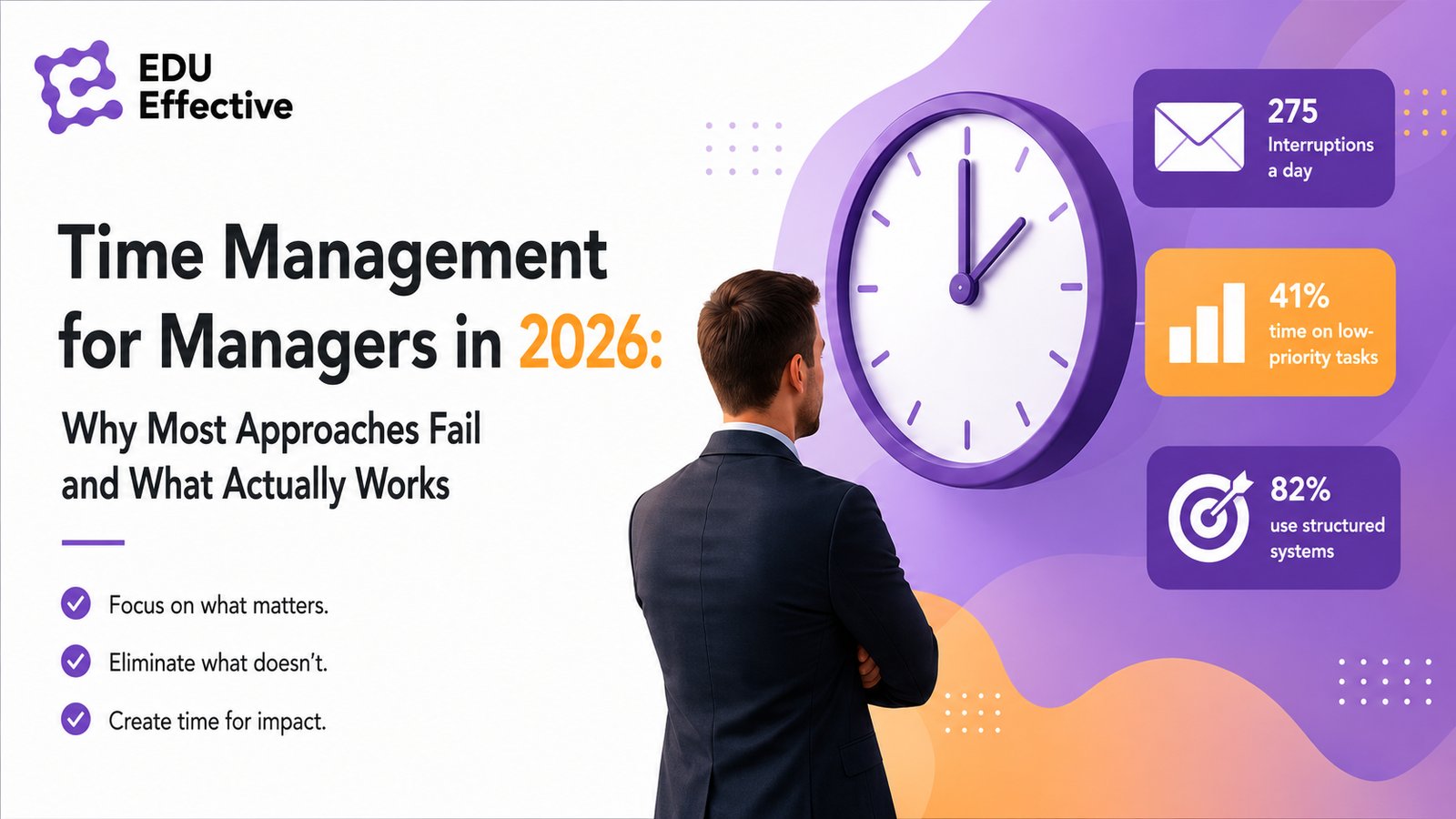

The average knowledge worker is interrupted by a meeting, email, Teams message, or notification 275 times during core working hours — roughly once every two minutes — according to Microsoft's 2026 Work Trend Index, which analysed telemetry across millions of Microsoft 365 users. That is the texture of a typical professional workday in 2026: a continuous stream of synchronous demands that structurally crowds out the sustained, focused thinking that meaningful work requires.
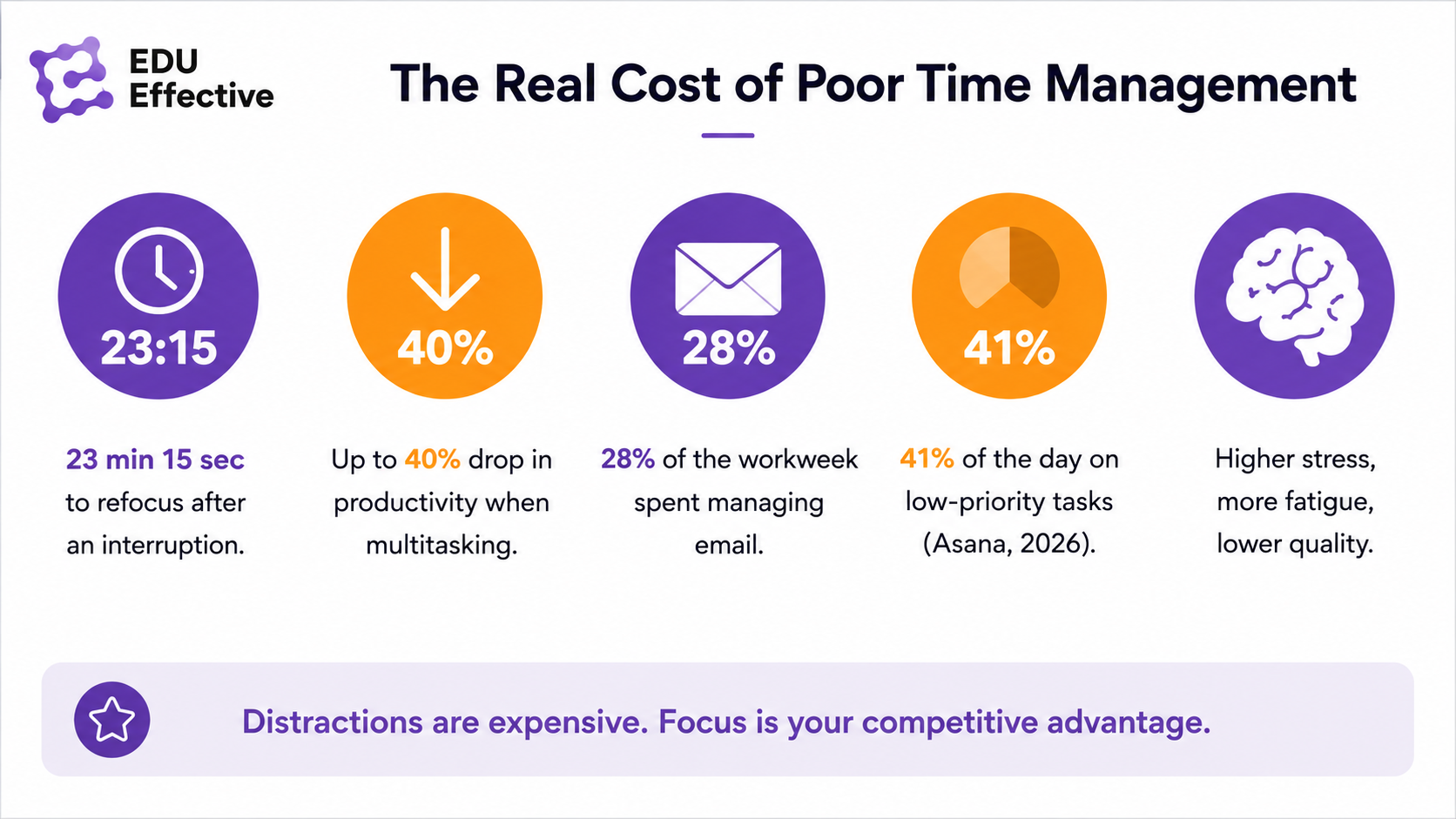
The consequences show up in several places simultaneously. Employees spend 41% of their workday on low-priority tasks that contribute minimally to their goals, according to Asana's Anatomy of Work Index. McKinsey Global Institute's Social Economy research — the most widely cited benchmark for knowledge worker time allocation — found that professionals spend 28% of the workweek managing email. Microsoft's Work Trend Index adds the current-day dimension: knowledge workers receive 275 interruptions per day from meetings, emails, and notifications combined.
And yet: 82% of successful professionals use structured time management systems to stay organised and meet their goals. Structured workflow and time management practices produce a measurable 20% improvement in knowledge work productivity in meta-analytic research. The gap between those who manage their time deliberately and those who respond reactively to whatever arrives is not a personality difference. It is a systems difference — and systems can be built.
Why time management problems are structural, not personal
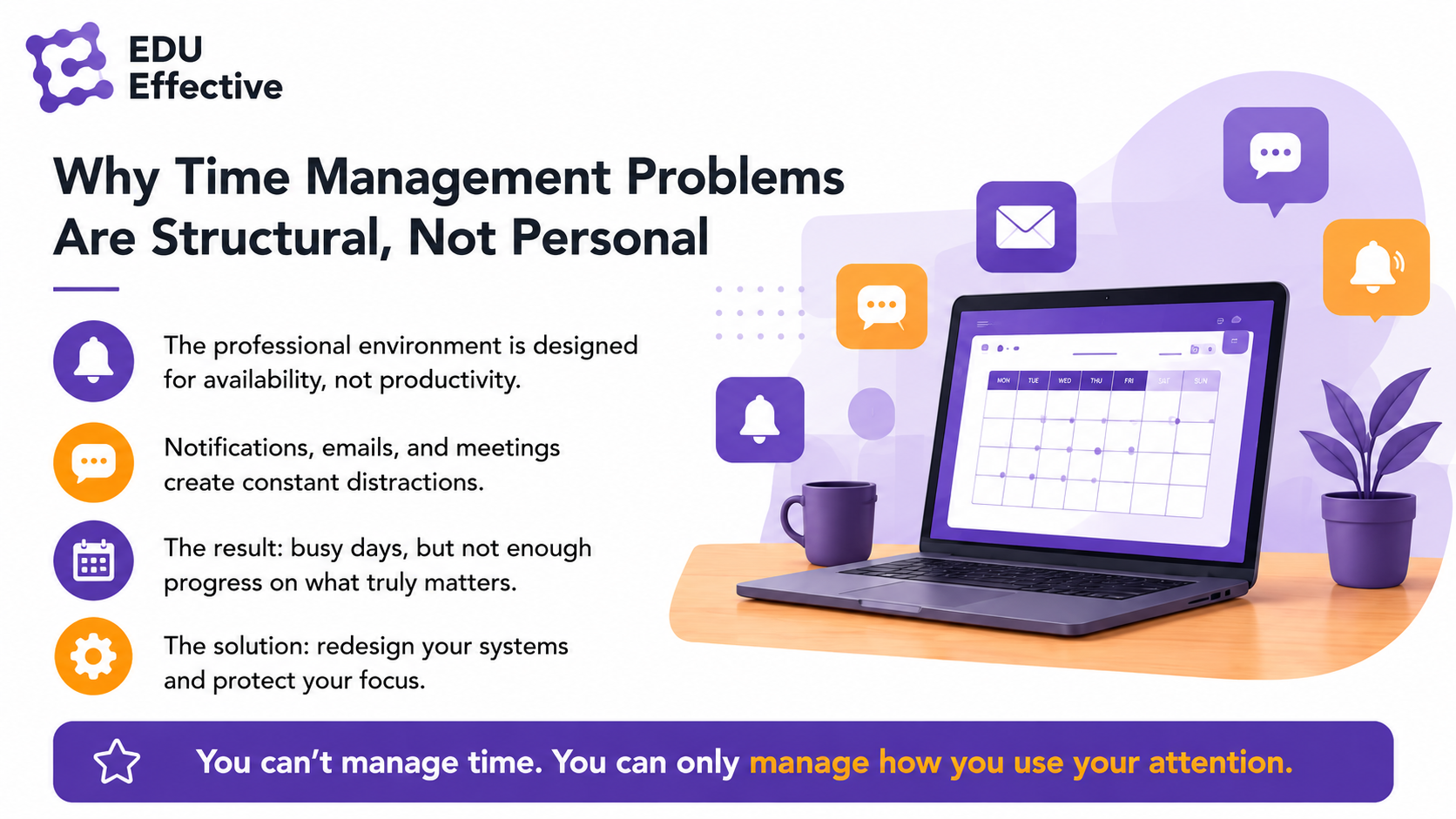
The instinct when struggling with time management is to attribute it to personal discipline, willpower, or organisation. This framing is both inaccurate and unhelpful, because it suggests a remedy — try harder, be more organised — that does not address the actual causes of the problem.
The real cause of most professional time management failures is environmental: the default configuration of most professional environments is optimised for availability and responsiveness rather than for productive output. Notifications arrive in real time. Email is expected to be answered quickly. Meeting invitations arrive without context or agenda. Calendars fill from the outside rather than being built from the inside.
This default configuration produces a specific failure mode: the manager who arrives at work each day and spends the day responding to whatever demands arrive, doing good work on each individual task, and arriving at the end of the week with a feeling of having been very busy but not having made meaningful progress on the things that actually matter.
The research on this is consistent and specific. It takes an average of 23 minutes and 15 seconds to refocus on the original task after an interruption, according to Gloria Mark's research at UC Irvine. Multitasking reduces productivity by up to 40% and increases error rates. Knowledge workers who switch between tasks frequently report significantly lower quality of output and higher levels of cognitive fatigue than those who work in sustained focus periods.
The solution is not time management in the sense of becoming better at handling the current configuration. It is redesigning the configuration itself — building an environment that protects the conditions for productive work rather than defaulting to the conditions that undermine it.
The attention economy problem: deep work versus shallow work
The most useful framework for understanding professional time management in 2026 is the distinction between deep work and shallow work, articulated by Cal Newport and consistent with a substantial body of cognitive science research.
Deep work is cognitively demanding, high-value activity performed in a state of distraction-free concentration — strategic thinking, complex problem-solving, substantial writing, difficult analysis, the kind of work that produces the outcomes that justify a professional's existence in an organisation. Deep work typically requires at least 60 to 90 minutes of uninterrupted concentration before it reaches the quality that makes it genuinely valuable.
Shallow work is logistical, administrative, or communicative work that can be done while partially distracted — answering emails, scheduling meetings, attending status updates, completing routine reports. This work needs to be done, but it rarely produces output that is difficult to replicate or delivers significant competitive advantage. It is the work that fills the default professional day.
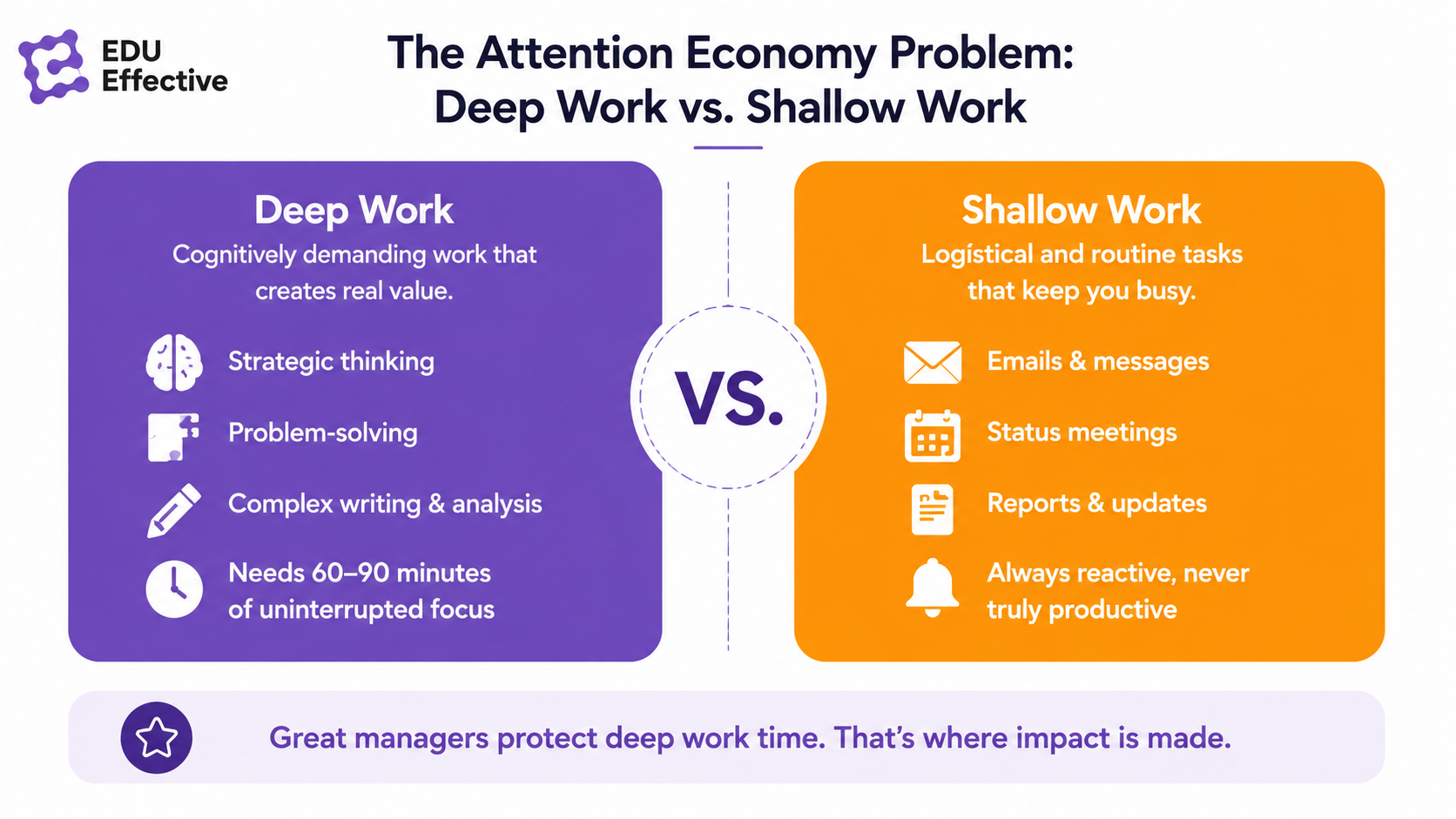
The structural problem of most professional environments is that they are configured to optimise for shallow work — immediate responses, perpetual availability, maximum meeting coverage — while requiring deep work outcomes. 68% of professionals report their workday does not include enough uninterrupted focus time, according to productivity research. The managers who achieve the most are not those who work the most hours. They are those who have designed environments and habits that protect consistent access to deep work time.
The Eisenhower Matrix: a framework for ruthless prioritisation
The single most consistently useful prioritisation tool for managers is the Eisenhower Matrix — a two-by-two grid originally associated with President Dwight Eisenhower's decision-making approach and formalised as a time management framework.
The matrix sorts all tasks into four quadrants based on two dimensions: urgency (does this need to be addressed immediately?) and importance (does this genuinely contribute to my most significant goals?).
Quadrant 1: Urgent and Important — crises, genuine deadlines, consequential problems that require immediate attention. Do these immediately. The instinct is to spend the whole day here, but a professional who lives primarily in Quadrant 1 is managing by crisis rather than by design.
Quadrant 2: Important but Not Urgent — strategic planning, relationship building, professional development, proactive problem prevention, the high-leverage activities that create the future rather than managing the present. This is where the most professionally successful people invest the majority of their intentional time. Employees who focus primarily on Quadrant 2 work report 33% higher purpose and meaning scores, according to Gallup research — because this is the work that connects to goals rather than merely responding to demands. why Quadrant 2 time investment is the structural precondition for strategic thinking — and how the managers who compound their results over time consistently protect the deliberate space that long-term strategic focus requires
Quadrant 3: Urgent but Not Important — most interruptions, many meetings, requests that feel time-sensitive but do not genuinely advance your most important objectives. These are the primary source of busyness without productivity. The appropriate response to most Quadrant 3 demands is to decline, delegate, or batch — not to treat them as priorities because they feel urgent.
Quadrant 4: Not Urgent and Not Important — distractions, busywork, low-value tasks that masquerade as productive activity. These should be eliminated, automated, or radically time-limited.
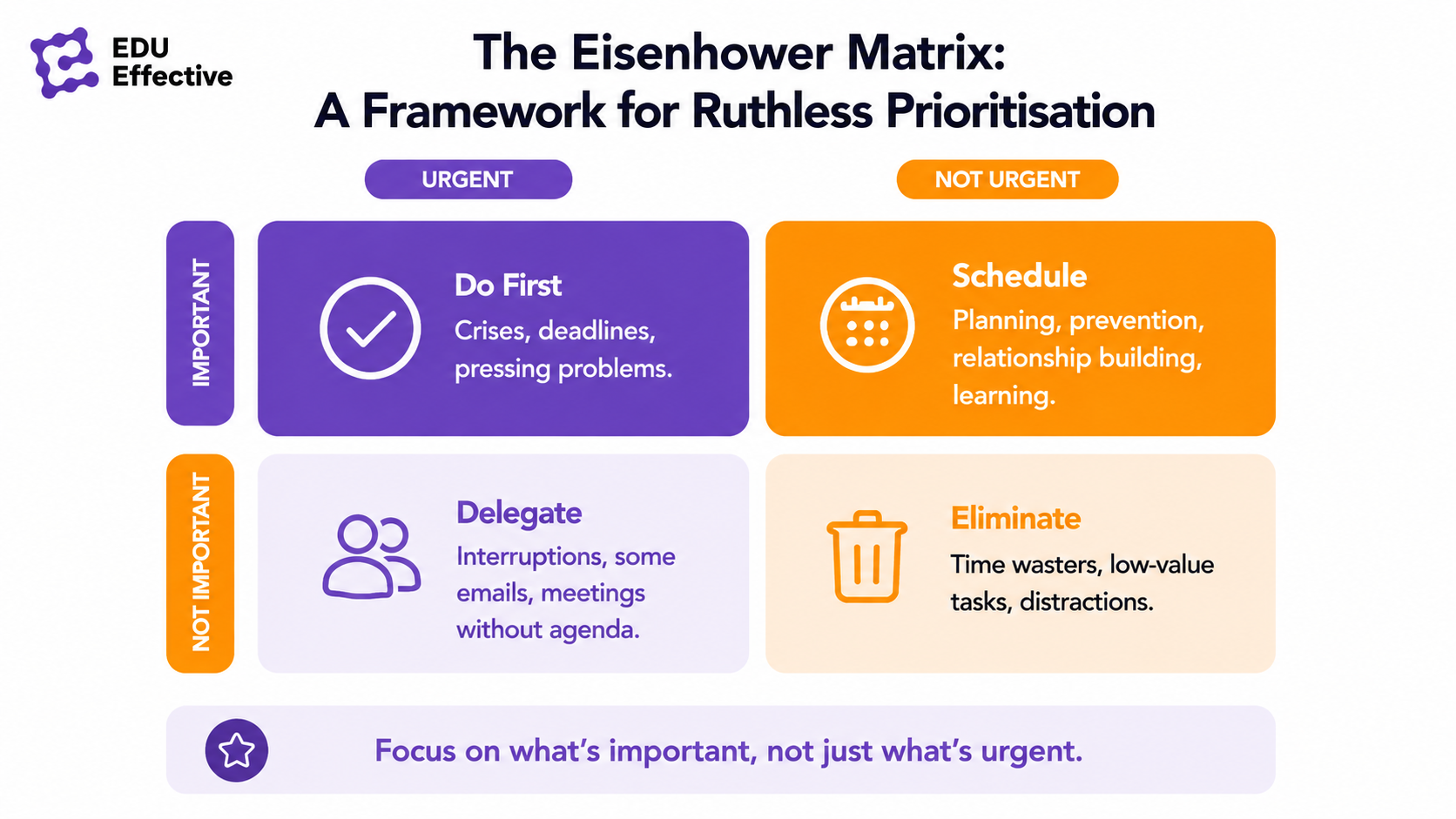
The practical discipline the matrix develops is a specific one: the ability to distinguish between what feels urgent and what actually matters. Most professionals are excellent at responding to what feels urgent. The professionals who compound their results over time are those who consistently invest in what is important — which rarely feels urgent until the failure to invest in it becomes a crisis.
Time blocking: protecting the calendar from the outside
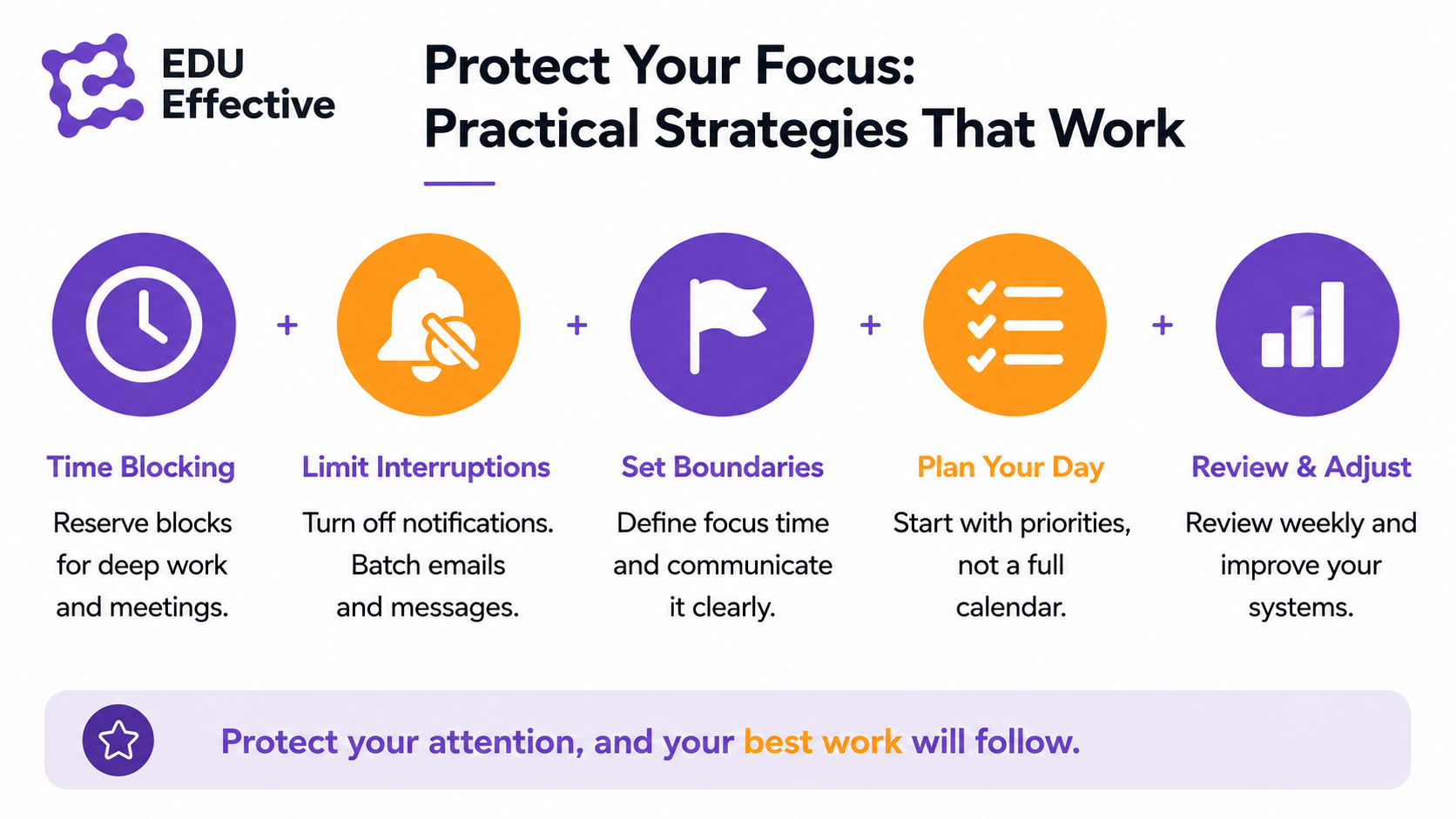
Time blocking is the practice of assigning specific calendar slots to specific types of work — and treating those blocks with the same commitment that would be given to an external meeting with an important client.
The mechanics are straightforward. At the beginning of each week, before the week begins, identify the two or three most important things you need to accomplish and block specific time for each. Deep work blocks should be at least 90 minutes and scheduled at the time of day when your cognitive performance is highest. Communication blocks — dedicated periods for email and messaging — can be shorter and scheduled at lower-energy periods.
The discipline that makes time blocking work is treating scheduled blocks as non-negotiable commitments rather than aspirational intentions. A blocked 90-minute period for strategic planning that gets cancelled every time a meeting request arrives produces no value. The same blocked period, protected consistently, compounds into the strategic work that distinguishes leaders who are building something from those who are merely managing the present. why protecting deliberate decision-making time is itself a time management discipline — and how time blocking creates the conditions for the slow, analytical System 2 thinking that consequential decisions require
Reclaim.ai's analysis of more than 1.5 million calendar events found the average professional attends 25.6 meetings per week — up from 14 per week before 2020. 72% of meetings are perceived as unproductive by their participants, according to Atlassian's research. The professionals who recover meaningful time from meeting overload are those who apply explicit criteria to every meeting invitation: does this require my presence? Does it need to be synchronous? Could the objective be achieved with an email, a shared document, or a brief async update? why reducing meeting overload in hybrid teams is both a time management and a distributed team management challenge — and how the async-first principle addresses both simultaneously
The prioritisation practice: weekly and daily
Time blocking is a calendar practice. Prioritisation is a thinking practice — and it needs to happen before the week and day begin, not reactively in response to what arrives.
The weekly review — a structured practice of reviewing the coming week's commitments and priorities before Monday begins — is one of the highest-return time management habits available. It takes 30 to 45 minutes. It produces clarity about which commitments matter most, identifies conflicts or overcommitments before they become crises, and provides the information needed to make intentional choices about time allocation rather than reactive ones.
The daily prioritisation practice is simpler and faster: at the end of each workday or the beginning of the next, identify the three most important things to accomplish in the coming day and schedule specific time for each. This practice disconnects your day's structure from whatever happened to arrive first in your inbox and reconnects it to what you have deliberately decided matters most.
58% of American workers say they are so busy with daily tasks that they lack time to consider anything beyond their current to-do list, according to Workfront research. This is precisely the condition that weekly and daily planning practices address — by creating the structure that makes deliberate prioritisation possible rather than leaving the day's shape entirely to external forces.
Delegation: the time management skill most managers underutilise
For managers specifically, delegation is the most high-leverage time management practice available — and the one most consistently underutilised. The manager who does not delegate is both failing to manage their own time effectively and failing to develop the team members who could and should be taking on more.
The barriers to delegation are well-documented: the sense that it is faster to do something yourself, the discomfort with handing over something that might not be done exactly as you would do it, the concern about appearing to avoid work. None of these barriers reflects the commercial reality that a manager's time is most valuable when applied to the work only they can do — strategic thinking, relationship management, decision-making, development of team members — and is least valuable when applied to work that a capable team member could do with appropriate support.
Employees who receive delegated responsibilities score 18% higher on engagement surveys in the manager relationship category, according to Gallup Q12 data. Delegation is not just time management — it is also team development and engagement investment, happening simultaneously. how delegation connects time management and coaching into a single management practice — and why the managers who develop their team's capability to take on more responsibility are simultaneously recovering the time they need for the work only they can do
Time management and microlearning: the direct connection
One of the most consistent objections to professional development among working adults is time. "I don't have time to study" is the most frequently cited reason for not investing in learning, according to OECD research on adult learners.
This objection is real. It is also addressable — and the microlearning model that EDU Effective is built around addresses it directly. Fifteen minutes a day, structured as a single focused block with a clear objective and immediate application to real work, fits into the schedule of any professional without requiring the reorganisation of their professional or personal life. It is the same principle as time blocking applied to professional development: protecting a small, consistent, non-negotiable block for the work that compounds over time. why microlearning is the format that resolves the OECD's most frequently cited barrier to professional development — and what 15 minutes of structured daily learning compounds into over ten months
A professional who completes one focused 15-minute learning block each day for ten months has built a meaningful qualification while also developing the time management habit that makes the learning possible. The two reinforce each other.
At EDU Effective, the Effective MBA: Executive Management & Leadership develops time management, prioritisation, and delegation skills alongside the full range of management capabilities — designed specifically for professionals who need to fit meaningful development into real working lives. Explore the programme →
EDU Effective Business School — professional development for your long-term success.
All five Effective MBA programs are built on the same educational model — designed for working adults who need learning that fits real professional life:
- Effective MBA: Executive Management & Leadership
- Effective MBA: Applied Artificial Intelligence
- Effective MBA: Coaching, Leadership & Mentoring
- Effective MBA: Mastery in AI
- Effective MBA: Online Marketing
Every programme runs on 15 minutes a day, completes in 10 months or less, is ASIC accredited, and starts from €990.
These are professional programmes, not academic ones — built for working adults to apply what they learn directly in their own business, not to collect a scholarly credential.
Join more than 9,000 students in over 120 countries who are investing in their professional development and career success. Read the experiences of our graduates here.
Apply now — from €990 · Talk to a Study Advisor
Study with NO risk: 14-day money-back guarantee, no questions asked.
Sources
- Microsoft — Work Trend Index 2026 (telemetry across millions of Microsoft 365 users) https://news.microsoft.com/annual-work-trend-index-2026/
- McKinsey Global Institute — The Social Economy: Unlocking Value and Productivity Through Social Technologies https://www.mckinsey.com/industries/technology-media-and-telecommunications/our-insights/the-social-economy
- Asana — State of Work Innovation https://asana.com/resources/state-of-work-innovation
- Atlassian — State of Teams 2026 (double-blind survey, 12,035 knowledge workers, Jan-Feb 2026) https://www.atlassian.com/blog/state-of-teams-2026
- Gloria Mark, UC Irvine — The Cost of Interrupted Work: More Speed and Stress & Attention Span https://www.ics.uci.edu/~gmark/
- Gallup — Q12 Employee Engagement: Purpose and Prioritisation Research https://www.gallup.com/workplace/236927/employee-engagement-drives-growth.aspx
- American Psychological Association — Multitasking: Switching Costs Research https://www.apa.org/research/action/multitask