

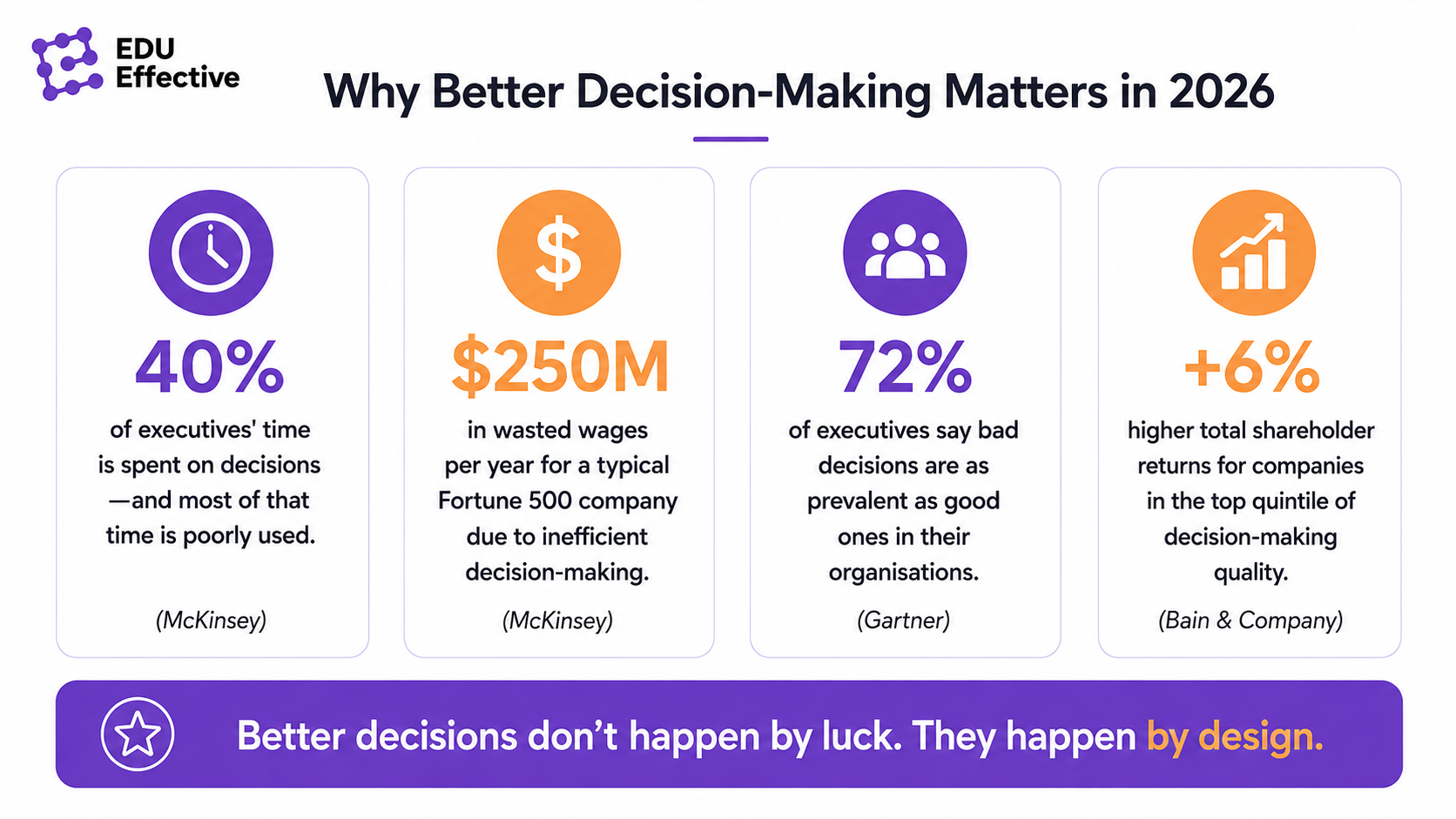
Executives spend an average of 40% of their time making decisions — and they believe most of that time is poorly used, according to McKinsey's research on decision-making effectiveness. Inefficient decision-making costs a typical Fortune 500 company 530,000 days of managers' time per year, representing approximately $250 million in wasted wages. And Gartner found that 72% of executives say that bad decisions are as prevalent as good ones in their organisations.
These numbers describe not just a competency gap but a structural problem. Most professionals are never explicitly taught how to make decisions. They make thousands of decisions over the course of a career and improve through experience — slowly, inconsistently, and without the conceptual tools that would allow them to learn from failures and replicate successes deliberately.
The research on decision quality is unambiguous about what it takes to improve: not more intuition, not faster reactions, but a clearer understanding of how decisions actually get made — including the systematic errors that distort human judgement — and the practical frameworks that counteract those errors. Companies in the top quintile of decision-making quality achieve average total shareholder returns nearly six percentage points higher than other companies, according to Bain & Company's Decision Effectiveness research — a finding consistent across countries, industries, and company sizes.
Two modes of thinking — and why both are necessary
The most influential framework for understanding human decision-making comes from the work of Nobel Prize-winning psychologist Daniel Kahneman, whose research on cognitive biases and heuristics fundamentally changed how organisations think about strategic judgement.
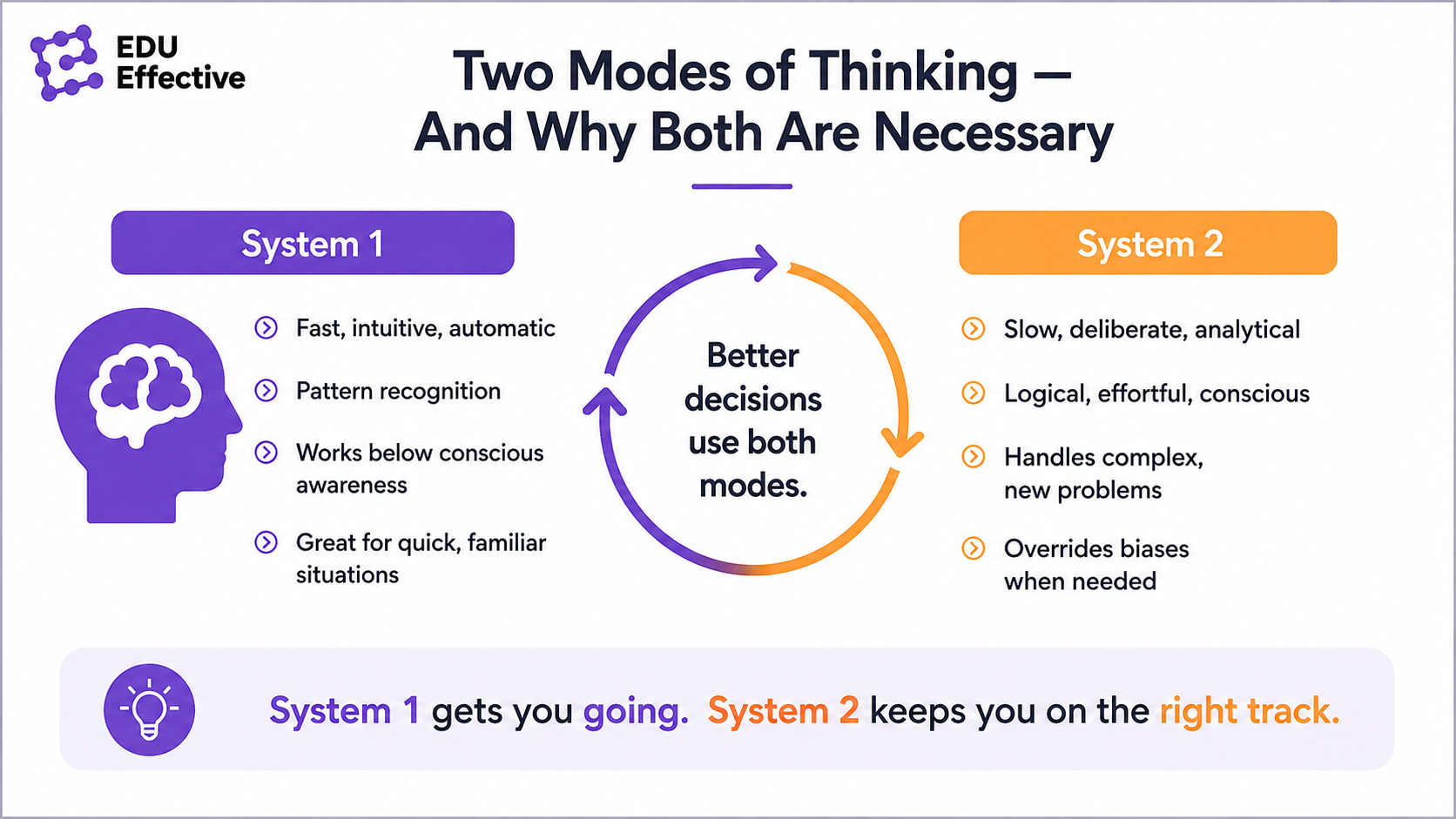
Kahneman's core insight — developed with Amos Tversky over decades of experimental research — is that human beings use two distinct modes of thinking. System 1 thinking is fast, intuitive, associative, and automatic. It operates below conscious awareness, drawing on pattern recognition built from experience to generate rapid responses to familiar situations. System 2 thinking is slow, deliberate, analytical, and effortful. It engages consciously with novel problems, evaluates alternatives, applies logic, and overrides System 1 responses when they are likely to be wrong.
Both modes are necessary and neither is inherently superior. System 1 thinking enables the experienced professional to read a situation quickly, respond to emerging dynamics without paralysis, and make fast decisions in time-sensitive contexts where deliberation would be too slow. The expert manager who can "read the room" in a difficult negotiation or identify that something is wrong with a financial model before consciously identifying the specific error is using System 1 thinking productively.
The problem is not System 1 thinking per se — it is the conditions under which System 1 thinking produces systematic errors. Kahneman calls these errors "cognitive biases" — predictable, reproducible patterns in which human judgement systematically deviates from rational analysis. These biases are not random. They occur in identifiable circumstances, they affect predictable categories of decision, and they can be anticipated and counteracted through deliberate process design. how strategic thinking frameworks shape the quality of decisions managers make — and why the ability to Anticipate, Challenge, and Interpret (McKinsey's six strategic thinking capabilities) directly determines whether the right decisions get made before they become urgent
The four biases that damage organisational decisions most
McKinsey's research identifies four cognitive biases as the most damaging in large organisational decision-making. Understanding each specifically — not as psychological curiosities but as predictable failure modes to actively counteract — is the foundation of decision quality improvement.
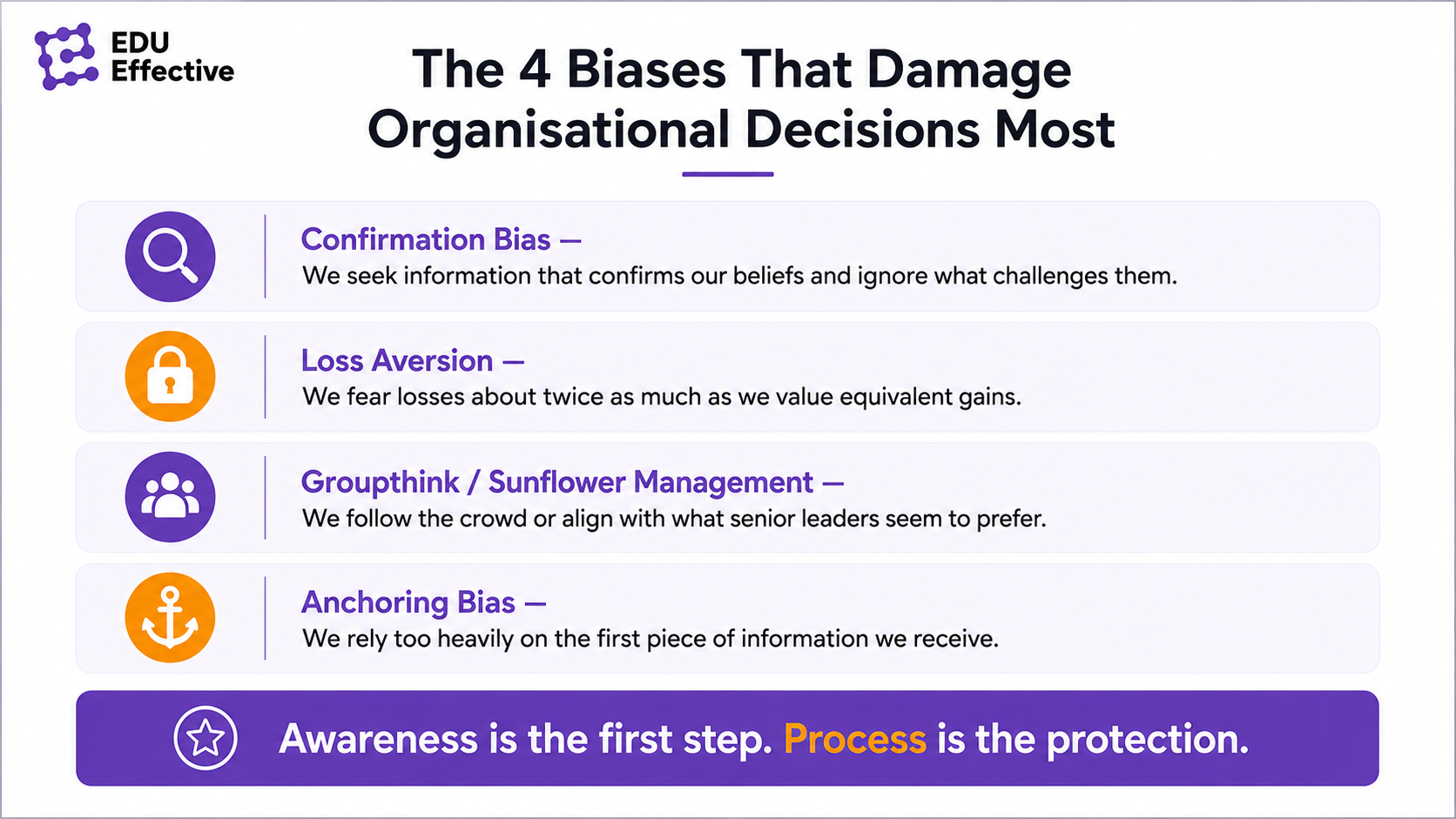
Confirmation bias is the tendency to seek out and weight information that confirms existing beliefs, while discounting or ignoring evidence that challenges them. In organisational settings, it shows up most damagingly in strategic analysis: the project team that has concluded a market opportunity is attractive will find the data that supports that conclusion, discount the data that does not, and interpret ambiguous signals in the direction of the existing hypothesis. The more committed the team is to an existing view, the more selective the information-gathering becomes.
The counteraction is structural: explicitly assign someone the role of seeking out the strongest case against the prevailing view before any significant decision is finalised. The pre-mortem technique — asking the team to imagine the decision has failed spectacularly twelve to eighteen months later and to identify what went wrong — forces the generation of disconfirming evidence that confirmation bias would otherwise suppress.
Loss aversion is the bias first documented by Kahneman and Tversky in which the pain of losing something is psychologically approximately twice as powerful as the pleasure of gaining something of equivalent value. In organisational decision-making, this produces systematic risk aversion — a preference for avoiding certain losses over pursuing uncertain gains even when the expected value of the gain is higher.
Loss aversion drives the sunk cost fallacy — continuing to invest in a failing project because the investment already made feels too large to write off — and produces status quo bias, the preference for the current situation over alternatives regardless of their relative merits. McKinsey's research notes that loss aversion manifests particularly strongly in resource allocation decisions: organisations systematically underinvest in new initiatives and overprotect existing ones.
The counteraction is framing: reframing decisions in terms of what is gained rather than what is lost, and explicitly separating sunk costs from future decision calculus. "What would we do if we were starting from zero?" is a question that counteracts loss aversion by removing the anchor of existing investment.
Anchoring is the tendency to rely too heavily on the first piece of information encountered — the "anchor" — when making subsequent judgements. A project budget presented as the starting point for negotiation will anchor the negotiation even if the figure is arbitrary. A financial forecast anchored on last year's performance will systematically underweight the possibility of discontinuous change. An acquisition price negotiation anchored on the seller's initial ask will orient the buyer's thinking around that number.
The counteraction is generating multiple independent estimates before any anchor is established. When McKinsey research on organisational decision-making recommends "outside view" thinking — actively seeking base rate data on comparable situations rather than reasoning only from the specifics of the immediate case — it is specifically counteracting the anchoring tendency to reason from the most available reference point rather than from the most accurate one.
Groupthink and sunflower management are social biases that suppress the honest expression of views in group settings. Groupthink occurs when individuals suppress doubts to maintain group harmony and apparent consensus. Sunflower management — McKinsey's term — occurs when team members orient their expressed views toward what they perceive the most senior person in the room wants to hear, generating a false consensus around the leader's position.
Both biases produce decisions that are less well-scrutinised than individual members' private views would produce, because the social dynamics of the decision process suppress the honest expression of those views. The counteraction requires explicit process design: collecting written views independently before group discussion begins, creating designated "devil's advocate" roles, and establishing norms where disagreement is explicitly valued rather than implicitly penalised. how the feedback environment a manager creates either enables or suppresses the honest expression of views that good collective decision-making depends on — and why psychological safety is the structural precondition for avoiding groupthink
Types of decisions and how to match process to type
Not all decisions are alike, and one of the most consistent sources of decision-making inefficiency is applying the same process regardless of the type of decision at hand.
McKinsey's research on decision-making identifies three broad categories that benefit from different approaches.
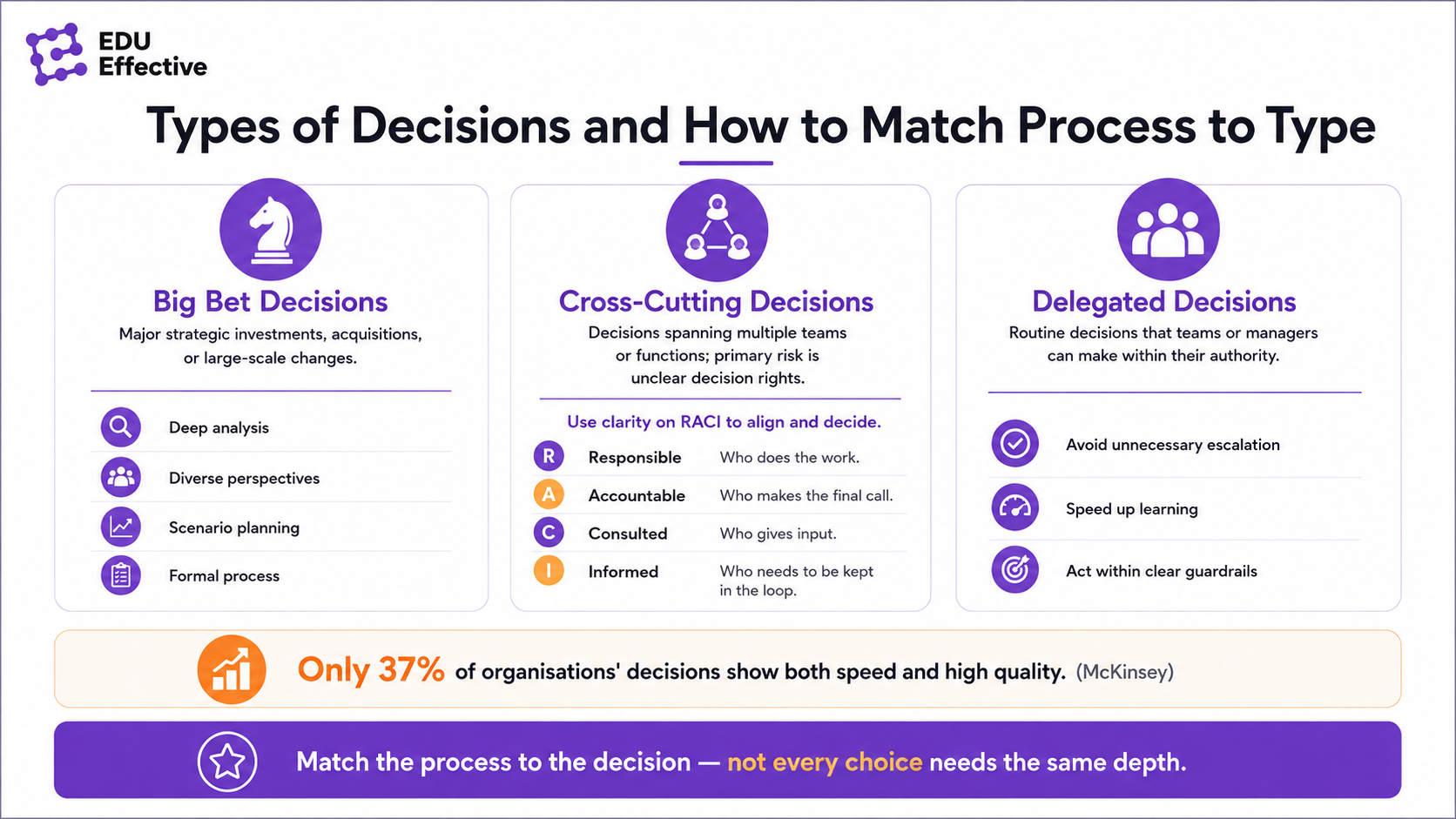
Big bet decisions — major strategic investments, acquisitions, large-scale organisational changes — justify the full investment of analytical rigour, diverse perspectives, scenario planning, and formal process. These are high-stakes, hard-to-reverse choices where the cost of a poor decision is very high and the time invested in careful analysis is well justified.
Cross-cutting decisions — choices that require alignment across multiple functions, teams, or stakeholders — are the category where most organisational decision-making dysfunction occurs. They tend to require extensive consensus-building, frequently involve misaligned incentives, and often stall at the boundaries between organisational units. The primary failure mode here is unclear decision rights — ambiguity about who has the authority to make the final call — which produces endless consultation without resolution. McKinsey's RACI-style clarity on who is Responsible, Accountable, Consulted, and Informed is the most straightforward intervention for cross-cutting decision dysfunction.
Delegated decisions — routine choices that individual managers or teams are equipped to make within their authority — should not require escalation, committee review, or senior approval. Yet organisations routinely over-escalate these decisions, consuming senior management time on choices that could and should be resolved at lower levels. McKinsey's research found that only 37% of organisations' decisions show both speed and quality, and a primary driver of slow decisions is escalation of choices that should be delegated.
Deciding under uncertainty: the specific challenge of 2026
The conditions in which managers make decisions in 2026 are characterised by elevated uncertainty across multiple dimensions simultaneously. AI capabilities are evolving faster than organisational strategy can track. Regulatory environments are shifting. Competitive dynamics are being disrupted by both AI adoption and geopolitical volatility. Consumer behaviour is changing at rates that make historical data a less reliable guide to future outcomes.
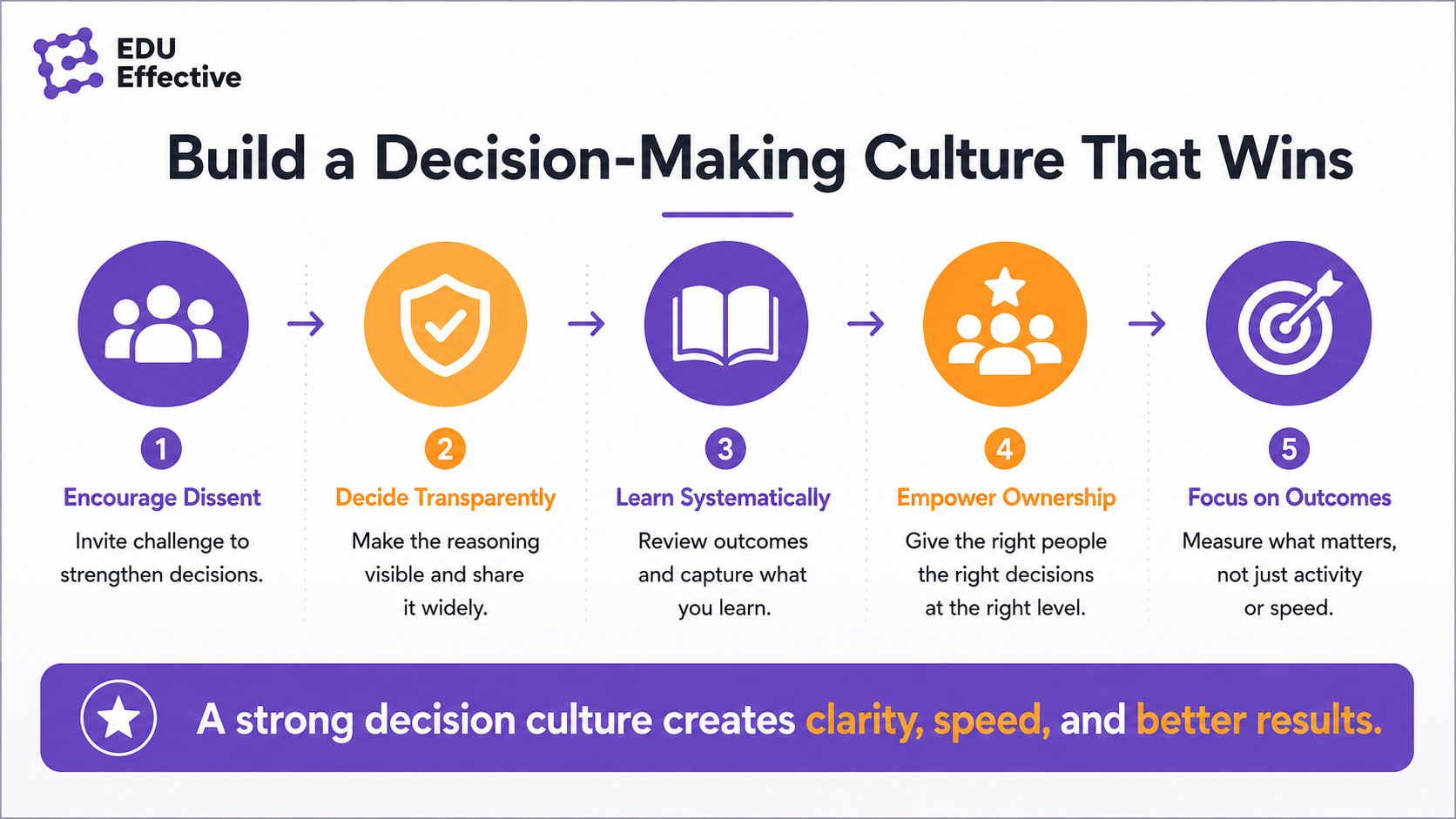
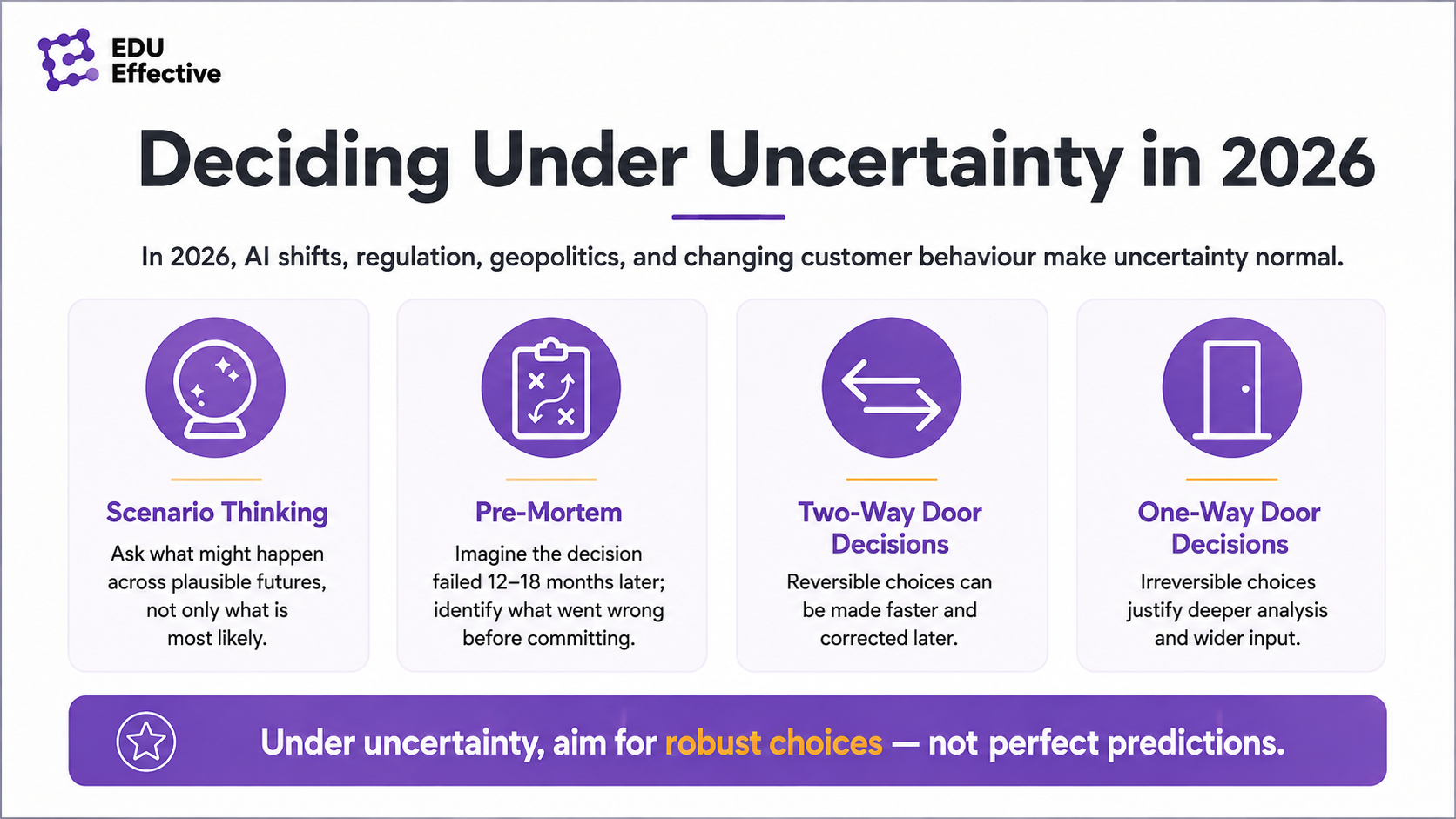
Uncertainty does not mean that analysis is futile — it means that the nature of the analysis needs to change. The most practical shift is from single-point forecasting to scenario-based thinking: rather than asking "what will happen?" and building a plan around the most likely answer, strategic decision-making under uncertainty asks "what might happen, across a range of plausible futures?" and builds strategies that are robust across those scenarios rather than optimised for one.
The pre-mortem technique, mentioned above in the context of confirmation bias, is particularly valuable under uncertainty because it forces the articulation of the specific mechanisms by which a decision could fail — not just the generic acknowledgement that things could go wrong. A team that has specifically identified five plausible failure modes and built responses to them is far better prepared for the uncertainty they will encounter than one that has produced a confident single-point forecast.
The "two-way door" test — popularised by Amazon and based on a distinction Jeff Bezos drew between reversible and irreversible decisions — is a useful heuristic for calibrating decision process to decision type under uncertainty. Reversible decisions (two-way doors — you can walk back through if you don't like what you find) can be made quickly with less analysis and reversed if they prove wrong. Irreversible decisions (one-way doors) justify significant investment in analysis, diverse perspectives, and careful deliberation before commitment. The most common decision-process error is treating two-way door decisions with the deliberateness appropriate for one-way doors — slowing the organisation's speed of learning and adaptation. why protecting deliberate decision-making time is itself a time management discipline — and how time blocking creates the conditions for the slow, analytical System 2 thinking that consequential decisions require
Building decision quality over time
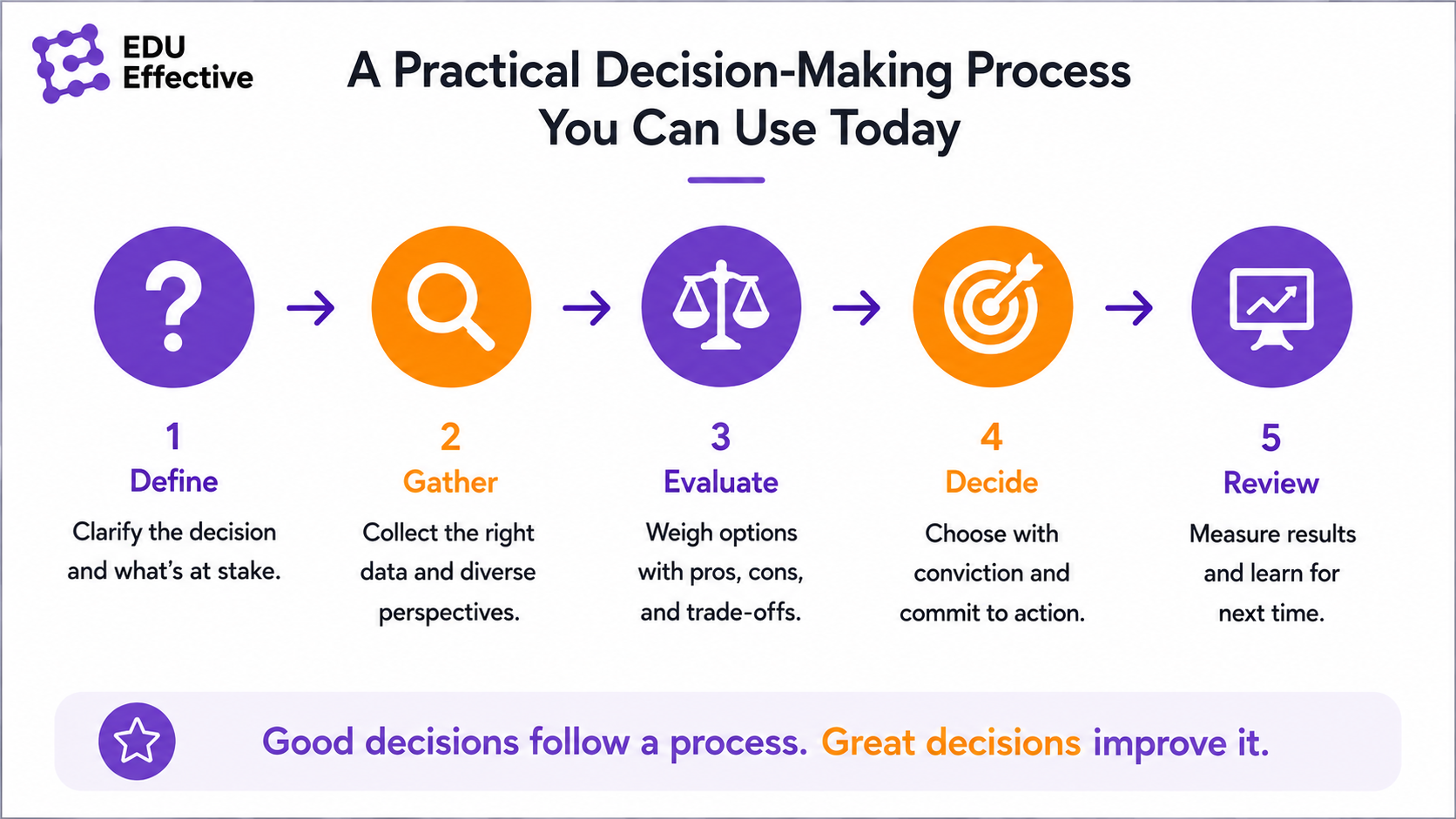
Individual biases and organisational dysfunction are both learnable. The professionals and organisations that improve decision quality over time share a practice that most do not maintain: they review consequential decisions after outcomes are known, examining not whether the outcome was good or bad, but whether the process was sound given the information available at the time of the decision.
This distinction is critical. Good decisions sometimes produce bad outcomes — because uncertainty is real and even well-reasoned choices are made on incomplete information. Bad decisions sometimes produce good outcomes — because luck can rescue poor process. Evaluating decision quality by outcome conflates process quality with luck, which makes learning impossible. The question to ask in a post-decision review is not "did this work out?" but "given what we knew at the time, was this a reasonable process for reaching this conclusion?"
Only 37% of respondents in McKinsey's decision-making survey say their organisations' decisions show both speed and high quality. The path from that minority to consistent decision quality is not primarily about individual intelligence or experience. It is about process — clear decision rights, explicit counteraction of predictable biases, appropriate matching of process depth to decision type, and the discipline of learning from decisions after outcomes are known. how coaching conversations — particularly around Options and Will in the GROW model — develop the decision-making capability of team members rather than centralising every consequential choice at the manager level
At EDU Effective, the Effective MBA: Executive Management & Leadership develops decision-making alongside strategic thinking, financial literacy, and the full management skill set — with content from practitioners at Goldman Sachs, McKinsey, Google, Amazon, and many more. Explore the programme →
EDU Effective Business School — professional development for your long-term success.
All five Effective MBA programs are built on the same educational model — designed for working adults who need learning that fits real professional life:
- Effective MBA: Executive Management & Leadership
- Effective MBA: Applied Artificial Intelligence
- Effective MBA: Coaching, Leadership & Mentoring
- Effective MBA: Mastery in AI
- Effective MBA: Online Marketing
Every programme runs on 15 minutes a day, completes in 10 months or less, is ASIC accredited, and starts from €990.
These are professional programmes, not academic ones — built for working adults to apply what they learn directly in their own business, not to collect a scholarly credential.
Join more than 9,000 students in over 120 countries who are investing in their professional development and career success. Read the experiences of our graduates here.
Apply now — from €990 · Talk to a Study Advisor
Study with NO risk: 14-day money-back guarantee, no questions asked.
Sources
- McKinsey & Company — Make Faster, Better Decisions: Decision-Making Research https://www.mckinsey.com/capabilities/people-and-organization/our-insights/decision-making-in-the-age-of-urgency
- McKinsey & Company — Biases in Decision-Making: A Guide for CFOs https://www.mckinsey.com/capabilities/strategy-and-corporate-finance/our-insights/biases-in-decision-making-a-guide-for-cfos
- McKinsey & Company — What I Learned from Daniel Kahneman: Groupthink, Loss Aversion, Confirmation Bias, Anchoring https://www.mckinsey.com/capabilities/strategy-and-corporate-finance/our-insights/what-i-learned-from-daniel-kahneman
- McKinsey & Company — The Business Logic in Debiasing https://www.mckinsey.com/capabilities/risk-and-resilience/our-insights/the-business-logic-in-debiasing
- Bain & Company — Decision-Making Quality and Shareholder Return: Review of 800 Companies https://www.bain.com/insights/score-your-organization-ame-info/
- Gartner / Forbes — Decision Making Is Getting Harder: 72% of Executives Say Bad Decisions Are As Prevalent As Good Ones (July 2026) https://www.forbes.com/sites/tracybrower/2026/07/27/decision-making-is-getting-harder-heres-how-to-increase-decision-velocity/
- Daniel Kahneman — Thinking, Fast and Slow: System 1 and System 2 Research https://www.researchgate.net/publication/332754061_Design_thinking_fast_and_slow_A_framework_for_Kahneman's_dual-system_theory_in_design